Introduction
The family Coccidae (Hemiptera: Coccoidea), or ‘soft scales’, is the third largest family of scale insects, with more than 1140 species described across approximately 169 genera (Hamon & Williams, Reference Hamon and Williams1984, Ben-Dov et al., Reference Ben-Dov, Miller and Gibson2014). Soft scales are an economically important group including notorious agricultural pests such as Ceroplastes rubens, Parasaissetia nigra, Saissetia coffeae, Saissetia oleae, and Coccus hesperidum (Hamon & Williams, Reference Hamon and Williams1984; Gill, Reference Gill1988). Soft scales suck plant sap and excrete copious honeydew covering the plant surface, which provides a medium for sooty mold (Hamon & Williams, Reference Hamon and Williams1984; Tang, Reference Tang1991; Ben-Dov & Hodgson, Reference Ben-Dov and Hodgson1997). In mainland China, 36 coccid species have been reported as serious pests of crop and ornamental plants (Wu, Reference Wu2009). Soft scales also cause serious problems as invasive species. Of the 66 soft scales in the USA, 41 are invasive pests (for example, the fig wax scale Ceroplastes rusci, the green coffee scale Coccus viridis, and the European fruit lecanium Parthenolecanium corni, Miller & Miller, Reference Miller and Miller2003).
Despite their economic importance, Coccidae is considered a difficult group to identify at the species level because of their small size and high degree of similarity. General swelling of the body and sclerotization of the dorsum with increasing maturity of soft scales frequently make identification impossible (Hodgson, Reference Hodgson1994). The group also lacks sufficient morphological characteristics to discriminate eggs or larvae at the species level. Only young adult females are available for species delimitation. Unfortunately, this stage is very short and challenging to collect. Meanwhile, intraspecific variation of morphological characteristics such as the stigmatic and dorsal setae is widespread in the soft scales (Gimpel et al., Reference Gimpel, Miller and Davidson1974; Gullan & Kosztarab, Reference Gullan and Kosztarab1997), making species delimitation more difficult. Traditional identification requires preservation of the adult female cuticle and preparation of slides, resulting in a time-consuming process of identification even for a trained taxonomist. These factors point to a need for a rapid method to effectively identify coccids, especially species common in quarantine work.
DNA barcoding has become a popular tool for species delimitation in vertebrates (Hebert et al., Reference Hebert, Stoeckle, Zemlak and Francis2004; Wong et al., Reference Wong, Shivji and Hanner2009) and invertebrates (Hajibabaei et al., Reference Hajibabaei, Janzen, Burns, Hallwachs and Hebert2006; Costa et al., Reference Costa, DeWaard, Boutillier, Ratnasingham, Dooh, Hajibabaei and Hebert2007; Mikkelsen et al., Reference Mikkelsen, Schander and Willassen2007), which makes it an ideal candidate for accurate and rapid identification of scale insects. However, universal primers fail to amplify the standard barcode region of the COI for any but a few taxa (Kondo et al., Reference Kondo, Gullan and Williams2008; Park et al., Reference Park, Suh, Hebert, Oh and Hong2011). Some recent studies on barcoding of scale insects have gradually expanded the range of application to several families, including Diaspididae, Pseudococcidae, Coccidae, and Margarodidae (Ball & Armstrong, Reference Ball and Armstrong2007; Malausa et al., Reference Malausa, Fenis, Warot, Germain, Ris, Prado, Botton, Vanlerberghe-Masutti, Sforza and Cruaud2011; Park et al., Reference Park, Suh, Hebert, Oh and Hong2011; Abd-Rabou et al., Reference Abd-Rabou, Shalaby, Germain, Ris, Kreiter and Malausa2012; Beltrà et al., Reference Beltrà, Soto and Malausa2012; Deng et al., Reference Deng, Yu, Zhang, Hu, Zhu, Wu and Zhang2012; Sethusa et al., Reference Sethusa, Millar, Yessoufou, Jacobs, Van der Bank and Van der Bank2014). However, among the 1140 coccid species, only the COI barcode region of 41 (with scientific names) has been submitted to GenBank. This limited information calls for further investigation of the performance of DNA barcoding on a broader scale and development of a more efficient means of DNA barcoding identification in soft scales. Meanwhile, the 28S nuclear gene can identify species in various insect taxa (Campbell et al., Reference Campbell, Steffen-Campbell and Werren1994; Smith et al., Reference Smith, Rodriguez, Whitfield, Deans, Janzen, Hallwachs and Hebert2008; Monaghan et al., Reference Monaghan, Wild, Elliot, Fujisawa, Balke, Inward, Lees, Ranaivosolo, Eggleton and Barraclough2009). Although the 28S rDNA lacks sufficient variation to delimitate some species (Park et al., Reference Park, Suh, Hebert, Oh and Hong2011; Deng et al., Reference Deng, Yu, Zhang, Hu, Zhu, Wu and Zhang2012), it is presently being proposed as a complementary marker to COI in scale insects (Sethusa et al., Reference Sethusa, Millar, Yessoufou, Jacobs, Van der Bank and Van der Bank2014).
In this study, we sequenced the COI and 28S genes of 340 individuals belonging to 36 common soft scale species in China. The aim of this study was to: (1) explore the efficacy of DNA barcoding in Coccidae using multiple methods and (2) provide a comprehensive barcode library of common soft scales in China.
Materials and methods
Specimen sampling
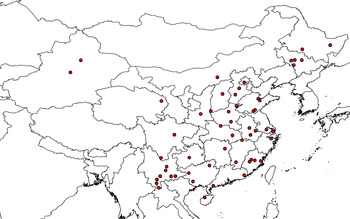
A total of 340 individual soft scales representing 36 species in 17 genera were used for barcode analysis, with 292 newly collected and 48 from previous barcoding studies (six species of Ceroplastes, Deng et al., Reference Deng, Yu, Zhang, Hu, Zhu, Wu and Zhang2012). The 292 collected specimens were obtained from 22 provinces in China and stored in 95% ethanol at −20°C. Morphological identification was based mainly on the taxonomic keys for Coccidae (Hamon & Williams, Reference Hamon and Williams1984; Gill, Reference Gill1988; Tang, Reference Tang1991). Slide-mounted voucher specimens were deposited in the Insect Collection of Beijing Forestry University. Details of collection including sampling locations, host plants, and date are available in Supplementary Table S1. The geographical distributions of sampling locations are provided in fig. 1.
Overview of geographic distribution of soft scales analyzed in this study. Collection sites are labeled with red circle. Materials from 26 provinces are concluded.

DNA extraction, amplification, and sequencing
Total genomic DNA was extracted from each individual using DNeasy Blood & Tissue Kit (Qiagen, Dalian, China) following the manufacturer's protocols. Amplification of COI and 28S were performed in 50 μl reactions using the respective primer pairs: C1-1554F (5′-CAGGAATAATAGGAACATCAATAAG-3′)/C1-2342R (5′- ATCAATGTCTAATCCGAT AGTAAATA-3′, Deng et al., Reference Deng, Yu, Zhang, Hu, Zhu, Wu and Zhang2012), and 28sF3633 (5-TACCGTGAGGGAAAGTTGAAA-3; Choudhury & Werren, Reference Choudhury and Werren2006)/28b (5-TCGGAAGGAACCAGCTACTA-3; Whiting et al., Reference Whiting, Carpenter, Wheeler and Wheeler1997). DNA amplification protocols of COI and 28S followed Deng et al. (Reference Deng, Yu, Zhang, Hu, Zhu, Wu and Zhang2012). The amplification success rates for the COI and 28S genes were 96.3 and 90.2%, respectively. The 28S sequence of Takahashia japonica was not obtained either due to the low quality of DNA template extracted from dry specimen or failed amplification. Products were visualized on 1% agarose, and the most intense products were sequenced bidirectionally using BigDye v3.1 on an ABI3730xl DNA Analyzer (Applied Biosystems, Foster City, California, USA). Sequences were aligned in Bioedit (Hall, Reference Hall1999).
Analysis of molecular data
Similarity-based method
The BLAST programs are popular tools for searching DNA databases to determine the nearest neighbor to the query sequence using a raw similarity score (Altschul et al., Reference Altschul, Madden, Schäffer, Zhang, Zhang, Miller and Lipman1997). All haplotypes of COI and 28S sequence were queried in the National Center for Biotechnology Information (NCBI) nucleotide database (http://blast.ncbi.nlm.nih.gov/Blast.cgi) with default parameters. Query COI sequences were assigned as the species associated with sequences with more than 90% coverage and 95% similarity. For 28S sequences, a higher similarity value (98%) was set because 28S lacks sufficient variation to resolve some species (Park et al., Reference Park, Suh, Hebert, Oh and Hong2011).
Distance-based method
Genetic interspecific and intraspecific distances were calculated using Mega 6 (Tamura et al., Reference Tamura, Stecher, Peterson, Filipski and Kumar2013) with the Kimura two-parameter (K2P) model (Kimura, Reference Kimura1980). A frequency distribution histogram of inter- and intraspecific divergences of COI sequences was generated to identify the barcoding gap (Meyer & Paulay, Reference Meyer and Paulay2005). To test the successful identification rate of COI and 28S, we employed the ‘best match (BM)’ criteria from Meier et al. (Reference Meier, Shiyang, Vaidya and Ng2006). This method assigns query sequences to species according to the best-matching barcode sequence. If query and match sequences are conspecific, the identification is considered a success, whereas mismatched names are considered failures. Several equally good best matches from different species are considered ambiguous (Meier et al., Reference Meier, Shiyang, Vaidya and Ng2006). TaxonDNA (Meier et al., Reference Meier, Shiyang, Vaidya and Ng2006) was used to estimate the proportion of correct matches according to BM.
Automatic barcoding gap discovery (ABGD) is a species discrimination tool based on clustering algorithms to distinguish partitions in the genetic distances (Puillandre et al., Reference Puillandre, Lambert, Brouillet and Achaz2012a ), and was used in this study to assign sequences to candidate species. ABGD analysis was performed using the web interface (http://wwwabi.snv.jussieu.fr/public/abgd/, web version) using default parameters of relative gap width (X = 1.5) and K2P distance. The range of prior intraspecific divergence from 0.001 to 0.1 was recorded with 20 steps.
Tree-based method
Tree-based methods considered a species correctly identified if the query and all its conspecific sequences formed a monospecific clade (Virgilio et al., Reference Virgilio, Backeljau, Nevado and De Meyer2010). Neighbor-joining (NJ) trees (Saitou & Nei, Reference Saitou and Nei1987) and Bayesian trees (BY) (Huelsenbeck & Ronquist, Reference Huelsenbeck and Ronquist2001) were constructed. The former represents the classical method of barcoding and the latter is recommended in further general mixed Yule coalescent (GMYC) analysis (Talavera et al., Reference Talavera, Dincă and Vila2013). NJ trees based on K2P distances were built in Mega6 (Tamura et al., Reference Tamura, Stecher, Peterson, Filipski and Kumar2013) using 500 bootstrap replicates. Bayesian inference analysis was performed with MrBayes v3.1.2 (Ronquist & Huelsenbeck, Reference Ronquist and Huelsenbeck2003). The GTR + I + G model was selected for both COI and 28S data using jModelTest (Posada, Reference Posada2008) based on the AICc criterion. Two independent runs (one hot and three cold chains) were performed for 5,000,000 generations by sampling one tree per 100 generations. The first 25% of trees were discarded as burn-ins. Bayesian posterior probabilities were used to evaluate tree robustness. Nipponaclerda biwakoensis (Hemiptera: Aclerdiae) was chosen as the outgroup.
Klee diagram
The Klee diagram approach is a recently described technique to assign sequences to known species and groups of organisms (Sirovich et al., Reference Sirovich, Stoeckle and Zhang2009, Reference Sirovich, Stoeckle and Zhang2010). This method transforms nucleotide sequences into numerical vectors and compares the species- and group-distinguishing vectors with others. Klee diagrams distinguish differences between species with high information density, enabling accurate quantitative display of affinities amongst taxa at various scales and extending to large genomic data sets (Sirovich et al., Reference Sirovich, Stoeckle and Zhang2010). In this study, all 332 COI sequences were sorted based of the order of the BI tree and then transformed into vectors following Sirovich et al. (Reference Sirovich, Stoeckle and Zhang2009).
GMYC model
We also used the GMYC method (Pons et al., Reference Pons, Barraclough, Gomez-Zurita, Cardoso, Duran, Hazell, Kamoun, Sumlin and Vogler2006), a likelihood method that fits within- and between-species branching models to reconstructed gene trees, to delimit soft scale species. The BI tree was adjusted by non-parametric rate smoothing (Sanderson, Reference Sanderson1997) to form an ultrametric tree using the r8s program (Sanderson, Reference Sanderson2003). The evolutionary units on the BI tree were then inferred using the GMYC approach (Pons et al., Reference Pons, Barraclough, Gomez-Zurita, Cardoso, Duran, Hazell, Kamoun, Sumlin and Vogler2006). Single-threshold GMYC analysis was conducted in R (Team, Reference Team2012) using the APE (Paradis et al., Reference Paradis, Claude and Strimmer2004) and SPLITS (Ezard et al., Reference Ezard, Fujisawa and Barraclough2009) packages. Haplotype sequences of COI and 28S were used in GMYC analyses.
Results
Sequence variation
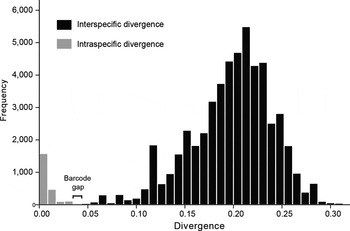
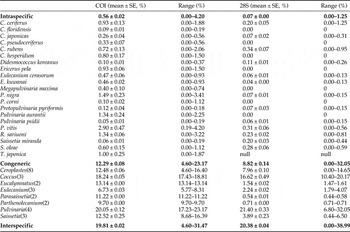
The length of all 332 COI sequences was 543 bp after edge trimming, with 232 conserved sites, 311 variable sites, and 276 parsimony-informative sites. No insertions, deletions, or stop codons were found in any sequence. All COI sequences had a bias toward low GC content (A = 41.4%, T = 38.4%, C = 14.2%, and G = 6.0%), averaging about 20.2% (range 16.0–25.7%). The mean interspecific K2P distance of COI sequences was 19.81% (Table 1), ranging from 4.60% (Ceroplastes ceriferus vs. Ceroplastes pseudoceriferus) to 31.47% (Pulvinaria vitis vs. Dicyphococcus ficicola). Intraspecific divergences of COI sequences were 0–4.20%, with a mean divergence of 0.56% (Table 1). There was no overlap between the maximum intraspecific and minimum interspecific divergence (fig. 2). The length of the 312 nuclear 28S sequences ranged from 665 bp in Prococcus acutissimus to 809 bp in Eulecanium kuwanai. The mean inter- and intraspecific divergences were 20.38 and 0.07%, respectively.
Frequency distribution histogram of genetic distances based on 332 COI sequences for 36 soft scale species in China. The intraspecific and interspecific K2P distances are displayed using gray and black columns, respectively.

K2P distance information about 21 species with intraspecific divergence >0 and eight genera with multiple species.

In bold are the intraspecific, interspecific, and congeneric divergences. The figures in parentheses refer to the number of species within genera.
Blast query
Using the Blast program, our COI profile identified 17 out of 36 species and the 28S profile identified 16 out of 35, resulting in 47.2 and 45.7% success rates of identification, respectively. Two factors may explain the low success rate. One was a lack of conspecific sequences in GenBank, such as E. kuwanai, Rhodococcus sariuoni, and Ceroplastes stellifer. The other was that the best hits contained more than one species. The latter situation often occurred when querying 28S sequences.
BM and ABGD
The BM method yielded correct identification rates of 100 and 95.52% for COI and 28S data sets, respectively. For the 28S data set, equally good BMs of C. ceriferus and C. pseudoceriferus were from different species, resulting in 14 ambiguous identifications (4.48%).
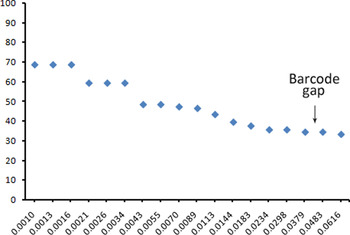
The number of partitions varied from 34 to 69; both the lowest and highest results were produced by ABGD (fig. 3). A major barcode gap was evident at a priori genetic distance thresholds of 0.042 and 0.046, strongly supporting the presence of 35 genetically distinct partitions in the COI data set. The number of partitions produced by ABGD was generally in accord with morphological identifications, excluding C. ceriferus and C. pseudoceriferus. The remaining groups were partitioned unambiguously.
Automatic partitions generated by ABGD using COI data set. Abscissa is the value of prior intraspecific divergence, while ordinate is the number of groups produced by ABGD.

Tree-based method and Klee diagram
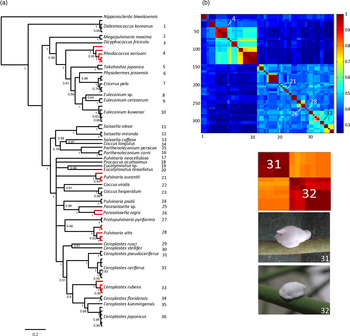
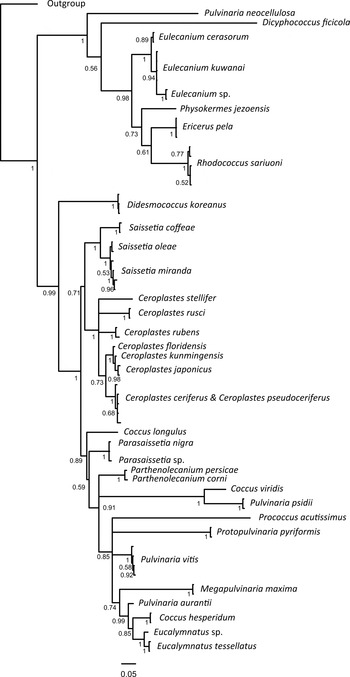
A total of 82 COI haplotypes and 59 nuclear 28S haplotypes were used to construct the BI (figs 4 and 5) and NJ trees (Supplementary figs S1 and S2). Both phylogenetic trees revealed similar topologies for most clades. The COI data set of common soft scales were split into 36 distinct clades according to the topologies and node supports, while the 28S data set (except T. japonicas because of polymerase chain reaction (PCR) failure) was split into 34 clades. C. ceriferus and C. pseduceriferus formed a monophyletic clade in 28S trees (fig. 5). A comparison between BI and NJ gene trees did not reveal obvious differences in the molecular operational taxonomic units (MOTUs). The affinities of 332 COI sequences are displayed in the Klee diagram (fig. 4b). Sequence clusters appeared as 36 blocks of high correlation along the diagonal and corresponded mutually to the 36 soft scale morphospecies. Two closely related species C. ceriferus and C. pseudoceriferus possessed distinct blocks, and the similarity of the sequences between them was close to 0.8.
Sequence clusters of 36 common soft scales in China according to the COI data set. (a) BT based on 83 haplotypes with posterior probabilities (>0.5) indicated next to each node. The 36 morphospecies are represented each by a monophyletic clade with scientific names at the tip of clade. Subclades in red refer to 12 GMYC entities in five morphospecies. (b) Klee diagrams of the 332 COI sequences (y-axis) showing the correlations among indicator vectors for the 36 soft scale species (x-axis). Sequences cluster as blocks with high correlation along the diagonal, corresponding to 36 morphospecies (the numbers beside blocks accord with those in fig. 4a and refer to the five species with multiple GMYC entities). In case of C. ceriferus and C. pseudoceriferus, magnifying Klee diagrams, along with their photographs, are showed below.

Bayesian 28S gene tree of tested coccid species from 60 haplotypes. Nipponaclerda biwakoensis (Hemiptera: Aclerdiae) is chosen as the outgroup. Posterior probability for each haplogroup is shown near to the node. Values <50% are hidden.

The GMYC model
The GMYC model based on COI data using a single-threshold method identified many morphological clusters as independent entities; its likelihood (LGMYC = 369.84) was significantly superior to that of the null model (Lnull = 349.09, P-value = 5.15 × 10⁻⁹). The confidence interval for the number of entities ranged from 37 to 47, with the most conservative estimate being exactly 44, seven more than that based on morphology. For example, R. sariuoni and P. vitis were split into three MOTUs and Pulvinaria aurantii, Pa. nigra, and C. rubens were divided into two MOTUs (fig. 4a).
Discussion
PCR success rate is an important criterion for DNA barcodes (Kress & Erickson, Reference Kress and Erickson2007). The limited utility of DNA barcoding on scale insects is mainly attributed to the lack of universal primers in this group (Kondo et al., Reference Kondo, Gullan and Williams2008). Thus, many attempts have been made to overcome this challenge (mealybugs, Malausa et al., Reference Malausa, Fenis, Warot, Germain, Ris, Prado, Botton, Vanlerberghe-Masutti, Sforza and Cruaud2011; mealybugs and armoured scales, Park et al., Reference Park, Suh, Hebert, Oh and Hong2011; wax scales, Deng et al., Reference Deng, Yu, Zhang, Hu, Zhu, Wu and Zhang2012). In this study, primer pairs from Deng et al. (Reference Deng, Yu, Zhang, Hu, Zhu, Wu and Zhang2012) were used to recover the COI barcodes of common soft scales in China. We successfully amplified and sequenced 96.3% samples, indicating that the primer set could be widely utilized in the barcoding work of soft scales. In addition, the 28S gene had a 90.2% PCR success rate, supporting its effectiveness as a complementary marker to the COI barcode (Sethusa et al., Reference Sethusa, Millar, Yessoufou, Jacobs, Van der Bank and Van der Bank2014).
The present study assessed the use of DNA barcoding for common coccids in China. Overall, the success identification rates using BM were high, over 100% for COI sequences and above 95% for 28S sequences, supporting the utility of DNA barcoding for identification of soft scales in China. Only 14 (4.48%) of 313 nuclear 28S sequences were ambiguously identified, and were derived from two sibling species, C. ceriferus and C. pseudoceriferus. The two taxa formed a monophyletic cluster in 28S phylogenetic trees, as observed by Deng et al. (Reference Deng, Yu, Zhang, Hu, Zhu, Wu and Zhang2012). They are morphologically similar and often difficult to identify (Deng et al., Reference Deng, Yu, Zhang, Hu, Zhu, Wu and Zhang2012). However, COI barcodes unambiguously distinguished them based on divergence values (5.0% between the two taxa), well-supported trees, unique GMYC entities, and indicator vectors on the Klee diagram, all of which were highly correlated (fig. 4). One possible explanation for this phenomenon is that the nuclear 28S gene is more conserved than the mitochondrial COI gene (Park et al., Reference Park, Suh, Hebert, Oh and Hong2011), and closely related species often possess 28S sequences that are nearly identical. Beyond that, the 28S gene could specifically identify common soft scales in China, although the differentiations between some congeners was minor (<1%) (fig. 5).
Four other approaches (tree-based, ABGD, GMYC, and Klee diagram) were used to distinguish coccid species. They produced congruent results with morphological identifications, except for some taxa in the ABGD and GMYC analyses. ABGD is an effective identification method because it automatically detects the barcoding gap distance, greatly reducing the interference of artificial factors (Puillandre et al., Reference Puillandre, Lambert, Brouillet and Achaz2012a ). In our COI data set, the 36 species were partitioned into 35 groups; C. ceriferus and C. pseudoceriferus were not successfully distinguished. This may be because the minimum distance between the two closely related species (4.6%) was near the maximum intraspecific divergence (4.2%), disturbing the analysis of ABGD. The GMYC model is generally considered an effective method to detect species boundaries (Leliaert et al., Reference Leliaert, Verbruggen, Wysor and Clerck2009) with a tendency to deliver a higher MOTU count (Fontaneto et al., Reference Fontaneto, Kaya, Herniou and Barraclough2009; Ceccarelli et al., Reference Ceccarelli, Sharkey and Zaldívar-Riverón2012; Puillandre et al., Reference Puillandre, Modica, Zhang, Sirovich, Boisselier, Cruaud, Holford and Samadi2012b ; Tang et al., Reference Tang, Leasi, Obertegger, Kieneke, Barraclough and Fontaneto2012; Talavera et al., Reference Talavera, Dincă and Vila2013; Weigand et al., Reference Weigand, Jochum, Slapnik, Schnitzler, Zarza and Klussmann-Kolb2013). The presence of cryptic taxa could explain splitting of species by GMYC. Bergsten et al. (Reference Bergsten, Bilton, Fujisawa, Elliott, Monaghan, Balke, Hendrich, Geijer, Herrmann, Foster, Ribera, Nilsson, Barraclough and Vogler2012) showed that expanding a study's geographic scale can increase intraspecific variation, meaning that the possibility of identifying cryptic species when sampled on a large geographical scale is high. In our study, among the five species with multiple GMYC entities, two species, namely, C. rubens and R. sariuoni, occupied vast geographic ranges. The other three species were also collected at two or three distant provinces (Supplementary Table S1). The presence of cryptic species of scale insects has been hypothesized because of their intimate relationship with host plants and the considerable intraspecific molecular divergence (Provencher et al., Reference Provencher, Morse, Weeks and Normark2005; Gwiazdowski et al., Reference Gwiazdowski, Vea, Andersen and Normark2011). The sedentary lifestyle of scale insects could allow local conditions to exert diversifying selection within and between populations (Gwiazdowski et al., Reference Gwiazdowski, Vea, Andersen and Normark2011).
DNA barcoding consists of constructing a barcode library from known species and then matching the barcode sequences of unknown samples (Kress & Erickson, Reference Kress and Erickson2012). However, query sequences from unknown samples can be difficult to identify using this approach because of the limited number of species in barcode libraries (Deng et al., Reference Deng, Wang, Yu, Zhou, Bernardo, Zhang and Wu2014; Jiang et al., Reference Jiang, Jin, Liang, Zhang and Li2014). GenBank® is a comprehensive public database of nucleotide sequences that supports bibliographic and biological annotation (Benson et al., Reference Benson, Cavanaugh, Clark, Karsch-Mizrachi, Lipman, Ostell and Sayers2012). COI sequences of 41 soft scales with scientific names were found in this database. Considering the 50% success identification rate of our Blast queries, its utility is limited for species identification of coccids in China. There are 36 soft scale pests in China (Wu, Reference Wu2009), most of which were included in our study. The present study, which included 36 species of 17 genera, will enrich the barcode dataset for coccid pests in China and provide a reliable and rapid diagnostic method. Furthermore, as the adult females of some coccids have distinctive morphological features for generic-level identification, additional photographs of the tested 36 species are provided in the Supplementary Material (figs S3–S5) to assist the primary distinction of soft scales in the wild.
In conclusion, our study suggests that DNA barcoding is a rapid and effective tool for identification of common soft scales in China. DNA barcoding with multiple methods not only accurately identifies species, but also quickly reveals species that require detailed inspection when conflicting results are available. Our results facilitate species identification and can be used to uncover new and cryptic species.
Supplementary material
The supplementary material for this article can be found at http://www.journals.cambridge.org/10.1017/S0007485315000413
Acknowledgements
We are grateful to two anonymous reviewers and editors for the helpful comments on an earlier version of the manuscript, and to the following people who helped us to collect coccids samples: Fang Yu, Lin-Lin Zheng, Qing-Tao Wu, Xin-Lei Huang, Xiu-Wei Liu, Xu Zhang, Xue-Mei Yang, Ying Wang (Institute of Zoology, Chinese Academy of Sciences, Beijing), Ju-Pu Chang (Puyang Academy of Forestry, Puyang), Xiao-Hua Dai (Gannan Normal University, Ganzhou), Yu-Qiang Xi (China Agricultural University, Beijing), Guo-Hua Huang (Hunan Agricultural University, Changsha), Shao-Bin Huang (Guangdong Forestry Vocational Technology College, Guangzhou), Jian-qin Wu (The Administrative Bureau of Tianbaoyan National Nature Reserve of Yong'an, Yong'an), Kai-Ju Wei (Youxi No.1 Middle school of Fujian Province, Youxi), Hong-Liang Li (Institute for Nutritional Sciences, SIBS, Chinese Academy of Sciences, Shanghai), Hu Li (Guizhou University, Guiyang), Xian Li (Forestry Protection Station of Chengdu, Sichuan), Qiang Shen (Forestry Protection Station of Yuyao, Ningbo), Xiu-Hao Yang (Forestry Protection Station of Guangxi, Nanning), Ying-Jie Zhang (Yunnan Agricultural University, Kunming), Fang-Ping Zhang (Chinese Academy of Tropical Agriculture Sciences, Haikou), Hai-Bin Li, Hui Wang, and Nan Nan (Beijing Forestry University, Beijing), Ping Zhang (Institute for Agricultural Sciences of the second division of Xinjiang production and construction corps, Korla), Xiu-Li Tang (Xinjiang University, Urumchi), Xu-Yang Zou (Henan Agricultural University, Zhengzhou). This project was supported by the National Natural Science Foundation of China (NSFC grant no. 31372151) and the Fundamental Research Funds for the Central Universities (BLYJ201305).