


Issues of state security and stability are important to policy makers and scholars, and in the early twenty-first century, explanatory factors such as democratization, the level of economic development, income distribution, the strength of domestic political institutions, and even civilizational forces have been emphasized (Acemoglu and Robinson Reference Acemoglu and Robinson2012; Brainard and Chollett Reference Brainard and Chollet2007; Coppedge et al. Reference Coppedge, Gerring, Altman, Bernhard, Fish and Hicken2011; Diamond Reference Diamond2008; Geddes Reference Geddes1999; Huntington Reference Huntington1993). However, many states face challenges to stability and security grounded in the enduring power of kin-based groups—clans—whose roots in society run deep and whose most consistent characteristic may well be their “severe patriarchy.”Footnote 1
Clans are not some relic of a distant past: As Collins notes (Reference Collins2006, 331), “Clans are not pre-modern phenomena, but socially embedded identity networks that exist in many societies and states, even in the twentieth and twenty-first centuries.” Tribal members today are as often metropolitan as rural, and they are more often salaried than pastoral (cooke Reference Cooke2014; Miller Reference Miller2007; Shryock Reference Shryock1997). Although various social science disciplines use terms such as “clan,” “tribe,” and “lineage groups” in ways that make demarcations imprecise, we favor Collins's emphasis on the term clan and its definition as “an informal organization comprising a network of individuals linked by kin-based bonds. Affective ties of kinship are its essence, constituting the identity and bonds of its organization. These bonds are both vertical and horizontal, linking elites and nonelites, and they reflect both actual blood ties and fictive kinship” (Collins Reference Collins2004, 231; see also Eickelman Reference Eickelman2002; Hart Reference Hart and Sweet1970; Khazanov Reference Khazanov1984). Barfield notes that, although tribes and confederacies may comprise as many as tens of thousands of persons, “collective action was not common at this level . . . political cooperation is restricted to much smaller lineages [having] organizational potential” (Barfield Reference Barfield, Khoury and Kostiner1990, 161). It is these politically active lineages that we hope to capture by our focus on clans.
Contrary to contemporary assumptions that “either these affiliations gradually disappear as the state apparatuses consolidate or they remain outside the purview of the state,” clan networks can be literally embedded within the workings of modern states, playing important political, social, and economic roles, even “at the center of politics” (Schatz Reference Schatz2004, 4, ix). For example, there are nominal democracies that are in actuality clan-based governance structures, such as Kyrgyzstan, and there are fairly functional democracies that have been systematically infiltrated by clans, such as in the Philippines (Kraft Reference Kraft2003). Certain authoritarian governments and monarchical governments, such as in Turkmenistan and Saudi Arabia, respectively, are in reality clan-based governance structures. In other words, one may find clan-based governance underlying a variety of “official” forms of government.
Clan networks—not to be confused with nonkinship-based and thus by nature more situationally defined patrimonialism,Footnote 2 patronage, or clientelism (see discussion by Collins Reference Collins2004, 233)—may flourish in the absence of state authority or in the presence of a state; clans may undergird state rule or may profoundly weaken it. The role that clans play may become more noticeable to outside observers when state governments are weak or nonexistent—as has been the case in Pakistan and Somalia, respectively. Furthermore, the resurgence of clan-based governance, as in Iraq, has posed serious obstacles to postconflict stabilization efforts (Weiner Reference Weiner2013). Schatz observes (Reference Schatz2004, xxiv), “[W]hile kinship divisions often remain below the researcher's field of vision (since they are less observable than other identity categories to which states give positive sanction), they may be more politically important than more visible divisions.”
Even though excellent qualitative work abounds on clan-based political systems (see, for example, Ahmed Reference Ahmed2013; Barfield Reference Barfield2010; Collins Reference Collins2002; Crone Reference Crone and Hall1986; Edgar Reference Edgar2006; Khoury and Kostiner Reference Khoury, Kostiner, Khoury and Kostiner1990; Lindholm Reference Lindholm1982; Schatz Reference Schatz2004; Weiner Reference Weiner2013), little aggregate empirical research has been conducted on the relationship between clan-based political systems and the stability and security of states (an exception is Jacobson Reference Jacobson2013). As Schatz (Reference Schatz2004, 3–4) explains, “[T]he problem of kinship and power lies at the interstices of academic disciplines and therefore largely goes unaddressed. . . . [It] occupies a conceptual blind spot. . . . By leaving explicit conceptualization of these identities to other disciplines, political science may misread their literatures and misunderstand the role these group solidarities play in the contemporary world.”
To address these concerns, we first characterize clan-based societies and synthesize a theoretical framework for understanding the linkage between clan influence and state stability and security. Noting the tight relationship between the reproduction of clan exclusivity and subordination of women in marriage, we then operationalize and validate a new indicator of the degree to which clans form the basis of political organization within a given society. Using that new indicator, we empirically probe the degree to which clan influence is associated with measures of state stability and security.
CHARACTERISTICS OF CLANS AND CLAN-BASED SOCIETIES
Clan identity is only one of various identities that individuals may privilege in a given situation (Barfield Reference Barfield2010, 21; Coburn Reference Coburn2011, 2–4). As Beck explains, “Tribes were not static entities, however, but were historically and situationally dynamic” (Beck Reference Beck, Khoury and Kostiner1990, 190). Rather than being “conceptually stable over time,” these affiliations are instead “on-going objects of affiliation” that are “rearticulated” encounter by encounter (Miller Reference Miller2007, 189). Although we use the term “clan” to explicate our thesis and explain our data, we recognize that we are reducing a great deal of diversity and nuance into a more simplified concept—an analytic—for the purposes of operationalization and empirical testing.
Native or local actors may conceptualize clan identity in a variety of ways, but generally focus on the importance of group descent from a common ancestor, whether putative or actual (Asfura-Heim Reference Asfura-Heim and Isser2011, 242–46; Hart Reference Hart and Sweet1970, 12; Lindholm Reference Lindholm1982, 70–74). However, scholars recognize that common descent may well be fictive instead of blood related (Barfield Reference Barfield2010, 18–22; Eickelman Reference Eickelman2002, 116–17), and “it is common to find subgroups that have become effective kin by ritual rather than by blood” (Gellner Reference Gellner, Khoury and Kostiner1990, 110).Footnote 3 Assertion of common descent serves to justify loyalty to the group, which in turn guarantees security and well-being for individuals who “make strategic decisions on how to define themselves” (Barfield Reference Barfield2010, 21).
The vast majority of lineage-based groups trace descent through the patriline, practice patrilocality,Footnote 4 and inherit land and property through the patriline (Barfield Reference Barfield2010, 22; Eickelman Reference Eickelman2002, 75; Lancaster Reference Lancaster1997, 36–42).Footnote 5 Even in the rare matrilineal societies, power, land, and resources are still held by male kin, in the form of brothers from a particular mother. Patrilineality permits groups of male relatives bound by blood ties to become politically powerful and band together in allegiances when conflict arises, and hence scholars have noted the deep importance attached by the clan to biological replication (Barfield Reference Barfield2010, 20). Charrad observes, “The socially meaningful ties unifying the network thus bind men together and bypass women” (Reference Barfield2001, 53). The early forms of private property were held not by individuals but by patrilines: Kinship relations founded on agnaticFootnote 6 lineage allow both property and labor, including reproductive labor, to remain within the clan under male control (UNDP 2005, 164).
Clans offer significant benefits to members. Although the prevailing ideology of clans is one of kinship morality, in clans that ideology is tangibly married to “shared interest, advantage, and service” (Tapper Reference Tapper, Khoury and Kostiner1990, 58) or, as Kostiner puts it, it is both “blood ties and booty” (or, now, subsidies) that keep clans both an affective and a rational investment (Reference Tapper, Khoury and Kostiner1990, 230). As Collins explains (Reference Collins2006, 332 and 335),
[Clans] persist over time because they are identity networks with cultural capital, rooted in both real kinship and the idea of kinship that incorporates one's trusted friends. . . . [C]lan elites can trust the members of their networks, and nonelites can rely on clan patrons to assist them in times of need . . . they are also rational networks that foster individual survival in an environment characterized by failing, inadequate, or repressive formal institutions.
Inevitably, then “clans emerged as distinctly political, by becoming ensnared with questions of distribution and exchange” (Schatz Reference Schatz2004, 97). Barfield even suggests that “[t]ribes and states . . . did not function as two separate, opposing systems. They represented alternative polities, each creating and solving political problems for the other” (Reference Barfield, Khoury and Kostiner1990, 191). There may be a cyclical aspect to the relationship between tribe and state: As Khoury and Kostiner explain, “from the perspective of the state, modernization and rapid social change were often counterproductive in that tribes were given a renewed role through their participation in the conflicts these changes inevitably produced” (Reference Barfield, Khoury and Kostiner1990, 16). Patricia Crone (Reference Crone and Hall1986) explains this is so because “tribes and states are not sequential stages but alternative answers to the problem of security” (emphasis added, quoted in Dresch, Reference Dresch, Khoury and Kostiner1990, 281). Rather than leave the individual defenseless against the power of the state, clans are “authority structures capable of countering other authority structures,” (Beck Reference Beck, Khoury and Kostiner1990, 192) available to many, even most, within the society simply by fact of birth.
When clans are strong, law focuses on the larger family or clan group as the principal unit (status societies); in contrast, contract societies recognize the importance of individual as the fundamental agent under the law (Maine Reference Maine1986, 163–65; Weiner Reference Weiner2013, 10–13). As societies modernize, they generally transform from the “status” to the “contract” type, typically freeing individuals from subordination to their extended families and granting them both rights and opportunities to develop on their own.
In status societies, such individual development is sharply curtailed. Each member of the clan is born into a certain status within the kin group, and to preserve and augment that status, individuals generally conform to goals determined by patrilineal clan leaders. This hierarchy reaches down to the household level; for example, the Romans saw each of these agnatic lineages as an “imperium in imperio” under the Patria Potestas, establishing the paterfamilias as emperor within the domestic realm (Maine Reference Maine1986, 144). This logic helps explain why clan influence is never associated with democratization (Collins Reference Collins2004, Reference Collins2006).
The delicate task of maintaining equilibrium within and between clans usually leads to the development of communal law, called here “clan law.” The necessity of maintaining such equilibrium is paramount because the spiral of clan-against-clan warfare can quickly become annihilative, or as Caton puts it, “blood descent leads[s] to bloody dissent” (Reference Caton, Khoury and Kostiner1990, 91). Clan leaders thus attempt to resolve problems quickly and decisively through established precedent in clan law regulating the resolution of murders, feuds, and so on, before they can escalate uncontrollably. The key to this “harmony” relies on an intangible—an honorable reputation—that serves to strengthen the group and its individual members. Good reputation is mandatory for leaders of the clan, because the respect paid them by clan members makes possible the enforcement of their judgments. For men, honor includes the vital characteristics of dignity, generosity, virility, courage, military prowess, hospitality, honesty, and the ability to protect not only one's family but also the vulnerable. Jacobson notes, “This notion of honor cuts across different kinds of religions, but it takes a particular form in tribal patriarchies—one that is martial, male and based on face-saving” (Reference Jacobson2013, 140).
Although clans serve to bind individuals together, it is important to realize that clans may use this unity to pursue conflict with other clans, as expressed by the Bedouin epigraph to this chapter (Hart Reference Hart and Sweet1970, 71–73; Lindholm Reference Lindholm1982, 66ff). Thus, procedures designed to maintain harmony among clans and not just within clans are also essential to clan governance societies, and their use often results in a long-lived shaky truce that cannot really be called peace. As Fukuyama notes, “In tribal societies, justice between individuals is a bit like contemporary international relations, based on the self-help of rival groups in a world where there is no higher third-party enforcer of rules” (Reference Fukuyama2011, 254). Although peaceful coexistence and the pursuit of well-being are nominally the goals, the means by which clans pursue these goals result in a system of “disequilibrium in equilibrium” (Hart Reference Hart and Sweet1970, 74). As Jacobson (Reference Jacobson2013, 60) explains,
Balanced opposition is a way to organize society. But it also means that violence, or the threat of violence, is an organizing principle of society—at a basic personal and communal level. Any potential attacker knows he may trigger a formidable collective response. It is the very antithesis of the civil republican form, where the state monopolizes violence (in principle) and social relations are conducted on the basis of restraint, etiquette, and norms of civility. The role of violence explains why, in good part, the prowess of males is so valued.
Clans are capable of using their influence in a strategic fashion to create temporary peace and stability in place of continual violence (Caton Reference Caton2010; Coburn Reference Coburn2011, 5). But despite their best efforts, certain behavioral predispositions of clans predictably and chronically undermine the stability and security of their societies.
BEHAVIORAL PREDISPOSITIONS OF CLAN-BASED GOVERNANCE AND THEIR EFFECTS ON STATE STABILITY AND SECURITY: A THEORETICAL FRAMEWORK
State security and state stability are conceptually intertwined. State/national security can be defined as “a capacity to control those domestic and foreign conditions that the public opinion of a given community believes necessary to enjoy its own self-determination or autonomy, prosperity and wellbeing” (Maier Reference Maier1990, as quoted in Romm Reference Romm1993, 5), but that “capacity” needs to be further defined.
In its working papers, the Princeton Project on National Security suggests ten key functions of the state that gauge its capacity to ensure state security: a legitimate monopoly on the means of violence, administrative control, sound management of public finances, investment in human capital, the creation of citizenship right and duties, the provision of infrastructure, the regulation of the market, management of state assets, effective management of international relations, and maintenance of the rule of law (Ghani, Carnahan, and Lockhart Reference Ghani, Carnahan and Lockhart2006). Lockhart suggests that “a state is fragile . . . where one or more of these functions have really eroded or are not being performed properly” (IMF Survey 2013). Pertinent to our discussion of clan-based polities, Buzan comments, “Note that national security in this sense presupposes a strong state (where government and society enjoy a high degree of consensual integration). The concept of national security is difficult to apply to weak states (low integration between government and society and high levels of coercion) because feuding parts will make their own security claims against each other” (Buzan Reference Buzan2007).
Stable states, then, are states that have moved beyond insecurity by achieving capacity in the provision of state functions, as listed earlier, and that are not significantly regressing on these measures. A stable state, accordingly, is relatively secure, so that when we speak of state stability, inferences about state security can be made as well. The World Bank uses this linkage, operationalizing several Worldwide Governance Indicators that capture state capacity and functioning, such as government effectiveness, rule of law, and control of corruption.
In what ways, then, might greater clan influence in a society affect state security and stability? Those researching patrilineal clan-based societies describe behavioral dispositions that appear remarkably similar across societies, comprising what might be considered a “syndrome” of clan governance sequelae apparent even in societies with established state structures and institutions. Lapidus observes that “we are dealing with a system involving two types of political and cultural entities [on] the same territory, competing for power and legitimacy” (Reference Lapidus, Khoury and Kostiner1990, 28). The tension between the goals of the clans and the state lead many to conclude that “tribes have proved an unstable basis on which to build the future of [a] country” (Tapper Reference Tapper, Khoury and Kostiner1990, 52).
The extent to which clan networks degrade state stability is dependent on the degree to which clans have “captured” state institutions and capabilities. Such capture becomes easier under certain conditions, such as endemic economic shortages. Other capture mechanisms include clan-based voting, kin-based patronage, the stripping of state assets (such as oil) by clans in power, and what Collins (Reference Collins2004) calls “crowding out” participation of nonclan members in formal institutions such as political parties, the media, or unions by clan mobilization:
[C]lan politics is not democratic. Even if civil and political liberties exist, clan politics creates informal political and economic rules that are not pluralist, equally and fully participatory and representative, or transparently contested. Clan politics therefore undermines formal civil and political liberties. By pervading formal institutions . . . clans use the [state’s] assets to fortify their group, effectively bankrupting state coffers, decentralizing state power, and creating competing wealth/power centers where they govern through an informal regime of clan bargaining. . . . As regime durability becomes uncertain, clans strip [state] assets faster, and the regime and state become weaker still. . . . Once the balance of clan or patronage power is disrupted and the state breaks down, clan lines become clearly visible, and clan warfare extremely personalistic and vengeful. (Collins Reference Collins2004, 244–45; Reference Collins2003, 187)
Underlying these macro-level observations linking state instability and clan influence are several micro-level processes at work. First, such societies are often ill prepared to pursue meritocracy. Individuals are provided opportunities simply because of their place in the clan hierarchy; “family, relatives, and extended clan fill the power ministries” (Collins Reference Collins2004, 333). The placement of kin (in some cases, female kin) in powerful government positions generally solidifies the power of the clan. Unless competition within and between clans is limited by such distribution of powerful positions, violence may well ensue. Clan interests, and the need for some measure of clan balancing to keep the peace, drive political appointments and policy decisions, rendering the political process irrational and incapable of pursuing national interests should they diverge from clan interests (Schatz Reference Schatz2004).
Our second proposition is that this type of nepotism tends to breed a culture of endemic corruption. Weiner suggests, “What we tend loosely to call corruption is often the distribution of favors along clan lines” (Reference Weiner2013, 81). The linkage between corruption and state instability is widely acknowledged:
The existence of widespread corruption . . . has a deeply corrosive effect on trust in government and contributes to crime and political disorder. . . . At the extreme, unbridled corruption can lead to state fragility and destructive conflict, and plunge a state into an unremitting cycle of institutional anarchy and violence. Inasmuch as corruption destroys the legitimacy of government in the eyes of those who can do something about the situation, it contributes to instability. [Corruption has] often been cited among the reasons for military takeovers. (Atuobi, cited in Mondays Reference Mondays2007, 2)
In clan-based societies, government positions are generally sought and used to obtain additional assets for the clan and its members, and not to build up the broader society or the institutions of the state. The resources of the government are often viewed as potential booty, which clans feel should be preemptively stripped lest they fall to the control of other clans. For example, in Kenya, there is even a colloquialism for this asset stripping by the clan in power—“eating.” As a new clan comes to power, members crow, “It's our turn to eat!” (Wrong Reference Wrong2010). But it is important to understand that clan-based corruption is a horse of a different color from run-of-the-mill corruption. As we have noted, “blood and booty” hold clans together: Booty, or asset stripping, is the only possible foundation of the economic system where clans are powerful.
Douglass North and his colleagues describe this system as one in which “the political system [is used] to create economic rents; the rents order social relations, control violence, and establish social cooperation” (North, Wallis, and Weingast Reference North, Wallis and Weingast2009, xii). Rather than being perceived as an impediment to governance, corruption is often seen as the means of governance and the primary leverage with which to control violence. Economic reform is typically a nonstarter in these states because it is largely through rent creation and allocation that “elites create credible incentives to cooperate rather than fight among themselves . . . rents then secure political order” (18). Gellner (Reference Gellner, Khoury and Kostiner1990, 116) elaborates,
The chief has to guard against defections among the tribal segments by giving subsidies that can rival those promised by other similar chieftaincies, ever ready to seduce some of his following by offering better terms. All this takes money; so he himself is in the market for the reception of subsidies and arms from outside powers, which in turn are eager to use his strategic position either to ensure their own communications or to undermine the communications and claims of their rivals.. . . Treachery is endemic.
Modern examples of these “Games of Clan Thrones” abound. For example, Chinese personal and familial relationships have aided lineage groups in gaining access to business opportunities (Weiner Reference Weiner2013, 81). In response to numerous scandals, President Xi Jinping launched a major anticorruption campaign on taking office, though it is unclear whether even the power of a one-party state can offset that of powerful patrilines (Anderlini Reference Anderlini2013). In Saudi Arabia, “The Saudi polity tributarises other clan groups, no longer nomadic, and ties them . . . to the redistribution of Saudi wealth; for plunder is substituted by subsidy and the privilege of citizenship, such as the legal sponsorship of foreign business is akin in many ways to the exaction of protection money. Thus tribalism becomes ascendant” (Aziz al-Azmeh, quoted in Kostiner Reference Kostiner, Khoury and Kostiner1990, 245).
Third, the culture of relational corruption acts to undermine any sense of common ties through citizenship. Members of the clan may not see themselves primarily as the citizens of their nation-state, but rather as clan members. As such, the notion of common sacrifice for the good of the country is attenuated because kin-based patronage networks are the dominant resource allocation mechanisms in society. Note what Weiner says about Indian jatis:
[T]he jati system and the extended family in which its values are imbued poses a deep challenge to Indian democracy, a challenge that is characteristic of all societies under the sway of the rule of the clan or of clannism. At its core, the jati system is marked by . . . an “anti-social spirit”—it lacks a sense of shared, common life. It lacks a belief in the public. Each jati . . . is confined within itself, its horizon of concern ending at the boundaries of its membership. Caste and family are more important than the nation. . . . Societies founded on kin solidarity lack the common consciousness necessary to pursue truly public ends. (Reference Weiner2013, 151–52)
Fourth, clan members generally have an instrumental view of formal government: In cases where the formal government supports the clan's interests—which may be ensured by placing its own members in governmental positions—the clan can strengthen the central government. However, where the formal government opposes clan interests, the clan may seek to undermine it. Seen in this light, many authoritarian regimes are actually not authoritarian at all: The “supreme leader” may lack the real power to govern society and be highly dependent on clan acquiescence, as we see in several post-Soviet Central Asian nations (Collins Reference Collins2006).
Fifth, clan governance lessens a sense of personal accountability under state law, which is viewed as less important than clan law, thus undermining the rule of law. As North and his colleagues put it, “The law cannot enforce individual rights if . . . every relationship between two individuals depends uniquely on their identity within the [group]” (Reference North, Wallis and Weingast2009, 63). Such a system may openly sanction impunity for the guilty and punishment for the innocent, undermining the very concept of justice being based on accountability for individual actions before the law. Such states “may have elections, but they do not have extensive systems of rights of rule of law for most citizens” (139).
Sixth, when clans engage in conflict, swift and dangerous escalation often ensues. In fact, this escalation is one of the most striking behavioral predispositions of societies governed by clans. As Weiner describes it, “Without a larger force to intervene to bring the feud to a close, the exchange of reciprocal violence can be ratcheted up until a community implodes in bloodshed. This outcome is especially likely when the ancient legal tool of feud is conducted with weaponry built for warfare by modern nation states” (Reference Weiner2013, 181). He calls this escalation of conflict the “Achilles heel of clan-based government” (37). North and colleagues note that in these societies, “the threat of violence permeates society . . . everyone must be prepared to be violent, and the military resources of the community are widely dispersed throughout the population” (Reference North, Wallis and Weingast2009, 173). As one shopkeeper in western Afghanistan commented, “You must have a gun to stay alive in Ghor. It is more important to have a gun at home than food” (Ali Reference Ali2013).
To summarize, then, clan-based governance tends to produce a dysfunctional, unstable, insecure, and frequently bloody society. Because clan-based governance can exist in failed states, weak states, democratic states, and authoritarian states—virtually any state—the ability to identify the underlying clan structure of a society would seem an important avenue of inquiry for scholars interested in state security and stability.
SEEING THE CONCEALED: LOOK TO THE WOMEN
Clan-based governance underlying state structures may be obscured from view, often purposefully. The state may formally prohibit clan identification, or as in the former USSR, it may create new “ethnicities” that cross clan lines in order to dilute their power. Clan members themselves may conceal clan identification to mitigate resentment. Schatz asserts that “the most important inherent quality of clan divisions [is] their concealability [though] we should not conflate the lack of a public presence with the lack of importance” (Reference Schatz2004, xxii, 48) and suggests that clan politics is “like watching bulldogs fight under a carpet” (95). Clans are “among those political phenomena that are hard to quantify. They are concealable, often invisible, private, and hotly contested. They are not election results or interest rates; they lend themselves poorly to quantification” (109).
To approach an empirical analysis of clan influence on state security and stability, it is necessary to find some way to gauge the relative power of clans in society. In our review of the literature, we found one possible lever to reveal the degree of influence: Clans can only reproduce themselves in a relatively exclusionary manner. Consider the following assertions by clan scholars:
-
• “The most powerful metaphor of exclusion was the clan” (Schatz Reference Schatz2004, 128).
-
• “[Tribes] invoked genealogies to define and maintain their exclusivity, and their lineages were often highly endogamous” (Beck Reference Beck, Khoury and Kostiner1990, 194).
-
• “The clan is the basis of a strong, but narrow and exclusivist social organization” (Collins Reference Collins2004, 232).
We argue that clan exclusivity can only be reproduced by restricting the agency of clan women in marriage. Arguably the most vulnerable family members in status societies are the women whose role is to reproduce the patriline, because the subordination of female interests, reproductive or otherwise, is how patrilineal clans are formed in the first place. Schatz is correct when he states, “If we can identify the mechanisms of identity reproduction, we gain exceptional purchase on both identity persistence and identity construction. . . . Whether clan divisions persist or not hinges on identifiable mechanisms of identity reproduction” (Reference Schatz2004, 13). Female subordination, specifically in marriage, plays that role for agnatic clans.
Patrilineal authority must define the parameters of marriage choice for women in order to strengthen the male kinship bond, or else the clan as a demarcated group will disappear. Goody explains that the supremacy of the agnatic lineage has been maintained because “the conjugal pair was incorporated into the larger unit, male authority was supported by the kin group and a woman's independent role in the household was minimal” (Reference Goody1983, 30). As Weiner notes, “The anti-individualism of the rule of the clan burdens each and every member of a clan society, but most of all it burdens women. The fate of women lays bare the basic values of the rule of the clan, and as outsiders, citizens of liberal states often find their own values clarified when they confront the lives clans afford their female members” (Reference Weiner2013, 64).
It is critical to understand that patrilineal clans cannot exist without the subordination of female interests to the goals of the male members of the clan. According to the Arab Human Development Report, “Patriarchal authority enshrines the hereditary nature of the economic structure and positions of leadership and sovereignty at the expense of women” (UNDP 2005, 167). As Fukuyama notes, “In agnatic societies, women achieve legal personhood only by virtue of their marriage to and mothering of a male in the lineage;” that is, women only “exist” in these societies as they create the patriline because patrilines cannot exist without women creating them (Reference Fukuyama2011, 233). He goes on to note, “We should not underestimate the importance of sex and access to women as a driver of political organization, particularly in segmentary or tribal societies that routinely use women as a medium of exchange” (76).
The fierceness and the sensitivity with which the subordinate status of women in clan-based societies is guarded by the men of these societies testify to Fukuyama's proposition. Charrad observes, “Women represent a potential source of rupture in the web uniting the men of the patrilineage” (Reference Charrad2001, 55). Men—and not women—must therefore control the clan's assets, whether these are children or land or cattle, or the power of the clan will dissipate. For example, Fukuyama observes, “While widows and unmarried daughters may have certain inheritance rights, they are usually required to keep the lineage's property within the agnatic line” (Reference Fukuyama2011, 233). The marriage of a daughter thus becomes a type of disinheritance: Early legal systems, such as Roman law, included the maxim, “Mulier est finis familiae . . . none of the descendants of a female are included in the . . . family relationship” (Maine Reference Maine1986, 143).
This understanding that clans can only be formed through the subordination of female interests, especially in marriage, suggests that mechanisms of control over female interests in sex, marriage, and reproduction may in fact be the most visible indicators of clan governance; thus, they should give us some purchase on the salience and influence of clans within the society. We therefore argue that the most effective way of seeing clan-based governance structures is by examining the usually very visible situation of women within society and particularly in marriage; as Jacobson puts it, “Gender is the hinge . . . the role of gender in tribes and tribalism is foundational” (Reference Jacobson2013, 115–16).
More general indicators of gender inequality within a society are therefore not sufficient for our purposes. The wage gap between men and women and the representation of women in parliament, for example, do not tap into the reproduction of clan exclusivity. But the prevalence of child marriage for women, the prevalence of patrilocal marriage, and other indicators of such control can inform us whether the reproduction of exclusivity is taking place. Charrad notes, “The central questions concern procedures for marriage, rights and obligations of each spouse, polygamy, conditions for divorce, custody of children, and inheritance” (Reference Charrad2001, 5).
We therefore propose that eight mechanisms of this particular type of female subordination serve as indicators of the degree to which clans are salient to governance in a given society: (1) patrilocality, (2) inequitable family law favoring males, (3) prevalence of polygyny, (4) early/child marriage for females, (5) marriage of women within the patriline (cousin marriage), (6) sanction for honor-based violence against women, (7) high levels of violence against women, and (8) lack of property rights for women in practice. Each is discussed below.
VARIABLES AND METHODS
Our overarching hypothesis is that nation-states scoring highly on these eight measures of subordination of women in marriage will exhibit greater political instability and violence than nations that do not, because this particular syndrome of subordination marks the heightened reproduction of clan exclusivity and thus the relatively greater importance of clan-based networks in state governance.
Patrilocality of marriage. Patrilocality makes the formation of agnatic clans a fairly straightforward task and thus is universally favored by patrilineal groups. In this system, most males in a particular area are kin, which forms a natural foundation for male alliances in patrilineal clans. Such societies, in which land and resources belong exclusively to men, effect the complete economic dependence of females, resulting in a profoundly subordinate status for women.
Inequitable family law that discriminates against females. Patrilineal clans make family law in the image of their own reproductive interests, as shown by inequitable family laws that favor men across time and space (Smuts Reference Smuts1992). The purpose of such inequality between male rights and female rights in marriage is clearly the subordination of female interests, especially reproductive interests, to male reproductive interests. Thus we see that adultery is a greater crime for women than for men, divorce may be easy for men to obtain but difficult for women, child custody may default to the father's kin, and so forth. This discrimination is most clearly seen in clan law, but can also be reproduced in formal state law where significant clan governance is found. It is important to examine practice as well, given that states with equitable family laws on the books might not enforce these laws because of clan-based tradition or practices (Hudson, Bowen, and Nielsen Reference Hudson, Bowen and Nielsen2011).
Polygyny. Prevalent polygyny goes hand in hand with a patrilineal clan-based social structure, making polygyny an excellent indicator of the presence of agnatic clans. Women in societies with prevalent polygyny are viewed as assets accumulated for economic benefit, for the status/honor such accumulation affords within the culture, or both. Furthermore, clan leaders often use polygyny to create inter-clan alliances or at least mitigate inter-clan rivalry; for example, Barfield notes, “The emphasis placed on reciprocal marriage ties created patterns of alliances that crosscut the seemingly rigid set of patrilineal relationships within a conical clan. For this reason, polygynous marriages by tribal rulers were common” (Reference Barfield, Khoury and Kostiner1990, 163). A broad literature already exists linking polygyny to societal governance and state instability (see, for example, Alexander Reference Alexander1979; Betzig Reference Betzig1986; Hudson, Bowen, and Nielsen Reference Hudson, Bowen and Nielsen2011; McDermott and Cowden, forthcoming; Wright Reference Wright1995).
Early marriage for women (child brides). Child marriage is by no means rare: In the early twenty-first century, fifteen million girls, roughly one in nine, were married between the ages of ten and fourteen (Hervish and Feldman-Jacobs Reference Hervish and Feldman-Jacobs2011). Marrying off daughters at young ages is a distinguishing characteristic of traditional marriage patterns that serve the interests of patrilineal clans. Girls are seen as an economic burden on their natal family; the investment in their health and welfare can never be repaid in a patrilineal clan-based society (except through payment of a bride price upon marriage). Furthermore, once girls reach puberty, guarding their honor can become a burdensome responsibility, exposing the clan to social calamity. In addition, the older the girl, the more likely she is to challenge an arranged marriage in the patriline's interest. Thus, the earlier the marriage, the better for the agnatic clan for several reasons. Yet patterns of child marriage certainly do not serve the interests of the girls involved in terms of their physical health, opportunities for education, or level of safety within the household. As a UNICEF report summarizes, “Child marriage is a violation of human rights, compromising the development of girls and often resulting in early pregnancy and social isolation. Young married girls face onerous domestic burdens, constrained decision-making and reduced life choices” (2005).
Cousin marriage. Another marriage-related indicator revealing the strength of patrilineal clans is endogamous marriage. Where cousin marriage is prevalent, such marriages are virtually always arranged between cousins within the patriline, which ensures that all tangible resources, including money that would otherwise be used for dower as well as the woman herself and the children she might bear, stay within the patriline. Cousin marriage thus offsets any siphoning of resources or strength from the patriline consequential to the birth of girls who must be one day be married. Although leaders may practice polygyny for strategic reasons, lower ranking clan members favor cousin marriage to conserve resources within the patriline. As a result, one often sees polygyny and cousin marriage within the same clan-based society, even when endogamy taboos are present (Schatz, Reference Schatz2004). Additionally, rivalry between male cousins in clans is often intense, and thus “agnatic rivalry and a mechanism to contain it characterize the predominant marriage patterns between cousins” (Ahmed Reference Ahmed2013, 50).
Honor-based violence against women. In clan-based societies, as we have noted, group honor is the cultural foundation of clan governance (Weiner Reference Weiner2013, 34–36). Blood feuds may be fought to defend a clan's honor. In some locales such as the Swat Valley, individuals may see honor killing as an essential element of the clan's system of kin solidarity and governance (Lindholm Reference Lindholm1982, 126). The sexual conduct of women is a potent means of manipulating the honor of men, often eliciting honor-based violence.
Violence against women. Patrilines find that women—even women born to the patriline—often do not share their interests. Mothers may object to child marriages of their daughters. Sisters may object to a lack of inheritance. Wives may object to male dominance in household decision making, including decisions that bring a new wife into the family. In addition to inequities in family law that keep male interests superordinate—such as arranged child marriage, polygyny, and patrilocality—the patriline is also prepared to use physical force to enforce the dominance of its interests over those of women. Thus we would expect that clan-based societies would tolerate the highest levels of violence against women (even though all societies tolerate a significant level of such violence).
Women's property rights in practice. Keeping resources within the patriline requires both that inheritance and property rights favor men and that major economic resources such as land will remain solely within male hands. Thus women's property rights in practice (as opposed to formal law) are strongly indicative of whether clans play an important role in societal governance. As Fukuyama notes, “[T]he ability of women to own and bequeath property is an indicator of the deterioration of tribal organization and suggests that strict patrilineality [has] disappeared” (Reference Fukuyama2011, 233).
In sum, we claim that this eight-dimensional index of female subordination in marriage should reveal what is often concealed: the degree to which clans can reproduce their exclusivity and thus become a significant power in the larger society.
To investigate the linkage between clan power and state stability and security, we conducted a two-step process of empirical investigation. First, we created and validated a Clan Governance Index based on these eight gender-focused variables. We then compared our index to those of two other researchers who have attempted to capture this phenomenon without recourse to indicators addressing marriage subordination and violence against women. Second, we built a statistical model that relates measures of state stability and security to our Clan Governance Index and then examined the index's complementarity with other explanatory variables such as wealth, level of democracy, and civilizational identity. We analyzed five operationalizations of state instability and insecurity to probe the involved linkages.
Operationalization of Variables
Dependent Variables
Our dependent variables are measures of state stability and security.
Fragile States Index 2014. Created by the Fund for Peace (2014) and originally called the Failed States Index, the Fragile States Index identifies those nations for which internal and external pressures such as resource scarcity and conflict are overwhelming. It incorporates twelve primary social, economic and political indicators, such as uneven economic development, poverty, state legitimacy, public services, human rights and rule of law. Note: GDP is a component of this index; therefore when this index is used as a dependent variable, GDP is not included in the model as a predictor variable.
Global Peace Index 2014. Created by the Institute for Economics and Peace, the Global Peach Index (GPI) ranks 161 countries according to their internal stability and peacefulness; it incorporates twenty-two indicators, including variables such as the number/level of external and internal conflicts fought, relations with neighboring countries, political instability, level of violent crime and demonstrations, and others. Note: GDP is a component of this index as well.
Corruption Perception Index 2014. Transparency International ranks 177 countries by their perceived levels of corruption as indicated by expert assessments and opinion surveys. The Corruption Perception Index is a composite index drawing from a variety of reputable institutions, and is the most widely used indicator of corruption worldwide. It defines corruption as the misuse of public power for private benefit, which we suggest should be strongly influenced by the presence of clan-based governance.
Rule of Law 2013. Published by World Bank as one of its Worldwide Governance Indicators, this scale gauges perceptions of the extent to which citizens have confidence in and abide by the rules of society, examining the quality of contract enforcement, property rights, the police, the courts, and levels of crime and violence (Thomas Reference Thomas2010).
Government Effectiveness 2013. Published by World Bank (2014) as one of its Worldwide Governance Indicators, this scale captures perceptions of the quality of public services, the quality of the civil service and the degree of its independence from political pressures, the quality of policy formulation and implementation, and the credibility of the government's commitment to such policies (Thomas Reference Thomas2010).
Explanatory and Control Variables
Our Clan Governance Index is used as the primary explanatory variable. The eight measures of women's subordination in marriage and family are drawn from the WomanStats Database. As McDermott notes,
The WomanStats database provides the largest compilation of information on the status of women in the world, coding over 350 variables for 175 countries. . . . The preponderance of data in WomanStats comes from scholarly research, NGO and IGO reports, governmental reports and national statistical bureaus, with each piece of information being fully indexed as to source . . . No other dataset on women's issues in the world ranks its equal, whether in terms of the breadth and depth of its coverage, the degree of its reliability checks, or the time spent in its creation. (McDermott and Cowden, forthcoming).
More specifically, we use the WomanStats Project's scales of patrilocality, inequity in family law and practice, polygyny, age of first marriage in law and practice, cousin marriage, honor-based violence against women, violence against women, and property rights in practice as indicators of the presence of clan-based governance within a society. Generally speaking, these scales draw on data covering the decade 2000–10.
Control Variables
The control variables are ones generally associated with state stability and security in the field of international relations and, as such, may be considered complementary hypotheses adding insight to what clan governance explains.
Freedom in the World 2013. Produced annually by Freedom House since 1973, this scale measures the degree of civil liberties and political rights in every nation and disputed territories around the world. The report is often used to measure democracy and correlates highly with several other measures of democracy such as the Polity IV data series (r = −0.846). (The coefficient is negative because Freedom House assigns low ratings to democracies, and Polity the opposite. We use the 2013 Polity IV rankings as a robustness check on the Freedom House indicator.Footnote 7 ) The level of democracy is often seen as highly conducive to state stability and security, thereby excluding by definition any taint of clan-based governance. However, we hypothesize that clan-based governance can indeed be present in nominal democracies, and therefore the Clan Governance Index may be a more foundational indicator of state stability and security.
Level of wealth as measured by GDP purchasing power parity (PPP), 2013. Highly unstable nations are more likely to be poor, and thus wealth may be an indicator of relative state stability (Brainard and Chollett Reference Brainard and Chollet2007). However, we posit that wealthy clan-based societies will be less stable than wealthy non-clan-based societies, all other things being equal. We also examine the World Bank's gross national income variable, GNI PPP 2013, as a robustness check on the GDP PPP variable.
Huntington's 1998 classification of civilizations. Samuel Huntington posited that certain civilizations were more prone to instability than others. However, we believe that association is epiphenomenal to clan-based governance, the presence of which is not evenly distributed across these civilizational identities.
Other possible explanatory variables. We also looked at the following covariates for their usefulness or lack thereof in explaining state stability and fragility and for robustness checks.
-
• Ethnic fractionalization 2003. Alesina et al. (Reference Alesina, Devleeschauwer, Easterly, Kurlat and Wacziarg2003) developed a one-time measure of ethnic fractionalization score for 190 countries. It is possible that the number of ethnic groups within a country is more indicative of clan power than our index based on the subordination of women in marriage.
-
• Number of years free from colonial power. We used the difference between the year 2014 and the country's year of independence from colonizer. It is possible that nations with fewer years as independent countries may experience greater infiltration of clans in governance structures.
-
• Oil production, 2013. This variable is the number of millions of barrels produced per day, as published by the U.S. Energy Information Administration. Because clan-based governance systems often gain power through capturable rents, we include oil production as an indicator.
-
• Overall literacy rate, 2013. It is possible that literacy rates are a more sensitive measure of state development than level of wealth; we explore that proposition by including literacy from the CIA World Factbook and use it as a substitute for GDP in models where GDP is a component of the dependent variable.
Method of Analysis
Because all our dependent variables are quantitative in nature, we used a general linear model, more specifically the analysis of covariance, to assess the nature and strength of the relationship among the dependent, explanatory, and control variables—using the software JMP, SPSS, and R. All data files are accessible online.
Steps One and Two: Creation and Validation of Clan Governance Index
We constructed our Clan Governance Index to include indicators of the reproduction of clan exclusivity through the subordination of women in marriage. Because this approach is quite different from other conceptualizations of clan governance, we validated the index by comparing it to two other extant operationalizations: the Tribal Patriarchy Index and Weiner's (Reference Weiner2013) rating of the prevalence of clan rule.
Sociologist David Jacobson developed the Tribal Patriarchy Index using the following formula:
 \begin{eqnarray*}
&& {\rm Jacobson's\, Tribal\, Patriarchy\, Index}\\
&&\quad = {\rm Corruption\, Perception\, Index} + {\rm 0}{\rm .5}\\
&&\quad \times {\rm (Ethno - } {\rm Linguistic\, Fractionalization\, Index)} \\
&&\quad + {\rm 0}{\rm .5} \times {\rm (Indigenous\, Population\, as\, a\, Percentage\, of } \\
&& \times\, {\rm Total\, Population\, Data} + {\rm 2} \\
&&\quad\times\, {\rm (World\, Economic\, Forum's\, Gender\, Gap\, Data)} \\
&&\quad+\, {\rm Group\, Grievance\, Data}
\end{eqnarray*}
Notice that corruption is a component of Jacobsen's index, whereas it is an outcome variable in our theoretical framework. Notice also the heavy weight given to the Global Gender Gap component, which seems in line with our own approach. However, the Global Gender Gap measure does not include marriage customs or violence against women. Instead, it examines women's participation in the labor force and the government, the educational attainment of women relative to men, sex ratio, and women's life expectancy. As mentioned previously, we believe these variables are epiphenomenal to the subordination of women's interests to men's interests in marriage and men's corresponding use of physical coercion of women. It is female subordination in marriage, specifically, that allows the clan to reproduce in exclusive fashion. We believe our index will correlate fairly strongly with Jacobson’s, but at the same time captures the most theoretically pertinent bases of clan strength.
Legal scholar Mark Weiner (Reference Weiner2013) rated 160 countries according to the prevalence of clan rule, concentrating on the salience of consanguineous relations; the penetration of private, familial interests within government functions; education levels and the extent of personal freedom for women; and tendencies toward intergroup violence, though political instability per se did not factor into the rankings. With regard to the concept of personal freedom for women, Weiner examines “the ability to own and devise property, the ability to enter the workforce and to have a professional career, the ease of divorce, the extent of allowed sexual freedom, the extent to which female family roles restrict their life opportunities, and the relative strength of socio-cultural pressures to conform to mainstream expectations regarding a woman's proper role” (Weiner, email to authors, February 22, 2014).
As with Jacobson's scaling, there are some similarities between the Clan Governance Index and Weiner's rankings, particularly in the areas of cousin marriage, property rights, and divorce. Nevertheless, like Jacobson, Weiner includes nongender-related dimensions in determining the degree of clan governance and excludes other important gendered variables, such as patrilocality. Because Weiner is not working from a dataset as much as from impressions regarding women's status, the rankings are thus not replicable. A high correlation among the three scales—our Clan Governance Index, Jacobson's Tribal Patriarchy Index, and Weiner's clan ratings—will constitute evidence of the predictive validity of the Clan Governance Index. Furthermore, if these scales are highly correlated, that also says something important about the relationship between female subordination in marriage and the degree of clan governance in society.
Step Three: Model Specification and Verification
We used multivariate linear modeling—more specifically a backward elimination procedure—to determine the best fitting model for our data using our five dependent variables as indicators of state stability and security. Model assumptions were checked, and if one or more of these assumptions were untenable, we eliminated problematic scores from the analysis, combined similar categories, or transformed the variable to address concerns with multi-collinearity, non-normality or variance-covariance heterogeneity. We then repeated the analyses using the transformed or reduced data. Significant results were probed using a post hoc investigation involving a set of univariate tests, one conducted for each dependent variable.
RESULTS
Step One: Creation of the WomanStats Clan Governance Index
A description of the Clan Governance Index component variables can be found in Appendix A; Appendix B contains the algorithm used to create it.Footnote 8 To determine if our eight indicator variables measured a single underlying construct, we first ran an exploratory factor analysis (EFA) using principal axis factoring as the extraction method and a Promax oblique method of rotation. The KMO measure of sampling adequacy was 0.840, meaning our sample size of 175 countries is adequate; Bartlett's test of sphericity indicated the existence of some relationships among our eight clan indicator variables, verified in the correlation matrix in Table 1.
Correlation Matrix for Clan-based Indicators

n = sample size. **significant at the 0.01 level (two-tailed); *significant at the 0.05 level (two-tailed).
To determine the number of factors these eight indicators comprised, we used the Scree plot, in which eigenvalues are plotted in descending order. Our Scree plot, shown in the Online Supplement with factor loadings, found one factor before the last major drop. These results corroborate our supposition that these eight variables are measuring the same phenomenon—the degree of subordination of female interests to male interests in the patriline.
We also ran a confirmatory factor analysis (CFA) using AMOS version 20 to assess the construct validity of our Clan Governance Index. Seven of the eight indicator variables showed substantial factor loadings. Honor-based violence against women has the lowest factor loading (0.30), but is still large enough to be significant and interpretable. These results confirm the construct validity of the Clan Governance Index.
Step Two: Predictive Validity of the Clan Governance Index: Bivariate Analysis for Jacobson, Weiner, and Clan Governance Indices
For ease of interpretation, we compare the three indices in Table 2.
Description of Jacobson’s, Weiner’s, and Clan Governance Indices

The Pearson's correlation coefficient between Jacobson's index and the Clan Governance Index is 0.823 (p < 0.0001), which is highly significant. A scatterplot of the data shows a strong positive linear trend: countries with high Jacobson tribal ratings are correlated with high Clan Governance ratings.
To determine if Weiner's clan rating is associated with our Clan Governance index, we ran an analysis of variance where Weiner's rating is the independent variable and the Clan Governance Index is the dependent variable. The results are also highly significant with F = 154.302 (p < 0.0001). Countries given a high rating by Weiner have higher Clan Governance Index scores, on average.
The strong relationships among these three indices argue for the predictive validity of our Clan Governance Index; the factor analysis demonstrates that it has construct validity. This means that observations of the reproduction of clan exclusivity through marriage customs and patterns of violence against women are sufficient to determine relative clan influence within a given society—a remarkable finding in and of itself.
Step Three: State Instability/Insecurity and Clan Governance: Model Specification and Verification
Tables 3 and 4 summarize the distribution of all the dependent and independent variables in our model, respectively. We observed the extreme skewness and presence of outliers in GDP PPP, so we transformed this variable using the log function.
Distribution of Dependent Variables

Distribution of Independent Variables

Hypothesis 1: The Clan Governance Index, which measures the reproduction of clan exclusivity through the subordination of women in marriage, is a useful predictor of political instability and violence, after controlling for the effects of other relevant covariates.
Model Specification
We first ran a full model for each of the dependent variables using all the following independent variables:
 \begin{eqnarray*}
Y &=& Clan\,Governance + Wealth + Oil\,Production\\
&&+\, Democracy + Ethno - Fractionalization \\
&&+\, Civilizational\,Identity + Overall\,Literacy \\
&&+\, Years\,of\,Independence
\end{eqnarray*}
This full model was used as a starting point for a backward elimination procedure using log GDP as a measure of level of wealth and Freedom Rating as a measure of level of democracy. The criteria used for goodness of fit test in model selection were highest adjusted R2 and lowest Bayesian information criteria (BIC). These two measures balance the conflicting demands of accuracy (fit) and simplicity (small number of variables).
A bivariate analysis displayed in Table 5 showed that most of our independent variables are, not unexpectedly, highly correlated with one another. To address the issue of multi-collinearity among these variables, we ran a VIF (variance inflation factor) check, excluding Civilizational Forces because of its categorical nature. These seven variables passed the multi-collinearity diagnostics: All VIF scores were less than 3.40.
Correlation Matrix for All the Independent Variables in the Fully Specified Model

n = sample size. ** significant at the 0.01 level (two-tailed); * significant at the 0.05 level (two-tailed).
Oil Production had a high percentage of countries with no natural oil resources and a few extreme outliers such as the United States, Russia, and Saudi Arabia. Unlike GDP, we cannot employ a log transformation of Oil production when 27% of countries produce no oil. Even with attempts at discretization or the removal of outliers, Oil Production was not a useful predictor of state stability and security. Ethnic Fractionalization and Years of Independence were also not useful. Hence, the models we used as a good fit for our data were variants of the model shown in Tables 6a and 6b. The best model selected varied according to the dependent variables:
 \begin{eqnarray*}
Y &=& log\,GDP + Freedom\,Rating + Clan\,Governance\\
&& +\, Civilizational\,Identity + Literacy
\end{eqnarray*}
Best-Fitting Models* (High Adjusted R2 and Low BIC with Least Number of Significant Terms), with Terms Arranged in Descending Order of Significance

** All parameter estimates, except Literacy for GPI, are significant at the 0.05 level. Details provided in the Online Supplement.
Best-Fitting Models* (High Adjusted R2 and Low BIC with Least Number of Significant Terms, with Terms Arranged in Descending Order of Significance
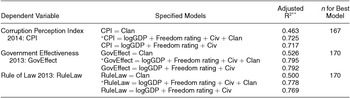
** All parameter estimates are significant at the 0.05 level. Details provided in the Online Supplement.
To ensure that the model was robust with respect to the primary control variables of wealth and democracy, we examined two measures of wealth (log GDP PPP and the World Bank's gross national income or log GNI PPP) and two measures of democracy (Freedom Rating and Polity IV). We found no substantial difference in the resultsFootnote 9 and conclude that the specification is robust with reference to the choice of indicator for these two concepts.
To investigate what the Clan Governance Index contributes, we examined the adjusted R2 for Clan Governance alone and the change in adjusted R2 when Clan Governance was excluded from the model of best fit. The summary of our model selection results are shown in Tables 6a and 6b. Recall that log GDP was excluded from the model for the dependent variables Global Peace Index and Fragile States Index because GDP PPP is a component of these indices; Literacy functions as a stand-in for economic wealth in these models, being highly correlated with log GDP (r = 0.719).
Because the focus of our efforts is the relationship between the Clan Governance Index and the five indicators of state stability and security, we first examined a model with only that explanatory variable. Alone, Tables 6a and 6b indicate the Clan Governance Index accounted for quite substantial R2 values (from 38% to 67%).
In addition, we explored what the remaining control variables add to the explanatory power of the Clan Governance Index, because we have reason to believe that these are not rival but complementary explanations. Tables 6a and 6b also show the different models that were analyzed and what variables are useful predictors of our five dependent variables. The best-fitting models were all verified using residual plots, Normal Q-Q plots, and Cook's Distance Index Plots for detecting outliers. We removed extreme outliers during reanalysis, and the models of best fit remained robust. The multi-collinearity problem was also absent in these models.
The results in Table 6a show that the two most influential predictors of GPI and State Fragility are Level of Democracy and Clan Governance. Civilizational Identity contributes the least to those models, though it is still significant, and literacy is only significant when associated with the measure of Fragile States Index. The results in Table 6b show that when log GDP is included in the model, it obscures the influence of the Clan Governance Index. The correlation matrix in Table 5 shows that the Clan Governance Index is highly correlated with log GDP (r = -0.717), which might explain the dominance of log GDP. Viewed in tandem, these two tables indicate that Clan Governance, Level of Wealth, Level of Democracy, and Civilizational Identity are complementary explanatory variables, which together result in a notably high level of the variance explained in the dependent variables. By complementing Clan Governance with log GDP per capita, Freedom Rating, and Civilizational Identity, we can account for 49–79% of the variance in the five dependent variables measuring state stability and security.
Hypothesis 2: Clan-based governance can be present in nominal democracies, and clan-based democracies will be less stable than non-clan-based democracies.
To examine this hypothesis, we partitioned the Clan Governance Index scores into three categories, classifying countries with scores of 0–4 as non-clan based; those with scores of 5–7 as countries in active transition, and those scoring 8–12 as clan-based. Figure 1 shows the distribution of this partitioned clan variable for each level of Freedom House's democracy classification: Free countries (1.0 to 2.5), Partly Free countries (3.0 to 5.0), or Not Free (5.5 to 7.0)). We can see that, although the distribution is certainly skewed, clan-based countries can be found in all three classifications, including that of “free” societies.
Distributions of clan-based classification for free, partly free, and not free countries

We also compared the means of our five dependent variables of state stability and security for free non-clan based countries and free clan-based countries (combined clan-based countries and countries in active transition). The results are displayed in Table 7.
Means of Dependent Variables Compared for Free Clan-Based and Free Non-Clan-Based Countries

*t-Test results significant at the 0.05 level.
These results show that free non-clan-based countries are significantly more peaceful, less fragile, less corrupt, and have more effective government where the rule of law is respected than free clan-based countries.
Hypothesis 3: Wealthy clan-based societies will be less stable than wealthy non-clan-based societies.
Given our theoretical framework, we would expect wealthy clan-based societies to be less stable than wealthy non-clan-based societies, all other things being equal. To address this hypothesis, we partitioned GDP PPP into treciles and classified countries as follows: income from $226 to $2,498 as “low income,” income from $2,499 to $11,037 as “middle income,” and income from $11,038 to $111,162 as “high income.” These labels are similar to those used by World Bank when classifying countries according to their GNI PPP measure.Footnote 10
Table 8 shows that wealthy clan-based countries are significantly less peaceful, more fragile, and more corrupt; have less effective governments; and are lacking in rule of law compared to wealthy non-clan-based countries. In other words, when wealth is held constant, clan-based countries have worse outcomes—even among the wealthiest nations in the analysis.
Comparison of Wealthy Clan-based and Wealthy Non-clan-based Countries Based on Five Indicators of State Security and Stability

*t-Test results are significant at the 0.05 level.
Hypothesis 4: The association between certain civilizations and state instability disappears when accounting for the presence of clan-based governance.
Clan-based societies are not evenly distributed among the various civilizations. This suggests that Civilizational Identity might be associated with state stability because of the relatively high percentage of clan-based governance in certain civilizations compared to others. To aid in this analysis, we defined non-clan-based societies as those scoring between 0–4 and clan-based societies as those scoring between 5–12 in the Clan Governance Index, classifying countries in active transition with the clan-based ones. Figure 2 illustrates that clans are more pervasive in some civilizations than in others.
Distribution of Clan-based and Non-clan-based countries by Civilizational Identity

To check if there are differences in the means of the five indicators of state stability when civilizational forces and clan-based status are considered jointly, we performed a two-way analysis of variance for these two independent variables. We found that clan-based status makes a significant difference in the five measures of state stability, whereas civilizational forces and the interaction between clan-based status and civilizational forces do not make any difference. Furthermore, when the Clan Governance Index is removed from the models of best fit discussed in Tables 6a and 6b, civilizational forces cease to be related to any indicators of state stability and security.
DISCUSSION AND CONCLUSIONS
When patrilineal clans are powerful—as indicated by the degree of emphasis placed on the reproduction of clan exclusivity through female subordination in marriage—such power is strongly associated with instability and insecurity at the state level in aggregate statistical testing, buttressing decades and even centuries of qualitative observation by social science researchers studying clans. This robust empirical finding suggests two important insights.
First, powerful clans tend to undermine the possibility of a functional, capable state.Footnote 11 It would appear that stable, secure states are those that have somehow broken the power of agnatic lineages. Clan scholars have explored pathways by which the power of patrilineal clans can be diluted. Brute force elimination does not appear to work: As the Soviets learned to their regret, “the intention to eradicate clan identities can translate into the practice of sustaining them” (Schatz Reference Schatz2004, 14); neither the promotion of literacy and education, the provision of free health care, an emphasis on industrial production, nor the imposition of a transcendent secular ideology has been able extinguish the power of the clans. Powerful clans can coexist side by side with each of these attributes and did so in Soviet/post-Soviet Central Asia (Collins Reference Collins2006; Edgar Reference Edgar2006; Schatz Reference Schatz2004).
Clan scholars are left exploring pathways that emphasize rule of law, a more equitable distribution of wealth, a robust market economy that obviates the need for special access networks, and/or a commitment to affiliation above clan levels, such as a religious community (e.g., the umma) (Schatz Reference Schatz2004; Tibi Reference Tibi, Khoury and Kostiner1990). For example, Collins suggests that that “a growing market economy and dispersed wealth will more likely prevent the centralization of wealth under authoritarian leaders and their clan and patronage networks, thereby transforming clan politics and stabilizing these regimes” (Collins Reference Collins2004, 260).
This begs the questions of how to move from point A to point B. After all, powerful clans in control of the state apparatus will not be able to create these conditions nor are they predisposed to do so. Collins herself admits that “clan politics becomes self reinforcing; it is a vicious cycle difficult to end” (Reference Collins2004, 245). Weiner asks,
How do societies move from Status to Contract? How do peoples governed by the rule of the clan transform into nations guided by the liberal rule of law? How can reformers within clan societies build states that treat individuals as worthy in themselves, as citizens, rather than as members of their kin groups, as cousins? (Reference Weiner2013, 185)
Weiner considers it a puzzle how “the ‘progressive’ societies of the world had been set on their course from Status to Contract through an internal force, an important social choice made in the ancient past, or by a unique accident of history” (Reference Weiner2013, 26).
Our research may be of assistance here. The second insight to be gleaned from our findings suggests that one important key to this puzzle is the degree of female subordination in marriage. Jacobson asserts, “The focal point is women's status and sexuality. We will elicit much through the lens of gender, not just about women as such, but about attitudes towards civic tolerance and governance more broadly” (Reference Weiner2013, 198). Anthropologist Barbara Smuts further explains that “the degree to which men dominate women and control their sexuality is inextricably intertwined with the degree to which some men dominate others” (Reference Smuts1995, 18).
It is female subordination in marriage—brought about by such mechansims as early marriage for girls, prevalent polygyny, patrilocality, patrilineal monopoly of household assets, and endogamy—that reproduces the exclusivity necessary to perpetuate clan influence and salience within a society. Might one pathway to diluting the influence of agnatic clans then be to ameliorate female subordination in marriage? There are two vastly different historical tales to be told here. The hopeful tale is that of the drastic decline of agnatic clan power in Western Europe, which many scholars attribute to the following factors: Christianity's ban on polygyny, the rising age of marriage of females from the onset of puberty to ages twenty-two to twenty-four beginning in northwest Europe in the thirteenth century, and the Catholic Church's insistence on inheritance rights for widows and the denial of such rights to other agnatic kin, including illegitimate offspring of the widow's deceased husband (see, for example, discussions in Fukuyama Reference Fukuyama2011; Goody Reference Goody1983; Hartman Reference Hartman2004). This is a tale suggesting that interference in the reproduction of agnatic kin exclusivity by improving the situation of women in marriage has great potential.
The cautionary tale is from the Soviet Union's attempt to “emancipate” the women of Central Asia, most vigorously pursued in the 1920s and 1930s. The USSR outlawed polygyny, bride price, underage marriage, and capture marriage; broke the male monopoly on divorce; and promoted interethnic marriage between Central Asians and Russians as well as literacy and education for women. The Soviets’ purpose was clear: As Edgar notes, “The campaign to emancipate women was in many ways an extension of the campaign to undermine [clan] kinship structures” (Reference Edgar2004, 221). The result was predictable—the efforts met with stiff resistance and were eventually abandoned. Edgar tells us, “Party officials reported that peasants who were passive throughout the conference proceedings, dozing through discussions of village soviet elections and land reform ‘came alive exactly as if shot from a cannon as soon as the women question came up’” (Reference Edgar2004, 248).Footnote 12
Despite a serious Soviet effort in those early days to punish transgressors with prison time and hard labor, the bride price went underground but remained universal, births and marriages went unregistered so that underage marriage and polygyny could not be detected, the threat of intermarriage caused some clan groups to flee the USSR entirely, and the uproar over female divorce rights was so extreme that the Soviets reversed themselves and judges were instructed to turn down requests from females for divorce. By the early 1930s, the Soviets realized that they were alienating the precise constituency—peasant clansmen—whose support they needed for governance, and for the most part they dropped their efforts to liberate Central Asian women (Edgar Reference Edgar2004, Reference Edgar2006, Reference Edgar2007). The remaining legal improvements for married women originated by the Soviets, such as the ban on polygyny, are under active assault today in several Central Asian states.
These dueling histories suggest that, although this pathway of bolstering women's rights in marriage is crucial, it can only be undertaken from within the society and perhaps only over a fairly long period of time. This is not to say, however, that external pressure for reform in women's situation is always futile. Changes in family law due to pressures arising from accession to the Convention on the Elimination of All Forms of Discrimination against Women, for example, are not uncommon (Hudson, Bowen, and Nielsen Reference Hudson, Bowen and Nielsen2011). But for the change to extend beyond cosmetic de jure change to de facto change, sources legitimate within a clan-based society must perform the heavy lifting.
At the same time, as Charrad notes, the state is not a disinterested actor: “[S]tate formation and struggles over state power play a key role in the development of state policies on women's rights. . . . [There are both] conflicts and alliances between the state elite and social groups that have the highest stakes in women's subordination. . . . Policies on family law and women's rights thus become pawns in broader conflicts and alliances. They become the outcome and sometimes a tool of struggles among social and political groups fighting over state power” (Reference Charrad2001, 241). This suggests that gains for women are easily subject to reversal depending on the interests of states and corporate groups.
Transition pathways aside, our findings have broader implications for political science: They suggest that the type of governance to which a society may aspire may be strictly limited by its level of female subordination in marriage. If female subordination in marriage is low, agnatic clans cannot reproduce their exclusivity, and their power is attenuated relative to the state. If female subordination in marriage is high, clan-based governance and its dysfunctional sequelae for state governance are likely.
Indeed, ours is not the only research to suggest a link between female subordination and political governance. Ronald Inglehart and Pippa Norris found little difference across regions in the degree to which survey respondents valued democracy and democratic institutions. However, they found substantial differences in attitudes concerning the role and place of women: “At this point in history, societies throughout the world (Muslim and Judeo-Christian alike) see democracy as the best form of government. Instead the real fault line between the West and Islam, which Huntington's theory completely overlooks, concerns gender equality and sexual liberalization” (Inglehart and Norris Reference Inglehart and Norris2003, 1).
These findings suggest it may be difficult to construct a more egalitarian—or more secure—society where households are profoundly inegalitarian between the sexes. Scholars have noted that “the tribe is based upon the legitimation of inequality by ideology” (Caton Reference Caton, Khoury and Kostiner1990, 82). Perhaps that legitimation finds its foundational expression in the subordination of females in marriage; if so, meaningful change cannot obtain without change at that foundation. As Fish (Reference Fish2002, 30) states,
Several leading writers have argued that the repressiveness and unquestioned dominance of the father in the family and of the male in relations between men and women replicate themselves in broader society, creating a culture of domination, intolerance, and dependency in social and political life. . . . Individuals who are more accustomed to rigidly hierarchical relations in their personal lives may be less prone to resist such patterns of authority in politics. The generalization applies to the wielders of authority as much as to the objects.
Our research suggests that a critical marker of the possibility of a transition away from clan-based governance is an improved situation for women in marriage. Those with the least power under the system of agnatic clans—women—may ironically possess the key to the system's entire dismantlement. If true, then in a meaningful sense the situation of women in marriage is an important determinant of state security and stability, and it deserves recognition and consideration as such by scholars in the field.
SUPPLEMENTARY MATERIALS
To view supplementary material for this article, please visit http://dx.doi.org/10.1017/10.1017/S0003055415000271
APPENDICES
APPENDIX A: CLAN GOVERNANCE INDEX SUBCOMPONENT VARIABLES
Description of Indicator Variables for WomanStats Clan Governance Index

APPENDIX B: CLAN GOVERNANCE ALGORITHM
The following algorithm was used for the creation of the Clan Governance Index. It operates on the simple principle that the higher the number of component variables indicating significant subordination of female interests to male interests in marriage, the more influence clans have in the governance of society.
-
• Use Inequitable Family Law as base for Index.
-
• Add Patrilocality score to Index.
-
• If Property Rights is 2, add 1 to Index.
-
• If Age of Marriage Scale is 3 or 4, add 1 to Index.
-
• If Polygyny is 3 or 4, add 1 to Index.
-
• If Cousin Marriage is 2, add 1 to Index.
-
• If Level of Violence against Women is 3 or 4, add 1 to Index.
-
• If Honor-based Violence is 2, add 1 to Index.
However, the use of this algorithm is problematic because of a high percentage of missing values for Property Rights in Practice (32% missing), Honor-based Violence (23.43% missing), and Cousin Marriage (21.14% missing). To address this problem, we used a multiple imputation method (IRMI: iterative robust model-based imputation) in the open source statistical package R that works well with nonrandom missing and ordinal data. We refer to the resulting index created using imputed data as the “Clan Governance Index.”
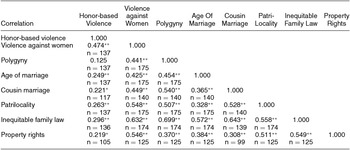
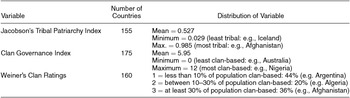
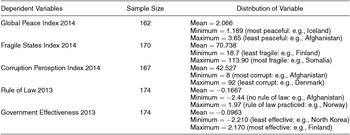
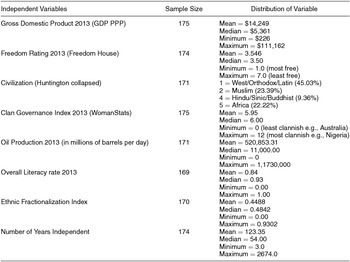
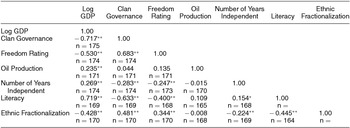

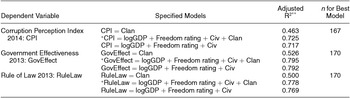
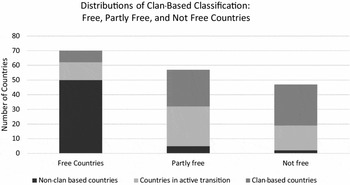


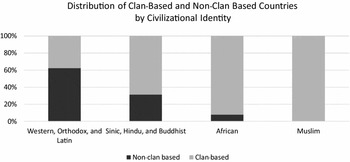
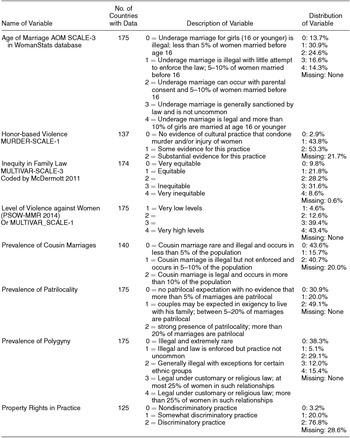




Comments
No Comments have been published for this article.