1. Introduction
Calc-alkaline lamprophyres are a unique rock type of volatile-rich (such as H2O and CO2) hypabyssal rocks, which are typically emplaced as a small volume of dykes, sills and plugs (Rock, Reference Rock1991). Moreover, they are generally featured by a diagnostic porphyritic texture with plentiful idiomorphic phenocrysts of hornblende and/or biotite. Lamprophyres have attracted much attention during the last few decades as a result of their unusual mineralogy and an apparent uncoupling of geochemical compositions as mantle- and crust-derived melts (Abdelfadil et al. Reference Abdelfadil, Romer, Seifert and Lobst2013). Moreover, lamprophyres are widely considered to mark the thermal and compositional fingerprints of the lithosphere (Karsli et al. Reference Karsli, Dokuz, Kaliwoda, Uysal, Aydin, Kandemir and Fehr2014; Ma et al. Reference Ma, Jiang, Hou, Dai, Jiang, Yang, Zhao, Pu, Zhu and Xu2014), and their generation had been attributed to a variety of the continental-scale geodynamic processes such as slab subduction and post-collisional and intraplate rifting (Aghazadeh et al. Reference Aghazadeh, Prelević, Badrzadeh, Braschi, van den Bogaard and Conticelli2015). Identifying those primitive lamprophyres from the orogenic belts could not only provide crucial insights into the nature of the subcontinental lithosphere and the interactions between the deep mantle and diversified crustal materials, but also can aid in understanding the geodynamic history of ancient convergent margins.
Most of the mafic magmas (including the lamprophyre melts) from the orogenic belts usually experienced a complex evolution involving fractionation and crustal contamination during migration through the crust, which might make attempts to reveal their mantle source and generation difficult (Rogers & Hawkesworth, Reference Rogers and Hawkesworth1989; Halama et al. Reference Halama, Marks, Brügmann, Siebel, Wenzel and Markl2004). In contrast, the primitive or relatively primitive magmas underwent only minimal fractionation or crustal contamination since leaving the mantle sources, and can therefore provide a more sensitive probe of the mantle source (Leat et al. Reference Leat, Riley, Wareham, Millar, Kelley and Storey2002). The primitive magmas are usually characterized by relatively low FeOt/MgO (< 1), and high Mg no. (= 100×Mg2+/(Mg2+ + Fet2+); > 64), Ni (> 200 ppm) and Cr (> 400 ppm; Tatsumi & Eggins, Reference Tatsumi and Eggins1995). Although the primitive magmas are volumetrically minor on earth, they are often exposed in the many arcs such as the Marianas, South Sandwich and Cascade arcs (Leat et al. Reference Leat, Riley, Wareham, Millar, Kelley and Storey2002; Mullen et al. Reference Mullen, Weis, Marsh and Martindale2017). The central Tibetan Plateau is a key area for comprehending the Palaeo-Tethyan tectonic evolution because of the preservation of many ophiolites or sutures, and abundant Triassic high-pressure (HP) to ultra-high-pressure (UHP) metamorphic rocks. However, the genetic mechanism of the widespread Upper Triassic magmatic rocks has long been a subject of debate. Many previous studies had been conducted on the granitoid rocks and intermediate to acid volcanic rocks, and proposed two competing mechanisms including a subduction-related model and a collision-related model for the generation of the Late Triassic magmatism (Zhang et al. Reference Zhang, Parrish, Zhang, Xu, Yuan, Gao and Crowley2007, Reference Zhang, Ding, Pullen, Xu, Liu, Cai, Yue, Lai, Shi, Ducea, Knapp and Chapman2014; Peng et al. Reference Peng, Zhao, Fan, Peng and Mao2015; Liu et al. Reference Liu, Ma, Huang, Xiong, Zhang and Guo2016 a; Yang et al. Reference Yang, Liu, Ma, Sun, Zhang, Mou, He and Xiao2020). Although some Middle Triassic mafic rocks have been reported in the central Tibetan Plateau (Liu et al. Reference Liu, Xu, Li, Sun, Zhao, Huang, Dong and Rong2020), the mantle sources and petrogenesis of Upper Triassic mafic rocks remain unclear, limiting our knowledge of the lithospheric mantle and hindering our ability to decipher the Triassic tectonic evolution.
Through detailed investigations, we have recently identified a series of calc-alkaline lamprophyre dykes in the North Qiangtang terrane, central Tibetan Plateau, which have geochemical compositions comparable to those of typical primitive magmas from the modern arcs (Leat et al. Reference Leat, Riley, Wareham, Millar, Kelley and Storey2002). In this study, we conducted a systematic analysis of the zircon U–Pb geochronology, mineral chemistry, bulk-rock geochemistry and Sr-Nd-Hf isotopic composition of the lamprophyre dykes. The data are used to constrain their mantle source, petrogenesis and geodynamic setting to enhance our understanding of the subcontinental lithospheric mantle, and to shed more light on the Late Triassic tectonic evolution of the central Tibetan Plateau.
2. Geological background and sample description
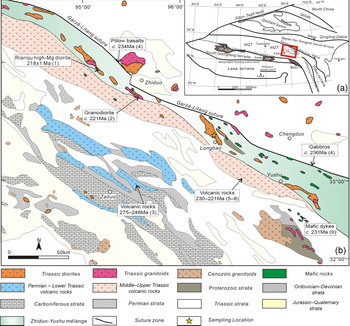
The Qiangtang terrane mainly consists of two parts, the South Qiangtang terrane (SQT) and the North Qiangtang terrane (NQT), which are separated by the central Qiangtang metamorphic belt (also referred to as the Longmuco–Shuanghu suture zone; Li et al. Reference Li, Zhai, Dong, Zeng and Huang2007). The NQT is bounded by the Longmuco–Shuanghu suture zone to the south and the Garzê–Litang suture zone to the north (Fig. 1a).
(a) Location of the central Tibetan Plateau and (b) simplified geological map of the study area. Data sources for the zircon U–Pb ages are as follows: (1) Zhao et al. (Reference Zhao, Fu, Wei, Tan, Wang, Zhao and Li2015); (2) Tan et al. (Reference Tan, Wei, Zhao, Li, Liu, Liu, Zhang, Gan and Wang2019); (3) Yang et al. (Reference Yang, Zhang, Liu, Wang, Song, Yang, Tian, Xie and Hou2011); (4) Liu et al. (Reference Liu, Ma, Guo, Xiong, Guo and Zhang2016 b); (5–8) Liu et al. (Reference Liu, Ma, Huang, Xiong, Zhang and Guo2016 a), Liu et al. (Reference Liu, Tan, Wei, Zhao, Liu, Gan and Wang2019), Zhao et al. (Reference Zhao, Tan, Wei, Tian, Zhang, Liang and Chen2014); (9) Liu et al. (Reference Liu, Xu, Li, Sun, Zhao, Huang, Dong and Rong2020).

The Longmuco–Shuanghu suture zone is featured by the presence of many dismembered ophiolitic mélanges and high-pressure metamorphic rocks (e.g. Triassic eclogites and blueschists; Zhai et al. Reference Zhai, Zhang, Jahn, Li, Song and Wang2011; Dan et al. Reference Dan, Wang, White, Zhang, Tang, Jiang, Hao and Ou2018). It has recently been considered as a main ocean of the Palaeo-Tethys in the central Tibetan Plateau (Metcalfe, Reference Metcalfe2013; Xu et al. Reference Xu, Dilek, Cao, Yang, Robinson, Ma, Li, Jolivet, Roger and Chen2015), although it had been previously interpreted as a tectonic mélange of the Songpan–Garzê flysch deposits underthrust along the Jinshajiang suture zone (Pullen et al. Reference Pullen, Kapp, Gehrels, Vervoort and Ding2008). Geochronological studies on those metamorphic rocks have revealed that the timing of the eclogite-facies metamorphism is c. 233 Ma (Dan et al. Reference Dan, Wang, White, Zhang, Tang, Jiang, Hao and Ou2018), while the timing of the exhumation of the eclogites is 222–203 Ma (Kapp et al. Reference Kapp, Yin, Manning, Harrison, Taylor and Ding2003; Dan et al. Reference Dan, Wang, White, Zhang, Tang, Jiang, Hao and Ou2018). The Garzê–Litang suture zone also marks a northern branch of the Palaeo-Tethyan ocean, which might be initiated by the rollback of the Longmuco–Shuanghu oceanic lithosphere (Liu et al. Reference Liu, Ma, Guo, Xiong, Guo and Zhang2016 b, Reference Liu, Xu, Li, Sun, Zhao, Huang, Dong and Rong2020). It is characterized by the exposure of voluminous Triassic ophiolitic mélanges with ages in the range 232–240 Ma. (Duan et al. Reference Duan, Wang, Bai, Yao, He, Zhang, Kou and Li2009; Zhang et al. Reference Zhang, Li, Yang and Na2012; Liu et al. Reference Liu, Ma, Guo, Xiong, Guo and Zhang2016 b), although some Permian mafic complexes have also been discovered (Yan et al. Reference Yan, Wang, Liu, Li, Zhang, Wang, Liu, Shi, Jian, Wang, Zhang and Zhao2005). Those Triassic ophiolitic mélanges are dominated by pillow basalts, gabbros, diabases and some altered peridotites. The mafic complexes usually display BABB-type or OIB-type affinities (Liu et al. Reference Liu, Ma, Guo, Xiong, Guo and Zhang2016 b), and they are similar in mineral and geochemical compositions to the Triassic mafic rocks in the NQT (Liu et al. Reference Liu, Xu, Li, Sun, Zhao, Huang, Dong and Rong2020).
The SQT is predominantly composed of Cambrian–Silurian and Carboniferous–Jurassic sedimentary sequences. The discovery of the Carboniferous–Permian cold-water biota and glacimarine deposits indicates that the SQT has a Gondwana affinity (e.g. Li et al. Reference Li, Zhai, Dong, Zeng and Huang2007). Early Permian radial mafic dyke swarms and flood basalts developed in the SQT, and are usually considered as the results of a mantle plume activity in northern Gondwana during Sakmarian–Kungurian time (Zhang & Zhang, Reference Zhang and Zhang2017). The NQT is covered by Devonian–Permian and Triassic–Cenozoic sedimentary rocks. Because the Carboniferous–Permian sedimentary units have many warm-water fossils (Metcalfe, Reference Metcalfe2013; Xu et al. Reference Xu, Liu and Dong2020), the NQT might have a Cathaysian affinity rather than a Gondwanan affinity. Recent studies have documented the Proterozoic Ningduo metamorphic rocks (991–1044 Ma; He et al. Reference He, Li, Wang, Gu, Yu, Shi and Cha2013) and the oldest detrital zircons of c. 4.0 Ga (He et al. Reference He, Li, Wang, Zhang, Ji, Yu, Gu and Shi2011), suggesting that a Precambrian crystalline basement developed beneath the NQT. Permian – Lower Triassic volcanic rocks and granitoids are widespread in the NQT, especially in the Tuotuohe to Yushu area. Most of them exhibit arc-like composition, which could be due to the N-wards subduction of the Longmuco–Shuanghu ocean (Yang et al. Reference Yang, Zhang, Liu, Wang, Song, Yang, Tian, Xie and Hou2011). Additionally, the rollback of the oceanic lithosphere, combined with the activity of the Emeishan mantle plume, triggered a series of Permian–Triassic mafic magmatism in the NQT (Liu et al. Reference Liu, Ma, Huang, Xiong, Zhang and Guo2016 a, Reference Liu, Xu, Li, Sun, Zhao, Huang, Dong and Rong2020).
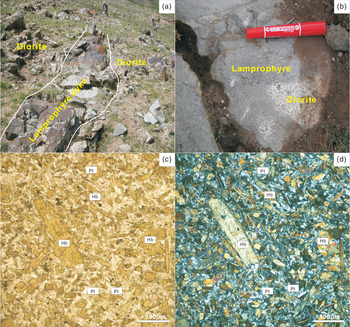
In this research, we have investigated a series of lamprophyre dykes in the north margin of the NQT (Fig. 1b). The lamprophyre dykes intrude the Longbao diorite pluton, which is emplaced into the Triassic low-grade metamorphosed clastic rocks of the Zhiduo–Yushu mélange. All the dykes exhibit sharp contacts with the host diorite pluton, and some dykes contain a small number of diorite xenoliths. They extend in an approximate NW–SE direction and their thicknesses range from 15 to 80 cm. The lamprophyre dykes show a characteristic lamprophyric texture in thin-sections (Fig. 2). The phenocrysts consist of plentiful idiomorphic hornblendes, while the matrixes are mainly composed of anhedral plagioclases and fine-grained hornblendes. The hornblende phenocrysts display an obvious pleochroism from brown to green and some of them have simple twinning. The plagioclases occur as interstitial mineral phases surrounding the idiomorphic hornblende phenocrysts, and the polysynthetic twinning can be found in some plagioclase with a relatively larger grain size.
(a–d) Photomicrographs of the Triassic lamprophyre dykes from the North Qiangtang terrane. Hb – hornblende; Pl – plagioclase.

3. Analytical methods
Zircon grains for the U–Pb isotopic dating were extracted using standard mechanical crushing, heavy magnetic-liquid techniques and handpicking. Cathodoluminescence (CL) images and transmitted to reflected light photomicrographs were used to check zircon textures and the related analytical sites. Zircon U–Pb isotopic analyses were performed using a GeoLas 2005 and an Agilent 7500a inductively coupled plasma mass spectrometer (ICP-MS) at the State Key Laboratory of Geological Processes and Mineral Resources (GPMR), China University of Geosciences (Wuhan). The spot size was 32 μm, while the frequency and energy of the laser were set to 6 Hz and c. 60 mJ, respectively. The 91500, NIST 610 and GJ-1 were applied as external standards for the elemental analyses and the isotopic normalizing. The operating conditions of the instruments and the offline-data calculation are described by Liu et al. (Reference Liu, Hu, Gao, Günther, Xu, Gao and Chen2008, Reference Liu, Gao, Hu, Gao, Zong and Wang2010).
Bulk-rock major-element contents of six samples were carried out by measuring X-ray fluorescence (XRF; Primus II, Rigaku) at the Wuhan Sample Solution Analytical Technology Co., Ltd. For major elements, the analytical precision and accuracy of the two instruments were better than 5%. Bulk-rock concentrations of trace elements were tested using an Agilent 7500a ICP-MS instrument at the GPMR. Typical samples were digested in the Teflon bombs using HF + HNO3. The analytical results of the standard materials (e.g. BCR-2, RGM-2, AGV-2 and BHVO-2) and the replicate samples are listed in the online Supplementary Material (available at http://journals.cambridge.org/geo). Bulk-rock Sr–Nd isotopic compositions of the representative samples were obtained at the GPMR using a Finnigan Triton thermal ionization mass spectrometer (TIMS) and a multi-collector (MC-) ICP-MS instrument. The TIMS and the MC-ICP-MS are applied to quantify the ratios of 87Sr/86Sr and 143Nd/144Nd, respectively. Detailed experimental methods are reported by Gao et al. (Reference Gao, Rudnick, Yuan, Liu, Liu, Xu, Ayers, Wang and Wang2004). The mass fractionation corrections of the isotopic ratios were conducted by using 146Nd/144Nd = 0.721900 and 88Sr/86Sr = 8.375209. Additionally, analyses made on the standard NBS 987 and JNdi-1 yielded the average 88Sr/86Sr ratio of 0.710274 ± 0.000009 and the average 146Nd/144Nd ratio of 0.512118 ± 0.000009, respectively.
4. Results
4.a. Zircon U–Pb ages
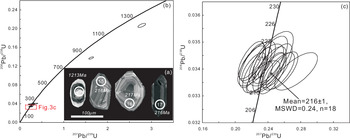
The sample JL01 for zircon U–Pb dating was collected from the site at 33° 17.006' N, 96° 24.977' E. Results of the LA-ICP-MS zircon U–Pb dating are given in Table 1, and plotted in Figure 3. The analytical sites and CL images of the representative zircon grains are also given in Figure 3.
Zircon LA-ICP-MS dating results for the Triassic lamprophyre dykes

(a–c) Zircon U–Pb Concordia plots with CL images of representative zircons for the Triassic lamprophyre dykes. The white circles in the CL images indicate analytical spots of the zircon U–Pb dating.

The zircon grains are mostly colourless or fawn, transparent and with grain sizes ranging over 30–150 μm. LA-ICP-MS U–Pb isotopic analyses were performed on 25 zircon grains. Seven of these grains have subhedral to anhedral crystals, and show an obvious core–rim structure in the CL images. Those grains have relatively low Th/U ratios of 0.03–0.89, and yield relatively old and scattered 206Pb/238U ages of 234–1213 Ma, which could be explained as the ages of the old inherited zircons. The other 18 zircon grains exhibit euhedral columnar or tabular shapes, and most of them display pronounced broadly spaced oscillatory zoning without complicated internal textures in the CL images, which is the analogy to those of typical mafic magmatic zircons (e.g. Wang et al. Reference Wang, Wu, Qin, Zhu, Liu, Liu, Gao, Wijbrans, Zhou, Gong and Yuan2013). Furthermore, those grains have relatively high Th/U ratios of 0.20–0.93. These features strongly argue that the other 18 zircon grains might be crystallized from the mafic magmas rather than inherited from the magma conduit. Analyses of those 18 grains give relatively uniform 206Pb/238U ages of 214–218 Ma, and define a weighted mean age of 216 ± 1 Ma with a mean square weighted deviation (MSWD) of 0.24. This mean age could be regarded as the crystallization time of the lamprophyre dykes in the NQT.
4.b. Major and trace elements
Analytical results of bulk-rock major and trace elements for the typical lamprophyre samples are given in Table 2.
Major- (in wt%), trace-element (ppm) and Sr–Nd isotopic compositions of the Triassic lamprophyre dykes

The lamprophyre samples have moderate contents of SiO2 (47.64–48.97 wt%), Al2O3 (13.74–15.69 wt%) and FeOt (8.54–9.14 wt%), low content of Na2O + K2O (3.66–4.16 wt%), and relatively high Na2O/K2O ratios of 1.28–1.82. They have relatively low TiO2 contents of 1.09–1.14 wt%, which could be comparable to those of island-arc calc-alkaline basalts (c. 0.98 wt%; Pearce, Reference Pearce and Thorpe1982) and distinctly lower than those of within-plate tholeiitic basalts (c. 2.23 wt%; Pearce, Reference Pearce and Thorpe1982). All samples plot in the field of subalkaline basalts on the Zr/TiO2 versus Nb/Y diagram (Fig. 4a), and they fall within the field of medium-K to high-K calc-alkaline lamprophyre on the K2O versus SiO2 diagram (Fig. 4b). Additionally, most of the samples have relatively high MgO contents (8.80–9.43 wt%), Mg no. (> 64) and Cr (> 400 ppm), with low FeOt/MgO ratios (< 1), analogous to those of the primitive magmas defined by Tatsumi & Eggins (Reference Tatsumi and Eggins1995).
The samples have comparatively high contents of rare earth elements (REEs), and their ∑REE values range over 99.83–121.29 ppm. All of them have comparatively high (La/Yb)N ratios of 5.96–7.23, and display an apparent enrichment of light REEs concerning heavy REEs on the chondrite-normalized REE patterns (Fig. 5a). Moreover, the samples have slightly negative Eu anomalies with Eu/Eu* ratios of 0.92–0.99. On the primitive-mantle-normalized trace-element patterns (Fig. 5b), the samples are depleted in high-field-strength elements (such as Nb, Ta and Ti), and enriched in the light REEs and some large-ion lithophile elements (LILEs; e.g. Th). Such trace-element patterns are analogous to those of the primitive melts of subduction-modified lithospheric mantle in the Antarctic Peninsula (Leat et al. Reference Leat, Riley, Wareham, Millar, Kelley and Storey2002).
Plots of (a) Zr/TiO2 versus Nb/Y (Winchester & Floyd,Reference Winchester and Floyd1977) and (b) K2O versus SiO2 (Rock, Reference Rock1991) for the Triassic lamprophyre dykes.

(a) Chondrite-normalized REE distribution patterns and (b) primitive-mantle-normalized trace-element spider diagrams for the Triassic lamprophyre dykes. Chondrite data from Taylor & McLennan (Reference Taylor and McLennan1985); primitive mantle data from Sun & McDonough (Reference Sun, McDonough, Saunders and Norry1989).

4.c. Sr–Nd isotopic composition
Bulk-rock Sr–Nd isotopic composition and the calculated parameters of four typical lamprophyre samples are presented in Table 3, and plotted in Figure 6. The initial values of Sr and Nd isotopic composition were calculated based on a timing of 215 Ma. The samples have relatively high initial 87Sr/86Sr ratios ((87Sr/86Sr)i) of 0.70538–0.70540, and relatively low ϵNd(t) values of −2.96 to −1.65. On the ϵNd(t) versus (87Sr/86Sr)i diagram, the samples exhibit distinctly lower ϵNd(t) values than those of the mafic rocks from the Triassic ophiolites in the Garzê–Litang suture zone.
Sr–Nd isotopic compositions of typical samples from the Triassic lamprophyre dykes

a Replicate analyses at the State Key Laboratory of Geological Processes and Mineral Resources (GPMR), China University of Geosciences (Wuhan).
Plot of (a) ϵNd(t) versus (87Sr/86Sr)i and (b) ϵNd(t) versus Mg no. for the Triassic lamprophyre dykes. Triassic S-type granites and Proterozoic gneiss (Tao et al. Reference Tao, Bi, Li, Hu, Li and Liao2014; Peng et al. Reference Peng, Zhao, Fan, Peng and Mao2015) are shown for comparison. MORB data from Liu et al. (Reference Liu, Ma, Guo, Xiong, Guo and Zhang2016 b). The MORB-type asthenosphere mantle is represented by: Nd = 12.7 ppm, Sr = 93.69 ppm, 87Sr/86Sr = 0.705372 and 143Nd/144Nd = 0.512811. Two typical types of crustal components are represented by (1) Nd = 20.9 ppm, Sr = 161 ppm, 87Sr/86Sr = 0.723624 and 43Nd/144Nd = 0.511967, and (2) Nd = 27.4 ppm, Sr = 105 ppm, 87Sr/86Sr = 0.740191 and 43Nd/144Nd = 0.511865.

5. Discussion
5.a. Effects of post-magmatic alterations
It is necessary to evaluate the effects of the post-magmatic alteration on the lamprophyre dykes, because most of the samples have comparatively high loss-on-ignition values (LOIs; 2.45–5.16 wt%). Considering that Zr has been proven to be one of the most stable elements during the medium- to low-grade metamorphism and alteration, the correlations between Zr and the other elements have been widely used to assess the element mobility (Polat & Hofmann, Reference Polat and Hofmann2003). In order to evaluate the alteration effects on various chemical compositions of the samples, representative major oxides (e.g. MgO, FeOt, TiO2, P2O5, K2O and Na2O) and trace elements (e.g. Rb, Ba, Sr, Cr, Ni, Eu, Nb, La, Ce, Th, Lu and Yb) were plotted against Zr. In the online Supplementary Material, the above-listed elements are strongly or roughly correlated with Zr, and the LOIs do not form a correlation with Zr. In addition, all the samples show uniform REE and trace-element patterns. Such observations indicate that those above-listed elements were not affected by the alterations.
5.b. Crustal contamination and differentiation
Before constraining the magma source characteristics of the lamprophyre dykes, it is necessary to access the possible influences of the crustal contamination and magma differentiation. Crustal contamination could observably change the geochemical and isotopic composition of mafic melts during magma ascent (DePaolo, Reference DePaolo1981; Halama et al. Reference Halama, Marks, Brügmann, Siebel, Wenzel and Markl2004). In that case, P2O5 and TiO2 contents and ϵNd(t) values would decrease, while the abundances of LILEs, Na2O and K2O would increase. However, the TiO2 and P2O5 contents of lamprophyre samples remain constant with decreasing Mg no. values, which are different from the features of the crustal contamination. The samples do not show a positive correlation between ϵNd(t), Nb/La and Mg no. values (Figs 6, 7), also suggesting that the contamination seems to be negligible. Their ratios of Nb/Ce and Nb/La (0.25–0.26 and 0.51–0.54, respectively) are lower than those of the average crust, the lower crust and the primitive mantle, suggesting no significant crustal contamination. All samples exhibit markedly negative Zr and Hf anomalies relative to the primitive mantle, and have homogeneous Sr–Nd isotopic compositions with uniform trace-element patterns. The ordinary Sr–Nd isotopic model (Fig. 6) indicates that those rocks could not have originated from the mixing between mid-ocean-range basalt (MORB) and crustal components (represented by the Proterozoic gneiss and the S-type granites from the NQT). Those features all suggest insignificant crustal contamination during the magma generation.
Plots of FeOt, TiO2, P2O5, Cr, Ni, Sc/Y, CaO/Al2O3, Eu/Eu* and Nb/La versus Mg no. for the Triassic lamprophyre dykes.

As mentioned above, most of the lamprophyre samples have comparatively high MgO contents (8.80–9.43 wt%), Mg no. values (> 64) and Cr (> 400 ppm), with low FeOt/MgO ratios (< 1), which are consistent with the features of the primitive magmas (Tatsumi & Eggins, Reference Tatsumi and Eggins1995). However, compared with the primitive magmas, one sample JL01-2 has slightly lower MgO (8.26 wt%), Mg no. (62) and Cr (404 ppm), and higher FeOt/MgO ratios (1.08), indicating that it might have undergone a low degree of magma differentiation. In this study, we use multiple binary diagrams defining Mg no. as the abscissa to trace magma differentiation. On the binary diagrams (Fig. 7), the samples show roughly decreasing positive correlations among Cr, Ni and Mg no. values, indicating the fractionation crystallization of olivine and/or clinopyroxene. Sc/Y ratios are usually controlled by clinopyroxene crystallization, and are not influenced by the fractionation of olivine and plagioclase (Naumann & Geist, Reference Naumann and Geist1999). The constant Sc/Y ratios with decreasing Mg no. values therefore preclude the clinopyroxene crystallization. There is a negative correlation between CaO/Al2O3 ratios and Mg no. values, further suggesting that olivine is probably the dominant fractionating mineral phase. Moreover, plagioclase, Fe–Ti oxide and apatite did not play a vital role during the magma evolution, as shown by the nearly constant Eu/Eu*, FeOt, TiO2 and P2O5 with decreasing Mg no. values.
In summary, the lamprophyre dykes could not have experienced any significant crustal contamination, but underwent a somewhat low degree of olivine crystallization.
5.c. A subduction-modified lithospheric mantle
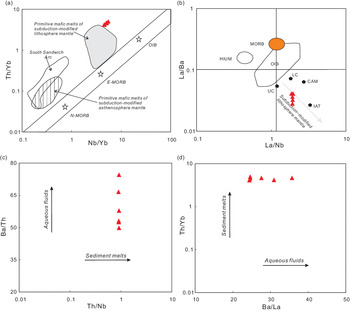
All of the lamprophyre samples exhibit typical crustal fingerprints (e.g. obvious enrichments in Th and LREEs, and strong depletions of Nb, Ta, Ti and P; Fig. 5), and are plotted above the MORB and ocean-island basalt (OIB) mantle array on the diagram of Th/Yb versus Nb/Yb (Fig. 8), suggesting the participation of crustal materials in the magma generation.
Plots of (a) Th/Yb versus Nb/Yb (Pearce, Reference Pearce2014), (b) La/Ba versus La/Nb (Saunders et al. Reference Saunders, Storey, Kent, Norry, Storey, Alabaster and Pankhurst1992), (c) Ba/Th versus Th/Nb and (d) Th/Yb versus Ba/La diagrams for the Triassic lamprophyre dykes.

Many studies have demonstrated that crustal contamination and the mantle metasomatism by subduction components were two dominating pathways for transporting the crustal components into the mafic magmas (e.g. Abdelfadil et al. Reference Abdelfadil, Romer, Seifert and Lobst2013; Zhao et al. Reference Zhao, Dai and Zheng2013). Because the lamprophyre dykes had experienced a negligible crustal contamination as discussed above, the mantle metasomatism by subduction components before the partial melting could be the dominant mechanism and the crustal-like compositions might be derived from the deep mantle source. The geochemical compositions of the lamprophyre samples (such as their trace-element patterns, ratios of Th/Yb and Nb/Yb) are similar to those of primitive mafic melts of the subduction-modified lithosphere in the Antarctic Peninsula (Fig. 8; Leat et al. Reference Leat, Riley, Wareham, Millar, Kelley and Storey2002), further supporting a sub-arc lithospheric mantle. The lamprophyre samples have relatively high La/Nb ratios (1.86–1.95) and low La/Ba ratios (0.03–0.04), which are typically associated with a subduction-modified lithospheric mantle (Fig. 8; Saunders et al. Reference Saunders, Storey, Kent, Norry, Storey, Alabaster and Pankhurst1992). Also, all have low ratios of Nb/U (3.04–3.58) and Ce/Pb (3.46–8.39) with high ratios of Zr/Nb (9.45–10.27), which are markedly distinct from those of global OIB and MORB (Sun & McDonough, Reference Sun, McDonough, Saunders and Norry1989). Moreover, they have negative ϵNd(t) values and relatively high (87Sr/86Sr)i ratios. These features strongly indicate an enriched lithospheric mantle modified by subduction-related components.
Questions remain as to which subduction-related components (e.g. slab- and sediment-derived melts or fluids) participate in the lithospheric mantle source. The slab–mantle interactions usually produce mafic melts with high concentrations of TiO2 and P2O5, and positive Nb anomalies relative to the primitive mantle (Sajona et al. Reference Sajona, Maury, Pubellier, Leterrier, Bellon and Cotten2000; Wang et al. Reference Wang, Zhao, Bai, Bao, Xiong, Mei, Xu and Wang2003). The lamprophyre samples have relatively low TiO2 and P2O5, and show distinctly negative Nb and Ti anomalies compared to the primitive mantle, thus excluding the contribution of the slab melt. Nb, Th and REEs are immobile in the low-temperature fluids, while Ba is mobile in the fluids and more soluble than the REEs. Several characteristic trace-elements ratios (e.g. Th/Nb, Th/Yb, Ba/La, Ba/Th) are therefore applied to reveal the influence of aqueous fluids and sediment-derived melts (Woodhead et al. Reference Woodhead, Hergt, Davidson and Eggins2001; Hanyu et al. Reference Hanyu, Tatsumi, Nakai, Chang, Miyazaki, Sato, Tani, Shibata and Yoshida2006). All the samples have relatively constant ratios of Th/Nb and Th/Yb, and variable ratios of Ba/Th and Ba/La (Fig. 5), suggesting the addition of aqueous fluids rather than the sediment-derived melts.
5.d. Melting of a phlogopite- and spinel-bearing peridotite
Many previous studies have documented that some non-peridotite lithologies involving pyroxenite or hornblendites in the lithospheric mantle could serve as sources of the mafic melts (Pilet et al. Reference Pilet, Baker, Müntener and Stolper2011; Murray et al. Reference Murray, Ducea and Schoenbohm2015). Evaluating the lithologies of the mantle source is therefore very crucial. Zn/Fet ratios have been widely applied to analyse the petrological features of the mantle source (Le Roux et al. Reference Le Roux, Lee and Turner2010; Liu et al. Reference Liu, Xu, Li, Sun, Zhao, Huang, Dong and Rong2020; Murray et al. Reference Murray, Ducea and Schoenbohm2015), because they are usually unaffected by the olivine crystallization, but they could be changed by the clinopyroxene or garnet crystallization. In general, pyroxenite-derived melts have higher Zn/Fet ratios than those of the peridotite-derived melts. All the lamprophyre samples have comparatively lower Zn/Fet ratios (10.98–12.29) than those of typical melts arise from partial melting of the pyroxenites (13–20), suggesting that their mantle sources are dominated by the peridotites rather than the pyroxenites.
As described above, the lamprophyre samples have relatively high K2O contents of 1.30–1.82, and exhibit strong enrichment of LILEs (e.g. Rb, Sr; Table 2), indicating a LILE-enriched lithospheric mantle source. It has been proposed that LILEs usually prefer to gather in volatile-bearing minerals such as amphibole and phlogopite. Melts in equilibrium with phlogopites exhibit relatively low Ba contents and Ba/Rb ratios, while melts in equilibrium with amphiboles show extremely low Rb/Sr ratios and high Ba/Rb ratios (Furman & Graham, Reference Furman and Graham1999). The lamprophyre samples have relatively low Ba contents (480.4–656.4 ppm) and Ba/Rb ratios (6.19–10.62), and high Rb/Sr ratios (0.11–0.18), suggesting a phlogopite-bearing peridotite mantle (Fig. 9). Moreover, the existence of phlogopites also indicates that the hydrous fluid metasomatism appeared before the mantle melting. The samples possess relatively low ratios of Ce/Y and (Tb/Yb)N (1.77–1.95 and 1.27–1.45, respectively), suggesting a spinel stability field (McKenzie & Bickle, Reference McKenzie and Bickle1988; Wang et al. Reference Wang, Plank, Walker and Smith2002). Moreover, melts sourced from a garnet-bearing mantle usually show significantly higher Dy/Yb ratios (> 2.5) than those of melts derived from a spinel-bearing mantle (< 1.5; Duggen et al. Reference Duggen, Hoernle, Van Den Bogaard and Garbe-Schönberg2005). All the samples have relatively low Dy/Yb ratios of 1.76–1.97 and plot near the spinel peridotite melting curves, further implying that the lamprophyre dykes originated from partial melting of a phlogopite- and spinel-bearing peridotite mantle.
Plots of (a) Rb/Sr versus Ba/Rb (Ma et al. Reference Ma, Jiang, Hou, Dai, Jiang, Yang, Zhao, Pu, Zhu and Xu2014) and (b) Dy/Yb versus (K/Yb)×1000 for the Triassic lamprophyre dykes. Melting curves in (b) after Duggen et al. (Reference Duggen, Hoernle, Van Den Bogaard and Garbe-Schönberg2005).

5.e. Geodynamic relationships with the Palaeo-Tethyan Ocean
Previous studies on the granitoid rocks and intermediate to acid volcanic rocks had led to the proposal of two competing mechanisms, namely the collision-related model and the subduction-related model, during the generation of the Late Triassic magmatism (Zhang et al. Reference Zhang, Parrish, Zhang, Xu, Yuan, Gao and Crowley2007, Reference Zhang, Ding, Pullen, Xu, Liu, Cai, Yue, Lai, Shi, Ducea, Knapp and Chapman2014; Peng et al. Reference Peng, Zhao, Fan, Peng and Mao2015; Liu et al. Reference Liu, Ma, Huang, Xiong, Zhang and Guo2016 a; Yang et al. Reference Yang, Liu, Ma, Sun, Zhang, Mou, He and Xiao2020). The collision-related model refers to crustal thickening, lithospheric delamination and slab break-off (Zhang et al. Reference Zhang, Parrish, Zhang, Xu, Yuan, Gao and Crowley2007; Yuan et al. Reference Yuan, Zhou, Sun, Zhao, Wilde, Long and Yan2010; Peng et al. Reference Peng, Zhao, Fan, Peng and Mao2015), while the subduction-related model involves an unproven Palaeo-Tethyan oceanic subduction (Zhao et al. Reference Zhao, Tan, Wei, Tian, Zhang, Liang and Chen2014, Reference Zhao, Fu, Wei, Tan, Wang, Zhao and Li2015; Liu et al. Reference Liu, Ma, Huang, Xiong, Zhang and Guo2016 a; Yang et al. Reference Yang, Liu, Ma, Sun, Zhang, Mou, He and Xiao2020).
As mentioned above, most of the lamprophyre samples in this study have geochemical compositions similar to those of the primitive magmas (Tatsumi & Eggins, Reference Tatsumi and Eggins1995), although some of them have experienced a slightly low degree of the olivine crystallization. Those lamprophyres could therefore provide new insights into the geodynamic mechanism of the Late Triassic magmatism. The lamprophyre samples have subduction-related geochemical compositions, for instance, enrichments in Th and LREEs with depletions of Nb, Ta, Ti and P, relative to the primitive mantle (Fig. 5b). Moreover, they show similar patterns and ratios of trace elements to those of the primitive melts of subduction-modified lithospheric mantle in the Antarctic Peninsula (Figs 5, 8; Leat et al. Reference Leat, Riley, Wareham, Millar, Kelley and Storey2002). All of the samples have low TiO2 contents, comparable to those of calc-alkaline basalts, and plot in the field of island-arc calc-alkaline basalts in the various tectonic discrimination diagrams by using immobile trace elements (such as DF2 versus DF1 and Hf/3-Th-Ta; Fig. 10). Such geochemical features strongly suggest a slab subduction environment. Furthermore, the collision-related model proposed that the Palaeo-Tethyan ocean might have closed during Middle Triassic time, and the generation of Triassic magmatism could be attributed to the crustal thickening and lithospheric delamination (Zhang et al. Reference Zhang, Parrish, Zhang, Xu, Yuan, Gao and Crowley2007; Yuan et al. Reference Yuan, Zhou, Sun, Zhao, Wilde, Long and Yan2010; Peng et al. Reference Peng, Zhao, Fan, Peng and Mao2015). However, the identification of Middle–Upper Triassic submarine fan and deep-marine facies rocks developed in the HBSG region (Ding et al. Reference Ding, Yang, Cai, Pullen, Kapp, Gehrels, Zhang, Zhang, Lai, Yue and Shi2013) and in the palaeomagnetic studies of the Upper Triassic volcanic rocks (Song et al. Reference Song, Ding, Li, Lippert, Yang, Zhao, Fu and Yue2015) suggest that the ocean did not close during Middle Triassic time. 40Ar–39Ar geochronological results of metamorphic minerals (such as biotite and muscovite) in the deformed Triassic plutons indicate that the timing of the continental collision might be 193–201 Ma (Yang et al. Reference Yang, Hou, Wang, Zhang and Wang2012; Zhang et al. Reference Zhang, Yang, Hou, Song, Chen, Ding, Chen and Hou2013), which is distinctly younger than the crystallization age of the lamprophyre dykes in this study (c. 216 Ma). A slab subduction might therefore have occurred during Late Triassic time.
Plots of (a) DF2 versus DF1 (Agrawal et al. Reference Agrawal, Guevara and Verma2008) and (b) (Hf/3)–Th–Ta (Wood, Reference Wood1980) for the Triassic lamprophyre dykes, where DF1 and DF2 are defined as 0.3518 ln(La/Th) + 0.6013 ln(Sm/Th) − 1.3450 ln(Yb/Th) + 2.1056 ln(Nb/Th) − 5.4763 and −0.3050 ln(La/Th) – 1.1801 ln(Sm/Th) + 1.6189 ln(Yb/Th) + 1.2260 ln(Nb/Th) − 0.9944, respectively. IAB – island-arc basalt; MORB – mid-ocean-ridge basalt; OIB – ocean-island basalt; CRB – continental-rift basalt; CAB – calc-alkaline basalts; IAT – island-arc tholeiites; N-MORB – normal-type MORB; E-MORB – enriched-type MORB; WPT – within-plate tholeiites; WPAB – within-plate alkaline basalts.

A Triassic ocean in the central Tibetan Plateau is indicated by the voluminous Triassic ophiolitic mélanges with ages in the range 232–240 Ma (Duan et al. Reference Duan, Wang, Bai, Yao, He, Zhang, Kou and Li2009; Liu et al. Reference Liu, Ma, Guo, Xiong, Guo and Zhang2016 b) in the western segment of the Garzê–Litang suture zone. The S-wards subduction of the Triassic ocean triggered the formation of abundant arc-like volcanic rocks, high-Mg diorites and granitoids, with ages ranging over 208–230 Ma (Zhang et al. Reference Zhang, Yang, Hou, Song, Chen, Ding, Chen and Hou2013; Zhao et al. Reference Zhao, Tan, Wei, Tian, Zhang, Liang and Chen2014, Reference Zhao, Fu, Wei, Tan, Wang, Zhao and Li2015; Liu et al. Reference Liu, Ma, Huang, Xiong, Zhang and Guo2016 a; Yang et al. Reference Yang, Liu, Ma, Sun, Zhang, Mou, He and Xiao2020). However, a back-arc extension could be also precluded, due to the scarcity of typical back-arc basin magmatism (e.g. back-arc basin basalts) and the associated Late Triassic hydrothermal sedimentation. Adakites with ages of c. 220 Ma have been investigated in the north margin of the NQT and their generation had been considered to be inherited from partial melting of a young subducted oceanic crust (Wang et al. Reference Wang, Wyman, Xu, Wan, Li, Zi, Jiang, Qiu, Chu, Zhao and Dong2008). Because slab melting to produce the adakitic melts usually requires a relatively young oceanic slab subducted at depths of 70–85 km (Kepezhinskas et al. Reference Kepezhinskas, Defant and Drummond1996; Wang et al. Reference Wang, Wyman, Xu, Wan, Li, Zi, Jiang, Qiu, Chu, Zhao and Dong2008), the eclogitization of the oceanic crust would have to have begun no later than 220 Ma. In that case, the massive eclogitization would signally increase the density of oceanic crust, and then induce the rollback of the subducted slab.
Because the mafic dykes are usually formed in a crustal extension tectonic setting, a slab rollback could induce the generation of the Late Triassic lamprophyre dykes in the central Tibetan Plateau.
6. Conclusions
1. Relatively primitive lamprophyre dykes have been identified in the North Qiangtang, central Tibetan Plateau, yielding zircon U–Pb ages of 214–218 Ma with a weighted mean age of 216 ± 1 Ma.
2. The lamprophyre dykes originated from the partial melting of a phlogopite- and spinel-bearing peridotite mantle modified by subduction-related aqueous fluids, and have experienced a slightly low degree of olivine crystallization.
3. A slab subduction might have occurred during Late Triassic time, and the rollback of the oceanic lithosphere induced the lamprophyre magmatism in the central Tibetan Plateau.
Supplementary material
For supplementary material accompanying this paper visit https://doi.org/10.1017/S001675682100100X
Acknowledgements
This study benefited from the financial support of the National Natural Science Foundation of China (grant no. 42130309 and 41502050), the China Geological Survey (grant nos DD20160022 and 12120115026901), the Foundation of the State Key Laboratory of Petroleum Resources and Prospecting, China University of Petroleum, Beijing (PRP/open-1908), the Open Foundation of Top Disciplines in Yangtze University (grant no. 2019KFJJ0818017), and the Yangtze Youth Fund (grant no. 2015cqn29). We thank Zhao-Chu Hu, Lian Zhou, Lu Chen and Hong-Fang Chen for their help with analytical work.
Conflicts of interest
None.