La musica, come la donna, è così santa d'avvenire e di purificazione, che gli uomini, anche solcandola di prostituzione, non possono cancellar tutta intera l'iride di promessa che la incorona.Footnote 1
(Giuseppe Mazzini, 1836)Vi sono delle nature virtuosissime, che hanno bisogno di credere in Dio; altre, ugualmente perfette, che sono felici non credendo a niente ed osservando solo rigorosamente, ogni precetto di severa moralità: Manzoni, e Verdi! … Questi due uomini mi fanno pensare, sono per me un vero soggetto di meditazione. Ma le mie imperfezioni e la mia ignoranza, mi rendono incapace di sciogliere l'oscuro problema.Footnote 2
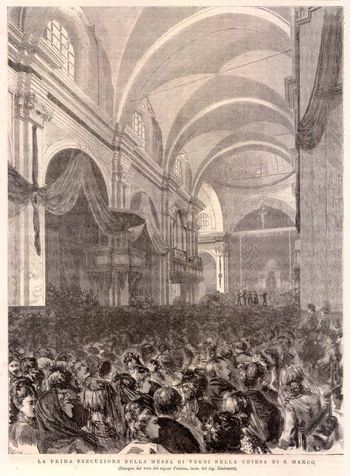
(Giuseppina Strepponi, 1872)On 22 May 1874, the first anniversary of the novelist Alessandro Manzoni's death, a small army of local citizens along with countless Italian and foreign visitors gathered – tickets in hand – in the nave of the church of San Marco in Milan to attend a distinctly unorthodox ceremony: the celebration of a messa secca (a Mass without the consecration of bread and wine) for the soul of Italy's most famous man of letters. The event featured the world première of Verdi's Messa da Requiem and was widely reported in both the Italian and the international press (see Figure 1).Footnote 3 It was almost entirely the artistic solemnity, as opposed to the liturgical goings-on, that attracted journalistic attention. Verdi's work, which marked his first public attempt at sacred composition and followed the success of Aida in 1871, was hailed in his homeland as ‘a new triumph for Italian art’, ‘the most important artistic event of the year’.Footnote 4 Numerous observers took pains to explain its relationship with the centuries-old Italian tradition of sacred music. The renowned critic Filippo Filippi even ventured that the piece would influence the development of all religious art.Footnote 5 The nationalist overtones, which re-emerged at further performances of the Requiem at La Scala a few days later, loom large in contemporary reviews. As so often during the period, Italian anxieties about crisis and degeneration – whether political, social, moral or artistic – were negotiated on musical grounds by extolling the nation's latest compositional achievement.Footnote 6 In the circumstances, the service celebrated by Monsignor Giuseppe Calvi, provost of the cappella metropolitana, went almost unnoticed in press reports – as did, more curiously, any substantial connection with Manzoni.
‘La prima esecuzione della Messa di Verdi nella Chiesa di S. Marco’, drawing by Pessina, L'illustrazione universale, 14 June 1874, 20.

The mixture of religious and secular matters is nevertheless inscribed, and poignantly so, in Verdi's autograph score. Bound between each movement of the Requiem are ‘rubric pages’ (a total of six) with indications of what was to happen at those points. Such notes, David Rosen has suggested, must have been written to help Verdi (the conductor) ‘fit the movements of the Requiem into the plainchant Ambrosian Mass’ celebrated by Monsignor Calvi. They range from records of Latin prayers to visual cues for the movements of the liturgical participants; from indications of when to attack the next piece to excerpts of plainchant.Footnote 7 What is more, if early critical sidelining of the liturgical service may be surprising, especially in the context of the tensions that existed at the time between Italian political and religious authorities,Footnote 8 the San Marco event's religious component is in a broader sense all too perceptible in contemporary reports.
Ever since the work's first nineteenth-century performances and Hans von Bülow's criticism of it as an ‘Oper im Kirchengewande’ (‘opera in ecclesiastical robes’), the ‘Requiem Problem’ has been posed chiefly in terms of musical genre: the extent to which Verdi's composition bears traces of either an operatic or a sacred idiom.Footnote 9 With these considerations have come attempts to define Verdi's work from a political perspective. The politics of Verdi's Requiem have been located not only in the composer's decision to pay public homage to Manzoni – the most prominent literary icon of Italy's so-called Risorgimento – but also in his turn to sacred composition during a time of nationalistic revival of ‘old’ Italian church music.Footnote 10 Pressing further on these and other oppositions – old/new, sacred/operatic, vocal/instrumental and progress/crisis – may seem to reiterate overstated aspects of the work's early reception. However, examining critics’ pluralistic concerns, as well as certain aspects of the Requiem itself, can also offer new perspectives on its nineteenth-century political reverberations.
To address such concerns requires placing early debates about the Requiem within a larger musical and cultural context, notably in connection with contemporary perceptions of opera and of a broader Italian cultural identity. Concepts of crisis and degeneration, as well as claims of progress and innovation, pervaded nineteenth-century European discourse; more importantly, they were among the most pressing preoccupations of Italian music critics. Opera had been at the core of such debates at least since the 1860s, and figured prominently in discussions of the musical genre of Verdi's Requiem. To be sure, no ‘German versus Italian’ dispute of the kind that often permeated operatic debates of the time was fought over Verdi's sacred work. Often-rehearsed criticisms of Wagnerian influences on the composer, which could easily have been applied to certain passages in the Requiem, left hardly any trace in the press (in Italy at least); nor was the future of Italian opera – apparently so uncertain and so tightly bound up with each and every new composition by Verdi – often addressed.Footnote 11 Of course, these represented two distinct groups of concerns: those about the ‘crisis’ of Italian opera and those about the hoped-for resurgence of ‘old’ sacred music. But Verdi's Requiem nevertheless came to be examined in ways that were, so to speak, operatically resonant: similar tensions and contradictions, perhaps even shared attempts to redefine ‘truly Italian music’, ran through discussions of both operatic and sacred music. On a wider level, nineteenth-century accounts of Verdi's sacred composition articulate larger trends in Italian culture, ones in which uneasy opposites coexisted. They thus lay bare the politics of Verdi's Requiem in multiform, subtle ways, ones whose conciliatory gestures may still be of interest today.
In what follows, I will use Verdi's work – both excerpts from the music and instances of its controversial Italian reception – to suggest a revised understanding of the late nineteenth-century self-image of Italy and Italian music. As we shall see, Italian reports were driven at least as much by an interest in the progressive quality of Verdi's music as by an attempt to emphasize the Requiem's connections with a burgeoning repertory of ‘old’ sacred Italian compositions. Verdi himself, through his musical language, offered suggestive ways out of those nationalistically inflected dichotomies mentioned earlier. The Requiem's style and its early Italian reception thus confront us with a multiple image of 1870s Verdi: one that upholds Italy's greatest artist as a force capable not only of conjuring the past, but also of musically regenerating the nation.
National religious sounds
As is well known, the origins of Verdi's project go back to 1869, when the composer suggested a composite Mass, to be composed by 13 Italian composers in memory of Rossini, who had died in Paris the previous November. According to Verdi's plan, the piece was to be performed in Bologna (Rossini's adopted home town) on the first anniversary of the great man's death; then the score would be sealed away in an archive. Although eventually completed, the Mass was not performed (at least, not until more than a century later). Verdi's contribution was a Libera me, the final movement. A few years later, this piece provided the initial material for Verdi's individual homage to Manzoni.Footnote 12
The Rossini and Manzoni compositions were in many ways different in scope and conception. The former aimed at representing, in Verdi's words, a Monumento all'Arte, a Festa patria: an event whose political and historical significance would stem from its exclusively Italian authorship and from a single performance at a precise place and date. Failing to accomplish these conditions would, he said, result in a ‘mere work of art’.Footnote 13 The Messa da Requiem for Manzoni, on the other hand, was conceived not just as a tribute to a highly esteemed Italian, but also as a musical work for immediate circulation. Verdi did insist on the Requiem being played on the exact date of the anniversary of Manzoni's death;Footnote 14 yet, soon after the Milan performances, he took it on a tour of major Italian and foreign theatres (Milan, Paris, London and Vienna), the income this generated causing journalistic criticism of the commercial nature of his initial proposal.Footnote 15
Few comparisons were drawn between the two commemorative projects at the time. Moreover, knowledge of Verdi's ‘recycling’ of the 1869 Libera me for the Manzoni Mass did not emerge immediately – at least, to my knowledge, not until 1876.Footnote 16 A different set of connections between Verdi and Rossini was nevertheless more easily made: that concerning their sacred compositions.Footnote 17 As Gundula Kreuzer has observed, Verdi's idea for the Requiem's European tour was to some extent inspired by the commercial success of Rossini's Petite messe solennelle (1863/7).Footnote 18 After Rossini's death, the unperformed orchestral version of the Petite messe had begun a voyage through several countries – one that took it to, among other places, Italy. Responses were mixed and, besides repeating the older tale of the contentious reception of the Stabat mater (1832/41), raised issues that re-emerged in the Verdi debates.Footnote 19
The première of the Petite messe (in Rossini's revised, 1867 version) at Paris's Théâtre Italien in February 1869 was preceded by much expectation, as were the first Italian performances during subsequent months.Footnote 20 Following initial enthusiasm, the work became the centre of polemics in various parts of Italy (Bologna, Turin and Milan). Debates focused on the appropriateness of the theatre for a religious piece. After its Parisian debut, the critic of Ricordi's Gazzetta musicale di Milano lamented:
[La Petite messe] ben altro effetto farebbe egualmente in una cattedrale, perché lo strumentale ne è ricco e possente; ma al teatro, splendidamente illuminato, senza quel mistero, quella solennità che deve accompagnar la musica religiosa; al teatro, con gli artisti seduti lì, in faccia agli spettatori, in abito nero, con le spettatrici che agitano i ventagli, giuocano cogli occhialetti o salutano le persone di loro conoscenza, l'esecuzione perde molto del suo bel carattere religioso.Footnote 21
([The Petite messe] would make a very different effect in a cathedral, because the orchestration is rich and powerful; but in the theatre, richly illuminated, it lacks that mystery, that solemn character which should accompany sacred music; in the theatre, with the performers seated in front of the audience and dressed in black, with the women in the audience fanning themselves, playing with their opera glasses and greeting their acquaintances, the performance loses much of its beautiful religious character.)
Similarly, following the first La Scala performance, the composer and music teacher Alberto Mazzucato criticized the ‘sconvenienza del luogo’, claiming that the correct environment for the Petite messe was ‘il tempio cristiano’.Footnote 22 The same sentiments were voiced by another critic, who complained about operatic habits (the breaking up of the composition into two parts, ‘come un libretto d'opera’, and the addition of a ballet) that had affected the concert.Footnote 23 The very forms, that is, in which the piece was realized were felt to impact negatively on its religious atmosphere. So, too, were aspects of its interpretation by the singers. As one critic reminded his readers,
Non bisogna eseguire un pezzo di musica da chiesa come si eseguirebbe un solfeggio qualunque. Bisogna che la voce si animi, diventi espressiva secondo la parola, secondo l'arcano senso del verso. Soprattutto vuolsi quell'accento convinto che è la caratteristica della fede, poi gli slanci ardenti dell'anima innamorata del bello, del vero.Footnote 24
(One should not perform a piece of church music as one would sol-fa any old piece. The voice should become animated, express the meaning of the words, following the hidden sense of the poetic line. Above all, what one needs is the sincere tone typical of faith, and the burning impetus of the soul which loves beauty and truth.)
There were nevertheless elements of Rossini's style that made negotiation of the Petite messe's sacred character even more difficult. The work was agreed to be less problematic than the Stabat mater, but remained an oddity in its blending of modern (operatic) and ancient (sacred) musical idioms.Footnote 25 What the latter pole of this dichotomy meant is not easy to pin down, but spotting some of the musical gestures with which it reverberated will help clarify the backdrop to the Verdian polemics.
What was generally understood in Italy to be ‘good’ sacred music was solemn, austere vocal compositions, relying on diatonic contrapuntal procedures and free from instrumental or rhythmic effects that could impede understanding of the liturgical text. These conditions were thought to have been accomplished most notably by Palestrina, hence the label alla Palestrina for music in this style.Footnote 26 The reasons for Palestrina's nineteenth-century popularity with Italians were not solely musical. By the latter part of the century, and through the heroic image fostered by his first Italian biographer, Giuseppe Baini, the composer had become a symbol of Italian-ness, a model in ‘moral terms’.Footnote 27 Revival of his music, both through preparation of editions and (increasingly) through performances, expanded in the last few decades of the century, characterized as they were by the rise of the Cecilian movement. Whatever the actual knowledge of his compositions during the period, Palestrina became a staple in the sacred musical canon that took shape after Italian unification – a canon that served church as well as nationalist agendas.Footnote 28
Perceptions of Palestrina's music were, however, complex. As James Garratt has stressed in the German context, there is no easy way of reducing the nineteenth-century expression alla Palestrina to a single notion.Footnote 29 One recurrent theme in Italian perceptions is the importance of imitative counterpoint: ‘canons, imitation and fugues technically constitute Palestrina's music’, proclaimed one of Italy's leading music critics of the time, Amintore Galli, in a collection of biographies of past and present composers.Footnote 30 In similar vein, Vincenzo Bigliani maintained that ever since Palestrina the two elements most typical of sacred music had been ‘fugue and dissonance’, and that the fugal style was ‘most appropriate for sacred texts and the liturgy’.Footnote 31 Even the authoritative pro-church journal Musica sacra, in its inaugural issue of 1877, declared that ‘the fugal, imitative style [is] the most appropriate for the purposes of sacred music’ (here ‘sacred music’ must, of course, be taken to refer to music alla Palestrina, rather than to plainchant).Footnote 32 More acute observers, such as Girolamo Alessandro Biaggi, keen on emphasizing musical progress, noted a transformation in Palestrina's style after the Missa Papae Marcelli, which marked the beginning of a second manner characterized by greater reliance on Italian melody (as opposed to the contrapuntal artifice of the Flemish school).Footnote 33 Overall, alla Palestrina compositions and church music more generally implied prominent voices undisturbed by musical instruments (except the organ).Footnote 34 Both Galli and Bigliani commented on this: the first praised the ‘gentle religious effusion [which] is instilled in [Palestrina's] extraordinary vocal symphonies’; the second pointed out, in accordance with church edicts, ‘severity of instrumentation, and sometimes total absence of it’ as a distinctive feature of church music.Footnote 35
Some of these ideas were rehearsed in responses to Rossini's Petite messe. In an article for La perseveranza, Filippi designated among the Messe's most successful ‘non-theatrical’ pieces the ‘Christe eleison’ from the Kyrie (a double canon for four-part chorus in a cappella style), the ‘Cum sancto spiritu’ from the Gloria (a fugue) and the Sanctus (for soloists and chorus with no orchestral accompaniment).Footnote 36 More precisely, the critic welcomed the ‘four-part canon in the stile osservato, alla Palestrina, on the words “Christe eleison”, written with sublime expertise and with all the severity and unction required by the religious style’. He went on to proclaim that the Gloria's ‘Laudamus’ was religiosissimo, because of its insistent chords and the (non-imitative) contrapuntal entries of the voices; then he applauded the fugue of the ‘Cum sancto’, in which Rossini had struck a magnificent balance between contrapuntal severity and free melodic inspiration. What is more, in recalling Rossini's Stabat mater, Filippi argued that the only piece one could call ‘authentically evangelical’, expressing ‘the religious, Christian feeling consecrated by tradition’, was ‘Quando corpus morietur’ – a homophonic unaccompanied quartet.Footnote 37
The boundaries within which sacred Italian music lay, then, were tied to distinct types of musical gesture. These – comprising notions of vocality and counterpoint – provided chances to utter musical-aesthetic statements that could be reabsorbed into definitions of Italian music more generally: vocality reverberated not only with ideas of ‘truly religious’ church music, but also with conceptions of the most authentic aspects of Italian opera. Furthermore, examination of such musical gestures carried implications for shaping larger perceptions of time and change. The 1860s and 1870s were the first two decades of Italy's nation-building, and as such were characterized by attempts to celebrate Italian achievements in all fields of culture and history. Monuments were raised to the Great Men of politics and the arts; public anniversaries and commemorations were planned to foster the sense of an ‘imagined’ national community; and the country's recent, and in many ways far from glorious, historico-political trajectory – the Risorgimento – was refashioned in mythical guise.Footnote 38 Musical criticism was also imbued with nationalist discourse. At a period when Italian opera seemed to have exhausted its capacity to regenerate itself except by capitulating to French and German elements, critical pronouncements stressed the importance of unmistakably Italian aspects of music: ‘melody’ was defended against the intrusion of complex harmonic devices; vocalità (particularly pre-Verdian bel canto) against the tyranny of ever weightier orchestration. What is more, supporters of the Italian tradition appealed to an increasingly old, long-forgotten repertory of both operatic and non-operatic works.
To tell such a tale, however, is to look at just one side of the musical and cultural preoccupations of the period. For one thing, there were competing, more forward-looking claims (to be examined later in this article). For another, traditional ideas of Italian vocality and counterpoint, and their interconnection in sacred music, did not go unchallenged. Both such categories were at the centre of early discussions of Verdi's Requiem. Their politics were nevertheless made more complex by certain elements of Verdi's musical language, elements that encourage a more nuanced approach to spelling out nineteenth-century dichotomies.
Blurring idioms
Verdi's personal role in Italy's search for cultural roots after unification was by no means passive. Increasingly from the late 1860s and the 1870s, he railed against the ‘Germanization’ of Italian composers, and soon became a self-appointed spokesman of those wishing to defend Italy's musical traditions. His motto ‘torniamo all'antico, e sarà un progresso’ (‘let's return to the past, it will be a step forward’), from an 1871 letter to his friend Francesco Florimo, was one of several Verdian statements used to support the rediscovery of old repertories of Italian music. The expression came to circulate widely later in the century, usually in books, journals and musical editions that supported the ‘vocal status’ of Italian music. True, the motto acquired a variety of meanings; Verdi's original intention in his letter to Florimo, in which he declined to be appointed director of the Naples Conservatoire, had been to recommend thorough studies of fugue and counterpoint for students.Footnote 39 But in line with contemporary trends, he also understood counterpoint as a legacy of Italy's musical past: as a feature of ancient Italian music that, via Palestrina and other sixteenth-century composers, was usually associated with the human voice. In his letter about ‘l'antico’, Verdi provided advice and models for vocal composition; and when elsewhere he mentioned a piece, later discarded, for the opening of Act 3 of Aida, which in his opinion could have won him ‘a position as a contrapuntist in any old conservatoire’, he referred to it as a ‘four-part chorus worked out in the style of Palestrina’.Footnote 40 That being said, Verdi's relationship with learned, ‘Italianate’ compositional devices was ambivalent, owing to his increasing experimentation with that idiom in both vocal and foreign-influenced instrumental music.
The vocal quality of Italian music figured in a large number of public and private pronouncements by Verdi on the burning topic of Italian music of the future. ‘Our art is not instrumental’, was his reaction in a letter to his friend Clara Maffei following the inaugural concert of the Società Orchestrale della Scala in 1879.Footnote 41 A few weeks earlier he had articulated the same idea to Opprandino Arrivabene, as well as in an official letter to the Società Orchestrale. In all cases, he hoped that the recent Italian developments in instrumental music (by way of the inauguration of orchestral and quartet societies) would be complemented by cultivation of ‘that art that was ours’ – namely, the vocal works of Palestrina and others of the time.Footnote 42 Starting in the 1870s and continuing until the late 1890s, Verdi himself set out to contribute to the resurgence of this vocal tradition by composing pieces – the Requiem, the Pater noster of 1880 and the Quattro pezzi sacri of 1889–96 – that involved contrapuntal and/or unaccompanied vocal writing.
At the same time, though, he applied contrapuntal procedures to instrumental pieces – such as the String Quartet (1873) and the disowned Aida overture (1871) – overtly rooted in foreign musical traditions. The language of the former piece, in particular, is so idiomatically instrumental that one cannot avoid relating its contrapuntal style to Germanic rather than Palestrinian models.Footnote 43 Such ambivalent attitudes to learned compositional devices are emblematic of a composer absorbed, in his later years, in a twofold project: one conservative, not to say reactionary, in its verbal formulations, but at the same time pioneering in its musical results. As early as 1874, the Requiem enters this increasingly murky picture as a paradigmatic case, questioning through music several of those unyielding definitions and abstractions we sometimes like to cast in words.
Vocality is a good case in point. The Requiem's seven movements draw on a large variety of vocal gestures with different music-historical connotations: chant-like, monotone declamation punctuating orchestral discourse (the opening of the Requiem e Kyrie); mostly homophonic moments for unaccompanied voices (the beginning of the ‘Pie Jesu’ in the Dies irae); passages with or without orchestral accompaniment that rely on contrapuntal procedures (the fugues of the Sanctus, the Libera me and the first version of the ‘Liber scriptus’ in the Dies irae,Footnote 44 as well as a cappella passages such as the ‘Te decet hymnus’ in the Requiem e Kyrie); and powerful outbursts of emotion conveyed through opera-like declamatory statements (the solo soprano at the opening of the Libera me and at the transition to the fugue in the same movement). Responses to this pot-pourri were various. Contemporary critics were particularly captivated by passages without orchestral accompaniment, which seemed to recall religious music more directly. The ‘Te decet hymnus’ was described by Filippi as a ‘chorale for voices only with imitations, written in the great style of classic art: a real piece for the church’. One of the most acclaimed and encored movements, the Agnus Dei, struck Verdi's audiences because its first 13 bars are scored for soprano and mezzo-soprano soloists singing an octave apart. ‘A nice melopoeia, a sort of cantabile recitative at the unison, but at the distance of an octave’, reported Filippi.Footnote 45 Others insisted on the striking fusion of sounds (quite possibly associated with plainchant) achieved by the soloists Teresa Stolz and Maria Waldmann.Footnote 46 Some of Verdi's most remarkable massed displays of contrapuntal mastery (particularly the Sanctus fugue) were also welcomed; they showed off Verdi's compositional skills and encouraged chauvinist listeners to hear connections with the ‘great musicians of the past’.Footnote 47 Yet, despite praise for these contrapuntal tours de force, vocality remained – in its barest, most stripped-down, most naively ‘melodic’ expressions – the main source of beguilement.Footnote 48
What makes this trend in early reception intriguing is the shadow of instrumental gestures in Verdi's vocal writing. Interpretation of the liturgical text led the composer to shape on occasion, in the words of Carolyn Abbate, a ‘marvellous confusion of human sound with the sound of the mouths of the instruments’, such as in the ‘Tuba mirum’ and ‘Mors stupebit’ sections of the Dies irae (where the bass soloist imitates the dotted rhythm of the brass heard before by repeating an accented e♭).Footnote 49 Indeed, Verdi's treatment of the voice in the Requiem invites consideration of the ways in which so-called Italian vocality might have become reimagined through interaction with the ‘foreign’, instrumental element.Footnote 50
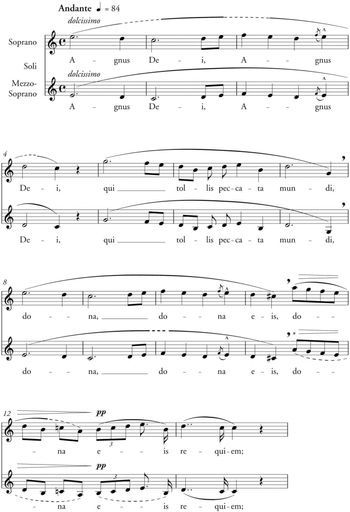
This tension between idioms emerges strongly in pieces where the singers’ melodies seem to be conceived less vocally than instrumentally. Rosen has drawn attention to the theme of the Agnus Dei, which relies on extensive word repetition and whose connection with the underlay (as the piece's compositional history shows) is far from straightforward.Footnote 51 What is more, despite the overall flexibility of the 13-bar phrase, and the psalmodic connotations stemming from its mostly stepwise motion, the melody sounds oddly squared off (see Example 1): constrained, at least for the first ten bars, by the rhythmic and melodic repetitions occurring at the beginning of each of its three subphrases (bars 1, 5 and 8); perhaps even awkward as the result of uncomfortable vocal gestures (the acciaccaturas of bars 3 and 10, the first placed on the second syllable of ‘A-gnus’).
Verdi, Messa da Requiem, Agnus Dei, bars 1–13. Giuseppe Verdi, Messa da Requiem per l'anniversario della morte di Manzoni 22 maggio 1874, ed. David Rosen (Chicago, IL, and Milan, 1990).

The rest of the movement only adds to the complexity of the vocal–instrumental relationship. The first variation of the theme – the Agnus Dei can be described as a cantus firmus variation, in which the melody is repeated almost verbatim but with changing orchestral accompaniment – consists of a new statement of the melody by the chorus, clarinets, bassoons and strings in octave unison. The blend of sound is striking, owing especially to the registral restriction of the whole ensemble. Subsequent statements with the chorus harmonize the melody and gradually expand both the vocal–orchestral range and the number of instruments, thus bringing greater diversity. Overall, though, the sonority remains compact, creating a stark contrast with the soloists’ statements. The latter passages are also underpinned by a clearer distinction between melody (singers) and accompaniment (instruments, both harmonizing and weaving around the theme). The alternation of choral and soloistic passages, then, as well as Verdi's different treatment of the instrumental layer in the two situations, conjures distinct ideas of vocality. Most importantly, these vocal sonorities are given a new context by mixing a plain, delicate, almost religious ‘Italian’ melody with the resounding voice of a modern orchestra.
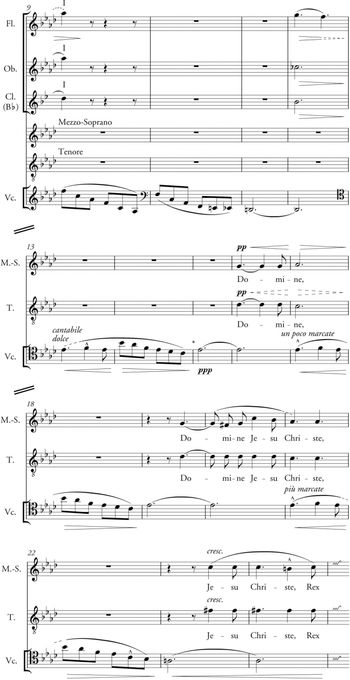
Verdi's engagement with instrumental idioms is even more apparent in some of the vocal writing of the Offertorio, for four soloists and orchestra. The movement consists of five sections organized according to an ABCBA form, and is characterized by exceptionally dense motivic repetition. This is especially evident in the A sections, in which most of the musical material is derived from the cantabile dolce theme played early on by the cellos (bars 13ff.; see Example 2). The phrase is preceded by 12 bars of ascending or descending arpeggio figuration (for the same instruments) finished off by chromatic scales, with passages for solo wind at the end of each subphrase. The theme itself consists of the repetition of a four-bar motif punctuated each time by brief cadential statements from mezzo-soprano and tenor soloists. From the very beginning, the Offertorio establishes the vocal–instrumental relationship in equivocal terms: not only does the cello phrase have a markedly ‘individual’ character – it could well have been scored for a solo cello, as in the introduction to Philippe's aria in Act 4 of Don Carlos Footnote 52 – but it is also rounded off by vocal remarks that, in the circumstances, carry instrumental connotations. When the melody is taken up by the soloists (bars 31ff.), the ambiguity of this apparent exchange of roles partly fades away; yet it soon reappears through other routes.
Verdi, Messa da Requiem, Offertorio, bars 9–24. Giuseppe Verdi, Messa da Requiem per l'anniversario della morte di Manzoni 22 maggio 1874, ed. David Rosen (Chicago, IL, and Milan, 1990).

For one thing, Verdi's use in the A sections of very limited musical material, elements of which generate moments of loosely imitative writing, means that different words will have to be set to music with the same rhythmic features: through its pervasiveness, the cellos’ lyrical motif requires adaptation of the varying prosodic qualities of the text. This can only increase the sense of an uneasy integration of the musical and textual elements whenever trivial words such as the preposition ‘de’ are set to the whole first bar of the theme (bar 39); or the same rhythmic element, such as the six quavers of the melody's second bar, generates different types of relationship with the word underlay (from one syllable per note in bar 36 to one syllable per six notes in bar 74).Footnote 53 To put it differently, it is as if (once again) Verdi had conceived his melody less as a vocal than as an instrumental idea. All of this is made more suggestive by such eerie moments as the soprano's entry with an exceptionally long pianissimo e′′ (bars 62ff.). Above this note and further accompaniment by violins and violas, two solo violins play the first two bars of the melody three times (with a shift of key on the third one) before giving way to an evocative exchange of roles: the singer takes up the theme while the violins continue her long-held note (the protagonists finally being reunited through simultaneous statements of the melody). For a few seconds, vocality bows to instrumentality: the former constrained – like the soprano – to hold back in both dynamics and melodic invention while still contributing to the weave of the overall musical texture.Footnote 54
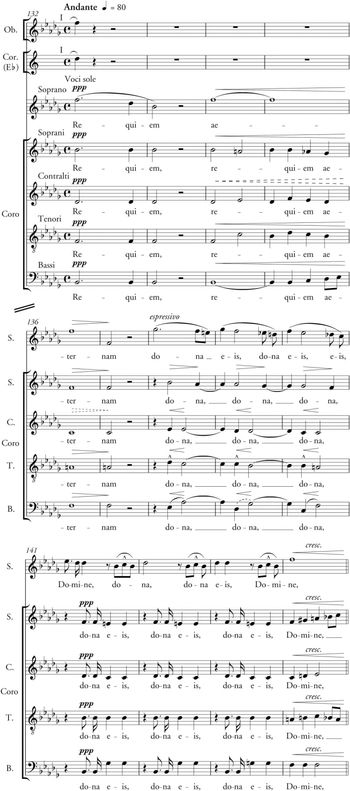
One further way of expanding traditional connotations of Italian vocality emerges in the ‘Requiem aeternam’ section of the final movement, the Libera me, a section scored for unaccompanied solo soprano and chorus (bars 132–70).Footnote 55 Through the soloist's part, the beginning of this section suggests some of the considerations made above in relation to the soprano's long-held note in the Offertorio. In the case of the Libera me, the soloist enters on and prolongs for three beats a long f′′ played by a solo oboe and horn in the preceding bars – a gesture that constitutes a gliding of instrumental into vocal sound. What comes next, though, is purely vocal discourse, in fact discourse of a type that both invokes and calls into question earlier traditions of sacred, a cappella music (see Example 3). The texture is prevalently homophonic, both in the four-part choral writing and often (as well as increasingly as the music unfolds) in its relationship with the soloist. In this sense, the soprano part is constructed less as a ruling solo than as a voice indistinguishably fused with all the others, according to the best sixteenth-century polyphonic tradition. At the same time, however, the soloist stands out as utterly independent from the choral mass. The soprano's range is such that it tends to single out her voice from the harmonies underneath. Owing also to the timbral difference from the blended sound of the choir, the soprano translates into a solo statement supported by a harmonic weave of human voices.Footnote 56 Her vocality is constructed as a more ‘modern’, perhaps even more ‘operatic’, expression of individuality: an expression that establishes distance from the homogeneous textures of ancient polyphonic music and instead consigns all remaining musical sound to a soloist-centred, or at least soloist-related, discourse.
Verdi, Messa da Requiem, Libera me, bars 132–44. Giuseppe Verdi, Messa da Requiem per l'anniversario della morte di Manzoni 22 maggio 1874, ed. David Rosen (Chicago, IL, and Milan, 1990).

All in all, Verdi's writing betrays a forcing of the human voice out of its customary habits into a domain of often unperformable, or at least evocatively instrumental, effects (see for instance the pppp he asks the soprano to produce at the very end on a high b♭′′). Verdi's ‘modern’ take on the interweaving of the soprano with the other lines is, above all, accomplished by relying on the human voice in all layers of the music, the chorus gaining a role that would have more naturally belonged to instruments. This is vocalità – ‘modern’ vocalità – celebrated through unspoiled vocal sound; the music of the present refashioned and sacralized in echoes of ages past.
Crisis and progress
Early discourse about the Requiem reflected many of these seeming contradictions, drenched as it was in statements that proclaimed both the conservative and the progressive character of Verdi's music. On the one hand, and as we saw earlier, Verdi's sacred work encouraged comparisons with an increasingly revered musical past, as well as endorsement of widespread complaints about the decadenza of sacred Italian music. The latter, it will now be obvious, was a common theme of late nineteenth-century writings. Its origin supposedly stemmed from the deviation of church composers from the recta via represented by medieval chant and Palestrina. In an 1879 issue of Musica sacra, Carlo Viganò defined canto fermo as ‘that collection of sacred melodies recorded by choral books with the aim of preserving them and prohibiting their alteration’. Despite his explanation of the adjective fermo as pointing to the chant's ‘stability’ (a stability dictated by the law that also applied to ‘sacred ceremonies, which are immutable’), Viganò's concern to stress this point – to summon up the materiality of enduring artefacts as a warranty against forgetfulness and decay – suggests that plainchant was in fact perceived as subject to the effects of time.Footnote 57 Indeed, the increasing proximity (through revivals and varied operations of monumentalization) in the late nineteenth century of old repertories of both sacred and operatic music came both to offer modern Italian musicians models with a didactic, even moralizing function, and to set in motion perceptions of crisis and degenerative processes. What is less often emphasized, however, in literature about Italian music criticism of the period are critics’ acknowledgments that modern composers should also move on.
Verdi's Requiem invited notable attempts to foresee future musical developments. ‘Verdi is the personification of musical progress’, announced Galli in Il secolo the day after the Requiem première.Footnote 58 A retrospective of the composer's career, spanning more than 30 years and culminating in religious composition, led the critic to identify in Verdi's constant transformations some sort of natural law dictating musical and historical development. Plainchant was the voice of an ancient age, one that by then seemed far off; and while it still survived in the church in traditional chants with a monumental status (such as the Te Deum), it should not impede the advancement of modern composition. A similar if more extended reckoning of the history of music since the tenth century – starting with Guido d'Arezzo and closing with Verdi – had constituted the material of a book published by Galli a few years earlier. To the burning question of whether modern sacred music ought to be modelled on sixteenth-century works, Galli answered in the negative, arguing that musical progress should not be held back.Footnote 59
Further efforts to distance Verdi's Requiem from the fixity of old forms and styles came from such authoritative critics as Filippi and Pietro Cominazzi. Praising Verdi's latest work, the former noted that, although
il tipo classico della musica religiosa, come esisteva molti secoli addietro, è certo ammirabile […] non ha ragione di essere che a titolo di ammirabile, venerabile memoria. Per il canto fermo, per la musica calma, grave, impassibile, la quale non modula, e non comporta nemmeno la battuta, ci vuole una fede, oserei quasi dire un'esaltazione religiosa, che non sono più del nostro tempo.Footnote 60
(the classic type of religious music, as it existed years ago, is certainly admirable […] it has no reason to exist but as an admirable, honourable memory. For plainchant, for that music which is calm, grave, impassive, which does not modulate and implies no measures, a faith, I would almost say, a religious exaltation is needed that no longer belongs to our time.)
Rather than clinging to outdated models, modern composers should seek to be ‘bold innovators’, as their predecessors had been.Footnote 61 Even a Verdi opponent such as Cominazzi, typically hostile to any anti-traditional move by the composer, criticized those who held that ‘church music should obey the immutable laws of Catholicism, thus remaining as fixed as them’. True, Verdi had moved ahead too fast; yet the ‘sterile forms of the old masters’ should be abandoned, making room for innovation.Footnote 62
Claims akin to these were voiced by others and were by no means restricted to the Verdi debates. In two articles on Rossini published in the Nuova antologia di scienze, lettere ed arti in 1869 and 1870, Biaggi complained about one common opinion that urged modern religious music to follow the models of plainchant and Palestrina. Such a trend, the critic opined, is incompatible with artistic advance. ‘With regard to style, forms, voice-leading, harmony, counterpoint and all that constitutes its external manifestation and technical mastery, church music must be conceived and written according to the practice of its time.’Footnote 63 In like fashion, Giuseppe Arrigo noted in 1875 the anachronism of Gregorian chant and alla Palestrina compositions. ‘Everything has its own time’, he argued, and one needs to learn to ‘abandon all that is conventional and that belongs to an age that is past, that cannot come back’.Footnote 64 Indeed, during the second half of the nineteenth century, Italian accounts of music history – and specifically the history of sacred music – were increasingly underpinned by the idea of an ascending sequence of technical developments whose ultimate goal coincided with the music of the present. Such a stance was not only in contrast to earlier trends (as exemplified, for instance, by Baini) advocating a return to a remote apex of musical composition, but also reflected shifting conceptions of history. Ever more teleologically inflected and coloured by moral tensions and expectations, these resulted in a late nineteenth-century explosion of narratives, both musical and historical, relentlessly articulating a story of progress and regeneration entwined with one of crisis and decline.Footnote 65
Paying greater heed to forward-looking claims in contemporary musical debates does not undermine any of the considerations made earlier in this article (as well as by previous scholars) concerning late nineteenth-century Italian revivalism and the search for cultural roots in the national past. Rather, it offers a corrective, as historian Axel Körner has noted, to a long-lasting image of post-unification Italy as a nation ‘obsessed’ with its own past and cultural traditions.Footnote 66 Mid- to late nineteenth-century Italian culture was no doubt saturated with protests against various kinds of weaknesses, decay and immorality. In the words of Suzanne Stewart-Steinberg, ‘The formulation of an Italian national self was predicated on a language that posited marginalization and powerlessness as fundamental aspects of what it meant to be modern Italians.’Footnote 67 Yet crisis had also a larger, European discursive dimension – one that cut across such varied disciplines as medicine, biology, politics, sociology and literature – and should also be read in connection with burgeoning pleas for progress and modernization.Footnote 68 As Svetlana Boym has argued, nostalgia ‘is a longing for that shrinking “space of experience” that no longer fits the new horizon of expectations. Nostalgic manifestations are side effects of the teleology of progress.’Footnote 69
There is yet another aspect, though, of late nineteenth-century Italian writings about music that attracts attention: the ubiquity and routine application of such critical utterances – utterances imbued with concerns about both crisis and progress – to varied musical genres. Accounts of sacred music are deeply redolent of Italy's oft-asserted ‘operatic crisis’ around 1860, the language used to describe the shortcomings of modern compositions, whether sacred or operatic, being at times surprisingly similar. In an examination of the current health of Gregorian chant and sacred music, the priest Luigi Bianchi started out by acknowledging their worrying decadence.Footnote 70 Later on, listing the deficiencies of modern religious music, he provided an inventory of what turned out to be the perceived negative qualities of Italian opera of the time: from a style that ‘often sacrifices melody for obscure harmonic artifice, so-called alla tedesca’ to an ‘entirely profane style […] that is purely instrumental’; from the lack of respect for the meaning and understanding of the text to the ‘roar’ caused by ‘a stormy sea of deafening instruments’. As if the allusions to contemporary operatic discourse were not enough, Bianchi took leave of his cataloguing impulse via a reference to the ‘musica enigmatica, so-called dell'avvenire’. ‘Posterity’, he said, ‘would be its judge.’Footnote 71
Language thus provided territory in which remarks about this or that composition or musical genre could (and did) take on wider resonances. Linguistic and rhetorical similarities bridging late nineteenth-century discussions of sacred and operatic music should give us pause: they encourage a more flexible and porous relationship between the two genres, or at least between the concerns of those who used opera and sacred music as ground for musical and cultural discussion. To return once more to Verdi's Requiem, its musical language and the eclectic claims it raised among critics made it political in a broader sense than those (mentioned at the beginning of this article) so far addressed by scholars. Early liking for Verdi's barest yet instrumentally inflected vocal writing could be seen as a symptom of wider trends in perceptions of Italian music – as a sign that seemingly inward-looking, old-fogey discussions about church composition could also (via Verdi's mediating presence) encompass refreshing visions of Italian opera. The fact that Italy's greatest opera composer and his Requiem came to embody the teleological drive that pushed music and history forward ultimately also suggests more progress-orientated views of Italian culture of the time. Pursuing such views would not only allow us to reconsider some of the traditional narratives and binary oppositions underlying many scholarly accounts of nineteenth-century Kulturkämpfe and processes of secularization – the most trodden interpretative route flowing invariably from the sacred to the secular, from tradition to modernity, from the church to the nation state;Footnote 72 it would also offer us a chance to recall that crisis always comes with a promise of alternatives, an anticipation of change.
Epilogue
Si aprono nuove pagine del libro del mondo, e come l'arcipelago indiano vide uscire un giorno, dalla schiuma delle sue onde immacolate, la sua Venere spirituale – dall'ampio mare dello scetticismo dominante, sorge una nuova figura che si atteggia ostile alla rivelazione. La terra ha sete di verità morali, più che di verità teologiche; l'arte la soccorre.Footnote 73
(New pages from the book of the world are being unfolded, and as the Indian archipelago once saw its spiritual Venus arise from the foam of its immaculate sea, a new figure hostile to revelation today emerges from the vast ocean of pervading scepticism. The world is thirsty for moral truths rather than theological ones; art comes to the rescue.)
The quotation that opens this final section is taken from a review of Verdi's Requiem published in the Gazzetta di Milano a few days after the work's première. It posits in powerful terms Italian aspirations to progress and regeneration, not solely artistic but also moral and social. In the uplifting role the author ascribes to musical art, one can hear echoes of Giuseppe Mazzini's unshakable faith in music's higher ‘destinies’, its ‘new and more solemn mission’,Footnote 74 and the same moral tension that runs through Francesco De Sanctis's Storia della letteratura italiana (1871) and its vision of a worldly religion of morals. The edifying quality of music was, of course, a topos of nineteenth-century writings, not only Italian but also European more generally, one that originated around the middle of the previous century and is usually connected with the rise of the bourgeoisie. In Italy, debates fomented by the Cecilian movement about the style and function of religious compositions are especially packed with instructive undertones, ones that emanated from church agendas. Yet they also resonate with wider, secular feelings about the formative possibilities of musical education and choral singing in particular.
I shall not set out, at such a late stage in this article, to explore any of these topics. Late nineteenth-century Italian discussions about the educational role of choral singing and the establishment of popular schools of music and musical societies (in Milan, for instance, from the 1860s) would be a compelling subject of study – one likely to bring new insights into perceptions and larger political implications of works such as Verdi's Requiem and Rossini's Petite messe solennelle.Footnote 75 Once again, examination of such debates would back the view that fluxes between secular and sacred domains were indeed possible, music offering itself, amid rising tides of decline and degeneration, as a medium of salvation. But my reason for ending this Requiem voyage along lines coloured with ideas of moral and social uplift is less ambitious, and to some extent also more personal. I want to recover in this picture the presence of Manzoni: Verdi's friend and the dedicatee of his sacred composition; a figure who remained surprisingly eclipsed, as mentioned much earlier in this essay, in nineteenth-century Italian reports.Footnote 76
Verdi's special attachment to the Requiem – even its material representation, the autograph score – must surely also have had to do with the friendship that tied him to the great man of letters. Contrary to his standard practice, Verdi demanded that his publisher Giulio Ricordi return the Requiem autograph to him after the first performances (rather than keep it in the firm's archive, as usually occurred with operas). It was not until December 1897, following the death of his wife Giuseppina Strepponi a few weeks earlier, that Verdi finally released it, handing it over – perhaps in an act of gratitude, perhaps in a nostalgia-driven clearing of the decks – to the soprano and close friend Teresa Stolz.Footnote 77 How ironic, in the circumstances, that Verdi's wish to pursue an afterlife in history hand in hand with Manzoni would come true only through the readings of later generations of critics.
Verdi may well have failed, during the poet's lifetime and immediate afterlife, to tie his name to that of Manzoni (the two men had met on remarkably few occasions). Still, they would both become paternal figures for the young Italian nation, their artistic output and their moral and intellectual rigour retaining their hortatory force to the present day. What is more, Verdi's and Manzoni's marked differences in matters of religious belief, so touchingly summarized by Giuseppina in the second epigraph to this article, invite us to muse on one last unexpected proximity. When it comes to narrating identities, whether individual or communal, whether our past or our present ones, differences tend to inflate; but they sometimes do so deceptively. Verdi and Manzoni superseded those differences through mutual esteem and a shared faith in art's power to effect change. Above all, though, their symbolic encounter provides us with a fitting metaphor for those boundaries – between the old and the new, the sacred and the secular, progress and crisis – that through early debates about the Requiem have revealed all their precariousness and refreshing permeability.
I am grateful to Harriet Boyd-Bennett, Katherine Hambridge, Roger Parker, Laura Protano-Biggs, David Rosen, Emanuele Senici, Gavin Williams and two anonymous readers for their feedback on earlier versions of this article. My thanks also to Giuseppe Martini for his assistance during my research at the Istituto Nazionale di Studi Verdiani.