Peer victimization is a common stressor among school-aged children that can interfere with healthy developmental outcomes. Victims of bullying, particularly those who are repeatedly victimized or who also behave aggressively toward their peers, are at increased risk for psychosocial and behavioral adjustment problems, including loneliness, low self-esteem, anxiety and depression, externalizing problems, and disengagement from school (Hanish & Guerra, Reference Hanish and Guerra2002; Kochenderfer-Ladd & Skinner, Reference Kochenderfer-Ladd and Skinner2002; Kochenderfer-Ladd & Wardrop, Reference Kochenderfer-Ladd and Wardrop2001; Leadbeater & Hoglund, Reference Leadbeater and Hoglund2009). Past research with community-based samples estimates that between 10% and 30% of children are chronic victims of peer aggression, and higher percentages are more likely in early grades (Hanish & Guerra, Reference Hanish and Guerra2002; Hawker & Boulton, Reference Hawker and Boulton2000; Kochenderfer & Ladd, Reference Kochenderfer, Ladd, Juvonen and Graham2001).
Transactional models of development view psychopathology as the product of individual differences in transaction with environmental adversities (Cicchetti & Toth, Reference Cicchetti, Toth, Luthar, Burack, Cicchetti and Weisz1997); however, no research has demonstrated that changes in peer victimization are linked with changes in child characteristics over time, or that changes in context can moderate victimization trajectories. In this study, we examine individual-level and school-level influences on victimization trajectories in elementary school children from the beginning of first grade to the end of third grade.
Patterns of Victimization Over the Elementary School Years
Early experiences of victimization are linked to continuity in victim–bully relationships in middle school (Kochenderfer-Ladd & Wardrop, Reference Kochenderfer-Ladd and Wardrop2001; Schwartz, Dodge, Pettit, & Bates, Reference Schwartz, Dodge, Pettit and Bates1997; Schwartz, Proctor, & Chien, Reference Schwartz, Proctor, Chien, Juvonen and Graham2001); however, patterns of victimization during the early elementary school years tend to be less stable than in later school years. Stability coefficients for victimization among middle school children range from ~0.45 to ~0.75 from one school year to the next (Boulton & Smith, Reference Boulton and Smith1994), but they typically range from ~0.20 to ~0.40 among elementary school children (Ladd & Kochenderfer-Ladd, Reference Ladd and Kochenderfer-Ladd2002). The early school years are clearly an important period for understanding the developmental processes that explain why some but not other children are repeatedly victimized and how changes in victimization are related to changes in their behaviors and contexts over time. Furthermore, the early school years delineate a period of rapid social, emotional, cognitive, and personality development during which intervention and prevention programs may have considerable impact on interrupting peer victimization before it becomes inveterate (Ladd, Reference Ladd, Sameroff and Haith1996; Olweus, Reference Olweus1994).
Two forms of peer victimization have been distinguished in the literature: physical and nonphysical. When victimization is chronic, both types usually involve a power differential (in age, size, or social status, etc.) favoring the perpetrator over the victim. Physical victimization is the consequence of another's intent to hurt, harm, or injure with physical force or threats of force (hitting, shoving, pushing, threatening). The distinctions among potentially distinct types of nonphysical (indirect, relational, or social) aggression have been the subject of considerable debate among researchers (Archer, Reference Archer2004; Björkqvist, Lagerspetz, & Kaukiainen, Reference Björkqvist, Lagerspetz and Kaukiainen1992; Coyne, Archer, & Eslea, Reference Coyne, Archer and Eslea2006; Underwood, Galen, & Paquette, Reference Underwood, Galen and Paquette2001; Xie, Cairns & Cairns, Reference Xie, Cairns, Cairns, Pepler, Madsen, Webster and Levene2005). In this study, we also investigate relational victimization (Crick & Grotpeter, Reference Crick and Grotpeter1995) defined as the consequences of intentional efforts to disrupt peer relationships by social exclusion, ignoring, spreading malicious rumors, gossiping, or threats to end the relationship. Physical and relational victimization are typically moderately to highly correlated (Card, Stucky, Sawalani, & Little, Reference Card, Stucky, Sawalani and Little2008; Hawker & Boulton, Reference Hawker and Boulton2000). Nevertheless, understanding the differences between these subtypes of victimization is important for prevention efforts (Leadbeater, in press; Leadbeater & Hoglund, Reference Leadbeater and Hoglund2009; Ostrov et al., Reference Ostrov, Massetti, Stauffacher, Godleski, Hart and Karch2009; Yeung & Leadbeater, Reference Yeung and Leadbeater2007). Finally, longitudinal research indicates that physical victimization (and its corollary, physical aggression) typically declines in elementary school (Brame, Nagin, & Tremblay, Reference Brame, Nagin and Tremblay2001; Cairns, Cairns, Neckerman, Ferguson, & Gariépy; Reference Cairns, Cairns, Neckerman, Ferguson and Gariépy1989; Côté, Vaillancourt, Barker, Nagin, & Tremblay, Reference Côté, Vaillancourt, Barker, Nagin and Tremblay2007; NICHD Early Child Care Research Network, 2004; Tremblay et al., Reference Tremblay, Nagin, Séguin, Zoccolillo, Zelazo and Boivin2004; Vaillancourt, Hymel, & McDougall, Reference Vaillancourt, Hymel and McDougall2003). However, longitudinal studies of changes in social, relational or indirect aggression are rare, and there is some evidence that the use of social aggression increases in late childhood and early adolescence for both boys and girls (Björkqvist et al., Reference Björkqvist, Lagerspetz and Kaukiainen1992; Harachi et al., Reference Harachi, Fleming, White, Ensminger, Abbott and Catalano2006; Leadbeater, Hoglund, & Woods, Reference Leadbeater, Hoglund and Woods2003; Salmivalli & Kaukiainen, Reference Salmivalli and Kaukainen2004; Underwood, Reference Underwood2003; Xie et al., Reference Xie, Cairns, Cairns, Pepler, Madsen, Webster and Levene2005). Hence, we examine these subtypes separately in this study. However, the correlations among physical and relational aggression and the paucity of past longitudinal research examining intraindividual trajectories of these subtypes discourage us from making separate hypotheses about their predictors.
Child Characteristics Associated With Victimization
Children's emotional displays and aggressive behaviors in response to peer victimization have been linked to the perpetuation of victimization (Hanish, Eisenberg, Fabes, Spinrad, Ryan, & Schmidt, Reference Hanish, Eisenberg, Fabes, Spinrad, Ryan and Schmidt2004; Jensen-Campbell, Knack, Waldrip, & Ramirez, Reference Jensen-Campbell, Knack, Waldrip and Ramirez2009; Rosen, Milich, & Harris, Reference Rosen, Milich, Harris and Harris2009; Shields & Cicchetti, Reference Shields and Cicchetti2001), yet little is known about their longitudinal association with patterns of peer victimization. Emotion regulation refers to “a multifaceted phenomenon whose development arises from the growth and integration of many behavioral and biological processes” (Thompson, Lewis, & Calkins, Reference Thompson, Lewis and Calkins2008, p. 124) that are also influenced by family socialization and cultural norms (Cole, Dennis, Smith-Simon, & Cohen, Reference Cole, Dennis, Smith-Simon and Cohen2009; Eisenberg, Champion, & Ma, Reference Eisenberg, Champion and Ma2004; Morris, Silk, Steinberg, Myers, & Robinson, Reference Morris, Silk, Steinberg, Myers and Robinson2007). Excessive expressions of negative emotions are frequent in descriptions of victims' responses to bullying. Several observational studies have noted that children who were frequently victimized became visibly upset by the interaction (Patterson, Littman, & Bricker, Reference Patterson, Littman and Bricker1967; Schwartz, Dodge, & Coie, Reference Schwartz, Dodge and Coie1993). Olweus (Reference Olweus1978), for example, found that victimized children frequently displayed overt distress, including tearfulness, anger, and crying. Poor emotional control can also result in poorly crafted social exchanges from which more skilled peers generate opportunities to advance their own social status and power by victimizing the emotionally vulnerable child (Veenstra et al., Reference Veenstra, Lindenberg, Zijlstra, de Winter, Verhulst and Ormel2007). However, gender may influence these patterns. Hanish et al. (Reference Hanish, Eisenberg, Fabes, Spinrad, Ryan and Schmidt2004) showed that young boys who are victimized early in the school year showed contemporaneous angry, aggressive behaviors, possibly reflecting their efforts to establish dominance in a new social group. By the spring semester, however, it was boys who did not engage in angry aggressive peer interactions who were more likely to be victimized. In contrast, girls who displayed anger were more likely to be victimized over time, and the link between anger expression and peer victimization was accounted for by poor regulatory skills (e.g., lack of capacity for sustained attention and inhibitory control). Furthermore, emotionally dysregulated children may become marginalized or rejected if their peers find their emotional behavior aversive (Casey & Schlosser, Reference Casey and Schlosser1994; Dearing et al., Reference Dearing, Hubbard, Ramsden, Parker, Relyea and Smithmyer2002; Eisenberg et al., Reference Eisenberg, Fabes, Shepard, Murphy, Guthrie and Jones1997; Hubbard & Coie, Reference Hubbard and Coie1994), robbing these children of protective friendships that could help prevent bullying (Hoglund & Leadbeater, Reference Hoglund and Leadbeater2004).
Many studies with children and adolescents also show links between physical aggression and peer victimization concurrently and over time (Hanish & Guerra, Reference Hanish and Guerra2002; Kochenderfer-Ladd, Reference Kochenderfer-Ladd2003; Leadbeater, Boone, Sangster, & Mathieson, Reference Leadbeater, Boone, Sangster and Mathieson2006; Leadbeater & Hoglund, Reference Leadbeater and Hoglund2009; Morrow, Hubbard, McAuliffe, Rubin, & Dearing, Reference Morrow, Hubbard, McAuliffe, Rubin and Dearing2006). It is notable that studies have shown that young children who respond to bullying with aggression are more likely to remain in a bully–victim relationship than those who do not (Mahndy Wilton, Craig, & Pepler, Reference Mahndy Wilton, Craig and Pepler2000; Leadbeater & Hoglund, Reference Leadbeater and Hoglund2009). Children who engage their peers in aggressive interactions are likely to display hostility and defensive posturing that can prolong their engagement with bullies and evoke further victimization from an already hostile bully (Kochenderfer-Ladd, Reference Kochenderfer-Ladd2004).
In a four-wave longitudinal study of children in kindergarten to Grade 3, Kochenderfer-Ladd and Wardrop (Reference Kochenderfer-Ladd and Wardrop2001) classified children as victims based on their reported frequency of experiencing physical or verbal victimization, with 14% classified as victims at three or more time points. In a second study with the same sample (Kochenderfer-Ladd, Reference Kochenderfer-Ladd2003), cluster analyses indicated that 22% to 36% of the victimized children were also physically aggressive. Early levels of physical aggression predicted increases in the frequency of victimization in Grade 1 and in chronic victimization over time. Similarly, in a previous report of the current sample, Leadbeater and Hoglund (Reference Leadbeater and Hoglund2009) found that children's physical aggression on entry to Grade 1 increased risks for victimization by the end of Grade 2, which in turn was related to increases in physical aggression by the end of Grade 3.
Contexts That Support or Reduce Peer Victimization
Accumulating research demonstrates that the use of aggression against peers interacts with social norms in schools, neighborhoods, families, and communities to augment or reduce aggressive peer interactions (Aber, Jones, Brown, Chaudry, & Samples, Reference Aber, Jones, Brown, Chaudry and Samples1998; Bagwell, Reference Bagwell, Kupersmidt and Dodge2004; Bellmore, Witkow, Graham, & Juvonen, Reference Bellmore, Witkow, Graham and Juvonen2004; Bukowski & Sippola, Reference Bukowski, Sippola, Juvonen and Graham2001; Graham, Bellmore, & Mize, Reference Graham, Bellmore and Mize2006; Hoglund & Leadbeater, Reference Hoglund and Leadbeater2004). Context also appears to affect intervention efforts (Aber et al., Reference Aber, Jones, Brown, Chaudry and Samples1998; Kellam, Ling, Merisca, Brown, & Ialongo, Reference Kellam, Ling, Merisca, Brown and Ialongo1998; Leadbeater et al., Reference Leadbeater, Hoglund and Woods2003). Evaluating a classroom intervention (the Good Behavior Game) directed at reducing children's aggressive behaviors, Kellam et al. (Reference Kellam, Ling, Merisca, Brown and Ialongo1998) found that placement in first grade classrooms with higher aggregate levels of physically aggressive peers (rated by teachers) contributed to boys' (but not girls') aggressive behaviors in middle school, independent of family and school-level poverty. Similarly, Aber et al. (Reference Aber, Jones, Brown, Chaudry and Samples1998), investigating classroom and neighborhood contexts effects on the effectiveness of a violence prevention program (Resolving Conflicts Creatively), found that expected reductions in children's aggressive cognitions were diminished for children who lived in poorer, more violent neighborhoods and attended classrooms in which more children rated the use of aggression as “perfectly OK.” In our previous work with the current sample (Leadbeater et al., Reference Leadbeater, Hoglund and Woods2003), we showed that classroom levels of relational and physical victimization decreased significantly in schools participating in a program that seeks to alter school contexts to reduce peer victimization (the WITS® program) compared to control schools. Effects of this whole school program (described below) on classroom levels of victimization were stronger in schools with greater numbers of children from families on income assistance. Classroom levels of teacher-rated social competence, emotional problems, and behavioral problems were also favorably influenced by participation in the program. This research suggests that changes in school and classroom norms are important to the reduction of victimization in elementary schools.
The Present Study
The general objective of the present study was to identify individual-level and school-level factors that are associated with longitudinal changes in peer victimization. There are three specific aims for this study. The first aim was to characterize the developmental trajectory of victimization over the early elementary school years. Cross-sectional studies have shown that levels of victimization, especially physical victimization, are initially quite high among early elementary school children but decrease during the elementary school years (Hanish & Guerra, Reference Hanish and Guerra2000; Olweus, Reference Olweus1994). We expected that individual patterns of physical victimization would, on average, decline in early elementary school grades. The trajectory of relational victimization is less well established in the literature, and some research suggests it may increase in elementary and middle school students. The second aim was to identify child characteristics that are developmental covariates of within-child victimization trajectories. Given that both aggression and emotional dysregulation have been previously linked to victimization in early elementary school children, we hypothesized that these problems would covary positively with victimization over time. More specifically, we hypothesized that on occasions when victimization was high for individual children, aggression and emotional dysregulation would also be high. The third aim was to assess between-child moderators of individual differences in victimization trajectories. Previous studies have suggested that patterns of victimization are related to age, sex, and school context. Consistent with the literature, we hypothesized that being younger than one's peers at entry into Grade 1 would be associated with higher levels of victimization because younger children tend to be more physically aggressive and emotionally dysregulated than older children (Kopp, Reference Kopp1989; Tremblay et al., Reference Tremblay, Nagin, Séguin, Zoccolillo, Zelazo and Boivin2004). Further, and in keeping with previous reports, we hypothesized that being male would be associated with higher levels of physical victimization and that participating in the WITS victimization prevention program would be associated with decreases in both physical and relational victimization from Grade 1 to 3.
Methods
Participants
Children (n = 432) were recruited in the fall of Grade 1 (51% boys; average age = 6.3 years, SD = 0.32) from 44 classrooms in 17 public schools in a medium-sized Canadian city. Baseline data were gathered in the fall of Grade 1. Follow-up data were collected in the spring of Grade 1 (Time 1, n = 423, 98% retention rate), Grade 2 (Time 2, n = 397, 92%) and Grade 3 (Time 3, n = 385 children, 89.1%). Children not followed had moved out of the school district and refusals to continue to participate were rare. Participants were also involved in an evaluation of the WITS peer victimization prevention program (see Leadbeater & Hoglund, Reference Leadbeater and Hoglund2006; Leadbeater et al., Reference Leadbeater, Hoglund and Woods2003).
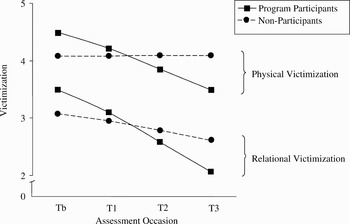
The trajectories of physical and relational victimization for program participants and nonparticipants; Tb, baseline; T1, T2, T3, Times 1–3, respectively.

According to parent reports at baseline, 65% of children lived in a two-parent household. Mothers' education ranged from eighth grade to university graduate-level education, with the average level being some college or technical training beyond high school. Thirty-two percent of children lived in a household with an annual income under $30,000 (range = <$8,500 to >$50,000/year). Children represented a range of ethnicities: 73% European Caucasian, 9% Southeast and East Asian, 4% South Asian, 7% Aboriginal, and 5% other (e.g., Hispanic, Caribbean). Two percent did not report. For 73% of the children, English was the only language spoken at home.
Procedure
Evaluation packages were sent to all parents of first grade children in participating schools informing them of the study and seeking consent for participation. Eleven schools were implementing the WITS program while six served as comparison schools. Consent rate for different schools ranged between 47% and 91% (overall 64%). Children who did not speak English and children with language difficulties (e.g., because of autism) were not included. Parents who granted consent completed a demographic questionnaire as well as several other questionnaires that are not reported here. Teachers completed questionnaires rating a broad range of child problems, including measures of aggression and emotional dysregulation. Children completed questionnaires reporting their experiences of victimization and their interpersonal negotiation strategies (not used in the current analyses) in small class groups (n = 5–20). All questions were read out loud, and one research assistant sat between pairs of children to monitor their placement of responses and answer questions.
WITS Intervention
This school-based approach engages teachers, parents, and school-based police liaisons in helping schools create environments where it is normative to get adult help by reporting peer victimization. The WITS actions (walk away, ignore, talk it out, and seek help) are not intended as social skills children should try in isolation, but are rather intended to create a common language that connects victimized children with adults who can help them. By making dealing with and reporting victimization normative, adults work to both discourage bullying interactions and to scaffold nonassertive and reduce aggressive behaviors of victims that make them vulnerable. Walking away and ignoring is encouraged as first steps to disengaging from a bully–victim relationship and for getting adult support to end the bullying. Visits from community-based police liaisons are used to affirm children's right to feel safe at school. Outreach to parents included WITS resource pamphlets and trinkets (e.g., refrigerator magnets) with WITS messages that children take home. Teachers' implementation of the program is supported by classroom activities and curricula that are based on publicly available books. The curricula are also integrated into the British Columbia language arts and social responsibility curriculum guidelines (see the WITS manual at http://www.youth.society.uvic.ca).
Levels of program implementation, which are assessed in the spring of each year, showed that all schools had police involvement in initiating the program and principal endorsement of the program. The majority of teachers in each program school endorsed the program and reported using books from the WITS booklist, recognizing a student for using his or her WITS to solve a conflict, used WITS class activities, displayed WITS projects and posters in their class, and had a class visit by the school police liaison (for details, see Leadbeater et al., Reference Leadbeater, Hoglund and Woods2003).
Measures
Peer victimization was measured from self-reported episodes of relational and physical victimization on the Social Experiences Questionnaire (Crick & Grotpeter, Reference Crick and Grotpeter1995). Children were told “Here is a list of things that sometimes happen to kids your age at school” and asked “How often do they happen to you?” Two practice items were used to help children understand the response scale, followed by 10 items that were read out loud. The 5 relational victimization items tap experiences of social exclusion and friendship restriction (e.g., “other kids leave you out on purpose,” “other kids say they won't like you unless you do what they want you to do,” “other kids keep other students from liking you”). The 5 physical victimization items assess incidents of physical harm and threats of harm (e.g., “get hit by another student,” “other kids kick you or pull your hair,” “other kids say they will beat you up”). Items were rated on a 3-point scale depicted pictorially to help younger children understand the scaling ( = never, □ = sometimes,
 = almost all the time). This was adapted from the original 5-point scale to reduce the difficulty for this young age group. Victimization scores were summed. Physical and relational victimization were strongly correlated at each time point (rs = .56–.72); however, they are modeled separately to allow for different trajectories over time as well as different longitudinal associations with physical aggression and emotional dysregulation.
Physical aggression and emotional dysregulation were assessed from teacher reports on the Early School Behavior Rating Scale (Caldwell & Pianta, Reference Caldwell and Pianta1991) at each time point. The teacher version included 40 items that assess a variety of problematic behavioral (e.g., aggression, inattentiveness), emotional (e.g., crying, temper tantrums), and social (e.g., not adhering to rules, uncooperative with peers and adults) indicators. Items were rated on a 4-point scale (1 = hardly ever, 4 = almost always). We selected the items that best represented the constructs of physical aggression and emotional dysregulation. For physical aggression, we selected three items that reflected clear physically aggressive behaviors in early childhood: “destroys other children's property,” “fights with other children,” and “kicks other children.” For emotional dysregulation, we choose four items: two that indicate a low threshold for activating experiences of emotion “is easily upset by failures,” and “feelings easily hurt, oversensitive” and two indicative of difficulty modulating the expression of emotion: “cries easily,” “has temper tantrums.” These items were selected to tap key aspects of emotional dysregulation (Gross & Thompson, Reference Gross, Thompson and Gross2007) and to reflect the content of other, established measures of emotion regulation (e.g., Shields & Cicchetti, Reference Shields and Cicchetti1997).Footnote 1 Symptoms of social anxiety, depression, withdrawal, loneliness, shyness, and asocial tendencies that were not exclusively characteristic of physical aggression or emotional dysregulation were excluded from our analysis.
Because we were interested in adjustment problems that are evident at school, only teacher reports of aggression and emotional dysregulation were used in this study. Teacher and parent reports of aggression and emotional dysregulation were low to moderately correlated at each time point (e.g., aggression: rs = .31–.43; emotional dysregulation: rs = .15–.28). Combined parent–teacher scores may be more reliable indicators of these constructs; they were not used because parent-reported data were available for only 80% of children at Time 1, 75% of children at Time 2, and 70% of children at Time 3. Although peer judgments of aggression and emotional dysregulation may be more proximal predictors of the link between these problems and peer victimization, they could not be collected because of logistical and ethical concerns of our school district.
Attrition for child- and teacher-reported data was minimal across the three years and four waves of data collection. Comparison of children who dropped out of the study (n = 47; 10.9%) with children who remained at the final assessment point (n = 385) on baseline demographic variables indicated that children who dropped out had higher socioeconomic status risks; that is, compared to children who remained in the study, children who dropped out experienced more family socioeconomic status risks (means = 1.68 vs. 0.79, range = 0–4) and attended schools with more low-income students (means = 13.98% vs. 11.62%, range = 3%–24%).
Statistical procedures
Multilevel equations were specified at three levels to account for the nested data structure (measurement occasion nested within student nested within school). The Level 1 model (Equation 1) fits an individual slope for each person where victimization for child i on four separate measurement occasions j (baseline, fall of Grade 1; spring of Grade 1, 8 months from baseline; spring of Grade 2, 1 year and 8 months from baseline; and spring of Grade 3, 2 years and 8 months from baseline) is a function of the child's victimization at baseline (π0i), plus a slope parameter (π1i) reflecting individual rate of linear change in victimization across time, plus an error term (σij) reflecting within-person residual variance about the child's best fitting slope. Centering time at zero (to reflect baseline assessment) results in π0i being interpreted as child i's expected score at baseline. Relative to a standard generalized linear modeling model, which assumes no individual differences and estimates a single regression equation for all individuals, Equation 1 estimates both fixed effects (average person intercepts and slopes) and random effects (person-specific variability across measurement occasion).

The Level 2 model treats the Level 1 intercepts and slopes as dependent measures in order to estimate between-person variance in these within-person parameters. Equation 2, individual intercepts (π0i) derived from Equation 1 are modeled as a function of average victimization at baseline (β00), plus a random effect (ɛ0i) to estimate between-person differences in initial levels of victimization. Equation 3 models each individual's predicted rate of victimization across the 2-year and 8-month period (π1i) as a function of the population average rate of victimization per additional year of measurement (β10), plus individual variability (ɛ1i) estimating between-person differences in rate of victimization.


The Level 3 model treats the Level 2 intercepts and slopes as dependent measures in order to estimate between-school effects in the between-person parameters. For Equation 4, individual intercepts (β00i) derived from Equation 2 are modeled as a function of average school-level rates of victimization at baseline (γ000), plus a random effect (u 00i) to estimate between-school differences in initial levels of victimization. Equation 5 models each individual's predicted rate of victimization across the 2-year and 8-month period (β10i) as a function of the school population average rate of victimization per additional year of measurement (γ100), plus a school variability random effect (u 10i) estimating between-school differences in rates of victimization.


The models described by Equations 1–5 are used to address our first aim of characterizing the longitudinal trajectories of victimization. In this study, the time-based models described in Equations 1–5 were extended in two ways. First, to identify intraindividual covariates of victimization, we constructed a time-varying covariation model by including physical aggression and emotional dysregulation as additional time-varying covariates in the Level 1 model. The Level 1 model for this analysis (Equation 6) differs from the model depicted in Equation 1 in that we postulate that in addition to changes in victimization because of time, victimization also changes as a function of changes in a child's aggression and emotional dysregulation. In other words, the model assumes that victimization at any given time depends upon (a) the amount of time since baseline, (b) the child's contemporaneous physical aggression, (c) the child's contemporaneous emotional dysregulation, and (d) person-specific and school-specific residuals. The slope parameter (β1i) in this model reflects an individual rate of linear change in victimization across time controlling for physical aggression and emotional dysregulation, whereas the slope parameters (β2i and β3i) assess whether higher (or lower) aggression or emotional dysregulation on specific occasions are linked to higher (or lower) victimization scores independent of linear changes in victimization across time. As with previous models, time was modeled as years since baseline. Aggression and emotional dysregulation were centered at zero, to reflect rates of victimization when aggression and emotional dysregulation are not present. Time-varying covariation between Level 1 variables indicates that scores on these variables “travel together” over time.

In order to achieve our third aim to identify individual and context differences that moderate victimization trajectories, we extend the basic model by adding candidate moderator variables (age, sex, and program participation) in the Level 2 and 3 models (Equations 7–10). These models evaluate whether variance in the Level 1 intercepts and slopes (i.e., individual differences in initial status or time-based rates of change in victimization) is conditioned by these between-person (Equations 7 and 8) and between-school (Equations 9 and 10) factors




HLM 6.06 software (Raudenbush, Bryk, & Congdon, Reference Raudenbush, Bryk and Congdon2004) was used to fit these equations separately to the physical or relational victimization data, and standard errors were estimated using full information maximum likelihood.Footnote 2 Where variance terms were not reliable, they were trimmed from the model (Snijders & Bosker, Reference Snijders and Bosker1999).
Results
Descriptive data
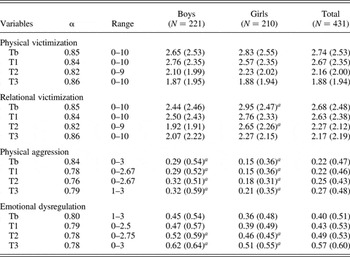
Psychometric data and mean levels of the physical and relational victimization, physical aggression, and emotional dysregulation at each time point are presented in Table 1.
Psychometric properties and mean levels (standard deviations) of peer victimization, aggression, and emotional dysregulation for girls and boys

Note: Tb, baseline, fall of Grade 1; T1, Time 1, spring of Grade 1; T2, Time 2, spring of Grade 2; T3, Time 3, spring of Grade 3.
aMean levels differ significantly (p < .05) between girls and boys.
Time-based trajectories of physical and relational victimization
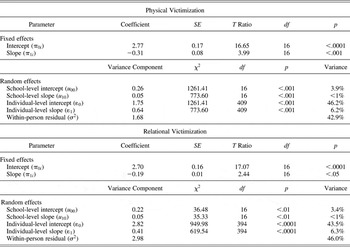
To establish the basic time-based trajectories of physical and relational victimization over time, the inferential test of the Equation 3 fixed effect addressed whether victimization scores change significantly over the early elementary school years. Table 2 summarizes results from these initial models. The negative slope coefficients for time (β10) reflect significant declines in both physical (β = −0.31, p < .001) and relational (β = −0.19, p < .05) victimization over time. In terms of baseline victimization, this represents an average decline of 11% (0.31/2.77) in physical and 7% (0.19/2.70) in relational victimization for each additional year from baseline. Over the course of Grades 1 to 3, the average levels of physical and relational victimization declined by 31% (11% × 2.75 years) and 19% (7% × 2.75 years), respectively. Notably, the random slope effect in the level 2 (ɛ1) and level 3 (u 10) models were significant, indicating reliable between-person and between-school differences about the average victimization slope.
Time-based models: Fixed and random victimization effects as a function of time in study

Separate variance components were used to calculate the proportion of total variance in victimization that was associated with between-school, between-person, and within-person sources. As shown in Table 2, school-level differences accounted for a relatively small proportion (4%–5%) of overall variance in victimization, whereas between-person differences accounted for an additional 50%–52%. The remaining 43%–46% of variance in victimization was because of within-person sources. To summarize, trajectories of victimization decreased over time and there was evidence to suggest that these declining trajectories were related to both within- and between-person sources of variation.
Time-varying covariation models
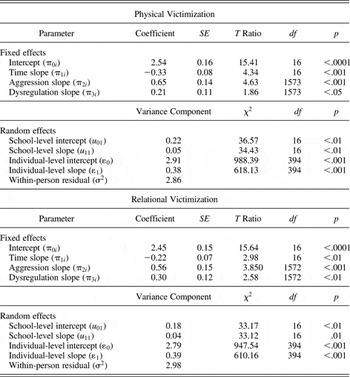
To identify potential developmental covariates of within-child victimization trajectories, we tested a model that included individual differences in physical aggression and emotional dysregulation as concurrent predictors. The inferential tests of the fixed effects associated with parameter estimates in Equation 6 (reported in Table 3) assess whether the average longitudinal trajectories for aggression and emotional dysregulation covary with the longitudinal trajectories for physical and relational victimization. Consistent with our directional hypotheses, we employed one-tailed probability tests. The significant negative slope coefficients for time reflect significant declines in both physical (β = −0.33, p < .001) and relational (β = −0.22, p < .01) victimization over time, independent of the effects of aggression and emotional dysregulation. The slope parameters for aggression were significant for both physical (β = 0.65, p < .001) and relational (β = 0.56, p < .001) victimization. Relative to baseline measures of victimization, for every one point increase in aggression (e.g., from hardly ever to sometimes), there were corresponding increases of 26% (0.65/2.54) and 23% (0.56/2.45) in physical and relational victimization that were independent of the time-based decreases in victimization. The net effect of physical aggression over Grades 1 to 3 nearly doubled physical and relational victimization scores relative to children who were not physically aggressive. The slope parameters for emotional dysregulation were also significant for both physical (β = 0.21, p < .05) and relational (β = 0.30, p < .01) victimization. For every unit increase in emotional dysregulation (e.g., from hardly ever to sometimes), there were corresponding increases in physical and relational victimization of 8% (0.21/2.54) and 12% (0.30/2.45), respectively. The net effect of emotional dysregulation over Grades 1 to 3 was an attenuation of typical decreases in physical victimization scores (dysregulated children decreased three times more slowly than more regulated children) and relational victimization increased by a factor of 1.5 among children who were relatively more emotionally dysregulated compared to children who demonstrated fewer emotional problems.
Time-varying covariation models: Fixed and random victimization effects as a function of time in study, aggression, and emotional dysregulation

Note: The tests of fixed effects are one tailed.
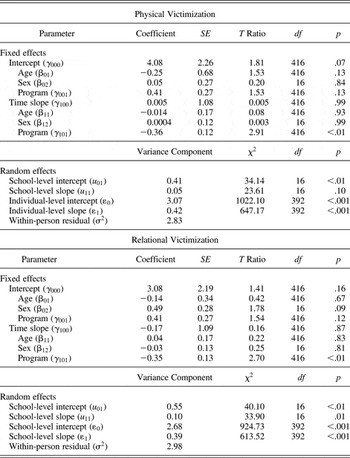
Moderator models
To identify between-person and between-context moderators in victimization trajectories, we included age at entry into Grade 1, sex, and participation in the WITS victimization prevention program in the Level 2 and 3 models (see Equations 7–10). The Level 1 model for these analyses was as Equation 1. Age at entry into Grade 1 was centered at the sample mean of 6.35 years, and sex and program participation were dummy coded (boys and nonparticipants = 0, girls and program participants = 1). These variables were modeled simultaneously to consider unique contributions of each predictor controlling for the influence of the others.
The results of this analysis are reported in Table 4. Intercept tests of group differences for sex, age, and program participation indicated no significant differences in physical or relational victimization at school entry. The slope coefficient for time was nonsignificant, indicating that victimization scores for boys who were 6.35 years of age at school entry and who did not participate in the WITS program did not decline over the course of the study. Holding the other predictors constant, age at school entry, and sex did not significantly impact trajectories of peer victimization during early elementary school years. The test of WITS program participation, however, indicated that, holding the other predictors constant, victimization scores for program participants declined significantly faster than nonparticipants. Accordingly, an average child who participated in the WITS program exhibited a 24% ([0.005 + −0.36]/4.08 × 2.75) decline in physical and 46% ([−0.17 + −0.35]/3.08 × 2.75) decline in relational victimization between baseline and the end of Grade 3 (Figure 1).
Moderator models: Fixed and random effects of between-person and between-school moderators of victimization trajectories

To determine if age at entry to Grade 1, sex, and WITS program participation also moderated the time-varying covariation between victimization and aggression and emotional dysregulation, a combined time-varying covariation and moderator analysis was conducted. The Level 1 model for this analysis was the same as Equation 6. The Level 2 and 3 models were as Equations 7–10. Results from this analysis were substantially equivalent to those already reported. That is, age at entry into Grade 1 and sex were not significant moderators for any of the Level 1 predictors; however, WITS program participation was a significant moderator of the time-based trajectories, but not for changes in aggression or emotional dysregulation.
Discussion
The findings of this study strongly indicate that child and context characteristics affect the continuity of physical and relational victimization in early elementary school. Because of the similar findings for relational and physical victimization, they are discussed together. In this study, both types of victimization declined from Grade 1 to 3. In contrast to the decline in victimization experienced by children in this study, children who were physically aggressive at school (as rated by teachers) showed net increases in victimization over time. Furthermore, children who were emotionally dysregulated at school showed markedly attenuated declines in physical victimization and increases in relational victimization. Despite higher mean levels of physical aggression and emotional dysregulation in boys, sex differences did not moderate the rate of decline in victimization. In addition, the decline in victimization was not moderated by age at entry into Grade 1. Finally, whereas children involved in the WITS program showed declines in both relational and physical victimization, nonparticipants showed stable levels of victimization.
Child characteristics as longitudinal covariates
The considerable victimization literature suggests many potential mechanisms that link children's aggression to their continued victimization (Hanish et al., Reference Hanish, Eisenberg, Fabes, Spinrad, Ryan and Schmidt2004; Ladd, Reference Ladd2006; Schwartz, Reference Schwartz2000). Whereas some aggression is used by preschoolers alongside prosocial behaviors to establish status or dominance (Hawley, Reference Hawley2002), children who do not decrease their aggression engage disciplinary actions of school authorities and frequently become victimized or rejected by their peers who fear they will hurt them or get them into trouble (Ladd, Reference Ladd2006; Leadbeater & Hoglund, Reference Leadbeater and Hoglund2009). Victims' reactive or retaliatory aggression may sustain the bully–victim relationship (Schwartz, Reference Schwartz2000; Venestra et al., 2007). Early behavioral interventions to specifically assist these children to manage their aggressive behaviors show promise in prevent the spiraling problems connected to cycles of aggression and victimization (Weisz & Kazdin, Reference Weisz and Kazdin2010).
In this study, emotional dysregulation also contributed to victimization even after controlling for the effects of aggression. A short-term longitudinal study with preschool children (Miller et al., Reference Miller, Gouley, Seifer, Zakriski, Eguia and Vergnani2005) demonstrated that, although displays of observed dysregulation were relatively brief, about one-quarter of children showed high levels of dysregulation, and individual differences in dysregulated behavior predicted teacher-rated peer conflict. Similarly, findings of the current study suggest that higher levels of emotional dysregulation on any occasion are associated with higher levels of victimization. Some children show emotional dysregulation because they are more frequently teased for being “babyish” and are provoked by other children, or because they attribute hostile intent to peers and react aggressively (Yeung & Leadbeater, Reference Yeung and Leadbeater2007). The school context creates the need to modulate aggression and emotions in order to learn, follow changing schedules, obey class rules, and form friendships. Children who have not been successful in these activities by Grade 1 may need individual and sometimes professional and sustained assistance to learn strategies for managing aggression and emotional responses.
Moderators of victimization trajectories
Findings showed expected sex differences in physical aggression and of emotional dysregulation, with boys exhibiting higher mean levels of aggression at each grade and higher dysregulation in Grades 2 and 3. Boys and girls reported similar levels of physical victimization, but girls reported higher levels of relational victimization on two of the four measurement occasions. Despite these differences, sex did not moderate the associations between victimization and any of our predictor variables (time, physical aggression, and emotional dysregulation). This suggests that although boys may display more aggression and emotional dysregulation, the role of these two factors in sustaining victimization are similar for both boys and girls. This suggestion is consistent with many studies that show sex differences in mean levels of risks or vulnerabilities, but similarities in the pathways leading from risks to psychopathology (e.g., Leadbeater, Kuperminc, Blatt, & Hertzog, Reference Leadbeater, Kuperminc, Blatt and Herzog1999). There is little evidence of sex differences in coping with emotional distress, but one observational study (Kyratzis, Reference Kyratzis2001) suggests that, even in preschool, boys may develop norms that associate emotions like crying easily and fearfulness with female characteristics and then tease other boys who fail to mask these emotions. Research is needed to assess factors affecting the trajectories of children's efforts to mask frustration, whining, anger, and so forth.
Young age at entry into Grade 1 also did not moderate the decline of physical or relational victimization over time, suggesting that age differences in victimization may be trumped by actual behaviors and experiences in classrooms. Furthermore, the narrow range of age differences may have attenuated moderating effects. Differences in size in relation to age may be more salient to the bully–victim relationships (Janssen, Craig, Boyce, & Picket, Reference Janssen, Craig, Boyce and Pickett2004).
Our findings showed that being in a school with the WITS victimization prevention program was the primary factor associated with declines in physical and relational victimization. The findings of the current study concur with previous studies showing the effects of this program on victimization (Leadbeater et al., Reference Leadbeater, Hoglund and Woods2003; Leadbeater & Hoglund, Reference Leadbeater and Hoglund2006). In variable centered analyses of changes in mean differences over time, children in program schools initially reported slightly more victimization than children in control schools. This was attributed to the encouragement they receive to “seek help.” In the current study, once sex, age, and school level factors were accounted for, no program differences were observed at baseline.
It is somewhat surprising that the program did not moderate the time-varying impact of physical aggression and emotional dysregulation on victimization; however, such time-varying models are computationally intensive with the statistical power required to assess moderators of the covarying relations between victimization, aggression, and emotional dysregulation somewhat limited in the present study. In contrast, it may be that child characteristics that impact on experiences of victimization are not changed by intervention; that is, aggression and emotional dysregulation are associated with peer victimization whether or not schools participate in a prevention program. More research is needed on the specific consequences of changes in classroom contexts and school climate on bullying and victimization.
Implications for interventions to prevent victimization
In attempting to keep schools safe, aggressive behaviors in children who are victimized may be dealt with harshly by school authorities who restrict these children's activities or suspend or expel them from school. Yet, repeated aggressive behaviors in young children may reflect their unsuccessful attempts to stop their victimization by peers. If these coping efforts are accompanied by expressions of frustration and anger such as temper tantrums, crying, whining, and other manifestations of emotional dysregulation, children are more likely to increase rather than decrease their vulnerability. Punitive adult responses that do not deal with the peer victimization may add to children's problems by pointing them out as deviant or targets for bullies, increasing the likelihood of peer rejection or isolating them from conventional friendships. Previous findings with this sample also suggest that some aggressive–victimized children, particularly boys, go on to show high levels of internalizing problems, perhaps again as a result of their perceived hopelessness of their efforts to stop the victimization as they are engaged in the cycle of aggression and victimization (Leadbeater & Hoglund, Reference Leadbeater and Hoglund2009). There are many programs that are effective in enhancing children's social skills (see review by Miller, Brehm, & Whitehouse, Reference Miller, Brehm and Whitehouse1998), although these do not always serve to reduce bullying and victimization (Smith, Schneider, Smith, & Ananiadou, Reference Smith, Schneider, Smith and Ananiadou2004). It is possible that emotion- and behavior-specific approaches are needed to increase children's competence in managing behaviors that can evoke bullying and to reduce the cycling of aggression and victimization that can result from ineffective strategies for managing peer conflict. Aggression and emotional dysregulation prolong the bullying interaction; walking away and ignoring the bullying may be effective because they create physical distance from the situation and promote help seeking. Moreover, programs that encourage children to stop and think before they act may help insert a protective pause between experiences of victimization and children's responses to them (Giesbrecht, Müller, & Miller, Reference Giesbrecht, Müller, Miller, Sokol, Müller, Young, Iarocci and Carpendale2010). For children who become chronic victims, adult intervention is essential to their safety and protection at school.
Study Limitations
The similarity of findings for physical and relational victimization in this study suggest that, at least for this age group, the two types of victimization are very similar. Nevertheless, shared method variance may have also inflated the similarities between physical and relational victimization. Moreover, using self-report questionnaires to assess very young children's experiences of victimization may test the upper limits of their understanding, particularly for relational victimization. However, past research supports the assessment of physical and relational victimization using the Social Experiences Questionnaire in young children (Crick et al., Reference Crick, Ostrov, Burr, Cullerton-Sen, Jansen-Yeh and Ralston2006; Desjardin, Yeung, Sukhawathanakul, MacDonald, & Leadbeater, Reference Desjardins, Yeung, Sukhawathanakaul, MacDonald and Leadbeater2009) and gives stronger support for the use of self-reports of victimization with very young children compared to peer-report measures (Ladd & Kochenderfer-Ladd, Reference Ladd and Kochenderfer-Ladd2002). We are encouraged in our belief that victimization can be assessed in our young sample by the invariance in item factor loadings and moderate stability in victimization across four waves of data (see Leadbeater & Hoglund, Reference Leadbeater and Hoglund2009).
Teacher ratings of physical aggression also yield only one source of ratings for children's maladjustment, although scores were moderately correlated with parent ratings. Our data are also limited in assessing teacher reports of physical but not relational aggression. The role of relational aggression in sustaining victimization is not known; however, it frequently co-occurs with physical aggression, and it is possible that it contributes to both children's victimization and to the social status of the aggressor (Card et al., Reference Card, Stucky, Sawalani and Little2008). In addition, relationally aggressive children frequently codisplay competent behaviors that may obscure their aggression from school staff (Hawley, Reference Hawley2002), increasing the need to support victimized children who seek help.
Our large longitudinal data set provides a unique opportunity to assess developmental issues related to peer victimization; moreover, the design of the present study itself is a definitive strength (with up to four measurement occasions per child). Despite these strengths, however, there are limitations to the time-varying covariation analysis:
1. These Level 1 variables are measured concurrently, which raises the problem of reciprocal causation: it is possible that increases in peer victimization are responsible for increases in aggression and emotional dysregulation.
2. Assessment of such longitudinal covariation models are computationally intensive and could benefit from additional occasions of measurement.
Future research could address these issues by linking each year's victimization outcomes to prior aggression and emotional dysregulation scores (e.g., dual change score model; McArdle, Reference McArdle, Cudeck, Toit and Sorbom2001) and by including additional data points during times when changes in victimization, aggression, and emotional dysregulation are most likely (e.g., soon after entry to each new grade).
Conclusion
The present investigation demonstrates that both child and context characteristics are important for understanding changes in experiences of physical and relational victimization during the early elementary school years. By demonstrating that physical aggression and emotional dysregulation are important longitudinal covariates of victimization, this study also signals the need to understand how interventions aimed at reducing aggression and dysregulation may influence children's experiences of victimization. This study also demonstrates the benefit of changes in the school-level context for reducing levels of relational and physical victimization during the early elementary school years, which is a period of rapid social, emotional, cognitive, and personality development during which intervention and prevention programs may have considerable impact on interrupting peer victimization before it becomes chronic.