Introduction
There is a growing awareness that issues such as climate change, food and energy price instability, population growth and changing dietary preferences will have a profound impact on the capacity of the global food system to meet human nutrition needs in the future. Although there is widespread recognition that food systems must evolve in the face of these critical sustainability challenges (Ostry and Morrison, Reference Ostry and Morrison2010; Foley et al., Reference Foley, Ramankutty, Brauman, Cassidy, Gerber and Johnston2011; Neff et al., Reference Neff2011; Kastner et al., Reference Kastner2012; Wheeler and von Braun, Reference Wheeler and von Braun2013), a polarized, global-versus-local debate over how to do so has emerged among scientists, policy-makers, activists and the private sector.
Local food systems are characterized by increased food self-reliance, defined generally as the ability to satisfy food needs with food grown locally. Proponents ascribe many potential advantages to local food systems, including social benefits (Halweil, Reference Halweil2002; Connell et al., Reference Connell, Smithers and Joseph2008; Arfini et al., Reference Arfini, Mancini, Donati, Arfini, Mancini and Donati2012), reducing negative environmental impacts associated with bringing food from farm to plate (Horrigan et al., Reference Horrigan, Lawrence and Walker2002; Ikerd, Reference Ikerd, Bertschinger and Anderson2004), improving community health, nutrition, and food safety (Enshayan et al., Reference Enshayan, Wilhelm and Clancy2004; Meehan et al., Reference Meehan, Yeh and Spark2008; Matt et al., Reference Matt2013; Harvard T.H. Chan School of Public Health—Center for Health and the Global Environment, 2015) and strengthening economies (Feenstra, Reference Feenstra1999; Conner et al., Reference Conner, Knudson, Hamm and Peterson2008; Hughes et al., Reference Hughes2008; Mullinix et al., Reference Mullinix, Dorward, Shutzbank, Krishnan, Ageson and Fallick2013). Numerous grassroots and non-governmental organizations advocate for the emergence of local food systems (Fairholm, Reference Fairholm1998; Greenberg and Andrews, Reference Greenberg and Andrews2013). Others, however, argue that the local food system movement has not yet succeeded in addressing structural and economic food system injustices, particularly those related to race and class (Passidomo, Reference Passidomo2013). Some point to evidence that reducing ‘food miles’ by sourcing food locally does not always reduce greenhouse gas emissions or contribute positively to climate change solutions (Milà i Canals et al., Reference Milà i Canals2007; Weber and Matthews, Reference Weber and Matthews2008; Coley et al., Reference Coley, Howard and Winter2009; Pelletier et al., Reference Pelletier2011). They also discredit the argument that locally produced foods have universally greater nutritional value or are otherwise superior in quality (Edwards-Jones et al., Reference Edwards-Jones, Milà i Canals, Hounsome, Truninger, Koerber, Hounsome, Cross, York, Hospido, Plassmann, Harris, Edwards, Day, Tomos, Cowell and Jones2008; Edwards-Jones, Reference Edwards-Jones2010). Some contend that a globalized food system, based on the trade of foods produced in areas with competitive advantages in terms of capital, energy, and/or labor, will be better able to facilitate a sustainable food supply in the future (Desrochers and Shimizu, Reference Desrochers and Shimizu2012).
This global versus local debate is robust in British Columbia, Canada (BC), where, in 2011, a small but diverse agriculture sector produced over 200 primary agricultural products and generated over US$2.6 billion in farm cash receipts on less than 3% of the province's land base (Government of British Columbia—Ministry of Agriculture Statistics and Research, 2013). BC's top agricultural commodities in terms of sales include dairy, chicken, floriculture products, beef, nursery products, greenhouse tomato, blueberry, greenhouse pepper, egg and mushroom. This province is one of Canada's leading fruit and berry producers (Government of British Columbia—Ministry of Agriculture Statistics and Research, 2013). Many BC residents, motivated by purported ecological, economic and social benefits, seek to source their food closer to home (Smith and MacKinnon, Reference Smith and MacKinnon2007; Hild, Reference Hild2009; Mustel Group Market Research, 2011; Fortin, Reference Fortin2014; McAllister, Reference McAllister2014). Provincial food security experts have identified increasing food self-reliance as a key climate change adaptation strategy (Lee et al., Reference Lee2010; BC Food Systems Network, 2012) and argue that increasing local fruit and vegetable production capacity ‘makes sense in a future where produce from California (the main source of fruit and vegetable imports to BC) may not be as available as it is at present nor at prices as low as they are at present’ (Ostry et al., Reference Ostry, Miewald and Beveridge2011). Furthermore, an increasing number of municipal governments in the province are introducing policies supportive of food system localization (Feeney et al., Reference Feeney, Sussmann and Kilford2014). However, in contrast to public interest and local policy momentum, the provincial Ministry of Agriculture's policy and programming largely supports a commoditized, export-oriented model of agriculture (Wittman and Barbolet, Reference Wittman, Barbolet, Desmarais, Wiebe and Wittman2011).
Underlying this debate, however, is a lack of understanding of how much capacity BC has to meet the food needs of its residents. Two previous studies measured BC's food self-reliance at the provincial scale (Government of British Columbia—Ministry of Agriculture and Lands, 2006; Ostry and Morrison, Reference Ostry and Morrison2010), but neither utilized newer methodologies for calculating food self-reliance such as discounting the production of any single crop that exceeds consumption of that crop and accounting for the effect of seasonality of production on the capacity to meet food need (Peters et al., Reference Peters, Wilkins and Fick2007; Morrison et al., Reference Morrison, Nelson and Ostry2011; Galzki et al., Reference Galzki, Mulla and Peters2015; Griffin et al., Reference Griffin, Conrad, Peters, Ridberg and Parry Tyler2014). Furthermore, these studies used different assumptions and methodologies and therefore their results differ substantially from one another. In particular, one (Ostry and Morrison, Reference Ostry and Morrison2010) assessed food self-reliance for a diet that satisfies standard nutrition recommendations while the other (Peters et al., Reference Peters, Wilkins and Fick2007) assessed food self-reliance for a diet that only satisfies the food preferences of the population. One (Government of British Columbia—Ministry of Agriculture and Lands, 2006) defined food self-reliance in livestock products as including only those livestock that could have been raised with local feed while the other (Ostry and Morrison, Reference Ostry and Morrison2010) used a definition that allowed for livestock feed imports from outside the region. Given that livestock production requires extensive land resource to grow feed (Soret and Sabate, Reference Soret and Sabate2014), this methodological difference could result in substantially different estimations of food self-reliance status and thus merits comparison. Inconsistencies such as these are evident throughout the food self-reliance literature (Giombolini et al., Reference Giombolini2010;Griffin et al., Reference Griffin, Conrad, Peters, Ridberg and Parry Tyler2014; Horst and Gaolach, Reference Horst and Gaolach2015), and the use of more systematic methods for assessing food self-reliance has been called for (Horst and Gaolach, Reference Horst and Gaolach2015).
Calculations of regional food self-reliance are enormously dependent on the scale and other attributes of the ‘region’ assessed. For example a region with a high food production to population density ratio is likely to have higher food self-reliance than one with a low ratio. Calculations that include population centers such as cities therefore generally benefit from a more expansive delineation of a ‘region’. In two previous assessments of self-reliance in BC the region was defined as the province and included large expanses of land with low density populations far from the major cities in the province (Government of British Columbia—Ministry of Agriculture and Lands, 2006; Ostry and Morrison, Reference Ostry and Morrison2010). Other studies elsewhere have measured food self-reliance at various scales including municipal (Colasanti and Hamm, Reference Colasanti and Hamm2010), regional (Giombolini et al., Reference Giombolini2010; Galzki et al., Reference Galzki, Mulla and Peters2015), multi-state (Griffin et al., Reference Griffin, Conrad, Peters, Ridberg and Parry Tyler2014) and national (Van Bers and Robinson, Reference Van Bers and Robinson1994). There seems to be no agreement as to what scale is preferable (Horst and Gaolach, Reference Horst and Gaolach2015). Indeed, the scale most appropriate to the study of food self-reliance might be considered as contentious as the concept of food self-reliance itself.
It has been argued that bioregions, defined as areas that share similar topography, plant and animal life, and human culture, are an appropriate scale for the development of sustainable food systems (Hutchinson and Hutchinson, Reference Hutchinson and Hutchinson1996; Harris et al., Reference Harris2014). Their delineation is largely based on eco-regions but incorporates human settlement and activity patterns and can take political boundaries into consideration. Implicit to the concept of bioregionalism are the core themes of resilience, sustainability and food security as well as aligning the human economy with the environmental capacity of place (Harris et al., Reference Harris2014). As such we deemed this scale appropriate for an assessment of food self-reliance and chose the Southwest BC bioregion (SWBC), as delineated by Harris et al. (Reference Harris2014), as our case study bioregion.
An assessment of food self-reliance is pertinent in SWBC given public interest and local policy momentum around the issue that is evident there. In 2014, for example, a series of food system dialogues were held across SWBC (Fortin, Reference Fortin2014). When asked to rank a series of eight priorities which related to the economic, environmental and social sustainability of SWBC's food system, participants at five out of six events identified increasing SWBC food self-reliance as their number one priority (Fortin, Reference Fortin2014). In addition, many SWBC municipalities have incorporated actions that support the development of a local food system into their municipal plans and policies (Feeney et al., Reference Feeney, Sussmann and Kilford2014) and numerous social sector organizations in SWBC advocate for and support food system re-localization (e.g., Farm Folk/City Folk, Society Promoting Environmental Conservation, Surrey/White Rock Food Action Coalition, the Whistler Centre for Sustainability, and others).
Given public interest, academic focus and local policy momentum regarding the issue of food self-reliance in SWBC, and the inconsistencies evident in previous food self-reliance research, further assessment of the food self-reliance status in this region is warranted. This motivated our research objectives, which were to:
-
1. Develop a method to evaluate land-based food self-reliance for a diet satisfying nutritional recommendations and food preferences that accounts for seasonality of crop production and allows for a comparison of outcomes when food self-reliance is defined as including livestock raised with local feed to that defined as including livestock raised with imported feed.
-
2. Apply this method to SWBC as a case study assessment of current food self-reliance status.
SWBC case study area
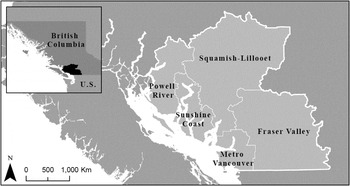
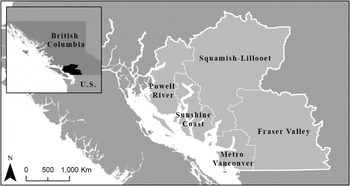
Harris et al. (Reference Harris2014) used a method that incorporated population centers and regional district boundaries, terrestrial and marine eco-regions, and regional watershed boundaries to delineate the bioregion of SWBC as a 41,380 km2 area in the southwest mainland corner of the province of BC, Canada. The area comprises five Regional Districts: Metro Vancouver (also known as Greater Vancouver), Fraser Valley, Sunshine Coast, Powell River and Squamish-Lillooet (Fig. 1) (Harris et al., Reference Harris2014).
Province of British Columbia (left) and the Southwest British Columbia bioregion with Regional District boundaries indicated (right).
The area is both an agricultural and urban center. Metro Vancouver alone is home to more than half of BC's total population (almost 2.7 million in 2011), and is one of the fastest growing metropolitan areas in Canada (Statistics Canada, 2014). The majority of agricultural land in SWBC is protected by the Agricultural Land Reserve (ALR), a provincially legislated zone in which agriculture is recognized as the priority use, farming is encouraged and non-agricultural uses are controlled (Government of British Columbia—Provincial Agricultural Land Commission, 2013a). In 2011, SWBC had almost 1500 km2 of ALR land (Government of British Columbia—Provincial Agricultural Land Commission, 2013b).
SWBC is part of the Pacific Maritime Eco-zone, with some of Canada's warmest and wettest weather and relatively little variation in monthly temperatures (Ecological Stratification Working Group, 1995). Its valleys receive as little as 290 mm of precipitation and up to 220 frost free days while mountainous areas receive up to 3000 mm of precipitation and as few as 100 frost free days (Ecological Stratification Working Group, 1995). Agricultural soils are primarily gleysols, regosols and brunisols (Government of Canada—Agriculture and Agri-Food Canada, 2009). Soil saturation is problematic in low-lying deltaic areas, but with proper drainage these soils are considered prime agricultural land (Government of British Columbia—Ministry of Agriculture and Food and Government of British Columbia—Ministry of Environment, 1983; Government of Canada—Agriculture and Agri-Food Canada, 2009).
SWBC is a major center for the production of dairy, egg, turkey and broiler chicken, all of which are supply-managed commodities. The supply management system ensures that supply meets Canadian demand, and that farmers receive prices that cover their costs of production. Production targets for the supply managed commodities are set by national marketing agencies (Canadian Dairy Commission, Egg Farmers of Canada, Turkey Farmers of Canada, and Chicken Farmers of Canada, respectively) and are allocated to the provinces based on their share of total national demand. Within BC, the license to produce and market a supply-managed commodity is issued to farmers by provincial marketing boards (BC Dairy Association, BC Egg, BC Turkey Marketing Board and BC Chicken Marketing Board, respectively). SWBC is also a major producer of cranberry, blueberry, raspberry and various other horticultural crops. The production and sale of greenhouse vegetables, processing vegetables and storage crops is regulated by the BC Vegetable Marketing Commission.
Methods
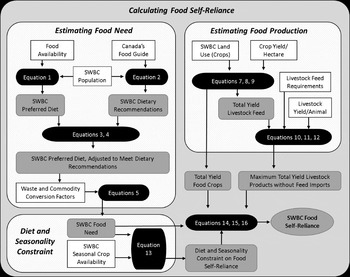
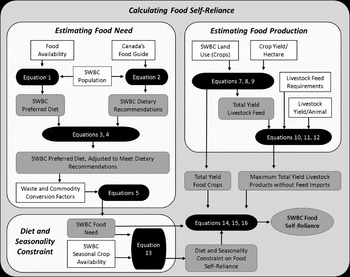
Food self-reliance is determined by food need, agricultural land use, food crop and livestock production, and a diet and seasonality constraint (Fig. 2). The methods we used to estimate these parameters are described below. Unless otherwise specified, all data were from 2011 (the year of the most recent Canadian Census of Agriculture).
Generalized schematic of method used to assess food self-reliance in this study. White boxes represent input data, grey boxes represent calculated datasets and black bubbles (which refer to equations explained in the section Methods) represent operations performed on the data.
Food need
‘Food Need’ was defined as the quantity of food required to meet dietary recommendations in a manner aligned with the ‘Preferred Diet’ (what the population is actually eating). The Preferred Diet was estimated using the Canadian Food Availability dataset (Statistics Canada, 2011b). This dataset is developed by subtracting exports, manufacturing, waste, and year-end stocks from total national food supply, and distinguishes between quantities of food consumed in fresh form (e.g., apples) and in processed form (e.g., apple sauce) (Statistics Canada—Agriculture Division, 2007). It has previously been used as a proxy for the average diet of BCs (Government of British Columbia—Ministry of Agriculture and Lands, 2006) and studies pertaining to other countries have used similar national datasets in comparable ways (Wirsenius et al., Reference Wirsenius, Azar and Berndes2010; Conner et al., Reference Conner, Becot, Hoffer, Kahler, Sawyer and Berlin2013). We assumed the dataset to be a reasonable representation of the Preferred Diet of SWBC residents. Dietary recommendations were ascertained from Canada's Food Guide (CFG), which specifies the number of ‘Servings’ from five ‘Food Groups’ (Fruits and Vegetables, Grains, Milk and Alternatives, Meat and Alternatives, and Oils and Fat) that should be consumed daily by each of nine demographic groups delineated by age and gender (Health Canada, 2011). A Serving is a unit specific to CFG, the specific mass or volume of which varies by food type.
The method developed by Kantor (Reference Kantor1998) was used to estimate Food Need based on the Preferred Diet dataset and CFG dietary recommendations. First, the per capita quantity of food in the Preferred Diet was scaled to SWBC using:
 $${\rm P}{{\rm d}_f} = P \times {\rm C}{{\rm a}_f}$$
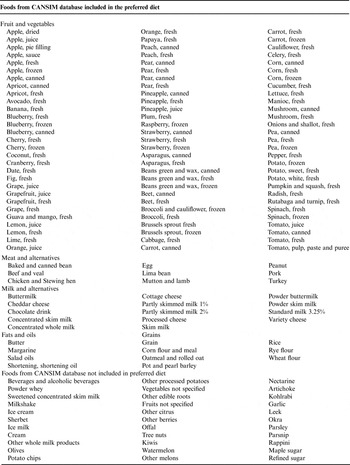
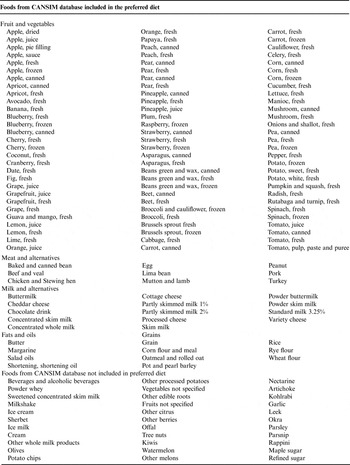
where f denotes an individual food, f = 1,…143; Pd f denotes the quantity (kilograms) of food f in the Preferred Diet; P denotes the SWBC population; and Ca f denotes the quantity (kilograms) of food f available per capita as identified in the Canadian availability dataset. All foods in the dataset, with the exception of those not in CFG, those reported as aggregate categories not comparable with agricultural production data, and those for which 2011 agricultural production data were not available, were included (Appendix 1). Note that, although fish and seafood was included to adjust the Preferred Diet to meet dietary recommendations, the remainder of the study, including food self-reliance assessment, focuses on the land-based components of the diet only.
Secondly, the servings required per Food Group to satisfy annual CFG recommendations for SWBC's population and the Servings per Food Group in the Preferred Diet were calculated using Equations (2) and (3).
 $${S_g} = \mathop \sum \limits_{all{\rm \;} a} {P_a} \times {S_{ag}} \times 365$$
where g denotes a CFG Food Group, g = 1, … 5; a denotes a CFG demographic group, a = 1…9; S g denotes the annual quantity (Servings) from Food Group g required to meet CFG recommendations for the SWBC population; P a denotes the SWBC population of age/gender group a (Statistics Canada, 2014); and S ag denotes the quantity (Servings) from Food Group g required daily to meet CFG recommendations for an individual in age/gender group a (Health Canada, 2011). Those aged 0–2 were not included as there are no CFG recommendations for this demographic, which comprised only about 3% of SWBC's total population in the study year (Statistics Canada, 2014). Further, given that many children continue to be breast-fed until at least age 2, we assume that some of the caloric requirements of this demographic are accounted for in the food intake recommendations for adult females.
 $${\rm SP}{{\rm d}_g} = \; \mathop \sum \limits_{\,f \in g\;} \left( {{\rm P}{{\rm d}_f} \times \left( {\displaystyle{Q \over S}} \right)_f^{ - 1}} \right)$$
where SPd g denotes the quantity (Servings) of Food Group g in the Preferred Diet and (Q/S) f denotes the quantity (grams or milliliters) per Serving of food f (Health Canada, 2002). The CFG does not specify the quantity of egg (a function of egg size) in a Serving, so an average (Q/S) f of all egg sizes was used (Health Canada, 2002).
For those Food Groups where Servings in the Preferred Diet were less than the number required to meet CFGs recommendations, we increased Preferred Diet food quantities proportionally such that they cumulatively satisfied CFG recommendations, and then converted to tonnes using:
 $${\rm Ad}_f = \left(\displaystyle{\left({\rm P d}_f \times \left(\displaystyle{Q \over S} \right)_f^{ - 1} \right) \over {\rm SP d}_g} \times {\rm S}{\rm R}_g \right) \times \left(\displaystyle{\left(\displaystyle{Q \over S} \right)_f \over 1,000,000} \right)$$
where Ad f denotes the quantity (tonnes) of food f in the Preferred Diet, adjusted to meet CFG recommendations. For those Food Groups where Servings in the Preferred Diet were greater than or equal to the number required to meet CFGs recommendations, no adjustment was made.
Finally, to derive total Food Need, we accounted for food waste at the institutional, retail and household levels and converted waste-adjusted food quantities to their equivalent fresh or commodity weight (e.g., apple sauce to fresh apples) using:
 $${N_f} = {\rm A}{{\rm d}_f} \times {W_f} \times {C_f}$$
where N f denotes the need (tonnes commodity weight) for food f in the bioregion; W f denotes the waste factor for food f (Statistics Canada, 2011b), and C f denotes the commodity conversion factor for food f (United States Department of Agriculture Economic Research Service, 1992; Health Canada, 2002). For commodities consumed fresh, the commodity conversion factor is 1. We assumed that shortening, margarine and salad oils were made with oil from Canola (Brassica napus) as it is a commonly used type of cooking oil from a species that can be grown in SWBC.
Agricultural land use
We retrieved 2011 agricultural land use data from the 2011 Census of Agriculture, which reports the quantity of farmland used for food production and other purposes (Statistics Canada, 2011a). We assumed that the following Census of Agriculture land use categories comprised the total land used for the production of food crops and livestock products: hay, field crops, vegetables, fruits, berries, nuts, greenhouse vegetables, mushrooms, tame or seeded pasture, natural land for pasture, summer fallow and barnyards. With the exception of ‘barnyards’ (livestock housing), these data were retrieved at the Census Consolidated Subdivision (CCS) scale, which is defined as an area of at least 25 km2 and/or having a population of at least 100,000 (Statistics Canada, 2013b). CCSs are rarely subject to boundary changes and are therefore useful for longitudinal data analysis (Statistics Canada, 2013b). As the area allocated to ‘barnyards’ is included in an aggregated Census of Agriculture category (‘all other land’), we estimated it with additional data sources using:
 $${\rm Ba} = \mathop \sum \limits_{all\; s} \mathop \sum \limits_{all\; j} {\rm B}{{\rm a}_j} \times {H_{\,js}}\; $$
where j denotes a specific livestock type (j = beef cattle, dairy cattle, lambs, hogs, broilers, turkeys, or layers); s denotes a CCS in SWBC; H js denotes the number of livestock j in CCS s; Ba j denotes barn area (hectares) required for housing livestock j (Canadian Agri-Food Research Council, 2003a; Canadian Agri-Food Research Council, 2003b; National Farm Animal Care Council and Dairy Farmers of Canada, 2009; National Farm Animal Care Council and Canadian Sheep Federation, 2013); and Ba denotes the total barn area (hectares) in SWBC.
Quantity of food crops produced
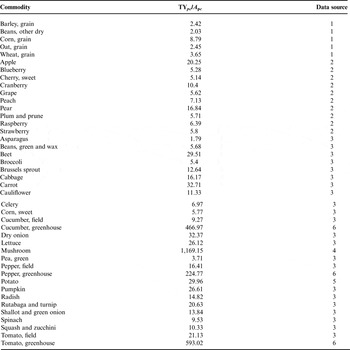
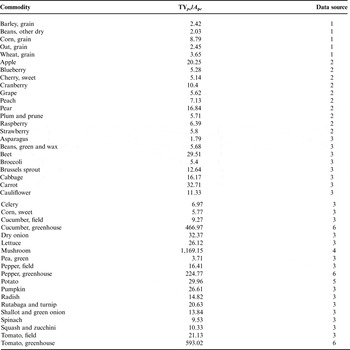
We assumed that food crops produced in SWBC first satisfied fresh Food Need (e.g., apples), then processed Food Need (e.g., apple sauce). We estimated the quantity (tonnes) of food crops produced in SWBC in 2011 using regionally specific data whenever possible, and Canadian data secondarily (Appendix 2). Data did not distinguish between alternative farming methods but rather represent the average of all contemporary farming methods used in SWBC for each crop. For vegetable, fruit and agronomic crops, we used:
 $${\rm T}{{\rm P}_{rc}} = \displaystyle{{{\rm T}{{\rm P}_{\,pc}}} \over {{A_{\,pc}}}} \times \; {A_{rc}}\; \; \; \; {\rm for}\; c \in v\; $$
where c denotes an individual crop food commodity; v denotes the subset of those commodities that are vegetable, fruit, or agronomic crops; TP rc denotes the total SWBC production (tonnes) of commodity c; TP pc denotes the total provincial production (tonnes) of commodity c (Statistics Canada, 2013a); A pc denotes the provincial area (hectares) planted in commodity c (Statistics Canada, 2013a); and A rc denotes the SWBC area (hectares) planted to commodity c (Statistics Canada, 2011a); 2011 data for mushrooms were not available so we used a 5 year (2002–2007) average. The preponderance of BC's tree fruit is grown in the semi-arid, south-central portion of the province, where temperatures and insolation levels are particularly favorable to fruit production and greater than in SWBC. However, as SWBC-specific data is not available, a 25% reduction in TP pc /A pc for tree fruit was applied based on consultation with a regional pomologist (K Mullinix, personal communication, January 14, 2014) to account for likely regional reduction in production potential. Based on BC Ministry of Agriculture factsheets we assumed 100% of the barley and oats grown in the region to be consumed by livestock (Government of British Columbia—Ministry of Agriculture). As data regarding end-use of corn grain or wheat were not available, we assumed that 50% was used for livestock feed and 50% went to human consumption.
For greenhouse-grown crops we used:
 $${\rm T}{{\rm P}_{rc}} = \displaystyle{{{A_{rc}}} \over {{A_{\,pc}}}} \times {\rm T}{{\rm P}_{\,pc}}\; \; \; {\rm \; for}\; c \in g$$
where g denotes the subset of commodities that are greenhouse-grown (i.e., tomatoes, cucumbers and peppers). We added the estimated quantity of greenhouse-grown tomatoes, cucumbers and peppers produced in SWBC (respectively) to the estimated quantity of field-grown tomatoes, cucumbers and peppers produced in SWBC (described above) to arrive at an estimated total production of each vegetable type.
For canola seed we used:
 $${\rm T}{{\rm P}_{rc}} = \displaystyle{{{\rm T}{{\rm P}_{nc}}} \over {{A_{nc}}}} \times \; {A_{rc}}\; \times \displaystyle{O \over S}\; \; \; {\rm for}\; c = o$$
where o denotes the specific commodity canola seed; TP nc denotes the total national production (tonnes) of commodity c (Statistics Canada, 2013a); A n denotes the national area (hectares) planted in commodity c; A rc denotes the SWBC area (hectares) planted in commodity c (Statistics Canada, 2011a); and O/S denotes the national canola oil yield (tonnes oil produced/tonnes seed crushed) (Statistics Canada, 2013a).
Quantity of livestock products produced
For comparison, we assessed livestock production according to two definitions of food self-reliance. In the first, we defined food self-reliance as including livestock raised with imported feed. In the second, we defined food self-reliance as including livestock raised with locally produced feed only.
To assess food self-reliance defined as including livestock raised with imported feed, we considered livestock products from all livestock present in SWBC in 2011 as contributing to SWBC's food self-reliance. For egg, chicken and turkey we retrieved 2010 production data from the Census of Agriculture (Statistics Canada, 2011a). For pork, beef and lamb we retrieved 2011 BC slaughter data for each livestock type (Statistics Canada, 2013a) and to determine SWBC production based on these values we assumed that the proportion of total BC slaughter that occurred in SWBC was equal to the proportion of total BC livestock of that type that were in SWBC, and multiplied the number of slaughtered animals by the quantity of product produced per animal (Statistics Canada, 2011a). Similarly for dairy, we retrieved 2011 BC milk sales data (Statistics Canada, 2013a) and assumed that the portion of total BC milk sales that occurred in SWBC was equal to the proportion of total BC milking cows that were in SWBC (Statistics Canada, 2011a).
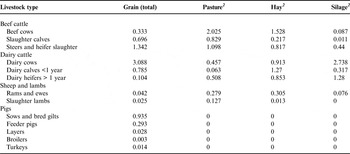
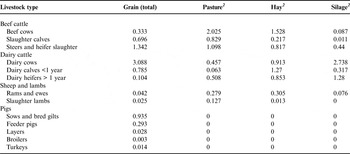
To assess food self-reliance defined as including livestock raised with local feed only, the livestock products that we considered to contribute to the region's food self-reliance were only those that could have been produced from animals pastured in and/or fed feed grown in SWBC. Using this method, rather than quantifying production based on the number of animals that were actually present in SWBC in 2011, we developed an optimization model to estimate the hypothetical maximum number of livestock that could have been raised if no livestock feed was imported. Model inputs were the hectares of pasture and livestock feed grown in SWBC and the feed requirements and production by livestock type. To be consistent with the method used to estimate food crop production, input data were representative of dominant contemporary livestock production practices and feeding regimes of the study area. Alternative livestock management systems such as pasture-based systems were not modeled as they are not widely used in SWBC at present (O Schmidt, personal communication, June 23, 2014). Feed requirement data were sourced from Statistics Canada (Statistics Canada—Agriculture Division, 2003) and validated by a regional livestock production expert (P Gumprich, personal communication, May 8, 2014) (Appendix 3). Model outputs were the optimal number of each livestock type that should be raised in SWBC in order to maximize self-reliance in livestock products and the resulting feed and pasture use and quantity of livestock products produced.
The optimization model was created in Microsoft Excel (Microsoft Corporation, 2014) and solved using OpenSolver (Mason, Reference Mason, Klatte, Lüthi and Schmedders2012). The model's objective function was to maximize total production of livestock products using only regionally produced livestock feed and pasture (Equation 10) and decision variables were the number of head of beef cattle, dairy cattle, lamb, hog, broiler chicken (broiler), turkey and layer hen (layer) that should be raised in the study area in order to do so (H jr ).
 $${\rm Maximize}\; \mathop \sum \limits_{c \in l} {\rm T}{{\rm Y}_{rc}} = \; \mathop \sum \limits_{all\; l} \left( {{H_{\,jr}} \times \displaystyle{{l/{H_j}_j} \over {{W_c}}}} \right)$$
where l denotes the subset of commodities that are livestock products (l = beef, dairy products, lamb, pork, chicken, turkey, or egg). Where j denotes a specific livestock type (j = beef cattle, dairy cattle, lamb, hog, broiler, turkey, or layer), H jr denotes the head of livestock j that are raised in SWBC and pastured locally and/or fed locally grown feed only, and l/H j denotes the quantity (tonnes) of commodity c produced by livestock type j (Statistics Canada, 2013a).
Given our objective to determine the maximum quantity of livestock products that could be produced using only bioregionally available pasture and feed, we defined two optimization model constraints. The first was that total livestock feed and pasture allocated to livestock in SWBC cannot exceed the quantity that was available in 2011 (Equation 11). The second was that total production of any one livestock product cannot exceed the SWBC population's Total Need for that product in 2011 (Equation 12).
 $$\mathop \sum \limits_{all\; j} \left( {{H_{\,jr}} \times {R_{\,jd}}} \right) \le \displaystyle{{{\rm T}{{\rm P}_{\,pd}}} \over {{A_{\,pd}}}} \times \; {A_{rd}}\; $$
where d denotes a livestock feed crop (d = grain, meal and silage; hay; pasture); R jd denotes the annual quantity (tonnes/head/year) of feed crop d required by livestock type j. R jd was estimated using the method developed by Cowell and Parkinson (Reference Cowell and Parkinson2003) and includes the feed requirements of the animal from birth to slaughter (for pig, beef cow, broiler chicken and turkey) or from birth through 1 year of production (for layer hens and dairy cattle), and for maintaining breeding livestock during that time period (Statistics Canada—Agriculture Division, 2003) (Appendix 3). TP pd denotes the total provincial production (tonnes) of livestock feed d (Statistics Canada, 2011a; O Schmidt, personal communication, June 23, 2014; J Hatfield, personal communication, June 24, 2014); A pd denotes the provincial area (hectares) planted in livestock feed d (Statistics Canada, 2011a); and A rd denotes the SWBC area (hectares) planted in livestock feed d (Statistics Canada, 2011a).
 $${\rm T}{{\rm Y}_{rc}}\; \le {N_f}\; \; \; {\rm for}\; c \in l$$
Diet and seasonality constraint on food self-reliance
Given our objective to assess food self-reliance in a diet that meets dietary recommendations in a manner aligned with food preferences, we assumed that no substitution between foods occurs (e.g., Food Need for tropical and citrus fruit cannot be satisfied by locally producible fruits) and that fresh fruits and vegetables are consumed at a constant rate year round (e.g., fresh strawberries are consumed during winter in the same quantities as during summer). Given these assumptions, there is an upper ceiling on the level of food self-reliance possible in SWBC because Food Need for foods that cannot be grown in SWBC and for foods consumed fresh out-of-season can only be satisfied by imports. We termed this upper ceiling the ‘diet and seasonality constraint on food self-reliance’ and it was calculated using:
 $${\rm DS}{{\rm C}_f} = \displaystyle{{{N_f}} \over {12}} \times {\rm M}{{\rm o}_f}$$
where DSC f denotes the diet and seasonality constraint on food self-reliance for food f (tonnes); N f /12 denotes the monthly need (tonnes) of food f in fresh form (Appendix 1); and Mo f denotes the number of months that food f is available fresh within SWBC (FarmFolk CityFolk, 2012). This constraint represents a ceiling on the portion of total Food Need that could ever be satisfied by SWBC production, regardless of how much food is actually produced in SWBC in a given year. In keeping with the definition of Food Need as the quantity of food required to meet dietary recommendations in a manner aligned with the Preferred Diet, any SWBC production in excess of this ceiling is not considered to contribute to total food self-reliance as that amount was assumed to not be preferred by the population.
Food self-reliance
We calculated self-reliance for each food (SR f ) by counting the minimum of the two values: total SWBC production (TP rc ) or the diet and seasonality constraint on food self-reliance (DSC f ), using:
 $${\rm S}{{\rm R}_f} = \; \displaystyle{{{\rm min}({\rm DS}{{\rm C}_f},\; \,{\rm T}{{\rm P}_{rc}})} \over {{N_f}}} \times 100\% $$
To calculate food self-reliance for the total diet (SR) all foods in the diet were considered simultaneously, using:
 $${\rm SR} = \; \displaystyle{{\mathop \sum \nolimits_{all\; f} \min \left( {{\rm DS}{{\rm C}_f},\; {\rm T}{{\rm P}_{rc}}} \right)} \over {\mathop \sum \nolimits_{all\; f} {N_f}}} \times 100\% $$
To more explicitly reveal how the level of total dietary food self-reliance achieved in SWBC relates to satisfaction of nutrition recommendations, we also calculated food self-reliance by Food Group (SR g ). To do so, all foods belonging to one Food Group were considered simultaneously, using:
 $${\rm S}{{\rm R}_g} = \; \displaystyle{{\mathop \sum \nolimits_{all\; f \in g} \min \left( {{\rm DS}{{\rm C}_f},\; {\rm T}{{\rm P}_{rc}}} \right)} \over {\mathop \sum \nolimits_{all\; f \in g} {N_f}}} \times 100\% $$
Results and discussion
Food need
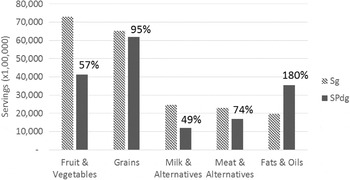
With a total population of approximately 2.69 million, SWBC is one of the Canada's most populous regions (Statistics Canada, 2014). For this population, servings of food in the Preferred Diet were found not to meet CFG recommendations in all food groups except for Fats and Oils (Fig. 3). The discrepancy was greatest in the Fruits and Vegetables and Milk and Alternatives Food Groups, for which Servings in the Preferred Diet were respectively 57 and 49% of those required to satisfy CFG recommendations. For the Grains Group, the Servings of food in the Preferred Diet were only slightly lower than the CFG recommendation. Servings of Fats and Oils in the Preferred Diet exceeded the number recommended by CFG.
Annual Servings per Food Group required to meet Canada's Food Guide recommendations for the Southwest British Columbia (SWBC) population in 2011 (S g ) and Servings per Food Group in the SWBC Preferred Diet in 2011 (SPd g ), including fish and seafood. Percentages indicate the percentage of Canada's Food Guide recommendations that are met by the Preferred Diet.
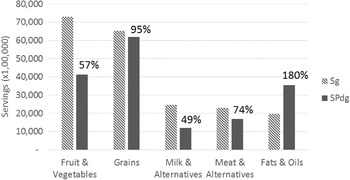
These findings are fairly consistent with a 2004 study of adult BC's food consumption patterns, which reports that the majority did not meet minimum recommendations for consumption of Fruits and Vegetables or Milk and Alternatives, while they did meet minimum recommendations for consumption of Grains (Government of British Columbia—Ministry of Health Services, 2004). While the same study reported that the majority of women did not meet recommended consumption levels for Meat and Alternatives but the majority of men did (Government of British Columbia—Ministry of Health Services, 2004), our results suggest that the total SWBC population under-consumes Meat and Alternatives by 26%. This difference between our analysis and that of the BC study could be as a result of the fact that some meat alternatives such as lentils, nuts and tofu, are either not tracked in the food availability dataset we used to estimate the Preferred Diet or could not be included in our analysis for reasons explained previously (see the section Methods).
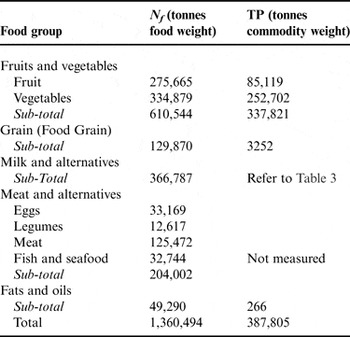
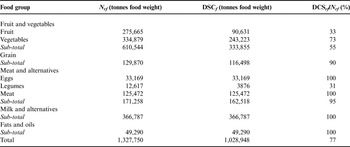
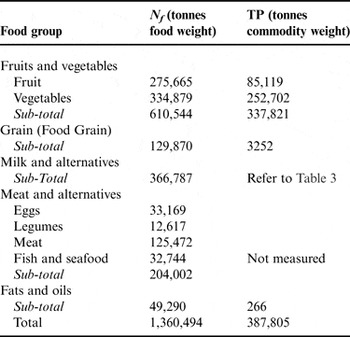
By adjusting the Preferred Diet to meet CFG recommendations, total Food Need for SWBC was estimated in tonnes food weight (Table 1).
Southwest British Columbia Food Need (N f ) and Total Production (TP) of crop commodities by Food Group, 2011.
Agricultural land use
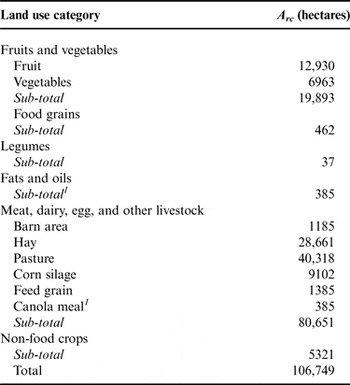
Actual agricultural land use in SWBC in 2011 was dominated by livestock feedstuff, with hay, pasture and corn silage together comprising 74% of total land use (78,466 hectares). Not reported in the available data is the type(s) of livestock this land supports, however it is likely that some is used for livestock not associated with food production (e.g., horses). The second most common use of agricultural land is for fruits and vegetables, which together make up 19% of total agricultural land use (19,893 hectares). The remaining 7% of the land is used for production of legumes, fats and oils, non-food crops and for sheltering livestock (Table 2).
Southwest British Columbia agricultural land use by land use category, 2011.
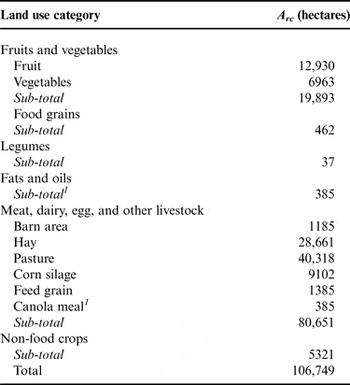
1 Canola seed produces both a food product (oil) and feed product (canola meal); therefore its acreage is included under both Fats and Oils and Livestock Fodder but only counted once in the grand total..
Quantity of food crops produced
SWBC food crop production is dominated by vegetables and fruit, which together comprise 87% of total food crop production by weight (Table 1). Berries [blueberry (Vaccinium corymbosum), cranberry (Vaccinium macrocarpon), raspberry (Rubus idaeus), and strawberry (Fragaria × ananassa)] comprised 96% of total fruit production in 2011 and greenhouse vegetables [cucumber (Cucumis sativus), bell pepper (Capsicum annuum), and tomato (Lycopersicum esculentum)] 42% of total vegetable production. This is consistent with SWBC's reputation as a provincial center for horticultural crop production characterized by substantial greenhouse and berry industries (Government of British Columbia—Ministry of Agriculture Statistics and Research, 2013).
Quantity of livestock products produced
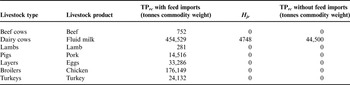
SWBC is recognized as being the heart of the provincial dairy, poultry and pork industries. 117,000 head of cattle (including 51,419 milking cows), 9400 sheep and lambs, 76,700 hogs and 118 million birds (broiler, layer and turkey) were present in SWBC in 2011 (Statistics Canada, 2011a). The levels of livestock production possible from these livestock inclusive of those raised with imported feed, is reported in Table 3.
Quantity of livestock commodities produced including livestock raised with imported feed (TP rc ) and number compared with results from livestock production optimization model including maximum number of livestock that could be raised if no feed was imported (H jr ), and corresponding maximum quantity of livestock commodity produced (TP rc without feed imports), southwest British Columbia, 2011.
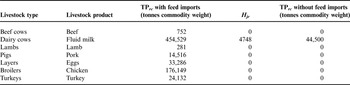
Results from the livestock production optimization model indicated that, if feed imports were not available and given SWBC's typical livestock production practices (per above), self-reliance in livestock products would be maximized by allocating all available local grain to dairy cows. In doing so, a maximum of 4748 milking cows, in addition to their breeding stock and replacement herd, could be supported by regionally produced livestock feed. Together, these cows could produce 44,500 tonnes of fluid milk (Table 3). At this level of production, all available feed grain would be utilized but over 40,000 hectares of hay and 28,000 hectares of pasture would not. As feed grain is the most limited feed crop produced in SWBC, it is the factor most limiting to both livestock production without feed imports, and pasture and hay utilization. We recognize that, in a scenario with no feed imports, more (and more diverse) livestock could be supported, and more hay and pasture utilized if more feed grain were produced locally. Additionally, more livestock could be supported than the optimization model suggests if alternative (e.g., pasture-based) livestock production practices were utilized in SWBC at present.
Comparing livestock production with and without imported feed reveals the degree to which SWBC's livestock operations are currently dependent on feed imports from other regions. In actuality, in the contemporary dominant production scenario, the use of ‘residual’ hay and pasture is enabled by the importation of feed grain to SWBC. This trend is not unique to SWBC but, rather, mirrors a global trend towards the decoupling of livestock production from a local land base or the integrated farming systems that support it (Naylor et al., Reference Naylor2005; Galloway et al., Reference Galloway, Burke, Bradford, Naylor, Falcon, Chapagain, Gaskell, McCullough, Mooney, Oleson, Steinfeld, Wassenaar and Smil2007). By the year 2000, for example, 72% of global poultry production and 55% of global pork production was sustained by feed imported from other regions (Galloway et al., Reference Galloway, Burke, Bradford, Naylor, Falcon, Chapagain, Gaskell, McCullough, Mooney, Oleson, Steinfeld, Wassenaar and Smil2007).
Diet and seasonality constraint on food self-reliance
The diet and seasonality constraint on food self-reliance was calculated per individual food type but is reported herein by Food Group (Table 4). Given these constraints, we calculated that the upper ceiling for food self-reliance for the total diet in SWBC is 77%, regardless of how much food is actually produced in SWBC. This is primarily due to the need to import preferred foods not able to be grown in the region (Table 4).
Total Food Need (N rf ), the diet and seasonality constraint on food self-reliance (DSC f ), and the hypothetical maximum portion of Total Food Need that can be satisfied by Southwest British Columbia food production (DCS rf /N rf ), by Food Group.
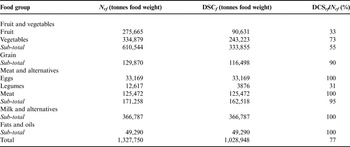
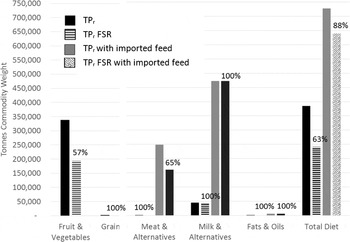
To determine how much of the food produced in SWBC contributes to SWBC's food self-reliance, total SWBC production was compared with the diet and seasonality constraint on food self-reliance for each crop or livestock product (Fig. 4). For the Total Diet, and for those Food Groups containing livestock products (Meat and Alternatives, Milk and Alternatives and Fats and Oils) we include results based on the number of livestock that were reported present in SWBC in 2011 and those based on the number of livestock that could have been raised on locally available feed and pasture only. Considering the livestock production possible using SWBC-produced grain and pasture, only 62% of total regional production of crop and livestock products could contribute to SWBC food self-reliance. The remaining 38% of food produced (comprised entirely of crops in the Fruit and Vegetable Food Group) are in excess of the diet and seasonality constraint on food self-reliance. In the Fruits and Vegetables food group, blueberries, cranberries, raspberries, mushrooms, Brussels sprouts, greenhouse cucumbers, greenhouse peppers, pumpkins and squash, and greenhouse tomatoes comprise the entirety of production in excess of the diet and seasonality constraint. The portion of SWBC-produced food that contributes to food self-reliance would increase to 88% if the definition of self-reliant food production were expanded to include livestock products that were produced using imported feed.
Comparison of Southwest British Columbia (SWBC) Total Production (TP r ) and amount of Total Production that contributes to SWBC food self-reliance (TP r FSR) in 2011, by Food Group and the Total Diet. For the Total Diet, and for those Food Groups containing livestock products (Meat and Alternatives, Milk and Alternatives, and Fats and Oils), results are presented from the analysis with and without feed imports. Percentages indicate the percent of Total Production that contributes to SWBC food self-reliance, by Food Group.
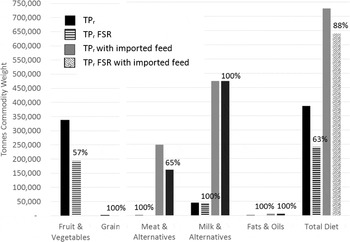
The values of Total Production that contribute to SWBC food self-reliance (TP r FSR) (Fig. 4) are specific to the foods included in this study and the Preferred Diet of this region, and would change if the diet was altered. For example, decreased consumption of tropical fruits would increase the diet and seasonality constraint for Fruits and Vegetables and corresponding level of potential food self-reliance. Without increasing the total area farmed in SWBC, self-reliance itself could be increased in SWBC if the discrepancy between Total Production and the amount of Total Production that contributes to SWBC food self-reliance was reduced. This could be achieved if the population were to substitute consumption of processed foods grown in SWBC for those consumed fresh out of season, or to substitute consumption of fruits produced in SWBC for currently consumed tropical and citrus fruit. The Canadian Food Availability dataset used to estimate the Preferred Diet in this study indicates that per capita consumption of tropical and citrus fruit has increased by 18% over 1986 levels and the per capita consumption of fruits that can be grown in SWBC has increased by 25% since 1986 (Statistics Canada, 2011b).
Similarly, diversification of SWBC agricultural production away from crops produced in excess of the diet and seasonality constraint on food self-reliance (i.e., export commodities) could potentially facilitate an increase in food self-reliance without increasing total farmed area. However, this would be counter to current provincial trends in agricultural land use. From 1986 to 2006 field vegetable production in BC declined by 40%, greenhouse vegetable production increased by 437% and blueberry production increased by 245% (Ostry and Morrison, Reference Ostry and Morrison2010).
Food self-reliance
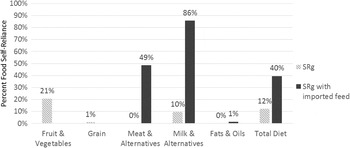
Total food self-reliance of SWBC in 2011 was calculated by Food Group and for the total diet. To illustrate the impact of the two alternative definitions of food self-reliance used in this study, results based on the number of livestock that were actually present in SWBC in 2011 are presented and compared with results based on the number of livestock that could have been raised exclusively on locally produced feed and pasture (Fig. 5). For the former, total dietary food self-reliance would be 40%, whereas for the latter (without feed imports), total dietary food self-reliance would be 12%.
Southwest British Columbia food self-reliance in 2011 by Food Group and the Total Diet (SR g ). For the Total Diet, and for those Food Groups containing livestock products (Meat and Alternatives, Milk and Alternatives, and Fats and Oils) results are presented from the analysis with and without feed imports.

Given that 100% food self-reliance was not achieved even with feed imports, it is important to assess self-reliance by Food Group to better understand how the level of total dietary food self-reliance achieved in this case relates to satisfaction of nutritional recommendations. With feed imports, self-reliance was highest in Milk and Alternatives (86%) followed by Meat and Alternatives (49%), but without feed imports, self-reliance in these Food Groups declined to 10 and 0%, respectively. This highlights that satisfaction of nutritional recommendations for these Food Groups is highly dependent on feed importation to SWBC.
For crop-based Food Groups, self-reliance was highest in Fruit and Vegetables (21%) followed by Grain (1%) and Fats and Oils (1%). This reflects the dominance of the horticulture sector in SWBC agriculture. Just as with animal production in SWBC, satisfaction of human nutrition recommendations for Grain relies nearly entirely on imports. Given SWBC's climate, which is more conducive to the cultivation of horticultural than agronomic crops, the likelihood of this changing significantly in the future is minimal.
Increasing SWBC's food self-reliance could potentially be achieved through shifts in production or in the preferred diet earlier mentioned, or by increasing total farmed area. Underutilization of agricultural land is an issue in SWBC (Mullinix et al., Reference Mullinix, Dorward, Shutzbank, Krishnan, Ageson and Fallick2013). In 2010/2011, for example, almost 18,000 hectares of agricultural land in Metro Vancouver (a regional district in SWBC), was classified as having potential for farming but not farmed (Government of British Columbia—Ministry of Agriculture, 2014). This comprised 25% of Metro Vancouver's total area of land protected for farming by the provincial ALR (Government of British Columbia—Ministry of Agriculture, 2014). Increased utilization of available agricultural land with the potential for farming could increase food self-reliance if production on it specifically targeted crops whose current production levels are lower than Food Need.
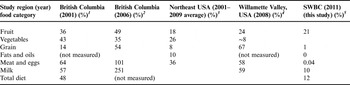
Results from two previous studies of food self-reliance in BC are summarized in Table 5. As described in the section Introduction, they used differing and now outdated methodologies and measured food self-reliance at a larger scale than in this study. A straightforward comparison of results is therefore not possible, but reasons behind some general trend differences can be surmised. Fruit and Vegetable self-reliance results from this study are lower than previous studies likely because the delineated SWBC bioregion does not include BC's major tree fruit producing region (the Okanagan) and because the previous studies do not discount production in excess of the diet and seasonality constraint on food self-reliance. Likewise, self-reliance in food grain and livestock products is higher in the 2001 study than in this study because SWBC does not include the province's major feed and food grain producing regions (the Peace River, Bulkley Nechako and Fraser Fort George Regional Districts). The 2006 study did not account for the production of feed to support provincial livestock; therefore their estimate of food self-reliance in livestock products and grains is high as all livestock present in the province in 2006 were counted and all grains produced in 2006 are considered to be for human consumption.
Comparison of Southwest British Columbia (SWBC) food self-reliance, as measured in this study, with that of other regions.
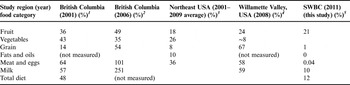
1 Government of British Columbia – Ministry of Agriculture and Lands (2006).
2 Ostry and Morrison (Reference Ostry and Morrison2010).
3 Griffin et al. (Reference Griffin, Conrad, Peters, Ridberg and Parry Tyler2014).
4 Giombolini et al. (Reference Giombolini2010).
5 Food self-reliance calculated based on the number of livestock that could have been raised on locally available feed and pasture only.
Comparison of this study's results to those from studies of other regions must also be done with caution due to discrepancies in scale of analysis and the methods used. Unlike this study's results, for example, analyses of the food self-reliance status of 13 states in the northeast USA and of western-Oregon's Willamette Valley found food self-reliance to be higher in livestock products than in plant-based foods (Giombolini et al., Reference Giombolini2010; Griffin et al., Reference Griffin, Conrad, Peters, Ridberg and Parry Tyler2014) (Table 5). Neither study considered the capacity of the study region to produce livestock without feed imports and nor did they discount production according to a diet and seasonality constraint.
Conclusion
In many regions in which the global versus local debate is playing out, there is a lack of sufficient information regarding current regional food self-reliance status (Pradhan et al., Reference Pradhan2014). Having identified this as a significant impediment to constructive discourse around the future of food systems it was our objective to develop a method for measuring current food self-reliance status and apply it to a case study region. Like other studies (Cowell and Parkinson, Reference Cowell and Parkinson2003; Government of British Columbia—Ministry of Agriculture and Lands, 2006; Colasanti and Hamm, Reference Colasanti and Hamm2010; Giombolini et al., Reference Giombolini2010; Griffin et al., Reference Griffin, Conrad, Peters, Ridberg and Parry Tyler2014) we measured the current food self-reliance status of a sub-national region according to current population, land use and a diet that satisfies nutritional recommendations. Where our methodology differs from that used in other studies was in its strict approach to the definition of food self-reliance that considers the diet and seasonality constraint on food self-reliance and its assessment and comparison of food self-reliance status with and without the availability of livestock feed imports.
This study revealed that the Preferred Diet of southwest BC falls substantially short of meeting nutritional recommendations for the consumption of foods in the Fruits and Vegetables and Milk and Alternatives Food Groups but nearly meets recommendations for the Grains and Meat and Alternatives Food Groups. Agricultural land use is dominated by livestock fodder production, followed by fruit and vegetable production, which together comprise the majority (93%) of crop food production in SWBC by area. SWBC production of feed grain was found to be a major constraint on self-reliance in livestock products; self-reliance in Meat and Alternatives is less than 1% and Milk and Alternatives is 10% if considering the availability of SWBC grown feed and pasture compared with 49 and 86%, respectively, if including livestock raised with imported feed. Total dietary self-reliance of SWBC is 12% if discounting livestock feed imports or 40% if including livestock raised with imported feed.
As anticipated, the food self-reliance assessment was greatly impacted by whether ‘local’ livestock production was defined as including or excluding livestock raised with imported feed. These findings support those of Galloway et al. (Reference Galloway, Burke, Bradford, Naylor, Falcon, Chapagain, Gaskell, McCullough, Mooney, Oleson, Steinfeld, Wassenaar and Smil2007), who argued that international trade of livestock feed allows feed importers to ‘escape what would otherwise be binding resource constraints’ on local production. For SWBC, defining ‘local’ livestock products as those produced only with locally grown feed paints a picture of a local food system that contrasts starkly with how the region is typically perceived (Table 3) and with how the livestock industries often characterize their sector; the BC Pork Producers’ Association, for example, brands BC pork under the slogan ‘proudly produced close to home’ (BC Pork Producers Association, 2015). Given the extensive availability of pasture in SWBC, an expanded analysis of livestock production that includes alternative, pasture-based livestock feeding regimes would likely reveal greater potential for production of livestock without feed imports than reported in this study. Such an assessment would further refine our understanding of food self-reliance capacity in this region.
Regardless of the feeding regime modeled, determining which definition of ‘local’ livestock production is best suited to SWBC, or any case study area, may ultimately depend on whether economic or environmental objectives are the priority of efforts to increase food self-reliance. The de-coupling of livestock production from the land base that supports it has drastically shifted global patterns of land and water use and the discharge of effluents such as nitrogen away from their balance in a non-trading system (Galloway et al., Reference Galloway, Burke, Bradford, Naylor, Falcon, Chapagain, Gaskell, McCullough, Mooney, Oleson, Steinfeld, Wassenaar and Smil2007). SWBC exemplifies this: the concentration of livestock operations in SWBC's Fraser Valley regional district, which is facilitated by the ability to import feed, is a source of ongoing environmental concern as it has been linked to nitrogen contamination of groundwater (Castle, Reference Castle1993). It may be however, that the continued importation of food and feed grains for livestock makes sense for SWBC from an economic perspective given its high population density, expensive and limited farmland, and climate more suitable to horticultural crop production. Comparing self-reliance measured according to these two definitions of ‘local’ livestock enables the evaluation of these environmental and economic trade-offs and represents a positive step towards reconciling those trade-offs in the design of a sustainable future food system. Finally, as establishing a food self-reliance baseline is important, it is only a first step in informing the discourse around what an alternate food system future might look like. Although many studies have measured current levels of food self-reliance at national, regional, or municipal scales, few have taken the next step of calculating the capacity to increase food self-reliance in the future, or what agricultural land use would look like in terms of crop mix and extent of production in a scenario of increased food self-reliance. In order to truly bring the local versus global debate out of the abstract, an understanding of current food self-reliance status must be complemented by an understanding of the capacity to increase future food self-reliance given population growth projections, dietary trends and bio-physical resources, and this should be the focus of future research.
Acknowledgements
This research was funded under the Southwest BC Bioregion Food System Design Project. In addition to project funders, the authors would like to recognize the efforts of Dr. Hannah Wittman (Associate Professor, Food Nutrition and Health, University of British Columbia) and Dr. Parthiphan Krishnan (Faculty Member, Faculty of Geography, Kwantlen Polytechnic University), who provided guidance and technical advice throughout this study, as well as Katie Robinson (Registered Dietician), who provided technical advice on the methodology used to estimate Food Need and assisted with associated data analysis, and Dr. Cornelia Sussmann (Institute for Sustainable Food Systems, Kwantlen Polytechnic University), who assisted regularly with data collection and interpretation.
Appendix
List of foods included and excluded from the preferred diet.
Total British Columbia yield (tonnes) divided by the total British Columbia area (hectares) planted in commodity c (TY pc /A pc ).