


1. Introduction
Coastal areas with high population densities and widespread poverty are experiencing increasing damage as a result of cyclones and storm surges (World Bank, 2013; IPCC, 2014). Coastal Bangladesh is one of the more exposed areas, susceptible to frequent and severe storms due to its unique geographical and geomorphological characteristics (Karim and Mimura, Reference Karim and Mimura2008; Dasgupta et al., Reference Dasgupta, Huq, Khan, Ahmed, Mukherjee, Khan and Pandey2014; IPCC, 2014). In such an unfavorable environment, it is becoming increasingly difficult for the government to support enough public initiatives to properly protect the vulnerable coastal communities (World Bank, 2013). Poor households in these areas are forced to undertake private defensive strategies to insulate themselves against the risk of damages from coastal storms. However, these private behavioral responses are likely to be influenced by public protection programs, such as public disaster relief and rehabilitation programs and publicly constructed protective barriers, dams and embankments, as well as the presence of any ‘natural barriers’ such as mangrove forests, in order to protect life and property. The purpose of the following paper is to explore how these factors influence the private defensive strategies of poor coastal households threatened by the risk of storm damage to their property.
Evidence suggests that individuals tend to place a low probability on the occurrence of a future natural disaster, even if it is considered to have high negative consequences (Kunreuther et al., Reference Kunreuther, Slovic and Olson2014; Kunreuther and Pauly, Reference Kunreuther and Pauly2015). Such lack of concern about impending natural disasters might inhibit investment in risk-reduction strategies (Grothman and Reuswigg, Reference Grothman and Reusswig2006; Kunreuther et al., Reference Kunreuther, Slovic and Olson2014). In addition, individuals tend not to insure themselves against natural disaster risks when they believe help will be available from outside sources, either via public-sponsored programs or private charities (Lewis and Nickerson, Reference Lewis and Nickerson1989; Browne and Hoyt, Reference Browne and Hoyt2000; Kunreuther and Pauly, Reference Kunreuther and Pauly2004). In this paper, we refer to such behavioral phenomenon as the crowding-out effect, where a household partially or fully reduces defensive expenditures because it is better protected by publicly constructed dams and embankments, or if it is aware of a likely rise in government spending on disaster relief or coastal rehabilitation programs after a storm event. Conversely, if a household increases defensive expenditures due to public programs, then this phenomenon is referred to as the crowding-in effect. In addition, since various studies show that mangroves are effective in protecting life and property in coastal areas due to their ability to attenuate the waves caused by storm surges (Alongi, Reference Alongi2008; Barbier et al., Reference Barbier, Koch, Silliman, Hacker, Wolanski, Primavera and Reed2008; Das and Vincent, Reference Das and Vincent2009; Spalding et al., Reference Spalding, Ruffo, Lacambra, Meliane, Hale, Shephard and Beck2014), households living in close proximity to mangroves might undertake more defensive actions in response to the perceived threat of a storm compared to households without such ‘natural barrier’ protection.
Given the possible influence of public programs and mangroves on private defensive strategies, we classify a household's defensive expenditures into two categories: (1) self-protection expenditures, and (2) self-insurance expenditures. Self-protection expenditures are actions that decrease the probability of a hazardous storm event occurring that inflicts property damages, whereas self-insurance expenditures are actions undertaken by the household to reduce its losses in the event of storm-inflicted damages. For coastal households in Bangladesh, examples of self-protection include converting a mud-built house to brick, raising the height of the homestead, moving the house inside an embankment, and locating further away from the shoreline to a safer place. Examples of self-insurance include income-source diversification, crop and plot diversification, private transfers in terms of remittances and charities, reciprocal gift exchanges, and inter- and intra-household income transfers (for informal risk sharing). Since these various self-protection and self-insurance expenditures can reduce the probability of a hazardous event and the severity of storm-inflicted damages, we propose a household model of private investment in storm protection under an endogenous risk framework. Under the model, the representative household chooses the level of self-protection and self-insurance against cyclone-induced storm surge damage. Although a similar framework has been employed to infer a household's value for health risk and property value changes due to pollution and other hazards (Berger et al., Reference Berger, Blomquist, Kenkel and Tolley1987; Shogren and Crocker, Reference Shogren and Crocker1991; Gayer et al., Reference Gayer, Hamilton and Viscusi2000; Kousky, Reference Kousky2010), our paper is the first to employ this approach in the context of a natural disaster risk faced by developing country households. This paper also examines the possible influence of exogenous factors such as public programs, and a natural protection barrier such as mangroves.
Results based on our theoretical analysis reveal that publicly constructed dams and embankments, as well as natural barriers such as mangroves tend to crowd-in private self-protection and crowd-out private self-insurance. On the other hand, government-sponsored disaster relief and rehabilitation programs that are introduced after any storm event tend to crowd-in private self-insurance but crowd-out private self-protection. We examined these influences empirically with a case study based on a survey of 500 households in southwest coastal Bangladesh that were affected by Cyclone Sidr in November 2007. Estimation results from our case study analysis reveal partial support for the crowding-in and crowding-out effects of public programs on private defensive expenditures. However, our results also show that a household protected by mangroves invests more in self-protection but less in self-insurance. Since insurance markets are non-existent in poverty-driven coastal communities like Bangladesh, we firmly believe that governments of low-income coastal nations should encourage more collective and individual participation in private storm-protection actions with their own public protection programs. If such public–private cooperation in disaster management is aligned with policies to encourage the conservation and restoration of mangroves and other storm-resistant trees, then market and government failures could be avoided through a reduction in ‘relief dependency’ and a more efficient allocation of resources.
The rest of the paper is organized as follows. Section 2 explains the household model of private investment on storm protection, while section 3 discusses the empirical and econometric estimations. Section 4 describes the process of data collection and offers a brief description of the study area. Section 5 reports the results and analyzes them. Section 6 outlines conclusions and policy recommendations.
2. The household model of private investment in storm protection
Assume that a representative rural household lives in a coastal area exposed to the threat of a severe cyclone-induced storm surge event that could inflict property loss. This storm surge risk has two characteristics: (1) the range of possible adverse consequences, and (2) the probability distribution across consequences. In this paper, we measure the adverse effects as monetary losses to property in terms of the damages to houses, trees, livestock and poultry, and agricultural crops. To keep the exposition simple, we assume that there is one adverse storm event. Since we are interested in the household's defensive actions when it is fully exposed to a storm surge event, we do not consider non-storm states.
We assume that a household's private spending on storm protection can influence its probability of experiencing a hazardous event that inflicts property damage through self-protection, whereas the severity of any damages resulting from the storm surge is reduced through self-insurance. For the sake of simplicity, the model does not consider any health-related impacts such as injury and loss of life as a result of the storm event.
The probability of a hazardous event inflicting damages on the property exposed to the storm for representative household i located in village j is
 $$\pi _{ij} (.) \equiv \pi _{ij} \lpar Z_{ij}; G_{ij}, M_{ij}, C_{ij} \rpar ,$$
where Z ij is the level of self-protection expenditures that decrease the probability of a hazardous event inflicting property damagesFootnote 1 ; G ij is government investment in nearby publicly constructed embankments or dams that reduce the probability that the household incurs flooding damages; M ij is a vector of characteristics capturing the role of mangroves as a natural storm-protection barrier, such as the area of the nearby mangrove forest, distance between the mangrove forest and the household, directional location of the household relative to the coast and the mangroves, etc.; and lastly, C ij is a vector of characteristics of a severe cyclone-induced storm surge, such as storm surge height and wind velocity, direction and distance of the cyclone path from the household location, etc.
When exposed to a storm, each household faces monetary losses. We can state this damage to property as
 $$L_{ij} = L_{ij} (A_{ij}; R_{ij}),$$
where A ij is the level of self-insurance expenditures that involve actions to reduce the severity of property damage, and R ij is government expenditures on public disaster relief and rehabilitation programs that are available to the household after the disaster occurs. We expect the severity or magnitude of the property losses to decrease if the household invests in self-insurance actions and has access to public assistance programs designed specifically to reduce the severity of the event.
The household is assumed to maximize a von Neumann–Morgenstern utility index over wealth (consumption). Considering the two possible states of nature, let
 $U_{ij}^{L} (.) \equiv U_{ij} (W_{1})$
denote the household utility when the household faces storm-inflicted monetary losses to property and
 $W_{1} \equiv (I_{ij} - A_{ij} -Z_{ij} - L_{ij} (.))$
is the net wealth considering the property loss. In W
1, a household's full income is represented by I
ij
, its level of self-protection expenditures by Z
ij
, and its level of self-insurance expenditures by A
ij
. On the other hand, let
 $U_{ij}^{NL} (.)\equiv U_{ij} (W_{2} )$
denote the household utility when it faces no storm damages and
 $W_{2} \equiv (I_{ij} - A_{ij} - Z_{ij})$
is the net wealth. Since we are dealing with two possible states of nature as a result of full exposure to a major storm, we suggest that storm-inflicted damages lower household utility since a household's exposure to a damaging storm event lowers its wealth (consumption) level. This could be interpreted as
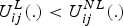 $U_{ij}^{L} (.) \lt U_{ij}^{NL} (.)$
. Furthermore, we assume that the utility functions are strictly increasing, concave, and twice continuously differentiable over wealth (consumption). Given these assumptions, the household maximization problem isFootnote
2
:
 $$\mathop{Max}\limits_{Z,A} E(U) = \lsqb \pi (Z;G,M,C) \cdot U(W_1)) + (1 - \pi (Z;G,M,C)) \cdot U(W_2) \rsqb $$
Expression (3) says that expected utility, which is to be maximized, is the sum of the utilities of facing damages and no damages, weighted by their respective probabilities. The first-order conditions with respect to the level of self-insurance and self-protection lead to:
 $$-\pi (.)\cdot U^{\prime} (W_1) \left[1 + {\partial L \over \partial A} \right] = U^{\prime} (W_2) \cdot \lsqb (1 - \pi (.)) \rsqb $$
 $$- {\partial \pi (.) \over \partial Z} \cdot \lsqb U(W_1) - U(W_2) \rsqb = \pi (.) \cdot U^{\prime} (W_1) + (1 - \pi (.)) \cdot U^{\prime} (W_2)$$
where U′(W 1) and U′(W 2) are the marginal utilities of wealth (consumption). Expression (4) reveals that a household could employ self-insurance to reduce the severity of storm surge damages up to the point where the expected marginal benefits of self-insurance, as defined by the net reduction in loss, equal expected marginal costs. Expression (4) indicates that a household could employ self-protection up to the point where the expected marginal benefits of self-protection, as defined by the decreased risk of a hazardous event inflicting storm damages weighted by the utility difference between the two states, equal expected marginal costs.
Appendix A, available online at http://dx.doi.org/10.1017/S1355770X16000164, shows the full solution to a household's maximization problem based on equation (4). We analyze four types of behavioral responses from the household to reduce the likelihood of the hazardous event and the severity of facing storm-induced damages to property: (a) both self-protection and self-insurance, i.e., the interior solution of the above model; (b) self-protection only, i.e., a corner solution; (c) self-insurance only, i.e., a corner solution; and (d) no self-protection and self-insurance. For the second-order sufficiency conditions associated with (3), the sign of the cross-partial derivatives with respect to self-protection and self-insurance expenditures cannot be determined, even if the household is considered to be averse to storm risks. We show later in this paper how imposing additional restrictions in determining the signs of these cross-partial derivatives plays a significant role in determining the key comparative static results.
2.1. Comparative static analysis of self-protection and self-insurance
A household's choice of self-protection and self-insurance to reduce storm-inflicted damage is influenced by its access to government protection programs as well as its proximity to mangroves. We examine these effects through comparative static analysis of the interior solution of the model. The full results are depicted in online appendix B and they show that determining how different public programs and proximity to mangroves impact a household's private defensive strategies depends on specific conditions. The results from the comparative static analysis reveal the following propositions.
Proposition 1
For a risk-averse household, government spending on publicly constructed embankments or dams G leads to crowding-in of self-protection Z, i.e.,
 ${\partial Z \over \partial G} \gt 0$
, but crowding-out of self-insurance A, i.e.,
 ${\partial A \over \partial G} \lt 0$
.
The proof of proposition 1 depends on the following two conditions, which are derived in online appendix B:
Condition 1
H AZ =H ZA <0. Self-protection and self-insurance are stochastic substitutes.Footnote 3 This implies that the marginal utility of self-protection, Z, decreases if more self-insurance, A, activities are taken by the household, and vice versa.
Condition 2
 ${\partial^2 \pi (.) \over \partial G\partial Z} \lt 0$
. An increase in government spending on nearby dams and embankments, G, accentuates the effect of self-protection, Z, in reducing the probability of facing storm-inflicted damages to property.
The validity of each of the conditions (assumptions) is based on the premise of how simultaneous occurrence of public provisions of public goods enhances or decreases the capacity of private storm-protection measures in terms of self-protection and self-insurance. For example, condition 2 implies that any self-protection action, such as moving the house inside an embankment or converting a mud-built house to a brick-built house, would be more effective in reducing the probability of facing storm-inflicted damages to property given that the government simultaneously invests in dams and embankments. Assuming no government failures, government allocation for dams and embankments should enhance the capacity of a brick-built house that has recently been converted from mud-built, or a mud-built house that is moved inside an embankment, to further improve the likelihood of not facing property damages from a major storm event.
Although literature on the relationship between public and private investment evidence reveals similar crowding-out and crowding-in effects (Ramirez, Reference Ramirez2000; Mitra, Reference Mitra2006; Gjini and Kukeli, Reference Gjini and Kukeli2012), it does not explore the relationship between public and private investment in hazard mitigation. Proposition 1 suggests that such a relationship may occur and, to verify whether this is the case, we will examine empirically later in the paper whether government spending on G causes crowding-out or crowding-in of defensive expenditures by households in relation to hazardous coastal storm events.
Proposition 2
For a risk-neutral household, government spending on public-assisted disaster relief and rehabilitation programs R leads to crowding-in of self-insurance A, i.e.,
 ${\partial A \over \partial R} \gt 0$
, but crowding-out of self-protection Z, i.e.,
 ${\partial Z \over \partial R} \lt 0$
.
The proof of proposition 2 depends on the following conditions, which are derived in online appendix B:
Condition 3
The probability of facing a hazardous event that inflicts property damages, π(.), is strictly quasi-convex with respect to self-protection expenditures, Z :
 ${\partial \pi (.) \over \partial Z} \lt 0$
;
 ${\partial^{2} \pi (.) \over \partial Z^2} \gt 0$
. This implies that this risk decreases for a household if it invests more in self-protection.
Condition 4
A strict quasi-convex relationship exists between storm-inflicted property damages and self-insurance expenditures,
 ${\partial L \over \partial A} \lt 0$
;
 ${\partial^{2}L \over \partial A^2} \gt 0$
. This means that these damages decrease as a household commits to more self-insurance expenditures.
Condition 5
 ${\partial^2 L(.) \over \partial R\partial A} \lt 0$
. Condition 5 states that more government spending on public-assisted disaster relief and rehabilitation programs, R, accentuate the effect of self-insurance in reducing property damages to property due to a severe storm event.
There is some support for the crowding-in and crowding-out effects of proposition 2 from an empirical analysis of low- and middle-income countries that encountered economic crises and natural disasters (Skoufias, Reference Skoufias2003; Baez and Mason, Reference Baez and Mason2008). For example, Skoufias (Reference Skoufias2003) highlights how some post-disaster government policies and relief programs can be effective in protecting households from adverse events along with their own self-protection actions. Baez and Mason (Reference Baez and Mason2008) suggest that public policies that provide education, training and critical information after a natural disaster event in Latin American countries can enhance the capacity of households to diversify their income and crop portfolios. Note, however, that the outcome depicted in proposition 2 assumes that the household is risk neutral. As demonstrated in online appendix B, the behavioral response of risk-averse households is much more difficult to discern. Hence, further understanding of the possible effects an increase in R would have on households’ defensive expenditures with respect to a hazardous event requires empirical analysis.
Proposition 3
For a risk-averse household, the storm-protection services of mangrove forests M increases the household's self-protection Z, i.e.,
 ${\partial Z \over \partial M} \gt 0$
, but decreases self-insurance A, i.e.,
 ${\partial A \over \partial M} \lt 0$
.
That is, storm protection provided by mangroves acts as a complement to self-protection, but as a substitute to self-insurance.
The proof and results of proposition 3 rely on condition 1 above, and the following condition derived in online appendix B:
Condition 6
 ${\partial^{2}\pi (.) \over \partial M \partial Z} \lt 0$
. This condition states that more storm protection from mangroves, M, accentuates the influence of self-protection, Z, in reducing the probability of a hazardous event that causes damages to property.
One possible explanation for proposition 3 and (the validity of) condition 6 is the ecological rationality assumption, which suggests that individuals adapt their behavior in response to positive or negative outcomes of an event by forming simple heuristics based on their past experiences, patterns of available information, or repeated exposure associated with that event (Smith, Reference Smith2003; Todd and Gigerenzer, Reference Todd and Gigerenzer2007). The implication here is that if nearby mangroves are offering some protection to coastal households, then this may reinforce their spending on their own protection measures to reduce the risk of a hazardous event that inflicts damages on their property. On the other hand, following the evidence from recent tropical disasters (Alongi, Reference Alongi2008; Spalding et al., Reference Spalding, Ruffo, Lacambra, Meliane, Hale, Shephard and Beck2014), we can infer that the greater the protection afforded by mangroves, the less the damages inflicted on households once they are exposed to a major storm event. As a result, households reduce their need for self-insurance expenditures. Whether an increase in storm protection by mangroves reduces or increases different defensive expenditures by households will be investigated empirically by this paper.
Table A1 in online appendix C summarizes the comparative statics results with the accompanying conditions. An interesting pattern emerges from these results. Factors that are in place before a storm occurs, such as government protection programs and mangroves, lead to an increase in self-protection expenditures by the household, whereas these exogenous influences cause a decrease in self-insurance expenditures by the household. The latter effect implies that, if the household is receiving protection from mangroves and government spending programs, then it is less likely to have to allocate expenditures reduction due to losses incurred from a storm. Also, if the household is already protected by mangroves and public programs, it can enhance its welfare by using complementary self-protection measures to reduce the risk of a hazardous event causing storm damage even further. On the other hand, the increased availability of relief and rehabilitation programs reduces self-protection by the household but increases its self-insurance. If the household expects more post-disaster programs to be implemented, it is less likely to take actions to reduce the probability of a hazardous event that causes storm damage to its property. However, if more relief and rehabilitation is available, the household may allocate more expenditures to self-insure against damages. As disaster relief and rehabilitation programs are normally community-wide or district-level efforts, such public programs may also spur individual households to adopt their own measures to safeguard their income and property after the storm.
3. Empirical analysis
Based on the above propositions on the possible influence of public programs and mangrove forests on a household's private self-protection and self-insurance decisions, we formulate four hypotheses to be tested empirically:
-
Hypothesis 1. Expected storm-inflicted damage is an important determinant of a household's participation in, and expenditures on, private defensive strategies in terms of self-protection and self-insurance.
-
Hypothesis 2. A household living inside publicly constructed embankments invests more in self-protection and less in self-insurance activities against expected storm-inflicted damages.
-
Hypothesis 3. The availability of public disaster relief and rehabilitation programs leads a household to invest less in self-protection and more in self-insurance activities against expected storm-inflicted damages.
-
Hypothesis 4. A household living in close proximity to mangroves invests more in self-protection and less in self-insurance.
Hypothesis 1 underlies all three propositions, as it suggests that the expectation of facing future storm-inflicted damages would encourage a household to employ more private defensive actions. Hypotheses 2, 3 and 4 relate to propositions 1, 2 and 3, respectively. Hypothesis 1 is tested by estimating whether actual property damages have positive relationships with households’ participation in self-protection and self-insurance. A positive relationship would confirm that storm-inflicted damage is an important determinant of a household's defensive choices. To test hypotheses 2, 3 and 4, we estimate how a household's self-protection and self-insurance spending changes as a result of publicly constructed embankments nearby, the protection from nearby mangrove forests and the availability of government-sponsored relief and rehabilitation programs.
We reason that hypothesis 2 might be true for households that are already protected by public programs, such as dams and embankments, but who can enhance their welfare by pursuing self-protection measures to reduce the risk of storm damage even further. Hence, there is a possibility that the households living inside publicly constructed embankments might decide to allocate more for self-protection. With more private funds allocated for self-protection under a limited budget, this might cause less allocation for self-insurance. On the other hand, hypothesis 3 indicates that a household might be less likely to pursue self-protection expenditures to reduce the probability of storm damage to its property if it expects that more publicly funded post-disaster programs are available. However, since disaster relief and rehabilitation programs are normally community-wide or district-level efforts, such public programs may also spur individual households to adopt self-insurance measures to safeguard their income and property after the storm event. Lastly, hypothesis 4 basically tests whether coastal households may reinforce their self-protection spending to reduce the risk of experiencing storm-inflicted damages to their property if their prior experiences and observations reveal that nearby mangroves are offering some protection to them. This might suggest that the average amount spent on self-protection per household in the mangrove areas should be higher than that spent by households located in the non-mangrove areas.
As indicated in online appendix A, we characterize four possible behavioral responses into a binary decision (0, 1) of whether a household undertakes any private defensive strategies in terms of self-protection and self-insurance. For a household that decides to participate in self-protection and self-insurance actions, it incurs additional self-protection and self-insurance expenditures compared to a household that does not participate in such defensive expenditures. However, if not all households participate in self-protection or self-insurance activities, then there will be sample selection bias if an OLS regression is applied on households’ optimal self-protection expenditures due to the censored nature of the sample. This problem arises because it may not be possible to make inferences about the determinants of the level of defensive spending for all households. Such sample selection bias is especially problematic if a household may not be able to allocate resources for defensive actions due to reasons other than its inability to afford such actions. Hence, we adopt the Heckman model as the most appropriate econometric approach to overcoming such sample selection bias. Following Heckman (Reference Heckman1979), the exact econometric specifications to empirically test for a household's investment in storm protection are as follows:
 $$\eqalign{&\hbox{(i) For the participation equation for self-protection:} \cr &d^{Z^\ast} = X_1^{\prime} \cdot \zeta_{1k} + \mu \quad \hbox{where}\cr &X_1^{\prime} = \left[\matrix{1 & G & M & R & C & \psi} \right], \quad k = 1, \ldots \ldots 6; \mu \sim N(0,1) \cr &d^Z = 1\quad \hbox{if} \, d^{Z^\ast} \ge 0 \cr &d^Z=0\quad \hbox{otherwise} \cr &\hbox{(ii) For the outcome equation for the subsequent level of self-protection}, \cr &\hbox{Z}^{\ast} = X_2^{\prime} \cdot \zeta _{2k} + \phi \quad \hbox{where}\cr &X_2^{\prime} = \left[\matrix{1 & G & M & R & C & \psi} \right], \quad k = 1, \ldots \ldots 6; \phi \sim N(0, \sigma_\phi^2) \cr &\hbox{Z} = Z^{\ast} \quad \hbox{if} \, d^Z = 1 \cr &\hbox{Z} = 0 \quad \hbox{if} d^Z = 0}$$
Expression (7) states that a separate set of factors as reflected under the vectors of explanatory variables, X 1 and X 2, influence the household participation decision equation for self-protection and the level of self-protection expenditures equation conditional on participation. A similar econometric specification can be determined for self-insurance participation and expenditures. For robustness checks, we estimate both the full information maximum likelihood (FIML) and the two-part model to test for the dependency between the participation and the outcome equations, and compare the results. We also employed joint estimation of self-protection and self-insurance choices using a bivariate Probit model to replicate the seemingly unrelated regression estimation (SURE) specification. This alternative econometric specification is applicable assuming the two defensive strategies of self-protection and self-insurance of a household are jointly determined.
4. Case study area and survey
Our empirical case study for the application of our model is based on a survey of 500 households in southwest coastal Bangladesh that were affected by Cyclone Sidr in November 2007. Meteorologists and researchers consider Cyclone Sidr, which made landfall on the southwestern coastal areas of Bangladesh on 15 November 2007, to be the most severe storm event to strike Bangladesh recently. It had a diameter of nearly 1,000 km and sustained wind speed up to 240 km per hour, accompanied by a maximum tidal surge height of 5.2 m (or around 17 feet) in some affected areas (GOB, 2008). Although early-warning systems contributed to the successful evacuation of the coastal people, which resulted in fewer human casualties, there was extensive damage to houses, livestock, crops and trees. In addition to the government-assisted early warning systems installed under the cyclone-preparedness program (CPP), one of the most significant factors to contribute to reduced loss of life and property in coastal areas was the Sundarban, the world's largest mangrove forest (GOB, 2008).
Based on the location of the Sundarban mangrove forest and the track of Cyclone Sidr, we adopted the following procedure to designate and demarcate the study area: first, we selected an area located on the southwest coast of Bangladesh that falls under the high cyclone risk zone.Footnote 4 Applying Geographic Information Systems (GIS), we followed the track of Cyclone Sidr and the position of the Sundarban mangrove forest in order to identify the areas that would be suitable for the analysis (see figure A1, online appendix C). Using GIS, we identified both the protected (P) and the non-protected (NP) coastal areas. We define as ‘protected’ (P) any area that is located behind the Sundarban mangrove forest and in a clockwise direction from Cyclone Sidr. Conversely, we define as ‘non-protected’ (NP) any area that is not located behind the Sundarban mangrove forest, and is in either a clockwise or counter-clockwise direction from Cyclone Sidr.Footnote 5 We then applied ‘random area sampling’ to select the unions that fall under P and NP areas.Footnote 6 The unions were chosen based on their location at an equal distance on either side along the track of Cyclone Sidr.
Taking into consideration the fact that Bangladesh is most vulnerable to severe cyclone and storm surge events during the pre-monsoon (April–June) and post-monsoon (October–November) seasons, we conducted the household survey during the post-monsoon season. Around 500 households were surveyed from 35 villages in 18 unions using a weighted stratified random sampling method. Out of the 18 unions, eight unions fall under the P areas while the rest fall under the NP areas. We selected the households randomly from each union based on the Bangladesh Population Census data. We conducted personal interviews with the head of the household using trained enumerators speaking the local language under our guidance and employing the questionnaire we developed. The questionnaires were pre-tested in October 2008 and the final survey was conducted in November 2008. Since we conducted the household survey within a year after Cyclone Sidr, we were able to obtain information, based on both actual records and recollections of the event, and on household involvement in private self-protection and self-insurance activities. In addition, we collected information on important demographic and socio-economic characteristics of each household. We also obtained secondary data on the storm characteristics of Cyclone Sidr and additional geophysical information on the Sundarban mangrove forest. Table A2 in online appendix C reveals the general demographic and socio-economic characteristics of the 500 households in the two case study areas, where 220 households fall under the P area and the rest fall under the NP area.
Consistent with our theoretical model, not all the households surveyed engaged in defensive actions against storms. Among the households, only 22 per cent participated in self-protection and 23 per cent of households in self-insurance. Only 8.87 per cent applied both self-protection and self-insurance. Of the 496 households surveyed, 13 per cent participated in only self-protection activities, 14 per cent in only self-insurance activities, and 9 per cent in both activities. In the P areas, of the 216 households, 13 per cent participated in only self-protection activities, 12 per cent in only self-insurance, and 16 per cent in both activities. In the NP areas, of the 280 households, 13 per cent participated in only self-protection activities, 16 per cent in only self-insurance, and 4 per cent in both activities. Average household income (US$1,005) and average land area (5,261 ha) were lowest for households not participating in any self-protection and self-insurance activities. However, both average household income (US$1,182) and average land area (8,053 ha) were largest for households that participated in both self-protection and self-insurance activities.
In the survey, self-protection expenditures were designated and measured by adding the approximate amount that a household invested to pursue each self-protection action. This information was based on a follow-up question to those households who responded affirmatively to the earlier question regarding whether they had pursued any self-protection actions to avoid damages to their property inflicted by Cyclone Sidr. The average amount spent on self-protection in the P area was US$1,825 per household, whereas in the NP areas it was US$768 per household. On the other hand, we could not directly determine the level of self-insurance expenditures due to data limitations in identifying all types of self-insurance except for private inward remittances. Besides remittances, in the survey approximate self-insurance expenditures are determined by also taking into account the medical expenditures associated with the health damages Cyclone Sidr inflicted, since such expenses could be supported by an informal risk-sharing mechanism through inter- and intra-household income transfers as part of economic resilience against a future natural disaster risk event.Footnote 7
Based on the results from our survey, the average expenditure on self-insurance in the P area was US$93 per household, and in the NP area US$407 per household. The wealthier households in both areas spend a significant proportion of their income on storm-protection actions as opposed to the poorer households. One possible explanation is that the wealthier households are willing and able to allocate more for self-protection and self-insurance since they expect to incur more storm-inflicted monetary losses to property. It is also possible that self-insurance makes households wealthier due to redistribution of their income to reduce property and health losses from a major storm. Damages from Cyclone Sidr to households in the NP areas (US$1,478 per household) were higher than for those households located in the P areas (US$1,327 per household). In terms of accessibility to public protection programs, 82 per cent of the households in the NP areas live inside an embankment, while only 35 per cent of the households in P areas live inside an embankment. Similarly, 62 per cent of households in the NP areas live close to a cyclone shelter, and 44 per cent in the case of households in the P areas. Thus, households in the NP areas appear to have more access to publicly funded protection facilities compared to households in the P areas. Regarding public programs for disaster relief and rehabilitation, households in both areas had equal access to relief programs, although households in the P areas had better access to rehabilitation programs.
5. Estimation results and discussion
Our empirical analysis is based on the full sample of the household survey. Online appendix C includes all the tables related to our empirical analysis. Table A3 shows the summary statistics for the explanatory variables used in our regression. Tables A4 and A5 present the results of the FIML of the full sample selection model for self-protection.Footnote 8 Table A4 displays various estimations of the selection equation of the probability of a household participating in self-protection activities, and table A5 shows the results from the corresponding outcome equation for the effects on the level of self-protection expenditures conditional on participation. Both tables report four regression specifications starting with a basic model (regression 1), which include as explanatory variables damages inflicted by Cyclone Sidr, pre-Cyclone Sidr household income, distance from the coast, asset holdings based on ownership of homestead, cropland and pond area, and other socio-economic characteristics.Footnote 9 For the other regression specifications, additional controls are progressively added, starting with mangrove characteristics (regression 2), then public programs (regression 3), and finally the storm characteristics of Cyclone Sidr (regression 4).
In order to deal with the exogenous sources of variations on households’ location preferences, we included in our estimation analysis a variable that captures households’ location preferences based on their previous experiences with major storm events. To control for exogenous sources of variations on households’ behavioral responses to public relief, we applied a household's access to electricity and access to phone as instruments, since we consider these two variables as not being correlated with the error term. This is also motivated by following the literature on the political economy of government responsiveness to natural calamities, which shows that the likelihood of receiving aid from the government is higher if the affected communities possess higher radio coverage, have strong political support for the incumbent government, and enjoy an accessible network to government-sponsored programs (Besley and Burgess, Reference Besley and Burgess2002; Francken et al., Reference Francken, Minten and Swinnen2012).
According to table A4, the regression results of the participation equation for self-protection suggest that storm-inflicted damage is an important determinant of households’ self-protection actions. The coefficient for the damage variable is positive and highly significant in all regression specifications. Although not highly significant in the full regression model (4), the coefficients for the log and the square of the log of a household's pre-Cyclone Sidr income display positive and negative signs, respectively, under all specifications. This suggests that the probability of a household participating in self-protection activities has an inverted U-shaped relationship with income, initially increasing but then declining. Hence, it is more likely that a middle-income household will pursue self-protection compared to a poor or wealthy household. The coefficient of ownership of homestead, cropland and pond area – a proxy for the household's asset holding – remains positive and significant throughout. Results also show that a household is more likely to participate in self-protection if it has fewer children and has less access to credit compared to other households. However, a household is less likely to participate in self-protection if it plans to migrate in the future. The elevation of the surrounding area is rarely significant in explaining the decision of the household to undertake self-protection. The directional distance between the household and the track of Cyclone Sidr has a positive influence on a household undertaking self-protection, although these actions are less likely if the households are located in a counter-clockwise direction from the storm.
With regard to the role of mangroves, regression results indicate that a household in a P area is more likely to participate in self-protection, although this influence turns out to be insignificant when other controls like public programs and storm characteristics are progressively added to the model. On the other hand, the location of the household with respect to the coast and the mangroves may possibly affect the household's participation in self-protection. Whether or not a household is protected by an embankment appears to have no statistically significant impact on whether it is more likely to participate in self-protection. Public disaster relief leads to households participating less in self-protection activities, although this effect is not significant at the 10 per cent level. Regression 3 indicates that the presence of public disaster rehabilitation leads a household to undertake self-protection, but this influence is insignificant when storm characteristics are added to the model. Table A4 summarizes the results.
Table A5 reports the results of the outcome equation for self-protection expenditures conditional on participation. The results confirm hypothesis 1: storm-inflicted damage is an important determinant of a household's level of investment in self-protection. The coefficients for the log and the square of the log of pre-Cyclone Sidr income are strongly significant in all regression specifications, with negative and positive signs, respectively. That is, conditional on participation, a household's level of self-protection expenditures exhibits a U-shaped relationship with income, initially declining but then increasing. Once a household decides to participate, if it is poor or rich, it is likely to spend more on self-protection activities compared to middle-income households. The results in table A5 indicate that a household invests more in self-protection if it has access to credit, but invests less if it is a member of any village-level organization, and if its house is located in higher elevations. A household located in a P area invests more in self-protection, implying that hypothesis 4 cannot be rejected. However, the coefficients of the other mangrove variables, such as location of the household with respect to the mangrove and its distance to the nearest forest, are not statistically significant. A household located inside an embankment invests more in self-protection, which suggests that hypothesis 2 cannot be rejected. However, public disaster relief and rehabilitation programs do not appear to have a statistically significant influence on a household's self-protection spending.Footnote 10
Table A6 shows the estimation results for self-insurance. Due to data limitations on determining the level of self-insurance expenditures, we cannot estimate both the FIML estimator and the two-part model. Instead, we estimate separate regressions for the decision to participate in self-insurance by performing a Probit estimation and a separate Tobit estimation to deal with the censored nature of the self-insurance expenditures. In addition, the estimations include a household's income before and after Cyclone Sidr.Footnote 11 The Probit estimation reveals that storm-inflicted damages are an important determinant of a household's participation in self-insurance. The coefficient for a household living inside an embankment has a negative sign, and is significant only at the 10 per cent level, although this effect disappears in regression 4. However, the coefficients of both public disaster relief and rehabilitation programs are positive and highly significant, which implies that the probability of a household participating in self-insurance increases if the household has more access to these programs. The coefficient for a household living within the mangrove-protected area has a negative sign and is statistically significant. This suggests that a household living in such an area is less likely to undertake self-insurance. On the other hand, households located close to the mangroves are more likely to participate in self-insurance. None of the income variables has a significant influence on the probability of self-insurance. This might imply that other factors rather than income play a major role in a household's choice to undertake self-insurance.
Table A6 also shows the censored Tobit model results for estimating the level of self-insurance expenditures of the households, starting with the basic model (columns 6–9). The results confirm hypothesis \hyperlink{link1}{1}: storm-inflicted damage is an important factor in the household's level of self-insurance investment. Under all specifications, the coefficient of the nominal value of storm-inflicted property damages remains positive and highly significant. The coefficients of the log and square log of post-Cyclone Sidr income (i.e., household income after Cyclone Sidr) are highly significant, with negative and positive signs, respectively. That is, a household's self-insurance expenditures exhibit a significant U-shaped relationship with post-Cyclone Sidr income, initially declining but then increasing. This suggests that low- and high-income households allocate more for self-insurance compared to middle-income households. For the socio-economic characteristics, the coefficient on age and years of education has a positive sign, and is significant at the 5 per cent level. These outcomes suggest that if the head of the household is older and possesses a higher level of education in terms of more education years, then the household invests more in self-insurance. In addition, households invest more in self-insurance if they have more children and their houses are located in lower elevations. None of the storm characteristic variables is strongly significant in the regressions for investment in self-insurance. Households within mangrove-protected areas invest less in self-insurance. This finding cannot reject hypothesis 4: close proximity to mangroves causes households to invest less in self-insurance. Households living further away from mangroves also invest less in self-insurance. The direction that the household faces with respect to the mangroves appears to have no influence on its self-insurance expenditures. Regarding public programs, a household located inside an embankment invests more in self-insurance. Thus, this result rejects hypothesis 2. However, access to public disaster relief and rehabilitation programs do not affect household self-insurance spending since they are not statistically significant.
To check the results for robustness, we also examined whether a household's self-protection and self-insurance choices are treated as joint rather than separate decisions. The joint estimation of the two private storm-protection strategies is based on a bivariate Probit model applying a seemingly unrelated regression (SUR). Using two separate columns for each of the four regression specifications, table A7 reports the joint estimation results which show that most of the results from the previous analysis hold. A Lagrange multiplier test is performed to see whether the Probit models can be estimated separately. The null hypothesis of separate estimations of the Probit models of self-protection and self-insurance is rejected at the 5 per cent level for the basic model and the regression with mangrove variables only. However, the null hypothesis can only be rejected at the 10 per cent level when public programs and the storm characteristics are progressively added to the model. However, we cannot perform joint estimation on either the conditional outcome equation for self-protection (see table A5), or the Tobit regression for self-insurance (see table A6), as there are not enough data points for the level of self-protection and self-insurance expenditures.
To summarize, our empirical results indicate that:
-
(i) storm-inflicted damage is an important determinant of a household's decision to undertake self-protection and self-insurance;
-
(ii) a household protected by an embankment invests more in both self-protection and self-insurance;
-
(iii) public disaster relief and rehabilitation programs have no impact on self-protection or self-insurance expenditures of a household;
-
(iv) a household located in a mangrove-protected area invests more in self-protection and less in self-insurance, and a household further away from the forest spends less on self-insurance, but the location of the household with respect to the forest is inconclusive;
-
(v) income has a strong influence on a household's investment in self-protection and self-insurance; and finally,
-
(vi) other socio-economic, demographic and geophysical factors seem to have considerable influence and add a degree of complexity to the defensive strategies of households.
Considering our findings, we acknowledge the fact that there could be other variables that might affect the adoption of private defensive expenditures. Due to our data limitations, we also acknowledge that some potential sources of government investments are missing in the analysis. Additionally, there could be some missing variables that might be relevant for future analysis. For example, data on inter- and intra-household income transfers, monetary values of reciprocal gift exchanges, other income-source diversification, and crop and plot diversification as potential sources of self-insurance would further improve the analysis. Moreover, identifying variables that clearly show the mechanism of how accessibility to public disaster relief and rehabilitation programs are targeted for a population affected by a major storm event would act as better instruments to control for exogenous sources of variations on households’ behavioral responses to public disaster programs than a household's access to electricity and phone. Another additional consideration for future research is to explore potential reverse causality between private defensive expenditures and government-funded disaster programs, where the government selects households that are affected the most from the major storm event. This might be a possibility if the government decides to leave out self-protected and self-insured households from the disaster relief and rehabilitation programs. Although identification of self-protected and self-insured households might be difficult for the government without any self-selection mechanism, existence of such potential reverse causality would reveal no correlation between private defensive expenditures and government-funded disaster programs. Despite the limitations, we think our empirical analysis based on the theoretical underpinnings has the potential to contribute to the endogenous risk literature by understanding the private storm-protection behavior related to coping with natural disasters from the perspectives of developing countries with an imperfect insurance market.
6. Conclusion
This paper examines two key issues that influence the way coastal communities protect themselves from the increasing frequency and severity of global climate change induced cyclones and storm surges. First, our analysis aims to determine whether public protection programs, such as public disaster relief and rehabilitation programs and publicly constructed embankments, have the potential to partially or fully crowd-out private storm-protection actions by poor coastal households threatened by a damaging storm. Secondly, we also seek to determine whether living in close proximity to a natural storm-protection barrier, such as mangrove forests, lessens the private storm-protection actions of households. In order to examine these two issues, we introduced a theoretical model using an endogenous risk framework to determine the possible influence of government programs and mangroves on a household's decision to invest in self-protection and self-insurance. Our theoretical model identifies four types of behavioral responses based both on interior as well as possible corner solutions, to reduce the likelihood of a hazardous event that causes property damages and the severity of these damages to property. The corner solutions might arise because of a household's inability to afford private storm protection, which may be a realistic outcome for a poor household in a developing country.
Results following the comparative static analysis reveal that the influence of public programs depends on whether they are implemented before any storm occurs or afterwards. Publicly constructed protective barriers, embankments or dams that reduce the probability of hazardous events, such as flooding from storm surges, crowd-in self-protection expenditures but crowd-out self-insurance. One possible explanation is that, because a household is better protected by such physical structures, it requires less self-insurance expenses to mitigate any damages resulting from a subsequent storm. Conversely, the household may also determine that the probability of its being afflicted with by storm damages will be reduced even further if it also undertakes its own self-protection activities before the storm occurs. Hence, the result of the public construction of protective barriers may crowd-in complementary investments in self-protection by the protected household. In contrast, public programs that are implemented after a storm event, such as public disaster relief and rehabilitation programs, crowd-out self-protection but crowd-in self-insurance. If a household knows that such relief and rehabilitation programs are available after the storm, then it may decide to allocate less expenditure to its own self-protection measures and, thus, have more funds available for self-insurance that complements the government efforts. Our theoretical model also explicitly shows the possible influence of mangroves on private defensive strategies against storm risks. Households protected by mangroves pursue more self-protection but less self-insurance. The likely explanation for this effect is similar to that for a publicly constructed embankment, dam or other protective barrier. A household better protected by a nearby mangrove forest needs to spend less on self-insurance for damages inflicted by a storm. On the other hand, the presence of a natural barrier may encourage the household to invest more in self-protection to even further reduce the risks of storm damage to its home and other property.
We tested the key hypotheses resulting from the model based on data obtained from a household survey of 35 villages comprising 500 households in the southwest coastal areas of Bangladesh, affected by Cyclone Sidr in November 2007. Our estimation results indicate that storm-inflicted damage is an important determinant of households’ decisions to undertake self-protection and self-insurance. A household living inside a publicly constructed embankment invests more in self-protection and self-insurance. However, the household's awareness that public disaster relief and rehabilitation programs are likely to be implemented has no impact on self-protection and self-insurance spending. Our results also show that a household protected by mangroves invests more in self-protection and less in self-insurance. A household located further away from the mangroves invests less in self-insurance, but the directional location of the household with respect to the mangrove forest has no influence on either self-protection or self-insurance expenditures. Household characteristics, such as income, access to credit, the age and education of the head of the household, and if the house is located in higher elevations, also influence defensive expenditures. On the other hand, none of the storm characteristics variables has significant influence on household self-protection and self-insurance investment.
Regarding policy implications, our empirical results support efforts by a government to invest in public protection programs that are implemented before a storm occurs, since they encourage more investment in self-protection and self-insurance by the coastal households. Besides investing in publicly constructed embankments or other protective barriers, a government could also disseminate knowledge through public-led disaster preparedness and educational programs to encourage adoption of more private storm-protection actions. By encouraging the coastal communities to pursue private storm-protection strategies in conjunction with public programs, a government can discourage ‘relief dependency’ among the coastal households after a storm occurs. As a result, a government can make its disaster relief and rehabilitation programs more efficient, as well as effective in reducing storm-induced damages among coastal households. As our results indicate that households in mangrove-protected areas invest more in self-protection but less in self-insurance, a government could also encourage mangrove restoration combined with publicly constructed embankments as part of its public storm-protection programs. In addition, policies could promote the plantation of trees other than mangroves, as evidence from coastal Bangladesh reveals that dense plantations of coconuts, beetle nuts and banana trees around the house can also provide some protection against storm damages (Paul and Routray, Reference Paul and Routray2011; Roy and Gow, Reference Roy and Gow2015).
Policies that help diversify post-storm household income could also enhance the ability of households to cope with storm-inflicted damages to their property. In addition, a government can earmark more funds under its disaster relief and rehabilitation programs for households with more elderly and child members, as well as ones that are located in lower elevations. Since our results indicate that these types of households invest more in self-insurance, such a program can create more incentives for these households by subsidizing their self-insurance investment. Conversely, a government can ease regulations for financial institutions and non-governmental organizations (NGOs) by lending credit to households that are willing to invest in self-protection, because our results show that households invest more in self-protection if they have better access to credit.
Considering the absence of insurance markets against natural disaster in poverty-driven coastal communities like Bangladesh, it is justifiable for the governments of low-income coastal nations to encourage more collective and individual participation in private storm-protection actions. Governments can establish the public–private cooperation of such initiatives with their own public protection programs. If the public–private cooperation in disaster management programs is coordinated with policies to encourage the conservation and restoration of mangroves and other storm-resistant trees, then market and government failures could be avoided through a reduction in ‘relief dependency’ and a more efficient allocation of resources.
Supplementary material and methods
To view supplementary material for this article, please visit http://dx.doi.org/10.1017/S1355770X16000164.



