





Introduction
Pupils’ conceptions of forests and foresters’ work matter for environmental literacy because they shape how ecological processes, human intervention and responsibility are interpreted. Environmental education and education for sustainable development have increasingly moved beyond linear, cognition-centred models towards situated and relational approaches connecting knowledge with lived experience, place attachment and responsibility (Ardoin et al., Reference Ardoin, Bowers and Gaillard2020; Heimlich & Ardoin, Reference Heimlich and Ardoin2008; Sterling, Reference Sterling2017). For short field-based programmes, group-level pre–post differences in open-ended articulations are educationally useful because they show which ideas about ecological processes, professional roles and stewardship are more prominent, specific or interconnected in post-programme responses and can inform programme refinement (Boeve-de Pauw et al., Reference Boeve-de Pauw, Gericke, Olsson and Berglund2019; Ferguson & Snell, Reference Ferguson and Snell2024; Olsson et al., Reference Olsson, Gericke, Boeve-de Pauw, Berglund and Chang Rundgren2022). Conceptual-change research distinguishes knowledge enrichment from deeper restructuring and indicates that durable conceptual change is generally gradual and requires sustained instructional support (Aleknavičiūtė et al., Reference Aleknavičiūtė, Lehtinen and Södervik2023). We use conceptual differentiation to denote greater specificity, concreteness and relational organisation in pupils’ articulations and treat these articulations as proximal indicators of meanings attached to forests, foresters’ work and forest stewardship (Gal et al., Reference Gal, Schur, Nevo and Gan2023).
Literature review
Forest education and forest-based learning
Place-based and forest-based education connect learning to specific places, practices and environmental responsibility (Kondo & Baars, Reference Kondo and Baars2025; Smith & Sobel, Reference Smith and Sobel2014; Smith, Reference Smith2002; Tooth & Renshaw, Reference Tooth and Renshaw2009). In forest education, the forest is both the learning setting and the object of inquiry: guided observation, practical activity and expert interpretation make ecological processes, forestry practices, management, protection, use and responsibility visible (Kowasch et al., Reference Kowasch, Oettel, Bauer and Lapin2022; Tal et al., Reference Tal, Dishon and Vedder-Weiss2023). Related models such as Forest School and udeskole share experiential and place-responsive features, but Forest School is typically sustained and repeated rather than a single short programme (Bentsen et al., Reference Bentsen, Mygind and Randrup2010; Knight et al., Reference Knight, Coates, Lathlean and Perez-del-Aguila2024; Waite et al., Reference Waite, Bølling and Bentsen2016). Reported outcomes include engagement, environmental knowledge, nature connectedness, problem-solving and collaborative learning; intentional design, qualified facilitation, active participation, reflection and continuity have been identified as important conditions for meaningful learning (Knight et al., Reference Knight, Coates, Lathlean and Perez-del-Aguila2024; Pirchio et al., Reference Pirchio, Passiatore, Panno, Cipparone and Carrus2021; Stern et al., Reference Stern, Powell and Hill2014; van de Wetering et al., Reference van de Wetering, Leijten, Spitzer and Thomaes2022). For short programmes, proximal indicators of what pupils notice, differentiate and connect are therefore especially relevant.
Pupils’ conceptions of forests and human roles
Children’s and adolescents’ forest meanings vary with age, experience and context. In a cross-age study, kindergarten children emphasised recreation and social relations, primary- and middle-school pupils emphasised appreciation of nature, and university students more often articulated aesthetic and place-related values (Wang & Luo, Reference Wang and Luo2025). Teenagers also differ from adults in forest-visiting patterns, motives, activities and perceptions of ecosystem services, supporting their examination as a distinct group (Hegetschweiler et al., Reference Hegetschweiler, Wartmann, Dubernet, Fischer and Hunziker2022). Existing studies nevertheless focus mainly on forests as environments, recreational spaces or providers of ecosystem services, while evidence on pupils’ conceptions of foresters’ work and responsibility for forest stewardship remains limited. Examining forests and foresters’ work together therefore addresses a specific gap.
From conceptual change to conceptual differentiation
Forest-related learning involves more than adding isolated facts. Pupils may enter programmes with partial, everyday or stereotypical representations, while place-based and forest-based approaches can connect ecological features with management, care, protection and use through experience, guided observation and interpretation (Ballantyne & Packer, Reference Ballantyne and Packer2009; Dabaja, Reference Dabaja2021, Reference Dabaja2022; O’Brien, Reference O’Brien2009; Prince, Reference Prince2020; Salmi et al., Reference Salmi, Thuneberg and Vainikainen2021). Conceptual-change approaches commonly engage learners’ prior conceptions and support them in constructing alternatives that are intelligible, plausible and fruitful; consolidation requires time and sustained support (Aleknavičiūtė et al., Reference Aleknavičiūtė, Lehtinen and Södervik2023). The same literature distinguishes knowledge enrichment from restructuring and shows why immediate open-ended responses cannot alone establish durable conceptual change (Aleknavičiūtė et al., Reference Aleknavičiūtė, Lehtinen and Södervik2023). Here, conceptual differentiation captures greater specificity, concreteness and relational organisation. Drawings and explanations can reveal how learners connect ecological and social dimensions (Gal et al., Reference Gal, Schur, Nevo and Gan2023), while attention to care, responsibility and human–environment relations aligns with relational environmental education (Beeman & Blenkinsop, Reference Beeman and Blenkinsop2025; Rousell & Tran, Reference Rousell and Tran2024).
Environmental education research cautions against assuming linear relationships between knowledge, attitudes and behaviour, underscoring the need for indicators aligned with an intervention’s purpose and timescale (Ardoin et al., Reference Ardoin, Bowers and Gaillard2020; Heimlich & Ardoin, Reference Heimlich and Ardoin2008; Morris, Reference Morris2022; Portus et al., Reference Portus, Endfield and Jones2024). Multi-site pre–post evidence at lower-secondary level remains limited for short, locally adapted forest education programmes using open-ended responses about forests and foresters’ work. Existing studies more often address outdoor learning, forest-related knowledge or programme outcomes without tracing which stewardship-related meanings are more or less prominent between pre- and post-programme response sets (Bentsen & Jensen, Reference Bentsen and Jensen2012; Činčera et al., Reference Činčera, Johnson, Kroufek and Šimonová2020; Dabaja, Reference Dabaja2021, Reference Dabaja2022; Prince, Reference Prince2020; Remmen & Frøyland, Reference Remmen and Frøyland2023).
We analyse two open-ended prompts administered before the programme and, in most classes, immediately afterwards. Group-level pre–post differences in specificity, concreteness and normative framing are examined as indicators of stewardship-related conceptual differentiation. The study makes two contributions. First, it provides multi-site evidence from a predominantly same-day pre–post evaluation at lower-secondary level (ISCED 2), identifying which forest- and stewardship-related meanings are more or less prominent in post-programme than in pre-programme responses following a 4.5-hour structured programme with local adaptation. Second, it demonstrates a low-burden approach that can support routine monitoring and iterative improvement of short forest-based programmes delivered through school–expert collaboration (Mills & Tomas, Reference Mills and Tomas2024).
Aim and research questions
The aim of this study is to compare group-level patterns in how lower-secondary pupils (ISCED 2) articulate forests and foresters’ work before and after a 4.5-hour structured forest education programme with local adaptation, with particular attention to forest stewardship.
The study was guided by three research questions:
RQ1: How do pupils articulate forests and foresters’ work prior to the programme, particularly in relation to forest stewardship?
RQ2: What group-level pre–post differences can be identified in the specificity, concreteness and normative framing of pupils’ articulations?
RQ3: How do the distributions of identified themes differ between pre- and post-programme responses, and which stewardship-related themes are more or less prominent in post-programme responses?
Materials and methods
Design
This study reports a qualitatively led evaluation using a single-group, predominantly same-day pre–post design with two unlinked group-level response sets collected before and after a single field-based session. The primary analytic strategy was reflexive thematic analysis (RTA) of open-ended responses, complemented by descriptive quantification of theme presence (coded as present/absent) and descriptive pre–post comparisons. RTA is suited to examining how pupils construct and articulate environmental meanings and responsibilities in relation to place. The focus is on pupils’ discursive articulations of forests, foresters’ work and forest stewardship; the analysis is descriptive and does not support causal inference. In this paper, forestry-related language denotes vocabulary concerning forest management, protection and monitoring, technical operations and education and outreach. We followed recommended practices for transparent qualitative reporting (Braun & Clarke, Reference Braun and Clarke2022, Reference Braun and Clarke2023, Reference Braun and Clarke2024).
Participants and sampling
Participants were pupils aged 11–13 (lower-secondary education, ISCED 2; typically Grades 6–7 in the national system; N = 264). Sampling was purposive and multistage: (i) selection of sites where certified forest educators delivered the structured forest education programme; (ii) selection of schools; and (iii) selection of intact classes (Grades 6–7). Data were collected in ten classes across seven programme sites in five regions of the Czech Republic. This approach enabled contextual variation in school and community settings while retaining a shared pedagogical framework and thematic focus across sites.
Intervention: Structured forest education programme with local adaptation
The intervention was a 4.5-hour forest-based field programme led by certified forest educators who had completed an accredited forest pedagogy training programme. The programme followed a shared pedagogical framework and common thematic domains across sites, drawing on a methodological compendium covering forestry and forest ecology, including forest management and planning, protection and monitoring, sustainable use, biodiversity and identification of common trees and plants. Delivery retained a common educational logic, while concrete examples, stopping points and activity emphases were adapted to local forest conditions and to the educator’s ongoing assessment of pupils’ prior experience and responses during the session.
Across sites, the programme typically began with an opening orientation, safety briefing, introduction to the forest educator and an activating activity that elicited pupils’ prior experiences with forests. The main part of the session involved guided movement through the forest with observation-based stops. At these stops, pupils discussed what they noticed, received educator-guided explanations and engaged in short didactic activities designed to consolidate the topic. The programme addressed appropriate behaviour in the forest, distinctions between foresters and gamekeepers or hunters, forest regeneration, planting and natural regeneration, forest tending, harvesting, bark beetle-related issues, wildlife damage and forest protection. Creative and sensory activities, such as rubbings, drawing with plant materials or recording observations, were used to support engagement. The session ended with a quieter reflective phase in which pupils revisited what they had noticed, remembered and found meaningful.
The programme emphasised a safe and inclusive learning environment and curricular relevance, consistent with guidance for high-quality outdoor learning (Council for Learning Outside the Classroom [CLOtC], 2022; Dillon & Lovell, Reference Dillon and Lovell2022).
Procedure and data collection
Data collection took place from May to October across two school years (2023/24 and 2024/25). The pre-programme questionnaire was administered immediately before the field session. The post-programme questionnaire was completed immediately after the programme in most classes; a small number of questionnaires were completed within one week as part of routine school follow-up.
The questionnaire comprised multiple sections; the present study analysed two open-ended prompts presented in Czech and translated here for reporting:
Forest prompt: “What comes to mind when you hear the word forest?”
Forester prompt: “What do you think a forester does?”
Participation was voluntary and responses were anonymous. No identifiers enabling linkage of individual pupils’ pre- and post-responses were collected. Pupils could provide multiple ideas or motifs within a single response; themes were therefore coded for presence (present/absent) within each response. Empty or non-informative entries (e.g., “don’t know” or “nothing”) were coded as NA. Here, NA denotes a non-informative response category rather than missing data. Such entries were excluded from category counts but retained in the denominator for Δpp summaries to keep N consistent across time points.
Data preparation and analysis
Coding and analysis
Coding was conducted on the two open-ended items across both time points. As the study used open-ended prompts, theme development was inductive: the coding framework was developed from pupils’ responses rather than being pre-specified. Themes were identified through RTA, and theme presence within each response was then recorded descriptively as present (1) or absent (0) to enable a transparent descriptive summary of prevalence patterns, without treating frequency as equivalent to analytic importance. Multiple mentions of the same theme within a single response were counted once to avoid over-weighting more verbose respondents. Coding was led by one coder, with a second coder involved for calibration and codebook refinement. Double annotation was conducted on approximately 20% of responses sampled across items and time points to support transparency and refinement of theme definitions; any differences were discussed to clarify interpretations, and the codebook was updated accordingly. This calibration was used to refine theme boundaries and support analytic transparency, not to establish coder interchangeability as a quality criterion. The remaining data were coded by a single coder, with regular reflexive review of theme definitions and boundaries throughout the process (Braun & Clarke, Reference Braun and Clarke2022, Reference Braun and Clarke2023, Reference Braun and Clarke2024).
Consistent with reflexive thematic analysis, we prioritised theoretically coherent and transparent theme development over coder interchangeability and therefore do not report inter-rater reliability (IRR) coefficients (Braun & Clarke, Reference Braun and Clarke2022, Reference Braun and Clarke2023, Reference Braun and Clarke2024). Supplementary File S1 provides the theme definitions and coding framework, and Supplementary File S2 provides the aggregated pre–post tables and change indices. Word clouds were generated as heuristic visualisations for reader orientation only; they were not used as a basis for inference (see Supplementary File S3 for preprocessing and visualisation parameters).
Quantification and change indices
For each theme, we report descriptive pre–post differences as absolute change in percentage points (Δpp = p_post − p_pre), alongside counts and proportions. These quantitative summaries were used to describe the distribution of theme presence across time points, not to rank themes by qualitative importance or to reduce interpretive meaning to frequency. Relative change is reported only where defined (i.e., when the pre-programme proportion is greater than zero); Δpp is interpreted descriptively in all cases. To support rapid descriptive orientation, we also report count-based change indices for each theme (Δn = n_post − n_pre; %Δn = [(n_post − n_pre)/n_pre] × 100, where n_pre > 0). These are labelled “Index of Change” in Supplementary File S2. As responses were collected anonymously without individual identifiers, within-pupil (paired) analyses were not possible. Accordingly, the analyses describe aggregated group-level pre–post differences rather than within-pupil conceptual trajectories.
Ethics and consent
Under the relevant institutional procedures, this anonymous, minimal-risk programme evaluation did not require formal ethics committee review. The study involved minimal-risk, anonymous questionnaire responses collected in school settings as part of a structured educational programme that participating schools had booked. Schools agreed to the pre- and post-programme administration of the questionnaire alongside the programme delivery and acted as local organisers of data collection. Information about the study was communicated to parents/guardians through the participating schools, and parental/guardian consent was obtained via each school’s standard communication and consent procedures. Pupils were informed that participation was voluntary and that they could decline to respond without consequences. No identifying information was collected, and responses remained anonymous throughout the analysis.
Results
Forest: Shifts in associations and thematic categories (pre–post)
Word associations (heuristic visualisation). These figures are provided for descriptive orientation only. Pre-programme responses combined generic nature-based associations with occasional fantastical or anxiety-related motifs. Post-programme responses more often included practice-linked vocabulary related to management and protection alongside more sensory descriptions (Figures 1 and 2; see Supplementary File S3 for preprocessing and visualisation parameters).
Forest – pre-programme. Word cloud of pre-programme associations.

Forest – post-programme. Word cloud of post-programme associations.

To complement the heuristic visualisation, responses were analysed using thematic categories from the coding framework (see Supplementary File S1 for representative formulations).
Descriptive change in category prevalence
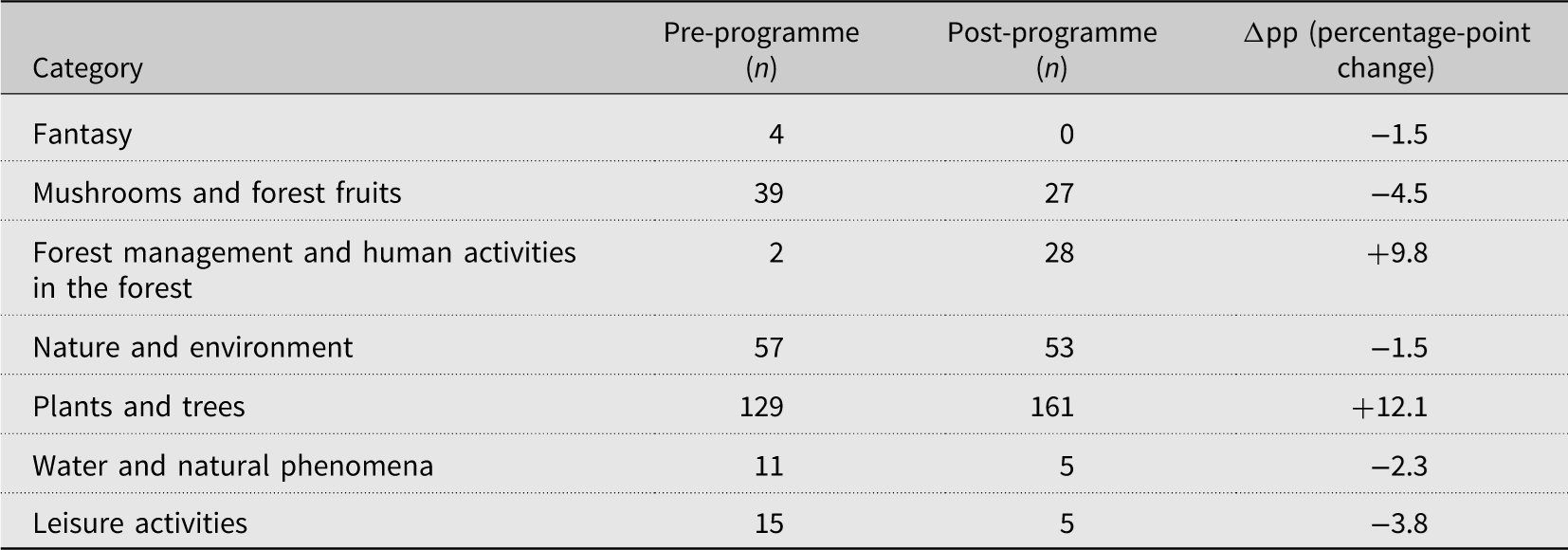
Table 1 summarises pre–post changes in category prevalence expressed as counts and absolute percentage-point differences (Δpp; N = 264). The largest increases in category prevalence were observed for Plants and Trees (+12.1 pp) and Forest Management and Human Activities in the Forest (+9.8 pp). Decreases were observed for Mushrooms and Forest Fruits (−4.5 pp), Leisure Activities (−3.8 pp) and Water and Natural Phenomena (−2.3 pp); Fantasy was absent post-programme. Overall, the pattern indicates a shift towards more concrete, practice-oriented articulations of forest environments.
Pre–post prevalence of thematic categories for the forest prompt (counts and percentage-point change, N = 264)

Table 1. Long description
A table with 8 rows and 4 columns comparing the prevalence of thematic categories before and after a program. The columns are labeled Category, Pre-programme (n), Post-programme (n), and Δpp (percentage-point change). The rows list different categories: Fantasy, Mushrooms and forest fruits, Forest management and human activities in the forest, Nature and environment, Plants and trees, Water and natural phenomena, and Leisure activities. Each row shows the counts before and after the program and the percentage-point change. Notable trends include increases in Plants and trees (+12.1) and Forest management and human activities in the forest (+9.8), and decreases in Mushrooms and forest fruits (-4.5), Leisure activities (-3.8), and Water and natural phenomena (-2.3). Fantasy was absent post-programme.
Note: Δpp is calculated using the full sample (N = 264). Non-informative entries (e.g., “don’t know” or “nothing”) were coded as NA and retained in the denominator to keep N consistent across time points. The category Other was included in the coding framework but was not observed for this prompt.
Forester’s work: Thematic categories (pre–post)
Pre-programme responses included a small Gamekeeping and Use of Firearms category and a larger Other category capturing vague formulations. Post-programme responses more frequently referenced Forest Management and Maintenance, Tree Care and Education and Outreach, whereas Monitoring, Forest Protection and Technical Forestry Tasks showed little or no change (see Supplementary File S1 for representative formulations).
Magnitude of change in category prevalence: Forester’s work
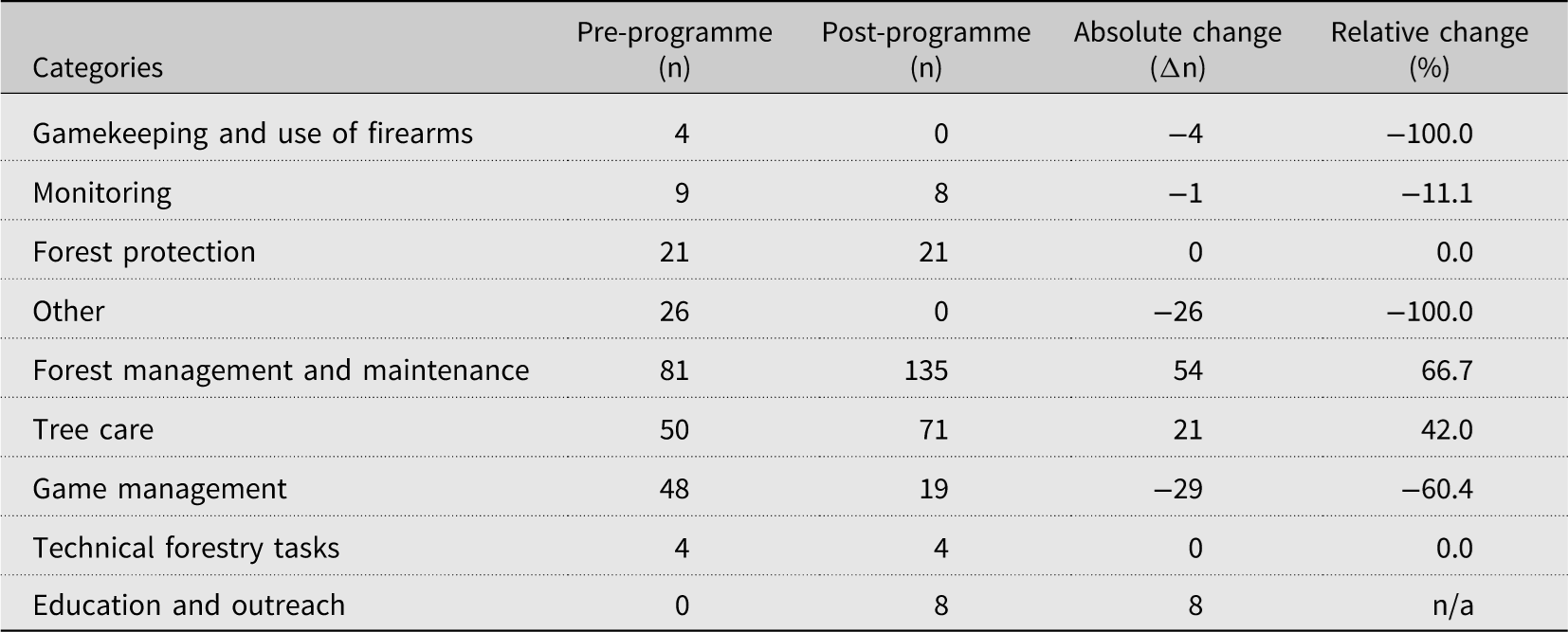
For comparability with the forest prompt, proportion-based summaries (Δpp) are reported in Supplementary File S2; in Table 2 we foreground count-based change (Δn) because it provides an intuitive summary of category presence across responses for this prompt. Table 2 reports descriptive pre–post change in category presence (Δn; relative change where defined). The largest increases were observed for Forest Management and Maintenance (81 to 135; +54) and Tree Care (50 to 71; +21). Education and Outreach increased from 0 to 8 (relative change undefined). The largest decreases were observed for Game Management (48 to 19; −29) and Other (26 to 0; −26); Gamekeeping and Use of Firearms also declined to zero (4 to 0; −4).
Pre–post counts (n) and descriptive change in category prevalence for forester’s work (Δn and relative change %)

Table 2. Long description
A table comparing pre-programme and post-programme counts in various categories of forester’s work, showing absolute and relative changes. The table has 11 rows and 4 columns. Column headers are: Categories, Pre-programme (n), Post-programme (n), Absolute change (Δn), Relative change (%). Row labels include: Gamekeeping and use of firearms, Monitoring, Forest protection, Other, Forest management and maintenance, Tree care, Game management, Technical forestry tasks, Education and outreach. Row 1: Gamekeeping and use of firearms, Pre-programme (n): 4, Post-programme (n): 0, Absolute change (Δn): -4, Relative change (%): -100.0. Row 2: Monitoring, Pre-programme (n): 9, Post-programme (n): 8, Absolute change (Δn): -1, Relative change (%): -11.1. Row 3: Forest protection, Pre-programme (n): 21, Post-programme (n): 21, Absolute change (Δn): 0, Relative change (%): 0.0. Row 4: Other, Pre-programme (n): 26, Post-programme (n): 0, Absolute change (Δn): -26, Relative change (%): -100.0. Row 5: Forest management and maintenance, Pre-programme (n): 81, Post-programme (n): 135, Absolute change (Δn): 54, Relative change (%): 66.7. Row 6: Tree care, Pre-programme (n): 50, Post-programme (n): 71, Absolute change (Δn): 21, Relative change (%): 42.0. Row 7: Game management, Pre-programme (n): 48, Post-programme (n): 19, Absolute change (Δn): -29, Relative change (%): -60.4. Row 8: Technical forestry tasks, Pre-programme (n): 4, Post-programme (n): 4, Absolute change (Δn): 0, Relative change (%): 0.0. Row 9: Education and outreach, Pre-programme (n): 0, Post-programme (n): 8, Absolute change (Δn): 8, Relative change (%): n/a.
Note: N = 264. Δn = post − pre (counts of responses with category presence). Relative change (%) = ((post − pre)/pre) × 100; reported as n/a where pre = 0 (relative change undefined). Changes are descriptive and reflect category presence (present/absent) within each response, not token frequency. Proportion-based summaries (Δpp) are reported in Supplementary File S2.
Cross-prompt synthesis (aligned to RQ1–RQ3). Across both prompts, pre-programme responses tended to rely on generic or stereotypical framings (including occasional fantastical motifs for forest and hunting/firearms for forester’s work). Post-programme responses more often incorporated practice-linked and care-oriented language, with greater differentiation of forest-related processes and increased references to forest management and maintenance, tree care and outreach. These patterns are interpreted as descriptive indicators of shifts in pupils’ meaning-making. As responses are unpaired at the individual level, the synthesis reflects aggregated pre–post patterns rather than within-pupil trajectories.
Discussion
Interpretation of the main findings
Following participation in the 4.5-hour structured forest education programme with local adaptation, post-programme responses more often articulated forests and foresters’ work through concrete ecological elements, forestry practices and stewardship-related roles. Rather than treating these group-level patterns as evidence of behavioural change, we interpret them as proximal discursive indicators of conceptual differentiation: the post-programme response set contained more specific, more practice-linked and more responsibility-oriented articulations than the pre-programme response set. This interpretation is supported by descriptive increases in Plants and Trees (+12.1 pp) and Forest Management and Human Activities in the Forest (+9.8 pp) for the forest prompt and in Forest Management and Maintenance (+54) and Tree Care (+21) for the forester’s work prompt. At the same time, fantastical, vague and hunting/firearms-related framings declined or were absent post-programme, while Education and Outreach appeared only after programme participation. These descriptive patterns suggest that pupils’ post-programme responses made visible aspects of forest stewardship that may otherwise remain implicit in everyday representations of forests and forestry.
This contribution matters because delayed behavioural outcomes are difficult to capture in evaluations of short programmes, whereas proximal differences in how pupils articulate environmental relationships, expertise and care can still be educationally informative. The observed pattern aligns with scholarship showing that place-based and education-outside-the-classroom designs can connect disciplinary knowledge with situated experience and responsibility in local environments (Bentsen & Jensen, Reference Bentsen and Jensen2012; Mann et al., Reference Mann, Gray, Truong, Brymer, Passy, Ho, Sahlberg, Ward, Bentsen, Curry and Cowper2022; O’Brien, Reference O’Brien2009; Prince, Reference Prince2020; Remmen & Frøyland, Reference Remmen and Frøyland2023) and with place-based and land-based pedagogies that treat connection to place as a learning outcome (Bates, Reference Bates2023; Bigby et al., Reference Bigby, Jim and Hatley2023; Hughes, Reference Hughes2023). The emergence of Education and Outreach suggests that the educator’s communicative role became visible as part of forest stewardship in some post-programme responses, a role that may become salient when professional expertise is enacted and modelled in situ (Dabaja, Reference Dabaja2021, Reference Dabaja2022; Garden & Downes, Reference Garden and Downes2024; Salmi et al., Reference Salmi, Thuneberg and Vainikainen2021). Together, the findings illustrate one way in which short structured forest-based programmes may be evaluated through meaning-based indicators without relying on behavioural proxies.
From a situated learning perspective, the greater prominence of sensory and concrete descriptions in post-programme responses suggests that features of the forest experience became visible in pupils’ articulations. This does not indicate increased nature connectedness, which was not measured, but it is consistent with accounts linking lived experience in nature with affective and cognitive dimensions of environmental learning and place-related meaning (Barrable et al., Reference Barrable, Booth, Adams and Beauchamp2021; Barrable, Reference Barrable2020; Clayton, Reference Clayton2021; Harris, Reference Harris2021; Price et al., Reference Price, Maguire, Firth, Lumber, Richardson and Young2022; Scannell & Gifford, Reference Scannell and Gifford2010). The findings also resonate with qualitative work on embodied encounters in biodiverse environments and relational perspectives that frame nature as a network of relationships through which meaning is formed (Adams & Beauchamp, Reference Adams and Beauchamp2021; Gray, Reference Gray2025).
Theoretical implications
Theoretically, the findings support the value of treating pupils’ open-ended articulations as proximal indicators of stewardship-related conceptual differentiation rather than as direct evidence of durable conceptual change (Gal et al., Reference Gal, Schur, Nevo and Gan2023). The post-programme response set contained more differentiated articulations of forests as managed socio-ecological settings, consistent with the programme’s combination of situated experience, educator-guided interpretation and disciplinary vocabulary. Such relational articulations resonate with research framing environmental learning as positioning children in relation to human and more-than-human communities (Gray, Reference Gray2025).
As a linguistic and conceptual indicator rather than behavioural evidence, this pattern is consistent with accounts of place-based education in which situated experience is coupled with disciplinary knowledge to foreground responsibility-oriented understanding and contextualised meaning-making (Bentsen & Jensen, Reference Bentsen and Jensen2012; Mann et al., Reference Mann, Gray, Truong, Brymer, Passy, Ho, Sahlberg, Ward, Bentsen, Curry and Cowper2022; Prince, Reference Prince2020; Remmen & Frøyland, Reference Remmen and Frøyland2023). It also aligns with empirical studies of place-based and land-based pedagogies showing how situated encounters can reconfigure learners’ narratives about local environments and their roles within them (Bigby et al., Reference Bigby, Jim and Hatley2023). In the present study, greater differentiation of forest elements and stewardship-related practices – including management, maintenance, tree care and outreach – can be interpreted cautiously as a proximal indicator of environmental literacy insofar as it makes relations among ecosystems, human action and stewardship more visible (Bianchi et al., Reference Bianchi, Pisiotis and Cabrera Giraldez2022).
At the same time, this interpretation remains bounded by the value–action gap: more differentiated articulations of understanding and normative framing may be educationally meaningful enabling conditions, but they should not be read as evidence of enacted behaviour (Heimlich & Ardoin, Reference Heimlich and Ardoin2008; Kollmuss & Agyeman, Reference Kollmuss and Agyeman2002; Portus et al., Reference Portus, Endfield and Jones2024). The theoretical contribution is therefore not a claim that a short programme produces behavioural change, but that stewardship-related conceptual differentiation can be made visible through feasible meaning-based indicators.
Pedagogical implications
The findings suggest that short structured forest-based programmes may be pedagogically valuable when they make stewardship practices explicit. Post-programme responses more often contained references coded as Forest Management and Human Activities in the Forest, Forest Management and Maintenance and Tree Care, while vague, fantastical and hunting/firearms-related framings declined or were absent. Curriculum-connected field programmes should therefore connect pupils’ observations with how forests are managed, maintained, cared for, used, protected and regenerated and with the ecological processes and professional responsibilities involved (CLOtC, 2022; Dillon & Lovell, Reference Dillon and Lovell2022; O’Brien, Reference O’Brien2009; Salmi et al., Reference Salmi, Thuneberg and Vainikainen2021).
Three pedagogical design principles follow from these findings. First, sensory engagement should be coupled with guided conceptual framing. The greater prominence of sensory and concrete language alongside more specific references to forest processes and forestry practices supports deliberately linking sensory experience to concepts, vocabulary and reflection rather than treating it as an outcome in itself (Adams & Beauchamp, Reference Adams and Beauchamp2021; CLOtC, 2022; Dillon & Lovell, Reference Dillon and Lovell2022; Garden & Downes, Reference Garden and Downes2024; Papadopoulou & Vincent, Reference Papadopoulou and Vincent2025). Second, the educator’s communicative role should be explicit. The appearance of Education and Outreach only in the post-programme response set suggests that communication, explanation and public education became visible as dimensions of professional environmental work, not merely as the programme’s delivery mode (Dabaja, Reference Dabaja2021, Reference Dabaja2022; Prince, Reference Prince2020). Third, brief classroom follow-up may help consolidate differentiated vocabulary and stewardship meanings. Revisiting key concepts, examples and pupil observations could support transfer into subsequent classroom discourse (Bølling et al., Reference Bølling, Otte, Elsborg, Nielsen and Bentsen2019, Reference Bølling, Mygind, Mygind, Elsborg and Bentsen2021; Mann et al., Reference Mann, Gray, Truong, Brymer, Passy, Ho, Sahlberg, Ward, Bentsen, Curry and Cowper2022). For evaluation, brief open-ended prompts offer a low-burden means of identifying visible stewardship-related ideas and refining programme design.
Although durability was not assessed, short curriculum-connected programmes may function as episodic but meaningful learning events when programme-related vocabulary, observations and stewardship meanings are revisited in subsequent teaching. Cumulative, distributed encounters may shape relationships with place and environmental responsibility over time (Ferguson & Snell, Reference Ferguson and Snell2024).
Limitations and cautions in interpretation
Several limitations should be considered. First, the predominantly same-day pre–post assessment captures proximal group-level differences in pupils’ articulations rather than evidence of durable change (Mann et al., Reference Mann, Gray, Truong, Brymer, Passy, Ho, Sahlberg, Ward, Bentsen, Curry and Cowper2022; Remmen & Frøyland, Reference Remmen and Frøyland2023). Without delayed follow-up, persistence cannot be assessed, and field-based outcomes may attenuate without reinforcement (Dillon & Lovell, Reference Dillon and Lovell2022; Heimlich & Ardoin, Reference Heimlich and Ardoin2008). Second, the single-group design without a control condition cannot separate the programme’s contribution from alternative explanations, including novelty effects, concurrent instruction or features of the excursion setting.
Delivery sites were selected where certified forest educators were active, which may limit generalisability to other institutional and practitioner contexts. Curriculum-connected environmental learning also depends on time, coordination, leadership and organisational support beyond individual teacher agency (Castellazzi et al., Reference Castellazzi, Hakkarainen, Saari and Raymond2025). Accordingly, transferability across national contexts lies in adaptable design principles rather than a fixed script, consistent with place-based perspectives that foreground locally grounded practice and responsibility to place (Kondo & Baars, Reference Kondo and Baars2025).
Although the programme followed a shared pedagogical framework and common thematic domains, local adaptation meant that pacing, emphasis, stopping points and interactional dynamics varied across sites. These variations may have influenced which themes became salient. Responses may also reflect social desirability or immediate response effects. Because responses were anonymous and unlinked, all comparisons are aggregated, unpaired pre–post summaries. Low base rates make relative change metrics volatile; accordingly, greater interpretive weight is given to absolute counts and percentage-point differences, while relative change is treated as descriptive rather than inferential (see Tables 1–2 and Supplementary File S2).
Finally, reflexive thematic analysis treats coding as an interpretive process rather than a reliability exercise. Accordingly, inter-rater reliability coefficients are not reported; analytic rigour was supported through calibration, iterative codebook refinement and documented discussions within the double-annotated subset (Braun & Clarke, Reference Braun and Clarke2022, Reference Braun and Clarke2023, Reference Braun and Clarke2024).
Directions for future research
Future research should examine the durability, conditions and mechanisms underlying the proximal group-level differences observed here. Longitudinal studies could test whether differentiated articulations persist and whether planned classroom reinforcement supports retention after three to six months (Binnington, Reference Binnington2024; Dillon & Lovell, Reference Dillon and Lovell2022; Heimlich & Ardoin, Reference Heimlich and Ardoin2008). Matched comparison classes or quasi-experimental comparisons across sites could strengthen interpretation beyond a single-group pre–post design (O’Neill et al., Reference O’Neill, Kelly, McCormack and Azevedo2024; Remmen & Frøyland, Reference Remmen and Frøyland2023). Mixed-methods studies could combine open-ended indicators with brief measures of nature connection or interest in nature without assuming linear attitude–behaviour relations (Neurohr et al., Reference Neurohr, Pasch, Otto and Möller2023, Reference Neurohr, Pasch, Bergmann-Gering and Möller2024; Otto & Pensini, Reference Otto and Pensini2017; Richardson et al., Reference Richardson, Hunt, Hinds, Bragg, Fido, Petronzi, Barbett, Clitherow and White2019). Implementation research should examine how the educator’s role, activity sequencing, curricular anchoring, timing and practitioner competencies relate to stewardship articulations, including whether structured professional learning supports consistent enactment across sites (Bianchi et al., Reference Bianchi, Pisiotis and Cabrera Giraldez2022; Mostafa & Eames, Reference Mostafa and Eames2025). Future studies could also examine associations with wider education-outside-the-classroom outcomes and test transferability across environmental education domains and national contexts (Elsborg et al., Reference Elsborg, Mygind, Bølling, Klinker, Melby, Andreasen, Brønd, Bentsen and Nielsen2024; O’Neill et al., Reference O’Neill, Kelly, McCormack and Azevedo2024; Schneller et al., Reference Schneller, Schipperijn, Nielsen, Bentsen, Skovgaard and Mygind2017).
Conclusion
This multi-site, predominantly same-day pre–post study compared two unlinked group-level response sets from lower-secondary pupils, collected before and after participation in a 4.5-hour structured forest education programme with local adaptation (N = 264 at each time point). In relation to RQ1, pre-programme responses framed forests in generic, recreational or occasionally fantastical terms and foresters’ work through vague or hunting/firearms-related representations, with less differentiated attention to stewardship practices. In relation to RQ2, post-programme responses were more specific, concrete and responsibility-oriented: forests were more often associated with ecological elements and management-related vocabulary, while responses about foresters’ work more often referenced Forest Management and Maintenance, Tree Care and Education and Outreach. In relation to RQ3, theme prevalence shifted towards practice-linked and stewardship-related categories, while vague, fantastical and hunting/firearms-related framings declined or were absent post-programme.
Interpreted conservatively, these patterns are proximal discursive indicators of stewardship-related conceptual differentiation rather than evidence of behavioural change or durable individual-level conceptual change. The study illustrates how feasible open-ended, meaning-based indicators can support routine evaluation of short forest-based programmes without treating behavioural outcomes as the sole criterion of value. For practitioners and programme providers, the findings point to the value of curriculum-connected field modules that explicitly connect situated observations, stewardship practices, educator-guided interpretation and disciplinary concepts.
The study is limited by its single-group design, anonymous unlinked responses and predominantly same-day measurement window. Nevertheless, it offers an adaptable evaluation approach and pedagogical design principles that may be applied beyond the Czech context with appropriate local adaptation. Stewardship-related meanings were more visible in the post-programme response set, but their durability remains an empirical question.
Supplementary material
The supplementary material for this article can be found at https://doi.org/10.1017/aee.2026.10209.
Data availability statement
De-identified aggregated data (pre–post counts, proportions and descriptive change metrics: Δpp, Δn and %Δn) and the codebook (category definitions, inclusion criteria and representative excerpts) are provided as Supplementary Files S1 and S2. Raw textual responses are not publicly available due to the protection of minors’ privacy. Additional aggregated summaries may be available from the corresponding author upon reasonable request.
Acknowledgements
The authors would like to thank the participating schools, pupils and teachers for their cooperation. We are also grateful to the forest educators who implemented the programme across sites and contributed to its consistent delivery.
Financial support
This work received no specific grant from any funding agency in the public, commercial, or not-for-profit sectors.
Ethical standard
The study involved minimal-risk, anonymous questionnaire responses collected in school settings as part of a structured educational programme that participating schools had booked. Under institutional guidelines, this anonymous, minimal-risk programme evaluation did not require formal ethics committee review. Participation was voluntary, and parental/guardian consent was obtained through standard school procedures.
Use of artificial intelligence
The authors used AI-assisted tools for language editing and stylistic refinement. All intellectual content, analysis and interpretation were developed and verified by the authors.
Author Biographies
Radka Stolariková is a researcher and lecturer at the Institute of Education and Counselling, Czech University of Life Sciences Prague. Her work focuses on didactics and environmental education, particularly place-based learning and the development of pupils’ conceptions of nature and forestry. She specialises in the design and evaluation of educational programmes using mixed-methods approaches, with an emphasis on meaning-based indicators and conceptual change in outdoor learning contexts.
Lucie Smékalová is Deputy Director of the Institute of Education and Counselling at the Czech University of Life Sciences Prague and a scholar in pedagogy and andragogy. Her research focuses on teaching and learning processes, adult education and the development of competencies in formal and non-formal educational contexts.
Aneta Vadovičová is an Assistant Professor at the Institute of Education and Counselling, Czech University of Life Sciences Prague. Her work focuses on education law, legislative frameworks and legal aspects of career guidance, integrating legal perspectives into educational practice and policy.




 Open access

