Explaining the economic underpinnings of peasant rebellion in colonial Southeast Asia, James Scott argues that, with the possible exception of the Dutch East Indies, especially Java, where the Dutch colonial state seemingly preserved, or rather ‘fossilised’, the agrarian community and ensured its subsistence needs, the colonial era in Southeast Asia was ‘marked by an almost total absence of any provisions for the maintenance of a minimal income while, at the same time, the commercialisation of the agrarian economy was steadily stripping away most of the traditional forms of social insurance’.Footnote 1 Consequently, Scott seems to argue, there were no severe shortages of food let alone famines in Java, and other Indonesian islands, under colonial rule, even if localised instances of erosion in subsistence guarantees provoked peasant rebellion.Footnote 2 Elsewhere in Southeast Asia, says Scott, ‘the spectre of hunger and dearth, and occasionally famine’ were brought to the ‘gates of every village’ as a result of ‘lilliputian plots, traditional techniques, the vagaries of weather and the tribute in cash, labor, and kind exacted by the state’ under colonial rule.Footnote 3
Indeed, a senior Dutch official writing an account of the improved well-being of indigenous people in Java under the liberal colonial economic policy in the early 1920s proudly claimed that Java had been free of famines, which plagued India under the British colonial rule, as a result of safeguards to ensure the food supply.Footnote 4 Famines do not appear in the annals of Indonesian economic history after 1870, in striking contrast to the famines, scarcity of food and the low standard of living, which allegedly affected the Javanese in the previous four decades.Footnote 5 The famines in east Indramayu (west Java) in 1843–44 and in Demak and Grobogan (central Java) in 1849–50 are notorious events as pernicious consequences of state enterprise in commercial agriculture in Java in the middle decades of the nineteenth century.Footnote 6 The known episodes of famine in the Dutch East Indies after 1870 occurred on the island of Lombok in 1891–99, just after Lombok came under colonial rule, and during 1938–40, with devastating consequences for the local population.Footnote 7 Those famines were insignificant, to judge by Scott's remarks made in the context of major devastating famines in Indochina in the 1940s, which was a terrible subsistence crisis even in comparison with the ‘Great Bengal famine’ of 1943.Footnote 8
Curiously enough, all known episodes of famine in the Dutch East Indies occurred in primary rice-growing regions and in times of great pressure on peasants imposed by the colonial state or its agents. The famine in east Indramayu (west Java) in 1843–44 was, for instance, precipitated by a sudden change in the existing arrangements for peasants to dispose of their rice for sale, disrupting arrangements of credit and food supplies. The local peasants were accustomed to sell an increasing portion of the rice crop to satiate the demand for rice in coastal towns from the 1820s onwards. A group of Chinese rice traders had built a network of credit supply to procure rice from the peasants, which served the needs of peasants and supplied local markets with a large amount of rice for over two decades, when a Dutch entrepreneur secured a monopoly of the rice crop in east Indramayu through his close association with the colonial administration. The peasants faced a serious problem because much of their rice crop was taken away from them, disrupting food supplies until the next harvest through credit from the Chinese traders, who were replaced by the new rice mill owner, causing sudden starvation and depopulation of considerable magnitude.Footnote 9 The Demak-Grobogan (central Java) famine in 1848–49 was precipitated by assiduous collection of land rent from peasants against the background of increasing landlessness, and shortage of cattle and money income. It was a rice-exporting region into the early 1830s, where the local indigenous supra-village elite had curtailed land available for peasants, causing landlessness among people, who had no other source of income to buy rice. A drought in 1848–49 set in motion a harvest failure, which was aggravated by shortage of cattle, leading to a second crop failure in 1849–50. The colonial officials collected the land rent assiduously regardless of the mounting difficulties of peasants, reducing whatever purchasing power peasants had and causing widespread starvation and depopulation.Footnote 10 The Lombok famine of 1938–40 occurred against a background of sudden efforts by the colonial state to commercialise rice production by dismantling the existing arrangements for credit and the sale of rice, reminiscent of the circumstances that led to the famine of Indramayu Regency in 1843–44. These few episodes of famine may not necessarily contradict Scott's view, but they certainly suggest that the colonial state occasionally lost sight of its broad policy of safeguarding subsistence needs, when the interests of the state or its private agents required a greater share of agricultural produce from peasants for sale. This view is further illustrated by a subsistence crisis in yet another primary rice-producing area in Java in the late nineteenth century.
Java experienced several episodes of unusually low rice production in the last quarter of the nineteenth century, notably in 1881, 1883, 1893 and 1902, when both India and China experienced devastating famines causing heavy crisis mortality.Footnote 11 Those crop failures were a result of natural calamities, mostly unusually prolonged drought, caused by the increased El Niño-Southern Oscillation in Asia and Africa.Footnote 12 But Java has considerable variation in rainfall, which precludes severe droughts precipitating famine, as it was the case in India, so a widespread fall in agricultural production is unlikely to occur throughout the island. Indeed, the number of droughts in Java recognised as El Niño events is small and confined to 1877–78 and 1899–1902, and not all of them caused subsistence crises.Footnote 13 But drought proved a catalyst for a severe subsistence crisis in a small area of Java, although the entire island was affected by drought, in 1883–84.
Rice production in west Indramayu, a primary rice-producing area in West Java, declined sharply in 1883–84, and the local population had very little rice for consumption after sacrificing the greater part of its rice crop to pay the land rent. The inhabitants of the famine-stricken area, who were rice producers and had very little or no money income to buy rice, endured great hardship. The subsistence crisis, if the reported statistics are to be believed, led to the displacement of some 3,000 people for a couple of years, and many more people who remained in their villages starved, but crisis mortality was very low if it occurred at all. The local peasants usually had enough rice to last from one harvest to the next and kept some rice in reserve in village rice barns as a contingency measure. The rice production had been falling since 1880 in the wake of devastating cattle disease that swept across West Java, and dry weather in 1883 is said to have severely reduced the rice crop, but these circumstances do not necessarily explain how the existing subsistence safeguards collapsed, reducing a large number of people in west Indramayu to sudden starvation and hardship.
The annual report on colonial affairs acknowledged that the fall in rice production in many parts of Java in 1883 was due to the ‘exceptional drought’, which caused a large area of wet-rice land to be left uncultivated. There were local factors such as the destruction of villages and deaths caused by the eruption of Krakatau,and the virulent cattle disease that affected most of west Java, and a disease of the rice crop that was particularly destructive in central and east Java. A great deal of wet-rice land was left uncultivated and the land cultivated under rice yielded a poor crop everywhere in Java, forcing the government to implement various short-term measures such as restricting rice exports and importing a considerable amount of rice from Siam, Saigon and Bali to ensure enough food to avoid a major crisis in food supply.Footnote 14 But there was no serious shortage of rice, let alone a famine anywhere in Java except in west Indramayu in 1883–84.
The plight of people affected by the famine in west Indramayu was worsened by the fact that they were, as shown below, pure and simplly subsistence peasants completely isolated from local markets, whereas people in most parts of Java were commercialised to a considerable degree and had ample means of survival in times of economic hardship, which minimised the danger of dearth, hunger and famine. While it is true that the production of food crops was not seriously threatened by that of agricultural crops for export, contra Scott and Geertz, it was probably commercialisation of the economy, including diversification of economic activity, which eradicated famine in most parts of Java under colonial rule. Peasants encountering crop failures could find some income from non-agricultural work while more and more people without access to wet-rice land – some 35 per cent of all workers – earned enough to live on without undue hardship by 1880.Footnote 15 The state of affairs in areas producing rice for sale, such as west Indramayu was, however, rather different, for the entire population was involved in rice production and very little if any diversification of economic activity was to be found, and no one was particularly careful to ensure subsistence of rice producers, especially when the market economic forces superseded the interests of peasants.
It is difficult to explain the famine in west Indramayu in terms of Amartya Sen's sudden deterioration of ‘exchange entitlements’. While starvation is a regular phenomenon in many societies, according to Sen, it does not necessarily imply famine, whereas famines cause starvation, which suggests a general decline in the level of food consumption. Famine is unequal in the way it affects people, although a degree of levelling in the predicament of people affected by famine is found under certain circumstances.Footnote 16 The distinction between the predicament of different segments of people in a society affected by famine is, Sen argues, a matter of the political economy of famine, which can be described as a result of the breakdown in exchange entitlements or people's ‘ability to command food through the legal means available in the society, including the use of production possibilities, trade opportunities, entitlements vis-à-vis the state, and other methods of acquiring food’, as exemplified by the Bengal famine in 1943–44.Footnote 17 Sen's hypothesis assumes a commercialised economy such as Bengal, where for ‘those who do not grow food themselves (e.g., artisans or barbers), or those who grow food but do not possess the food they grow (e.g., cash-wage agricultural labourers), the vagaries of the market can have a decisive influence on their ability (and that of their families) to survive’.Footnote 18 It does not satisfactorily explain famines in societies where the greater part of the population produced their food and the economy was only marginally commercialised.
Sen's ‘general framework for analysing famines’, explaining famine as a result of sudden rupture in ‘endowments’ with the consequence of inadequate food for various groups of people in a society, has been praised, and criticised.Footnote 19 According to some critics, its inability to consider famine from the perspective of ‘redistributive class struggle’, recognising the interplay of politics at different levels in society involving different groups of people, a crucial factor in understanding the famines in pre-modern societies, is a major shortcoming in Sen's approach. In explaining famines in the nineteenth century, as Mike Davis argues following Karl Polanyi and Michael Watts, it is necessary to understand them as a consequence of societies being drawn into the capitalist world economy, a process which undermines the existing norms and patterns of command over food, causing subsistence crises.Footnote 20
The dynamics of famines reveal complexities in the way different groups of people negotiate their claims as market economic forces permeate through pre-modern economies to transfer agricultural products to the markets. Transferring a portion of agricultural production from peasants to markets via supra-village intermediaries could precipitate famine in subsistence peasant economies as they come under the influence of commercialisation,Footnote 21 exposing structural constraints in peasant economies invisible under normal circumstances, and disrupting the existing mechanisms to deal with the scarcity of food, as exemplified by the famine in west Indramayu in 1883–84. The course of events precipitating the famine and its effects are serendipitously recorded in detail, enabling us to come to face-to-face with famine victims and to see in unusual clarity how they coped with the situation.
It was the way in which an increasing portion of rice production was acquired for export while peasants were being completely shielded from the market economy, denying them any advantage of an alternative to producing rice and other crops for sale, which probably precipitated a famine against a background of drought and severe depletion of the cattle population in west Indramayu in 1883–84. Rice cultivation was the sole means of livelihood of people in the area, who were isolated from the adjacent areas, where economic activities were considerably diverse and provided people with plenty of opportunities to earn a money income. The inhabitants of west Indramayu received no pecuniary benefit from growing rice for sale because of the way surplus rice was expropriated from them by the landlords in lieu of land rent, and being shielded from rice trade in east Indramayu, where the majority of people managed to gain access to wet-rice land, albeit in small plots, which produced enough income from the sale of rice for people to live without hardship into the early 1900s.Footnote 22 So the mode of transferring surplus agricultural production to the market clearly determined the degree to which market economic forces affected Javanese peasants, creating communities of subsistence peasants living next to a thriving community of commercial rice-growing peasants with a greater degree of material prosperity.
Place
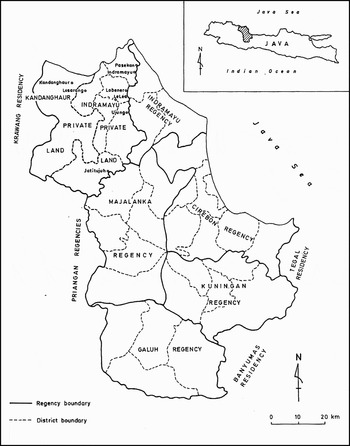
The River Cimanuk flows across the Indramayu region, dividing it into two parts and irrigating a large area of land suitable for wet-rice agriculture on both sides of the ricer. Indramayu was one of the five regencies that comprised the Residency of Cirebon; the area to the east of Cimanuk River was under direct government control, whereas the area to the west of the river consisted of two private domains (particuliere landerijen) outside of government control (map 1).Footnote 23 In 1812, the British interim administration of Java sold two large tracts of land, Indramayu and Kandanghaur, as part of its efforts to raise revenue.Footnote 24 The landlords exercised full control over all affairs in their domains, much to the chagrin of Dutch colonial officials who resented the existence of semi-independent enclaves. Their relationship with the landlords of private domains was uneasy even at best of times, and particularly when something out of the ordinary occurred in the private domains, making official interference inevitable, as was the case after the subsistence crisis of 1883–84.Footnote 25
Private Domains of Indramayu and Kandanghaur

The landlords of Indramayu and Kandanghaur domains were astute entrepreneurs, who realised the value of their property as a lucrative source of rice for sale. They encouraged local inhabitants to produce rice, subject to a land rent to be paid in kind and compulsory public services levied on all able-bodied men. The landlords supplied some funds for peasants to buy cattle and for irrigation projects in order to attract more people to bring new land under cultivation in the early decades of the nineteenth century. These measures apparently had some success, for the population rose in the 1830s and 1840s, probably as a result of people from the adjacent areas of Cirebon Residency moving into the private domains to avoid growing indigo and sugar on behalf of the government.Footnote 26 The population rose slowly over the next four decades, from 37,323 to 49,642 in Indramayu and 23,655 to 61,942 in Kandanghaur between 1840 and 1880.Footnote 27 There was plenty of virgin land so a commensurate increase in the area of wet-rice land (sawah) occurred on a par with the population increase and all peasant households had access to arable land in perpetuity.Footnote 28 Some peasant households with sufficient manpower and funds enlarged their holdings of wet-rice land and most peasant households appear to have possessed holdings of wet-rice land large enough to produce rice to feed a family of five people on average. People recalled that they produced enough rice to pay the land rent to the landlords and to support themselves from one harvest to the next well into the early 1870s.
The landlords were initially content with collecting one-fifth of rice production, mostly in paddy as allowed by law, and seldom allowed traders from the nearby Indramayu town, the centre of a flourishing rice trade, to visit the private domains. The local population consequently remained entrenched in a rather narrow subsistence economy, in striking contrast to the situation in most parts of Java, where diversification of economic activity provided means of livelihood outside agriculture for an increasing number of people in the middle decades of the nineteenth century.Footnote 29 This state of affairs produced a standard of living for people much lower in comparison with that in the adjacent areas of Cirebon Residency and caused serious difficulties in procuring food for the inhabitants of private domains in times of crop failure.
The famine
In April 1883, J. Faes, the head of local government of Cirebon Residency, informed his superiors in Batavia of a crop failure in west Indramayu; he felt that ‘it is not entirely unreasonable to presume that the inhabitants of the private domains will be in a miserable state by the end of the year unless something is done to prevent it’.Footnote 30 The officials in Batavia were cautious in reacting to the news and asked for further information from the administrators of private domains and the local government.Footnote 31 The administrators reluctantly admitted that the prospects for the rice crop were bleak, but felt that the situation was not as serious as to cause widespread starvation and hardship for people, except in the districts of Lelea and Losarang in Kandanghaur domain, where the rice crop was likely to be meagre.Footnote 32 Several months later, the administrator of Indramayu private domain confidently reported that, ‘it is true that people would not have a large rice crop this year, but it would be large enough to meet their needs so there is no great scarcity of food’.Footnote 33
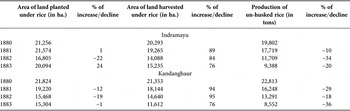
The official enquiries, however, revealed that the rice harvest in 1883 had fallen by almost half of the production three years previously.Footnote 34 ‘There will be a great scarcity of food among people’, wrote a local official summing up the situation, ‘not only later this year, but also in the early months of next year’, paving the way for ‘hunger in the near future’.Footnote 35 This assessment was based on information from Kam Tjeng Bie, the Lieutenant of Chinese in Indramayu, who had seen during a recent visit to Losarang district, hundreds of men and women looking for edible roots to eat, a sure sign of the growing scarcity of food, while people elsewhere in Kandanghaur were equally desperate and walked a long way to find food.Footnote 36 In the light of mounting evidence of a major subsistence crisis, the central government found it difficult to remain quiet, especially after the management of the private domains admitted that there was a serious shortage of rice causing starvation among people, and ordered a thorough enquiry into the situation.Footnote 37 The central government was reluctant to interfere in the affairs of the two private domains, which were outside its jurisdiction anyway, because official interference could embarrass an influential Dutch nobleman cum politician who was one of the owners of Indramayu private domain.Footnote 38 The enquiry was entrusted to a senior officer, H.J. Heyting, who was asked to be discreet and not to provoke the management of the private domains.Footnote 39 Being greatly interested in Java's peasant economy, Heyting probed closely into the plight of the inhabitants of private domains, and collected information from nearly 250 households.Footnote 40 Heyting's report is unique even among the riches of colonial reports on Java, because of its unusually probing character into the material circumstances of individual peasant households and simple yet moving depiction of the struggle for survival of people in times of extreme hardship.Footnote 41 Heyting's sympathetic approach made people reveal to him the extent of their hardship in a candid manner. The statistics of the area planted under rice and rice production that Heyting procured from the administrators of private domains could have been contrived to some extent to hide the scale of the calamity, but they suggest a considerable decline in rice production between 1880 and 1883 (Table 1).
Rice production in Indramayu and Kandanghaur private domains, 1880–83

Sources: Heyting, ‘Monographie Indramajoe west’, appendix ‘Staat aantoonende de geslagde en mislukte sawahs van 1879 t/m 1883’ and ‘Monographie Kandang Haoer’, appendix ‘Staat aantoonende de geslagde en mislukte velden van 1879 t/m 1883’.
There was apparently little change in the area of sawah planted under rice in Indramayu between 1880 and 1883, but a quarter of the area of land planted under rice failed and rice production had halved by 1883. Indramayu reportedly suffered less than Kandanghaur, where the area of land planted under rice declined by 30 per cent, and three-quarters of the area of land planted with rice yielded just one-third of the rice crop in 1880. The poor rice crop, Heyting concluded, had a devastating effect on food supply, despite the administrators' optimistic claims that rice stocks at the district level were sufficient to last up to several months.Footnote 42
The widespread scarcity of rice was, however, not a result of the poor harvest in 1883, for it was large enough to feed the local population if much of it had not been taken away from the peasants in the form of land rent. The peasants managed to retain only a small portion of rice crop after paying the land rent, collected in prime-quality rice, regardless of a poor rice harvest for the third successive year.Footnote 43 The administrators of private domains reportedly bought rice in the adjacent Cirebon and Majalengka Regencies, ostensibly to feed people during the current hardship, but probably to make up for the shortfall in exports caused by the meagre rice harvest in the private domains.Footnote 44 They were reluctant to provide rice to feed people and claimed that the existing stocks of rice in the stores were reserved for seed paddy.Footnote 45 Some peasants recalled with bitter resentment that, in the past the landlords supplied them with rice for consumption in times of hardship, but were now reluctant to do so because it would be difficult if not impossible for the peasants to repay their debts in the aftermath of a subsistence crisis. Some 5,400 ton of rice was estimated to have been available in the villages by early October 1883 and, according to Heyting's calculations, another 4,250 ton of rice should have been enough to feed the entire population until early June 1884.Footnote 46 There was no shortage of rice for sale, but people could not afford it.Footnote 47 Even in Losarang district, which was worst hit by the crop failure, rice was available for sale in local markets.Footnote 48 The price of rice was high and ranged from f.2.50 per pikul (62 kilogram) to f.3.00 per pikul in 1883,Footnote 49 too expensive for people who had little or no money even under normal circumstances.
People strove very hard to obtain some rice, ate just once a day to minimise the trouble of finding food, and left for the adjacent areas when all else failed. They preserved their rice supplies by eating other kinds of food so they would have some rice left until the beginning of the next wet season, but most peasants could not make the meagre rice supplies extend that far because their rice stocks had been very low. The peasant households with large plots of wet-rice land, cattle and the manpower to work land effectively had gathered a good rice crop, experienced no hardship in food supply and ate rice once or twice a day as usual. For instance, Janisem in the village of Alla Atta in Jatitujuh district had a reasonably good rice crop despite the drought, and had stocks of a little over 2 ton of rice to feed his family for another three months.Footnote 50 Masrib in the village of Cilandak in the district of Luwangamalang, who had 3.2 hectares of wet-rice land, managed to gather 53 ton of rice in 1882, but less, 35 ton of rice, in the following year; he still had 35 ton of rice in stock and could feed his family of eight people without any difficulty.Footnote 51 But most peasants were fast reaching the bottom of their rice barns. Sainten counted the number of days his family could eat rice twice a day and felt that his supplies would last for another three months. His family was small – only two small children – and required a small amount of rice; he had been working hard on his dry rice field that was due to yield within a month, so his family could afford to eat rice twice a day with vegetables and occasionally with fish.Footnote 52
The peasant families without rice stocks obtained some rice in several ways. Dani, a landless villager in the village of Trusan in Pasekan district, who used to rent some land when he could afford it, had little rice left from his last crop, but his family ate rice twice a day because Dani managed to buy some rice with the money he earned from wage labour in Pasekan town.Footnote 53 Likewise, Dasan in the village of Sukadedah was engaged in petty trade, the income from which enabled Dasan, his wife and child to eat rice twice a day with vegetables and occasionally with fish.Footnote 54 Sepa, a widow in the village of Plumbon in Pasekan district, sold vegetables from her house-yard and participated in harvesting work for others, which enabled her to eat rice twice a day.Footnote 55 Sanjem, a widow in the village of Bodas in district Ujung, earned 15 cents a day from pounding paddy, which was just enough to provide both her son and herself a meal of rice twice a day supplemented by yam.Footnote 56 The widow Rasa in the village of Kerticala in district Ujung, saddled with the burden of supporting her grandson in addition to two grown-up daughters, earned a little rice from doing odd jobs while one of her daughters also brought home more rice and a little money earned from pounding paddy in Indramayu town.Footnote 57
Many peasants were fortunate enough to eat once or twice a day from working for others or selling something. Income from the wage labour of one person was insufficient to buy rice for a big family, in which case both the husband and wife worked, sometimes together but often at different places. For instance, Lawen himself worked in Indramayu town while his wife earned something from working in the village.Footnote 58 Desperate to find food, Armidem walked a long way to Pamanukan, while his wife sold leaves of all sorts to obtain food for her large family of 11 people including six children; she did not know when her husband would come home and her house-yard produced nothing that could be sold or exchanged for rice.Footnote 59 Wage labour, selling fruit, leaves and roots gathered from the jungle, carrying sand or water from the Cimanuk River to Indramayu town provided just enough money to buy rice for a family for two meals. Sometimes it was not enough as found by Walizan, whose family consisted of his wife, two children and two brothers. Walizan worked for others during the rice-cultivating period; his daily income of three kati (0.62 kilogram) rice and his brother's income of two kati (0.41 kilogram) of rice was inadequate to feed the family with rice twice a day so they ate rice only once a day.Footnote 60
People who lived in remote villages of Kandanghaur private domain, where the opportunities to earn any money income were scarce, ate yam and leaves in desperation in order to survive. Eating yam was a mark of extreme poverty. Poor old villagers like Aburti and his wife ate yam when they could not obtain a little rice from their neighbours or from their children who lived elsewhere.Footnote 61 Sanjem, a poor widow, worked hard to earn some rice to mix with yam gathered by her family members.Footnote 62 The old and poor villagers figured prominently among the starving. They could no longer rely on the charity of neighbours or even family members, as in the case of old Kamasi whose children lived far away.Footnote 63 The successive crop failures and poor food supply had weakened the bonds of mutual help and disposition for charity among the villagers.
The population statistics compiled by the administrators of two private domains suggesting rapid recovery from the subsistence crisis should be treated with a modicum of caution (Table 2). It may well be that people who left their homes for shelter elsewhere began returning once the worst part of the subsistence crisis was over, but it is very unlikely that population rose as fast in a few years as suggested by the statistics. The subsistence crisis probably displaced 5,000 people and brought hunger, misery and illness to more people, although its toll of human lives is likely to have been small. There was considerable population movement between the two private domains and adjacent areas. Moving out in times of difficulty was a common practice in Java, but population movement on a large scale had become less common in the second half of the nineteenth century. This explains why local officials were surprised, and even unprepared for, a large exodus of people from the two private domains at the onset of the subsistence crisis.
Demographic impact of subsistence crisis

Sources: Regeringsalmanak and KV for the years 1882–85.
The crisis would have caused a considerable stir in colonial political discourse had it not occurred in a region outside government control and had not the landlords of private domains wielded considerable influence. The central government of the Indies was vexed with the head of the local government of Cirebon Residency, J. Faes, a severe critic of the institution of private domains in west Java, who probed into the subsistence crisis; Frederick van s'Jacob, Governor-General (1881–84), discharged him even before ascertaining the truth of the subsistence crisis.Footnote 64 Frederick van s'Jacob was a strong supporter of free enterprise in Java and, as a former free sugar manufacturer himself, he may have disliked officials interfering in the management of a private enterprise.Footnote 65 The enquiry into the subsistence crisis was conducted in a quiet manner without much cooperation from the managers of the two domains and the results of the enquiry were kept secret. The usually vociferous press in the Indies remained silent as well, implying pressure from the government. The landlords escaped with a request to do more for the well-being of inhabitants in their domains. The colonial state acted in collusion with the Ministry of Colonies to prevent the subsistence crisis in Indramayu and Kandanghaur private domains becoming a public scandal.
Agents of crisis
The migrants from Kandanghaur who sought shelter in Kerrawang admitted that the persistent dry weather severely affected the rice crop of 1883–84; the administrators of private domains also stressed the drought as the cause of the subsistence crisis.Footnote 66 The ‘lean rice crop is entirely a result of the unusually dry weather in the last wet season’, said van der Veen, who was in charge of Kandanghaur, while his colleague in Indramayu, Jellinghaus, observed that ‘this year rice fields have badly yielded as a result of the prolonged drought’, adding further that the damage done by mice had also affected the crop.Footnote 67 Bad weather had always been something of a red herring in official explanations of crop failure or falling agricultural production in Java. In the present case, it was an effort to prevent a thorough investigation into the subsistence crisis, although not necessarily a false claim, for the wet season of 1882–83 was reportedly unusually dry. The wet-season rainfall in the Indramayu-Kandanghaur area did not show significant enough variation to cause a local drought, but low rainfall in the entire coastal belt from Kerrawang to Cirebon made rice cultivation vulnerable to drought.Footnote 68 The rice fields located on the banks of the Cimanuk River were less vulnerable to the vagaries of climate, but arable land located further away from the river did not get enough water, except when the water level in the river was high in the wet season.Footnote 69 In any case, the peasants in Kandanghaur private domain could depend on irrigation facilities to a lesser extent, and were consequently exposed to drought whenever the wet-season rainfall was inadequate or late. The drought probably reduced the area of sawah harvested by nearly a quarter, but a single crop failure does not necessarily cause widespread hardship and hunger. In fact, rice production had been falling since 1880 as a result of the devastating cattle disease, identified as typhus fever, which decimated the cattle population in West Java.Footnote 70
The cattle disease first appeared in the private domains of Simplicitas in Meester-Cornelis in early 1879, presumably brought in by cattle imported from Sumatra, soon spread to the vicinity of Batavia, and appeared in Kerrawang Residency towards the end of 1879.Footnote 71 The disease spread eastwards early the following year as a result of the regular movement of cattle out of Kerrawang Residency into Kandanghaur over the swamps, where guarding the fence built to prevent the movement of cattle was slack to facilitate the ploughing of wet-rice land.Footnote 72 Thereafter it was difficult to monitor the movement of cattle from one village to another by peasants who were either unaware of the danger, or anxious to save their cattle from the disease. ‘It would be impossible to contain the disease’, a local official remarked after reporting one incident of moving infected cattle, ‘as long as the movement of cattle between the infected and uninfected villages continues unabated’.Footnote 73 The peasants were careless in allowing their cattle to wander around looking for fodder and water, a quest that often brought them into contact with the infected cattle.Footnote 74 The local government felt justified in slaughtering cattle in the private domains to avoid a major economic disaster spreading eastwards. Slaughtering cattle began in earnest in early March 1881, and the cattle population had sharply declined by July, due either to the disease or culling of cattle. In Lelea and Losarang districts, for instance, the cattle population declined respectively from 4,687 and 7,810 in 1880 to 1,452 and 1,977 in July 1881. The decline in cattle population in Kandanghaur domain was far greater – from 23,864 in 1880 to 4,906 in July 1881 – than in Indramayu domain, where it declined from 8,868 to 2,037 during the same period.Footnote 75 It was a major disaster for cattle owners, who received compensatory payments soon after the slaughter of their cattle, but did not receive any compensation for cattle killed by the disease. The peasants could not buy cattle immediately after they received compensation, for they were hard pressed for money to buy food, and in any case the movement of cattle was prohibited. The destruction of cattle had a devastating effect on rice cultivation; Heyting estimated that, as a result of the lack of means to plough the wet-rice land, a little over one-quarter of the area of land remained fallow in 1881.Footnote 76 So it is not surprising that the area of land planted under rice and rice production declined considerably during the next few years.Footnote 77
The peasants usually had personal rice stocks and saved some rice in village rice barns as well, to safeguard their survival under difficult circumstances. This practice had been abandoned in some villages due to frequent poor rice crops in previous years. It amounted to 22,892 tons of un-husked rice or paddy in Indramayu and 22,800 tons of paddy in Kandanghaur in 1875,Footnote 78 and it was hardly greater five years later (Table 1). In fact, the local peasantry had been trying to maintain a precarious balance between population and food supply, which probably reached a critical level by 1880, against the background of falling rice production and increasing expropriation of rice by the landlords.
Dynamics of subsistence peasant economy
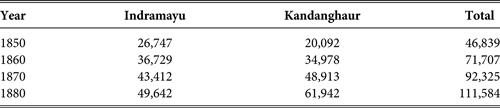
The population of west Indramayu, according to the statistics supplied by administrators rose steadily between 1850 and 1880, doubling it in three decades but rising at a slower pace in Indramayu in comparison with Kandanghaur (Table 3).
Population growth of Indramayu and Kandanghaur private domains, 1828–80
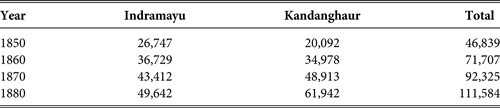
Sources: Heyting, ‘Rapport omtrent den toestand, vooral der particuliere landerijen Kandang Hauer en Indramajoe west in het algemeen, als omtrent de aldaar aanwezige voedingsmiddelen in het bijzonder’, appendix 1 and ‘Statistiek van Cheribon 1835–1857’.
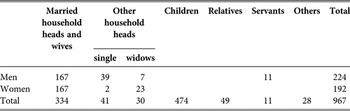
The rapid population growth in the two private domains was not unusual by Java's standard, for the population of Java as a whole rose at the rate of 1.5 per cent a year in the nineteenth century.Footnote 79 The dynamics of population growth in Java are notoriously difficult to ascertain due to the paucity of data, which more often than not encourages scholars to speculate on slender evidence. Therefore it is fortunate to have some information on matters such as household formation among the inhabitants of Indramayu and Kandanghaur private domains at the time of the famine, which reveals the dynamics of population growth of a predominantly subsistence peasant community (Table 4).
Members of households by relation to head of household

Source: Heyting, ‘Desa onderzoekingen op het particuliere land Kandang Hauer’ and ‘Desa onderzoekingen op het particuliere land Indramajoe west’.
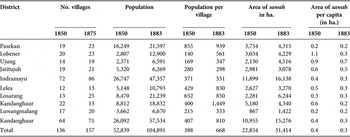
Most households Heyting investigated consisted of married couples, because it was common practice to establish a household after marriage; only a small number of householders – 16 per cent of all households – consisted of single men and women, some of whom may well have postponed matrimony under the current difficult circumstances. The incidence of marriage was high, 19 marriages per 1,000 people, compared with 16 marriages per 1,000 people elsewhere in West Java.Footnote 80 Young men married and formed households when their means of livelihood as subsistence farmers was assured.Footnote 81 This involved obtaining a piece of wet-rice land, agricultural tools, cattle and seed in addition to a dwelling, all of which required funds. The majority of peasant families in west Indramayu apparently did not find it hard to provide funds for their grown-up sons to set up new households upon marriage. Many households consisted of nuclear families, i.e., husband, wife and children, and the average household size was small, 4.1 persons per household. If the mean household size was bigger than that it invariably contained relatives.Footnote 82 The small average household size in the early 1880s does not necessarily imply low marital fertility, as observed in pre-industrial Europe,Footnote 83 for the proportion of children to total population in the two private domains rose from 44 per cent in 1855 to 49 per cent in 1870, and even a decade later it was still 49 per cent, according to Heyting's survey.Footnote 84 The data suggest a regular increase in natural fertility of an agrarian population capable of sustaining itself without straining the resources at its disposal in the middle decades of the nineteenth century. By 1880, many villages had twice as many people and the per capita area of arable land had declined a little, notwithstanding the peasants' efforts to extend the area of arable land, in comparison with the situation three decades previously, causing a slight fall in per capita area of arable land practically everywhere in the two private domains. The situation had probably reached a critical level by 1880, for it was increasingly difficult for people to maintain a satisfactory level of subsistence after fulfilling their obligations to the landlords (Table 5).
Population and agricultural density in Indramayu and Kandanghaur private domains, 1858–83

Sources: ‘Statistiek van Cheribon 1835–1858’; ‘Verslag betreffende de particuliere landerijen Indramajoe west en Kandanghauer’; Heyting, ‘Rapport omtrent den toestand, vooral der particuliere landerijen Kandang Hauer en Indramajoe west in het algemeen, als omtrent de aldaar aanwezige voedingsmiddelen in het bijzonder’, appendix A ‘Aantooning der aanwezige hoeveelheden rijst bij de bevolking der Kandanghauer en Indramajoe west’.
It is reasonable to assume that, even with restrained reproduction as suggested by the average family size, rice production could barely keep abreast with the rising population. The food supply of peasant households was assured as long as rice production was stable and the peasants had generous stocks of rice left after paying the land rent. They probably found it increasingly difficult to make ends meet with the rice harvest increasing slowly vis-à-vis the increasing demands of the landlords. The risk of subsistence crises was consequently high, because people had no other source of income to enable them to survive being confined in a narrow subsistence rice economy. The inhabitants of west Indramayu, in contrast to their peers in other private domains in Java, produced nothing but rice; only the inhabitants of coastal villages in Kandanghaur were fishermen while some people in the villages nearby Indramayu town were engaged in handicrafts for living.Footnote 85
The proliferation of non-agricultural economic activities, income from which raised purchasing power, arguably made people less vulnerable to starvation elsewhere in Java after 1850. In most parts of Java peasants were engaged in various non-agricultural economic activities in order to earn some money income, and an increasing number of landless people were able to earn their livelihood through wage labour, domestic industry, petty trade and other paid work in the middle decades of the nineteenth century.Footnote 86 Even in remote parts of central Java, people had become accustomed to sell some agricultural crops and products of cottage industries, as the economy became monetised and people's increasing purchasing power generated a market for a wide range of commodities.Footnote 87 Therefore peasants with a smaller rice crop and non-agricultural workers had enough money to buy food and did not experience starvation let alone famine. The effects of harvest failure in west Indramayu in 1883–84 were evidently exacerbated by the low purchasing power of people confined within a narrow subsistence economy. Nearly half of the peasant families Heyting encountered were engaged in some income-earning activity due to their present economic hardship, but they usually had very little opportunity to earn a money income from non-agricultural activities.
To make matters worse, the landlords had been extracting more and more rice in lieu of land rent, leaving less and less rice for people to live on from one harvest to another. Increasing expropriation of rice by landlords was hardly conducive for peasants to raise rice production beset as they were with constraints such as poor irrigation facilities and heavy compulsory public services. In the eyes of the peasants, the landlords' persistent efforts to collect more and more prime quality rice was the major factor for their present predicament, a view Heyting found justified after scrutinising the way land rent was assessed and collected.
Tax burden
‘The misery people are now experiencing is ascribed to the cattle disease and persistent dry weather, but the major factor of people's misery is self-interest of the landlords’, wrote J. Faes, referring to the arbitrary ways in which the land rent was collected.Footnote 88 Even under adverse circumstances such as drought and cattle disease, according to Faes, people would not have suffered so much had not the landlords collected the land rent in rice instead of paddy as stipulated by law. His views were vindicated by Heyting's findings, which established that it was not only that landlords collected a rent higher than allowed by law but that the village and supra-village officials also abused collection of the land rent to their advantage.
The landlords were well aware of the potential commercial value of their investment and lost no time in making arrangements to collect the land rent in rice. The area of wet-rice land was small but it yielded a good crop in the early 1800s.Footnote 89 The landlords probably derived a considerable profit from selling rice in Batavia, where the price of rice remained high for well over a decade notwithstanding periodic fluctuations.Footnote 90 They soon observed that it was even more lucrative to export rice to Europe. The bulk of rice exported from Java to the Netherlands, which amounted to over 10,000 tons a year on average in the nineteenth century, came from west Indramayu.Footnote 91 It was a highly profitable business for the landlords whose initial outlay of capital had long been recovered and whose future profits were assured with very little expense. The canals, dams, roads and bridges in the private domains were all built and maintained by the compulsory public labour services of people. The landlords left the peasants alone as long as they paid the land rent in superior quality rice.
The landlords were entitled to a share of the ‘produce of the soil’, a tax consistent with ‘law, and with the established usage of the country’ under the original conditions of the sale of lands.Footnote 92 But what portion of agricultural production ought to be taxed was not stipulated, for the limited scope for exploitation of private domains allowed by law was considered sufficient to discourage the landlords from excessive exploitation of people.Footnote 93 The landlords, however, blatantly ignored the regulations, which led to widespread unrest among people, forcing the government to stipulate in 1817 that the landlords should not exact any more than one-fifth of the rice crop.Footnote 94 This piece of legislation too had little effect on the landlords, who allegedly exacted a large portion of agricultural production ranging from 20 per cent to 30 per cent.Footnote 95
A new set of regulations subsequently stipulated that a moderate rent of one-fifth of rice production should be collected in paddy.Footnote 96 There was, however, no supervision of assessment and payment of the land rent. The landlords continued to collect one-fifth of the rice crop as stipulated, and found it more profitable to collect the land rent in superior quality polished rice, export of which brought considerable profits, rather than in paddy that had to be milled at their own expense. The land rent consequently amounted to 1.5 kati (0.62 kilogram) of polished rice per square rood of wet-rice land, which comprised less than one-fifth of the yield of poor land and almost one-tenth of the yield of good land.Footnote 97 By collecting the rent in polished rice the landlords are said to have raised it by 60 per cent.Footnote 98 In monetary terms, the rent amounted to f.25.00 per 0.7 hectare (one bouw) of wet-rice land, or three times the average land rent in east Indramayu.Footnote 99
The central government had ostensibly sanctioned collection of the land rent in rice, provided all such agreements were made with the consent of the peasants and registered by the local government.Footnote 100 The local government's conscience was occasionally pricked by what it regarded as an unfair method of collecting the land rent, but it dared not interfere with the existing arrangements.Footnote 101 The inhabitants of west Indramayu protested in vain against the arbitrary method of collecting the land rent,Footnote 102 for any criticism of the land rent raised the ire of the central government. Faes' view that the amendment of regulations concerning the land rent was a flagrant breach of law made him unpopular with his superiors in Batavia.Footnote 103 In an effort to redress peasants' grievances over the abuses in collection in land rent, local officials perhaps exaggerated the abuses in their reports to the central government, hoping it would ask the landlords to look into the matter. They rejected those claims and insisted that the landlords had the right to exact the land rent in rice in accordance with the amended regulations.Footnote 104
Peasants had no control over assessment of the land rent conducted by the village head and his assistants. They measured wet-rice land once every three years, made a test harvesting of several units of a holding of wet-rice land, and accordingly estimated the size of the harvest of the entire holding and assessed its rent.Footnote 105 This method of land rent assessment was prone to mistakes and abuse by village officials, who were affluent peasants chosen by the administrators of private domains and had no loyalty to their fellow peasants.Footnote 106 The village officials drove a hard bargain in assessment of the land rent and made no concessions, except to their cronies as evinced by numerous complaints by peasants.
The assessment of land rent was favourable to affluent peasants and a burden to the majority of peasants, whose rice crop was small due to the poor quality of land and insufficient resources to cultivate it effectively. Their difficulties were exacerbated by the fact that the land rent had to be paid in full grain rice, to obtain which a large amount of paddy had to be sacrificed. This was not a major problem in times of good harvests, peasants admitted, for they could achieve a favourable ratio of rice to paddy. When the rice crop was poor in quality as well as in quantity, however, payment of the land rent required most if not all of the rice crop to obtain the due amount of rice in full grain. The end result was widespread discrepancies in payment of the land rent and many peasants paid more than they should have paid according to the regulations. This practice was so widespread that it could not have resulted from village officials applying different standards to suit the local conditions. It was, as Heyting observed, ‘due to the unjust and arbitrary method of test harvesting. Test harvesting of one square rood of land is not a reliable measure of the yield, but a convenient way for the petty native officials involved in collection of the land rent to derive personal benefits.’Footnote 107
The village officials, according to Heyting, pocketed the difference between what peasants should have paid and what was exacted from them, which explains considerable variations in the land rent levied on the same amount of rice in one village. For instance, Patman and Asibah, both inhabitants of the village of Selur, each harvested 3.16 ton of paddy, but paid respectively 0.2 ton and 0.6 ton of rice.Footnote 108 Patman was an ex-village head who could have easily secured a low assessment while Asibah, a common peasant who had his land in another district, could not influence the village officials. Likewise, Sapta and Kamin in the village of Pagedongan, each harvested 0.5 ton of paddy, but Sapta paid 62 kilogram of rice while Kamin paid 1.24 kilogram of rice.Footnote 109 Marsidem and Kalim in the village of Sumber paid respectively 22 kilogram and 62 kilogram of rice on the same amount of rice, 0.42 ton of paddy.Footnote 110 Neither the peasants nor the village officials concerned offered any explanation of these discrepancies.
After carefully weighing up his information, Heyting concluded that payment of the land rent consumed ‘more than one-fifth of the crop, often occupying one-fourth or one-third of it, in most cases exhausting the entire crop. There were cases where the peasants found that even their entire rice crop was insufficient to pay the rent.’Footnote 111 Heyting observed that the landlords collected the land rent in rice, because they had no facilities to process paddy on a large scale and were also disinclined to spend money to build a mill. The difference in payment of the land rent in rice and paddy was considerable, concluded Heyting, after calculating the money value of the rent in rice and paddy. In Indramayu, the peasants paid 1,732 ton of rice in lieu of the land rent in 1880, which had a money value of f.189,972 at the current rate of f.6.80 per kilogram of rice. If the peasants paid the land rent in paddy, it should have amounted to 3,464 ton of paddy with a money value of f.153,653 at the current rate of f.2.75 per kilogram of rice. In Kandanghaur, the money values of the rent in rice and paddy were respectively f.257,565 and f. 202,372 for the same year.Footnote 112 It was a difference of considerable magnitude and, with the added cost of pounding paddy, payment of the land rent in rice was most probably a heavy burden for the peasants.
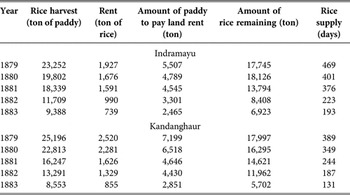
The burden of rent was exacerbated by the added demand to provide gunny bags for packing the rice, something the peasants found taxed their slender money income even further. The task of transporting rice to the district stores and from there to the main store in Pasekan district for shipment, all making use of compulsory public labour services, albeit in return of a small wage, was also burdensome.Footnote 113 The additional expense, time and labour weighed heavily on peasants who endured so much hardship to cultivate rice with inadequate manpower, cattle and funds, only to find the greater portion of their rice harvest being taken away from them every year. The majority of peasants would have been discouraged from increasing rice production under such circumstances, knowing very well they could not enjoy any more than bare subsistence needs of their families. Many peasant families probably did not have much rice left after paying the land rent even under normal circumstances. Successively smaller rice crops had a devastating impact on the local peasantry, particularly when the greater part of the rice crop was spent to pay the land rent, reducing the food supply by half in 1883 (Table 6).
Rice production, land rent and amount of rice available for consumption, 1879–83

Notes: One pikul of paddy yielded 57.5 kati normal rice and between 30 and 35 kati superior quality rice, depending on the state of the crop. In calculating the amount of paddy required to pay the land rent, the rate of 35 kati superior quality rice is used for the 1879–81 period and the rate of 30 kati superior quality rice is used for the 1882–83 period. In calculating the amount of rice for consumption, it is assumed that 0.7 kati of rice was sufficient per person per day.
Sources: Heyting, ‘Rapport omtrent den toestand, vooral der particuliere landerijen Kandang Hauer en Indramajoe west in het algemeen, als omtrent de aldaar aanwezige voedingsmiddelen in het bijzonder’, ‘Monographie Indramajoe west’ and ‘Monographie Kandanghauer’.
The figures for rice production and land rent appear to be more or less correct, for they agree with the figures given in other official documents. The amount of paddy required to pay the land rent, however, should have been higher and consequently the amount of rice available for consumption should have been smaller, given the fluctuating rice crop and its varying quality, which forced peasants to spend more than the usual amount of paddy to obtain enough superior quality rice to pay the land rent. The collection of land rent in superior quality rice, notwithstanding the adverse conditions affecting rice production, most probably made a subsistence crisis inevitable when forces beyond peasants' control threatened rice production.
The land rent had been increasing for some years before the subsistence crisis; it rose from f.60,000 in 1870 to f.70,000 in 1880.Footnote 114 The amount of land rent collected declined sharply in the following three years – f.56,000 in 1881, f.41,000 in 1882 and f.32,000 in 1883 – but began to rise steadily thereafter bearing witness to the landlords' hard position in collecting the land rent. They made good their losses during the previous three years by collecting nearly 90 per cent of the land rent collected before the subsistence crisis. The landlords probably began collecting increasing quantities of rice in the 1870s to meet the growing demand for rice in Europe as well as in Java, against the background of buoyant private enterprise in commercial agriculture in the Dutch East Indies.Footnote 115 They probably lost sight of the fact that rice production in their domains had been falling and was barely enough to feed the population after paying the land rent in prime quality rice even under normal circumstances. Times were anything but normal in the early 1880s, as the cattle population was decimated with the concomitant result of declining area of land planted under in rice. The collection of land rent as usual, let alone an effort to increase it to satisfy the growing demand for rice in the lucrative European market, exacerbated the difficulties in food supply encountered by people with no other source of income to weather a subsistence crisis.
Conclusion
The subsistence crisis in west Indramayu was merely an aberration in Dutch colonial economic policy if one accepts that it had a carefully devised mechanism to safeguard the subsistence needs of indigenous people as argued by Scott and Geertz. The idea that the colonial state preserved the subsistence peasant economy calls for a radical revision in light of the extent to which it was commercialised and the indigenous peasants' inability to derive a greater degree of economic prosperity from commercialisation of economy, probably due to the constrains within which the market economy developed under colonial rule, weakening the weight attached to the colonial state's adherence to safeguarding the subsistence needs of people.
The famine is also difficult to explain satisfactorily in terms of Sen's famine trajectory as defined by a sudden deterioration of exchange entitlements affecting certain groups of people dependent on the market for their food supply. A subsistence crisis in a community of primary producers with access to land such as in west Indramayu is more satisfactorily explained by analysing the dynamics of the subsistence peasant economy.
The private domains of Indramayu and Kandanghaur had a turbulent history from the beginning, marked by constant complaints of abuse of power and uprisings against atrocities of the landlords. But it is difficult to explain the famine of 1883–84 in simplistic terms of abuse of power on the part of landlords and their agents and much less by natural disasters, which no doubt exacerbated the difficulties of peasants trying to survive being confined within a narrow subsistence economy.
The landlords of Indramayu and Kandanghaur domains remained steadfastly faithful to the idea of allowing the inhabitants of their domains to grow rice for sale locally and overseas, whereas the landlords of private domains elsewhere in west Java allowed a degree of freedom to the inhabitants of their domains to grow a range of products for sale. West Indramayu was suitable for only two crops, rice and sugar. Whereas rice cultivation could be left to the indigenous people, sugar cultivation required technology, capital and entrepreneurial skills, in addition to a large administrative apparatus beyond the reach of individual landlords trying to derive as much profits as possible from their modest investments. Therefore the landlords of Indramayu and Kandanghaur private domains were reluctant to diversify agriculture in their domains and concentrated on producing rice for sale.
The subsistence rice economies are, however, not monolithic. They in fact encompass a wide range of economic activity outside agriculture, which supplements the income of peasant families and stimulates economic growth as evinced by the situation elsewhere in Java, where domestic industries and petty trade played a major role in the economic life of rice-growing communities in the middle decades of the nineteenth century. The inhabitants of west Indramayu were not engaged in non-agricultural economic activities, had very little extra income with which to survive in times of crop failures and enjoyed a very low level of well-being compared to the inhabitants of adjacent areas, where people had ample means of earning a money income from a wide range of economic activities outside agriculture.
The land rent was the means by which the landlords exacted a share of agricultural produce sanctioned by law. The size of the land rent and how it should be collected were vaguely defined by regulations, so the landlords exercised a considerable degree of freedom in collecting it. The land rent was assessed arbitrarily and often collected in polished rice of full grain, which more than doubled the amount of paddy required to pay the land rent. This state of affairs introduced an element of uncertainty into peasant economic life, for the peasants could not be certain of the portion of rice crop they could enjoy after paying the land rent. It was, furthermore, collected regardless of the difficulties peasants encountered from time to time, and minor officials added a small commission to the tax for their own benefit, reducing even further the amount of rice at the disposal of peasant households. There was little rice peasants could sell for cash money to meet the expenses of their material needs, and their ability to earn any cash income from other economic activities, which required them to be away from home, was severely curtailed by the demand for corvée labour services. The local economy was consequently depressed and people remained firmly entrenched in the subsistence rice cultivation.
The land rent was not burdensome as long as rice production was bountiful and enough to satisfy the needs of the landlords and peasants, a state of affairs that appears to have lasted well into the 1850s. The situation changed as the population growth accelerated while rice production remained static or increased very little in the following three decades, just when the landlords felt a greater sense of urgency to gather more rice for sale against the background of greater freedom allowed to private enterprise in the Dutch East Indies.
Peasants now found themselves consuming their stockpiles of rice saved from earlier harvests in order to fill the deficiency caused by more rice being spent to pay the land rent. The rice cultivation was seriously affected by the destruction of cattle and crop failures after 1880. The local peasantry was dependent on the landlords' good offices to borrow rice and credit, but its pleas for help in its current plight went unheeded by the landlords and their agents who were so engrossed in exporting rice in increasing quantities. There was no shortage of rice for sale in the markets, but people in west Indramayu were too impoverished to buy rice at the prevailing high prices. The relief measures organised by Heyting, as some contemporary observers noted, prevented people dying of hunger.Footnote 116 The peasants in west Indramayu had been trying hard to produce enough rice to meet their needs and to pay the land rent under the difficult circumstances of rising population against the static area of land under cultivation. The famine brought to the surface the structural weaknesses of local subsistence economy. Peasants' efforts to maintain a precarious balance in subsistence needs by resorting to a regime of population homeostasis was somewhat successful, but it did not minimise the risk of subsistence crises under adverse conditions and against increasing demands on the rice supplies made by the landlords. The last frontier of indigenous economy that came to be commercialised was the Indramayu region, which was the foremost example of commercial rice-producing area in Java. The plight of peasants in west Indramayu trying to safeguard their livelihood worsened with the rapid commercialisation of rice local industry, which apparently prevented them from being successful players in a market economy, because of the distorted ways in which market economic forces were allowed to operate, in the first four decades of the twentieth century. That state of affairs, explored in a sequel study, calls for a revision of the notion that the Dutch colonial state consistently ensured the subsistence needs of the indigenous population while exploiting their land and labour for its own ends.