





Introduction
A diverse early Miocene fauna (Mammal Neogene Zone 3 = MN3) was reported from the Negev district of Israel during the 1960s to 1980s (Neev, Reference Neev1960; Savage and Tchernov, Reference Savage and Tchernov1968; Goldsmith et al., Reference Goldsmith, Tchernov, Ginsburg, Tassy and Van Couvering1982, 1988; Tchernov et al., Reference Tchernov, Ginsburg, Tassy and Goldsmith1987). The fossil assemblages collected in the Negev Desert (Fig. 1) represent an important record for the paleobiogeography and evolution of early Neogene mammals occupying the area located in the Levantine corridor, between Africa and Eurasia (Tchernov et al., Reference Tchernov, Ginsburg, Tassy and Goldsmith1987; López-Antoñanzas et al., Reference López-Antoñanzas, Gutkin, Rabinovich, Calvo and Grossman2016; Grossman et al., Reference Grossman, Calvo, López-Antoñanzas, Knoll, Hartman and Rabinovich2019).
Location and geological map of Miocene deposits in Israel. (1) Location map of all Miocene outcrops in Israel and adjacent countries: the two largest southern exposures of the Hazeva Formation are along the Arava Rift Valley and in the northern Negev, the elevation model (DEM) is based on Hall (Reference Hall1997); geological mapping is based on Sneh et al. (Reference Sneh, Bartov and Rosensaft1998); (2) geological map of the synclinal basins and cut-and-fill exposures of the Hazeva Formation in the northern Negev; site localities: Oron junction (OR), Anthracothere Hill (AH), Kamus junction (KJ), and Mamshit; coordinate system: Israel Transversal Mercator projection; (3) Hazeva Formation members emphasized in a Landsat image: red-colored sandstones and clays of the Rotem Member against the dark conglomerate of the Hufiera Member.

In recent years, a new project was launched in which new Miocene localities were found and the older collected fauna was revised (López-Antoñanzas et al., Reference López-Antoñanzas, Gutkin, Rabinovich, Calvo and Grossman2016; Grossman et al., Reference Grossman, Calvo, López-Antoñanzas, Knoll, Hartman and Rabinovich2019). The current contribution includes both elements that were published previously (Tchernov et al., Reference Tchernov, Ginsburg, Tassy and Goldsmith1987, p. 295–296) and new elements found during the faunal revision.
The reconstructed geological setting is based on a terrestrial fluviatile and lacustrine sedimentary unit, the Hazeva Formation (Calvo and Bartov, Reference Calvo and Bartov2001), which was deposited during the early to middle Miocene (Zilberman and Calvo, Reference Zilberman and Calvo2013; Bar and Zilberman, Reference Bar and Zilberman2016). This formation is preserved in the Negev mainly in synclinal basins and in cut-and-fill channels, while in the Arava and the Central Negev, it is exposed mainly in tectonically subsided blocks (Fig. 1). Large drainage systems flowed from inland areas in the southeast, toward the Neo-Tethys shoreline, which was located during the early to middle Miocene in today's Be'er Sheva area (Fig. 1.1) (Gvirtzman and Buchbinder, Reference Gvirtzman and Buchbinder1969). Estuarine oyster reefs are found within the Hazeva Formation in the Yeroham-Dimona basin (e.g., the Mamshit site; Margaritz, Reference Margaritz1972; Goldsmith et al., Reference Goldsmith, Hirsch, Friedman, Tchernov, Derin, Gerry, Horowits and Weinberger1988), attesting to occasional marine transgressions. The Hazeva Formation consists mostly of fluvial, fine- to coarse-grained sandstones, shale, and conglomerates, with some lacustrine marls and limestone (Calvo and Bartov, Reference Calvo and Bartov2001). It is stratigraphically subdivided into six members (Shahaq, Mashaq, Gidron, Zefa, Rotem, and Hufeira), but also could be subdivided into three litho-tectonic units (Calvo and Bartov, Reference Calvo and Bartov2001). The upper litho-tectonic unit (“the syntectonic unit”) consists of the Rotem and the Hufeira members. The Rotem Member contains low- and high-energy alluvial facies represented by cycles of conglomerate, sand, silt, and clay. The differences between the lithological units of the Rotem and Hufeira members are clearly seen in Figure 1.3. The Oron junction site (OR) is located within the red sandstone and shales at the base of the Rotem Member. The Anthracothere Hill site (AH) is located within the coarse-grained white sandstones at the top of the Rotem Member, just below the Hufeira Member. Recently, rodents and anthracothere remains were reported from the AH site and the Kamus junction site (KJ), respectively (López-Antoñanzas et al., Reference López-Antoñanzas, Gutkin, Rabinovich, Calvo and Grossman2016; Grossman et al., Reference Grossman, Calvo, López-Antoñanzas, Knoll, Hartman and Rabinovich2019). Those sites are located along one of the main drainage systems that crossed the elevated anticlines within cut-and-fill channels. Two of them are clearly seen in Figures 1.2 and 1.3. Based on the geomorphological relationships between episodes of marine invasion and terrestrial erosion in the Be'er Sheva area, Bar and Zilberman (Reference Bar and Zilberman2016) concluded that deposition of the Hazeva Formation ended before ca. 16–14 Ma.
The fauna from the Negev comprises a mix of taxa with an African origin (e.g., Prodeinotherium, Gomphotherium) and taxa with an Eurasian origin (e.g., Eotragus, Listriodon, Dorcatherium) (Tchernov et al., Reference Tchernov, Ginsburg, Tassy and Goldsmith1987; Grossman et al., Reference Grossman, Calvo, López-Antoñanzas, Knoll, Hartman and Rabinovich2019). Further, the age of the fauna corresponds with the beginning of the Orleanian Land Mammal Age and the African-Eurasian faunal interchanges of the first dispersal linked to the Proboscidean Datum Event, with the renewal of Agenian faunas and the extinction of the last Oligocene taxa in Europe (Tassy, Reference Tassy, Lindsay, Fahlbusch and Mein1990; Gentry et al., Reference Gentry, Rössner, Heizmann, Rössner and Heissig1999; Made, Reference van der Made, Rössner and Heissig1999; Koufos et al., Reference Koufos, Zouros and Mourouzidou2003; Antoine and Becker, Reference Antoine and Becker2013; Scherler et al., Reference Scherler, Mennecart, Hiard and Becker2013; Sen, Reference Sen2013).
Despite its undisputable importance, the fossil fauna from the Negev has hardly been investigated or revised since the work of Tchernov et al. (Reference Tchernov, Ginsburg, Tassy and Goldsmith1987). Recently, a new project was launched to revise the old collections (López-Antoñanzas et al., Reference López-Antoñanzas, Gutkin, Rabinovich, Calvo and Grossman2016), and survey and excavate new localities. Since then, new rodent taxa were recognized in the old collections (López-Antoñanzas et al., Reference López-Antoñanzas, Gutkin, Rabinovich, Calvo and Grossman2016) and new species, such as the anthracotheriid Sivameryx, were described from new collections (Grossman et al., Reference Grossman, Calvo, López-Antoñanzas, Knoll, Hartman and Rabinovich2019), highlighting the role of the corridor in intercontinental faunal dispersals and the need for the work underway.
As part of this effort, we describe here and revise the rhinocerotid material collected from the Rotem and Yeroham basins in the Negev of Israel (Fig. 1.3). This revision includes an update of the systematic attribution of the studied material and suggests a new framework for the paleobiogeography and dispersal of Rhinocerotina between and within Africa and Eurasia during the early Neogene.
Localities assigned to the Paleogene-Neogene transition and the Miocene are poorly documented in the Levantine Corridor and neighboring areas, with only a few of these yielding remains of Rhinocerotidae. In northern Africa, brachypotheres have been reported from the early Miocene sites of Jebel Zelten (Libya) and Moghara (Egypt) (Fourtau, Reference Fourtau1920; Hamilton, Reference Hamilton1973; Hamilton et al., Reference Hamilton, Whybrow and McClure1978; Geraads, Reference Geraads, Werdelin and Sanders2010). In Saudi Arabia, Rhinocerotidae are recorded from the early middle Miocene (MN5) Dam Formation at Ad Dabtiyah, which yielded remains of an indeterminate species of “dicerorhine” (i.e., two-horned rhinocerotine) and of a brachypothere (Gentry, Reference Gentry and Whybrow1987), and at Al-Sarrar, which yielded remains of an indeterminate species of acerathere and scanty remains of an indeterminate species of a dicerorhine (Thomas et al., Reference Thomas, Sen, Khan, Battail and Ligabue1982). Several early Neogene Rhinocerotidae taxa are reported from areas farther away from the Levantine Corridor.
In Western Europe, early Neogene rhinocerotids are represented by five genera and seven species belonging to the Rhinocerotinae that are endemic to different geographic areas (Antoine et al., Reference Antoine, Bulot and Ginsburg2000; Antoine and Becker, Reference Antoine and Becker2013). The records of Rhinocerotinae incertae sedis (usually called aceratheres sensu lato) and Teleoceratina extend at least to the early Miocene (some genera since the Oligocene), whereas Rhinocerotina occur for the first time in Europe during the late early Miocene with Lartetotherium (MN4) (Guérin, Reference Guérin1980; Heissig, Reference Heissig, Peigné and Sen2012). The record from South Asia includes numerous genera and species from various sites (i.e., Chitarwata Formation, Bugti Hills, Pakistan; Métais et al., Reference Métais, Antoine, Baqri, Marivaux and Welcomme2009; Antoine et al., Reference Antoine, Downing, Crochet, Duranthon, Flynn, Marivaux, Métais, Rajpar and Roohi2010). This region is characterized by the occurrence of several taxa such as the aceratheres s.l. (Pleuroceros, Mesaceratherium, Plesiaceratherium, Protaceratherium), and by the presence of teleoceratines (Brachypotherium and Prosantorhinus) (Métais et al., Reference Métais, Antoine, Baqri, Marivaux and Welcomme2009; Antoine et al., Reference Antoine, Downing, Crochet, Duranthon, Flynn, Marivaux, Métais, Rajpar and Roohi2010; Antoine, Reference Antoine, Badgley, Pilbeam and Morganin press). In addition, some endemic taxa, such as the elasmotheriine Bugtirhinus praecursor Antoine and Welcomme, Reference Antoine and Welcomme2000, and the rhinocerotinans Gaindatherium cf. G. browni Colbert, Reference Colbert1934, and cf. Rhinoceros, are also documented in South Asia (Métais et al., Reference Métais, Antoine, Baqri, Marivaux and Welcomme2009; Antoine et al., Reference Antoine, Downing, Crochet, Duranthon, Flynn, Marivaux, Métais, Rajpar and Roohi2010; Antoine, Reference Antoine, Badgley, Pilbeam and Morganin press). Recently, Pleuroceros, Protaceratherium, and Bugtirhinus were also identified in lower Miocene deposits of Southeast Asia (ca. MN3, Thailand; Prieto et al., Reference Prieto, Antoine, Made, Metais, Schneider, Vasilyan and Boehme2018). In Africa, the record of Rhinocerotidae extends to ca. 20 Ma, comprising endemic taxa, such as the large rhinocerotinans Rusingaceros leakeyi (Hooijer, Reference Hooijer1966) and “Diceros” australis Guérin, Reference Guérin2000, the elasmotheriines Chilotheridium pattersoni Hooijer, Reference Hooijer1971, Turkanatherium acutirostratum Deraniyagala, Reference Deraniyagala1951, and Ougandatherium napakense Guérin and Pickford, Reference Guérin and Pickford2003 (Geraads, Reference Geraads, Werdelin and Sanders2010; Geraads et al., Reference Geraads, Lehmann, Peppe and McNulty2016), and the teleoceratines Brachypotherium snowi Fourtau, Reference Fourtau1920 and B. minor Geraads and Miller, Reference Geraads and Miller2013 (Geraads and Miller, Reference Geraads and Miller2013; Grossman et al., Reference Grossman, Liutkus-Pierce, Kyongo and M'Kirera2014). Despite this rich record, less is known of Rhinocerotina (taxa most-closely related to the extant rhinoceroses), including their species distribution and their origin compared to other groups of the family Rhinocerotidae.
Materials and methods
The fragile rhinocerotid remains from the Negev are curated and housed at the National Natural History Collections of The Hebrew University of Jerusalem (Israel). We base the comparisons on direct observations of the fossils, as well as published material on early and early middle Miocene rhinocerotids. We base our comparisons on the characters codified by Antoine et al. (Reference Antoine, Duranthon and Welcomme2003, Reference Antoine, Downing, Crochet, Duranthon, Flynn, Marivaux, Métais, Rajpar and Roohi2010) for several early Neogene rhinocerotids, such as Pleuroceros, Diaceratherium, Brachypotherium, Protaceratherium, Prosantorhinus, Lartetotherium, Plesiaceratherium, Mesaceratherium, and Bugtirhinus. Among published works, we consulted: Hooijer (Reference Hooijer1966) for Rusingaceros and Turkanatherium; Heissig (Reference Heissig1972) for Rhinocerotini indet. = Gaindatherium sp.; Cerdeño (Reference Cerdeño1986, Reference Cerdeño1992, Reference Cerdeño1996a) for Lartetotherium; Cerdeño (Reference Cerdeño1993) for Brachypotherium and Diaceratherium; Cerdeño (Reference Cerdeño1996b) for Prosantorhinus; Santafé-Llopis et al. (Reference Santafé-Llopis, Casanovas-Cladellas and Belinchon1987) for “Dicerorhinus montesi” Santafé-Llopis, Casanovas-Cladellas, and Belinchon, Reference Santafé-Llopis, Casanovas-Cladellas and Belinchon1987 = Lartetotherium montesi in Cerdeño and Nieto (Reference Cerdeño and Nieto1995); Antoine (Reference Antoine1997, Reference Antoine2002) for Hispanotherium beonense (Antoine, Reference Antoine1997); Guérin (Reference Guérin2003) for “Diceros” australis and Chilotheridium pattersoni; Antoine et al. (Reference Antoine, Downing, Crochet, Duranthon, Flynn, Marivaux, Métais, Rajpar and Roohi2010) for Pleuroceros blanfordi Antoine et al., Reference Antoine, Downing, Crochet, Duranthon, Flynn, Marivaux, Métais, Rajpar and Roohi2010 and Mesaceratherium welcommi Antoine et al., Reference Antoine, Downing, Crochet, Duranthon, Flynn, Marivaux, Métais, Rajpar and Roohi2010; Heissig (Reference Heissig, Peigné and Sen2012) for Lartetotherium and Hoploaceratherium; and Becker and Tissier (Reference Becker and Tissier2020) for Hispanotherium, Plesiaceratherium, and Lartetotherium. We made direct observations on juvenile mandibles and teeth and postcranial remains of Brachypotherium and Hoploaceratherium from the Czujan sandpit (Czech Republic; Březina et al., Reference Březina, Luján and Ivanov2017; MMB), of Rhinocerotinae indet. from the Dam Formation at Ad Dabtiyah (Saudi Arabia; Gentry, Reference Gentry and Whybrow1987; NHMUK), Diaceratherium from Chilleurs-aux-Bois (France; NHMUK), Hoploaceratherium and Lartetotherium from Sansan (France; NHMUK, NMB) and several Spanish localities (MNCN), Protaceratherium minutum (Cuvier, Reference Cuvier1822) from the Paris Basin (France; MGGC), and Bugtirhinus from the Bugti Hills (Pakistan; NHMUK). Classification above genus level follows Antoine et al. (Reference Antoine, Downing, Crochet, Duranthon, Flynn, Marivaux, Métais, Rajpar and Roohi2010). Description of postcranial remains is based on Guérin (Reference Guérin1980) and Antoine (Reference Antoine2002). We measured the studied specimens using a digital caliper. Measurements and comparative tables are in Supplementary Data 1.
Repositories and institutional abbreviations
HUJI, National Natural History Collections of The Hebrew University of Jerusalem, Jerusalem (Israel); MGGC, Museo Geologico Giovanni Capellini, Bologna (Italy); MMB, Moravian Museum, Brno (Czech Republic); MNCN, Museo National de Ciencias Naturales, Madrid (ES); NHMUK, The Natural History Museum, London (UK); NMB, Naturhistorisches Museum, Basel (Switzerland).
Anatomical and morphometrical abbreviations
APD, antero-posterior (mesio-distal) diameter; C6, sixth cervical vertebra; DAPD, distal antero-posterior diameter; DTD, distal transversal diameter; DTPA, proximal transverse diameter of the articular surface; M/m, upper/lower molar; max, maximal; min, minimal; mt, metatarsal; P/p, upper/lower premolar.
Systematic paleontology
Order Perissodactyla Owen, Reference Owen1848
Superfamily Rhinocerotoidea Gray, Reference Gray1825
Family Rhinocerotidae Gray, Reference Gray1821
Subfamily Rhinocerotinae Gray, Reference Gray1821
Tribe Rhinocerotini Gray, Reference Gray1821
Subtribe Teleoceratina Hay, Reference Hay1902
Genus Brachypotherium Roger, Reference Roger1904
Type species
Brachypotherium brachypus (Lartet, Reference Lartet1837).
Brachypotherium cf. B. snowi Fourtau, Reference Fourtau1920
Figures 2, 3, Supplementary Data 1, 2
Description
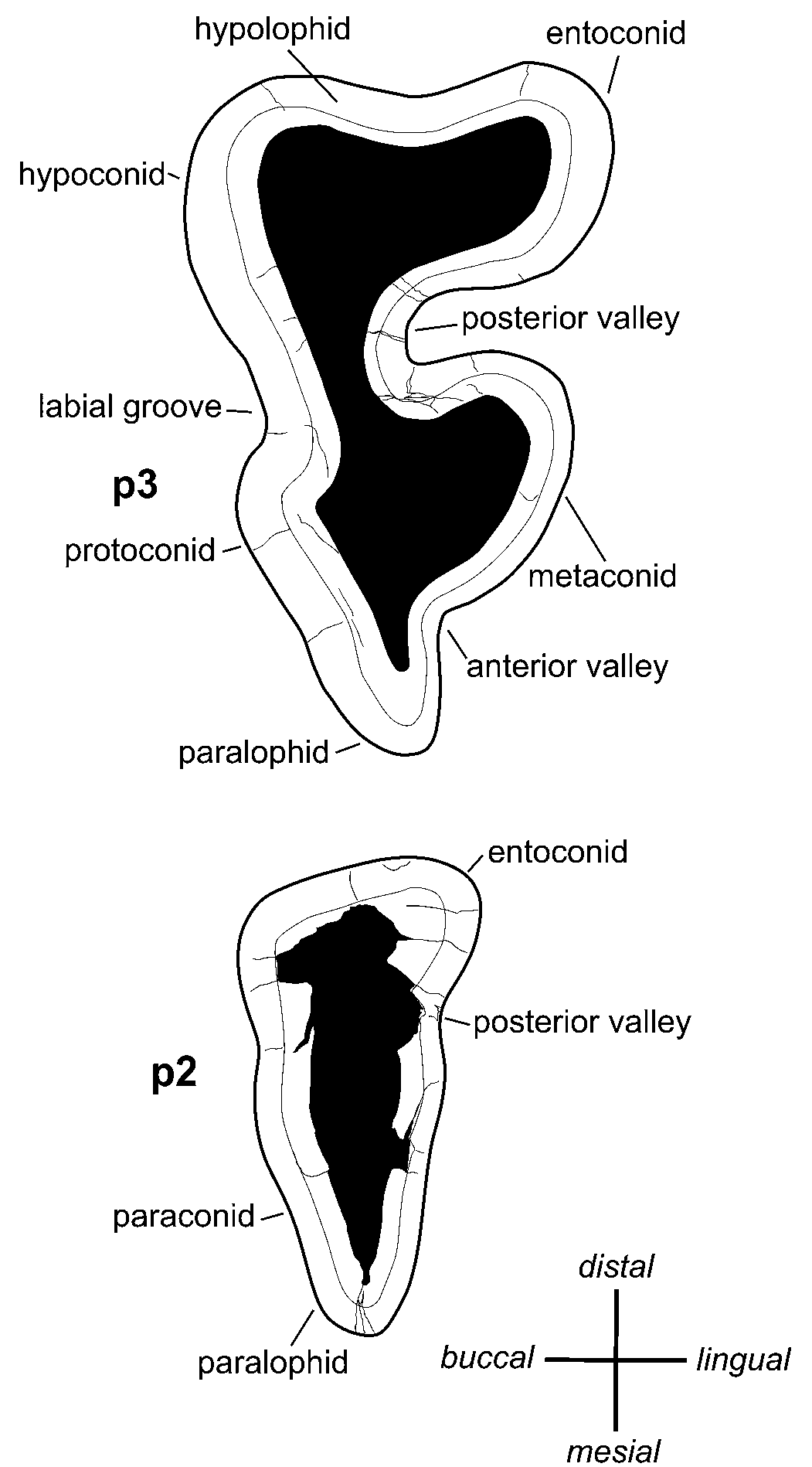
AH 1458 includes part of the left horizontal ramus, including the unerupted p2, erupting p3, and the roots of dp3 and a part of dp4 (Fig. 2.1). The fragment extends mesially, terminating past the large mental foramen that is easily discerned in buccal view (Fig. 2.2) below the anterior portion of dp3. In lingual view (Fig. 2.3), due to the state of preservation of the specimen, it is difficult to ascertain the morphology of the lingual groove of the mandible. An erupting p3 (L max = ~40 mm) and a premolar bell of p2 (L max = ~27.5 mm; TD = ~14.5 mm) are evident inside the mandible (Fig. 2; Supplementary Data 2, 3). The lingual valleys of the two teeth are V-shaped, and the lingual and labial cingula are absent (Supplementary Data 2, 3). On p2 (Fig. 3), the anterior lingual valley is absent, the paralophid is long and simple, and the paraconid is developed. On p3 (Fig. 3), there is a distal cingulum, the lingual groove is marked and reaches the base of the crown, the paralophid is straight and does not reach the lingual rim of the tooth, and the metaconid and entoconid are not constricted.
Brachypotherium cf. B. snowi left hemimandible HUJI AH 1458 from the Negev, Israel. (1–3) Occlusal, buccal, and lingual views. Scale bars = 5 cm.

Brachypotherium cf. B. snowi left hemimandible (reversed) HUJI AH 1458 from the Negev, Israel; p2 (length ~27.5 mm) and p3 (length ~40 mm) drawings from CT slides (Supplemental Figure S1).
Materials
A partial left hemimandible of a juvenile individual, AH 1458.
Remarks
Bugtirhinus differs from AH 1458 by its more hypsodont teeth and much smaller size (see Antoine et al., Reference Antoine, Downing, Crochet, Duranthon, Flynn, Marivaux, Métais, Rajpar and Roohi2010). Turkanatherium acutirostratum has proportionally shorter and wider p3 and narrower lingual valleys (Hooijer, Reference Hooijer1966, pl. 9, fig. 4). Aceratheres have narrower lingual valleys. Contrary to Chilotheridium from Loperot, the labial groove on the p3 of AH 1458 is shallower (cf., Hooijer, Reference Hooijer1971). Rhinocerotines differ from AH 1458 by a curved and lingually flexed paralophid of the p3. A juvenile mandible of Lartetotherium from Relea (middle Miocene, Spain: MNCN NM18102) differs from the studied specimen by its U-shaped lingual valleys and postero-lingually bent paralophids on the p3. Lower teeth of G. browni described by Heissig (Reference Heissig1972) from Nagri have narrower lingual valleys; in addition, in G. browni, the lingual groove of the p3 does not reach the base of the crown and the paralophid is curved. In “Aprotodon” fatehjangense (Pilgrim, Reference Pilgrim1910) the labial groove of p3 does not reach the base of the crown, labial and lingual cingula are present, and the paralophid on p2 is curved (Heissig, Reference Heissig1972; Antoine et al., Reference Antoine, Duranthon and Welcomme2003). In B. brachypus the paraconid on p2 is reduced, the labial cingulum on the premolars is reduced and the metaconid is constricted; in general, the teeth are shorter and wider than on the Negev specimens. In B. perimense (Falconer and Cautley, Reference Falconer and Cautley1846) the lingual groove of p3 is smooth and does not reach the base of the crown, the lingual valleys are U-shaped whereas the paraconid is reduced (Heissig, Reference Heissig1972; Antoine et al., Reference Antoine, Reyes, Amano, Claude, Bautista, Vos and Ingicco2021). In B. minor, the paralophid of p3 is short and curved and the paraconid reduced (Geraads and Miller, Reference Geraads and Miller2013). In B. snowi from Jebel Zelten and Moghara (LP, personal observation at NHMUK, 2013; Fourtau, Reference Fourtau1920; Hamilton, Reference Hamilton1973), similar to AH1458, the p2 is long and narrow (L max = 27 mm; TD = 17 mm; Hamilton, Reference Hamilton1973), the p3 has a marked labial groove that extends to the base of the crown, the hypolophid and metalophid are well developed, and the paralophid is straight (not flexed lingually).
Subtribe Rhinocerotina Gray, Reference Gray1821
Rhinocerotina indet.
Description
The tooth fragment (OR 1008) displays rough enamel and is a fragment of the protocone of an upper molar. The cone is enlarged at the base (APD = ~1.7 mm) and the mesial cingulum is partially preserved. A weak cingulum is present on the distal side of the cone (the entrance of the median valley), similar in height to the mesial cingulum.
The vertebra C6 (AH 2068) is missing the right transverse process and the spinous process (Fig. 4.1). In anterior view (Fig. 4.1), the left transverse process is well developed and massive, with evident (but badly preserved) dorsal (laterally directed) and ventral (ventrally directed) tubercles. The process is perforated by an elliptical transverse foramen, with its major axis oblique with respect to the major dorsal-ventral axis of the bone. The anterior articular head of the vertebral body is elliptical, with the main axis parallel to that of the bone; its ventral border is convex. The posterior articular surface of the vertebral body is subcircular (Fig. 4.2), wider than the anterior one, and slightly concave. The angle between the dorsal side of the transverse process and the ventral side of the vertebral arch is <90°. The anterior articular processes are directed upward and the angle with the spinous process is very sharp. The vertebral canal is taller than it is wide, with a concave ventral border and a very sharp dorsal border. In anterior view, the anterior articular surface of the vertebral body is squarer, particularly its dorsal part. In lateral view, the anterior dorsal process is less extended anteriorly than the articular surface, whereas the posterior dorsal process is slightly more posteriorly extended than the posterior articular surface. The anterior articular surface of the vertebral body is more dorsally placed on the vertebral body with respect to the posterior one.
Rhinocerotidae remains from the Negev, Israel. (1, 2) HUJI AH 2068, sixth cervical vertebra, anterior and posterior views; (3, 4) HUJI OR 1046, distal humerus, anterior and distal views; (5, 6) HUJI OR 1044, ulna, anterior and lateral views; (7, 8) HUJI OR 1043, tibia, anterior and distal views; (9) HUJI OR 1009, distal mtIII, anterior view. Scale bars = 5 cm.

Materials
A fragment of a right protocone of an upper tooth (misidentified as P1 in Tchernov et al., Reference Tchernov, Ginsburg, Tassy and Goldsmith1987), OR 1008; a fragmentary cervical vertebra (sixth), AH 2068.
Remarks
It is very difficult to assign a fragment of a tooth to a well-defined genus or species. Nevertheless, a comparison with several upper teeth of early Miocene Rhinocerotidae enables several considerations. (1) A mesial cingulum and a weak cingulum at the entrance of the median valley of OR 1008 resembles the protocone of an M3 from Rusinga (NHMUK M32951); also, as in OR 1008, the protocone on NHMUK M32951 is antero-posteriorly enlarged; an M1 from Rusinga (NHMUK M32946) exhibits a protocone with similar characteristics as well. (2) The protocones of the upper molars of Brachypotherium brachypus from Villefranche d'Astarac (NHMUK 33522) have a continuous lingual cingulum and lack the weak cingulum along their distal side. (3) The protocones of isolated M2 (NHMUK M29269) and M3 (NHMUK M29254) from Jebel Zelten, assigned to Brachypotherium snowi, have a flattened lingual side and show no trace of a cingulum on the distal side. (4) The molars of Bugtirhinus praecursor from the early Miocene of Bugti Hills have a narrower protocone (NHMUK; Antoine and Welcomme, Reference Antoine and Welcomme2000), and are more flattened on the lingual side; the same is true for Prosantorhinus molars from Sandelzhausen (Cerdeño, Reference Cerdeño1996b) as well. (5) The protocone of a M3 from Ad Dabtiyah (NHMUK 36897), identified as ?Dicerorhinus sp. aff. D. sansaniensis (Lartet, Reference Lartet1851), resembles OR 1008 because it is inflated and has a mesial cingulum, but differs from the Negev specimen because it lacks the weak cingulum on the distal side.
Thus, pending discovery of more dental material from the early Miocene of Israel and considering the similarities with the material from Rusinga and Ad Dabtiyah, we tentatively refer OR 1008 to Rhinocerotina indet.
Very few cervical vertebrae of Miocene Rhinocerotidae have been published, and thus we can only remark that the size of the sixth cervical vertebra from the Negev (AH 2068) resembles that of Lartetotherium from Sansan and is somewhat larger than that of Hoploaceratherium (Supplementary Data 1, Supplementary Table S1). The neural canal in AH 2068 is proportionally narrower and higher than in Teleoceras (cf., Short et al., Reference Short, Wallace and Emmert2019); the anterior articular processes are more upwardly directed than in Teleoceras and resemble those of Stephanorhinus (Made, Reference van der Made2010, pl. 10). The specimen from the Negev is here tentatively assigned to Rhinocerotina.
Genus Gaindatherium Colbert, Reference Colbert1934
Description
As previously mentioned, the elements are poorly preserved; however, we identified important characteristics permitting detailed comparisons and identification.
Morphological comparison between the distal humerus from the Negev, Israel, and humeri of selected early Miocene rhinocerotids, in anterior view. (1) HUJI OR 1046, cf. Gaindatherium sp. from the Negev, Israel; (2) MGGC 7224, Protaceratherium minutum from the Paris basin; (3) NHMUK M27456, Hoploaceratherium tetradactylum from Sansan; (4) MMB no collection number, Brachypotherium brachypus from the Czujan sandpit. Abbreviations: CE = epicondylar crest; CF = coronoid fossa; DA = distal articular surface (trochlea); G = trochlear notch; LE = lateral epicondyle; LL = lateral lip of the trochlea; ML = medial lip of the trochlea; RF = radial fossa; TM = tuberosity on the medial face. Scale bar = 10 cm.
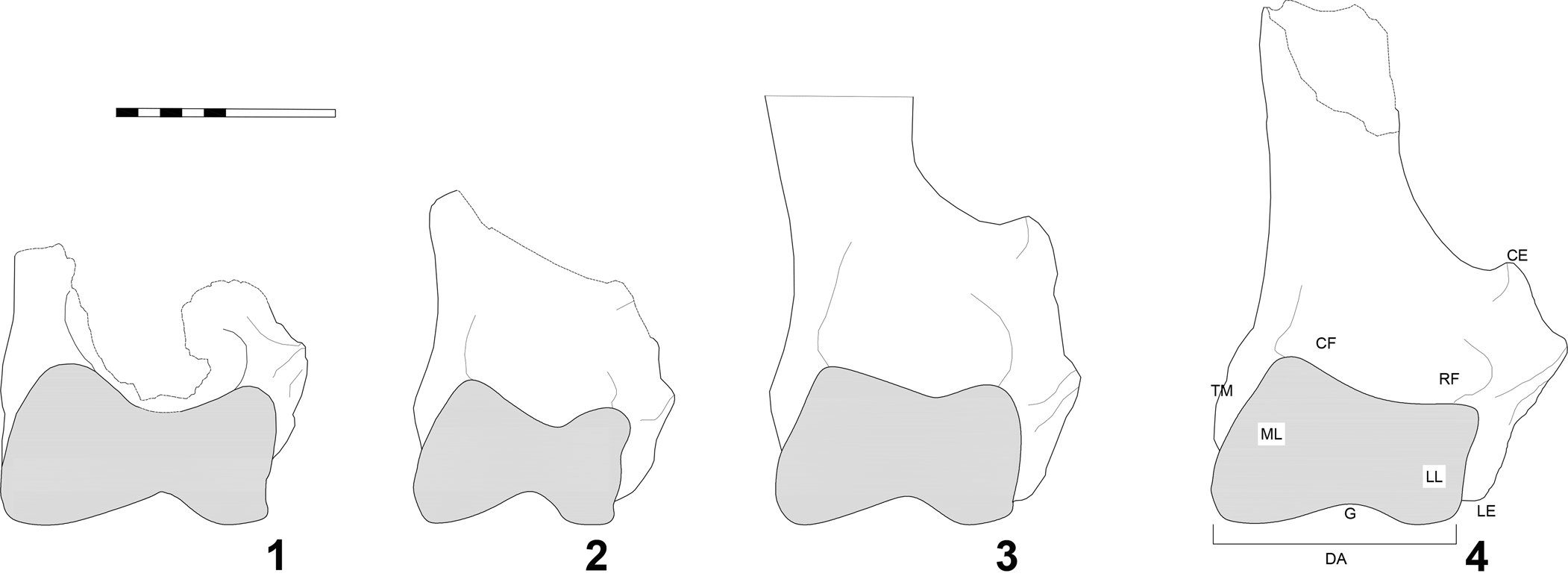
OR 1046 is a distal portion of a left humerus preserving the distal diaphysis and epiphysis. The medial epicondyle is evident in anterior view (Figs. 4.1, 5.1), the medial border of the medial lip of the articular condyle is oblique, whereas the lateral border of the lateral lip is almost straight. The trochlea is asymmetric, the medial lip is more developed and wider than the lateral lip, and the trochlear gorge is deep. The partially preserved coronoid fossa appears well marked and deep; the radial fossa is well marked. The epicondylar crest is weak and the lateral border of the distal epiphysis is oblique. In posterior view, the olecranon fossa is partially preserved, and wider than it is high; the lateral epicondyle is not preserved and the epitrochlea is partially damaged. In medial view, the articular border of the trochlea is smoothly rounded and ends weakly in the proximal-anterior side at the level of the condylar fossa. In distal view (Fig. 4.2), the medial lip of the trochlea is clearly much more developed and wider than the lateral lip.
OR 1044 is a right ulna missing the distal epiphysis and proximal portion of the olecranon process (Fig. 4.5). The olecranon and the diaphysis are aligned (Fig. 4.6) and the proximal articular facets for articulation with the radial head are fused to the shaft of the ulna on both sides. The articular surfaces for the humerus are asymmetric; the medial surface is more elongated proximodistally than the lateral one. The latter is wider and less concave than the medial surface. The diaphysis has a sub-triangular section (Fig. 4). The articular facet of the humerus is worn.
The tibia (OR 1043) is badly preserved. The proximal epiphysis is strongly damaged, but the tibial spine is partially preserved, thus it is possible to estimate the maximal length of the bone (~334 mm). The diaphysis was reconstructed because it was severely damaged (Fig. 4.7); no synostosis appears along the diaphysis. The distal epiphysis is much better preserved than other parts of the bone (Fig. 4.8). The mediodistal gutter is absent. In distal view, the distal articular surface is wider than deep and is less developed than the distal epiphysis. The distal-lateral articular surface is oblique with respect to the anterior border of the distal epiphysis; it is narrower and slightly longer than the distal-medial articular surface (Fig. 4.8). The latter is partially damaged on the medial side and is separated from the lateral surface by an antero-posteriorly concave and transversally convex saddle. The anterior border of the distal epiphysis is sinuous in distal view.
The third metatarsal (OR 1009) displays a smooth and low intermediate relief, and the distal articular surface is transversally smaller than the distal epiphysis (Fig. 4.9). The antero-proximal border of the distal articulation is rounded.
Materials
A portion of a distal left humerus (Tchernov et al., Reference Tchernov, Ginsburg, Tassy and Goldsmith1987), OR 1046; a right ulna missing the distal epiphysis and the proximal part of the olecranon (Tchernov et al., Reference Tchernov, Ginsburg, Tassy and Goldsmith1987), OR 1044; a left tibia with an extremely damaged proximal epiphysis and diaphysis, OR 1043; a left distal third metatarsal (Tchernov et al., Reference Tchernov, Ginsburg, Tassy and Goldsmith1987), OR 1009.
Remarks
With respect to the studied specimen, in Protaceratherium minutum the medial tuberosity of the humerus is more prominent and placed lower on the medial face, the trochlear gorge is narrower and deeper in anterior view, and the epicondylar crest is well developed (Fig. 5.2). Unlike the humerus from the Negev, in the humerus of Pleuroceros blanfordi the olecranon fossa is high, there is a scar on the trochlea, and a distal gutter on the epicondyle is present (Antoine et al., Reference Antoine, Downing, Crochet, Duranthon, Flynn, Marivaux, Métais, Rajpar and Roohi2010). The humeri of Hoploaceratherium tetradactylum (Lartet, Reference Lartet1851) (Fig. 5.3) and Aceratherium incisivum (Cuvier, Reference Cuvier1822) are larger than the humerus from Negev, although the available data are too scarce for an exhaustive morphometrical comparison (Supplementary Data 1, Supplementary Table S2). In distal view (Guérin, Reference Guérin1980, fig. 32), the lateral lip of the distal trochlea is narrower than in the studied specimen and the anterior border of the trochlear gorge is wider. Brachypotherium brachypus and Plesiaceratherium mirallesi (Crusafont, Villalta, and Truyols, Reference Crusafont, Villalta and Truyols1955) display a higher and narrower olecranon fossa with respect to OR 1046 (cf., Antoine et al., Reference Antoine, Downing, Crochet, Duranthon, Flynn, Marivaux, Métais, Rajpar and Roohi2010). In Brachypotherium, the epicondylar crest is much more developed, as is the lateral epicondyle; the distal trochlea is laterally oriented with an oblique lateral lip (Fig. 5.4). Prosantorhinus douvillei (Osborn, Reference Osborn1900) and Diaceratherium aurelianense (Nouel, Reference Nouel1866) have a low olecranon fossa (Cerdeño, Reference Cerdeño1993, pl. 2, fig. 3). In addition, the humerus of Prosantorhinus is smaller than the studied specimen (cf., Cerdeño, Reference Cerdeño1996b) and has a higher distal epicondyle (Cerdeño, Reference Cerdeño1996b, pl. 19, fig. 4). In Diaceratherium, the humeral crest and the epicondylar crest are much more prominent than in the studied specimen, the coronoid fossa is weakly marked, and the lateral epicondyle is more proximal and curved externally. Hispanotherium (Aegyrcitherium) beonense has a much more developed lateral non-articular side of the distal epiphysis (e.g., Antoine, Reference Antoine2002, fig. 198b), the epicondylar crest is more marked, and there is a scar on the trochlea (Antoine, Reference Antoine2002, fig. 199). Hispanotherium grimmi Heissig, Reference Heissig1974, displays a wider distal trochlea with a wider distal epiphysis and medial tuberosity, more prominent in anterior view (Heissig, Reference Heissig1976, fig. 3). In medial view, the articular surface stops well before the anterior border of the condylean fossa. The humerus of the middle Miocene Victoriaceros kenyensis Geraads, McCrossin, and Benefit, Reference Geraads, McCrossin and Benefit2012 (NHMUK M32755; Geraads et al., Reference Geraads, McCrossin and Benefit2012) is much more massive than the Negev specimen and displays a more developed medial tuberosity on the distal epiphysis. The humerus from the Negev is less massive than that of Rusingaceros leakyei, but a detailed morphological comparison is not possible because the distal epiphysis of the Rusinga humerus is damaged (Hooijer, Reference Hooijer1966, pl. 2, fig. 2). Some morphological characters of OR 1046 are shared with Lartetotherium sansaniense from Sansan (Guérin, Reference Guérin1980; Heissig, Reference Heissig, Peigné and Sen2012). In particular, both have a marked crest on the lateral face, lack a central fossa on the medial face, and the coronoid and radial fossae are deep with a well-marked lateral border. Nevertheless, in posterior view, the olecranon fossa of L. sansaniense is narrower than in the specimen from the Negev. “Dicerorhinus montesi” Santafé-Llopis et al., Reference Santafé-Llopis, Casanovas-Cladellas and Belinchon1987, resembles L. sansaniense in having a higher and narrower olecranon fossa than the Negev specimen. The latter closely resembles the humerus from Nagri reported by Heissig (Reference Heissig1972, p. 34) and assigned to Rhinocerotini. The morphology and proportions of the studied humerus also resemble that assigned to ?Dicerorhinus sp. aff. D. sansaniensis and collected at Ad Dabtiyah (Saudi Arabia) (Gentry, Reference Gentry and Whybrow1987; LP, personal observations at NHMUK, 2013).
The described characters allow the studied ulna (OR 1044) to be distinguished from Plesiaceratherium mirallesi which displays an open angle between the diaphysis and the olecranon (cf., Antoine et al., Reference Antoine, Downing, Crochet, Duranthon, Flynn, Marivaux, Métais, Rajpar and Roohi2010). The ulna is more slender than those of “Diceros” australis, Brachypotherium, and Diaceratherium (Supplementary Data 1, Supplementary Table S3). The size of the diaphysis (Supplementary Data 1, Supplementary Table S3) resembles the rhinocerotid from Ad Dabtiyah (NHML M36912) and Lartetotherium from Sansan (Heissig, Reference Heissig, Peigné and Sen2012), but with a smaller DTPA (~58 mm in OR 1044, size ranges between 77–90 mm in Lartetotherium).
The tibia OR 1043 (DAPD = 54.37 mm) is close in size to Lartetotherium from the Vallesian of Spain (DAPD size ranges between 55–62.8 mm), but is smaller than the older Lartetotherium from Sansan (DAPD size ranges between 64.5–70 mm) (Supplementary Data 1, Supplementary Table S4). The studied specimen is more slender and proportionally different from “Diceros” australis, Brachypotherium, Diaceratherium, and Plesiaceratherium. The mediodistal gutter is present in Plesiaceratherium and Pleuroceros and absent in Mesaceratherium. In the latter, the anterior border of the distal epiphysis is straight. The general morphology of the distal articular surface resembles the tibia from Ad Dabtiyah (NHML M3678), and both closely resemble the tibia NMB SS124, assigned to Lartetotherium sansaniense. According to Gentry (Reference Gentry and Whybrow1987), the tibia from Ad Dabtiyah is close to a tibia from Sansan NHML 27458; nevertheless, the latter displays a different morphology of the distal surface (oblique anterior and posterior borders, transversally narrower articular surfaces, lateral distal tuberosity more developed) and belongs to Hoploaceratherium. The tibia of Gaindatherium is unknown at present.
The smooth and low intermediate relief of the distal articular surface of the third metatarsal (OR 1009) distinguishes the specimen from the Negev from Brachypotherium, Diaceratherium, Pleuroceros, Mesaceratherium, Plesiaceratherium, and Prosantorhinus. OR 1009 shares this character with Lartetotherium and the extant taxa (cf., Antoine, Reference Antoine2002, p. 231; Antoine et al., Reference Antoine, Downing, Crochet, Duranthon, Flynn, Marivaux, Métais, Rajpar and Roohi2010, p. 194). The specimen from the Negev (DTD = 45.57 mm; DAPD = 32.15 mm) is anteroposteriorly smaller than Diaceratherium (min-max DAPD = 37–50 mm), is transversally shorter than Brachypotherium (min-max DTD = 59–70.6 mm), Rusingaceros (DTD = ~ 60 mm), and “D.” australis (min-max DTD = 55.5–61.5 mm), and is morphometrically close to the third metatarsals of Lartetotherium reported by Cerdeño (Reference Cerdeño1993, min-max DTD = 43.8–54.5 mm; min-max DAPD = 31–39.6 mm). OR 1009 is slightly smaller than the Lartetotherium from Sansan (Supplementary Data 1, Supplementary Table S5; min-max DTD = 47–53.5 mm; min-max DAPD = 34–40.5 mm) and differs from it in having less-prominent and less-sharp supra-articular tuberosities (Heissig, Reference Heissig, Peigné and Sen2012, fig. 349). The studied specimen is distinct from Rhinocerotini indet. (= Gaindatherium sp.) from Nagri (Heissig, Reference Heissig1972, pl. 25, figs. 1, 2), but it is very similar to Gaindatherium sp. (mtIII Y46571) from the Siwaliks of Potwar Plateau by having blunt and rounded supra-articular tuberosities and a low articular surface in anterior view.
Discussion
Rhinocerotids are documented in several areas of Eurasia and Africa during the early Neogene (Antoine et al., Reference Antoine, Downing, Crochet, Duranthon, Flynn, Marivaux, Métais, Rajpar and Roohi2010; Geraads, Reference Geraads, Werdelin and Sanders2010; Antoine and Becker, Reference Antoine and Becker2013; Lu et al., Reference Lu, Zheng, Sullivan and Tan2016; Fig. 6; Table 1). Nevertheless, early representatives of the subtribe Rhinocerotina (extant species and closely related fossil species) remain scarce compared to genera and species belonging to other rhinocerotid subtribes (Table 1). Consequently, the origin and geographic distribution of this group are still poorly understood. Within this framework, the record of the Negev is particularly important in depicting the dispersal routes of early Neogene Rhinocerotina and the origin and relationships of some taxa. Although the studied specimens consist only of a partial juvenile mandible and incomplete postcranial elements, some morphological and morphometric features allow us to exclude an attribution to aceratheriine and elasmotheiine species commonly documented in Asia (Table 1). Among the early Miocene true rhinoceroses, Rhinocerotina, some specimens from the Negev closely resemble Lartetotherium from Western Eurasia and Gaindatherium from the Siwalik Group. A few morphological characters, such as the shape of the oleocranon fossa in the humerus and of the distal articular surface of mt III, lead us to assign the studied material to cf. Gaindatherium sp.
Early Miocene paleogeographic map (modified from Popov et al., Reference Popov, Rögl, Rozanov, Steininger, Shcherba and Kovac2004) showing selected localities mentioned in the text. (1) The Negev, early Miocene, MN3, Israel; (2) Bugti Hills (Upper Member of Chitarwata Formation), early Miocene, MN2, Pakistan; (3) Moghara, early Miocene, MN3, Egypt; (4) Jebel Zelten, early Miocene, MN3, Libya; (5) Sansan, middle Miocene, MN6, France; (6) Bézian-La Romieu, late early Miocene, MN4, France; (7) Al-Sarrar, middle Miocene, MN5, Saudi Arabia; (8) Ad Dabtiyah, middle Miocene, MN5, Saudi Arabia. The Rhinocerotidae taxa for each locality are listed in Table 1. Mnt = Mountain.

Early Neogene Rhinocerotidae taxa recorded from selected localities mentioned in the text (data from Hooijer, Reference Hooijer1966; Hamilton, Reference Hamilton1973; Guérin, Reference Guérin1980; Thomas et al., Reference Thomas, Sen, Khan, Battail and Ligabue1982; Ginsburg and Bulot, Reference Ginsburg and Bulot1984; Gentry, Reference Gentry and Whybrow1987; Métais et al., Reference Métais, Antoine, Baqri, Marivaux and Welcomme2009; Antoine et al., Reference Antoine, Downing, Crochet, Duranthon, Flynn, Marivaux, Métais, Rajpar and Roohi2010; Geraads, Reference Geraads, Werdelin and Sanders2010; Heissig, Reference Heissig, Peigné and Sen2012). Suprageneric classifications are reported in brackets, A = Aceratheriini, E = Elasmotheriini, IC = Rhinocerotinae incertae sedis (aceratheres s.l.), R = Rhinocerotina, T = Teleoceratina.

Two representatives of Gaindatherium occurred during the Miocene in the Siwaliks (Antoine, Reference Antoine, Badgley, Pilbeam and Morganin press). The early representative, Gaindatherium browni, is documented from the early to late Miocene, ranging from 16.5–8.7 Ma (Antoine, Reference Antoine, Badgley, Pilbeam and Morganin press and references therein), while its sister species, G. vidali Heissig, Reference Heissig1972, spans from 14.1–8 Ma. The two species exhibit considerable morphological and morphometric overlap (Antoine, Reference Antoine, Badgley, Pilbeam and Morganin press), and several remains from the Siwalik area have been assigned only on a generic level. Recently, Gaindatherium sp. has been recorded from the Upper Member of the Chitarwata Formation (Pakistan) and assigned to the early Miocene (MN2) ca. 21 Ma (Métais et al., Reference Métais, Antoine, Baqri, Marivaux and Welcomme2009; Antoine et al., Reference Antoine, Downing, Crochet, Duranthon, Flynn, Marivaux, Métais, Rajpar and Roohi2010, Reference Antoine, Métais, Orliac, Crochet, Flynn, Marivaux, Rajpar, Roohi, Welcomme, Flynn, Wang and Fortelius2013).
Gaindatherium and Lartetotherium are closely related, according to several cladistic analyses (Cerdeño, Reference Cerdeño1995; Antoine et al., Reference Antoine, Duranthon and Welcomme2003, Reference Antoine, Downing, Crochet, Duranthon, Flynn, Marivaux, Métais, Rajpar and Roohi2010; Pandolfi, Reference Pandolfi2015; Lu et al., Reference Lu, Zheng, Sullivan and Tan2016), but the morphological differences between them probably justify generic separation (Heissig, Reference Heissig, Peigné and Sen2012). The possibility of Lartetotherium and Gaindatherium evolving from the same common ancestor cannot be ruled out (Becker and Tissier, Reference Becker and Tissier2020), and the Negev record could provide evidence in support of this hypothesis. Gaindatherium reached the Levantine region during the late early Miocene (MN3) and subsequently may have given rise to a lineage leading to Lartetotherium in Europe (from MN4; Ginsburg and Bulot, Reference Ginsburg and Bulot1984; Cerdeño, Reference Cerdeño1992; Antoine et al., Reference Antoine, Bulot and Ginsburg2000; Heissig, Reference Heissig, Peigné and Sen2012; Becker and Tissier, Reference Becker and Tissier2020).
Some similarities in the morphology and size of humerus, ulna, and tibia (see comparisons) highlight the resemblance between the specimens from the Negev and the small rhinocerotine from the lower middle Miocene (MN5) Dam Formation at Ad Dabtiyah (Saudi Arabia), here assigned to cf. Gaindatherium sp. However, Gentry (Reference Gentry and Whybrow1987) identified the Ad Dabtiyah rhinocerotine as ?Dicerorhinus sp. aff. sansaniensis, suggesting that it is closely related to the Sansan rhinoceros, previously considered to be Dicerorhinus sansaniensis. Although the specimens from Ad Dabtiyah need to be carefully revised, several morphological characters suggest a close affinity with L. sansaniense, as discussed by Gentry (Reference Gentry and Whybrow1987, p. 425–427), or with Gaindatherium (as shown in the comparison section). This is true even if some other features, in particular of the upper teeth (e.g., lack of metacone folds on the premolars), prevent a reliable attribution to the Sansan species. The scanty tooth remains (incomplete right P4 and a small size upper incisor) from Al-Sarrar (Saudi Arabia), identified as Dicerorhinus sp. (Thomas et al., Reference Thomas, Sen, Khan, Battail and Ligabue1982), most probably also should be assigned to the taxon documented at Ad Dabtiyah. If the fossils from Ad-Dabtiah and Al-Sarrar belong to Gaindatherium, as here suggested, then the genus arrived via the Levantine corridor and continued in the Arabian region at least to the early middle Miocene (MN5).
The CT scan of the partial juvenile mandible (Supplementary Data 2, 3) allows key morphological features of a teleoceratine to be viewed for the first time in the Negev. The morphology of p2 and p3 more closely resembles that of the large-sized B. snowi than that of other species of the same genus and could provide insight into the dispersal pattern of this taxon. Brachypotherium occurs within the Siwalik faunal sequence, from ca. 18 Ma to ca. 7.2 Ma, with two relatively large-sized species, B. fatehjangense and B. perimense (Antoine, Reference Antoine, Badgley, Pilbeam and Morganin press). The earliest representatives of this genus in Africa are B. snowi, described at Moghara (17.5 Ma; Egypt) and well documented at Jebel Zelten (ca. 16.5 Ma; Libya) and in other East African localities (Geraads, Reference Geraads, Werdelin and Sanders2010), and B. minor from Buluk (ca. 17 Ma; Geraads and Miller, Reference Geraads and Miller2013). However, remains assigned to this genus from some localities dated back to ca. 20–18 Ma, such as Napak-Iriri (Uganda), should be classified with caution due to scarce and poorly preserved specimens (e.g., a worn and fragmented upper premolar and a very worn lower tooth; Hooijer, Reference Hooijer1966, pl. 8, figs. 1, 2). In Europe, the genus is a little bit younger stratigraphically, documented by B. brachypus only after the beginning of MN4 (in Garonne Basin, at Bézian and La Romieu, together with L. sansaniense: Ginsburg and Bulot, Reference Ginsburg and Bulot1984; Antoine et al., Reference Antoine, Bulot and Ginsburg2000; Heissig, Reference Heissig, Peigné and Sen2012; Becker and Tissier, Reference Becker and Tissier2020). The morphological affinity of the remains from the Negev with B. snowi suggests dispersal of this species from the Levantine region towards Africa during the early Miocene. The origin of this taxon could be in southern Asia, and the description of new material from the Lower Siwaliks on the Potwar Plateau and coeval deposits in adjacent areas (e.g., belonging to B. fatehjangense) could be helpful to investigate the relationships between Eurasian and African brachypotheres.
Conclusions
The early Miocene sites of Oron and Anthracothere Hill in the Negev of Israel preserve at least two different rhinocerotid species: Brachypotherium cf. B. snowi and cf. Gaindatherium sp.
Brachypotherium cf. B. snowi from Israel is the first record of a teleoceratine in early Miocene sites in the Levant and demonstrates that the Levantine corridor was utilized by Brachypotherium as the genus dispersed presumably from Asia to Africa. Previously, cf. Gaindatherium sp. was only known from the Siwaliks of South East Asia. The material from the Negev demonstrates that this genus dispersed out of that region into the Levant and likely into Arabia. Furthermore, a phylogenetic relationship between Gaindatherium browni and the younger Lartetotherium sansaniense from Europe was previously hypothesized, suggesting they evolved from a common ancestor. The finds from the Negev may have given rise to a lineage leading to Lartetotherium in Europe.
Regardless of which exact evolutionary scenario bears out, the fossils from the Negev demonstrate the importance of the Negev and Arabia as a dispersal route.
Acknowledgments
This research is an outcome of a Synthesys Grant to L.P. (IL-TAF-1324). We are grateful for the following funding: Israel Foundation of Science grant 925/16 (R.R. and R.C.). A.G. is supported by a grant from Midwestern University. This paper has also been developed within the “Ecomorphology of fossil and extant Hippopotamids and Rhinocerotids” research project, funded by a grant to L.P. from the University of Florence (“Progetto Giovani Ricercatori Protagonisti” initiative). L.P. also thanks the European Commission's Research Infrastructure Action, EU-SYNTHESYS project AT-TAF-2550, DE-TAF-3049, GB-TAF-2825, HU-TAF-3593, HU-TAF-5477, ES-TAF-2997; part of this research received support from the SYNTHESYS Project (http://www.synthesys.info/), which is financed by European Community Research Infrastructure Action under the FP7 “Capacities” Program. We wish to thank G. Beiner for preparing the material and E. Lachman for the editing. The faunal collection is deposited at the National Natural History Collection of the Hebrew University of Jerusalem. The CT scanning was done at the Afeka Academic College of Engineering, Tel-Aviv, ACMPE laboratories, Micro-CT industrial. We thank P.-O. Antoine and M. Mihlbachler for their suggestions on a previous version of the manuscript. The data for Gaindatherium sp. from the Siwaliks of Potwar Plateau have been provided by P.-O. Antoine. We thank J. Tissier, E. Tsoukala, and P.-O. Antoine for their advice and comments, which improved this manuscript.
Data availability statement
Supplementary Data related with the manuscript are available from the Dryad Digital Repository: https://doi.org/10.5061/dryad.mpg4f4r0b.


 Open access

