Introduction
In the past 2 decades, the number of natural hazards has risen dramatically worldwide. Reference Seddighi and Baharmand1 Natural hazards such as earthquake, flood, and tsunami have affected a large number of people around the world. Reference Mörchen, Ocasiones, Relator and Lewis2 Disaster risks are dependent on the type of hazard, exposure, and vulnerability. 3,Reference Seddighi4
Vulnerable groups who are exposed to disasters encounter greater dangers and hazards in their life. Reference Franklin and Stephens5 Children are one of the most vulnerable groups. Disasters affect children in different ways, directly or indirectly. Reference Seddighi, Salmani, Javadi and Seddighi6 Reducing vulnerability is one way for protecting children in disasters. Reference Hoffman7,Reference Seddighi, Sajjadi and Salmani8 Children are more susceptible to injury, and they are dependent on others for lifesaving, livelihood, decision-making, and emotional support, and this makes them vulnerable. Reference Hoffman7,Reference Peek and Stough9-Reference Salmani, Seddighi and Nikfard11 Attention to children before disasters is part of the disaster preparedness phase and will reduce their vulnerability. Reference Peek, Abramson, Cox, Rodríguez, Donner and Trainor12,Reference Cutter13 An important factor for children’s disaster preparedness is disaster education. Reference Mermer, Donmez and Daghan14,Reference Seddighi, Yousefzadeh, López López and Sajjadi15 Disaster education has a major role in enhancing awareness of children about disasters and their risk perception. Reference Mermer, Donmez and Daghan14 By raising awareness of children about disasters, the children can share their knowledge with adults, which may help raise adults’ preparedness. Reference Sakurai, Bisri and Oda16 Disaster education for children can be conducted in schools. Reference Faydalı, Küçük and Yeşilyurt17 Schools have a critical role in disaster risk reduction providing an ideal space for children disaster preparedness by using policy frameworks, skilled teachers, textbooks and curriculum for learning, and peer education. Reference Bandecchi, Pazzi and Morelli18 It is mentioned in global treaties that: “Children and youth are agents of change and should be given the space and modalities to contribute to disaster risk reduction, in accordance with legislation, national practice and educational curricula.” Reference Kelman19 The United Nations members committed to 5 essential dimensions of disaster education, including understanding the science and mechanisms of natural hazards, learning and practicing safety measures and procedures, understanding risk drivers and how hazards can become disasters, building community risk education capacity, and building an institutional culture of safety and resilience. 20 For school-based disaster education, several programs should be defined, such as integrating disaster risk reduction in textbooks, preparing teachers for training students, and applying practical education (ie, drills). Education could be classified into formal, non-formal, and informal education. Reference Coombs and Ahmed21 Formal education, such as education in schools, is an institutionalized education system. Non-formal education is any organized and systematic education outside the framework of the formal education. Informal education is the knowledge that every person acquires in their life. In this study, our focus is on non-formal education, mostly including the disaster education that is happening in schools outside the formal education framework, such as drills and lectures. Reference Koeffler, Demeter and Kysh22 There are several studies on outcomes of school-based disaster education to children in different countries, yet no comprehensive review has been conducted to find the strengths and limitations of these programs. This systematic review aims to explore outcomes of school-based disaster education programs in reviewed articles, to find barriers of school-based disaster education programs, to explore geographic differences in school-based disaster education, and to find approaches of disaster education in schools in reviewed articles.
Methodology
This study is a systematic review of English language papers published in peer-review journals. This systematic review complies with the Preferred Reporting Items for Systematic Reviews and Meta-analyses (PRISMA) checklist. Reference Moher, Liberati, Tetzlaff and Altman23 Qualitative studies (those evaluating the process of school-based disaster education), observational studies (including case-control, cohort, and cross-sectional studies), and clinical trials (including non-randomized and randomized controlled trials) examining the effect of disaster preparedness education to knowledge, attitude, and preparedness of school students at all levels were eligible for inclusion in this review.
The studies included in the systematic review are those describing disasters preparedness in schools, different intervention in school before natural hazards, and the problems experienced because of improper preparedness in schools. The systematic search has included the papers published from 2000 (because the change in technology and communication that helped education) to October 2020. Articles should be published in the English language and in peer-review journals. Furthermore, only articles about natural hazards were included in this systematic review.
The initial literature search was organized in June 2019 to identify peer-reviewed and English articles on providing evidences about change in knowledge, attitude, and preparedness of school students as the result of school-based disaster preparedness education and ended in October 2020.
During the initial literature search, different keywords were identified. Researchers from various disciplines, depending on their academic field, use completely different keywords in their studies about disaster and children. Main concepts for searching were natural hazards, children, school, and preparedness. The terms applied to retrieve qualified articles are shown in Supplementary File 1.
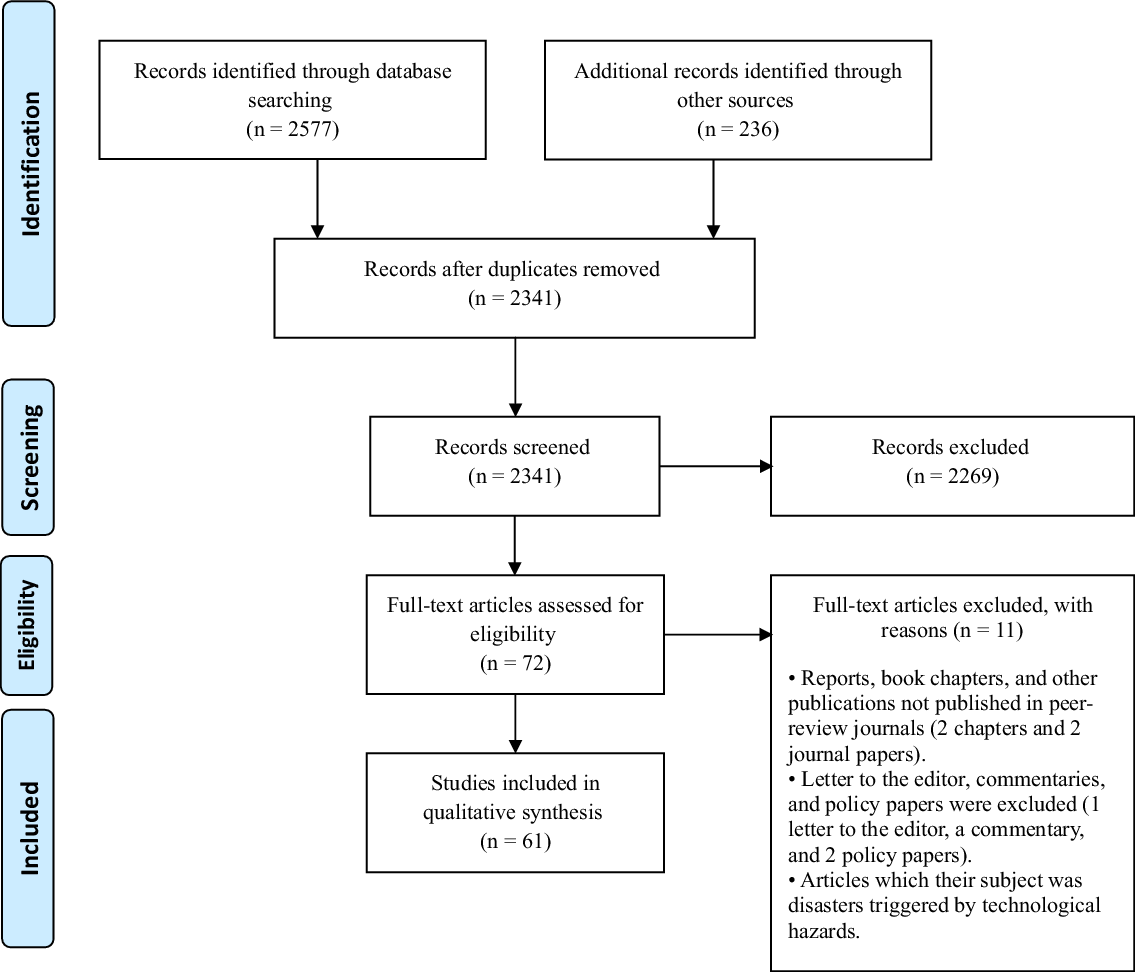
At the first screening, a total of 2577 articles were found from PubMed (104 articles), Cochrane Library (150), Scopus (1335 citations), and Web of Science (988 citations) databases. Besides searching in the above databases, the references of reviewed papers were also checked. Figure 1 provides more information on the screening process. The reasons of exclusion are shown in Figure 1.
Flow chart of study selection process.

In order to decide on inclusion or exclusion of the papers, the titles and abstracts were assessed, respectively.
The studies retrieved during the search were screened for relevance, and those identified as potentially eligible were fully assessed against the inclusion/exclusion criteria to be accepted or rejected. PRISMA guidelines were applied to appraise the papers. The following data were extracted from the qualified studies: authors, year of publication, population, study design, country, type of disaster, assessment tools, outcomes, age, and diversity.
Given the heterogeneity of research in this topic, a meta-analysis was not possible. Therefore, the collected data were analyzed in a narrative synthesis. In the narrative synthesis, authors explored and described the results of any interventions that happened in disaster preparedness of children in schools. The MAXQDA 2018 software was used for data analysis. The method for the systematic review was registered through PROSPERO with registration number CRD42020146536.
Results
Search Results
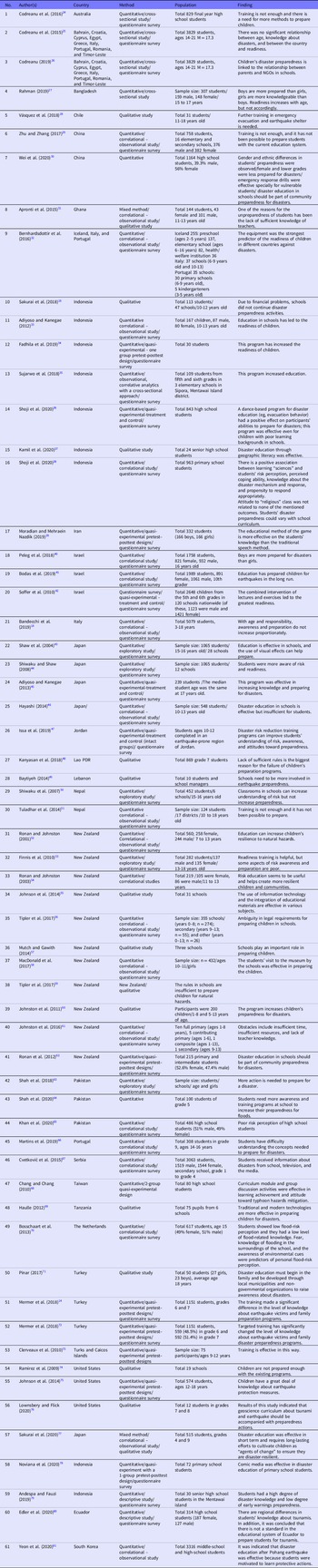
The search identified 2577 publications, of which 236 duplicates were removed (see Figure 1). During title/abstract screening, 2270 articles were excluded. At full-text screening, 11 publications were excluded due to not been published in peer-review journals, article format, and type of disaster. A final number of 61 articles met the selection criteria and were included in the review. Article characteristics are shown in Table 1.
Characteristics of the reviewed studies

Description of Geographical Region
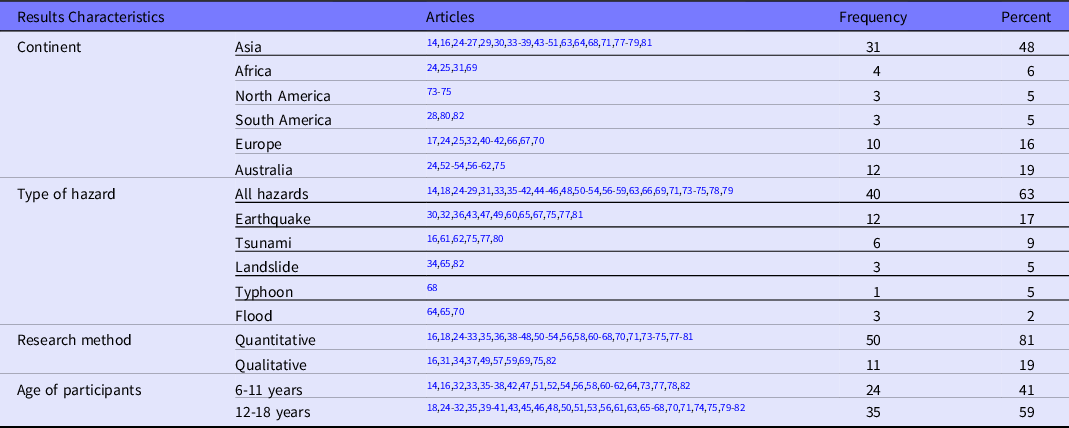
As shown in Table 2, among the reviewed articles, 11 were related to New Zealand, Reference Ronan and Johnston52-Reference Ronan, Crellin and Johnston62 9 to Indonesia, Reference Sakurai, Bisri and Oda16,Reference Adiyoso and Kanegae33-Reference Shoji, Takafuji and Harada38,Reference Noviana, Kurniaman and Munjiatun78,Reference Andespa and Fauzi79 5 to Japan, Reference Shaw, Shiwaku, Kobayashi and Kobayashi43-Reference Hayashi46,Reference Sakurai, Sato and Murayama77 3 to Israel, Reference Peleg, Bodas, Shenhar and Adini40-Reference Soffer, Goldberg and Avisar-Shohat42 3 to Pakistan, Reference Shah, Ye and Pan63-Reference Khan, Rana and Nawaz65 2 to Nepal, Reference Shiwaku, Shaw and Chandra Kandel50,Reference Tuladhar, Yatabe, Dahal and Bhandary51 2 to Romania, Reference Codreanu, Celenza and Ngo24,Reference Codreanu, Celenza and Alabdulkarim25 2 to the United States, Reference Ramirez, Kubicek, Peek-Asa and Wong74,Reference Johnson, Johnston, Ronan and Peace75 2 to Italy, Reference Bandecchi, Pazzi and Morelli18,Reference Bernhardsdottir, Musacchio, Ferreira and Falsaperla32 2 to Timor-Leste, Reference Codreanu, Celenza and Ngo24,Reference Codreanu, Celenza and Alabdulkarim25 2 to China, Reference Zhu and Zhang29,Reference Wei, Su and Li30 1 to Serbia, Reference Cvetković, Dragičević and Petrović67 1 to Bangladesh, Reference Baytiyeh49 1 to Turks and Caicos Islands, Reference Clerveaux, Spence and Katada73 1 to Ghana, Reference Apronti, Osamu, Otsuki and Kranjac-Berisavljevic31 1 to Tanzania, Reference Haulle69 1 to Lao PDR, Reference Kanyasan, Nonaka and Chatouphonexay48 1 to Australia, Reference Codreanu, Celenza and Ngo24 1 to Chile, Reference Vásquez, Marinkovic and Bernales28 1 to Iceland, Reference Bernhardsdottir, Musacchio, Ferreira and Falsaperla32 1 to Portugal, Reference Bernhardsdottir, Musacchio, Ferreira and Falsaperla32 1 to Taiwan, Reference Chang and Chang68 1 to the Netherlands, Reference Bosschaart, Kuiper, van der Schee and Schoonenboom70 1 to Ecuador, Reference Edler, Otto and Toulkeridis80 1 to Iran, Reference Moradian and Mehraein Nazdik39 1 to South Korea, Reference Yeon, Chung and Im81 and 3 papers focused on school-based disaster preparedness in Turkey. Reference Mermer, Donmez and Daghan14,Reference Codreanu, Celenza and Ngo24,Reference Zhu and Zhang29
Results characteristics

There are different results found about the relation of school-based disaster education and the geographical region within and between countries. Codreanu et al. (2015) claimed that the students who live in the low disaster risk and high-income country members of the Organisation for Economic Co-operation and Development (OECD) seem to be discussing more on disasters. Reference Codreanu, Celenza and Alabdulkarim25 In addition, they found that predictors such as country disaster risk index and level of economic development are not good predictors for discussing disasters among teenagers. Musacchio et al. (2016) compared disaster education in schools of Italy, Iceland, and Portugal. Reference Bernhardsdottir, Musacchio, Ferreira and Falsaperla32 Their results show that these 3 countries have laid emphasis on the disaster education, but they are somehow different in education of specific disasters (such as earthquake), number of drills, resources, and tools for education. In another study about secondary school students’ disaster awareness, the level of development of the country has been indicated as a determinant for disaster management. Reference Pinar71 Another study showed that there were regional differences in students’ education about tsunami in Ecuador. Reference Edler, Otto and Toulkeridis80 In addition, researchers concluded that a standard procedure of education was not followed in different regions in Ecuador. Reference Edler, Otto and Toulkeridis80
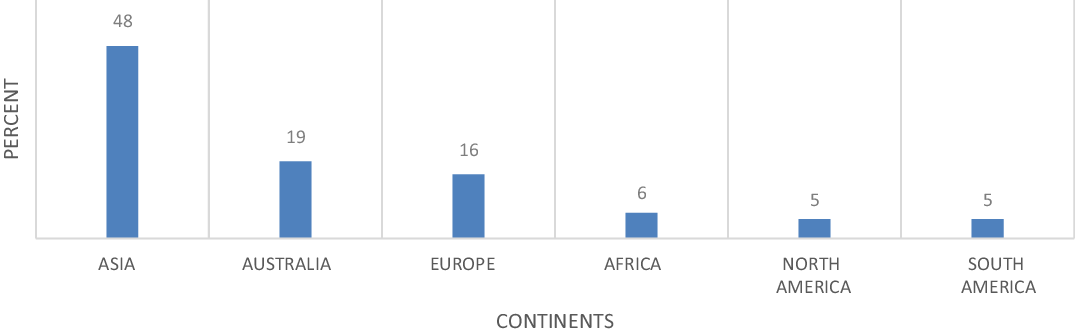
Figure 2 shows a comparison of disaster education in schools across various continents.
Comparison of students’ education about natural hazards in various continents.

Description of Participants
The ages of the children in this study were classified as primary school (6-11 years) and secondary school or adolescence (12-18 years). As shown in Table 2, the most prevalent age group of participants was the adolescents (34 studies). Twenty-four studies have participants living in the middle childhood age, and 6 studies researched about child preparedness in early childhood age.
Rahman’s (2019) findings show that the awareness of students in the upper grades is higher. Reference Rahman27 In another study, Bandecchi et al. (2019) emphasize that the children’s awareness about disasters is relatively adequate according to their age range but that this awareness does not increase as the children grow older. Reference Bandecchi, Pazzi and Morelli18 Also, Codreanu et al. (2015) concludes that there is no significant relationship between disaster discussion and the age of students. Reference Codreanu, Celenza and Alabdulkarim25 Wei et al. (2020) observed that students in lower grades (or ages) were less prepared for disasters and more vulnerable. Reference Wei, Su and Li30
Among 48 reviewed papers, many of them, excluding 14 papers, Reference Sakurai, Bisri and Oda16,Reference Vásquez, Marinkovic and Bernales28,Reference Shaw, Shiwaku, Kobayashi and Kobayashi43,Reference Shiwaku and Shaw44,Reference Hayashi46,Reference Baytiyeh49-Reference Tuladhar, Yatabe, Dahal and Bhandary51,Reference Tipler, Tarrant, Johnston and Tuffin56,Reference Mutch and Gawith57,Reference Johnston, Tarrant and Tipler60,Reference Martins, Nunes and Lourenço66,Reference Haulle69,Reference Clerveaux, Spence and Katada73 note under their methodology sections that their samples are coeducational (combinations of female and male students), but only 4 studies indicate the importance of gender differences in school-based disaster preparedness education. Reference Codreanu, Celenza and Alabdulkarim25,Reference Rahman27,Reference Wei, Su and Li30,Reference Peleg, Bodas, Shenhar and Adini40 Rahman (2019) observed that girls’ awareness about disasters in Bangladesh are higher than boys’, and also that they communicate more with their family about preparedness. Reference Rahman27 Peleg et al. (2018) and Wei et al. (2020) indicate that boys have more preparedness and resilience than girls in Israel and China, respectively. Reference Wei, Su and Li30,Reference Peleg, Bodas, Shenhar and Adini40
Only 1 study mentioned ethnic differences in students’ preparedness. Wei et al. (2020) indicated that students from ethnic minorities were less prepared for an earthquake in China. Reference Wei, Su and Li30
Description of Outcomes
Among the reviewed studies, 24 papers confirm that disaster education for children in schools is useful and beneficial. Reference Mermer, Donmez and Daghan14,Reference Sakurai, Bisri and Oda16,Reference Zhu and Zhang29,Reference Wei, Su and Li30,Reference Adiyoso and Kanegae33,Reference Bodas, Peleg, Shenhar and Adini41-Reference Adiyoso and Kanegae45,Reference Shiwaku, Shaw and Chandra Kandel50,Reference Ronan and Johnston52,Reference Finnis, Johnston, Ronan and White53,Reference Mutch and Gawith57,Reference Johnston, Tarrant and Tipler60,Reference Cvetković, Dragičević and Petrović67,Reference Haulle69,Reference Sakurai, Sato and Murayama77,Reference Noviana, Kurniaman and Munjiatun78 They point out that hazard education raises children’s perception, knowledge, and awareness about disasters. Nevertheless, researchers in 14 studies argue that disaster education in schools is both positive and effective but yet insufficient. Reference Vásquez, Marinkovic and Bernales28,Reference Zhu and Zhang29,Reference Adiyoso and Kanegae45,Reference Hayashi46,Reference Shiwaku, Shaw and Chandra Kandel50,Reference Tuladhar, Yatabe, Dahal and Bhandary51,Reference Finnis, Johnston, Ronan and White53,Reference Johnson, Ronan, Johnston and Peace55,Reference Tipler, Tarrant, Tuffin and Johnston59,Reference Johnston, Tarrant and Tipler61,Reference Shah, Ye and Pan63,Reference Martins, Nunes and Lourenço66,Reference Ramirez, Kubicek, Peek-Asa and Wong74-Reference Lownsbery and Flick76 They propose that lectures in schools can raise awareness but cannot prepare students, Reference Shiwaku, Shaw and Chandra Kandel50,Reference Johnson, Johnston, Ronan and Peace75,Reference Lownsbery and Flick76,Reference Andespa and Fauzi79 that education is not comprehensive and is poor in some aspects of hazard awareness, Reference Finnis, Johnston, Ronan and White53,Reference Johnston, Tarrant and Tipler61 that education methods are not proper, Reference Bandecchi, Pazzi and Morelli18,Reference Tuladhar, Yatabe, Dahal and Bhandary51,Reference Johnson, Johnston, Ronan and Peace75 that there is ambiguity in legislative requirements for school-based education, Reference Tipler, Tarrant, Johnston and Tuffin56,Reference Tipler, Tarrant, Tuffin and Johnston59 that there are gaps between disaster awareness and disaster preparedness in action, Reference Bandecchi, Pazzi and Morelli18,Reference Adiyoso and Kanegae45,Reference Lownsbery and Flick76,Reference Andespa and Fauzi79 and that there is lack of education resources and tools. Reference Sakurai, Bisri and Oda16,Reference Codreanu, Celenza and Ngo24,Reference Codreanu, Celenza and Alabdulkarim25,Reference Vásquez, Marinkovic and Bernales28,Reference Zhu and Zhang29,Reference Bodas, Peleg, Shenhar and Adini41,Reference Shaw, Shiwaku, Kobayashi and Kobayashi43,Reference Adiyoso and Kanegae45,Reference Hayashi46,Reference Shiwaku, Shaw and Chandra Kandel50,Reference Finnis, Johnston, Ronan and White53,Reference Johnson, Ronan, Johnston and Peace55,Reference Tipler, Tarrant, Johnston and Tuffin56,Reference Tipler, Tarrant, Tuffin and Johnston59,Reference Johnston, Tarrant and Tipler61,Reference Shah, Ye and Pan63,Reference Martins, Nunes and Lourenço66,Reference Cvetković, Dragičević and Petrović67,Reference Clerveaux, Spence and Katada73 Researchers in 3 studies indicated that disaster education should be organized periodically and regularly. Reference Zhu and Zhang29,Reference Bodas, Peleg, Shenhar and Adini41,Reference Shiwaku, Shaw and Chandra Kandel50
School-based disaster education needs resources and tools. The strongest facilitator factor for disaster preparedness is the wide use of various tools and resources. Reference Johnson, Ronan, Johnston and Peace55 Researchers in many reviewed articles argue over this topic. Reference Sakurai, Bisri and Oda16,Reference Codreanu, Celenza and Ngo24,Reference Codreanu, Celenza and Alabdulkarim25,Reference Vásquez, Marinkovic and Bernales28,Reference Zhu and Zhang29,Reference Fadhila, Fauzi and Rifai34,Reference Moradian and Mehraein Nazdik39,Reference Bodas, Peleg, Shenhar and Adini41-Reference Shaw, Shiwaku, Kobayashi and Kobayashi43,Reference Adiyoso and Kanegae45,Reference Hayashi46,Reference Shiwaku, Shaw and Chandra Kandel50,Reference Finnis, Johnston, Ronan and White53,Reference Johnson, Ronan, Johnston and Peace55,Reference Tipler, Tarrant, Johnston and Tuffin56,Reference Tipler, Tarrant, Tuffin and Johnston59,Reference Johnston, Tarrant and Tipler61,Reference Shah, Ye and Pan63,Reference Martins, Nunes and Lourenço66,Reference Cvetković, Dragičević and Petrović67,Reference Haulle69,Reference Clerveaux, Spence and Katada73 Findings from 6 studies indicate that relying on textbooks and pictures for teaching disaster prevention is ineffective. Reference Zhu and Zhang29,Reference Moradian and Mehraein Nazdik39,Reference Soffer, Goldberg and Avisar-Shohat42,Reference Hayashi46,Reference Shiwaku, Shaw and Chandra Kandel50,Reference Chang and Chang68 Some reviewed papers emphasized using different tools, for instance, technology-based visual resources and emergency equipment, Reference Sakurai, Bisri and Oda16,Reference Zhu and Zhang29,Reference Bernhardsdottir, Musacchio, Ferreira and Falsaperla32,Reference Johnson, Ronan, Johnston and Peace55,Reference Shah, Ye and Pan63,Reference Martins, Nunes and Lourenço66,Reference Haulle69 and dance-based education in schools. Reference Shoji, Takafuji and Harada36 Besides, developing disaster curricula and compulsory curricula, and designing special textbooks for children disaster education are of inevitable importance. Reference Fadhila, Fauzi and Rifai34 Cvetković et al. (2015) indicate that radio, video games, or stories told by family are not effective in disaster education. Reference Cvetković, Dragičević and Petrović67 Moradian (2019) remarks in his study that disaster education by using games can be more effective than lectures. Reference Moradian and Mehraein Nazdik39 The schools that are benefiting using the necessary equipment are facing some other issues, including the maintenance of these equipment, the quantity of tools, and the budget. Reference Sakurai, Bisri and Oda16 Bernhardsdottir et al. (2016) emphasize that the availability of equipment for earthquake preparedness causes the greatest difference among studied countries. Reference Bernhardsdottir, Musacchio, Ferreira and Falsaperla32 Researchers in reviewed studies suggest that lack of teaching resources has a great effect not only on student knowledge of disaster preparedness but also on the knowledge of teachers. Reference Fadhila, Fauzi and Rifai34,Reference Peleg, Bodas, Shenhar and Adini40,Reference Johnson, Ronan, Johnston and Peace55,Reference Tipler, Tarrant, Tuffin and Johnston59,Reference Martins, Nunes and Lourenço66 Bodas et al. (2019) found that disaster preparedness education improves student knowledge and preparedness even 6 months after the training. Reference Bodas, Peleg, Shenhar and Adini41 However, Ramirez (2009) shows that drills and equipment do not improve school children’s preparedness if it is performed poorly. Reference Ramirez, Kubicek, Peek-Asa and Wong74
Researchers in 8 studies argue that disaster education for children should not be limited to schools; they consider that different stakeholders, including families, communities, fundraisers, and teachers, should support school-based disaster education. Reference Codreanu, Celenza and Alabdulkarim25,Reference Wei, Su and Li30,Reference Apronti, Osamu, Otsuki and Kranjac-Berisavljevic31,Reference Bodas, Peleg, Shenhar and Adini41,Reference Hayashi46,Reference Tuladhar, Yatabe, Dahal and Bhandary51,Reference Tipler, Tarrant, Johnston and Tuffin56,Reference Ronan, Crellin and Johnston62 Codreanu et al. (2016) observe that the interactions of families and charitable organizations with schools have a significant influence on disaster risk education. Reference Codreanu, Celenza and Ngo24 Other reviewed studies found that, although predictors such as national educational budget, national disaster program, school lessons, gender, ability to list examples of disasters, country’s disaster risk index, and level of economic development are significant, they are insufficient to predict disaster knowledge and discussion among students. Reference Codreanu, Celenza and Ngo24,Reference Codreanu, Celenza and Alabdulkarim25,Reference Pinar71
Description of Natural Hazards
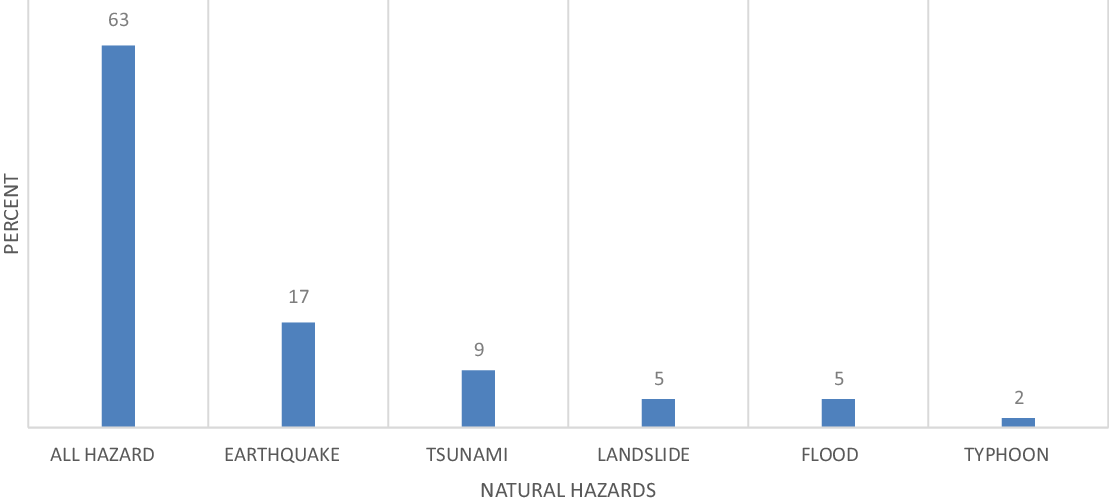
Among 60 reviewed studies, as shown in Table 2, 40 studies applied the all-hazard approach and a specific natural hazard was not mentioned in their study. In addition, 11 papers researched about earthquakes, 6 papers focused on tsunamis, 3 studies on landslide preparedness, 3 studies on floods, and 1 study focused on typhoons preparedness among students. Reference Shah, Gong and Ali64 Figure 3 shows the comparison of natural hazards education in schools according to reviewed articles.
The comparison of natural hazards education in schools according to reviewed articles.

Discussion
This study aimed to investigate disaster education programs in schools by reviewing the studies published in peer-review journals during 2000–2020.
This study revealed that hazards education was not sufficient for disaster preparedness. Reviewed articles mentioned several challenges for student preparedness, including quality of education, teaching methods (ie, lecture and drill), learning materials, policy gaps and silences, and socioeconomic status.
Empowerment and Preparedness
One way to discuss these challenges of children’s preparedness for disasters is through an empowerment perspective. Alsop et al. (2005) defined empowerment “as a group’s or individual’s capacity to make effective choices, that is, to make choices and then to transform those choices into desired actions and outcomes.” Reference Alsop, Bertelsen and Holland83,Reference O’Sullivan, Fahim and Gagnon84 The capacity is influenced by agency (the child must be able to make purposeful decisions) and opportunity structure (institutions that influence children’s behaviors and lead to the success or failure of their choices). Reference Alsop, Kakwani and Silber85 Children’s agency can be predicted based on their assets, which include the accumulation of resources such as economic, social, psychological, educational, and emotional resources. Reference Fischer and McKee86
To prepare children for disasters, it is necessary to pay attention to their access to various resources. Reference Samman and Santos87 This article revealed that children’s access to resources and materials for education was one of the determinants of their readiness. Psychological resources are another necessary asset for children’s agency. Reference Cocco, Caoci, Lorefice and Marrosu88 Another finding of this article was that children’s perception of risk had a significant impact on children’s preparedness for disasters. Children with low-risk perceptions were less prepared for disasters, even with the same natural hazards’ education.
Another finding of our paper is that regulations and policies should be adapted to prepare children, and that standards should be considered by governments for educating students in different areas. Empowerment on this issue emphasizes that the structure of opportunity should provide this situation. Reference Seddighi, Seddighi, Salmani and Sharifi Sedeh89 Challenges of children’s preparedness in this article in terms of opportunity structure include short-term education (natural hazards’ education was not sustainable), insufficient budget allocation, lack of proper curriculum, and lack of proper teacher training.
This approach emphasizes that empowerment must take place at various levels, including the individual, family, community, national, and international. Reference Chiapperino and Tengland90 This article revealed that children’s preparedness is a challenge that needs to be improved with only individual-level interventions. The reviewed articles suggested that educational programs at the family and community levels should also be defined to prepare children for disasters. In this case, these interventions will be more effective.
Natural Hazards’ Education and Disasters’ Preparedness
This review indicates that, although school-based disaster education can raise awareness of children, it will not necessarily lead to disaster preparedness of children. Researchers mentioned several factors affecting disaster preparedness, including risk perception, Reference Miceli, Sotgiu and Settanni91 available resources, Reference Wei, Su and Li30,Reference Paton and Johnston92 self-efficacy, Reference Paton, Bajek, Okada and McIvor93 and community participation. Reference Paton, McClure, Bürgelt, Patron and Johnston94 In lessons learned from previous studies, knowledge, perception, comprehension, and actions were found to be vital to disaster education of children. Reference Shaw, Shiwaku and Takeuchi95 Family, community, and self-education are 3 main factors in the comprehension of knowledge and preparedness. Reference Shaw and Oikawa96 An important issue revealed in the reviewed papers is the methods of education. Lectures in class and reading textbooks may raise awareness only when they come accompanied by practical education (eg, equipment, games, and multimedia).
This study revealed that, in some countries, disaster education was not reflected properly in national policies. It was indicated that an effective disaster education for children needs to a holistic education in different levels and policy integration. Reference Shaw, Shiwaku and Takeuchi95 In the OECD Policy Handbook on Natural Hazard Awareness and Disaster Risk Reduction Education, a long-term and sustained strategy was emphasized by governments for disaster education. In addition, risk awareness and risk education should be integrated into national policy with collaborating different sectors at different levels. 97
Education Resources
Using equipment for disaster education is identified as an important factor for children preparedness. Disaster preparedness should be presented in different levels, including individual, family, community, and national levels. For example, in Cuba, implementing national hurricane preparedness programs for people, including children, resulted in an enormous decrease in the number of casualties. Children learned about early warning, evacuation, and safety via school-based education, media, and their families. Reference Miranda and Choonara98 On the other hand, it seems that, in many countries, special textbooks are not designed to be used in schools and therefore results in poor awareness. Continuity of disaster education is another factor for better preparedness.
Social Determinants of Inequality in Disaster Preparedness
Results of this study show that preparedness of boys is higher than that of girls, whereas girls have more awareness than boys. This could also be influenced by the sociopolitical context. More research on gender differences of children disaster preparedness is needed in order to better understand the possible gender differences in disaster impacts. In a systematic review of literature with investigating 60 000 survivors of disasters, female survivors were found to be more adversely affected, especially having posttraumatic stress disorder (PTSD) and other disorders. Reference Norris, Friedman and Watson99 Another systematic review about gender differences in children’s mental disorders after earthquakes in Iran found that girls reported symptoms of PTSD more than boys, except anger symptoms. Reference Seddighi, Salmani, Javadi and Seddighi6
When it comes to the mutual relation of age and preparedness, there are no solid findings for a concrete conclusion. Most papers studying school-based disaster preparedness focused on teenagers, and only a few papers dealt with earlier ages. However, one cannot conclude from the studies that there are fewer disaster education programs for children of ages 5-11, although it may be realized as an alarm. Age factor is important because many children between 5 and 11 years old, especially in developing countries, are caught in disasters and it is vital to teach them how to prepare for disasters in schools.
The geographic distribution of school-based disaster education varied. Studies in America were less than in other continents, and only 3 papers in America focused on school-based disaster education. It seems that the number of studies on children’s disaster preparedness in North America, South America, and Africa is less than that in Asia, Europe, and Australia. Reports indicated that flooding was the first cause of mortality by disasters in South Africa, South America, and South of Asia. Reference Guha-Sapir, Hoyois and Below100 The storm has been the deadliest disaster during the last decade in North America. Reference Guha-Sapir, Hoyois and Below100 These statistics reveal that focusing on children’s preparedness is important, especially in disaster-prone countries. Investigating articles about preparedness based on geographical region is relevant because the pattern of disaster strike is different around the world. Natural hazards had the most human impact in Asia. Reference Wallemarq and House101 The death comparisons by natural hazards in Asia were 50.2%, America, 35.4%; Europe, 9.6%; Africa, 4.5%; and Oceania, 0.2%. Reference Wallemarq and House101
Natural Hazards
The method of investigation of disaster is important because some preparedness knowledge and skills are specific to a certain disaster. Between 2008 and 2018, a near 348 natural hazards occurred globally per year. Reference Wallemarq and House101 Flood was the most prevalent natural hazard, occurring 153 times during these years. Next prevalent disaster was hurricanes, which happened 101 times, then earthquake, extreme temperature, landslide, drought, wildfire, volcanic activity, and mass movement (dry). Reference Wallemarq and House101 Earthquake was the deadliest natural hazard between 2008 and 2017 with 35 197 deaths, storm was next with 16 762 deaths, then extreme temperature with 7388, flood with 5039, and drought, landslide, wildfire, volcanic eruption, and mass movement (dry) with the least fatalities. Reference Wallemarq and House101 The number of people affected by natural hazards who needed help was different. Reference Wallemarq and House101 Drought affected an average of 73.9 million people between 2008 and 2017; flood, 73.1 million people; storm, 9 million; earthquake, 8.3 million; landslide, 0.3 million; volcanic activity, 0.2 million; wildfire, 0.1 million; and mass movement (dry), 0.1 million people. Reference Wallemarq and House101
Limitation
In this study, we included English language papers published in peer-review journals. However, there are other related articles that were published in other languages that we couldn’t translate.
Conclusion
This systematic review revealed that school-based disaster education raises the awareness but does not necessarily result in children preparedness. Different methods in disaster education should be used, and continuity in education is vital for preparedness education to children. Lecture and reading textbooks for disaster education are not effective in themselves, and these methods should come together with disaster exercises and drills. Using different tools and equipment is vital for disaster preparedness. Comprehensive and exclusive textbooks of school-based disaster education are required for better results. School-based disaster education should be an integral part of community-based disaster preparedness programs.
There is little evidence indicating how schoolchildren’s disaster knowledge is influenced by some elements, including gender, diversity, and socioeconomic position. Therefore, more investigation is required for applying preparedness education to protect different groups of children form disasters. Also, more research on children’s disaster preparedness should be carried out in North America, South America, and Africa.
Conflict(s) of Interest
The authors declared no potential conflicts of interest with respect to the research, authorship, and/or publication of this paper.
Funding Statement
The University of Social Welfare and Rehabilitation Sciences supported the development of the manuscript.
Ethical Standards
This paper, as part of a PhD thesis at the University of Social Welfare and Rehabilitation Sciences, with ethics code IR.USWR.REC.1399.008 was approved by the university’s ethics committee.