

Provision of public goods by pasture-based livestock systems in Europe
Pasture-based livestock systems constitute key examples of High Value Nature (HNV) farming (Lomba et al., Reference Lomba, Guerra, Alonso, Honrado, Jongman and McCracken2014) and have the greatest potential to deliver public goods (non-excludable, non-rival) across European agricultural systems (Cooper et al., Reference Cooper, Hart and Baldock2009). They play an important role in preserving agricultural landscapes, farmland biodiversity, cultural heritage and in sustaining rural development (Renting et al., Reference Renting, Rossing, Groot, Van der Ploeg, Laurent, Perraud, Stobbelaar and Van Ittersum2009). However, many of these functions are ignored in evaluation frameworks because public goods do not have market price (non-market goods) and are often ignored in policy design, so farmers do not get the appropriate incentives to provide them. Therefore, there is a need to objectively evaluate the multiple private and public goods that pasture-based livestock systems deliver to the society, including their trade-offs and synergies, from different perspectives: biophysical, socio-cultural and economic (Rodríguez-Ortega et al., Reference Rodríguez-Ortega, Oteros-Rozas, Ripoll-Bosch, Tichit, Martín-López and Bernues2014).
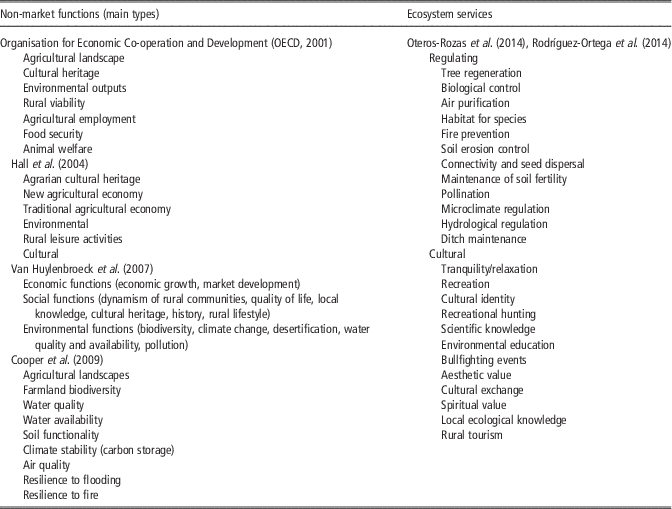
However, due to the varying subjective perceptions and interest of stakeholders, the portfolio of outcomes (private or public goods) of pasture-based livestock systems that are relevant for people can vary across regions, socio-economic and policy contexts, and cultural backgrounds (Randall, Reference Randall2002). In Table 1, we present a non-exhaustive overview (mainly referred to Europe) of non-market functions and ecosystem services (ES, defined below) provided by these livestock systems, respectively. It is worth mentioning that some functions are intrinsically linked to pasture-based livestock farming systems, particularly in HNV farmland areas. These are the maintenance of cultural landscapes, the preservation of biodiversity and the reduction of risk of forest wildfires, particularly in Mediterranean areas (Cooper et al., Reference Cooper, Hart and Baldock2009).
Examples of public goods (non-market functions and regulating/cultural ecosystem services) delivered by pasture-based livestock systems in Europe

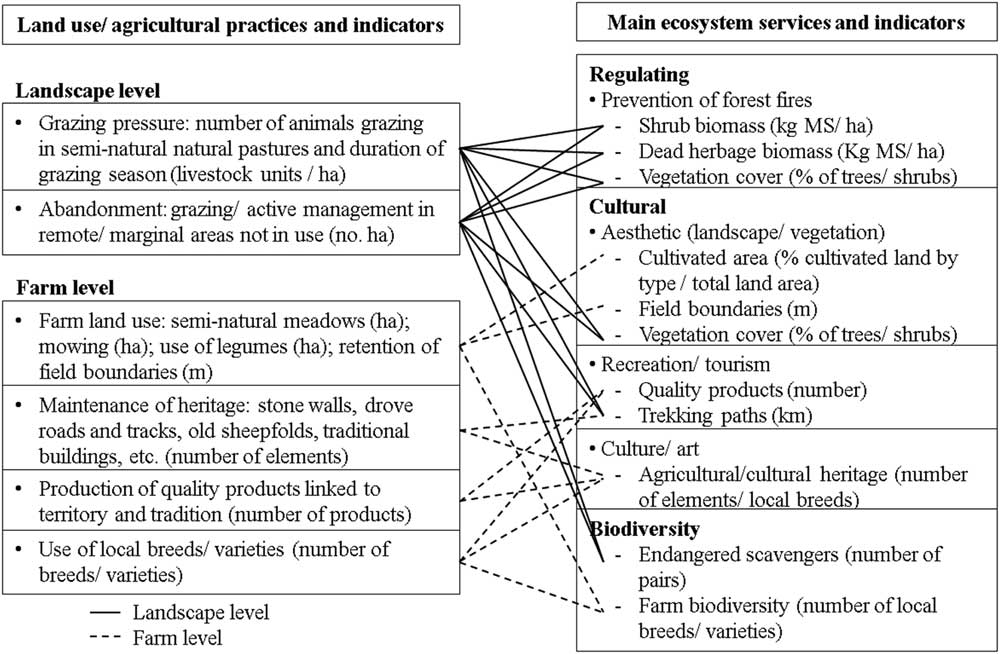
It is important to notice that not all farms or farming systems that are located in HNV farmland areas provide the same outcomes. The type and amount of private and public goods (or negative externalities) delivered by a particular farm or system of production will depend on the use of on-farm and off-farm resources, the land use, the degree of intensification (Bernués et al., Reference Bernués, Ruiz, Olaizola, Villalba and Casasús2011) and ultimately on the specific agricultural practices implemented by the farmer. These practices need to be identified and monitored if we want public intervention to be effective (prevent negative externalities and/or promote the provision of non-market goods). As an example based on previous research and the review by Rodríguez-Ortega et al. (Reference Rodríguez-Ortega, Oteros-Rozas, Ripoll-Bosch, Tichit, Martín-López and Bernues2014), we present an inventory of land use regimes and agricultural practices (with tentative indicators) that can enhance the delivery of ES in Mediterranean mountains (Figure 1).
Agricultural practices and land management regimes that have an influence on ecosystem services in Mediterranean mountains.

Concepts of multifunctionality, ecosystem services and total economic value
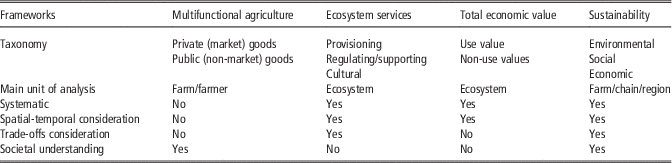
Different integrative evaluation frameworks can be utilized to evaluate the multiple functions or services of agriculture (Table 2). A common characteristic of these frameworks is that they place human benefits and societal demands at the core of their definitions, so they are essentially human-centred. The first one is the Multifunctional Agriculture (MA) framework that has several wide interpretations: for example, the consideration of positive externalities in economic analysis, or the multiple roles of agriculture in developing countries (Renting et al., Reference Renting, Rossing, Groot, Van der Ploeg, Laurent, Perraud, Stobbelaar and Van Ittersum2009). In Europe, MA refers to the capability to satisfy the social demands of (predominantly urban) populations for the multiple public goods delivered by agriculture (see below). The MA framework is based on the private (market)/public (non-market) good divide. In MA the main unit of analysis is the farm, recognizing the farmer and his/her family as the key actors that provide multiple functions to society (Bernués et al., Reference Bernués, Rodríguez-Ortega, Alfnes, Clemetsen and Eik2015). MA is a rather bottom-up approach, easily understood by farmers and society at large. However, the MA framework is not systematic (there is no a unique list of functions of agriculture) which makes it more difficult to consider the trade-offs between functions.
Characteristics of the multifunctional agriculture, ecosystem services, total economic value and sustainability frameworks

The ES framework has recently become predominant in the literature (Rodríguez-Ortega et al., Reference Rodríguez-Ortega, Oteros-Rozas, Ripoll-Bosch, Tichit, Martín-López and Bernues2014). It refers to the direct and indirect benefits that people obtain from ecosystems, including agroecosystems (de Groot et al., Reference de Groot, Fisher, Christie, Aronson, Braat, Gowdy, Haines-Young, Maltby, Neuville, Polasky, Portela and Ring2010). Therefore, the (agro)ecosystem constitutes the main unit of analysis. Although a definitive taxonomy of ES is still in discussion, they are normally classified into four groups: provisioning ES are material or energy outputs including goods such as food, water, fuel, timber and fibre; regulating ES are biophysical processes providing benefits such as climate regulation, flood prevention, waste treatment and water purification; cultural ES are recreational, aesthetic and spiritual benefits provided by ecosystems; and supporting ES, such as soil formation, photosynthesis or nutrient cycling, are the various processes that are necessary for the production of all the other ES. The last three types can be grouped as non-provisioning ES. It is therefore a top-down systematic approach that has great potential to consider trade-offs (and synergies) among ES (e.g. provisioning of food and biodiversity). However, the concept of ES is still deficiently understood by the public (Bernués et al., Reference Bernués, Rodríguez-Ortega, Ripoll-Bosch and Casasús2013; Hauck et al., Reference Hauck, Görg, Varjopuro, Ratamäki and Jax2013).
The total economic value (TEV) refers to all aggregated values provided by a particular (agro)ecosystem (Pearce and Pretty, Reference Pearce and Pretty1993). The TEV taxonomy includes different use and non-use values. Use values can be split into direct (extractive resources used directly such as fish, timber, etc.) and indirect (non-extractive services used indirectly such as recreation). Non-use values do not involve direct or indirect use of the ecosystem, but reflect value of future use or the satisfaction that individuals derive from its existence (e.g. enjoyment of a beautiful landscape). So many non-use values are related to moral, religious or aesthetic properties of individuals. It is therefore a systematic top-down approach but, as for ES, not easily understood by lay people. In addition, non-use values are very difficult, if not impossible, to estimate (Rodríguez-Ortega et al., Reference Rodríguez-Ortega, Oteros-Rozas, Ripoll-Bosch, Tichit, Martín-López and Bernues2014).
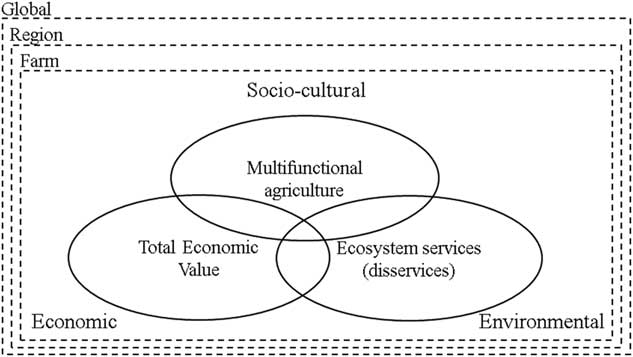
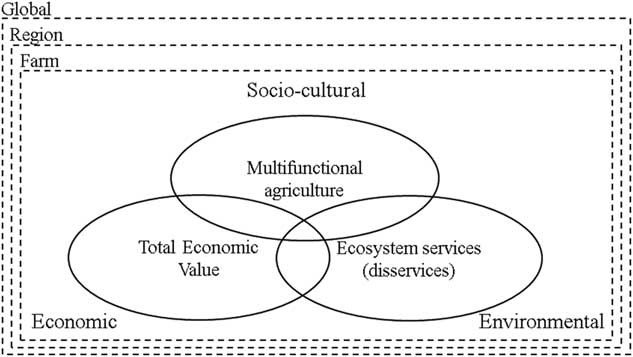
The three concepts described above (MA, ES and TEV) overlap to some extent. They can be embedded in the wider concept of sustainability, which despite its multiple definitions and understandings (Velten et al., Reference Velten, Leventon, Jager and Newig2015), is unique in its capacity to integrate multiple societal, ecological and economic consequences of development choices. Sustainability is a multidimensional, integrative concept that includes multiple, often interrelated, dimensions that differ across scales (farms, farming systems, regions), and can change with time (Ripoll-Bosch et al., Reference Ripoll-Bosch, Díez-Unquera, Ruiz, Villalba, Molina, Joy, Olaizola and Bernués2012). Therefore, sustainability evaluation should not only include different sustainability indicators, but also different perspectives, spatial-temporal scales and methodological frameworks to evaluate these indicators. Due to the existing links and overlaps between concepts, hybrid approaches combining different frameworks can be utilized. For example, participatory MA analysis could serve to identify the main societal demands for private and public goods from agriculture (socio-cultural, economic or environmental) in a specific geographical and socio-economic context. The ES framework could help analyzing the ES (benefits) and disservices (negative externalities) and the main trade-offs and synergies among them. Finally, the TEV could integrate all the use and non-use values of agroecosystems giving economic visibility to non-market functions they deliver (Figure 2).
Methodological frameworks to evaluate the three pillars of sustainability of agriculture from a societal perspective.
Despite the specificities summarized in Table 2, the frameworks have important characteristics in common. They all consider agriculture to be a multidimensional socioecological system that delivers a wide range of market and non-market products and services. They also recognize the need to evaluate the socio-cultural, economic and biophysical components of animal agriculture, which requires multidisciplinary approaches. Finally, as mentioned above, they place human benefits and societal demands at the centre, and therefore, the importance of considering the perceptions and demands of different stakeholders is implicit (Bernués et al., Reference Bernués, Rodríguez-Ortega, Alfnes, Clemetsen and Eik2015). Whereas, MA is better understood at the farm or local level in a particular point in time, the last two frameworks normally operate at wider spatial and temporal scales.
Valuing public goods: two case studies in Europe
We will now present how the different concepts above can be combined to value pasture-based livestock farming systems from a socio-cultural and economic perspective. These systems have suffered a notorious recession in recent decades in many mountain and other less-favoured areas, which constitute the largest proportion of HNV farmland areas in Europe. This recession has originated changes in the type and intensity of land utilization such as intensification of the management system, reduction of grazing and abandonment of remote rangeland areas. Consequently, a general process of vegetation encroachment and landscape closure is happening (Riedel et al., Reference Riedel, Bernués and Casasús2013), with negative consequences on many other non-market functions of HNV agriculture such as biodiversity loss, difficult access for recreation, modification of the water cycle, etc.
Two representative HNV farmland areas in Mediterranean (Bernués et al., Reference Bernués, Rodríguez-Ortega, Ripoll-Bosch and Alfnes2014) and Nordic (Bernués et al., Reference Bernués, Rodríguez-Ortega, Alfnes, Clemetsen and Eik2015) regions were selected to quantify the biophysical effects of agricultural practices on the environment, and value these effects (non-market functions or ES) from the socio-cultural and economic points of view. We first established a correspondence between environmental, social and economic functions of HNV agriculture (easily understood by farmers and other local and urban stakeholders) and different ES belonging to the ES typology. We then established a correspondence between the ES and the different values of the TEV taxonomy to be able to calculate the TEV of Mediterranean and Nordic HNV agroecosystems.
For this purpose, we combined deliberative (focus groups and interviews to farmers and other local stakeholders) and survey-based stated-preference methods (choice modelling) to, first, identify the perceptions of farmers, other local stakeholders and urban citizens on the diverse functions of pasture-based livestock systems and, second, to value the corresponding ES in economic terms according to the willingness to pay (WTP) of the local (residents of the study areas) and general (regions where the study areas are located) populations.
In the Mediterranean mountains, the deliberative research with local farmers and urban residents showed many relationships between pasture-based farming and the environment; with greater importance for the aesthetic and recreational values of the landscape, the maintenance of biodiversity and the prevention of forest fires. The availability of high-quality food products linked to the territory was also highly valued, especially by urban citizens. In the fjord and mountain regions of northern Europe, the most important functions were the control of forest growth, the maintenance of cultural heritage, the maintenance of rural life and activity, the conservation of soil fertility, the maintenance of tourism attraction, the maintenance of traditional agricultural landscape, the conservation of biodiversity and the production of local quality foods.
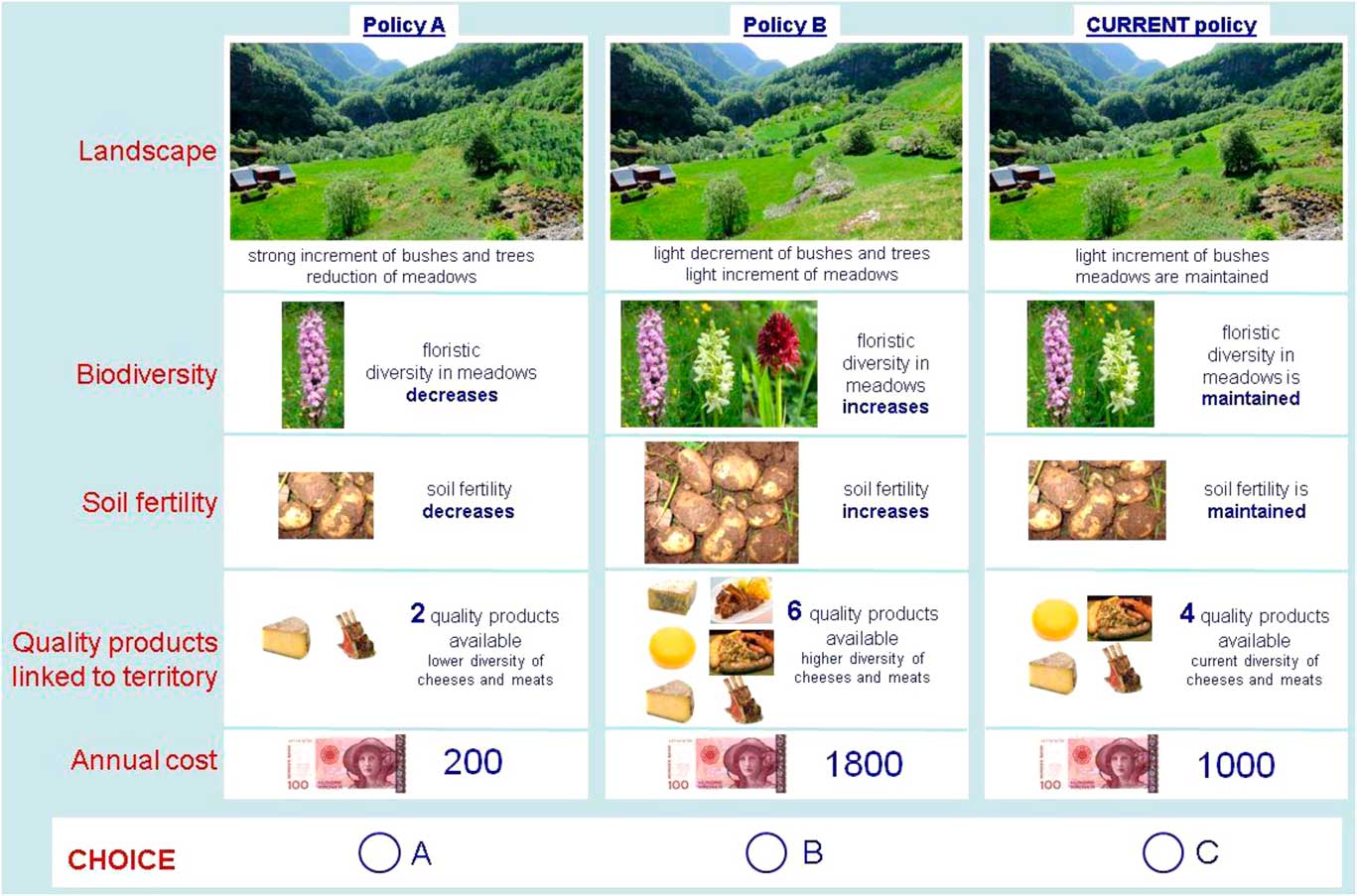
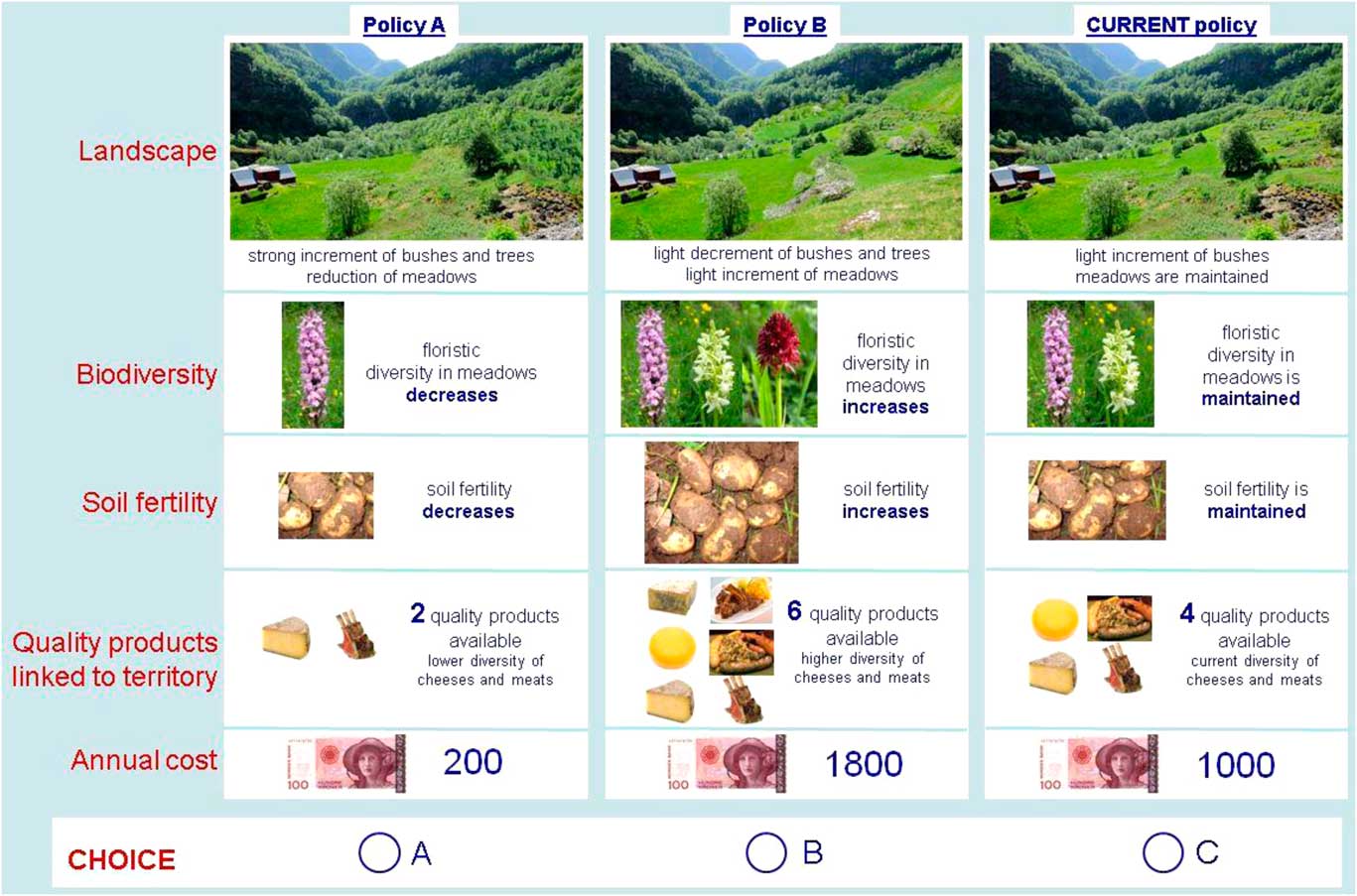
In a second stage, the functions above were translated into (i) a number of ecosystems services, according to the taxonomy established by The Economics of Ecosystems and Biodiversity study (The Economics of Ecosystems and Biodiversity (TEEB), 2010) and (ii) the economic values according to the TEV taxonomy (Pearce and Pretty, Reference Pearce and Pretty1993). In both regions, a representative sample of the local and general populations were asked to choose their most preferred level of delivery of the ecosystems services under three policy scenarios (see full details of choice experiment design, survey, questionnaire and data analysis in Bernués et al., Reference Bernués, Rodríguez-Ortega, Ripoll-Bosch and Alfnes2014 and Reference Bernués, Rodríguez-Ortega, Alfnes, Clemetsen and Eik2015). The status quo scenario corresponded to the current delivery of ES previously identified, whereas the liberalization (reduction of agri-environmental support) and targeted support (additional funding to agri-environmental schemes) scenarios represented different combinations of levels of ES delivery (see example in Figure 3).
Choice set in Nordic agroecosystems. For illustration, the attributes (agricultural landscape, biodiversity, soil fertility, availability of quality products linked to the territory and societal cost in Norwegian kroner) of policies A and B are represented with levels that correspond to the liberalization and targeted support policy scenarios. The actual choice sets that were presented to respondents used different combinations of attribute levels in policies A and B. Source: Bernués et al. (Reference Bernués, Rodríguez-Ortega, Alfnes, Clemetsen and Eik2015).
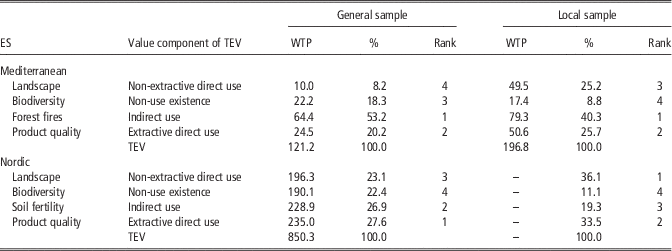
The analysis of responses with a mixed logit model allowed obtaining a ranking of ES according to the WTP of society for their delivery (Table 3).
Willingness to pay (WTP) (€/person per year), composition of the total economic value (TEV) (%) and rank of ecosystem services (ES).

In the Mediterranean, the prevention of forest fires (≈50% of total WTP) was valued by the general population as a key ES delivered by mountain agroecosystems, followed by the production of specific quality products linked to the territory (≈20%), biodiversity (≈20%) and cultural landscapes (≈10%). The value given by local residents to the last two ES differed considerably (≈10% and 25% for biodiversity and cultural landscape, respectively). The TEV of Mediterranean mountain agroecosystems was ≈120 €/person per year, three times the current level of support of agro-environmental schemes.
In Nordic regions, for the general population all ES had similar importance. The production of quality products (≈28% of total WTP) was valued as a key ES, followed by the preservation of soil fertility (≈27%), the conservation of the agricultural landscape (≈23%) and the conservation of biodiversity (≈22%). The values given by local residents were rather different; agricultural landscape represented 36% of total WTP, followed by the production of local quality products (≈33%) and soil fertility (≈19%), whereas biodiversity was valued rather low (≈11%). The TEV of Nordic fjord and mountain agroecosystems was ≈850 €/person per year, seven times the current level of support of agro-environmental schemes. WTP of local sample in the Nordic region could not be estimated as the parameter for cost was positive (see Bernués et al., Reference Bernués, Rodríguez-Ortega, Alfnes, Clemetsen and Eik2015 for details).
Large differences in the WTP were observed between regions. In Nordic countries, the WTP was much higher than in the Mediterranean, both in absolute terms and in relation to the level of public expenditure on agri-environmental measures. This could be due to differences in the level of wealth between regions, but also to the fact that open farmland is very scarce in Nordic countries and forest is very predominant, so people are more sensitive to further abandonment of farming and loss of agricultural landscapes.
For the ranking of importance of ES, however, the differences were smoother between regions. Use values, either direct (product quality) or indirect (forest fires and soil fertility in Mediterranean and Nordic regions, respectively), were ranked higher in all sub-populations, except for the Nordic local sample that ranked the agricultural landscape in the first place. The general population in Nordic regions gave similar importance to all attributes, with higher scores for product quality and soil fertility. However, the general population in the Mediterranean gave >50% of WTP to forest fires and very low to a more human-intervened landscape. A similar pattern was observed in the local populations, with smoother differences in WTP in Nordic than in Mediterranean regions. In general, agricultural landscape (with the exception aforementioned in the Nordic local population) and biodiversity (especially in local populations in both regions) were ranked comparatively low.
These studies allowed us to conclude that there was a clear underestimation of the socio-cultural and economic values of ES provided by pasture-based livestock farming in Mediterranean and Nordic HNV agroecosystems. Moreover, the social welfare loss linked to further abandonment of livestock farming and the associated environmental degradation (liberalization scenario) was very large in these areas. From a societal perspective, it is necessary to jointly measure the biophysical, socio-cultural and monetary values of ES (market and non-market) provided by HNV agroecosystems in order to promote their sustainability. By individualizing support to farmers for the delivery of public goods (e.g. targeting particular agricultural practices), measuring and monitoring objective indicators for ES, the so-called ‘green’ subsidies of the Common Agricultural Policy may truly become Payments for ES.
Acknowledgements
The research was funded by Marie Curie FP7-PEOPLE-2011 IEF (Contract no. 299794; European Commission) and INIA-RTA2011-00133-C02-02 (Spanish Ministry of Economy and Competitiveness, Government of Aragón and FEDER).