INTRODUCTION
Major depressive disorder (MDD) affects 15–20% of patients with incurable cancer (Mitchell et al., Reference Mitchell, Chan and Bhatti2011). The disorder is diagnosed according to the Diagnostic and Statistical Manual of Mental Disorders (DSM) or the International Classification of Diseases (ICD) (APS, 1994; World Health Organization, 1992). These diagnostic systems define MDD slightly differently but with similar content.
The DSM-IV diagnostic criteria for MDD include nine symptom criteria. The two main symptom criteria are depressed mood and diminished interest or pleasure in activities (anhedonia). The seven additional criteria are weight or appetite changes, sleep changes, psychomotor agitation or retardation, fatigue or loss of energy, feelings of worthlessness or guilt, diminished ability to think or concentrate or indecisiveness, and recurrent thoughts of death or suicidal ideation (American Psychiatric Association, 1994). Five of the criteria including at least one of the main criteria, must be present to establish a diagnosis of MDD. The ICD-10 also includes reduced energy or fatigue as a main symptom criterion and “bleak and pessimistic views about the future” as an additional symptom criterion (World Health Organization, 1992). Further, both diagnostic systems state that the symptoms shall be present most of the day and nearly every day during a two-week period, and they shall cause clinically significant distress or impairment in social, occupational or other important areas of functioning. Finally, the symptoms shall not be accounted for by bereavement (American Psychiatric Association, 1994).
The DSM-IV also states that the symptom criteria are not caused by a medical condition (American Psychiatric Association, 1994; First et al., Reference First, Spitzer and Gibbon1997a, Reference First, Spitzer and Gibbon1997b). Symptom criteria such as fatigue, loss of weight, or appetite and sleep disturbances are common symptoms of medical conditions including cancer. This so-called symptom overlap represents a challenge for clinicians as well as researchers (Trask, Reference Trask2004). How the diagnostic criteria for MDD fit patients with symptomatic medical conditions has been subject to a long-lasting dispute. The DSM proposes an etiologic approach, that is, to regard the symptom not indicative of depression if the symptom is clearly attributable to the medical condition (First et al., Reference First, Spitzer and Gibbon1997a, Reference First, Spitzer and Gibbon1997b). Some have argued to exclude physical symptoms from the classification (Bukberg et al., Reference Bukberg, Penman and Holland1984; Zimmerman et al., Reference Zimmerman, Chelminski and McGlinchey2006; Reference Zimmerman, Galione and Chelminski2010), and others have argued for substituting them with other symptom criteria (Endicott, Reference Endicott1984). Some have argued that retaining them does not have an effect on the prevalence rate of depression in the somatically ill, particularly at high levels of depressive symptoms (Chochinov et al., Reference Chochinov, Wilson and Enns1994; Mitchell et al., Reference Mitchell, Lord and Symonds2012). These conflicting viewpoints hamper research and might also contribute to the low detection rate of MDD in cancer patients (Passik et al., Reference Passik, Dugan and McDonald1998; Greenberg, Reference Greenberg2004; Trask, Reference Trask2004).
Incurable cancer implies a limited life expectancy. The disease trajectory typically includes progressive disease, increasing functional impairment, loss of roles, complex symptom profiles, and bereavement. Loss of appetite, loss of weight, fatigue, and sleep changes are very common cancer-related symptoms among these patients. Further, recurrent thoughts of death might be a normal reaction to a forthcoming event. Taken together, the progressive functional decline, bereavement as a normal response to forthcoming death, and the complex symptom profiles observed in patients with incurable cancer, pose a challenge for the clinician and the researcher regarding which symptom criteria to be used when diagnosing MDD in these patients (Plumb & Holland, Reference Plumb and Holland1977; Bukberg et al., Reference Bukberg, Penman and Holland1984; Endicott, Reference Endicott1984; Kathol et al., Reference Kathol, Mutgi and Williams1990; Massie, Reference Massie2004; Trask, Reference Trask2004; Zimmerman et al., Reference Zimmerman, Chelminski and McGlinchey2006, Reference Zimmerman, Galione and Chelminski2010). Presently, no consensus has been established regarding which symptom criteria to use (Rayner et al., Reference Rayner, Price and Hotopf2011). How to best define and assess depression in the palliative care setting is, therefore, an unresolved issue. This was clearly demonstrated in a recent systematic literature review revealing that among 200 studies, > 100 assessment methods had been used for assessment and classification of depression in palliative care (Wasteson et al., Reference Wasteson, Brenne and Higginson2009).
In order to better decide which symptom criteria to use for assessment of depression in palliative care, exploration of the symptom experience of the depressed patients has been proposed as an effort to identify the most appropriate symptoms to be counted as diagnostic criteria (Trask, Reference Trask2004; Kelly et al., 2006; Li et al., Reference Li, Fitzgerald and Rodin2012). Against this background, the present study was conducted in order to explore which depression symptoms are experienced by patients with incurable cancer and limited life expectancy, and treated with antidepressants for clinically recognized depression. The specific research questions were as follows:
1. Which are the core depressive symptoms experienced by the patients?
2. Do the symptoms correspond to the DSM-IV criteria of depressive disorders?
3. Could other symptoms supplement the criteria of the DSM-IV?
This article is a part of the research portfolio of The European Palliative Care Research Collaborative (EPCRC), (see Appendix) in which classification of depression in cancer patients with metastatic advanced disease is one of the key tasks (Kaasa et al., Reference Kaasa, Loge and Fayers2008). A stepwise research approach has been followed including specified research methods at each step (Fearon et al., Reference Fearon, Strasser and Anker2011; Kaasa et al., Reference Kaasa, Payne and Sjogren2011; Knudsen et al., Reference Knudsen, Brunelli and Kaasa2011; Reference Knudsen, Aass and Heitzer2012).
METHOD
Norwegian (n = 20) and Austrian (n = 10) patients with an incurable cancer, < 1 year life expectancy, and a recent history of a depressive disorder experienced were included. The patients had been evaluated by their treating physician and were included if they were willing to participate, received antidepressants for a clinically recognized depressive disorder beginning after the cancer became incurable, and had responded positively to the antidepressive pharmacotherapy. Sampling was purposeful, that is, the patients were able to give good descriptions of their experience of depression, and their cognitive function was adequate (shortened Mini Mental State Examination [MMSE] 4–5/5) (Fayers et al., Reference Fayers, Hjermstad and Ranhoff2005).
A phenomenographic method was considered appropriate for this specific research purpose. Phenomenography is a qualitative research method used to identify categories of content and patterns of these categories in human phenomena (Marton, Reference Marton1981; Reference Marton, Husèn and Neville1994; Dahlgren & Fallsberg, Reference Dahlgren and Fallsberg1991; Barnard et al., Reference Barnard, McCosker and Gerber1999; Malterud, Reference Malterud2001a,Reference Malterudb; Patton, Reference Patton2002; Kvale, Reference Kvale2006; Larsson, Reference Larsson2007). The patients were interviewed, and the interviews consisted of two parts; a semistructured main interview and a structured interview.
The Semistructured Interview
A semistructured interview was conducted without predefinition of categories. The interview guide comprised four questions:
If you think about the time before you started on an antidepressant: What did you notice?
What sort of emotions did you go through?
Could you please describe how you experienced a day?
When you started on an antidepressant, what was the most important reason for you to start on this medication?
The patients in Norway were interviewed by a palliative care physician (EB). The Austrian patients were interviewed by a research assistant (EH). The interviews were transcribed verbatim by the interviewers or by a secretary.
Structured analysis of interview transcripts was used to explore themes of the patients' experiences of being depressed. The analysis was guided by the question: What is the content of the experience of depression reported by the patients? The analytic steps were as follows (Dahlgren & Fallsberg, Reference Dahlgren and Fallsberg1991):
Step 1: Based on a brief impression of the interviews, preliminary headings of themes were outlined.
Step 2: The individual interviews were analysed. Meaning-bearing units of the descriptions were identified and sorted according to preliminary headings. Each meaning-bearing unit was condensed to an artificial citation extracting the core content.
Step 3: Cross-case analysis was conducted. Descriptions and artificial citations were merged across interviews according to content. A pattern of headings gradually evolved, each representing a core theme.
Step 4: Final headings of the themes labelled the identified core symptoms. The common content of each symptom was described. The analysis was conducted under continuous discussion between researchers and with interplay between the analytic steps.
The Norwegian interviews were analyzed in the Norwegian language. The Austrian interviews were initially reviewed and meaning-bearing units marked in the original Austrian transcripts. The markings were transposed to an English translation of the transcript.
The Structured Interview
The structured interview included responding verbally to a questionnaire containing items on depressive symptoms. The items included the diagnostic symptom criteria of MDD according to the DSM-IV and alternative criteria proposed for patients with cancer by Endicott (Endicott, Reference Endicott1984) . Additionally the item “hopelessness” and “worries” were added. The items were revised after three interviews, because some items included more than one symptom (e.g., sleeping less or more than usual, physical restlessness or slowness), and these were difficult for the patients to respond to. This revision resulted in 24 items, each addressing one symptom. The patients were asked to rate to which degree they had experienced each symptom on a numerical rating scale (NRS 0–10), 0 indicated “not at all”, 10 indicated “a lot”. Mean scores for each of the items are reported. The patients' comments during the structured interview were integrated in the qualitative analysis.
Ethics
The study was approved by the regional committee for medical research ethics at each site and by the Norwegian Data Inspectorate. All patients signed written informed consent forms. A potential need for individual follow-up was evaluated after each interview.
RESULTS
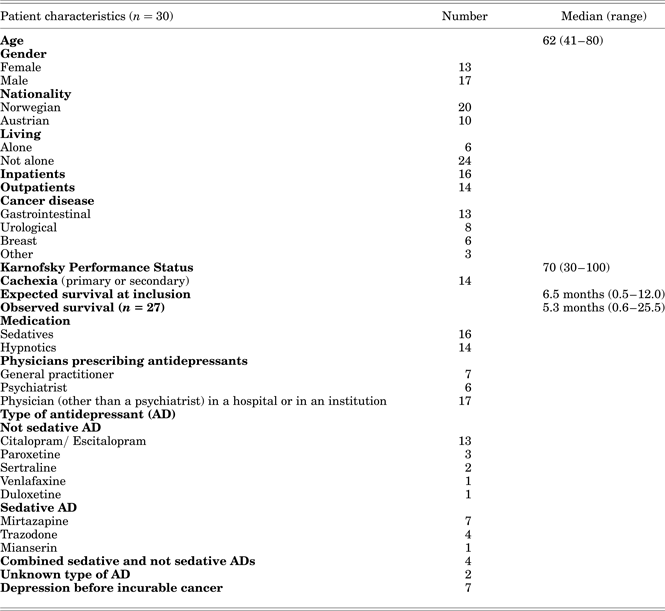
In total, 35 patients were interviewed. Five of the interviews were not included in the analysis for the following reasons: one patient had a seasonal depressive disorder, one patient denied having been depressed and resisted further interview, one patient denied depression and described no depressive symptoms, and one patient described start of the depressive disorder prior to the cancer disease becoming incurable. One interview was not audiotaped because of technical problems. Therefore, 30 interviews were included in the analysis. Further, the numeric responses to the first three structured interviews were not included in the analysis because of revision of the questions as described previously. One interview was discontinued before the quantitative part because of the patient's physical condition. Table 1 presents patients' characteristics.
Patients' characteristics

The semistructured interviews revealed the following core symptoms: (1) lowered mood, (2) diminished motivational drive, (3) despair, (4) anxiety, (5) relentless focus on their actual situation, (6) social withdrawal, (7) restlessness, (8) disrupted sleep, (9) appetite and weight changes, (10) feelings of worthlessness, (11) feelings of guilt, and (12) thoughts of death as a solution. The wish to stay alive was a core feature. Illustrative patient quotations are presented for each symptom.
Symptoms 1 and 2 (lowered mood, diminished motivational drive) were reported by all patients. Symptoms 3–6 (despair, anxiety, a relentless focus on their actual situation, and social withdrawal) were reported by most of the patients. Symptoms 7–12 (restlessness, disrupted sleep, appetite and weight changes, feelings of worthlessness, feelings of guilt, and thoughts of death as a solution) were variably reported, but composed a common pattern.
Lowered Mood
The patients felt sad, depressed and dark. Life lacked content. It was like existing without living.
Q1. One can say that everything is black. There's nothing at all. It's black.
Diminished Motivational Drive
Motivational inner drive and energy were diminished. It was a feeling of being inhibited, lacking initiative and effort. Ability to show interest and be committed was lost. Enthusiasm, pleasurable involvement, and expectations were low. Little was accomplished; it was easy to postpone or cancel activities. This characterized the course of the day from dawn postponing getting up, during the day when little happened, until night, with a sense of only waiting for the day to pass by. Typically the patients spent a lot of time watching TV. Fatigue was also a part of these descriptions but was typically also present before and after the depressive period.
Q2. You try, but it's not really anything that drives you.
Q3. It is just like a barrier, like something preventing - the ability to take initiative to whatever it may be.
Q4. To sum up I did nothing.
Q5. I ended up sitting in front of the TV. I had neither the means nor the strength to continue. Everything stopped.
Q6. I didn't get involved, had no energy to care. Everything was pointless.
Q7. I haven't lost my will to live, but the joy in living.
Despair
The patients felt desperate. The situation was experienced as unmanageable, a challenge beyond the ability to cope with; in a way, unbearable. They felt powerless and did not know what to do facing the situation of disease progression and forthcoming death. Some described repetitive crying attacks. The symptom was relieved by antidepressants, making it possible to face reality without feeling the same degree of despair.
Q8. My picture of it is to cross over a river with strong currents… . . Then you have a sense of incongruous powerlessness when you see that I do not get over onto the other side.
Q9. I could't stand it anymore, and I was crying all the time. I was not anxious, but despaired. Why me? Why do I have to go through this?
Anxiety
Anxiety was experienced commonly and described as a strong feeling. The salient and invariant theme was the fear of death. Fear of the progressing disease accompanied by suffering or the loss of roles was also described. When depression was relieved by the antidepressants, anxiety was also relieved. Sedatives had been prescribed to 16 of the 30 patients.
Q10. I was scared of dying. That was actually the worst part, the fear of dying. I was thinking: why am I going to die at the age of 50?
Q11. I had anxiety attacks. I dared not be alone, I was almost hysterical. Kind of like a fear of death.
Q12. I felt as though I was hanging on a cliff face and was tired and terrified of falling and couldn't manage to continue on up, only hold tight. Then you know that when you're hanging, you end up falling.
Relentless Focus on their Actual Situation
The patients described that the focus of thoughts was persistently on the disease and their actual situation. It caught their full attention and was on their minds all the time. The thoughts were present day and night and could not be deliberately diverted. Questions and worries on the impending time, death, the present, and the past were core contents. It was difficult to pay attention to anything else and hard to stay focused on anything else over time.
Q13. I talked only about myself. It was only the disease. There was nothing else. Do not know how my wife endured. She should have had a medal. It must be tiring. It was my whole existence actually.
Q14. All the time I couldn't manage to sit down without thinking about death or dying. Couldn't think of anything else.
Social Withdrawal
The patients withdrew from others and isolated themselves. Characteristically they did not answer the telephone. They did not initiate contact, did not issue invitations or visit others. Participation in conversations was reduced, and they talked less.
The feeling of shame was closely connected to social withdrawal. This feeling was described as a need to hide and not to be seen or approached by others.
At the same time, the patients did not want to be alone, but had a strong need for the presence of someone else. This “someone else” was mostly centered on the next of kin. The patients, who did not have this kind of relationship, described their situation as very lonely.
Q15. I started to delete the phone numbers on my mobile phone until there was left only the immediate family members, and finally I just turned it off.
Q16. I kept my distance from friends. When neighbors asked me home to tea, I said no. I used detours in order not to talk to the neighbors. I avoided people.
Q17. Yes, especially when you live in a small place. Consistently, I have stopped driving, and sat in the back seat because I did not want people to see me.
Restlessness
Inner restlessness was described as not being able to relax. For some patients this led to physically being compelled to walk around. However, physical symptoms and immobility limited this.
Q18. Unrest in the entire body. Disquiet in the entire person, inside the human being.
Disrupted Sleep
Sleep problems or a need for hypnotics were characteristic. Sleep problems typically were described as problems falling asleep or disrupted sleep during night. Hypnotics were used by 14 of the 30 patients and generally gave good relief. Sleeping too much during the day was also described.
Q19. Big problems with sleeping. I basically turned the day around. Slept not until the morning when others woke up. It was safer with sounds in the house.
Q20. I started with sleeping medicine that I got prescribed by the GP. That was when all the heavy thoughts came.
Appetite and Weight Changes
Changes of appetite and weight were described, mostly as reduced. Increased appetite was described after start of antidepressants. Reduced appetite and weight loss were also described in relation to disease progression and cancer therapy. Loss of weight and reduced appetite were not only described in relation to the experience of depression but also in relation to the disease trajectory. The patients could not distinguish between what caused loss of weight and reduced appetite.
Q21. I told everyone how bad I am feeling. I told them that I have no appetite and no sense of taste. I weighed 106 kilogram and now I weigh 64, so I lost more than 30 kg in less than 3 months, and from that time it was going downhill, it was a frightful sign.
Q22. I have trouble eating. Very often I don't feel like eating because I feel sick.
Feelings of Worthlessness
The patients knew they had value for others, especially for the closest relatives. A basic experience of value was maintained. Still an inner feeling of worthlessness was typically connected to physical reduced performance and loss of roles and functions.
Q23. I have not really felt worthless. I have felt useless… . but in relation to friends and family… . . I got a lot of positive feed-back.
Q24. Why am I here? I am only a big burden for the society. I can no longer work. I am dispensable.
Feelings of Guilt
Expressions of guilt were in some patients connected to thoughts of having caused the cancer disease themselves, at the same time rationally knowing that it was not the case. Blame on life or destiny for being in the situation was also present.
Q25. I thought sometimes that it was my own fault, that I did not know my body better. It was also there that I put the blame on others, the medical system … Why should I get this?
Thoughts of Death as a Solution
Pervasive in the patients' descriptions was the wish to live and not to die. Death was a threat. Thoughts of death as a solution were vague, transient, and ambivalent. Uttering of such thoughts reflected despair and the need to escape. A few patients described suicidal ideation, but none had made an attempt.
Q26. I said to him that I had nothing to live for, but basically it was not honest. I did not really wish to die. It was only thoughts that might come about that it would have been much better to die.
Findings in the Structured Interviews
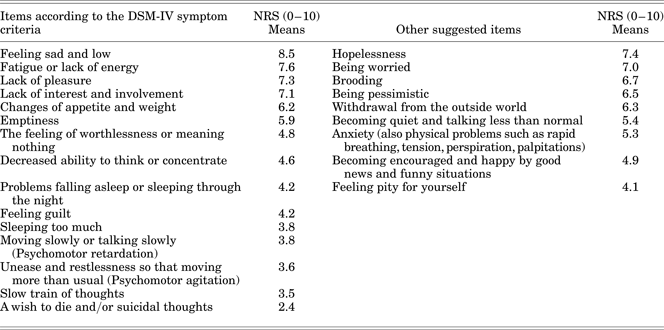
Table 2 shows the mean scores for the experience of the 24 depressive symptoms included in the structured interviews. The two main symptom criteria of the DSM-IV (lowered mood and anhedonia) reached the highest scores. The physical symptoms appetite changes, weight changes, and fatigue also reached high scores. Some of the alternative symptoms had higher scores than several of the DSM-IV criteria such as hopelessness, being worried, brooding, being pessimistic, withdrawing socially and feeling anxious. The symptoms reaching the lowest scores were the wish to die and having suicidal thoughts.
Patients' numerical scores of depressive criteria according to the DSM-IV and other suggested items
DISCUSSION
This study investigated depression symptoms experienced by patients with incurable cancer, who were under treatment with antidepressants for a clinically recognized depressive disorder. Lowered mood was confirmed as a major symptom in both the semistructured and the structured interview. Anhedonia was confirmed as a major symptom, but was expressed more as loss of motivational drive in the semistructured interview. The somatic symptoms fatigue and loss of weight or appetite were prominent but often indistinguishable from manifestations of the progressing cancer. Despair, anxiety, and social withdrawal emerged as alternative symptom criteria. Recurrent thoughts of death partly represented relevant thoughts of forthcoming death. These symptoms were experienced intensively and obsessively. Functional impairment was prominent and related to the depression, often described as social withdrawal in spite of intensive need for the presence of someone else. Patients' expressions of an intense desire to live contrasted the impact of depression with a lost ability to participate in their actual lives.
The two main symptoms of the DSM-IV for MDD; “depressed mood” and “diminished interest and pleasure in activities” (anhedonia), were major and dominating symptoms in the interviews. Descriptions of anhedonia primarily addressed loss of motivational drive and energy, but also comprised the original meaning “without pleasure” (Greek an-hedonia). Loss of energy was difficult to separate from this experience. Performance was reduced because of the depression as described by the patients. Their median Karnofsky Performance Status was 70 (range 40–100) at interviews. The patients' descriptions of their functioning indicate that the depressive disorder contributed significantly to a lowered functional level; however, most patients with advanced cancer and short life expectancy also are cachectic and with low level of function because of the strong catabolic drive. Diminished appetite and weight loss were also present before the depression symptoms emerged, and they were reduced by the antidepressive therapy. These two symptoms are also key symptoms of the cachectic syndrome (Fearon et al., Reference Fearon, Strasser and Anker2011). The overlapping of the fatigue and appetite and weight changes associated with depression, with common cancer symptoms in patients with and without cachexia is in accordance with previous findings (Teunissen et al., Reference Teunissen, Wesker and Kruitwagen2007; Radbruch et al., Reference Radbruch, Strasser and Elsner2008; Luthy et al., Reference Luthy, Cedraschi and Pugliesi2011).
Psychomotor retardation (slowness) or agitation (observable restlessness) are symptom criteria in the DSM-IV. Slowness was described as immobility related to cancer/cancer treatment, and physical restlessness was hampered by cancer symptoms such as pain and neurological symptoms. However, inner restlessness was a prevalent and important symptom. Adjustment of the criterion to a feeling of inner restlessness might be a candidate for further investigation.
“Diminished ability to think or concentrate or indecisiveness” is a symptom criterion in the DSM-IV. It resembles the reports on a “relentless focus on the actual situation.” The relentless rumination of questions and worries connected to the patients' medical status was a prominent description of being depressed. Sleep changes as in the DSM-IV symptom criterion were reported, but in the majority of patients, the symptom experience was modified by hypnotics. The DSM-IV symptom criterion “worthlessness or guilt” was prominent in a minority of patients. The descriptions were typically ambivalent.
The DSM-IV symptom criterion “recurrent thoughts of death (not just fear of dying), recurrent suicidal ideation without a specific plan, or a suicide attempt or a specific plan for committing suicide” does not require the presence of the symptom “most of the days nearly every day” but should be experienced “frequently” (First et al., Reference First, Spitzer and Gibbon1997a). A core feature of the interviews was the patients' wish to live and their experience of death as a threat. A wish to die or suicidal thoughts were described vaguely, and were transient and ambivalent and expressed as despair. To be useful as a criterion, a redefinition of this symptom criterion reflecting thoughts of death as a solution or a positive wish to die seems appropriate. Thoughts of death as a solution seemed multifaceted by also reflecting coping in terms of having control without actually planning to commit suicide. Similar findings have been described in previous studies regarding thoughts of euthanasia or desire for hastened death in palliative care patients (Johansen et al., Reference Johansen, Holen and Kaasa2005; Nissim et al., Reference Nissim, Gagliese and Rodin2009). In sum, the findings point to a need for a broader understanding of “recurrent thoughts of death or suicidal ideation” in patients with incurable cancer (Plumb & Holland, Reference Plumb and Holland1981; Rodin et al., Reference Rodin, Zimmermann and Rydall2007; Madeira et al., Reference Madeira, Albuquerque and Santos2011; Walker et al., Reference Walker, Hansen and Butcher2011).
Social withdrawal was consistently reported. It has previously been proposed as an alternative criterion (Endicott, Reference Endicott1984; Koenig et al., 1997). It was relieved by antidepressants and appeared to give valuable information about the depressive disorder. Further, is also greatly impacted on the patients and their families. Clinical evaluation of social withdrawal could easily be separated from physical causes because it included intent, attitudes, and emotions as well as physical isolation.
The co-occurrence of anxiety with depression is in accordance with previous findings (Wilson et al., Reference Wilson, Chochinov and Skirko2007; Mitchell et al., Reference Mitchell, Chan and Bhatti2011). Anxiety, mostly as fear of death, appeared as part of the depressive disorder and was also relieved by antidepressants. The inner restlessness described by many patients can also be interpreted as an expression of anxiety. Despair was a symptom, not only initially after receiving bad news related to the disease, but a persistent feeling. The experience of despair was relieved by antidepressants. Despair has previously been pointed to as an important symptom in patients with incurable cancer (Clarke & Kissane, Reference Clarke and Kissane2002; Kissane et al., Reference Kissane, Wein and Love2004; Clarke et al., Reference Clarke, Kissane and Trauer2005; Jacobsen et al., Reference Jacobsen, Vanderwerker and Block2006). Both anxiety and despair contributed to the psychological distress experienced by the patients, and the symptoms might help the identification of a depressive disorder in patients with incurable cancer.
The purpose of the numerical ratings was to enhance critical reflection in the qualitative analysis. In large, the numerical ratings resembled the findings from the qualitative analyses. However, several alternative items yielded higher scores than some of the items assessing the DSM-IV symptom criteria. Hopelessness, being worried, brooding, being pessimistic, withdrawal from the outside world, becoming quiet and talking less than normal, and anxiety had all relatively high mean scores. Brooding, withdrawal from the outside world, becoming quiet and talking less than normal, and anxiety also emerged in the qualitative analysis. Being worried had for many been present throughout the cancer trajectory and partly represented relevant and realistic reflections on the patients' actual situation. Worries also constituted major parts of “relentless focus on the actual situation” and partly also overlapped with restlessness. Several patients responded to the question of being worried by specifying the term to one of the other symptoms, such as anxiety or despair. Some patients also referred to being worried as a personal trait pointing to personality traits such as neuroticism as a factor of importance in depressive disorders in relation to cancer. “Despair” was not a predefined item and was therefore not included in the list of items in the questionnaire. When asked about “becoming encouraged and happy by good news and funny situations,” most patients answered that they responded positively to good news about the cancer but not to other types of news. “Feeling pity for oneself” was perceived as a negative trait. Many patients hesitated to respond to the item, and some commented on this. When patients were asked about pessimism and hopelessness, the typical understanding of pessimism was acknowledging death as the outcome of the disease and hopelessness as a fact of the same. Hopelessness also expressed the dark, lowered mood, and anhedonia as diminished expectations and despair at being in an unmanageable situation.
This study has some limitations that need to be addressed. First of all, the present findings must be regarded as hypotheses for future work. The sample was pragmatically recruited, and the diagnosis of a depressive disorder was determined by clinicians on a clinical basis. By having positive response to antidepressants as an inclusion criterion, we think it is reasonable to state that the patients had been severely depressed and that their symptom experiences reflect this diagnosis. The symptom experiences of patients with “lighter” forms of depressive disorders might differ. The pattern of core symptoms gradually evolved, and alternative symptom models were discussed as relevant during the analytic process. This relates to, for example, defining restlessness as a separate symptom and not part of anxiety, defining despair as a separate symptom and not part of anxiety or depressed mood, the inability to distinguish loss of energy from anhedonia, and not defining worries as a separate symptom.
Phenomenography searches for categories that have clear demarcations and do not overlap. This had to be combined with wordings and descriptions that did overlap regarding symptom content. The collection of data in two different countries partly limited the possibility to have discussions between the interviewers, although both spoke German fluently, so exchange of information in general was not hampered.
CONCLUSION
In summary, symptoms of depressive disorder in patients with incurable cancer partly differ from the gold standard (i.e., DSM-IV). In addition to the overlap between some symptom criteria and symptoms of the cancer, the patient's forthcoming death further challenges the official diagnostic criteria. Anxiety, despair, and social withdrawal might represent alternative depressive symptoms in these patients. The DSM-IV diagnostic criteria “psychomotor agitation and retardation,” “diminished ability to think or concentrate or indecisiveness,” and “recurrent thoughts of death (not just fear of dying), recurrent suicidal ideation, an attempt or a plan” might be evaluated for adjustment of nuances. The diagnostic criteria “fatigue and loss of energy” and “diminished appetite and weight loss” should be evaluated for inappropriateness, because of the overlap with cancer symptoms, which is of special relevance in this multisymptomatic group of patients.
Currently, the psychiatric classification systems are the diagnostic standards, but these must be regarded only as guidelines in the clinical setting where these patients are seen. Individual considerations related to the specific situation of incurable cancer are therefore needed in the clinical setting when a possible depressive disorder is assessed. Clinicians should be aware of anxiety, despair, and social withdrawal as indicators of a depressive disorder in patients with incurable cancer and carefully evaluate the validity of a wish to die.
ACKNOWLEDGMENTS
This study was supported by the European Union's Sixth Framework, contract no. 037777, Principal Investigator Stein Kaasa, and funding from Trondheim University Hospital, Norway. Elisabeth Brenne received a grant from the Norwegian Cancer Society. The authors thank Bente Moldaune for transcribing interviews; Sunita Prugsamatz, Lars Øyvind Ofstad, Maria Langer-Winter, Arild Fehn, and April Almaas for translations of citations; and Sunita Prugsamatz for proofreading of the manuscript.
APPENDIX
About the EPCRC
The EPCRC is funded by the European Union's Sixth Framework Programme (contract no LSHC-CT-2006-037777) with the overall aim to improve treatment of pain, depression, and fatigue through translation research.
Core scientific group/work package leaders: Stein Kaasa (project coordinator), Frank Skorpen, Marianne Jensen Hjermstad, and Jon Håvard Loge, Norwegian University of Science and Technology (NTNU); Geoffrey Hanks, University of Bristol; Augusto Caraceni and Franco De Conno, Fondazione Istituto Di Ricovero e Cura a Carattere Scientifico (IRCCS) Istituto Nationale dei Tumori, Milan; Irene Higginson, King's College London; Florian Strasser, Cantonal Hospital St. Gallen; Lukas Radbruch, Rheinisch-Westfälische Technische Hochschule (RWTH) Aachen University; Kenneth Fearon, University of Edinburgh; Hellmut Samonigg, Medical University of Graz; Ketil Bø, Trollhetta AS, Norway; Michael Schaude, Bender MedSystems GMbH, Austria; Odd Erik Gundersen, Verdande Technology AS, Norway.
Scientific advisory group: Neil Aaronson, The Netherlands Cancer Institute; Vickie Baracos and Robin Fainsinger, University of Alberta; Patrick C. Stone, St. George's University of London; Mari Lloyd Williams, University of Liverpool.
Project management: Stein Kaasa, Ola Dale, and Dagny F. Haugen, NTNU.