Significant outcomes
-
Angiotensin II receptor blockers benefit mostly apolipoprotein E (APOE)-ϵ4 carriers with Alzheimer’s disease (AD) concerning cognitive and functional decline, and also caregiver burden variations, possibly by way of suppression of AT1 receptors while preserving the amyloid-β-degrading properties of the angiotensin-converting enzyme 1 which are most needed for carriers of these genetic variants.
-
Angiotensin-converting enzyme inhibitors benefit APOE-ϵ4 non-carriers with AD concerning cognitive and functional decline due to improved blood pressure control in addition to possible central cholinergic, anti-inflammatory and anti-amyloidogenic mechanisms.
-
The ACE insertion/deletion polymorphism interferes with levels of the angiotensin-converting enzyme 1 and leads to variable response to disease-modifying properties of angiotensin modulators concerning neurological outcomes and blood pressure variations, thus justifying the need for stratification of samples according to specific genetic variants in clinical studies of AD.
Limitations
-
Generalisability of these findings may be compromised by the non-randomised single-centre approach, the relatively short follow-up, small subgroup sizes, and the lacking stabilisation of results according to ethnicity, environmental factors, or prospective effects of arterial hypertension.
-
It is still unknown whether the neurological properties of angiotensin modulators are dose-dependent or attributed to their central or peripheral effects, while variability in brain distribution of angiotensin modulators is controversial in the literature and may be affected by several previously undefined factors such as age.
-
Absent measurements of cerebrospinal fluid or plasma amyloid-β or activity and levels of the angiotensin-converting enzyme 1 also prevented proper adjustments for specific genetic variants.
Introduction
The assembly of amyloid-β into insoluble extracellular amyloid fibrils is one of the core mechanisms of Alzheimer’s disease (AD) (Chuang et al., Reference Chuang, Hori, Hesketh and Shorter2018). Several proteases are able to degrade amyloid-β and potentially affect risk of AD mediated by apolipoprotein E (APOE)-ϵ4 alleles or not, such as the insulin-degrading enzyme (Edland, Reference Edland2004), neprilysin (Helisalmi et al., Reference Helisalmi, Hiltunen, Vepsäläinen, Iivonen, Mannermaa, Lehtovirta, Koivisto, Alafuzoff and Soininen2004), presequence peptidase (Malito et al., Reference Malito, Hulse and Tang2008), cathepsin D (Iwata et al., Reference Iwata, Higuchi and Saido2005), endothelin-converting enzymes 1 and 2 (Eckman & Eckman, Reference Eckman and Eckman2005), and plasmin and matrix metalloproteinase-9 (Zhao & Pei, Reference Zhao and Pei2008). However, from the standpoint of blood pressure as a remarkable modulator of risk of AD, the angiotensin-converting enzyme 1 must be taken into account for its amyloid-β-degrading properties (Meng et al., Reference Meng, Baldwin, Bowirrat, Waraska, Inzelberg, Friedland and Farrer2006).
Combined midlife cerebrovascular risk factors including arterial hypertension have been associated with earlier onset of AD (De Oliveira et al., Reference De Oliveira, Bertolucci, Chen and Smith2014), though they may lead to cognitive improvement in late life (De Oliveira et al., Reference De Oliveira, Pivi, Chen, Smith and Bertolucci2015b), possibly due to enhanced cerebral perfusion. Even though angiotensin-converting enzyme inhibitors (ACEis) and angiotensin II receptor blockers (ARBs) are among the most prescribed anti-hypertensive medications in older people, most studies have not shown differences in cognitive or functional decline in AD concerning the choice of anti-hypertensive therapy, regardless of APOE-ϵ4 carrier status or blood pressure control (De Oliveira et al., Reference De Oliveira, Chen, Smith and Bertolucci2016).
The renin-angiotensin system is upregulated in AD, with angiotensinogen being cleaved by renin to form angiotensin I, which is then hydrolysed by the angiotensin-converting enzyme 1 to form angiotensin II, which wields its hypertensive effects when interacting with the AT1 receptor (Gouveia et al., Reference Gouveia, Camins, Ettcheto, Bicker, Falcão, Cruz and Fortuna2022). The pro-inflammatory AT1 receptor and vasopeptidases such as the angiotensin-converting enzyme 1 may be overexpressed concurrently with the amyloid-β load in brains of patients with AD (Cosarderelioglu et al., Reference Cosarderelioglu, Nidadavolu, George, Marx-Rattner, Powell, Xue, Tian, Salib, Oh, Ferrucci, Dincer, Bennett, Walston and Abadir2022), though some studies have shown that only vasopeptidases such as neprilysin and the endothelin-converting enzymes regulate amyloid-β levels in vitro (Eckman et al., Reference Eckman, Adams, Troendle, Stodola, Kahn, Fauq, Xiao, Bernstein and Eckman2006). Theoretically, treatment with ARBs could be beneficial in neurological terms by reducing cerebrovascular dysfunction when preventing angiotensin II from binding to its receptors, while brain-penetrating ACEis might increase amyloid-β concentrations in the brain. Contrariwise, ACEis may improve cognitive function by several different mechanisms: decreasing the amyloidogenic processing of the amyloid precursor protein (Gouveia et al., Reference Gouveia, Camins, Ettcheto, Bicker, Falcão, Cruz and Fortuna2022); reducing cerebrovascular damage caused by rising levels of the angiotensin II (Ouk et al., Reference Ouk, Wu, Rabin, Jackson, Edwards, Ramirez, Masellis, Swartz, Herrmann, Lanctôt, Black and Swardfager2021), which could accelerate glial activation and tau phosphorylation; stimulating the potassium-induced release of acetylcholine, which is naturally inhibited by the pro-inflammatory angiotensin II (Gouveia et al., Reference Gouveia, Camins, Ettcheto, Bicker, Falcão, Cruz and Fortuna2022); enhancing endothelial function and upregulating brain substance P (typically degraded by the angiotensin-converting enzyme 1), which has been reported to boost the activity of neprilysin to degrade extracellular amyloid-β (Ohrui et al., Reference Ohrui, Tomita, Sato-Nakagawa, Matsui, Maruyama, Niwa, Arai and Sasaki2004); and by way of peripheral effects implicated in the modulation of glucose homoeostasis and in the increased secretion of adipokines such as adiponectin and leptin, thus boosting insulin sensitivity and potentially slowing cognitive decline in patients with AD (De Oliveira et al., Reference De Oliveira, Chen, Smith and Bertolucci2018a).
Pharmacogenetics account for more than 60% of the heterogeneity of drug response, which is particularly relevant considering that less than 30% of patients with neurodegenerative diseases are moderate responders to conventional treatment (Cacabelos, Reference Cacabelos2020). Regarding hypercholesterolemia as a cerebrovascular risk factor, earlier pharmacogenetic studies from our group had already shown that protective variants of APOE, LDLR (De Oliveira et al., Reference De Oliveira, Chen, Smith and Bertolucci2020), CETP and NR1H2 (De Oliveira et al., Reference De Oliveira, Bertolucci, Chen and Smith2022a) against risk of AD may also slow cognitive decline, which is particularly important considering that the low-density lipoprotein receptor is also a receptor of the apolipoprotein E (the main cholesterol transporter in the brain).
Considering the ACE insertion/deletion polymorphism, associations with risk of AD are conflicting, with most studies showing association with the insertion allele, others showing association with the deletion allele and many finding no association with this marker (Panza et al., Reference Panza, Solfrizzi, D’Introno, Colacicco, Capurso, Capurso and Kehoe2003). However, effects of this polymorphism could be mediated via epistatic interactions with other variants of risk (Oliveira et al., Reference Oliveira, Almeida, Smith and Bertolucci2021). The deletion allele has been associated with boosted serum levels of the angiotensin-converting enzyme 1 while increasing the risk of arterial hypertension, though leading to better blood pressure response to ACEis (De Oliveira et al., Reference De Oliveira, Berretta, Almeida Junior, Almeida, Chen, Smith and Bertolucci2019).
In addition to the effects of the ACE insertion/deletion polymorphism, APOE haplotypes are also likely effect modifiers throughout the progression of AD (Oliveira et al., Reference Oliveira, Almeida, Smith and Bertolucci2021). We had previously shown that APOE-ϵ4 non-carriers with AD who also carried other ACE variants could benefit from the use of an ACEi to slow cognitive decline (De Oliveira et al., Reference De Oliveira, Chen, Smith and Bertolucci2018a), while APOE-ϵ4 carriers with AD who also carried ACE deletion/deletion were prone to have more dysphoria (Oliveira et al., Reference Oliveira, Almeida, Smith and Bertolucci2021); thus, we hypothesised that longitudinal effects of angiotensin modulators on clinical changes in AD could also be mediated by interactions of the APOE-ϵ4 carrier status with the ACE insertion/deletion polymorphism.
In this observational pharmacogenetic study, we aimed to investigate whether the ACE insertion/deletion polymorphism is associated with clinical changes in patients with AD, while also taking APOE-ϵ4 carrier status and blood pressure response to angiotensin modulators into account for stratification.
Methods
Participants and clinical assessment
From 2010 to 2014, we prospectively recruited consecutive outpatients with late-onset AD according to National Institute on Aging – Alzheimer’s Association criteria (McKhann et al., Reference McKhann, Knopman, Chertkow, Hyman, Jack, Kawas, Klunk, Koroshetz, Manly, Mayeux, Mohs, Morris, Rossor, Scheltens, Carillo, Thies, Weintraub and Phelps2011) from the Behavioral Neurology Section of Hospital São Paulo, Federal University of São Paulo (UNIFESP). All patients had a magnetic resonance exam to evaluate either medial parietal or medial, basal or lateral temporal atrophy or, in cases of claustrophobia or use of pacemakers, a computed tomography scan to exclude vascular lesions. We employed the Modified Ischemic Score (modified version of the Hachinski ischemic score) (Loeb & Gandolfo, Reference Loeb and Gandolfo1983) to exclude vascular dementia or mixed dementia, in which patients could not score more than 2. Late-onset AD corresponded to onset of the dementia syndrome after patients turned 60 years of age (De Oliveira et al., Reference De Oliveira, Bertolucci, Chen and Smith2014). Each patient was followed for 1 year.
After diagnostic confirmation, all patients had at least three medical appointments in the following year: in the first one, they were evaluated for sex, education and estimated age at dementia onset, while assessments of body mass index, arterial hypertension and pharmacological therapy (cholinesterase inhibitors, Memantine, ACEis or ARBs) were conducted in all appointments. Information concerning age at dementia onset was determined following a review of medical records and confirmed after the most frequent caregiver (preferably a family member) was interviewed. Blood pressure was measured in every evaluation after the participant sat resting for 5 min in a quiet room, while the diagnosis of arterial hypertension followed the JNC 7 report (Chobanian et al., Reference Chobanian, Bakris, Black, Cushman, Green and Izzo2003). All efforts were directed to achieve normal blood pressure levels for all patients rather than just lowering systolic and diastolic levels.
All patients were prospectively assessed by way of a 15-item Clock Drawing Test (free drawing) (CDT) (De Oliveira et al., Reference De Oliveira, Wajman, Bertolucci, Chen and Smith2015a), the Mini-Mental State Examination (MMSE) (Bertolucci et al., Reference Bertolucci, Brucki, Campacci and Juliano1994) and the Severe Mini-Mental State Examination (SMMSE) (Wajman et al., Reference Wajman, Oliveira, Schultz, Marin and Bertolucci2014a), while their caregivers were queried for scores on the Clinical Dementia Rating Sum of Boxes (CDR-SOB) (Lima et al., Reference Lima, Castilhos and Chaves2017), the Brazilian Version of the Zarit Caregiver Burden Interview (Zarit) (Taub et al., Reference Taub, Andreoli and Bertolucci2004), the Index of Independence in Activities of Daily Living (ADL) (Katz & Akpom, Reference Katz and Akpom1976) and Lawton’s Scale for Instrumental Activities of Daily Living (IADL) (Lawton, Reference Lawton1988). Scoring guidelines for these tests have been previously described (De Oliveira et al., Reference De Oliveira, Wajman, Bertolucci, Chen and Smith2015a). The same examiner (FFO) conducted all assessments on weekdays in the morning. Only the first and last evaluations were considered for statistics.
Genotyping
After blood samples were collected from all patients in tubes with ethylenediaminetetraacetic acid 0.1%, genomic DNA was extracted using a standard salting-out procedure. For the determination of APOE haplotypes, genotyping of rs7412 and rs429358 followed the standard protocols of Real-Time Polymerase Chain Reactions using TaqMan® SNP Genotyping Assays on the Applied Biosystems 7500 Fast Real-Time PCR System (Applied Biosystems®, USA). The ACE Alu insertion/deletion (I/D) polymorphism was determined by conventional Polymerase Chain Reactions (Nacmias et al., Reference Nacmias, Bagnoli, Tedde, Cellini, Bessi, Guarnieri, Ortensi, Piacentini, Bracco and Sorbi2007). All genotyping procedures were blindly carried out after full collection of clinical data.
Outcome measures
The primary outcome measure was the score variation at 1 year, separately for APOE-ϵ4 carriers or APOE-ϵ4 non-carriers, concerning cognition (CDT, MMSE and SMMSE), functionality (ADL and IADL), global ratings (CDR-SOB) or caregiver burden (Zarit), taking the following independent variables into account: ACE genotypes and use of an ACEi or an ARB. Patients were compared according to use of an ACEi versus no angiotensin modulator, use of an ARB versus no angiotensin modulator, use of an ACEi versus an ARB, APOE-ϵ4 carriers using an ACEi versus APOE-ϵ4 non-carriers using an ACEi, APOE-ϵ4 carriers using an ARB versus APOE-ϵ4 non-carriers using an ARB and APOE-ϵ4 carriers using no angiotensin modulator versus APOE-ϵ4 non-carriers using no angiotensin modulator. In secondary analyses, the impacts of angiotensin modulators on systolic and diastolic blood pressure variations at 1 year were assessed.
Statistical analyses
Paired Student’s t-test was employed for variations of anthropometric values and test scores (taking baseline and final scores after 1 year into account). The Hardy–Weinberg equilibrium for ACE genotypes was estimated by way of the Chi-square test. Scores of each test were logarithmically transformed to meet the normality assumptions for a general linear model that was employed for test score variations at 1 year, separately for APOE-ϵ4 carriers and for APOE-ϵ4 non-carriers, with two degrees of freedom: ACE genotypes and use or not of an ACEi or an ARB. The general linear model was adjusted for sex, years of education, estimated dementia duration at baseline and body mass index variations at 1 year, significance at p < 0.05, and corrected for false discovery rates according to the Benjamini–Hochberg procedure to minimise the occurrence of type I errors. The same general linear model was reproduced for assessments of systolic and diastolic blood pressure variations at 1 year, separately for APOE-ϵ4 carriers and for APOE-ϵ4 non-carriers, and adjusted for sex and body mass index variations at 1 year, with the same degrees of freedom. Univariate analyses disclosed the effects of genetic variants on blood pressure variations and each test score variation regardless of pharmacological treatment, as well as the effects of pharmacological treatment on blood pressure variations and each test score variation regardless of ACE variants, while multivariate analyses showed results of interactions between genetic variants and use or not of an ACEi or an ARB.
Ethical standards
This study is part of the research project 1067/10 (CAAE 0540.0.174.000-10) approved by the Ethics Committee of Hospital São Paulo, Federal University of São Paulo (UNIFESP), in August 2010. All invited patients and their legal representatives agreed to participate on the research and signed the Informed Consent Form before the evaluation. The authors assert that all procedures contributing to this work comply with the ethical standards of the Helsinki Declaration of 1975, as revised in 2008.
Results
From 217 patients who had been included at baseline, 14 (6.5%) passed away and 10 (4.6%) abandoned the study. The final sample consisted of the 193 patients who completed the follow-up. Full details on cerebrovascular risk factors have been described elsewhere (De Oliveira et al., Reference De Oliveira, Pivi, Chen, Smith and Bertolucci2015b), but the burden was considerable, with more than 80% of patients having arterial hypertension, almost three-quarters having hypercholesterolemia and more than one-quarter having diabetes mellitus.
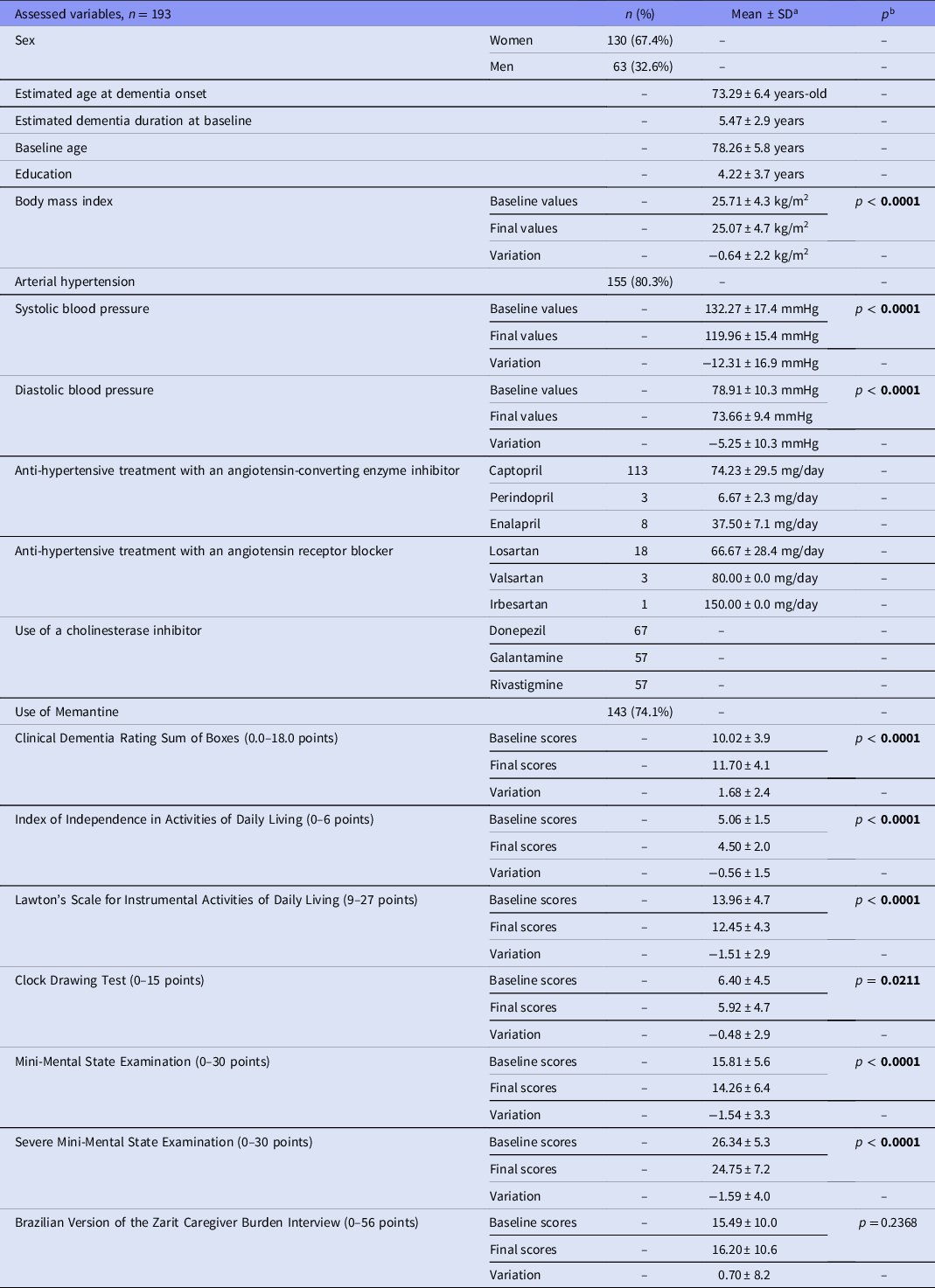
Table 1 shows the cross-sectional demographic results, as well as anthropometric and clinical features. More than two-thirds of all patients were women, more than 90% were treated with a cholinesterase inhibitor, almost three-quarters used Memantine, almost two-thirds used an ACEi and more than 10% used an ARB to control blood pressure. No patient used an ACEi and an ARB at the same time. Mean body mass index and systolic and diastolic blood pressure levels were significantly lower after 1 year. Most test scores were significantly lower after 1 year, except for the CDR-SOB (which was higher) and the Zarit (which was not significantly different).
Demographics and clinical results

a SD, standard deviation.
b Paired Student’s t-test.
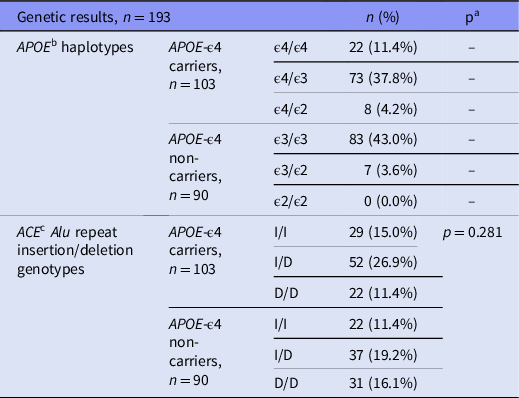
Table 2 shows genetic results. Of all patients, 53.4% were APOE-ϵ4 carriers and 46.6% were APOE-ϵ4 non-carriers. The ACE insertion/deletion polymorphism was in Hardy–Weinberg equilibrium.
Genotypes and haplotypes

a Hardy–Weinberg equilibrium (Chi-square test).
b APOE = apolipoprotein E gene.
c ACE = angiotensin-converting enzyme gene.
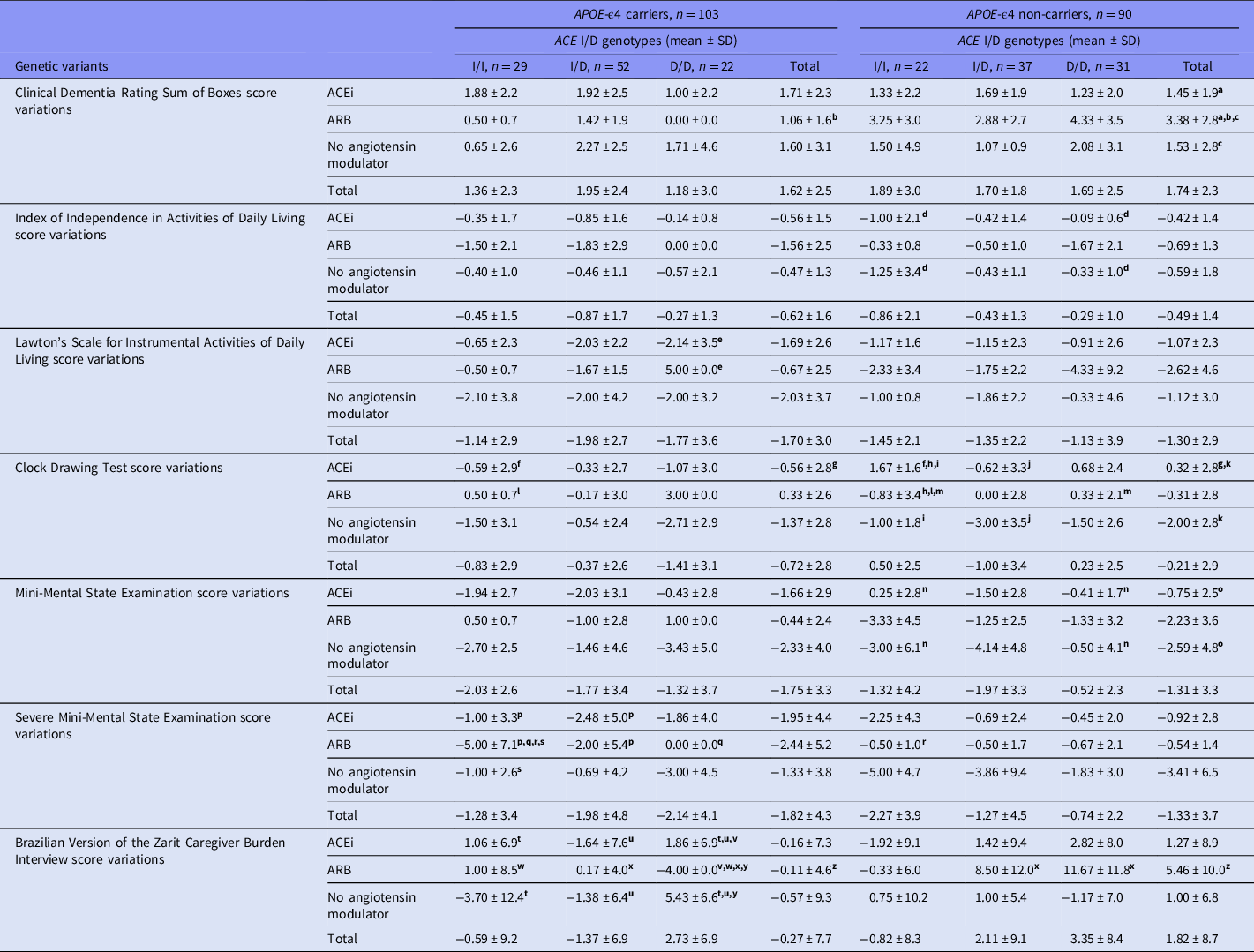
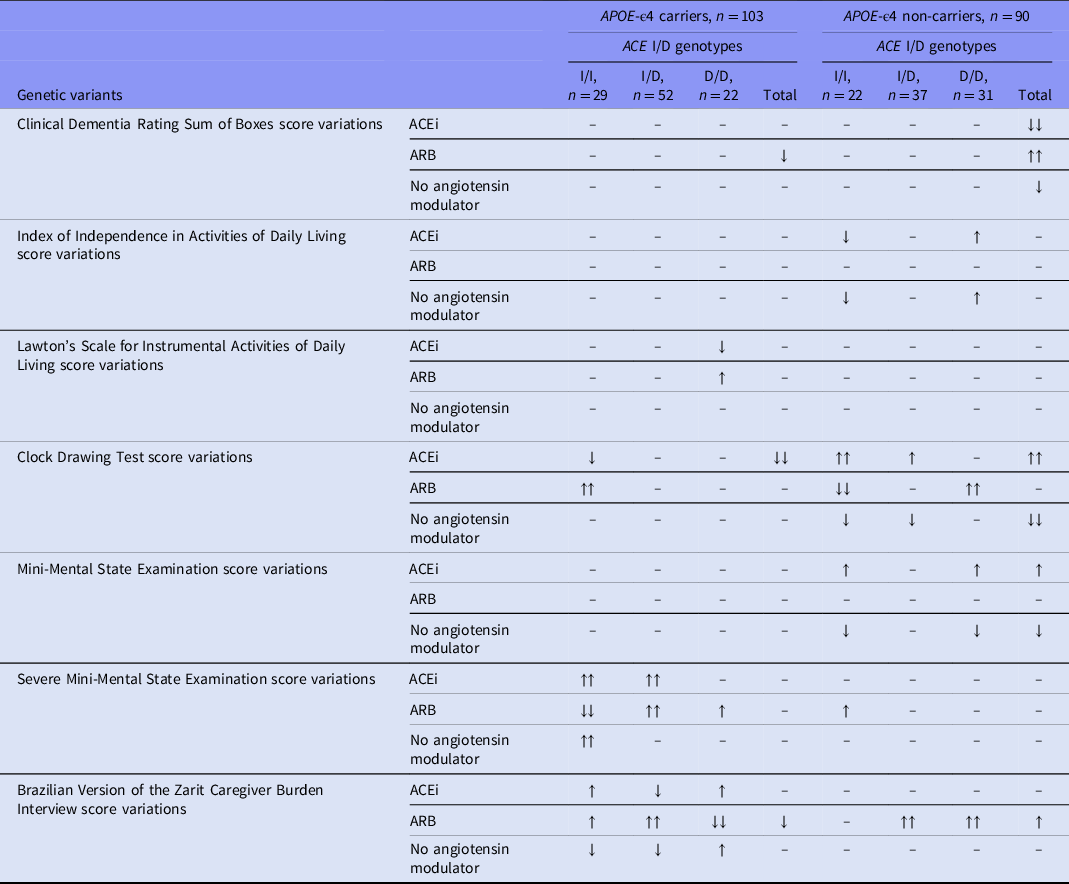
Table 3 shows cognitive, functional and caregiver burden variations in 1 year according to genotype frequencies for the ACE insertion/deletion polymorphism and the use or not of an ACEi or an ARB in APOE-ϵ4 carriers and APOE-ϵ4 non-carriers (see Fig. 1). Table 4 summarises the main comparative outcomes from Table 3.
Significant results concerning neurological response to angiotensin modulators at 1 year according to genotype frequencies for the ACE Alu I/D polymorphism in APOE-ϵ4 carriers and APOE-ϵ4 non-carriers: (a) among APOE-ϵ4 non-carriers, ACEis were protective in comparison with ARBs regarding CDR-SOB score variations (corrected p < 0.05); (b) among APOE-ϵ4 non-carriers, those who used an ARB had faster worsening of CDR-SOB scores than those who did not use an angiotensin modulator (uncorrected p = 0.014); (c) APOE-ϵ4 carriers who used an ARB had slower worsening of CDR-SOB scores in comparison with APOE-ϵ4 non-carriers who used an ARB (uncorrected p = 0.028); (d) among APOE-ϵ4 non-carriers, carriers of ACE D/D who used an ACEi had slower worsening of ADL scores than carriers of ACE I/I who used an ACEi and carriers of any ACE genotypes who did not use an angiotensin modulator (uncorrected p = 0.049); (e) among APOE-ϵ4 carriers who also carried ACE D/D, ARBs were protective in comparison with ACEis regarding IADL score variations (uncorrected p = 0.026); (f) among APOE-ϵ4 non-carriers, carriers of ACE I/I had improved CDT scores when they used an ACEi (corrected p < 0.05), while carriers of ACE D/D had improved response to an ARB in comparison with carriers of ACE I/I (corrected p < 0.05); (g) among APOE-ϵ4 non-carriers, those who used an ACEi had improved CDT scores in comparison with those who did not use an angiotensin modulator (corrected p < 0.05), particularly when they also carried the ACE insertion allele (uncorrected p = 0.049); (h) APOE-ϵ4 non-carriers who used an ACEi had improved CDT scores in comparison with APOE-ϵ4 carriers who used an ACEi (corrected p < 0.05), particularly when they also carried ACE I/I (uncorrected p = 0.040), while among carriers of ACE I/I, APOE-ϵ4 carriers who used an ARB had improved CDT scores in comparison with APOE-ϵ4 non-carriers who used an ARB (corrected p < 0.05); (i) among APOE-ϵ4 non-carriers, those who used an ACEi had slower worsening of MMSE scores than those who did not use an angiotensin modulator (uncorrected p = 0.020); (j) among APOE-ϵ4 carriers, ACEis were protective in comparison with ARBs regarding SMMSE score variations for carriers of ACE I/I (corrected p < 0.05), while ARBs were protective regarding SMMSE score variations for carriers of ACE D/D (uncorrected p = 0.026); (k) among APOE-ϵ4 carriers, carriers of ACE I/I who used an ARB had faster worsening of SMMSE scores than those who did not use an angiotensin modulator (corrected p < 0.05); (l) APOE-ϵ4 non-carriers who also carried ACE I/I and used an ARB had slower worsening of SMMSE scores, while APOE-ϵ4 carriers who also carried ACE I/I and used an ARB had faster worsening of SMMSE scores (uncorrected p = 0.013); (m) among APOE-ϵ4 carriers who also carried ACE D/D, ARBs were protective regarding Zarit score variations (uncorrected p = 0.015); (n) among APOE-ϵ4 carriers, carriers of ACE D/D had faster worsening of Zarit scores particularly when they did not use an angiotensin modulator (uncorrected p = 0.013), while carriers of ACE I/I had faster worsening of Zarit scores when they used an ACEi (uncorrected p = 0.023); (o) among APOE-ϵ4 carriers, ARBs were protective regarding Zarit score variations for carriers of ACE D/D in comparison with those who did not use an angiotensin modulator (uncorrected p = 0.021) and in comparison with carriers of other genotypes who used an ARB (uncorrected p = 0.049); (p) APOE-ϵ4 carriers who used an ARB had improved Zarit scores in comparison with APOE-ϵ4 non-carriers who used an ARB (uncorrected p = 0.016), particularly when they also carried ACE D/D (corrected p < 0.05).

Caregiver burden and cognitive and functional responses to angiotensin modulators at 1 year according to genotype frequencies for the ACE Alu insertion/deletion polymorphism in APOE-ϵ4 carriers* and APOE-ϵ4 non-carriers*

SD, standard deviation; APOE, apolipoprotein E gene; ACE, angiotensin-converting enzyme gene; ACEi, angiotensin-converting enzyme inhibitor; ARB, angiotensin II receptor blocker.
*General linear model adjusted for sex, years of education, estimated dementia duration at baseline and body mass index variations at 1 year.
ACEi, users of an ACEi: 64 (62.1%) APOE-ϵ4 carriers and 60 (66.7%) APOE-ϵ4 non-carriers used an ACEi.
ARB, users of an ARB: 9 (8.7%) APOE-ϵ4 carriers and 13 (14.4%) APOE-ϵ4 non-carriers used an ARB.
a Significant p < 0.05 (corrected for false discovery rates).
b Uncorrected p = 0.028.
c Uncorrected p = 0.014.
d I/I versus D/D, ACEi versus no angiotensin modulator, uncorrected p = 0.049.
e Uncorrected p = 0.026.
f Uncorrected p = 0.040.
g Significant p < 0.05 (corrected for false discovery rates).
h Significant p < 0.05 (corrected for false discovery rates).
i Uncorrected p = 0.049.
j Uncorrected p = 0.029.
k Significant p < 0.05 (corrected for false discovery rates).
l Significant p < 0.05 (corrected for false discovery rates).
m Significant p < 0.05 (corrected for false discovery rates).
n I/I versus D/D, ACEi versus no angiotensin modulator, uncorrected p = 0.020.
o Uncorrected p = 0.037.
p I/I versus I/D, ACEi versus ARB, significant p < 0.05 (corrected for false discovery rates).
q Uncorrected p = 0.026.
r Uncorrected p = 0.013.
s Significant p < 0.05 (corrected for false discovery rates).
t I/I versus D/D, ACEi versus no angiotensin modulator, uncorrected p = 0.023.
u I/D versus D/D, ACEi versus no angiotensin modulator, uncorrected p = 0.013.
v Uncorrected p = 0.015.
w Uncorrected p = 0.049.
x I/D versus D/D, significant p < 0.05 (corrected for false discovery rates).
y Uncorrected p = 0.021.
z Uncorrected p = 0.016.
Summary of the comparative results concerning caregiver burden and cognitive and functional responses to angiotensin modulators at 1 year according to genotype frequencies for the ACE Alu insertion/deletion polymorphism in APOE-ϵ4 carriers* and APOE-ϵ4 non-carriers*

APOE, apolipoprotein E gene; ACE, angiotensin-converting enzyme gene; ACEi, angiotensin-converting enzyme inhibitor; ARB, angiotensin II receptor blocker.
* General linear model adjusted for sex, years of education, estimated dementia duration at baseline, and body mass index variations at 1year.
ACEi, users of an ACEi: 64 (62.1%) APOE-ϵ4 carriers and 60 (66.7%) APOE-ϵ4 non-carriers used an ACEi.
ARB, users of an ARB: 9 (8.7%) APOE-ϵ4 carriers and 13 (14.4%) APOE-ϵ4 non-carriers used an ARB.
↑↑, significant comparatively elevated or less decreased variations (corrected for false discovery rates).
↑, uncorrected significant comparatively elevated or less decreased variations.
↓, uncorrected significant comparatively decreased or less elevated variations.
↓↓, significant comparatively decreased or less elevated variations (corrected for false discovery rates).
The following significant longitudinal trends were observed for APOE-ϵ4 carriers:
-
among carriers of ACE deletion/deletion, those who used an ARB had improved IADL scores, while those who used an ACEi had faster worsening of IADL scores;
-
carriers of ACE deletion/deletion had faster worsening of Zarit scores, particularly when they did not use an angiotensin modulator, while those who used an ARB had improved Zarit scores;
-
among carriers of ACE insertion/insertion, those who did not use an angiotensin modulator had improved Zarit scores (and were more resistant to systolic blood pressure variations), while those who used an ACEi had faster worsening of Zarit scores;
-
among those who used an ARB, carriers of ACE insertion/insertion had improved Zarit scores.
The following significant longitudinal trends were observed for APOE-ϵ4 non-carriers:
-
those who used an ARB had faster worsening of CDR-SOB scores than those who did not use an angiotensin modulator;
-
carriers of ACE deletion/deletion had slower worsening of ADL scores than carriers of ACE insertion/insertion, particularly when they used an ACEi (yet APOE-ϵ4 non-carriers who carried ACE deletion/deletion had lower systolic blood pressure and diastolic blood pressure when using an ACEi);
-
carriers of ACE insertion/deletion had slower worsening of CDT scores when they used an ACEi in comparison with those who did not use an angiotensin modulator;
-
users of an ACEi had slower worsening of MMSE scores in comparison with those who did not use an angiotensin modulator (yet APOE-ϵ4 non-carriers who carried ACE deletion/deletion had lower systolic blood pressure and diastolic blood pressure when using an ACEi).
The following significant longitudinal trends were observed between APOE-ϵ4 carriers and APOE-ϵ4 non-carriers:
-
APOE-ϵ4 carriers who used an ARB had slower worsening of CDR-SOB scores than APOE-ϵ4 non-carriers who used an ARB;
-
APOE-ϵ4 non-carriers who used an ARB had slower worsening of SMMSE scores than APOE-ϵ4 carriers who used an ARB when they carried ACE insertion/insertion.
After corrections for false discovery rates, the following results remained significant:
-
APOE-ϵ4 non-carriers who used an ACEi had slower worsening of CDR-SOB scores than those who used an ARB, while those who used an ARB had faster worsening;
-
APOE-ϵ4 non-carriers who used an ACEi had improved CDT scores in comparison with those who did not use an angiotensin modulator and in comparison with APOE-ϵ4 carriers, particularly when they carried ACE insertion/insertion, and also in comparison with those who used an ARB;
-
carriers of ACE insertion/insertion who used an ARB had improved CDT scores when they were APOE-ϵ4 carriers in comparison with APOE-ϵ4 non-carriers;
-
among APOE-ϵ4 non-carriers, those who used an ARB had improved CDT scores when they carried ACE deletion/deletion in comparison with those who carried ACE insertion/insertion;
-
APOE-ϵ4 carriers had faster worsening of SMMSE scores when they carried ACE insertion/insertion and used an ARB (and were more resistant to diastolic blood pressure variations when using an ARB), while among those who carried ACE insertion/deletion the use of an ACEi resulted in faster worsening of SMMSE scores;
-
among those who used an ARB, APOE-ϵ4 carriers who carried ACE deletion/deletion had improved Zarit scores, while APOE-ϵ4 non-carriers who carried ACE deletion/deletion had faster worsening of Zarit scores.
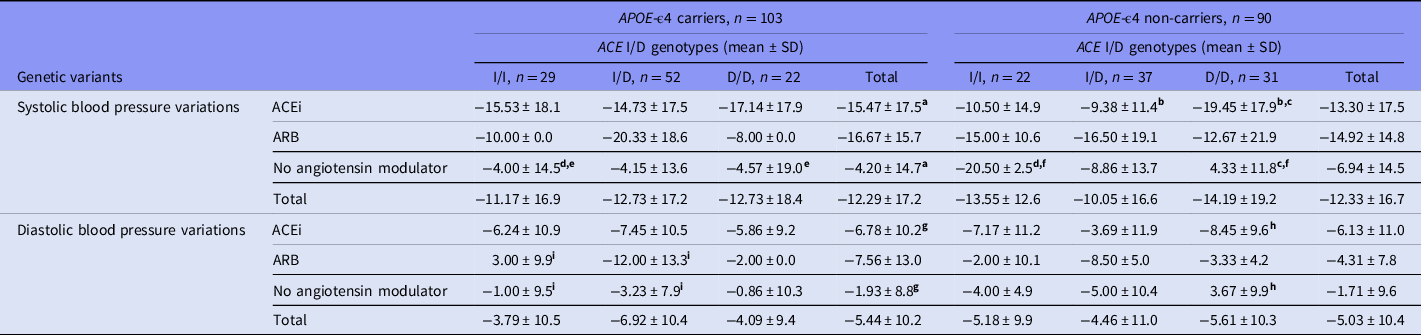
Table 5 shows blood pressure variations in 1 year according to genotype frequencies for the ACE insertion/deletion polymorphism and the use or not of an ACEi or an ARB in APOE-ϵ4 carriers and APOE-ϵ4 non-carriers (see Fig. 2). Concerning blood pressure variations, the following significant results were unrelated to caregiver burden, cognitive and functional test variations:
Significant results concerning blood pressure response to angiotensin modulators at 1 year according to genotype frequencies for the ACE Alu I/D polymorphism in APOE-ϵ4 carriers and APOE-ϵ4 non-carriers: (a) among APOE-ϵ4 carriers, those who used an ACEi had lower systolic blood pressure than those who did not use an angiotensin modulator (p = 0.006), while those who also carried ACE I/I and did not use an angiotensin modulator had narrower systolic blood pressure variations (p = 0.011); (b) among APOE-ϵ4 non-carriers, those who also carried ACE D/D had lower systolic blood pressure when using an ACEi (p = 0.003), while among those who did not use an angiotensin modulator, those who also carried ACE I/I had lower systolic blood pressure (p = 0.013); (c) among APOE-ϵ4 carriers, those who used an ACEi had lower diastolic blood pressure than those who did not use an angiotensin modulator (p = 0.035); (d) among APOE-ϵ4 carriers, those who also carried ACE I/D had lower diastolic blood pressure when using an ARB (p = 0.022); (e) among APOE-ϵ4 non-carriers, those who also carried ACE D/D and used an ACEi had lower diastolic blood pressure than those who did not use an angiotensin modulator (p = 0.023).

Systolic and diastolic blood pressure responses to angiotensin modulators at 1 year according to genotype frequencies for the ACE Alu insertion/deletion polymorphism in APOE-ϵ4 carriers* and APOE-ϵ4 non-carriers*

SD, standard deviation; APOE, apolipoprotein E gene; ACE, angiotensin-converting enzyme gene; ACEi, angiotensin-converting enzyme inhibitor; ARB, angiotensin II receptor blocker.
* General linear model adjusted for sex and body mass index variations at 1 year.
ACEi, users of an ACEi: 64 (62.1%) APOE-ϵ4 carriers and 60 (66.7%) APOE-ϵ4 non-carriers used an ACEi.
ARB, users of an ARB: 9 (8.7%) APOE-ϵ4 carriers and 13 (14.4%) APOE-ϵ4 non-carriers used an ARB.
a p = 0.006.
b p = 0.041.
c p = 0.003.
d p = 0.037.
e p = 0.011.
f p = 0.013.
g p = 0.035.
h p = 0.023.
i I/I versus I/D, ARB versus no angiotensin modulator, p = 0.022.
-
APOE-ϵ4 carriers who used an ACEi had lower blood pressure than those who did not use an angiotensin modulator;
-
carriers of ACE deletion/deletion had wider variations in blood pressure when using an ACEi, particularly when they were APOE-ϵ4 non-carriers;
-
APOE-ϵ4 non-carriers who carried ACE deletion/deletion had higher rises in systolic blood pressure than those who carried ACE insertion/insertion;
-
APOE-ϵ4 carriers who carried ACE insertion/deletion had lower systolic blood pressure when they used an ARB, while those who carried ACE insertion/insertion were more resistant to systolic blood pressure variations when using an ARB.
Discussion
General findings for APOE-ϵ4 carriers
Concerning APOE-ϵ4 carriers, carriers of ACE deletion/deletion had faster worsening of caregiver burden when not using an angiotensin modulator, in line with the expected boosted serum levels of the angiotensin-converting enzyme 1 for carriers of the deletion allele (De Oliveira et al., Reference De Oliveira, Berretta, Almeida Junior, Almeida, Chen, Smith and Bertolucci2019), though they benefitted from the use of an ARB regarding variations in caregiver burden and instrumental functionality. APOE-ϵ4 carriers who carried ACE insertion/insertion benefitted from the use of an ARB concerning CDT score variations and were more resistant to blood pressure variations when using an ARB, possibly explaining the faster worsening of SMMSE scores when using an ARB. Among APOE-ϵ4 carriers who carried ACE insertion/deletion, the use of an ACEi also resulted in faster worsening of SMMSE scores. In addition, APOE-ϵ4 carriers who used an ARB had slower worsening of CDR-SOB scores than APOE-ϵ4 non-carriers who used an ARB.
Use of an ARB benefitted mostly APOE-ϵ4 carriers in terms of caregiver burden, cognitive and functional decline. APOE-ϵ4 alleles lead to increased amyloid-β42 in the brains of patients with AD by reduced clearance and accelerated aggregation of the peptide (De Oliveira et al., Reference De Oliveira, Pivi, Chen, Smith and Bertolucci2015b), while preservation of amyloid-β-degrading properties of the angiotensin-converting enzyme 1 could be more beneficial for carriers of these alleles.
Regarding blood pressure variations with no impact on caregiver burden, cognitive and functional test variations, APOE-ϵ4 carriers who used an ACEi had lower blood pressure than those who did not use an angiotensin modulator, while those who also carried ACE insertion/deletion had lower systolic blood pressure when they used an ARB.
General findings for APOE-ϵ4 non-carriers
Concerning APOE-ϵ4 non-carriers, they benefitted from the use of an ACEi concerning CDR-SOB score variations and also CDT score variations particularly for carriers of the ACE insertion allele. APOE-ϵ4 non-carriers who carried ACE deletion/deletion benefitted from the use of an ARB concerning CDT score variations but had faster worsening of caregiver burden when using an ARB. On the other hand, carriers of ACE insertion/insertion using an ARB had slower worsening of SMMSE scores when they were APOE-ϵ4 non-carriers than when they were APOE-ϵ4 carriers.
APOE-ϵ4 non-carriers who carried ACE deletion/deletion had higher rises in systolic blood pressure, but use of an ACEi led to deeper lowering of systolic blood pressure and diastolic blood pressure; thus, the trend towards slower worsening of basic functionality when using an ACEi in comparison with carriers of ACE insertion/insertion, and slower worsening of MMSE scores for users of an ACEi in comparison with those who did not use an angiotensin modulator, could largely be explained by concurrent blood pressure lowering when using an ACEi. The ACE insertion allele is more often associated with lower levels of the angiotensin-converting enzyme 1 and potentially higher risk of disability in hospitalised older men (Seripa et al., Reference Seripa, Paroni, Matera, Gravina, Scarcelli, Corritore, D’Ambrosio, Urbano, D’Onofrio, Copetti, Kehoe, Panza and Pilotto2011) as well as higher risk of AD (Narain et al., Reference Narain, Yip, Murphy, Brayne, Easton, Evans, Xuereb, Cairns, Esiri, Furlong and Rubinsztein2000) but not of vascular dementia (Barba et al., Reference Barba, Martínez-Espinosa, Rodríguez-García, Pondal, Vivancos and Del Ser2000), possibly due to lower amyloid-β-degrading activity. However, the genetic regulation of levels of the angiotensin-converting enzyme 1 in the brain is still poorly understood and apparently unassociated with peripheral measurements (Xu et al., Reference Xu, Garcia, Lu, Ozuna, Adjeroh and Wang2022).
Our results showed that ACEis benefitted mostly APOE-ϵ4 non-carriers, in accordance with an earlier study (De Oliveira et al., Reference De Oliveira, Chen, Smith and Bertolucci2018a). The fact that APOE-ϵ4 carriers had lower blood pressure when using an ACEi could also support the notion that APOE-ϵ4 non-carriers have more neurological benefits from the use of an ACEi.
Mechanistic explanations
APOE-ϵ4 carrier status may affect neurobehavioural performance still at younger ages (Acevedo et al., Reference Acevedo, Piper, Craytor, Benice and Raber2010) and has been shown to mediate the relationship of ACE genotypes with atherosclerosis (Xu et al., Reference Xu, Garcia, Lu, Ozuna, Adjeroh and Wang2022) and AD (Oliveira et al., Reference Oliveira, Almeida, Smith and Bertolucci2021). APOE-ϵ4 carriers have earlier loss of blood–brain barrier integrity (Silva et al., Reference Silva, Bracko, Nelson, Oliveira, Robison, Shaaban, Hainsworth and Price2022), potentially affecting the distribution of brain-penetrating angiotensin modulators. Recent studies have shown the benefits of Candesartan in prodromal AD not only when reducing amyloidosis and improving cognition (Hajjar et al., Reference Hajjar, Okafor, Wan, Yang, Nye, Bohsali, Shaw, Levey, Lah, Calhoun, Moore and Goldstein2022) but also when improving episodic memory and executive functions in comparison with Lisinopril (Hajjar et al., Reference Hajjar, Okafor, McDaniel, Obideen, Dee, Shokouhi, Quyyumi, Levey and Goldstein2020). Though one randomised controlled trial showed no benefits of Losartan in reducing the rate of brain atrophy in AD (Kehoe et al., Reference Kehoe, Turner, Howden, Jarutyte, Clegg, Malone, Barnes, Nielsen, Sudre, Wilson, Thai, Blair, Coulthard, Lane, Passmore, Taylor, Mutsaerts, Thomas, Fox, Wilkinson and Ben-Shlomo2021), the fact that pharmacogenetic information was not taken into account might have compromised the discovery of significant findings. Our results confirm the need for stratification of samples according to APOE-ϵ4 carrier status to analyse the effects of angiotensin modulators in such patients (De Oliveira, Reference De Oliveira2023).
Chronic inflammation may facilitate the effects of dysfunctional metabolism on neuronal structure and function, with implications to the progress from prodromal AD to dementia (Leonard & Wegener, Reference Leonard and Wegener2020). Angiotensin II induces tau phosphorylation and cognitive impairment in normal rat brains and increases reactive oxygen species, inflammation, mitochondrial dysfunction and endothelial dysfunction in the central nervous system; concurrently, ACEis suppress hippocampal astrocyte activation and oxidative stress, while ARBs may lessen the oligomerisation of amyloid-β and promote synaptogenesis (Gouveia et al., Reference Gouveia, Camins, Ettcheto, Bicker, Falcão, Cruz and Fortuna2022). Prevention of cognitive decline by angiotensin modulators in this study may be at least partially mediated by the suppression of AT1 receptors, attributed to the reduction of brain angiotensin II in case of ACEis.
Blood pressure lowering reduces dementia risk in older people (Silva et al., Reference Silva, Bracko, Nelson, Oliveira, Robison, Shaaban, Hainsworth and Price2022). Slower cognitive decline in AD has been reported when patients are treated with an ACEi (De Oliveira et al., Reference De Oliveira, Chen, Smith and Bertolucci2018a) or an ARB (Ouk et al., Reference Ouk, Wu, Rabin, Jackson, Edwards, Ramirez, Masellis, Swartz, Herrmann, Lanctôt, Black and Swardfager2021), possibly due to prevention of vascular damage induced by amyloid-β, while amyloid-β may upregulate brain levels and activity of the angiotensin-converting enzyme 1 according to the progression of AD (Cosarderelioglu et al., Reference Cosarderelioglu, Nidadavolu, George, Marx-Rattner, Powell, Xue, Tian, Salib, Oh, Ferrucci, Dincer, Bennett, Walston and Abadir2022). One study in particular (Ouk et al., Reference Ouk, Wu, Rabin, Jackson, Edwards, Ramirez, Masellis, Swartz, Herrmann, Lanctôt, Black and Swardfager2021) showed more cognitive benefits for APOE-ϵ4 non-carriers with AD who used supposedly brain-penetrating ARBs (such as Valsartan) in comparison with those who used ACEis. Still concerning ARBs, metabosartans (such as Irbesartan) are agonists of PPAR-γ in addition to being ARBs, an important aspect considering that PPAR-γ activation has been implicated in the degradation and clearance of amyloid-β and in reduced activity of the amyloid-β-promoting β-secretase BACE1 (Gouveia et al., Reference Gouveia, Camins, Ettcheto, Bicker, Falcão, Cruz and Fortuna2022).
In some observational studies, brain-penetrating ACEis have shown benefits for slowing functional (O’Caoimh et al., Reference O’Caoimh, Healy, Gao, Svendrovski, Kerins, Eustace, Kehoe, Guyatt and Molloy2014) and cognitive (Sink et al., Reference Sink, Leng, Williamson, Kritchevsky, Yaffe, Kuller, Yasar, Atkinson, Robbins, Psaty and Goff2009) decline. Though such studies have reported cognitive and functional benefits with the use of brain-penetrating ACEis Captopril and Perindopril, but not with supposedly non-brain-penetrating ACEis such as Enalapril (Ohrui et al., Reference Ohrui, Tomita, Sato-Nakagawa, Matsui, Maruyama, Niwa, Arai and Sasaki2004), it is still unknown whether the neurological properties of these drugs are attributed to their central or peripheral effects. Other studies have shown that these effects were more remarkable for carriers of specific genetic variants and independent of blood pressure control or brain distribution of these drugs (De Oliveira et al., Reference De Oliveira, Chen, Smith and Bertolucci2018a), despite the controversy surrounding their mechanisms of action. Notwithstanding the fact that we had few patients using Enalapril, we are inclined to believe that the class effect is relevant regardless of the brain-penetrating properties of these drugs. In addition, it is not known whether age affects the brain distribution of ACEis, an aspect that could be meaningful in the interpretation of our results.
Final considerations
Whereas our results were stratified according to APOE-ϵ4 carrier status, almost all patients used a cholinesterase inhibitor, while most of those in moderate and severe dementia stages also used Memantine, thus minimising potential APOE-ϵ4-mediated effects of variability in psychotropic therapy on cognitive and functional decline (De Oliveira et al., Reference De Oliveira, de Almeida, Chen, Smith and Bertolucci2022b). The high prevalence of arterial hypertension in our sample confirms the burden of this cerebrovascular risk factor for older people, which seems to be more relevant for patients with AD than for other primary dementia syndromes (Oliveira et al., Reference Oliveira, Machado, Sampaio, Marin, Chen, Smith and Bertolucci2015).
Limitations of this study include the non-randomised single-centre approach, the relatively short follow-up and the lacking stratification according to environmental factors (the full spectrum of which is hard to incorporate) or brain-penetrating properties of angiotensin modulators. Since race was not specifically assessed, it could not be included as a stabilising factor, even though it has been shown to heterogeneously affect rates of brain amyloidosis (Deters et al., Reference Deters, Napolioni, Sperling, Greicius, Mayeux, Hohman and Mormino2021) and outcomes of the ACE insertion/deletion polymorphism (Wang et al., Reference Wang, Fung, Hsu, Wu, Lin, Ro, Chang, Hwu, Hsu, Huang, Lee-Chen and Chen2006) and of APOE-ϵ4 carrier status (Deters et al., Reference Deters, Napolioni, Sperling, Greicius, Mayeux, Hohman and Mormino2021). In addition, the small subgroup sizes affected the power of the associations we found, particularly considering the relatively low number of patients using an ARB, while prospective effects of arterial hypertension were not assessed. Absent measurements of cerebrospinal fluid or plasma amyloid-β or activity of the angiotensin-converting enzyme 1 also prevented proper adjustments for specific genetic variants (Wharton et al., Reference Wharton, Stein, Korcarz, Sachs, Olson, Zetterberg, Dowling, Ye, Gleason, Underbakke, Jacobson, Johnson, Sager, Asthana and Carlsson2012). Furthermore, it is unknown if functional or cognitive effects of ACEis or ARBs are dose-dependent or more significant when starting therapy or at any time during anti-hypertensive therapy because many patients were already under treatment when included in the study. We tried to minimise these caveats by keeping observers blinded to genetic data during the neurological evaluations and by prescribing angiotensin modulators only for patients with arterial hypertension. We also sustained the use of cholinesterase inhibitors and Memantine for most patients who did not have side effects to these drugs so that the results of this study may be attributed mostly to the effects of angiotensin modulators.
Most test scores were significantly different after 1 year, thus demonstrating that the duration of follow-up was suitable; however, caregiver burden did not significantly change for all patients at 1 year, but it has been shown that it does not always follow cognitive change for patients with AD (De Oliveira et al., Reference De Oliveira, Wajman, Bertolucci, Chen and Smith2015a). Functionality usually follows cognitive performance even in the severe dementia stage (Wajman et al., Reference Wajman, Oliveira, Marin, Schultz and Bertolucci2014b). Mean body mass index and blood pressure levels were significantly lower after 1 year, also ascertaining the proper duration of follow-up, even though they may differentially affect cognitive decline according to sex and APOE-ϵ4 carrier status (Oliveira et al., Reference Oliveira, Chen, Smith and Bertolucci2016). In addition, our analyses were adjusted for several relevant confounders, including sex, education (De Oliveira et al., Reference De Oliveira, Pereira, Pivi, Smith and Bertolucci2018b), and variations in body mass index which have been significantly associated with functional and cognitive performance in AD (De Oliveira et al., Reference De Oliveira, Pivi, Chen, Smith and Bertolucci2015b). Nonetheless, this is a pioneering study on the evaluation of effects of angiotensin modulators throughout the evolution of AD while taking into account relevant genetic variants. Future studies should also longitudinally consider neuroimaging parameters and gene expression according to therapy with such drugs (Greenberg, Reference Greenberg2001). Given the benefits of angiotensin-neprilysin inhibitors on the reduction of death and hospitalisation due to heart failure in comparison with ACEis (McMurray et al., Reference McMurray, Packer, Desai, Gong, Lefkowitz, Rizkala, Rouleau, Shi, Solomon, Swedberg and Zile2014), these drugs should also be studied for potential adverse neurological effects due to reduced amyloid-β degradation (Helisalmi et al., Reference Helisalmi, Hiltunen, Vepsäläinen, Iivonen, Mannermaa, Lehtovirta, Koivisto, Alafuzoff and Soininen2004).
Conclusions
Therapy with ACEis benefitted mostly APOE-ϵ4 non-carriers concerning cognitive and functional decline, though some of these findings could be due to improved blood pressure control. On the other hand, ARBs benefitted mostly APOE-ϵ4 carriers concerning cognitive and functional decline and also caregiver burden variations. The ACE insertion/deletion polymorphism leads to variable response to angiotensin modulators concerning both neurological outcomes and blood pressure variations. Therapy with such drugs may be disease-modifying in AD.
Acknowledgements
This work was sponsored by CAPES – Coordenação de Aperfeiçoamento de Pessoal de Nível Superior (grant #1067/10) and FAPESP – The State of São Paulo Research Foundation (grant #2015/10109-5). The authors declare no financial or other conflicts of interest related to this study.
Author contribution
All authors have read the paper and agreed to be listed as authors, having approved it and validated the accuracy of the data. Raw data will be made available to scientists upon reasonable request. Individual author contributions include, as follows:
-
1. Fabricio Ferreira de Oliveira, MD, MSc, PhD, is a medical researcher at the Department of Neurology and Neurosurgery of the Federal University of São Paulo – UNIFESP, a Member of the American Academy of Neurology Global Strategies Subcommittee, of the Awards Committee of the International Parkinson and Movement Disorder Society (MDS, 2021–2025), and of the Executive Committee of the ISTAART Biofluid Based Biomarkers Professional Interest Area (Alzheimer’s Association, 2018-2025); he has received research support from CAPES – Coordenação de Aperfeiçoamento de Pessoal de Nível Superior and FAPESP – The State of São Paulo Research Foundation, and serves as a healthcare council member for Gerson Lehrman Group, for Atheneum Partners, for Guidepoint and for Lionbridge; he was involved in conceptualisation, methodology, formal analysis, investigation, data curation, writing of the original draft, review and editing, visualisation, and project administration.
-
2. Sandro Soares de Almeida, MSc, PhD, is a researcher at the Department of Biophysics of the Federal University of São Paulo – UNIFESP, and has received grants from CNPq – Conselho Nacional de Desenvolvimento Científico e Tecnológico and FAPESP – The State of São Paulo Research Foundation; he was involved in conceptualisation, methodology, validation, formal analysis, resources, data curation, and review and editing of the draft.
-
3. Elizabeth Suchi Chen, MSc, PhD, is a professor at the Department of Morphology and Genetics of the Federal University of São Paulo – UNIFESP; she was involved in methodology, formal analysis, resources, and review and editing of the draft.
-
4. Marilia Cardoso Smith, MSc, PhD, is a full professor at the Department of Morphology and Genetics of the Federal University of São Paulo – UNIFESP; she has received grants from CAPES – Coordenação de Aperfeiçoamento de Pessoal de Nível Superior, CNPq – Conselho Nacional de Desenvolvimento Científico e Tecnológico, and FAPESP – The State of São Paulo Research Foundation; she was involved in conceptualisation, methodology, formal analysis, resources, review and editing of the draft, supervision, and funding acquisition.
-
5. Paulo Henrique Ferreira Bertolucci, MD, MSc, PhD, is a full professor at the Department of Neurology and Neurosurgery of the Federal University of São Paulo – UNIFESP; he has received grants from CAPES – Coordenação de Aperfeiçoamento de Pessoal de Nível Superior and FAPESP – The State of São Paulo Research Foundation, and serves as a consultant for Janssen, Lundbeck, Novartis, Pfizer and Support; he was involved in conceptualisation, methodology, resources, review and editing of the draft, project administration, supervision, and funding acquisition.
Competing interests
The authors report no conflicts of interest related to this paper. This study is part of the research project 1067/10 (CAAE 0540.0.174.000-10) approved by the Ethics Committee of Hospital São Paulo, Federal University of São Paulo (UNIFESP), in August 2010. All invited patients and their legal representatives agreed to participate on the research and signed the Informed Consent Form before the evaluation. This study was sponsored by CAPES – Coordenação de Aperfeiçoamento de Pessoal de Nível Superior (grant #1067/10) and FAPESP – The State of São Paulo Research Foundation (grant #2015/10109-5).
Previous presentation of information from the paper
Preliminary aspects of this study were previously presented (and published in the form of abstracts) at the following meetings:
-
1. AAIC>18 – Alzheimer’s Association International Conference 2018 (with an Alzheimer’s Association Travel Fellowship to the first author)
(Alzheimer’s Association, Chicago/USA, July 2018)
-
2. 3rd Congress of the European Academy of Neurology
ORAL PRESENTATION
(European Academy of Neurology, Amsterdam/NETHERLANDS, June 2017)
https://doi.org/10.1111/ene.13368
Press Release (VJDEMENTIA): https://www.youtube.com/watch?v=lAInuFO0uog
-
3. 29th CINP World Congress of Neuropsychopharmacology
(Collegium Internationale Neuro-Psychopharmacologicum, Vancouver/CANADA, June 2014)
-
4. ICVD 2013 – 8th International Congress on Vascular Dementia & The First Cognitive Impairment European Meeting
ORAL PRESENTATION
(World Federation of Neurology Research Group on Dementia, Athens/GREECE, October 2013)