Due to their broad-spectrum antimicrobial coverage through a novel mechanism, relative safety, and ease of delivery, fluoroquinolone (FQ) use in the United States has increased exponentially since its introduction in the 1980s.Reference Linder, Huang, Steinman, Gonzales and Stafford 1 , Reference Arizpe, Reveles and Aitken 2 With widespread use both in the inpatient and outpatient settings, resistance among gram-negative pathogens to this class of antibiotics has also increased. A recent analysis of FQ resistance rates among Escherichia coli urinary isolates in the United States found rates consistently above 25% and up to 40% in some regions.Reference Bidell, Palchak, Mohr and Lodise 3 , Reference Scheld 4 Prior FQ use has been identified in multiple studies as a risk factor for resistant infection.Reference Lautenbach, Fishman and Bilker 5 – Reference Lautenbach, Strom, Bilker, Patel, Edelstein and Fishman 10 Additionally, invasive infection with FQ-resistant bacteria is associated with increased mortality.Reference Camins, Marschall, DeVader, Maker, Hoffman and Fraser 9
Antimicrobial stewardship programs (ASPs) have been shown to be effective at improving antimicrobial use in hospitals.Reference Camins, King and Wells 11 ASPs vary in their interventions, but they share the same common goals of decreasing inappropriate antimicrobial use, improving resistance patterns, and reducing cost.Reference Johannsson, Beekmann, Srinivasan, Hersh, Laxminarayan and Polgreen 12 A common intervention employed in ASPs is requiring prior authorization before use of certain antimicrobials. A large-scale public health data project from the United Kingdom demonstrated that decreased use of FQ in prescribing practices led to declining resistance rates.Reference Livermore, Hope, Reynolds, Blackburn, Johnson and Woodford 13 Therefore, we sought to evaluate the impact of requiring prior authorization for fluoroquinolone prescription on gram-negative bacteria FQ susceptibility rates at an academic medical center.
Methods
Design and setting
At the University of Alabama at Birmingham (UAB) Hospital, a 1,157-bed academic tertiary-care center, we performed a retrospective, quasi-experimental analysis of FQ susceptibility among 5 common hospital isolates: Acinetobacter species, Enterobacter cloacae, Escherichia coli, Klebsiella pneumoniae, and Pseudomonas aeruginosa. We included clinical isolates from all body sites, including blood, skin or soft tissue, respiratory tract, urinary tract, and sterile cultures from the clinical microbiology laboratory from inpatient and emergency department locations. Any organism with the same susceptibility pattern from the same patient was only included once per calendar year. The minimum inhibitory concentration (MIC) for each isolate was determined by Microscan (Beckman Coulter, Carlsbad, CA). Susceptibility breakpoints were determined using Microscan MIC breakpoints in accordance with US Clinical and Laboratory Standards Institute (CLSI) guidelines. Volume of antimicrobial use is reported in days of FQ therapy per 1,000 patient days.
Antibiotic restriction program
In October 2005, as recommended by the ASP, the Pharmacy and Therapeutics Committee at UAB Hospital instituted a restriction policy requiring prior authorization for FQ. As part of this policy, our antimicrobial inpatient formulary was first streamlined from levofloxacin, gatifloxacin, moxifloxacin, and ciprofloxacin to moxifloxacin and ciprofloxacin as the only FQs available. All inpatient providers were required to obtain ASP approval for empiric use of an FQ (with the exception of moxifloxacin for use for community-acquired pneumonia). Fluoroquinolone use was permitted for treating gram-negative infections if culture results were available and the bacterial isolate was susceptible to an FQ. Prior to the availability of computer physician order entry (CPOE; 2008), FQ prescriptions were manually reviewed by clinical pharmacists. After implementation of CPOE, providers were required to document reason for the use of FQ or to document approval by the ASP ID attending physician. Any data point prior to January 1, 2006 was considered to have occurred during the preintervention period, and any data point after was considered to have occurred during the postintervention period.
Statistical analysis
To determine whether the annual trends in susceptibility were different in the periods prior to and following implementation of the stewardship program (ie, 1998–2005 vs 2006–2016), a Poisson regression including an interaction between time period and continuous time was used to estimate rate ratios (RRs) and associated 95% confidence intervals (CIs) for the annual rate of change in susceptibility for each of the 2 time periods. A likelihood ratio test of the interaction between period and continuous year was used to examine whether the slopes of the annual rate of change in susceptibility differed statistically between periods. Poisson models were created for overall susceptibility as well as species-specific susceptibility. All Poisson models accounted for dispersion utilizing a dispersion parameter calculated as the division of the model deviance by degrees of freedom. For all analyses, P < .05 was considered statistically significant, and SAS version 9.4 software (SAS Institute, Cary, NC) was used for all analyses.
Results
Fluoroquinolone use
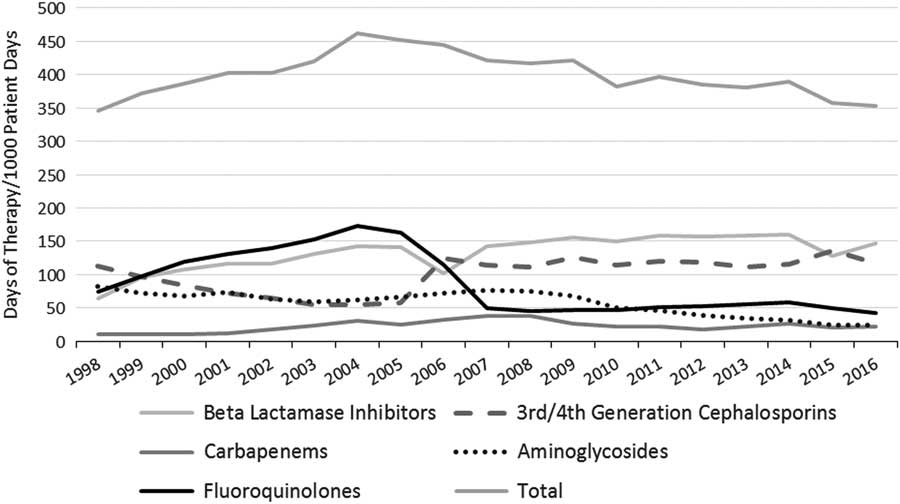
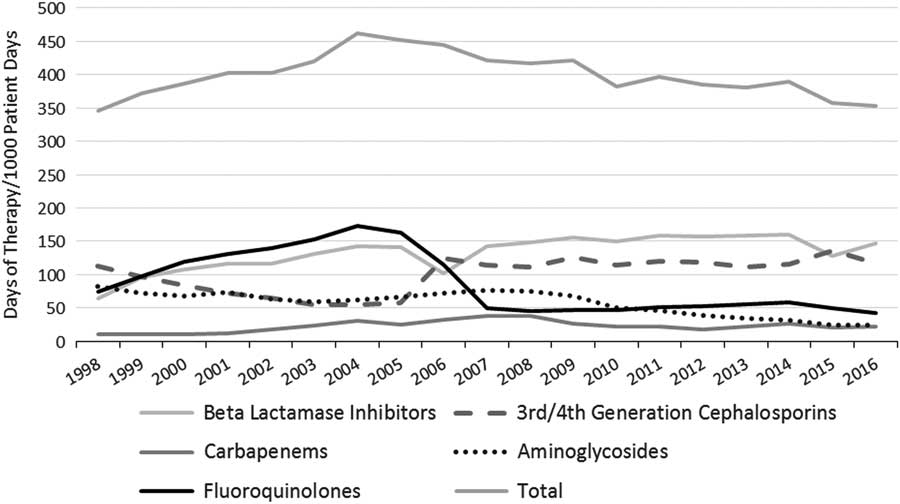
Inpatient FQ use steadily increased from 1998 to 2004 and peaked at 173 days of therapy (DOT) per 1,000 patient days in 2004 (Fig. 1). Following the implementation of the FQ restriction program in October 2005, there was a precipitous drop in FQ use from 2006 to 2007: usage declined from 141 to 52 DOT per 1,000 patient days. From 2007 and continuing through 2016, the rate of FQ use remained below 60 DOT per 1,000 patient days. The lowest period of use was in 2016, with 36 DOT 1,000 patient days. The FQ restriction policy resulted in a decrease in FQ use with a subsequent increase in third- and fourth-generation cephalosporin use. The average number of positive cultures of the 5 total isolates studied increased from 2,615 per year before the policy was implemented to 3,226 per year after the policy was implemented. However, a net total decrease was observed for all common parenteral anti–gram-negative antimicrobials, including β-lactamase inhibitors such as piperacillin-tazobactam and ampicillin or sulbactam, cephalosporins, aminoglycosides, and carbapenems.
Total average days of therapy per 1,000 patient days of major classes of antibiotics. Beta-lactamase inhibitors include ampicillin/sulbactam, piperacillin-tazobactam, and ticarcillin-clavulanate.
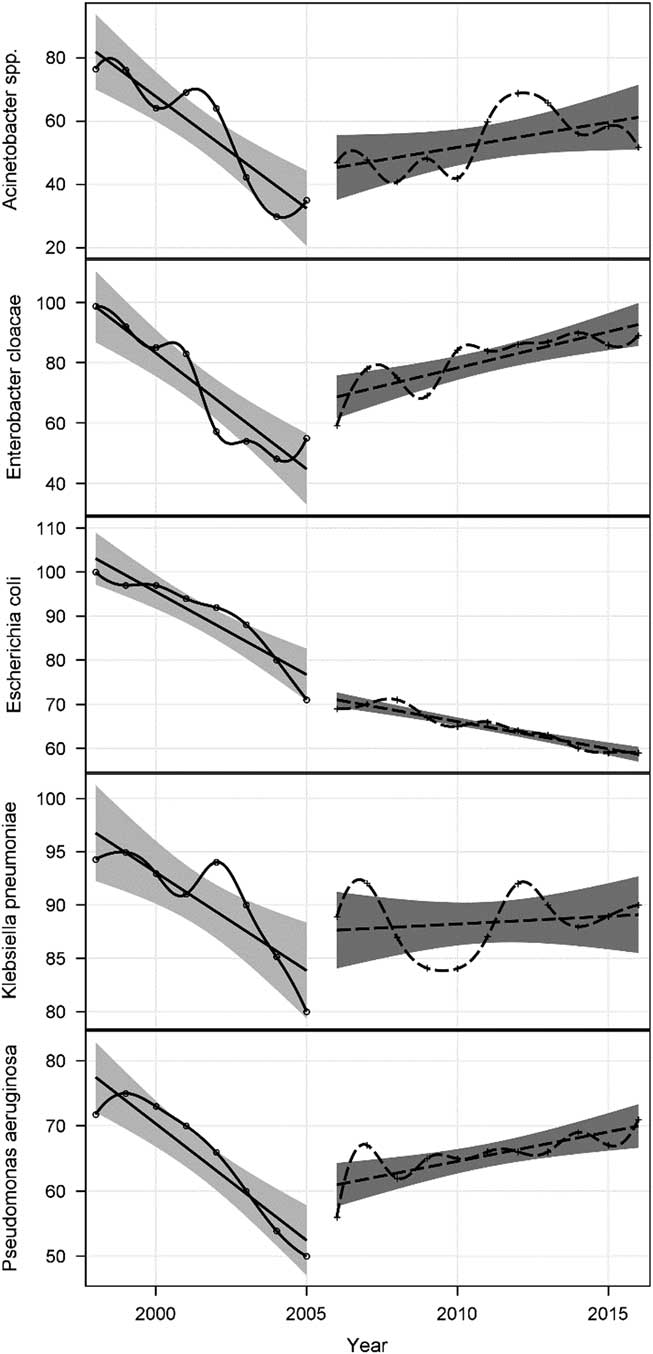
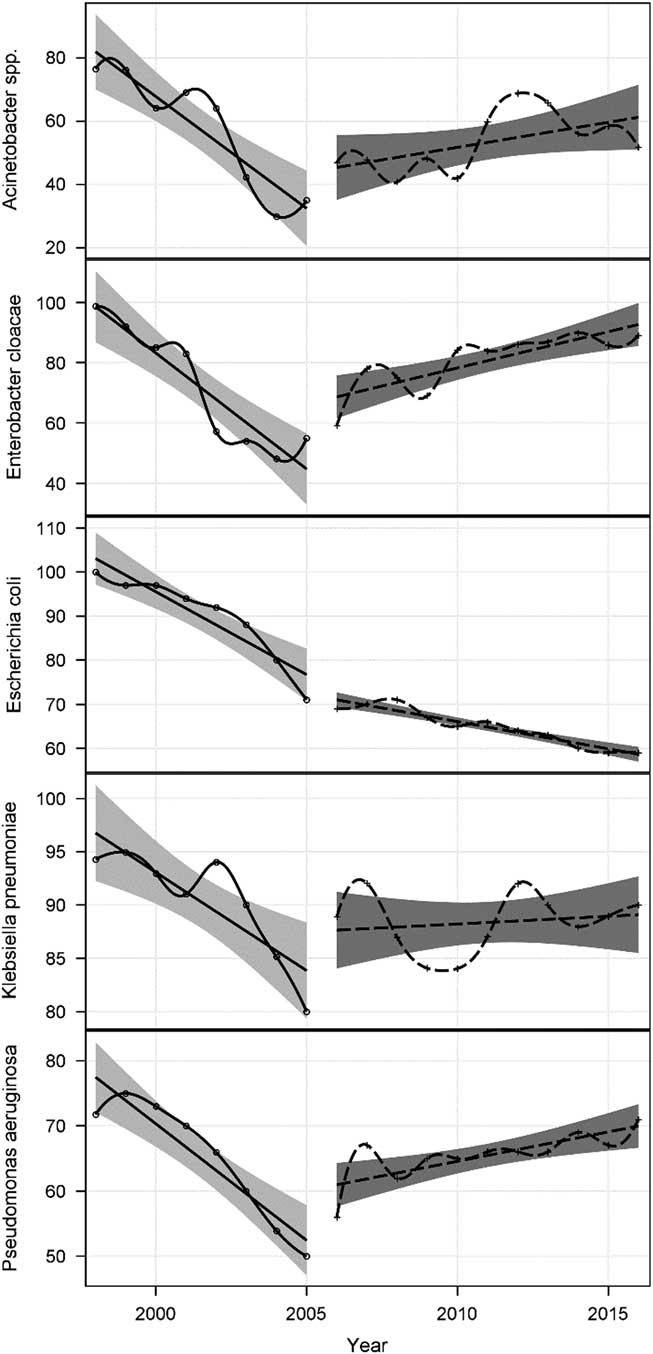
Linear annual trends in fluoroquinolone-susceptibility rates before and after implementation of a policy requiring prior authorization for fluoroquinolone prescription.
Fluoroquinolone susceptibility
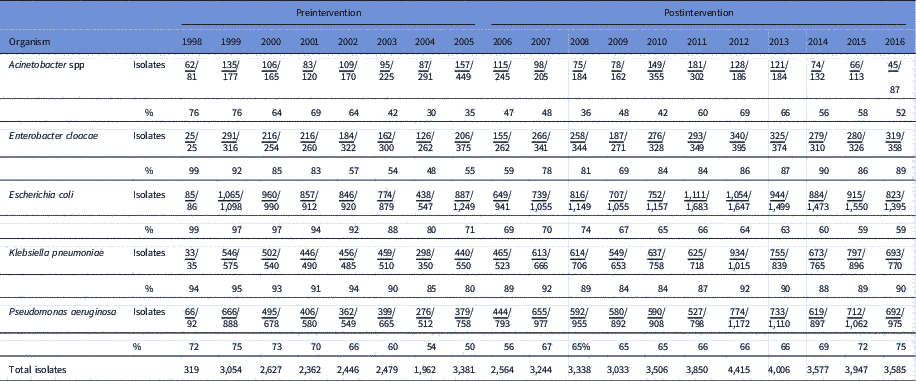
The FQ susceptibilities were assessed for 5 common gram-negative organisms: Acinetobacter spp, E. cloacae, E. coli, K. pneumoniae, and P. aeruginosa (Table 1, Figure 2). In the preintervention period (1998–2005), all 5 isolates had decreasing rates of susceptibility to FQs. Acinetobacter spp susceptibility declined from 76% to 35% (annual trend RR, 0.871; 95% CI, 0.833–0.912); E. cloacae susceptibility declined from 99% to 55% (annual trend RR, 0.898; 95% CI, 0.870–0.926); E. coli susceptibility declined from 99% to 71% (annual trend RR, 0.952; 95% CI, 0.941–0.964); K. pneumoniae susceptibility declined from 94% to 80% (annual trend RR, 0.976; 95% CI, 0.964–0.989); and P. aeruginosa susceptibility declined from 72% to 50% (annual trend RR 0 (annual trend RRn 0.937; 95% CI, 0.923–0.951) (Tables 1 and 2).
Percent Susceptibility of Isolates to Fluoroquinolones in 5 Gram-Negative Species From 1998 to 2016
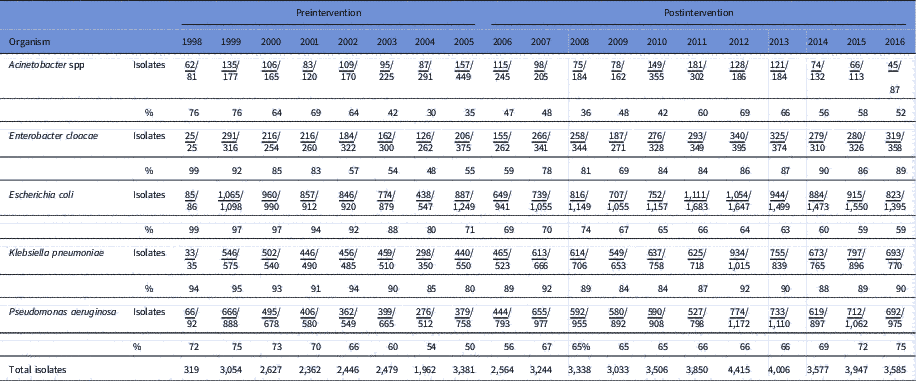
Note: Numerator represents the number of isolates susceptible to fluoroquinolones; denominator represents total number of isolates tested yearly.
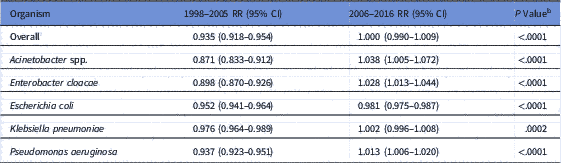
Rate Ratios a (RRs) and Associated 95% Confidence Intervals (CIs) to Compare Annual Trends in Fluoroquinolone Susceptibility Rates Before (1998–2005) and After (2006–2016) the Implementation of an Antimicrobial Stewardship Program Requiring Preauthorization for Fluoroquinolone Use
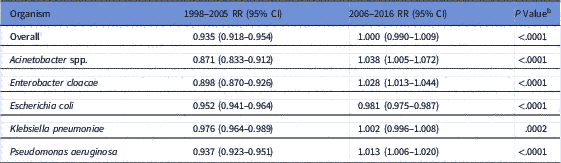
a Estimated from Poisson regression.
b P value for the comparison of annual trends between periods.
Comparing the annual trends between the preimplementation and postimplementation periods, overall, a decreasing annual trend of the FQ susceptibility rates was observed during 1998–2005 (RR, 0.935; 95% CI, 0.918–0.954). Following the implementation of the restriction policy, the annual trend was flat (RR, 1.000; 95% CI, 0.990–1.009), a difference that was statistically significant between the 2 periods (P < .0001) (Table 2). When examining trends by organism, a significant difference in the annual trends between the preimplementation and postimplementation periods was observed for all 5 gram-negative organisms (P < .0001 for all organisms except K. pneumoniae, which had a P = .0002). Specifically, following the implementation of the restrictive policy, susceptibility increased for Acinetobacter spp (RR, 1.038; 95% CI, 1.005–1.072), E. cloacae (RR, 1.028; 95% CI, 1.013–1.044), and P. aeruginosa (RR, 1.013; 95% CI, 1.006–1.020). The annual trend of K. pneumoniae did not increase in the postimplementation period, though it did remain flat (RR, 1.002; 95% CI, 0.996–1.008), and the trend of E. coli continued to decrease though not as sharply (RR, 0.981; 95% CI, 0.975–0.987).
Discussion
Our study demonstrates either cessation in (K. pneumoniae) or reversal of (Acinetobacter spp, E. cloacae, and P. aeruginosa) FQ resistance for hospital isolates which correlates with the implementation of an FQ restriction policy within the hospital that has been sustained for more than a decade. Interestingly, the FQ resistance rates not only stabilized, we also observed a reemergence of overall population susceptibility for certain species. The timing of these improvements varied, but we observed a 10% improvement in FQ susceptibilities within the first 2 years of implementing the restriction program for these 4 classically healthcare-associated pathogens.
In contrast, E. coli isolates continued to demonstrate decreasing FQ susceptibility despite declining FQ use, although at a notably slower rate compared to the preimplementation period. Although some stewardship programs have shown more success in improving hospital E. coli resistance rates, these studies were followed for shorter periods, focused on only 1 type of isolate, excluded isolates from primary care, or focused on nosocomial infections alone.Reference Boel, Andreasen and Jarløv 22 – Reference Wu, Liu, Lin, Hsueh and Lee 24 Langford et alReference Langford, Seah, Chan, Downing, Johnstone and Matukas 25 found that selectively withholding FQ susceptibility results on cultures involving E. coli significantly halted the increase in the resistance rate. Interestingly, these researchers did not observe a significant change in P. aeruginosa susceptibility rates despite a decrease in FQ use.Reference Wu, Liu, Lin, Hsueh and Lee 24 , Reference Langford, Seah, Chan, Downing, Johnstone and Matukas 25 These mixed observations demonstrate that reversing the resistance trends in gram-negative bacteria is a very complex process, especially with respect to enteric bacteria such as E. coli, and that antimicrobial restriction programs are likely be more effective if both inpatient and outpatient settings are targeted. However, these restriction programs were only followed for 2–3 years, while our ongoing FQ restriction program has been sustained for more than a decade.
Although our FQ restriction program did not result in an improvement of susceptibility to E. coli, we were able to demonstrate an improvement in the rate of the decline in susceptibility. We hypothesize that the continued decline in FQ susceptibility may be due to the use of FQ in the community; thus, to achieve a sustained increase in FQ susceptibility among E. coli isolates, community prescribing practices must be targeted. Similar studies have demonstrated that hospital E. coli resistance correlates to community FQ use and not to hospital FQ use.Reference Vernaz, Huttner and Muscionico 14 – Reference Eom, Hwang and Sohn 17 In a study of 9 hospitals and several long-term care facilities, an FQ restriction program was associated with a decline in FQ prescriptions at their facilities, a decrease in the FQ resistance rate in E. coli urinary isolates, and a concomitant decrease in FQ use in the community.Reference Sarma, Marshall, Cleeve, Tate, Oswald and Woolfrey 18 Other stewardship programs that only restricted FQ use in hospitals have failed to demonstrate any improvement in E. coli FQ resistance.Reference Stapleton, Lundon and McWade 19 – Reference Wong-Beringer, Nguyen, Lee, Shriner and Pallares 21 Thus, community FQ use, as opposed to hospital use, appears to be driving the development of E. coli resistance and its persistence, and stewardship efforts focusing on community restriction are essential.
In terms of the classic healthcare-associated pathogens, there are data demonstrating limited success in improving P. aeruginosa susceptibility in the context of FQ restriction, but susceptibility data pertaining to E. cloacae, Acinectobacter spp. and K. pneumoniae susceptibility have not shown significant improvement with similar restriction programs.Reference Guo, He and Wang 20 , Reference Wong-Beringer, Nguyen, Lee, Shriner and Pallares 21 , Reference White, Atmar, Wilson, Cate, Stager and Greenberg 26 , Reference Cook, Das, Gooch and Catrou 27 Interestingly, a 1997 study showed that while E. cloacae, Acinetobacter spp. and K. pneumoniae did not improve their susceptibility rates to ciprofloxacin with restricted use, susceptibility rates for nonrestricted antibiotics, including β-lactams, demonstrated improvement.Reference White, Atmar, Wilson, Cate, Stager and Greenberg 26 Other studies have shown similar improvements in susceptibility to other antibiotic classes, including decreasing rates of extended spectrum β-lactamases (ESBL)–producing urinary isolates with FQ restriction.Reference Sarma, Marshall, Cleeve, Tate, Oswald and Woolfrey 18 Fluoroquinolones, β-lactams, and aminoglycosides are known to co-select for resistance, even with chemically unrelated drug exposure due to multiple plasmid-mediated mechanisms that carry resistance genes to multiple drug classes, such as the E. coli ST131 clone.Reference Dalhoff 28 Fluoroquinolone exposure is a risk factor for development of ESBL E. coli urinary tract infections, and globally, 35%–65% of ESBL-producing Enterobacteriaceae are also FQ resistant.Reference Dalhoff 28 ESBL producing bacteria continue to be an escalating problem, especially in the southeastern United States,Reference Thaden, Fowler, Sexton and Anderson 29 and adoption of FQ restriction in stewardship programs is a useful tool available to fight this trend. Despite the continued decrease in FQ susceptibility in E. coli in our study, our overall ESBL rates are low for all isolates, which indicates less likely clonal expansion of multidrug-resistant bacteria in our institution.
Given the dual approach that our stewardship program has taken not only in restricting empiric FQ use but also in streamlining the choices of FQs through a restricted formulary, we cannot definitively conclude which aspect had the largest effect on our observed susceptibility results. Interestingly, some in vitro data show that gram-negative resistance to levofloxacin occurs faster and reaches higher MICs than for ciprofloxacin.Reference Gilbert, Kohlhepp and Slama 30 Not surprisingly, a survey of US hospital data found that increasing levofloxacin and ofloxacin expenditures were correlated with decreasing P. aeruginosa susceptibility to ciprofloxacin.Reference Bhavnani, Callen and Forrest 31 In contrast, increased ciprofloxacin use has not been associated with FQ resistance, suggesting that levofloxacin is playing a more significant role in driving FQ class resistance. Thus, the removal of levofloxacin from our formulary may have had a significant impact on our susceptibility profile.
Our study had several limitations. Our data were compiled from a single academic medical center. The stewardship initiative was broadly applied; thus, no control units or hospitals were available for comparison. We did not collect data on the indications for FQ use to evaluate the quality of our restricted use policy; instead, they used FQ DOT per 1,000 patient days as a surrogate measure. Based on this measure alone, our program was highly successful. We witnessed a 60% decline in use between the pre- and postimplementation data. Furthermore, these data focus on clinical isolates gathered in the microbiology laboratory; thus, they do not distinguish between colonizing isolates versus true pathogens. More detailed data on the influence of restricted-use policies on prescribing practices may help elucidate areas of focus for programmatic improvement and may better explain the lack of susceptibility improvement in certain species. For example, it is not clear to us why Acinetobacter spp. FQ susceptibility initially improved, then plateaued, and has started to decline over the last few years despite continued low FQ use. This may be the result of cluster outbreaks of Acinetobacter, but this trend will require further study. This study occurred over a long period; thus, infection prevention efforts may have also played a role in improving FQ susceptibility. Finally, our data demonstrate the feasibility and the critical importance of long-term tracking to re-evaluate the influence of stewardship programs.
As hospitals and health systems attempt to combat growing resistance rates to antibacterial agents, FQ resistance in gram-negative organisms remains a serious challenge. Our data demonstrate that decreasing overall FQ use, possibly through limiting routine access to levofloxacin specifically, can result in improvement overall in susceptibility of several gram-negative bacteria. For certain organisms, such as E. coli, decreasing hospital use alone appears to be insufficient to reverse the FQ resistance trend, whereas efforts focused on appropriate community FQ use are likely of major importance. Larger, multicenter longitudinal studies focusing on the influence of active ASPs and restricted use of particular agents are critically important to better understanding how these interventions influence antimicrobial resistance patterns and how these policies can be applied for optimal effect.
Acknowledgments
We are grateful to the members of the antimicrobial stewardship committee for their continued support and dedication.
Financial support
No financial support was provided relevant to this article.
Conflicts of interest
All authors report no conflicts of interest relevant to this article.