

Introduction
The history of Italy is a history of migration. Once a country of emigration to the Americas and European countries such as Belgium, France, and Germany, it is nowadays one of the most affected European states by incoming migration flows, given its strategic geographical position on the cusp of the Mediterranean Sea. The Italian media documentation of migration inflows after 2015, the year that signposts the so-called migration ‘crisis’ for Europe, has slowly but steadily adopted a series of images and tropes that have settled into the audience’s collective memory of the new migratory phenomena. These tropes characterize refugees through metaphors of sea vessels and natural catastrophes as a threat to stability and safety (Charteris-Black Reference Charteris-Black2006; Olson and Wessels Reference Olson, Wessels and Kerstin2020). What is more, the overarching narrative of the Italian media landscape is rarely able to account for the multiscalarity of the phenomenon (Adinolfi and Caracciolo Reference Adinolfi and Caracciolo2023), whereby personal stories of migration are given less prominence in favour of big-scale events. Despite the rise in the use of digital media to retrieve news information, a rise that has seen a significant halt during the 2020 COVID-19 pandemic (Rizzuto Reference Rizzuto2023, 118), television is still an important medium for information consumption in Italy.
Bringing together memory studies, intermedial narrative theory, migration, and media studies, this article proposes an analysis of two episodes of the Italian current affairs TV programme Il cavallo e la torre (from here on, The Knight and the Rook), that airs on the state television channel RAI 3 since 2022. Between the end of October and the beginning of November 2022, the TV programme managed to document the installation of the newly elected right-wing government while reporting the situation of three NGO (Non-Governmental Organisation) ships at sea with hundreds of refugees on board, which were being denied access to Italian harbours. By following the situation closely and proposing a narrative that merges a prominent event in the history of the country (namely, the installation of the new government) and the situation of the rescued refugees at sea, the show contributes to the cultural memory of migration of the country by proposing a narration of the events that employs individual memories and ethical narrative strategies.
In the sections that follow, I will first introduce the Italian television landscape and its complex history entangled with politics. Subsequently, I will move on to introduce The Knight and the Rook as an exception to the kinds of TV programmes on current affairs available in the Italian context, outlining its structure. Then, I will illustrate the theoretical framework that builds on Aleida Assmann’s four formats of memory (Assmann Reference Assmann, Tilmans, van Vree and Winter2010) on the model of narrative ecology of migration of Marco Caracciolo and colleagues, which I will use to analyse the episodes of the show. Finally, I will proceed with the analysis. I will examine two episodes, paying particular attention to how the programme’s narrative strategies undermine existing tropes related to migration by proposing remediated individual memories of migration. Overall, the TV programme is able to respond to an appeal for ethical storytelling practices for the representation of migration (Musarò and Parmiggiani Reference Musarò and Parmiggiani2017; Gebauer and Sommer Reference Gebauer and Sommer2024).
Tropes of migration and Italy’s ‘anomaly’: the state of Italian television
Due to its geographical position, Italy stands out in the discourse around migration policies in the European Union (EU) and in the West in general. Italy is a water-border country and one of the most prominent places in which migration into the EU takes place. It has been at the centre of disputable anti-migration policies and bordering practices, with pushbacks and externalization of borders. The election of Giorgia Meloni in October 2022, documented in the episodes of the show that I analyse below, marked a significant shift in Italian and, by extension, European migration policies (Ambrosini Reference Ambrosini2025).
Even before the installation of the Meloni government and throughout the so-called ‘migration crisis’, the representation of migrants in the Italian media has been constructed negatively and has focused on solving the ‘migration problem’. After the 2015 refugee crisis, today, Italy is still a hotspot for refugees, and, just like for any other country, social media has increasingly sidelined Italian television for all kinds of news coverage. The representation of migrants in legacy media in the first decade of the 21st century in Italy was significantly negative (Montali et al Reference Montali, Riva, Frigerio and Mele2013), with the employment of visual metaphors that are in line with other Western countries’ media portrayal of migrants. In fact, in a 2019 study on Italian media and migration, Sara Gabai highlighted the correlation ‘between negative media representations and Italians’ public perception of migrants’ (131). Gabai notices that ‘Key themes that are emphasized in mainstream and online media, including cultural, social and religious anxieties about foreigners, and the relationship between criminality, migrants and terrorism, are also predominant in the presented public perception surveys’ (Gabai Reference Gabai, Shaw and Selvarajah2019, 131). In general, one of the main tropes surrounding migration in the last decade has been that of considering migration as a threat. More specifically, a threat to security, economic stability, and Italianness. In their study on the role of media in the representation of migrants in Italy, Pierluigi Musarò and Paola Parmiggiani report how migrants and asylum seekers are depicted as ‘threats to security or merely vulnerable subjects, and not as agents of their own destiny, with education and employment experiences and skills’ (Reference Musarò and Parmiggiani2017, 246). Musarò and Parmiggiani wish for a representation of migrants that highlights the personal experience of refugees and makes them the subject and not the object of ‘communication’ (251). The Knight and the Rook does exactly that for the way it remediates (Erll et al. Reference Erll, Rigney, Basu and Bijl2009) individual memories of the migrants and offers a multifaceted and complex view on migration in Italy.
TV narration of events can rely on visual, as well as verbal, and aural modes. In her essay on the narrative construction of television news, Slávka Tomaščíková underlines the multimodality of the television medium as a pivotal aspect of the narration of media events on TV:
Narrative in television news is multimodal, so that the visual mode rarely if ever functions alone in the process of the narrative construction. It is accompanied by audio (spoken and musical) mode of construction. Visual signs are conveyed by voice-over; interviews are part of both audio and visual modes. The narrative carries characteristics of factuality and entertainment. Factuality is mostly presented in a spoken mode and it is combined with dramatic and entertaining visual elements. (Tomaščíková Reference Tomaščíková2010, 265)
All these elements need to be taken into account when studying the ways in which a current affairs TV programme works, as in the case of the analysed show. Moreover, Tomaščíková points out, television news is also responsible for transmitting certain cultural and ideological beliefs embedded in a certain society (Tomaščíková Reference Tomaščíková2010, 261). These beliefs, which can be considered as tropes, are carried over in television both verbally as well as visually in its narration of migration.
Keeping in mind that this narrative on migration propagates through media journalism in Italy is particularly important because of its peculiarity. Media scholars have been studying Italian journalism for its exceptionality. Francesca Rizzuto speaks of the ‘anomaly’ of Italian journalism (2023), with specific reference to its ‘historical lack of autonomy, pronounced political parallelism, and a “weak” news market’ (Rizzuto Reference Rizzuto2023, 112). According to Rizzuto, scholars have been classifying Italian journalism under the Mediterranean model, highlighting its distinctive features shaped by Italy’s slow progression towards economic development and democracy. From the 19th-century Risorgimento to the Republic’s founding in 1946, journalism in Italy was seen more as a political tool than a neutral information source. After the Second World War, journalism became an educational tool, significantly helping to alphabetize the population, as well as a tool serving party-political aims. The Fascist era intensified this trend, using censorship and propaganda to reinforce the idea that the media was essential for maintaining public consensus. In the postwar democratic era, political parties retained strong control over media messaging, treating it as a means to amplify political voices rather than address audience needs. As a result, Italian media remained disconnected from market forces, with newspapers primarily serving elites and ignoring broader readership demands. This legacy reflects the Italian media’s structural weaknesses – economic and political dependence, minimal market orientation, and a rigid, politically driven communication model (Rizzuto Reference Rizzuto2023, 112–13). Put simply, Italian journalism, and especially its TV journalism, with the main state broadcasting company RAI, is deeply influenced by historical and political changes and political agendas. In this context, the way Italian television reports and discusses migration has been in line with the ‘migration as threat’ trope discussed above.
What is more, and should be taken into consideration here, is that Italian television, too, has been affected by the creation of streaming platforms. As a legacy medium and with the advance of digital and social media platforms, television has seen its prominence as the preferred means of information and entertainment slowly decrease over the last two decades. This tendency has only been countered by the creation of online streaming platforms worldwide. Television studies have pinpointed immediacy, simultaneity, and constant flow of information as the TV news’s main characteristics (Tomaščíková Reference Tomaščíková2010). With the advent of streaming platforms, however, television programmes, and TV news too, can be re-produced – re-watched, or watched later – with unprecedented ease. These developments complexify the affordances and understanding of television as a medium today. As Berber Hagedoorn observes
Liveness, presence, or immediacy must therefore not be equated with transiency, and television culture is not necessarily disposable … Television can be considered more in terms of instantaneous contact with the audience rather than liveness, especially since the number of television programs that is experienced out of time by viewers has severely increased in the multiplatform era. (Hagedoorn Reference Hagedoorn, Große and Drechsler2020, 184)
What Hagedoorn defines as the multiplatform era further complicates and advances the possibility of memories being remediated (Erll et al. Reference Erll, Rigney, Basu and Bijl2009). For a TV programme like The Knight and the Rook, being available on a streaming platform means that certain news, communicated on live TV, can be accessed or revisited by the audience at a later stage, and keep on contributing to the cultural memory of the audience. Streaming platforms afford repetitiveness, and this allows for a much more sustained impact of TV programmes on the collective memory of historical events, and in turn, on cultural memory. As technologies evolve, such as the streaming platforms mentioned above, our memories of events are constantly reshaped and remediated through them. By reprising the concept of remediation from Richard Grusin and David Jay Bolter, Erll and Rigney show how media deeply influence cultural memories and emphasize the need to speak of dynamics of cultural memories as deeply linked with remediation (2009, 4–5). The cultural memory of migration in Italy is constantly being negotiated through processes of remediation that the TV medium makes possible. Of course, the cultural memory of historical events does not simply rely on television and its new characteristics.
As Sabina Mihelj writes, all media ‘function as key mnemonic sites in modern societies’ (Mihelj Reference Mihelj, Castello, Dhoest and O’Donnell2019, 126). In her analysis of the influence of television news on national remembering, Mihelj too underlines how the historical events’ transition across various media is responsible for the formation of collective national memory (Reference Mihelj, Castello, Dhoest and O’Donnell2019, 120). The Knight and the Rook speaks of the detainment of refugees on three NGO boats in the Mediterranean in a historical moment in which national attention is focused on the installation of the Meloni government. Only after the programme has reported and shown the situation at sea will other news channels and media report it alongside the historical event of the new government’s installation. This, I suggest, is interesting for two reasons: first, it offers a representation that undermines the migration tropes intrinsic to the understanding of migration in Italy; second, it impacts the cultural memory (Assmann Reference Assmann, Tilmans, van Vree and Winter2010, 43) of migration in Italy by remediating individual memories of migration. As we will see in the analysis, in fact, the programme offers its audience the direct testimony of migrants who arrived in Italy and were detained in prison camps in Libya before their arrival in Italy.
Doing narrative journalism on TV: The case of The Knight and the Rook
The Knight and the Rook is a current affairs TV programme that airs on Rai 3, the third channel of the state broadcasting company. It has been broadcasted live at around 8:30 pm every weeknight since the end of August 2022, 1 month before the political elections of September 25th took place. The programme lasts about 15 minutes in total, and every episode is named after an abstract concept taken from the news of the day, which the presenter spells out at the beginning of each episode while writing it in his notebook. The success of this programme in the Italian prime time slot has been significant to the point that the first channel of the RAI broadcasting company, namely RAI Uno, has created its own version of the show, airing in the same time slot as The Knight and the Rook since February 2023. The programme is titled Cinque minuti (5 minutes) and functions under a remarkably similar format to the programme I analyse here. These kinds of live broadcasts are particularly interesting to study from a narratological perspective because they ‘offer a simulation of traditional oral storytelling’ (Kozloff Reference Kozloff and Allen1992, 89) and because they retain the simultaneity and immediacy of TV news, combined with a more nuanced narrative of the events and a deeper intimacy with the audience. Indeed, the presenter looks at the camera and addresses the audience directly, asking questions in an attempt to engage them. The speaker here, or as Sarah Kozloff suggests, the ‘onscreen narrator’ (1992, 81), is an expert press journalist, Marco Damilano.
Damilano introduces the topic of the day while overtly keeping an eye on his tight schedule – he frequently tells the time to the audience throughout the episode, and can overtly be seen glancing over his tablet and over his watch, through a shot that frames the journalist’s desk from above (see Figure 1). In most of the episodes, his speech is intertwined with videos, recorded interviews, or, sometimes, with an actual live interview with a guest, be they a politician, another journalist, or a member of the cultural sector. What is clearly conveyed to the audience is a sense of immediacy and urgency, as if the important things are happening elsewhere, yes, but that they are happening right now, and he is telling you about it as they happen. At times, when media events happen during the programme’s broadcasting, Damilano makes his audience feel as if the narration almost coincides with the experience of the events themselves. In other instances, however, the video reports that are aired during the programme demonstrate how the show has been carefully curated throughout, and the narrative material has been collected and selected in a way that can grant the audience a wider understanding of what is happening in the country and in the world. This mix of immediacy and slowness created by the interjecting TV reports and videos creates a unique format that can be placed between proper TV news and current affairs programmes. As Erll and Rigney observe, ‘While “immediacy” creates the experience of the presence of the past, “hypermediacy,” which reminds the viewer of the medium, points to the potential self-reflexivity of all memorial media’ (2009, 4). The show manages to effectively combine immediacy and hypermediacy by using narrative strategies that privilege first-hand witnessing of the migration experience and by constantly reminding the audience of the TV show as a container and mediator of memories of migration.
4% of Italians think migration is a priority.
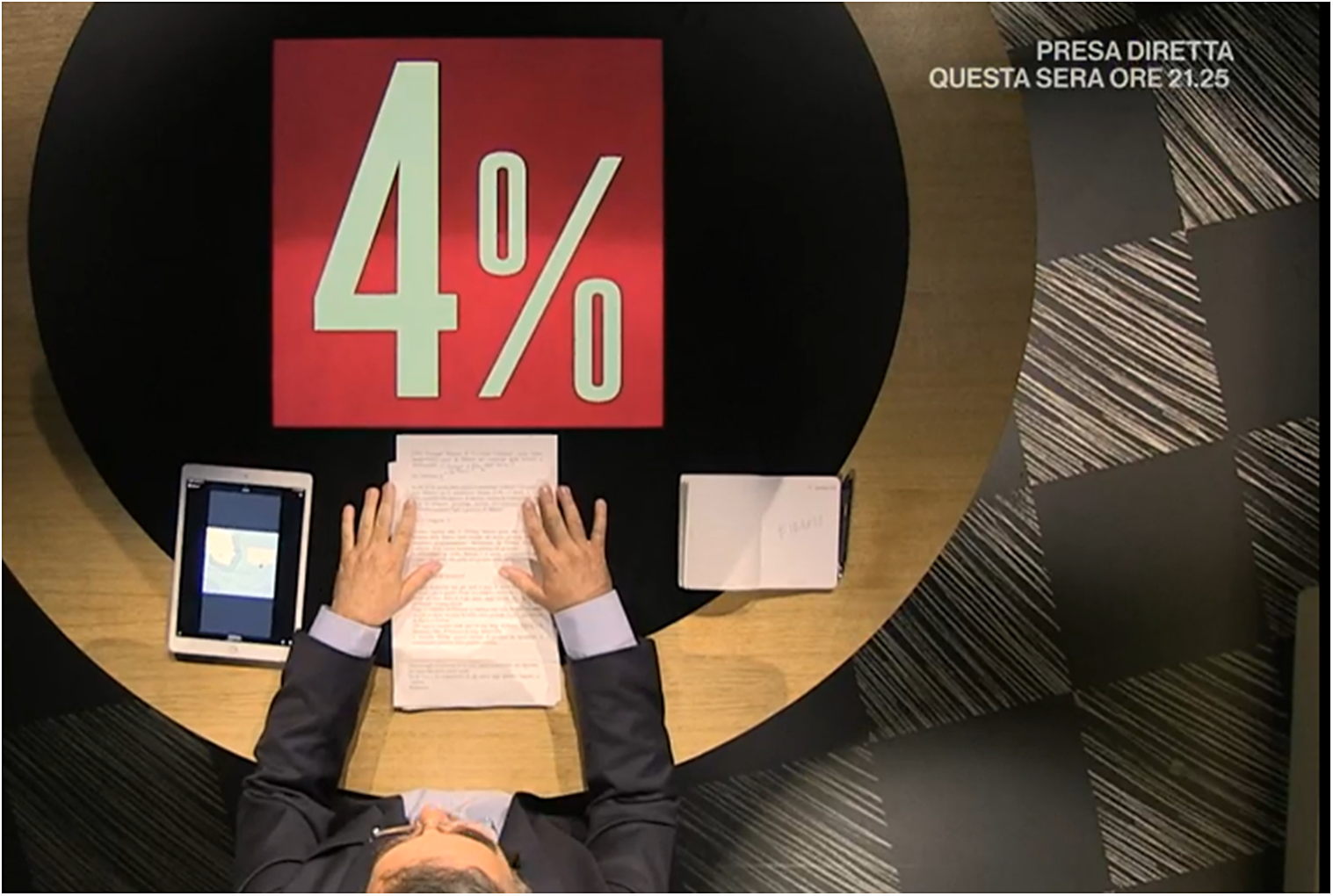
Figure 1. Long description
View from above of the table in the TV programme. The hands of the host are visible, as well as his notes, his notebook, and a tablet with the GPS location of the boats. The screen on the table shows the 4% cypher indicating the percentage of Italians who think migration is a priority for the new elected government.
It comes as no surprise to any spectator tuning in on RAI 3 at 8:30 pm that the programme is politically oriented towards more centre-left, progressive views. RAI 3 is historically the more centre-left channel of RAI, and Damilano has never made any mystery about his political orientation, having also been the editor of L’Espresso , a centre-left Italian political magazine. Because of its brevity, its presenter coming from the press world, and the presence of many illustrious guests from the very first episode, such as Chimamanda Ngozi Adichie, Jhumpa Lahiri, Bernard-Henri Lévy, Salman Rushdie, and the ministers of the newly elected government shortly after its formation the show managed to distinguish itself with a notable and stable audience share, that has allowed for its permanence in the channel’s schedule. Incidentally, the show also has a pretty stable presence in the Italian X (former Twitter) trends, and this is due, I speculate, to the particular brevity of the format that makes it easily adaptable for the short video formats (like reels and stories) on social media platforms.
What, however, made the programme stand out and be itself a topic in the daily news was its coverage of the three NGO ships that were being kept at sea in the weeks between the end of October and the beginning of November 2022, the same week of the new government’s installation. This constant coverage, which spanned the arc of 10 days, also made it so that the violation of human rights that was being perpetrated in Italian waters finally made it to the TV news, elbowing its way among the news of the government’s installation.
After illustrating the theoretical framework in the next section, I will be examining two episodes from that week. The first is called ‘Fidarsi’ (Trust), and it aired on October 24th; the second is titled ‘Nave’ (Ship) from October 26th. In the conclusion, I will briefly refer to one final episode titled ‘Velocemente’ (Quickly), which aired on November 2nd. My analysis will specifically focus on the narrative strategies that allow for an ethical narration of the conditions of the migrants at sea and aim to show how they manage to effectively combine information and immersion, and to tap into the cultural memory of the audience by also offering individual memories (Assmann Reference Assmann, Tilmans, van Vree and Winter2010, 40,43). Indeed, the use of individual memories, multiperspectivity (also rendered visually through the split screen), and vicarious storytelling all contribute to creating an ethical narration of the story and undermine tropes that are implicitly connected to migration.
The scopes and scales of memories of migration – Four memory formats for migration
Collective understandings of migration can take different paths and rely on a diverse range of memories. In trying to complexify the notion of collective memory, Aleida Assmann’s seminal differentiation of the four memory formats (Assmann Reference Assmann, Tilmans, van Vree and Winter2010) allows me to trace a trajectory that illustrates how The Knight and the Rook works on a series of levels to affect the Italian collective memory of migration. Drawing on Sontag, Assmann underlines how ‘what is called collective memory is not a remembering but a stipulating: that this is important, and this is the story about how it happened, with the pictures that lock the story in our minds’ (Reference Assmann, Tilmans, van Vree and Winter2010, 38). This act of stipulation relies on a shared narrative that propagates at various levels. Assmann, then, proposes four formats of memory that can help understand how our memories as humans have different layers and ‘extensions in space and time’ (Reference Assmann, Tilmans, van Vree and Winter2010, 40). Assmann distinguishes between individual memories, which do not span more than a century, given that they are born and die within the circle of humans that share these memories among one another, and collective memories of the social, political, and cultural kinds, that should substitute the ‘vagueness’ of the term collective (Reference Assmann, Tilmans, van Vree and Winter2010, 40).
For the purpose of this article, it is productive to pay attention to individual and cultural memories. Assmann defines cultures as ‘systematic and highly elaborate strategies against the primary experience of ongoing decay and general oblivion’ (2010, 43). Cultural memories are the result of these strategies that are repeated and found in multiple instances of cultural productions, such as the migration tropes that I have mentioned throughout the article. Indeed, cultural memories are ‘mediated’ and ‘founded on durable carriers of symbols and material representations’ (Assmann Reference Assmann, Tilmans, van Vree and Winter2010, 42).
Assmann’s formats can work in synergy with the narrative ecology of the migration model proposed by Marco Caracciolo, Carolin Gebauer, and Roy Sommer in 2023. Based on the concept of narrative ecology theorized by Keith Turvey, they construct a three-level scheme, represented by three concentric circles, which summarizes the possible types of stories of migration that circulate through media. In the outer circle, they place ‘metanarratives & migration myths’ (Caracciolo et al. Reference Caracciolo, Gebauer and Sommer2023, 11). This level includes widely circulating ideas such as the myth of migration as a threat or the theory of the Great Replacement, which, along the course of the article, I call migration tropes, such as the threat trope that I proposed earlier. The middle circle is represented by ‘(media & artistic) narratives on migration’ (Caracciolo et al. Reference Caracciolo, Gebauer and Sommer2023, 11). This is the level where the stories told in the episodes of The Knight and the Rook can be placed, as it refers to news stories or artistic representations of migration which, as the authors explain, ‘present migration from an etic or outside perspective’ (Caracciolo et al. Reference Caracciolo, Gebauer and Sommer2023, 10). Finally, there are ‘(individual) stories of migration’ (Caracciolo et al. Reference Caracciolo, Gebauer and Sommer2023, 11) that present personal experiential accounts of migration. As the model shows, these stories feed into each other and influence each other in a complex and nonlinear way.
Assmann concludes her essay on the formats of memory by emphasizing that individual memories are ‘externalised’ through media representations (2010, 49). This is precisely what The Knight and the Rook does in the episodes that I analyse in the following section: by externalizing individual memories of the migrants and NGO activists onboard the ships at sea, the TV show offers individual stories of migration that enter the cultural memory level as they are remediated on television. Moreover, the show’s format allows for this particular kind of narration of migration because, I argue, it is an effective example of media narrative, namely, narrative journalism.
According to Marie Vanoost, media narratives are aggregated fragments, which may be narrative texts but may also be more argumentative texts, such as editorials, or even pictures, caricatures, etc. [A media narrative] grows from one newspaper to another, and even from newspapers to radio, television or the Internet. [It] follows the events or reports them as they occur – in live television for example. It is thus not clear where media narrative starts and where it ends. Moreover, no single reader will ever ‘read’ it entirely; every reader rather gets their own narrative according to their own media consumption. (Vanoost Reference Vanoost2013, 79)
Put simply, media narratives are the overarching narrative of a specific set of events that each reader/viewer/digital media user constructs through their act of retrieving information through media. Within the context of media narratives, scholars have observed how, in specific cases, narrative strategies deriving from fiction are used in news reporting. This is the case of what Vanoost calls narrative journalism. In her 2021 essay, Vanoost suggests another way to tell the news – as the title of her work aptly shows – by looking at how narrative journalism is able to merge two affordances that are usually considered separately, namely its immersive and its informative dimensions. She emphasizes how ‘narrative journalism [is to] be viewed as an attempt to reconcile immersion and information within a single narrative’ (Vanoost Reference Vanoost2021, 414). The informative dimension is clearly the more intuitive aim of journalism. We read/watch/scroll the news because we want to know more about a specific event, or a set of events, that have recently been happening in the world. What the immersive form adds, Vanoost suggests, is ‘the re-creation of lived experience’ and is ‘strictly meant to serve or even reinforce the informative mission of journalism’ (Vanoost Reference Vanoost2021, 413). By interviewing 15 journalists who write narrative journalism and five readers of narrative journalism she finds out that journalists wrote immersively using narrative techniques borrowed from fiction writing ‘as a way to share human experiences and thus deepen the public’s comprehension of the news and the issues we face as a society’ as well as ‘as a way to inspire action in order to make the world better’ (Vanoost Reference Vanoost2021, 421). In turn, the readers were found to be more impressed and remember better stories that were narrated by also using immersive techniques (Vanoost Reference Vanoost2021, 421).
Albeit limited to a restricted group of people – only 15 journalists and five readers – Vanoost’s study is a useful starting point to consider the immersive feature of narrative journalism as effective on the memory of the viewers. As far as my analysis is concerned, I ask how media narratives more widely impact recipients’ memories of migration? Combining Caracciolo et al. (Reference Caracciolo, Gebauer and Sommer2023) with Assmann (Reference Assmann, Tilmans, van Vree and Winter2010), I want to suggest that individual memories of migration remediated through media narratives have an impact both on a personal level and on a collective level. On the collective level, tropes related to migration resist more strongly (see also Gabai Reference Gabai, Shaw and Selvarajah2019). Indeed, as Assmann suggests, cultural memories are ‘long-term memories’ which, however, do not imply that they cannot be changed or undermined (2010, 44).
Hence, connecting all the dots from this section, the suggestion I want to make here is that, as a particularly effective form of narrative journalism, The Knight and the Rook, with its double affordance of information and immersion, works on the cultural memory of the Italian TV audience. And it does so, thanks to a series of narrative strategies that undermine the migration tropes and offer ‘externalised’ (Assmann Reference Assmann, Tilmans, van Vree and Winter2010, 49) individual memories of migration. In this way, the show becomes a good example of an ethical representation of migration called for by scholars and activists.
One week of coverage of refugees at sea in The Knight and the Rook
‘Trust’ – October 24th, 2022.
‘Trust’ is the first episode in which there is mention of the ships at sea that are waiting to be assigned a safe harbour by the Italian government. The title of the episode refers to the main media event of the week, namely, Meloni’s first official speech to the parliament after the inauguration, that works as a formal request to entrust her and her government with powers.
After introducing what is expected of Meloni for the week, as well as her first meeting with French President Emmanuel Macron, Damilano then abruptly steers the narrative towards a survey. The survey illustrates that, despite the fact that the government made it clear that uncontrolled migration is a priority, only 4 per cent of Italians think so. The number is shown on the digital desk with a shot from above (Figure 1). Matteo Salvini, Deputy Prime Minister of Italy and Minister of Infrastructure and Transport, ensures – continues Damilano – that Italy will not allow any more ships to disembark on Italian soil. Visualizing the 4 per cent number on the screen vis-à-vis the declarations against migrants released by the members of the newly elected government results in a sharp contrast that highlights the discrepancy between the beliefs that propagate through the narratives on migration in politics and the available data. This is how Damilano’s narration fulfils the information dimension of narrative journalism proposed by Vanoost. Salvini’s declarations prompt him to introduce the situation at sea: there are two NGO rescue ships in the Mediterranean Sea, named Ocean Vikings and Humanity One, which rescued about 118 shipwrecked migrants and are waiting to receive permission to disembark on the Italian island of Sicily. The situation in Sicily is particularly tense as refugees are stuck on the ships and placed in very stressful conditions, waiting to disembark and receive proper assistance. Damilano talks about a clinic in Palermo for refugees who were victims of torture, where about 750 people are hosted. ‘But these – he says to the camera – are not just numbers: they are faces, they are stories, and here’s one of them’ (00:00:45–00:00:48). This sentence crucially positions the show’s criteria of storytelling: not only are numbers and data important as they allow viewers to assess the situation in the country; single stories are crucial too, because they help viewers to zoom into individual (Assmann Reference Assmann, Tilmans, van Vree and Winter2010, 40) migrants’ memories, which insert themselves in the broader narrative on migration.
Damilano’s last words launch a video testimony of one of the guests in the centre of Palermo. The video presents a person whose face is never shown (Figure 2). We see their hands, their t-shirt, the way they gesticulate, and parts of their chin and lips, but overall, their identity is preserved. The person tells their story in French, and their voice is dubbed in Italian. As they share their memories of migration, and their three attempts to escape torture in Libyan detention camps, before finally reaching the Italian coast, their narrative alternates between the first and second person. In the Italian voiceover, this results in sentences such as ‘They beat you’, ‘They give you food once a day’, and ‘They hit you’ when referring to life in the camp.
A guest of the refugee clinic in Palermo tells his story.
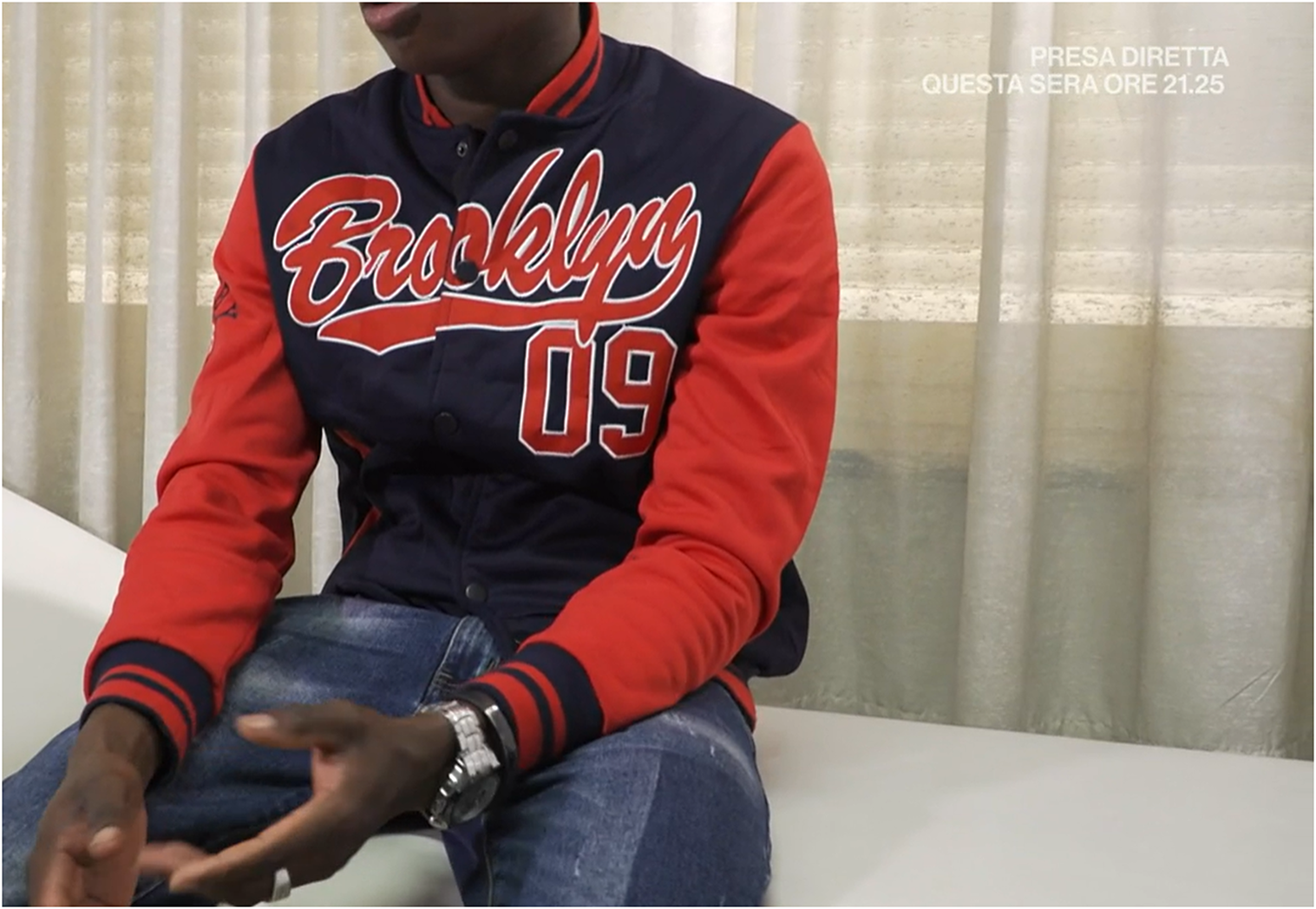
Figure 2. Long description
A shot of the interview to one of the guests of the refugee clinic in Palermo. His face is not visible, only his torso and legs to grant anonimity.
The use of a you-narrative together with a story of migration, which in Gebauer’s and Sommer’s words ‘grant[s] migrants full authority and control over their narrative’ (2024, 6) offers a different perspective on the so-called refugee ‘crisis’ in Italy, which is mostly conveyed through numbers and statistics, or reported via vicarious storytelling practices (Gebauer and Sommer Reference Gebauer and Sommer2024, 11). Vicarious storytelling practices happen when volunteers or migration experts narrate personal stories of refugees, mainly for humanitarian purposes. The Knight and the Rook does make use of vicarious storytelling in the following episodes, where volunteers of the NGO Doctors Without Borders explain the situation on the ships and tell some of the stories of the people on board. But it is through the combination of the two, through multiperspectivity (especially in the second episode analysed here), that the show offers its audience the possibility to know about how complex and dangerous fleeing to Italy by sea can be.
Although viewers cannot see the face of the speaker, their memories of the dangerous travel they went through and their present condition in the refugee clinic in Palermo immerse the audience in some of the most gruesome aspects of the reality of migration. The show manages to contribute to the cultural memory (Assmann Reference Assmann, Tilmans, van Vree and Winter2010) of migration by juxtaposing these individual memories with the declarations of government members and creating cracks in the solidity of the migration tropes perpetrated by the media. This is confirmed by Damilano’s closing words for the episode, which prove to be significant for the ways in which the narration of the ships at sea unfolds in the following episodes as well. At the end of the video interview, he looks straight into the camera and pronounces the concluding words for the episode:
‘States are in pieces; bodies are torn to pieces. 1400 are the dead people dispersed in the Mediterranean Sea in 2022. Throughout these years, migrants have been used as a political tool to overturn old governments or create new ones, and then they have been forgotten when other priorities arose. I think they must not be forgotten, I think each of them, with their own individuality, with their face, with their story deserves to be narrated and shed light on. In these minutes, the NGO Mediterranea informs us that 400 people are fleeing Libya and are in Italian waters, water is entering the ship. We need to intervene now. We need to invigilate onto all of this. (00:13:34 – 00:14:26; all quotes from The Knight and the Rook have been translated by the author of the article)
Damilano’s words express what could be considered a manifesto for how the show intends to continue narrating migration in a way that defies stereotypes, but also that seeps into the national cultural memories of migration. The emphasis on forgetting the migrants as individuals with their own identities and stories while using migration for political purposes powerfully interjects the overarching narrative on migration. This approach to the story is kept consistently in the subsequent episodes as well.
‘Ship’ October 26th, 2022.
The episode ‘Nave’ (Ship) contains some of the many updates of the story of the NGO ships at sea as it develops. Overall, it is the most important episode for its narrative choices, and for the way it manages to effectively use multiperspectivity and vicarious storytelling practices (Gebauer and Sommer Reference Gebauer and Sommer2024, 11) to ethically narrate what is happening at sea and be in line with the programmatic promise of not forgetting migrants. In this episode, Damilano promises to show a day in Italy through three different storylines. This has the effect of juxtaposing, on the one hand, the urgency of the situation at sea, and the latest political development in the Parliament on the other. The simultaneity of the events is shown both visually, through the split screen, and orally, through different video interviews launched during the show.
The onscreen narrator opens the show by telling the audience that tonight he will ‘talk about an Italian afternoon from three different viewpoints: a palazzo, a seat of the Italian power, a public square (a piazza), the Mediterranean Sea’ (00:00:30–00:00:40). Before turning to the videos of the afternoon, he shows a live streaming of the vote of trust in the Senate. The live streaming is juxtaposed with a live satellite view of the ships at sea (Figure 3), thanks to a split-screen view. The day before, Damilano reports, PM Meloni opened her instalment speech by employing a specific metaphor: Italy is a ship sailing through a storm and is in danger of sinking. The Italian people entrusted the right-wing parties to take the country to a safe harbour. This highly problematic metaphor is implicitly put face to face with a demonstration in Rome, where people are protesting against the renovation of an agreement between Italy and Libya, which sees Italy funding the Libyan coastguard in the attempt to limit the arrival of refugees on the Italian coasts, and that is due in a week from that day.
Use of the split screen.
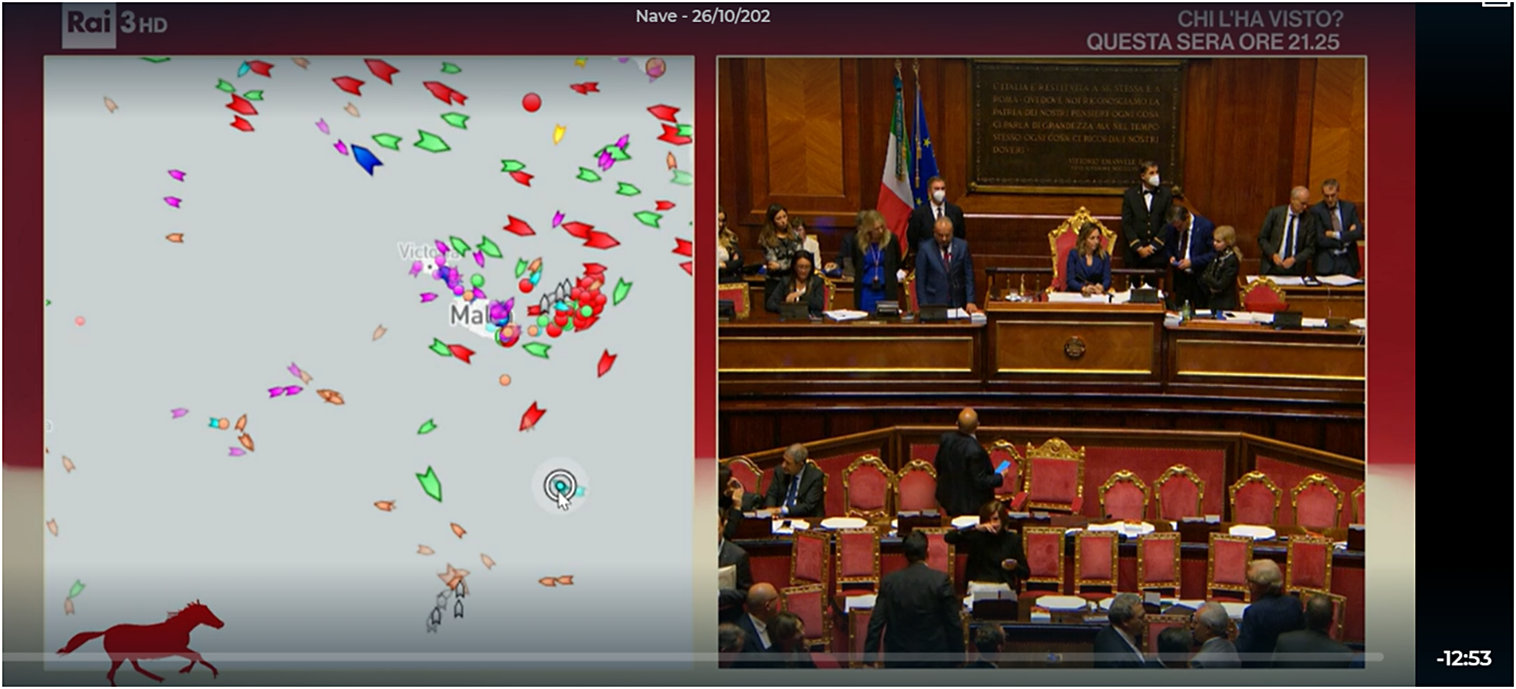
Figure 3. Long description
A split screen from the TV programme. On the left, the GPS position of the boats at sea on a digital map. On the right, the Italian Parliament with politicians discussing.
After that, there is a video report of the peaceful protest (Figure 4), various interviews with the demonstrators: one of them is a person who escaped a prison camp in Libya and now lives in Italy, another example of an individual memory of migration. The video shows images from the protest and many faces in the crowd while the stories of two migrants narrating what happened to them in a detention camp in Libya are audible throughout, together with the representatives of NGOs and political parties present at the protest.
A protester against the Italy-Libya agreement.
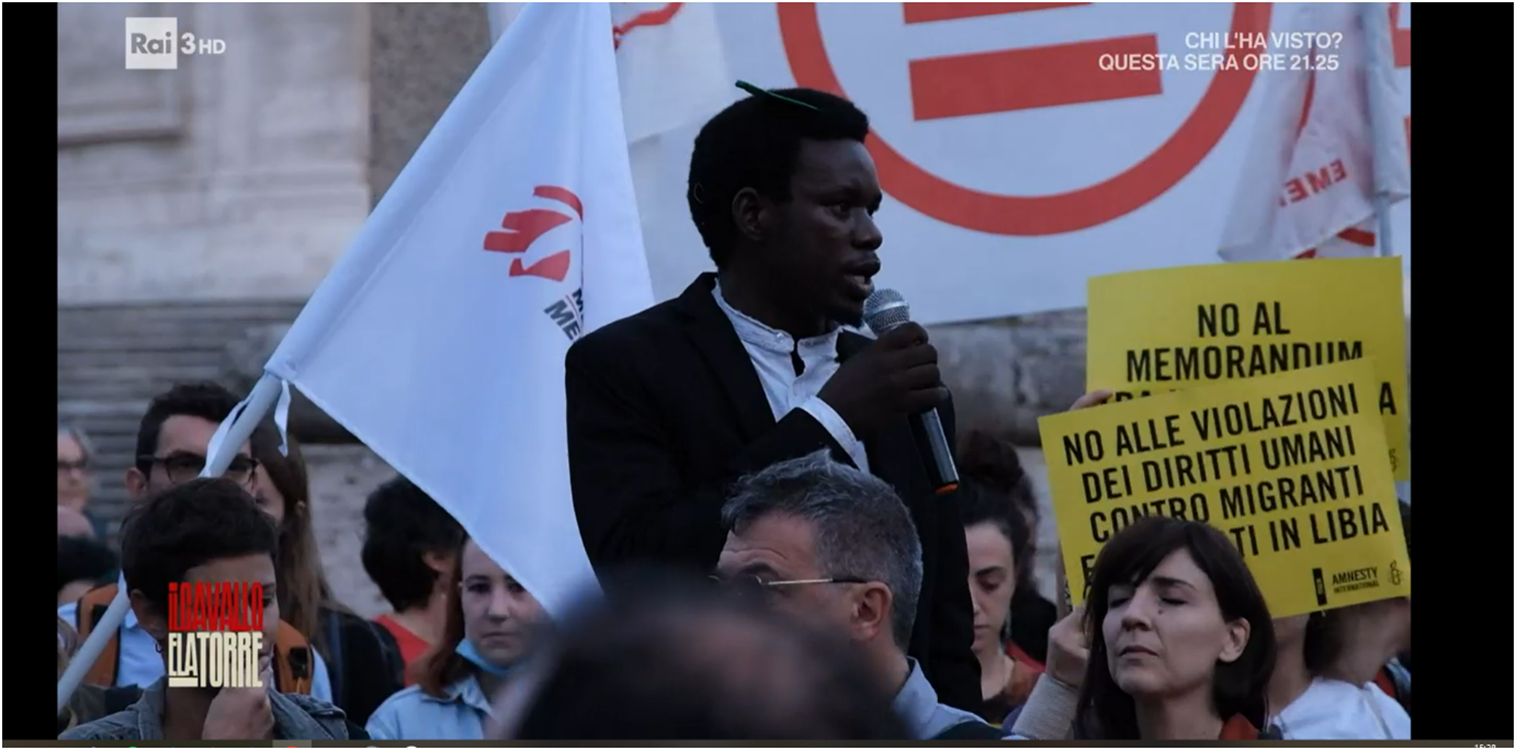
Figure 4. Long description
A scene of protest in Rome. A man is holding a microphone and speaking against the Italy-Libya agreement. Below him and behind him the heads of other people are visible, as well as flags from NGOs such as Doctors without Borders and Emergency.
At the end of the video, Damilano shows the GPS screening of the NGO ships again. Damilano reports that the day before, the Minister of the Interior, Matteo Piantedosi, communicated to the Italian Coast Guard that the two NGO ships at sea only informed Italy about the rescuing operations after the latter had already happened. This resulted in a violation of the norms for the welcoming of refugees (00:09:01–00:09:16). As if answering to the minister’s accusation, Damilano launches a video interview from one of the NGO ships, the Ocean Viking. One of the volunteers aboard the ship, Nicola Stalla, testifies to the situation on board, telling some stories of the rescued refugees who are waiting to disembark. Images rolling while the interview proceeds show the refugees playing chess on the floor of the ship, napping, and with flashbacks of the rescue operations conducted during the night. Stalla rejects the minister’s accusations, finding a space to defend the NGO and to underline that a ship is not ‘a welcome centre’ in the show.
Before finishing, the split screen with the live stream from the senate and the GPS satellite view of the ships is shown again, while Damilano comments ‘The navigation of the new government begins tonight, while we hope that these two ships will soon find a safe harbour instead’ (00:13:08–00:13:13), thus alluding to Meloni’s inaugural speech at the Parliament mentioned at the beginning of the episode.
Multiperspectivity, here visualized thanks to the split screen, fulfils two objectives. From a narrative viewpoint, it allows for a diverse and multi-faceted view on migration in Italy, helping Damilano and the programme as a whole to remind its audience that migrants are being forgotten by politicians. By employing multiperspectivity, the show highlights the striking contrast between what happens within, at the seats of power, and without, in the public squares where people are protesting, and at sea, where shipwrecked refugees and volunteers are waiting for an answer. One final, crucial observation that needs to be emphasized is the way Damilano reappropriates the metaphor of the ship in the storm employed by Meloni, to shift it onto the ongoing situation of the NGO ships at sea. Metaphors, as mentioned in the introduction, play a crucial role in the narration of migration but also in the construction of cultural memories, as shown by Assmann (Reference Assmann, Tilmans, van Vree and Winter2010). Subverting the use that Meloni made of that image contributes to shifting the collective attention onto the experience of the rescued refugees at sea.
Conclusion: Notes for an ethical narration of migration on television
From October 27th until November 3rd, The Knight and the Rook gave its audience constant updates about the NGO ships at sea waiting for instructions from the Italian government. Throughout those days, another NGO ship, Geo Barents, also asked to disembark the rescued refugees in Italy, adding to a third request to the government. In the November 2nd episode, titled ‘Quickly’, Damilano reports how Italy sent a note to Norway and Germany, the countries to which the ships belong, to say that Italy cannot accept refugees rescued by their ships. At this point, Damilano explains that the show directly contacted the German embassy to collect a reaction about the Italian government’s note. The reply of the German embassy is shown via the split screen on the left, with the most important sentences highlighted and enlarged. In the letter, the German embassy urges Italy to disembark the shipwrecked refugees ‘quickly’ (Figure 5), hence the title of the episode. The show’s initiative in contacting the embassy resulted in the creation of the media event and increased the tellability (namely, the narrative worth of the story) of the ships’ situation at sea, revealing diplomatic tensions between the newly elected Italian government and the German one.
Germany asks Italy to disembark the refugees quickly.

Figure 5. Long description
The screen is divided into two main sections.
Top-Left: The R A I 3 H D logo is visible. Below it is an inset image of a formal letter on white paper. The letter is addressed to Dear C and is written in English and Italian. It states that the German Embassy is responding to an inquiry. The Italian text within the letter matches the large text on the right. It is signed by Frank Horst, Head of the Press Office and First Secretary at the Embassy of the Federal Republic of Germany in Rome. The embassy logo, featuring a black eagle, is at the bottom left of the letter.
Bottom-Left: A red silhouette of a galloping horse is positioned against the light background.
Top-Right: Text reads CHI L’HA VISTO? QUESTA SERA ORE 21.25.
Right Side: A large red block contains a white text transcription of the letter’s core message in Italian. It translates to: The Federal Government has responded in writing to the Italian Government’s Note Verbale, setting out its interpretation of the law. For the Federal Government, civil organizations engaged in the rescue of migrants provide an important contribution to saving human lives in the Mediterranean. Saving people in danger of life is the most important thing. According to information provided by S O S Humanity on the ship Humanity 1, flying the German flag, there are currently 104 unaccompanied minors. Many of them need medical care. We have asked the Italian Government to provide assistance quickly.
Six main national newspapers, including Il Corriere della Sera and La Repubblica, the two most read newspapers, started reporting on the ships at sea on their first pages on the 3rd of November, the day after the programme’s revelation of the diplomatic tensions between Germany and Italy. The show itself made it to the other news media for the way it revealed the diplomatic tensions between Germany and Italy, but also for being the only show that had been fully covering the story as it was happening.
In a moment in which a country is undergoing a significant political change and reassessing its identity within the geopolitical context of the EU through the choice of a right wing government, The Knight and the Rook chooses to propose a different way of narrating this historical event by reporting a story that would otherwise fall into background noise and it is yet of pivotal importance for the country’s understanding and remembering of migration. The show does so by offering stories of migration, juxtaposing the installation of the government to the ship’s position at sea, and reappropriating troubling metaphors to resist migration tropes. Through careful narrative choices, The Knight and the Rook has shown that narrating migration in a different way is possible, worth doing, and that it can resort to individual memories of migration to impact the cultural memories related to a phenomenon. Employing narrative theory and memory studies to understand the way current affairs TV programmes work can expand our understanding of the ways in which television as a medium influences our memory of migration.
Data availability statement
As this is a theoretical article, there are no data involved, except the quotations, which are referenced. Videos of the TV programme described are available on the RAIPLAY streaming platform, also referenced.
Funding statement
This work was supported by the Deutsche Forschungsgemeinschaft (DFG, German Research Foundation) – Projektnummer 458456362. The funder had no role in study design, data collection and analysis, decision to publish, or preparation of the manuscript.
Competing interests
The author declares none.
Simona Adinolfi (JLU Giessen and Ghent University) is a postdoctoral researcher in the project MeDiMi – Human Rights Discourse in Migration Societies. Her PhD was part of the project OPPORTUNITIES, where she analysed migration narratives in the Italian media. Her research interests include narrative theory, migration studies, critical posthumanism, and memory studies.




 Open access

