Cardiomyopathy describes a heterogenous group of disorders defined by myocardial injury and impaired contractility that poses significant risk of morbidity and mortality in the paediatric population. It has been described that almost 40% of children with symptomatic cardiomyopathy will either go on to heart transplant or die within the first 2 years. Reference Lipshultz1 Development and progression of heart failure leads to widespread activation of neurohormonal and inflammatory cascades, which subsequently leads to circulating catecholamine and pro-inflammatory factors. Reference Vaidyanathan2 Circulating catecholamines can subsequently cause vasoconstriction, and salt and water retention, which in turn exacerbates heart failure symptoms and ventricular function. Due to the complexity of this process on a cellular and molecular level, multiple medical interventions from different pharmacologic classes are utilised in managing cardiomyopathy.
In general, management of cardiomyopathy in paediatric populations is based largely on adult literature due to the relative paucity of evidence on optimal medical therapy in the paediatric population. Reference Vaidyanathan2 Further, this lack of evidence has led to significant anecdotal variability in management of these patients. Some studies have shown downregulation of proinflammatory and upregulation of anti-inflammatory cytokines following dexamethasone administration in the myocardium; however, steroid therapy is not consistently used when managing cardiomyopathy. Reference Heying, Wehage and Schumacher3 A study by Kantor et al describes that, in some centres, therapy has shifted towards combination therapy with angiotensin-converting enzyme inhibitor and beta blocker therapy, as is the common practice in adult patients with evidence that this dual therapy improves survival; however, their retrospective review suggested only a transient survival advantage with dual therapy. Reference Roche, Timberlake and Manlhiot4 Lewis et al showed significantly improved survival data during the first 2 years following diagnosis with angiotensin-converting enzyme inhibitor therapy, with a tendency toward improved survival past this time point though statistical significance was not shown. Reference Lewis and Chabot5
The purpose of this study was to determine the impact of various medications on intensive care unit length of stay, total length of stay, billed charges, and mortality for paediatric cardiomyopathy admissions utilising information from a large database.
Material and methods
As this study utilised de-identified data from a national database, no consents were obtained by the authors of this study. This study is in concordance with the Helsinki declaration.
Pediatric Health Information System database
Data for this study were obtained from the Pediatric Health Information System database. Pediatric Health Information System database is an administrative and billing database that contains inpatient, emergency department, ambulatory surgery, and observation data from not-for-profit, tertiary care paediatric hospitals in the United States of America. The 53 hospitals that contribute data to Pediatric Health Information System database are affiliated with the Children’s Hospital Association (Lenexa, KS), a business alliance of children’s hospitals. Data quality and reliability are assured through a joint effort between the Children’s Hospital Association and participating hospitals. For the purposes of external benchmarking, participating hospitals provide discharge/encounter data including demographics, diagnoses, procedures, and charges. Data are de-identified at the time of data submission, and data are subjected to several reliability and validity checks before being included in the database.
Admission identification
Pediatric Health Information System database data from 2004 to 2015 were utilised for this study.
Firstly, admissions with cardiac diagnoses were identified. Supplemental material 1 outlines the cardiac diagnoses which ultimately were eligible for consideration. Of these admissions, those with cardiac surgery were identified. Of these, then admissions with cardiomyopathy were identified. Thus, the inclusion criteria for admissions for this study were: 1) paediatric admissions under 18 years of age; 2) a cardiomyopathy diagnosis with one of the following International Classification of Diseases (ICD-9) codes: 425.1 (hypertrophic cardiomyopathy), 425,11 (hypertrophic obstructive cardiomyopathy), 425,18 (other hypertrophic cardiomyopathy), 425.4 (dilated cardiomyopathy). Any admissions not meeting these criteria were excluded. From this point forward, the word “admission” will be used to refer to admissions meeting these inclusion criteria unless otherwise specified.
The admissions were then separated into two groups: those with and without inpatient mortality.
Cardiomyopathy medical interventions of interest
Medical therapies of interest were vast and included steroids, vasoactive agents, angiotensin-converting enzyme inhibitors, angiotensin receptor blockers, aldosterone antagonists, diuretics, calcium channel blockers, beta-blockers, digoxin, thyroid hormone replacement, and inhaled nitric oxide.
Admission characteristics
Several data points were captured for each of the included admissions. Age of admission, gender, year of admission were captured for all admissions. Length of stay, billed charges, and inpatient mortality were also recorded for all admissions. Any use of “mortality” from here after will refer to inpatient mortality during the admission of interest.
The presence of specific congenital malformations of the heart was captured using the ICD-9 codes outlined in supplemental material 1. The presence of specific cardiac surgeries including heart transplantation during the admissions was also captured using the ICD-9 codes outlined in supplemental material 1.
The presence or absence of the following comorbidities was recorded as well: heart failure, tachyarrhythmia, bradyarrhythmia, acute kidney injury, pulmonary hypertension, and the presence of syndromes. The centre at which care was delivered was also recorded.
Statistical analyses
Continuous variables were described as median and range while categorical variables were described as absolute frequency and percentage. Analyses of continuous variables across groups were conducted using a Mann–Whitney-U test while analyses of categorical variables were conducted using a Fisher exact test.
Characteristics between admissions that did and did not require surgical intervention for cardiomyopathy were compared initially with univariate analyses.
Next, regression analyses were conducted to determine the impact of the medical interventions on intensive care unit length of stay, hospital length of stay, billed charges, and inpatient mortality. Logistic regressions were utilised for surgical intervention for cardiomyopathy and inpatient mortality. Linear regressions were utilised for lengths of stay and billed charges. The dependent variable was one of the aforementioned outcomes while the dependent variables included congenital heart disease, need for extracorporeal membrane oxygenation, the presence of syndromes, the comorbidities previously mentioned, and the various medical interventions for cardiomyopathy previously defined as being of interest. Including the various comorbidities was meant to help adjust for clinical severity of illness as well. The centre at which care was delivered was also included in the regression analyses. Because of the large number of admissions in this dataset, we were able to support all of the variables listed in Table 1 as independent variables in the regression analyses. While the discussion of events needed per variable is beyond the scope of this manuscript as it was a consideration in the design of the methodology for this study here are provided references of manuscripts which discuss the number of events per variable that are required to develop a reasonably fitted model. While there has been an anecdotally accepted value of 10 events per variable it should be noted that this is not truly based on evidence and that large simulation studies have demonstrated six to eight events per variable as being plenty. Reference van Smeden, de Groot and Moons6,Reference Vittinghoff and McCulloch7 Other studies have even shown reproducible results with two events per variable. Reference Austin and Steyerberg8 The current study do have a far greater number of events per variable, regardless.
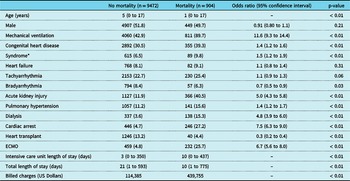
Univariate comparison of characteristics of those with and without inpatient mortality
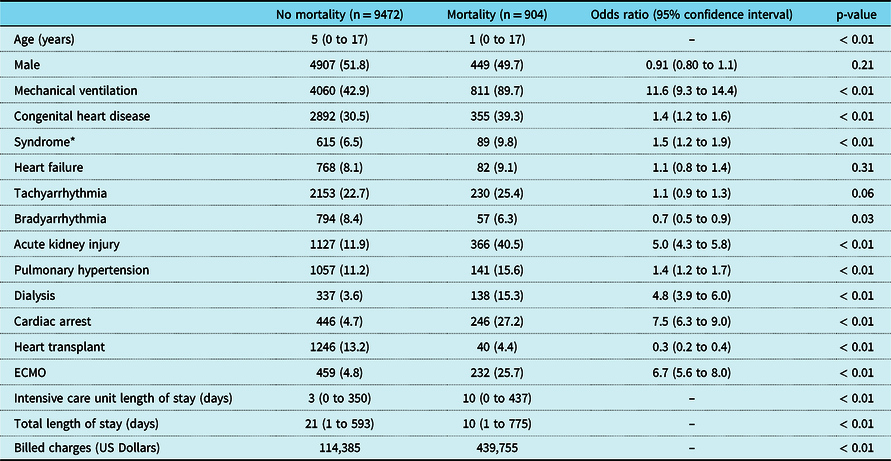
ECMO = extracorporeal membrane oxygenation; N = number of patients; US = United States
* Trisomy 13, 18, and 21 and unspecified genetic syndromes
Regression analyses were utilised intentionally rather than propensity score matching as the large number of admissions in this dataset makes regression a more powerful tool than propensity score matching. Additionally, regression analyses allow for assigning each independent variable a specific effect estimate.
To further account for clinical severity, regression analyses for impact of various interventions on intensive care unit length of stay, hospital length of stay, and billed charges were repeated with only data from survivors being included.
All statistical analyses were conducted using SPSS, Version 23.0. A p-value of less than 0.05 was considered statistically significant. Any use of the word “significant” throughout this manuscript implies statistical significance unless otherwise specified.
Results
Univariate comparison of those with and without inpatient mortality
A total of 10,376 admissions were included in these analyses. Of these, 904 (8.7%) experienced mortality. Those who experienced mortality tended to be younger (median age 1 year versus 5 years, p < 0.01). Those who experienced mortality also had significantly increased frequency of congenital heart disease, mechanical ventilation, syndrome, acute kidney injury, pulmonary hypertension, need for dialysis, and cardiac arrest. Those who experienced mortality also had significantly greater intensive care unit length of stay and billed charges (Table 1).
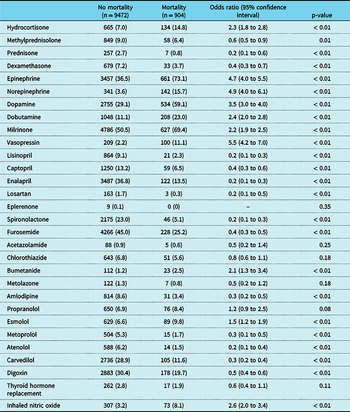
Admissions without mortality were significantly more likely to have utilised methylprednisolone, prednisone, dexamethasone, lisinopril, captopril, enalapril, losartan, spironolactone, furosemide, amlodipine, metoprolol, atenolol, carvedilol, and digoxin (Table 2).
Univariate comparison of interventions of those with and without inpatient mortality
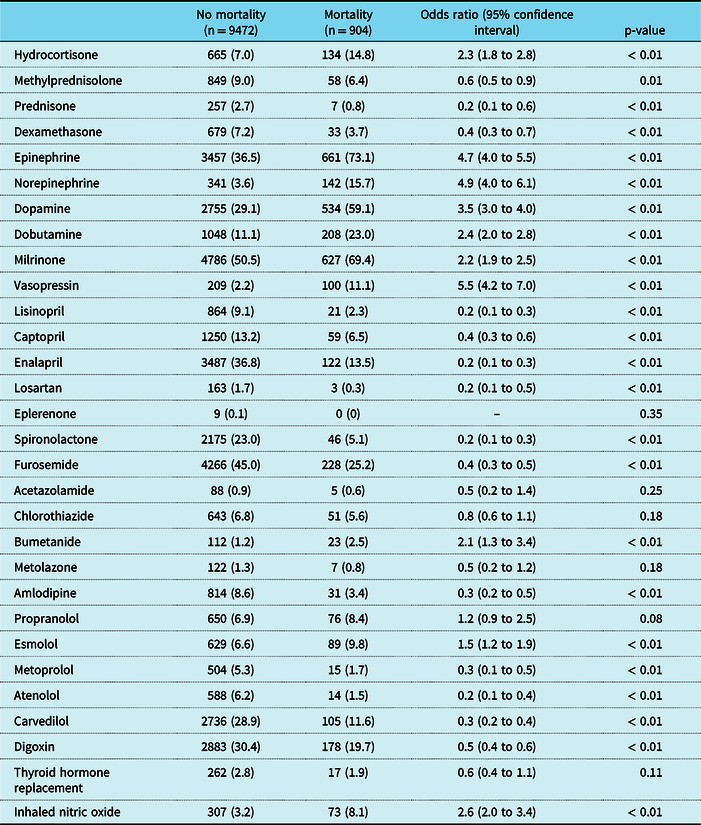
N = number of patients
Admissions with mortality were significantly more likely to have utilised hydrocortisone, epinephrine, norepinephrine, dopamine, dobutamine, milrinone, vasopressin, bumetanide, and esmolol (Table 2).
Multivariate regressions, entire cohort
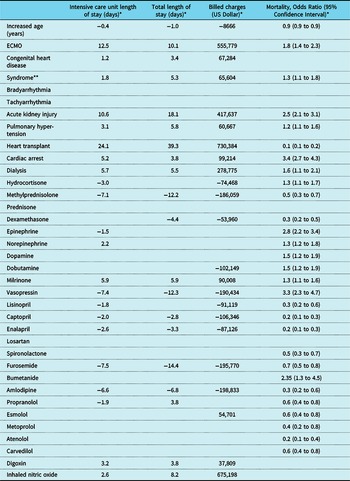
When all admissions were included in the regression analysis for intensive care unit length of stay, the following interventions were significantly associated with decreased intensive care unit length of stay: hydrocortisone, methylprednisolone, epinephrine, vasopressin, lisinopril, captopril, enalapril, furosemide, amlodipine, and propranolol (Table 3).
Multivariate regression analysis of the effects of medical interventions in the entire cohort
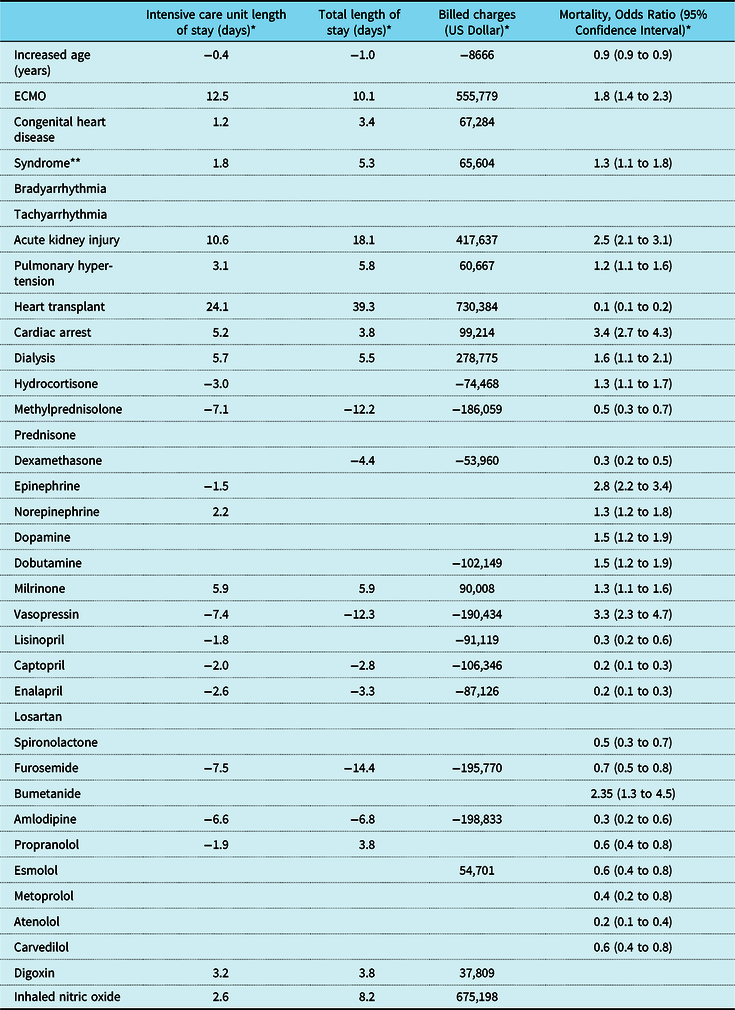
ECMO = extracorporeal membrane oxygenation; N = number of patients; US = United States
* All fields with values provided have a significant p-value of less than 0.05. The remainder cells without values were statistically insignificant
** Trisomy 13, 18, and 21 and unspecified genetic syndromes
When all admissions were included in the regression analysis for total length of stay, the following interventions were significantly associated with decreased total length of stay: methylprednisolone, dexamethasone, vasopressin, captopril, enalapril, furosemide, and amlodipine (Table 3).
When all admissions were included in the regression analysis for billed charges, the following interventions were significantly associated with decreased billed charges: hydrocortisone, methylprednisolone, dexamethasone, dobutamine, vasopressin, lisinopril, captopril, enalapril, furosemide, and amlodipine (Table 3).
When all admissions were included in the regression analysis for mortality, the following interventions were significantly associated with decreased mortality: methylprednisolone, dexamethasone, lisinopril, captopril, enalapril, spironolactone, furosemide, amlodipine, esmolol, metoprolol, atenolol, and carvedilol.
Thus, the following interventions significantly decreased intensive care unit length of stay, hospital length of stay, billed charges, and mortality: methylprednisolone, captopril, enalapril, furosemide, and amlodipine.
Multivariate regressions, only survivors
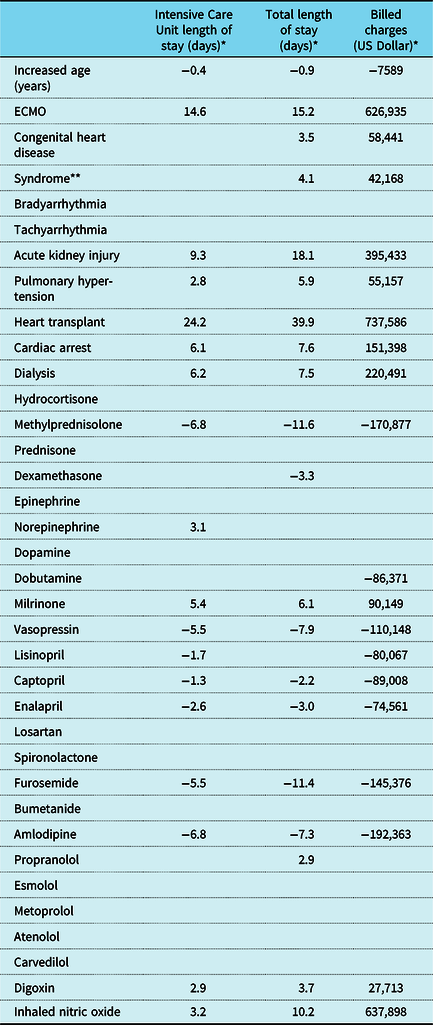
When only admissions without mortality were included in the regression analysis for intensive care unit length of stay, the following interventions were significantly associated with decreased intensive care unit length of stay: methylprednisolone, vasopressin, lisinopril, captopril, enalapril, furosemide, and amlodipine (Table 4).
Multivariate regressions analysis of the effects of medical interventions in only the survivors
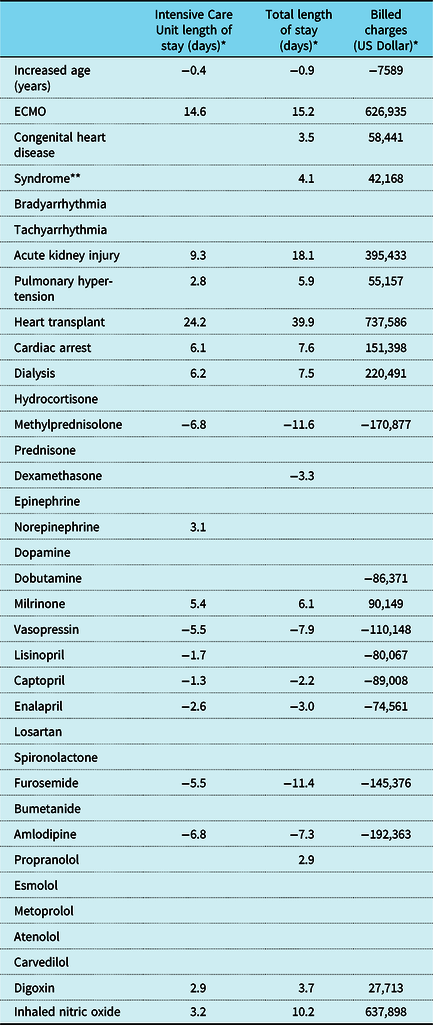
ECMO = extracorporeal membrane oxygenation; N = number of patients; US = United States
* All fields with values provided have a significant p-value of less than 0.05. The remainder cells without values were statistically insignificant
** Trisomy 13, 18, and 21 and unspecified genetic syndromes
When only admissions without mortality were included in the regression analysis for total length of stay, the following interventions were significantly associated with decreased total length of stay: methylprednisolone, dexamethasone, vasopressin, captopril, enalapril, furosemide, and amlodipine (Table 4).
When only admissions without mortality were included in the regression analysis for billed charges, the following interventions were significantly associated with decreased billed charges: methylprednisolone, dobutamine, vasopressin, lisinopril, captopril, enalapril, furosemide, and amlodipine (Table 4).
Thus, the following interventions significantly decreased intensive care unit length of stay, hospital length of stay, and billed charges: methylprednisolone, vasopressin, captopril, enalapril, furosemide, and amlodipine.
Medical interventions with benefit for all endpoints after multivariate regression analyses in both cohorts
The following medical interventions were found to have positive benefit on all admission characteristics after multivariate analyses in both sets of analyses (entire cohort and survivors only): methylprednisolone, captopril, enalapril, furosemide, and amlodipine.
Table 3 and 4 outlines what medications had positive benefit in either the entire cohort or any positive benefit in just the survivors.
Discussion
These analyses demonstrate that several medications have a positive effect on intensive care unit stay, total length of stay, billed charges, and inpatient mortality. The following medical interventions showed decreases in all these endpoints in the entire cohort as well as survivors only: methylprednisolone, vasopressin, captopril, enalapril, furosemide, and amlodipine. Other medications such as hydrocortisone, dexamethasone, epinephrine, lisinopril, spironolactone, propranolol, esmolol, metoprolol, atenolol, and carvedilol also exerted positive benefits with respect to the admission characteristics of interest but just did not significantly impact all of them.
There is limited data on the efficacy of specific medical interventions on outcomes of cardiomyopathy admissions. These analyses offer data from a large number of cardiomyopathy admissions to help delineate what medical interventions may be of benefit. Steroids, angiotensin-converting enzyme inhibitors, diuretics, and calcium channel blockers seem to offer the greatest benefit although beta blockers also seem to have some benefit.
This study identified the association between improved admission characteristics if steroids were listed as medications. Data regarding steroids and paediatric cardiomyopathy are limited. Some forms of cardiomyopathy where inflammation is the hallmark may benefit from steroids. Reference Alkhateeb, Alsakkal, Alfauri and Alasmar9–Reference Al Jarallah13 In addition, patients with Duchene muscular dystrophy may have a delayed onset of cardiomyopathy after steroid therapy. Reference Barber, Andrews and Lu14 Further studies are required to determine the benefits and risks of steroid administration for cardiomyopathy.
Angiotensin-converting enzyme inhibitors are among the most common medications used in the setting of paediatric cardiomyopathy. Reference Harmon, Sleeper and Cuniberti15 Angiotensin-converting enzyme inhibitors have been shown to improve survival in paediatric cardiomyopathy. Reference Lewis and Chabot5,Reference Kantor, Abraham, Dipchand, Benson and Redington16 Angiotensin-converting enzyme inhibitors likely exert their benefits through a variety of mechanisms. Direct decrease in afterload by angiotensin-converting enzyme inhibitors may promote increased systemic cardiac output. Additionally, in some cardiomyopathy, there may be underlying genetic polymorphisms affecting outcome. Thus, angiotensin-converting enzyme inhibitors may have some benefits in these children by directly acting on a genetically impacted rennin–aldosterone–angiotensin axis. Reference Yuan, Meng, Zhou and Lu17,Reference Momma18 Whether or not ventricular remodelling occurance is unclear in the paediatric population although there is some data from those with left ventricular non-compaction cardiomyopathy that demonstrates decrease in left ventricular end diastolic pressure with medical therapy regimens including angiotensin-converting enzyme inhibitors. Reference Parent, Towbin and Jefferies19 Captopril and enalapril seemed to have greater benefit across all endpoints when compared to lisinopril based on the results of the current analyses.
While a previous study has demonstrated no difference in the effect of angiotensin-converting enzyme inhibitor when compared to angiotensin receptor blockers in relation to impact of ejection fraction in paediatric patients, our current study shows no significant change in any of the endpoints with angiotensin receptor blockers. Reference Allen, Flanigan and Thrush20
Diuretics have become a mainstay in the medical management of paediatric cardiomyopathy, allowing for symptomatic control by decreasing systemic, pulmonary, and venous congestion. Of note, the current analyses demonstrate that furosemide but not bumetanide or chlorothiazide offered improvements in the admission characteristics. The precise mechanism of this cannot be commented on although the number of admissions in which bumetanide was utilised was lower than that in which other diuretics were utilised, thus the analyses may have not been powered enough. The same could be said for acetazolamide although acetazolamide is also, admittedly, a weaker diuretic. Nonetheless, diuresis with furosemide was found to be beneficial in paediatric cardiomyopathy admissions.
Calcium channel blockers have been previously demonstrated to have benefit in the setting of paediatric cardiomyopathy. Most of the beneficial effects of calcium channel blockers in this setting come in two forms: 1) reduction of arrhythmia burden and 2) improved diastolic function. Reference Spicer, Rocchini, Crowley and Rosenthal21–Reference Pacileo, De Cristofaro, Russo, Sarubbi, Pisacane and Calabro23 The mechanism behind the beneficial effects seen in these current analyses cannot be discerned. Nonetheless, amlodipine demonstrated beneficial effects on all endpoints of interest in both sets of analyses.
Beta blockers have become increasingly used in the setting of paediatric cardiomyopathy. This has been based on data that has demonstrated improved cardiac function and survival in a number of studies. Reference Ostman-Smith24–Reference Gachara, Prabhakaran, Srinivas, Farzana, Krishnan and Shah31 These effects are believed to be mediated by reduction in arrhythmia burden and improvement in cardiac function. The current analyses demonstrated the effects of several beta blockers. While mortality was lowered by all the beta blockers included in the analyses, atenolol and metoprolol had the greatest benefit.
Digoxin has been historically used for improving cardiac function. In our current analyses, digoxin did not have any positive benefit in paediatric cardiomyopathy admissions.
These analyses provide an unprecedented amount of data on the effect of several medications on clinical endpoints for paediatric cardiomyopathy admissions. However, these data are not without their limitations. The database does not provide the dosing or duration of medications used, does not provide data on what order medications were introduced, and does not contain clinical data such as echocardiography data, venous saturations, or regional near spectroscopy. This study is also constrained by limitations inherent to administrative databases such as miscoding or undercoding. Inaccurate or incomplete coding may lead to misreporting and affect outcome analyses and are difficult to account for by statistical methodology. Data quality and reliability are assured through a joint effort between the Children’s Hospital Association and participating hospitals, and data are subjected to a number of reliability and validity checks. The multi-institutional data utilised for this study represents the perspective on outcomes only in participating centres and may not be representative or generalisable of non-participating centres and non-US centres. Outcomes were only measured for the index hospitalisation; data from subsequent hospitalisations were not evaluated. Finally, these analyses are limited to direct hospital costs and do not include physician fees and other costs carried by patients and families.
The current analyses benefit from a large number of admissions available for inclusion. Such analyses are not frequently noted utilising administrative databases. It is important to keep in mind the following points: 1. regression analyses are well-powered as discussed earlier; 2. all end-points of interest that are modelled for (total length of stay, total billed charges and inpatient mortality) happen at the culmination of the admission so all interventions would have happened prior to it; 3. centre variability was controlled for. Limitations, as discussed above, still exist as with any study. These data are to be utilised as preliminary, pilot studies to help further future hypothesis generation and study design. These are not meant to be definitive data.
The lack of clinical data makes it difficult to fully account for severity of illness, although including the comorbidities should help with some of this. Nonetheless, with the current paucity of data these data allowed for evidence-based recommendations to be made. Furthermore, this dataset does not distinguish between systolic and diastolic dysfunction.
For patients in whom intravenous vasoactive medications are not required to be initiated or are no longer needed then it is reasonable to start by starting an angiotensin-converting enzyme inhibitor. Based on the current analyses it seems that enalapril, captopril, and lisinopril are all reasonable options. Next, adding spironolactone seems reasonable. Next, calcium channel blocker in the form of amlodipine, or beta blocker seems appropriate and reasonable. While carvedilol has gained increasing favour as of late, it appears from the current analyses that atenolol or metoprolol may be most beneficial. The initiation of either calcium channel blocker or beta-blocker can be left to the discretion of the treating physician. Overall, the current analyses seem to show more benefit associated with calcium channel blockers when compared to beta blockers but if it is believed that beta blocker will offer additional clinical advantage over calcium channel blockers it would be reasonable to initiate beta blockers instead of calcium channel blockers.
Conclusions
Diuretics, steroids, angiotensin-converting enzyme inhibitors, calcium channel blockers, and beta blockers all appear to offer beneficial effects in paediatric cardiomyopathy admission outcomes. Specific agents within each group have varying effects.
Supplementary material
To view supplementary material for this article, please visit https://doi.org/10.1017/S1047951120004175
Acknowledgements
None.
Financial support
This research received no specific grant from any funding agency commercial, or not-for-profit sectors.
Conflicts of interest
None.
Ethical standards
All study procedures complied with the ethical standards of the Helsinki Declaration, and has been approved by Institutional Research Board of Cincinnati Children’s Medical Center.