1. Introduction
Are the findings of variationist sociolinguistics compatible with standard versions of Minimalism, as claimed in this journal by Adger (Adger Reference Adger2006)? In 1986 one could write that ‘none of these mainstream theories [including generative grammar] pays any attention whatsoever to what sociolinguists have been discovering’ (Hudson Reference Hudson1986: 1053) and in 1995 that ‘this work [on sociolinguistics] has had no influence at all on the most popular theories of syntax’ (Hudson Reference Hudson, Joachim, Arnim von, Wolfgang and Theo1995: 1514). Indeed, some generative grammarians denied that variation could in principle be relevant to a theory of competence (N. Smith Reference Smith1989: 178–186) and as recently as 1998 it was possible to write, in relation to variationist sociolinguistics and Chomskyan generative theory: ‘There have been few real attempts to marry these seemingly divergent positions' (Wilson & Henry Reference Wilson and Alison2007). If this marriage is to take place, it is most likely to be arranged by experts in generative grammar, so we must welcome the recent flurry of attempts (Cornips & Corrigan Reference Cornips, Karen, Peter, Frans and Paul2000, Reference Cornips and Karen2005; Adger & Smith Reference Adger, Jennifer, Cornips and Corrigan2005; Henry Reference Henry, Cornips and Corrigan2005; Adger Reference Adger2006; Parrott Reference Parrott2007; van Gelderen Reference van Gelderen, Cornips and Corrigan2007).
Adger's paper is a particularly useful example of what Minimalism can offer because (unlike most other attempts) it at least tries to explain the observed frequencies as well as the structural variation. To summarise Adger's analysis, it concerns the variation between was and were after we and you in the small Scottish town of Buckie (Smith Reference Smith2000, Adger & Smith Reference Adger, Jennifer, Cornips and Corrigan2005). Adger reports that the ratio of was to were is 2:1 after we and singular you, and explains this ratio as a consequence of the internal organisation of Buckie grammar. For the past tense of BE with we or you (singular) as subject, this grammar provides three lexical items with different but overlapping feature structures. Two of these lexical items are pronounced was; only one is pronounced were. On the assumption that each item has an equal chance of being selected, this explains the observed 2:1 ratio in favour of was without, crucially, invoking probabilities inside the grammar. Moreover, Adger reports that Buckie is so small and isolated that speakers all show about the same tendencies in their speech. Consequently, these variable data can be explained, he claims, without including any social distinctions in the grammar.
If Adger is right, then at least one example of Labov's ‘inherent variability’ (Labov Reference Labov1969), which he calls ‘intra-personal morphosyntactic variation’, can be explained in a Minimalist grammar. But is even this modest conclusion justified? Section 2 will point out four weaknesses of Adger's analysis, but the discussion will show that inherent variability can only be accommodated in a theory of language structure which can also accommodate usage information about typical speakers and about frequencies – a point that I have been arguing for some time (Hudson Reference Hudson1980: 188–190; Reference Hudson1986; Reference Hudson, Joachim, Arnim von, Wolfgang and Theo1995; Reference Hudson1996: 243–257; Reference Hudson1997; Reference Hudson2007a; Reference Hudson2007b: 246–248). If I am right, then Minimalism needs at least some fairly serious revision; but I have to leave it to the experts to decide whether the necessary changes are possible. I return in section 3 to a very brief outline of a radical alternative to Minimalism which is certainly compatible with inherent variability.
2. Flaws in the argument
Adger's analysis of was/were variation in Buckie fails for a number of reasons. Some of these are ‘statistical’ because they concern his interpretation of the observed figures, while others involve ‘structural’ issues in the grammar that he proposes.
2.1 Statistics: age and sex have a significant influence
Adger claims (p. 525) that
was/were variability in Buckie is not affected by extra-linguistic factors in any clearly systematic way … each generation of speakers has a very similar statistical pattern for the use of was/were in the various person/number combinations, although it is true that the older generation have more was in general. As regards the gender of the language users, Smith shows that it is only middle-aged females who have a markedly more standard pattern (although even these speakers show the same basic pattern of categoricality versus variability, and in fact show a broadly similar pattern of frequency distribution).
This generalisation allows him to ignore age and sex differences in a grammar for the whole community, thus avoiding one of the main challenges of inherent variability.
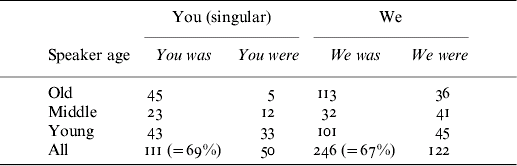
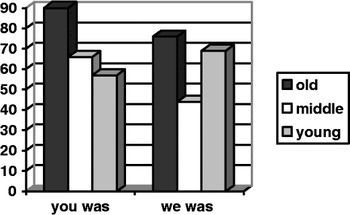
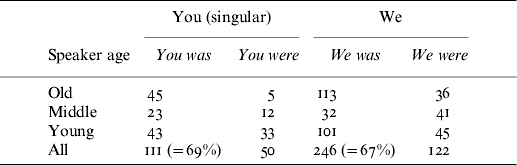
In fact, the generalisation is far from true. The raw data for was/were with you and we are shown in table 1 (from Smith Reference Smith2000: 61). The average in the bottom line does indeed support Adger's generalisation that on average speakers use about two wass for every were; but for both subject types, the age differences are very highly significant (p <0.005 in both cases), and the effect of the subject type is significant (p <0.05) for both of the older age groups and almost significant (p=0.062) for the young speakers. The figures are presented more accessibly in figure 1, which shows for each pronoun the number of was tokens as a percentage of the total of was plus were.
Was or were after you and we for three age groups in Buckie
Was as a percentage of was/were after you and we for three age groups in Buckie

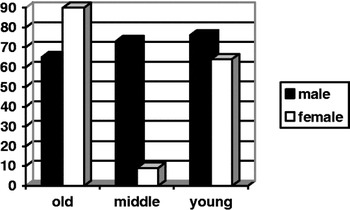
The most striking feature of figure 2 is the clear effect of age when the subject is you, with a general decline in the use of was. However, we produces a very different age effect, with a reverse of the decline between middle-aged and young speakers. As Adger notes, this is mainly due to the female middle-aged speakers shunning we was, in contrast with young males who increasingly revel in it (Smith Reference Smith2000: 64); this complex pattern is shown in figure 2. Without real-time data it is not possible to know what changes have actually taken place to produce this effect, but one possibility is that middle-aged women have changed (considerably) within their own lifetime while young men have changed (slightly) in comparison with older men; and equally speculatively, it is possible that these changes were motivated by a desire on the part of these groups to distance themselves from one another – the more often young men said we was, the more often middle-aged women, who disapproved of this usage, said we were.
We was as a percentage of we was/were for three age groups and two sexes in Buckie

These figures clearly contradict Adger's claim that age and sex have so little influence on the was/were variable that they can be ignored, and more generally that the was/were variable has no ‘social meaning’ (p. 526, fn. 9) – i.e. that it carries no information about the speaker. But even if there are age and sex differences, it does not follow immediately that these differences must in some way be part of the grammar. Maybe it is possible to explain them in some other way. Let us consider the two most plausible alternative candidates: distinct grammars, and prescriptive knowledge (both suggested to me by David Adger, p.c.).
If middle-aged women had different grammars from the other speakers, this might indeed explain why their output frequencies are different. But what kind of grammatical difference could explain an output ratio of about 1:9 in favour of were? If the 2:1 ratio of other speakers reflects the number of distinct lexical items pronounced was, are we to believe that middle-aged women have nine different lexical items pronounced were? Even less plausibly, if they still have the same two wass as other speakers, we would need no fewer than 18 distinct weres to explain the 1:9 ratio. This avenue looks unpromising, though it cannot be ruled out altogether.
Prescriptive knowledge is a more attractive explanation as there is some evidence that speakers are sufficiently aware of the difference between we was and you was to comment on it. One middle-aged woman who never used we was but used you was a great deal showed considerable self-awareness: ‘Well, maybe I would say you was but I would never say we was. I ken that's just wrong … ' (Jennifer Smith, p.c.). If this were true of all middle-aged women in Buckie, then it might well explain why they avoid we was even though it is allowed by their grammar on just the same basis as you was. Admittedly this answer would create another question: Why is it only middle-aged women who feel this way about we was? But this question could reasonably be left for sociologists and educationalists to worry about; the linguistic analysis, with its grammar insulated against social influences, would be saved.
The trouble with this argument is that it is no stronger than the arguments for excluding prescriptive knowledge from grammar. It is easy to exclude certain kinds of information from grammar by fiat, and one such exclusion could be applied to all ‘social knowledge’ (that tummy is for children, that attempt is formal, that we was is wrong, and so on). In this way it would be possible to rescue the boundary round grammar by distinguishing ‘the grammar proper’ from other kinds of knowledge such as the ‘user's manual’ (Culy Reference Culy1996, Zwicky Reference Zwicky1999); but it is easier to imagine such modules than to justify them either linguistically or psychologically.
One possible defence would be to argue that the objects in these two kinds of knowledge are in fact different (David Adger, p.c.): that grammar is about lexical entries such as ‘[uauthor:+] was’ (p. 521), whereas prescriptive knowledge is about word combinations such as we was, which are not part of the grammar as such even if they are generated by it. But this defence fails for two reasons. First, prescriptive knowledge is not reserved for multiword phrases, but can be about single words (e.g. ain't). And second, the two-word description of we was implies an analysis in which was has the features [uauthor:+, usingular:− ], which is sufficient to identify the subject as we, so the prescriptive knowledge may well apply to this single word; indeed, it is hard to see how ‘[uauthor:+] was' could be learned except by induction from a collection of more specific examples such as we was and you was. In short, prescriptive knowledge and grammatical knowledge may apply to the same objects.
Another kind of defence of a fundamental distinction between grammatical and prescriptive knowledge would be to demonstrate differences in how they are acquired or used; for example, if prescriptive knowledge was only learned at school and only used in school-like situations then the two might be assigned to different parts of our mind. But this defence faces two problems. One is that it leaves unanswered the question why the school-teachers of Buckie picked out we was (but not you was) for special condemnation; if this was because they were middle-aged women, then the school teaching would be the result of the general trend, and not its cause. The other problem is that the ban on we was does not just apply in special situations; indeed, the woman who condemned it as ‘just wrong’ never used it even in casual family situations (Jennifer Smith, p.c.). A piece of knowledge which applies regardless of situation is hard to distinguish from an ordinary part of competence.
In conclusion, then, the Buckie data show that the choice between was and were is much less uniform than Adger assumes. Performance is heavily influenced not only by the subject (you or we) but also by the speaker's age and sex in a complex interactive pattern – a classic example of the micro-links between fine-grained linguistic structure and social structure which make inherent variability so fascinating and challenging for theoretical linguistics. These performance differences do not appear to be due to external influences such as prescriptive attitudes, so they must in some sense be part of speakers' competence.
2.2 Statistics: few speaker groups show the predicted 2:1 ratio
The second statistical weakness of Adger's analysis follows directly from the first. His claim that was is twice as frequent as were after both you and we is based on a gross averaging of the data. This average conceals the much more complicated picture in figure 1 and figure 2, where very few speaker groups show the 2:1 ratio which his analysis predicts, and where the patterns for we and you are rather different. Of course, it is possible that even these group averages conceal significant differences among individuals but individual figures are not available, and in any case, such differences would merely deepen the problem.
If the speakers all have the same grammar, and the grammar predicts a 2:1 ratio, then all the cases where the observed ratio is significantly different from 2:1 must either refute the analysis, or receive some kind of special explanation in terms of ‘extra-linguistic’ influences (such as the possible effects of prescriptivism that we considered briefly above). We cannot rule out the possibility of an extra-linguistic explanation, but it seems most unlikely that such an explanation is possible for the purely linguistic difference between the two subjects, we and you.
But if, on the other hand, the speakers have different grammars, what kinds of difference are possible? One possibility is that they have structural differences which predict the observed ratios, but, as I pointed out earlier, these are much less simple than the 2:1 ratio of Adger's explanation; for example, the middle-aged women's 90% (figure 2) implies nine lexical entries for was compared with only one for were. While worth pursuing, this analysis seems implausible. The other possibility is that the grammars differ quantitatively – i.e. they contain the same elements, in the same structural relations, but with some kind of quantitative difference which affects their availability. Adger explicitly rejects this kind of analysis:
In my model, the input probabilities for the sets of lexical items that constitute variants are all equal, but I agree with Bender that certain social and psychological factors may very well alter these input probabilities. I disagree that there's any need to build these social factors into the linguistic information in lexical items, however. (p. 527)
Nevertheless, it is hard to see a viable alternative to an analysis such as Bender's. Section 3 develops this point further.
2.3 Structure: biased usage does not require inflection
Adger's explanation for the variation between was and were relies on the assumption that every lexical item has an equal chance of being used (subject to external disturbances which lie outside the grammar). The case of was/were looks like an exception because was is used more often than were, but is actually regular because there happen to be two distinct lexical items that happen to be both pronounced was and that are both compatible with the inflectional features required with you and we. In other words, the only reason why usage is biased in favour of was is because it is part of a rather special inflectional paradigm.
The explanation is ingenious, but no evidence is offered for the underlying assumption that every lexical item has an equal chance of being used, which predicts that whenever two items share the same meaning, they should each have about 50% of the total usage. Common experience suggests that this is not so; for example, pairs of synonyms like try and attempt (as in try/attempt to open the door) offer speakers a lexical choice, but stylistic differences strongly favour try in ordinary casual conversation. Research evidence supports this conclusion. Take, for example, the pairs of compound pronouns such as someone and somebody, no one and nobody, and so on, which appear to be exactly synonymous. This choice tends to be resolved in favour of -body in casual speech and -one in formal writing; so -body words account for between 65% and 82% of the total in spoken corpora, compared with only 9%–48% (depending on formality) in written corpora (Jane Edwards, message 5.1196 on the Linguist List, 1994; Carter & McCarthy Reference Carter and Michael2006: 14). In other words, where there is a free choice between two lexical items, the choice is likely to be biased in favour of one alternative, and to be strongly influenced by contextual factors such as formality and medium. In these cases there is no way to explain the bias in terms of inflectional features. (Nor, incidentally, can it be due to differences in the frequencies of the meanings concerned, contra to Newmeyer Reference Newmeyer2003, Reference Newmeyer2006; after all, the meaning of somebody is precisely the same as that of someone.)
This conclusion is typical of findings in quantitative sociolinguistics, where the data normally show context-sensitive bias in favour of one of two synonymous alternatives, and examples can be found in any introduction to variationist sociolinguistics (Hudson Reference Hudson1996, Coupland & Jaworski Reference Coupland and Adam1997, Trudgill Reference Trudgill2000, Chambers, Trudgill & Schilling-Estes Reference Chambers, Peter and Natalie2001, Wardhaugh Reference Wardhaugh2005). To take one further example at random, the pronunciation of the suffix -ing varies between velar (ing) and alveolar (in’) in Norwich (as in every other dialect of English), with apparently continuous variation depending on social class (from Lower, Middle and Upper Working Class to Lower and Middle Middle Class) and style (from Word List Style, through Reading Passage and Formal Style, to Casual Style). Figure 3 shows a typical statistical pattern for variation, with a continuous range of percentages for the in’ pronunciation from 0 to 100. Admittedly, each of these percentages aggregates the results for a number of speakers, but when individual performances are reported in other studies they tend to be broadly in line with the group scores; and in any case, the more individual variation there is, the more continuous the variation. This continuous variation, with contextual influences, is not at all what Adger's theory predicts.
Alveolars as percent of all (ing) in Norwich (Trudgill Reference Trudgill1974: 92)

Adger's theory therefore rests on the unsupported assertion that in general lexical choices are random: ‘I have assumed that there is a random choice of lexical items (that is, that there is an equal probability that any of the three lexical items is chosen)’ (p. 511). It is true that he accepts that usage itself can produce a bias, but for him this is an occasional perturbation of the basic pattern; thus the passage just quoted continues as follows:
However, this is almost certainly not true in all cases. Choice of a lexical item by a speaker in any particular utterance is potentially influenced by social and/or psychological factors, so that a particular lexical item may have a higher probability of being chosen in a particular utterance (for example, if that lexical item has been recently accessed, it may be easier to access again; or if a lexical item is simply more frequent overall, it may be easier to access). (ibid.)
Section 3 sketches a theory in which usage (recency and frequency) is the only source of influence on lexical choices. In this theory, the Buckie pattern for was/were alternation is a self-perpetuating pattern of behaviour which needs no explanation in the grammar's structure.
2.4 Structure: subject restrictions are lexical, not semantic
My final criticism is a rather technical point about Adger's use of features for subject selection, using features such as ‘usingular’, where u stands for ‘uninterpretable’. For example, when the subject is singular you, the verb's features include: [usingular:+, uparticipant:+, uauthor:–] which are paired with the corresponding interpretable features [singular:+, participant:+, author:−] on the subject pronoun. Crucially, ‘interpretable’ features are interpretable in terms of meaning (p. 510), and not in terms of phonology or mere lexical identity; so the features identify the subject in terms of its meaning (e.g. we is a word that refers to one person who is a participant and who is not the ‘author’, i.e. the speaker) rather than identifying it directly as the pronoun you or we. This may seem harmless, but in fact it is potentially problematic because you is ambiguous, and has a ‘generic’ interpretation as in (1) (which might be addressed to a man) or (2), where the addressee could not possibly be the referent of you.
(1) When you're having a baby you have to push hard.
(2) In the old days, if they caught you stealing you were put in the stocks.
No information seems to be available about how such examples are treated in Buckie, but Adger's analysis predicts a completely different pattern of alternation between was and were because the verb were in (1)–(2) must be a different lexical item from the one in (say) You were late last night.
The alternative to Adger's analysis is one which identifies the subject in terms of lexical items rather than in terms of semantic features. In this kind of analysis, the two kinds of you could be unified under a single polysemous lexical item, and the prediction for was/were would be that the two uses of you would show the same alternation pattern. Of course, ultimately this is a matter of fact, and Adger's analysis may turn out to be vindicated by the facts, but the general approach that he offers predicts that contextual influences on variation can never be defined in purely lexical terms. This seems unlikely to be true.
3. Modularity or usage?
Adger summarises his argument in this way:
If the approach I defend here is tenable, then we have a clear rapprochement between transformational generative grammar and variationist sociolinguistics. The grammar produces variants in a way that predicts particular probability distributions, but those probabilities can be perturbed at the point of use by factors such as ease of lexical access, recency effects, metalinguistic or social judgements on the form, etc. (p. 506)
I have argued that this approach is not in fact tenable, so it does not represent a ‘rapprochement between transformational generative grammar and variationist sociolinguistics’.
Indeed, I believe that such a rapprochement is inherently impossible in any theory which assumes that language is a ‘purely linguistic’ module free of all social and usage information. Adger rightly sees this as a major issue when he rejects Bender's analysis (Bender Reference Bender2000) in terms of ‘social meaning’ in the grammar:
This is an intriguing position, but one which I wholly reject, mainly for broader reasons of modularity, dissociation of linguistic and social skills, etc. (p. 525)
What is at stake is the fundamental claim that language is a distinct mental module which cannot include ‘non-linguistic’ information. The findings of variationist sociolinguistics offer a particularly strong prima facie challenge to this claim, so the debate about the was/were alternation in Buckie takes us right to the heart of linguistic theory.
The modularity claim is hard to evaluate in detail without a clear specification of what it entails. What, precisely, is it that is claimed to be modular in language: its structure, its storage, its acquisition or its processing? Each of these properties of language entails a different theory of modularity, and any one of them would explain some of the dissociations that Adger mentions, but they clearly have very different implications for sociolinguistics. For example, if the modularity only applied to storage or processing, the structure of language could be intimately connected with social (and other) knowledge, so that Bender's social meaning could be part of a lexical entry, and indeed the grammar might even include frequency and recency effects. But if modularity applies to language structure, as Adger seems to assume, this will not be possible. In that case, of course, there will be serious questions about how properties of general memory such as the effects of frequency can apply to elements of language structure such as individual lexical items. The debate is clearly important but progress is unlikely without more clarity.
What, then, do I recommend instead? The data from inherent variability converge with a great deal of other evidence in support of a ‘usage-based’ account of language learning (Barlow & Kemmer Reference Barlow and Suzanne2000, Hudson Reference Hudson2007b: 52–59) in which syntactic patterns (among others) are learned inductively on the basis of experience, with a great deal of very specific information stored in memory about patterns such as subject–verb pairs (Goldberg Reference Goldberg2006). This is exactly what the Buckie data show: that memorised items include we was, you was, we were and you were. Moreover, in this usage-based account, our memories of tokens may include their contextual specifics such as who uttered them and when (Bender's ‘social meaning’), and will certainly reflect their frequencies in usage – the two crucial elements in any account of inherent variability.
Fortunately, however, we do not face a choice between explaining dissociations and explaining socially determined variation. Even a usage-based theory allows different kinds of knowledge to be dissociated because the total network of knowledge is by no means undifferentiated; but these dissociations arise largely from the structure of experience rather than from imposed ‘modules’ of the mind. And most importantly for the project of integrating the data of sociolinguistics into linguistic theory, it allows the elements of I-language to relate freely to those of what we might call ‘I-society’.