Surgical site infections (SSIs) are among the most commonly reported healthcare-associated infection in adults and children,Reference Magill, Wilson and Thompson 1 and they are associated with substantial morbidity and cost. 2 , Reference Perencevich, Sands, Cosgrove, Guadagnoli, Meara and Platt 3 However, SSI epidemiology, outcomes, and prevention research has primarily examined inpatient surgery in adults. Although children undergo nearly 3 million ambulatory surgical procedures annually,Reference Hall, Schwartzman, Zhang and Liu 4 few large studies have examined the incidence of and risk factors for SSIs in this population.
The case mix of adult and pediatric surgeries markedly differs, suggesting that we cannot generalize all findings derived from adult studies to pediatric patients.Reference Somme, Bronsert, Morrato and Ziegler 5 , Reference Hyder, Hanson and Storlie 6 Furthermore, our understanding of the epidemiology of a pediatric SSI is limited because most studies have focused on a small group of surgical procedures that have been deemed “high risk,” such as repair of complex congenital cardiac lesions, placement of ventricular shunts, or spinal fusion procedures.Reference Schaffzin, Harte and Marquette 7 Thus, little is known about the incidence of and risk factors for SSI after the most commonly performed pediatric surgical procedures.
Broad changes in surgical practices have occurred over the past decade. The number of “same day” or ambulatory surgery procedures (those without an overnight hospital stay) has risen to nearly 3 million per year and is expected to continue to rise.Reference Hall, Schwartzman, Zhang and Liu 4 Many of these procedures are now performed in ambulatory surgical facilities (ASFs), freestanding facilities that are not located within an acute-care hospital. Because most ambulatory cases performed at either an ASF or a hospital-based facility are short in duration and are characterized as wound class 1 or 2, SSI rates have been presumed to be low. Data to support this assumption, however, are scarce. With the rising volume and complexity of ambulatory procedures, we must define the SSI risk to appropriately target surveillance and prevention efforts.Reference Edwards, Peterson and Mu 8 Therefore, we aimed to describe the epidemiology of SSI in children after ambulatory surgery.
Methods
Study design and setting
We conducted a prospective, observational study to describe the epidemiology of SSIs after pediatric ambulatory surgery across the Children’s Hospital of Philadelphia (CHOP) Care Network. At the time of the study, the network, located in southeastern Pennsylvania and southern New Jersey, included 3 freestanding ASFs, 1 hospital-based surgical facility, 29 primary care practices, 8 specialty care centers, a 521-bed acute-care hospital, and an emergency department. All sites used a common electronic health record (EHR, Epic Systems, Verona, WI) except for surgical procedure data prior to May 2013, which were collected and stored in OR Manager (Picis Clinical Solutions, Wakefield, MA). Decisions regarding the location of ambulatory surgical encounters are dictated largely by patient and clinician preferences, which include nonclinical factors such as parental preference and ease of scheduling. The CHOP Institutional Review Board reviewed and approved this study.
Study cohort
The EHR data were extracted biweekly for children <18 years of age who had an ambulatory surgical procedure (ie, with admission, procedure, and discharge on the same calendar day) performed at any of the 4 surgical centers (ie, 3 ASFs and 1 hospital-based facility). A surgical procedure was defined using 2010 National Healthcare Safety Network (NHSN) criteria, which required that the procedure was performed in an operating room and that incision and complete closure of the wound occurred during the same operating room visit. 9 Eligible wound class 1 and 2 procedures were identified from the procedure name (free-text field) recorded by the surgeon in the EHR after the procedure was performed. Multiple surgical procedures performed during a single operating room visit were included as long as all procedures met NHSN surgery definitions or the additional procedures that did not meet NHSN surgery definitions did not involve penetration of sterile tissue by an instrument or medical device (eg, ear tubes, cystoscopy, biopsy) or an open wound (eg, debridement, closure). Eligible surgical encounters were identified at the 3 ASFs between June 2012 and December 2015 and at the hospital-based facility between August 2012 and December 2015. Children could be enrolled more than once if they had multiple surgical encounters (ie, OR visits) that met eligibility criteria over the study period.
Data collection
Parents or guardians were contacted by phone between 30 and 45 days after their child’s surgical encounter. At the time of phone contact, non–English-speaking parents or guardians were excluded. The guardian provided verbal informed consent for both the telephone interview and the review of data from the EHR. If consent was obtained, a structured telephone interview was completed. The interview included questions about healing of the surgical site, including the occurrence and details of any healthcare encounters during the initial 30 days after the surgery. Additionally, occurrence and details of any healthcare encounters in the CHOP network were abstracted electronically from the EHR for up to 60 days after surgery for each child.
Manual case reviews of the EHR were conducted by 1 of 2 certified infection preventionists, each of whom had more than 20 years of experience working in infection prevention and control. A manual case review was completed if the interview indicated a potential postsurgical complication or if electronically abstracted EHR data indicated that an antibiotic was prescribed or that the child had an emergency department visit or hospitalization during the surveillance window. For manual case reviews of the EHR, the infection preventionist documented diagnoses (ICD-9 diagnosis codes as well as diagnoses from clinical notes), wound descriptions, culture orders, antibiotic treatment, recommendations for over-the-counter medications, and related follow-up procedures (eg, incision and drainage procedures). The manual case review covered the 60 days after the surgical encounter.
Procedure category
Eligible procedure names (free-text field) were grouped into 50 procedure categories by 2 pediatric infectious diseases specialists with experience in hospital epidemiology/infection prevention and control (S.E.C. and J.S.G). If multiple procedures in the same procedure category were performed in a single surgical encounter (ie, OR visit), the surgical encounter was counted only once for that category. However, if multiple procedures of different categories were performed in a single surgical encounter, the encounter was counted for each category. For example, a single surgical encounter with adjacent tissue transfer or arrangement, chordee correction with circumcision, and repair of concealed penis would be counted in 2 different procedure categories: skin and/or tissue graft (first procedure) and penile reconstruction (second and third procedures).
Outcomes
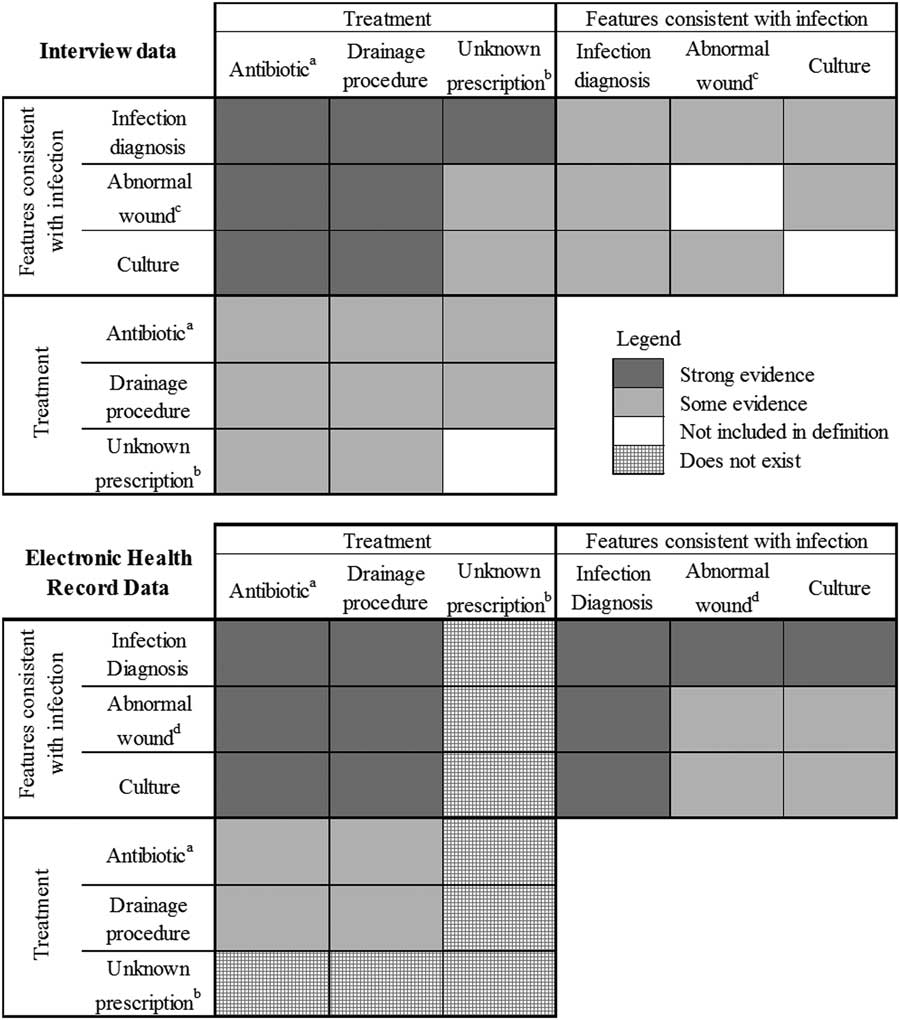
We used 2 different definitions to identify infectious events associated with surgery. First, we identified SSIs assessed in the 30 days after the surgical procedure by applying 2010 NHSN definitions including superficial, deep, and organ-space infections.Reference Horan, Andrus and Dudeck 10 Second, we developed and applied a broader definition to describe evidence of possible infection associated with surgery. We developed this “expanded” definition for 2 reasons: First, NHSN SSI criteria require clear documentation of each qualifying element in the EHR; thus, an infection reported by the parent but for which there was no documentation in the EHR (eg, if a patient had been evaluated in a nonnetwork emergency department) would not meet this NHSN definition. Second, NHSN SSI criteria exclude certain infectious events (eg, cellulitis) that may be related to surgery if it occurs at the wound site. Therefore, we aimed to develop an expanded definition that would capture all possible events with high sensitivity. The expanded definition included independent assessments of data obtained from the interview and the EHR review (Fig. 1) and categorized each surgical encounter by the strength of evidence (some or strong) for possible infection reported in the interview or documented in the EHR. The nature of the evidence required varied depending on the source (interview vs EHR). The expanded definition was applied to the interview data for the 30 days after surgery and the EHR data for the 60 days after surgery. The expanded definition was constructed to ensure that any SSI meeting NHSN criteria would also meet the expanded definition criteria for strong evidence of possible infection associated with surgery based on EHR documentation.
Components of the expanded definition for evidence of possible infection associated with surgery based on data from the telephone interview and data from the electronic health record (EHR). aPrescription or over-the-counter medication in the absence of another infection, excluding continuation therapy. bPrescription for which the parent could not recall the name or type, in the absence of another infection. cParental report of 2 of the following symptoms: fluid, dehiscence, erythema, warmth, tenderness, or edema. dEHR documentation of purulent fluid or 2 of the following symptoms: dehiscence, erythema, warmth, tenderness, edema, or nonpurulent fluid. Note: When a category intersects in the grid with itself, this indicates that this category alone was observed. For example, for parental interview, an infection diagnosis alone was considered some evidence; however, abnormal wound description alone was not included.

Comparison of hospital-based facility and ASFs
To compare rates of NHSN SSI between the 2 types of facilities, we restricted the cohort to procedure categories routinely performed at both types of facility. We defined routinely performed procedures as those procedure categories performed >10 times at both facility types in our cohort. Of the 50 procedure categories, 23 categories were routinely performed at both facility types. Because NHSN SSI after ambulatory surgery was rare, we implemented exact conditional logistic regression to compare rates between the 2 types of facilities, conditioning on procedure category. The analysis controlled for patient age (continuous) and the number of surgical procedures completed (ie, 1, 2, or ≥3) during the same surgical encounter.
Risk factors of infection related to surgery
To identify risk factors for infection after ambulatory surgery, we used the restricted cohort of 23 procedure categories routinely completed at both facility types and applied the expanded definition of infection related to surgery (either strong or some). We implemented conditional logistic regression conditioned on procedure category. First, we assessed the association of each potential risk factor with the outcome in univariate analysis. Factors with a P value <.20 in the univariate analysis were included in the final multivariable conditional logistic regression model. We reported odds ratios (OR) and 95% confidence intervals (CI).
Descriptive analyses were completed in SAS version 9.4 software (SAS Institute, Cary, NC), and conditional analyses (commands exlogistic and clogit) were performed using Stata version 15.0 software (StataCorp, College Station, TX). P values were 2-sided, and P values <.05 were considered statistically significant.
Results
Cohort
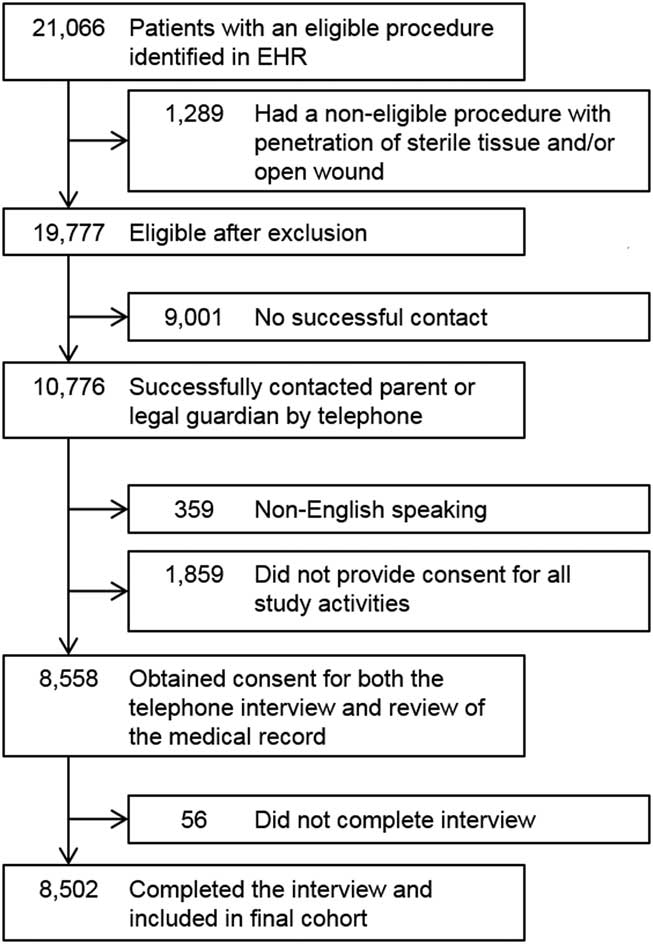
Of 19,777 eligible surgical encounters across the 4 surgical facilities during the study period, the parents or legal guardians of 8,502 subjects (surgical encounters) were successfully contacted, enrolled, and interviewed by telephone (Fig. 2). Of these 8,502 surgical encounters, manual EHR reviews were completed for 1,259 patients (15%), including 634 cases triggered by potential postsurgical complications reported in parental interviews and an additional 625 records triggered by antibiotic prescriptions and/or ED visits or hospitalizations documented in the EHR (data electronically extracted). The enrolled cohort and the cohort of eligible surgical encounters were demographically similar (Supplementary Table 1).
Assembly of study cohort. Note. EHR, electronic health record.

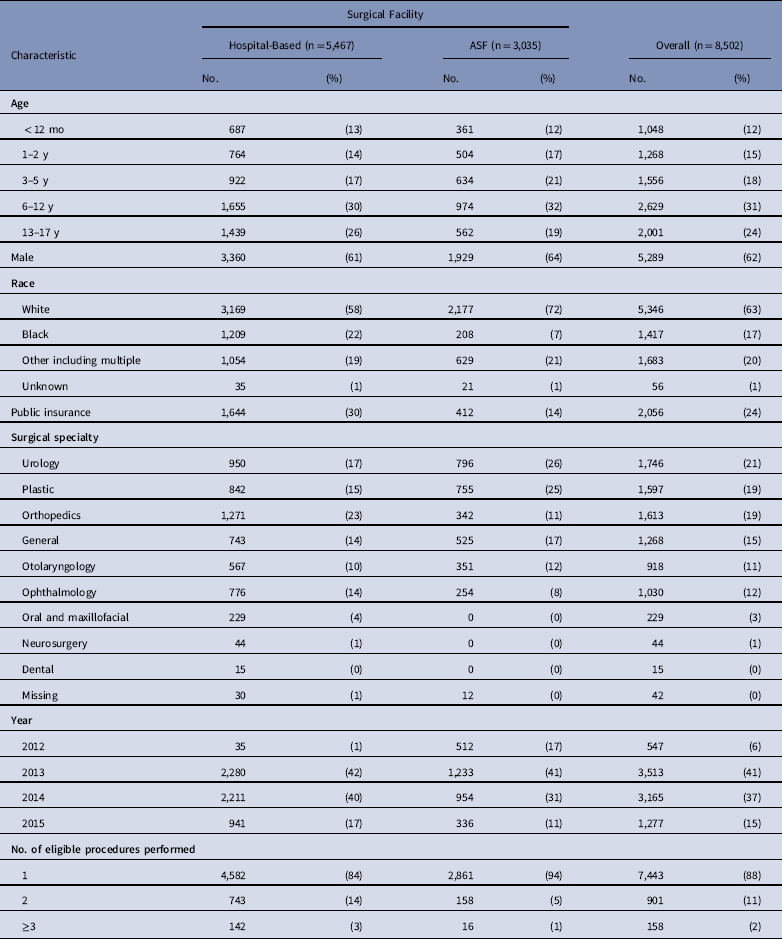
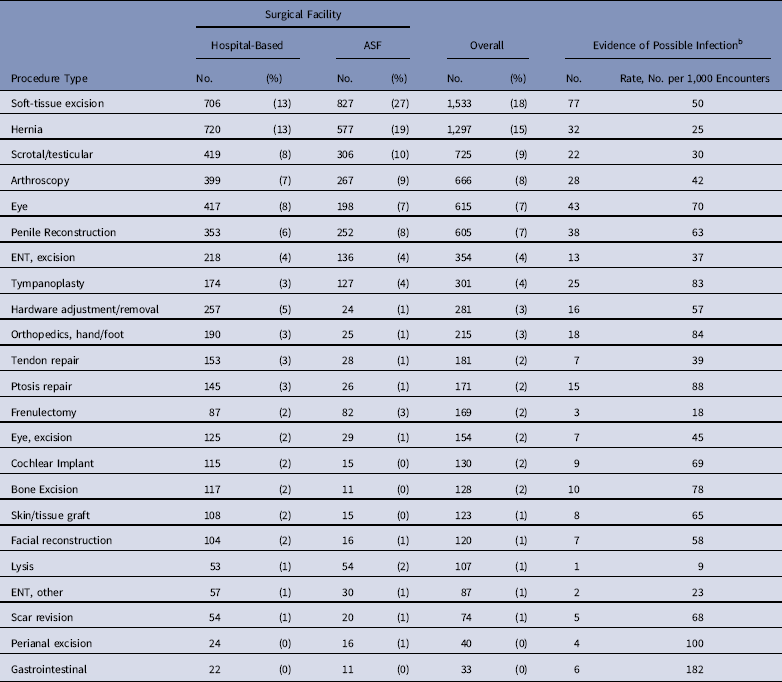
Overall, 5,467 (64%) of the surgical encounters in the enrolled cohort occurred at the hospital-based facility. Children who underwent surgery at the hospital-based facility were more likely to be of black race, to use public insurance, and to have >1 procedure performed during the surgical encounter (Table 1). Also, the distribution of surgical encounters by surgical specialty differed between the facility types. Only 23 procedure categories were performed >10 times at the ASFs and only 3 categories (soft tissue excision, hernia, scrotal/testicular) accounted for 56% of enrolled surgical encounters at the ASFs (Table 2). Overall, 16 procedure categories performed only at the hospital-based facility; the top 3 were surgery involving teeth (n=131), oral/maxillofacial surgery (n=75), and cataract extraction (n=57).
Demographic and Clinical Characteristics of Cohort by Surgical Facility Type

Note. ASF, ambulatory surgical facility.
Procedure Categories by Surgical Facility TypeFootnote a

Note. ASF, ambulatory surgical facility; ENT, ear, nose and throat.
a Percentages sum to >100% because multiple procedure categories could be performed in a single surgical encounter. Table is restricted to the 23 procedure categories (n=7,747) that occurred >10 times at both facility types in the cohort, sorted in descending order of overall number of procedures.
b Expanded definition, cases with strong or some evidence. Cases may have been counted twice if the surgical encounter included multiple procedure categories.
NHSN SSIs
We identified 21 SSIs that met NHSN criteria for an overall SSI rate of 2.5 SSIs per 1,000 surgical encounters: 2.9 SSIs per 1,000 surgical encounters at the hospital-based facility and 1.6 SSIs per 1,000 surgical encounters at the ASFs.
In the restricted cohort of procedures routinely performed at both facility types (n=7,747), unadjusted NHSN SSI rates were similar to the full cohort (overall rate, 2.5 SSIs per 1,000 surgical encounters; hospital-based facility rate, 3.0 SSIs per 1,000 surgical encounters; ASF rate, 1.7 SSIs per 1,000 surgical encounters). The adjusted conditional analysis of this restricted cohort (adjusted for age and number of procedures conditioned on procedure category) revealed no difference in the NHSN SSI rate between the hospital-based facility and the ASFs (OR, 0.7; 95% CI, 0.20–2.3).
Expanded definition of possible infection associated with surgery
Based on parental interviews, 306 cases were identified with evidence of possible infection, including 119 cases with strong evidence and 187 with some evidence. Based on data from the EHR manual case reviews, 228 cases had evidence of possible infection, including 154 cases with strong evidence and 74 with some evidence. Of 228 cases, 204 cases (89.5%) documented in the EHR occurred within 30 days of surgery. Combining both data sources, we identified 404 surgical encounters with strong or some evidence of possible infection that would warrant investigation from the infection prevention and control staff (rate, 48 SSIs per 1,000 surgical encounters). At the hospital-based facility, the unadjusted rate was 51 SSIs per 1,000 surgical encounters (279 cases), and at the ASF, the rate was 41 SSIs per 1,000 (125 cases). Table 2 lists the rate by procedure category.
When we compared case identification by data source (parental interview and EHR) within the 30 days after surgery, there was poor agreement: Of the 306 cases with evidence of possible infection associated with surgery reported in the parental interview, 176 (57%) did not meet the definition for some or strong evidence based on documentation in the EHR (Supplementary Table 2). Of 204 cases with evidence of possible infection associated with surgery documented in the EHR, 74 (36%) were not supported by evidence reported in the parental interview.
Risk factors for evidence of possible infection associated with surgery
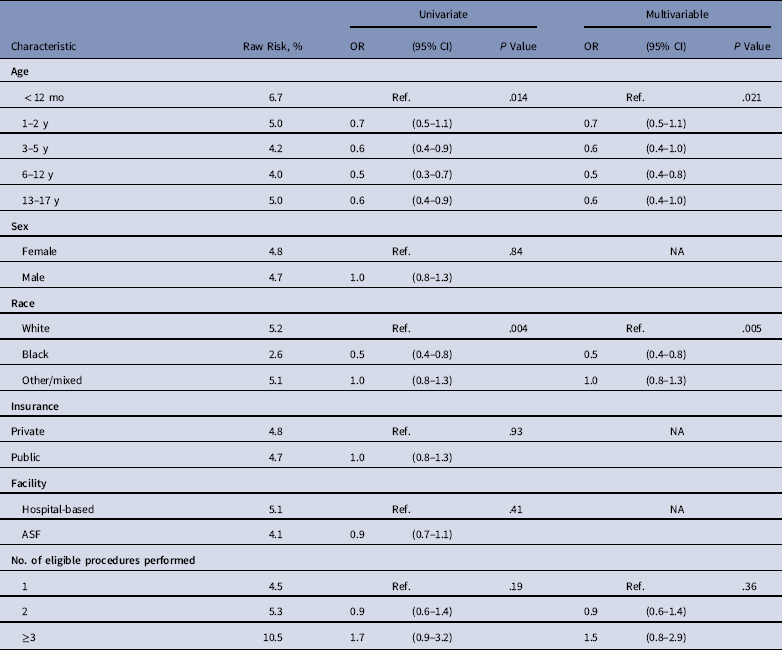
Using our expanded definition in the restricted cohort (n=7,747), there were 367 (4.7%) surgical encounters with evidence of possible infection. In univariate analysis conditioned on the procedure category, both older age and black race were associated with reduced risk of evidence of infection related to surgery (Table 3). In multivariable analysis, these associations remained statistically significant. Multivariable analysis was replicated only using cases identified from the interviews, and the results for race were consistent (black race: OR, 0.62; 95% CI, 0.42–0.93).
Risk Factors for Evidence of Possible Infection Associated With Surgery (N = 7,747)Footnote a

Note. OR, odds ratio; CI, confidence interval; ASF, ambulatory surgical facility; Ref., reference group; NA, not applicable.
a Using expanded definition, cases with strong or some evidence; 76 observations dropped in conditional analysis due to no outcomes in Strata; 53 children missing race were dropped from analyses including race.
Discussion
Utilizing a large, integrated, pediatric healthcare network in the United States, we prospectively defined the incidence of and risk factors for infections after ambulatory surgery in children. While the estimated incidence of SSI after pediatric ambulatory surgery was 2.5 SSIs per 1000 surgical encounters using NHSN definitions, an expanded definition using parental report and EHR review revealed a much higher rate of possible infections (48 SSIs per 1,000 surgical encounters). Older children and those of black race were less likely to experience postsurgical infections.
The rate of NHSN-defined SSI observed in our study was slightly less than previously reported. Using administrative billing codes, Rinke et alReference Rinke, Jan, Nassim, Choi and Choi 11 reported a rate of 2.9 SSIs per 1,000 pediatric ambulatory procedures. Using a more liberal SSI definition, Owens et alReference Owens, Barrett, Raetzman, Maggard-Gibbons and Steiner 12 found a 30-day rate of “clinically significant SSI” of 4.84 SSIs per 1,000 surgical encounters among adults undergoing ambulatory surgery. Our data suggest that rates of infection following pediatric surgery might be lower than that reported in adults, particularly when strict surveillance definitions are applied.
Recognizing that definitions used for surveillance can fail to capture all infections after a healthcare encounter, we also applied a more permissive definition of possible infections after surgery.Reference Kulaylat, Engbrecht and Rocourt 13 , Reference Dicks, Lewis and Durkin 14 This definition captured information from parental interviews as well as data readily available from the EHR suggestive of postoperative infection. This expanded definition revealed a substantially higher infection rate, which is not surprising given the limitations of strict application of NHSH criteria. For example, cellulitis at the surgical site does not meet NHSN criteria for SSI but was identified by this expanded definition. Efforts to prevent SSI might benefit from incorporation of such clinical presentations, particularly since they can lead to unscheduled patient encounters, procedures, and/or antibiotic prescriptions, all of which indicate resource utilization and potential patient harm. Determining the optimal definitions and surveillance strategies will require future work that considers the need for objective surveillance criteria with comprehensive capture of infectious events, which are not always well documented.
While the incidences of both NHSN-defined SSI and possible infection associated with surgery were low, the volume of ambulatory surgeries suggests that the cumulative burden experienced by patients, families, and clinicians is substantial. An estimated 2.9 million pediatric (<15 years old) ambulatory surgical procedures were performed in 2010,Reference Hall, Schwartzman, Zhang and Liu 4 and we estimate that the annual burden of pediatric SSI after ambulatory surgery may be >7,000 and that that the annual burden of possible infections after surgery may be >100,000. Thus, pediatric SSI represents a significant additional burden to the healthcare system as well as suffering and inconvenience to patients and their families. Because the volume of surgeries was high and the incidence of SSI was low, traditional surveillance methods cannot be efficiently deployed. Tools that can highlight patients, procedures, and facility characteristics at increased risk of infection would streamline the surveillance process. Alternatively, EHR functionality that flagged postoperative events (unscheduled encounters, antibiotic prescriptions, etc) could also help to focus surveillance resources. However, we observed poor agreement between parental report and EHR data indicating that surveillance relying on a single data source alone may not capture all possible infections.
In our risk factor analysis, younger age and nonblack race were associated with possible postoperative infection. While not previously reported for ambulatory pediatric surgery, young age has been reported as a risk factor for SSI after pediatric cardiac surgery.Reference Costello, Graham and Morrow 15 We hypothesize that higher risk may be due to behavioral and hygiene factors in this younger age group. For example, infants and toddlers may be apt to manipulate a wound and to also be diapered. Explanation of the association between patient race and infection is not clear, though it is unlikely to be biological. Race may be associated with factors (not captured in this study) that may affect tendency to seek or ability to access follow-up care or documentation and/or provision of information from the parental interview. We believe this association warrants further investigation.
Our study has several limitations. Our study was performed in a single healthcare network, so our findings may not be generalizable to all pediatric surgical settings. Ascertainment bias might have led to incomplete capture of all potential events. Similarly, our supplemental use of an expanded definition of postsurgical infection has not been validated. Children may seek follow-up care from a provider outside the CHOP network, such as an urgent care center, which would not be captured in the her; however, these events would hopefully be captured by the parental interview. The interview was conducted after the 30-day window and was subject to recall bias. Finally, our outcomes may be subject to misclassification.
In this study, we have identified that the rate of SSI after pediatric ambulatory surgery is low, although there may be a substantial additional burden of infectious morbidity related to surgery that is not captured by current surveillance strategies and definitions. Furthermore, given the volume of pediatric ambulatory surgery, even with a low risk, the overall burden on the population may be very high and should not be ignored.
Supplementary material
To view supplementary material for this article, please visit https://doi.org/10.1017/ice.2018.211
Acknowledgments
We thank the network of surgeons, surgical facility staff, and their patients and families for their contributions to this project and clinical research facilitated through the Pediatric Research Consortium (PeRC) at the Children’s Hospital of Philadelphia. We also thank the research staff who coordinated and conducted the thousands of interviews for this project including Folasade Odeniyi, MPH (CHOP), Christina Voigt, BS (CRF Health), Heather Brouwer, BS (Samsara, Inc.), Matthew Miller, MS (CHOP), Cory Matchulat, BA (no current affiliation) and Brandon Putz, BS (University of Chicago); and Mark Ramos, BS from the CHOP Department of Biomedical and Health Informatics for his assistance with extraction of electronic health record data. All of these individuals were compensated for their work on this project. We also thank and acknowledge Dr Katherine Deans, who was instrumental in helping us design this study.
Financial support
The research was supported by the Agency for Healthcare Research and Quality (AHRQ grant no. R01HS20921). The contents presented in this publication are solely the responsibility of the authors and do not necessarily represent the official views of AHRQ. The authors have no financial relationships relevant to this article to disclose.
Conflicts of interest
The authors have no potential conflicts of interest to disclose.