Introduction
Intense processes of welfare reform can be observed across Latin America in recent years. The intervention of the state in the social realm has been stepped up to unprecedented levels, although not through the traditional social insurance programmes but through new social assistance programmes. A number of studies have provided rich analyses of those changes (Barrientos, Reference Barrientos2009, Reference Barrientos and Cruz-Martínez2019; Dion, Reference Dion2010; López Calva and Lustig, Reference López Calva and Lustig2011; Huber and Stephens, Reference Huber and Stephens2012; Lavinas, Reference Lavinas2013; Fritz and Lavinas, Reference Fritz and Lavinas2015; Garay, Reference Garay2017; Cruz-Martínez, Reference Cruz-Martínez2019). This article aims to complement this literature by applying welfare regime theory to study the effects of social policy changes on levels of welfare (de)commodification and (de)familialisation.
The research follows a descriptive case study research strategy (Gerring, Reference Gerring2016). The expansion trend was pioneered and unfolded with strong intensity in Mexico (Barrientos, Reference Barrientos2009; Dion, Reference Dion2010; Borges Sugiyama, Reference Borges Sugiyama2011). In this sense, this country can serve as a typical case studyFootnote 1 to investigate (de)commodification and (de)familialisation effects in the region. The article’s main arguments are that, in spite of the significant expansion of social policy registered since the late 1990s, decommodification and defamilialisation effects are limited and that families continue to bear the heaviest responsibility of protecting and caring for individuals.
The rest of the article is organised as follows. The next two sections provide an overview of the application of welfare regime theory to Latin America and Mexico and describe recent developments of the Mexican welfare system. The following section analyses the reconfiguration of the country’s welfare regime after the reforms, and its welfare outcomes in terms of decommodification and defamilialisation effects. Lastly, some concluding remarks are offered.
Recent developments in welfare regime theory
The concepts of decommodification and defamilialisation have evolved from their first conceptualisations in the 1990s (Powell and Barrientos, Reference Powell and Barrientos2011; Gingrich, Reference Gingrich, Mahoney and Thelen2015). Esping-Andersen (Reference Esping-Andersen1990) defined decommodification as the degree to which individuals and families can maintain acceptable living standards independently of market participation, by the provision of a social service as a right. This definition, however, is problematic for three reasons. First, a service may be granted as a matter of right, but in practice, access, quality or generosity may be so poor, or even non-existent, that it does not free its beneficiaries from the need to purchase it in the market (Martínez Franzoni and Sánchez-Ancochea, Reference Martínez Franzoni and Sánchez-Ancochea2016). Secondly, decommodification should not only embrace the extent in which people are freed from depending on labour market participation to maintain living standards. That interpretation has led to confusion in its application. For example, some authors have suggested that because decommodification is only possible when a person forms part of the formal waged labour force, governments should aim to first commodify people and then decommodify them by offering protection through social policies (Rudra, Reference Rudra2007; Martínez Franzoni, Reference Martínez Franzoni2008). Without arguing that the promotion of a formal labour force should not be a government objective, social policy should go beyond that scope, especially in segmented labour markets like Latin American ones, where not only informal waged labour has been historically high, but also where many self-employed workers are formal, paying taxes and conducting their economic activities within the legal framework, but not entitled to social insurance exclusive for waged workers.Footnote 2 Thirdly, as Bambra (Reference Bambra2005) noted, the study of decommodification should include welfare services, like healthcare, not only cash benefits as originally devised by Esping-Andersen and others. Hence, if welfare outcomes want to be evaluated in a comprehensive manner, decommodification should be analysed for the entire population, regardless of labour market status, and should incorporate actual provision of transfers and services across welfare areas.
Feminist scholars criticised Esping-Andersen’s interpretation of decommodification for not considering women’s unpaid domestic work, a welfare source that falls out of market and government spheres. As a response, Esping-Andersen introduced the concept of defamilialisation, defined as the extent in which people can uphold acceptable living standards independently of the family (Esping-Andersen, Reference Esping-Andersen1999). Public policy should support families by enabling members to take care of each other, shouldering the obligations they freely choose to enter, without creating power imbalances or over-burdening of responsibilities (Saraceno, Reference Saraceno1996). The concept became strongly associated with the provision of social care and gender policies (Sainsbury, Reference Sainsbury1999). However, an alternative interpretation embraces the importance of the family in the provision of welfare beyond care. Families play a fundamental role for the sustainment of livelihoods of every individual throughout the life cycle. Families not only provide care, but also constantly mobilise material and emotional resources to offer support and protection to all its members, not only dependent ones (Papadopoulos and Roumpakis, Reference Papadopoulos and Roumpakis2013, Reference Papadopoulos and Roumpakis2019). Hence, if the aim is to capture the defamilialising effects of public policies in a comprehensive manner, the analysis should incorporate the role of the family in all welfare areas, not only social care.
Welfare regime theory in Latin America and Mexico
Gough and Wood (Reference Gough and Wood2004) organised more than a decade ago an initiative to extend the study of welfare regimes beyond the handful of Western European and North American countries included in Esping-Andersen’s original study. Their research was valuable to promote the application of welfare regime theory to other regions of the planet. Yet, in their attempt at covering the entire world, what was gained in breadth was lost in depth. They depicted the welfare regime of Latin AmericaFootnote 3 as an informal security regime, broadly defined as a set of conditions where people cannot expect to meet security needs through public policies or participation in labour markets, so they have to rely on familial relations. However, the authors based their empirical research on the analysis of just three indicators and came up with only general regime features, hindering a comprehensive or dynamic understanding of welfare provision in any specific region or countryFootnote 4.
Gough and Wood complemented their research with case studies of contributors to their edited volume. For Latin America, Barrientos (Reference Barrientos, Gough and Wood2004, Reference Barrientos2009) argued for a unique welfare regime, which, after policy reforms adopted in the 1990s and 2000s, passed from a conservative-informal to a liberal-informal regime, similar to the regimes found in countries with more ample welfare systems, but informal because of pervasive informal employment and high reliance on family support. Barrientos and other authors (Dion, Reference Dion2010; Garay, Reference Garay2017; Barrientos, Reference Barrientos and Cruz-Martínez2019) later noted the formation of dual welfare systems, as social policy was expanded to informal sector workers and their families, traditional labour market outsiders, albeit through social assistance programmes that do not offer the same protection levels as social insurance for labour market insiders.
Other authors that have applied welfare regime theory to Latin America have argued for the existence of several regimesFootnote 5. Filgueira (Reference Filgueira and Roberts1998, Reference Filgueira2005) classified Mexico, as well as Brazil, as dual welfare regimes until the 1980s, because half of the population enjoyed comprehensive levels of protection through social insurance and the other half, comprising informal sector workers and their families, was excluded. As mentioned above, this duality is in fact present in all of Latin America to a significant extent, and has not been broken but has rather been institutionalised by the expansion of social policy through social assistance. In a 2005 paper, Filgueira claimed that after the reform period, the Mexican model underscored efficiency, fiscal responsibility and limited coverage of targeted programmes, but he did not elaborate on those features (Filgueira, Reference Filgueira2005).
Martínez Franzoni (Reference Martínez Franzoni2008) incorporated the role of families and analysed defamilialisation effects for all Latin American countries in the early 2000s. She placed Mexico in the same cluster as other countries with highly developed welfare systems, but noted that it had lower levels of social spending and fiscal effort, although, as with Filgueira, she did not delve deeper in any case study. In single case studies of the Mexican regime, Barba and Valencia (Reference Barba and Valencia2013) stressed the duality, segmentation and stratification of social policy created by the particular type of expansion pursued by recent governments, without a specific analysis of decommodification or defamilialisation outcomes; Barba (Reference Barba, Valencia and Oróñez2016) studied those outcomes but on defamilialisation centred only on gender and social care areas, and Bayón (Reference Bayón2009) argued that there had been a transition towards a residual regime but missed the significant expansion of social policy to labour market outsiders.
This article aims to complement, update and expand existing welfare regime research on Latin America by analysing the effects of social policy changes in Mexico during the entire reform process that began in the late 1990s, adopting broad conceptualisations of (de)commodification and (de)familialisation, and covering several welfare areas. The research undertaken here may also serve to examine empirically with an updated case study, those broader conceptualisations found in recent developments of welfare regime theory.
Social policy reforms and welfare regime outcomes
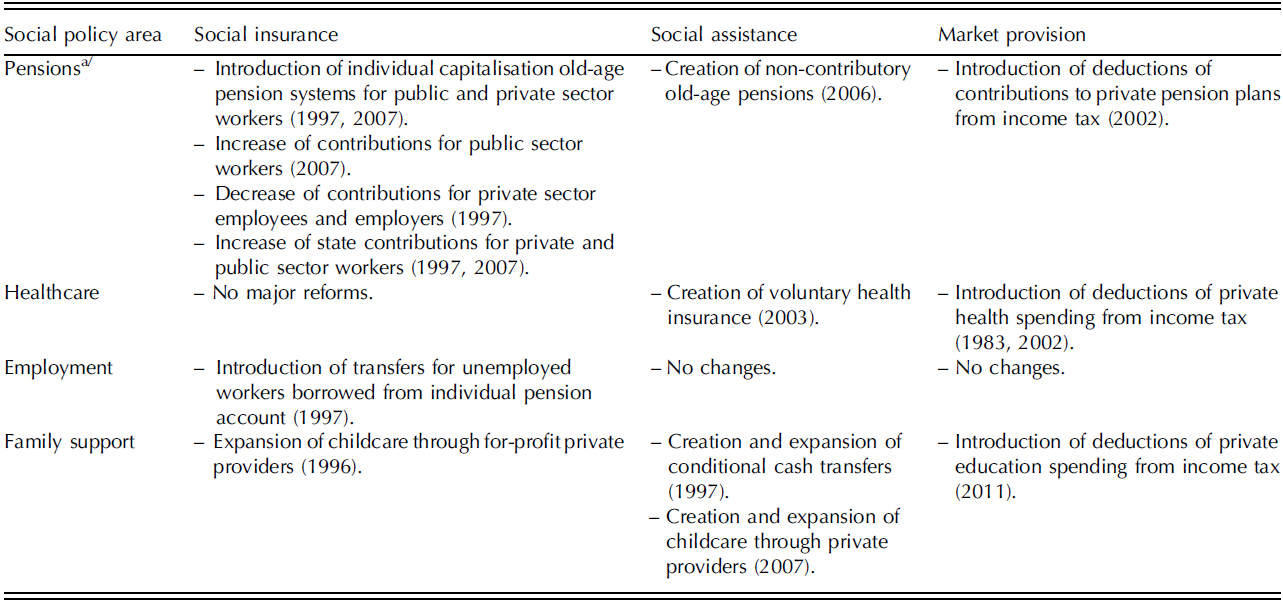
Two trends have been identified in the reforms introduced in Mexico since the mid-1990s (Barba, Reference Barba, Franco and Lanzaro2006, Reference Barba, Valencia and Oróñez2016; Levy, Reference Levy2008; Dion, Reference Dion2010; Velázquez Leyer, Reference Velázquez Leyer2019): social insurance retrenchment, mainly observed in the substitution of pay-as-you-go pension systems with systems of individual capitalisation, and the introduction and expansion of social assistance for people without social insurance. A third trend has consisted of the incorporation of market provision through income tax deductionsFootnote 6. Table 1 summarises the changes in each welfare areaFootnote 7. The sections below analyse (de)commodification and (de)familialisation in each area.
Social policy reforms in Mexico, 1990s-2010s (years of introduction in parenthesis)

Notes:
a/ Social insurance systems also provide work injuries, disability and survivor’s pensions, which are not discussed here because they were not reformed or were but only in a minimal way.
b/ Social insurance beneficiaries are also entitled to sick, work injuries and maternity leave payments, which were not altered by the reforms, and that have more generous conditions for public sector workers (IMSS, 1997).
Source: adapted from Velázquez Leyer (Reference Velázquez Leyer2015b)
Changes in (de)commodification levels
On protection for the elderly, the reforms of social insurance pension systems for private sector employees and civil servants replaced pay-as-you-go systems with systems of individual capitalisation and gave away the administration of pension funds to private financial firmsFootnote 8 (IMSS, 1973, 1997; ISSSTE, 1982, 2007). An OECD report concludes that outcomes are not optimal, as replacement rates are expected to drop because of the low rates of return paid by pension fund administrators, caused by fluctuations in financial markets and the high commissions they charge. Additionally, the already quite low, by international standards, pension coverage is expected to be reduced even more as the number of contribution years required to receive a pension increased from ten to twenty-five years and the calculation of the pension benefit is no longer preferential towards the years with the highest salary (OECD, 2015).
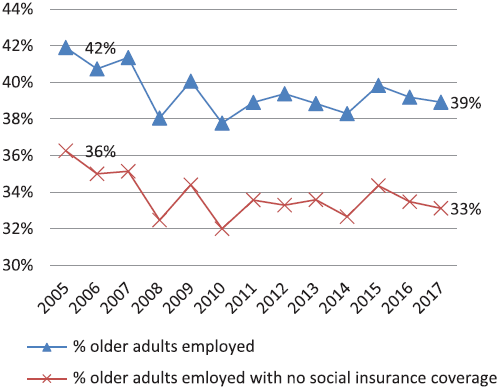
To expand protection, non-contributory pensions were introduced in 2005 (Ramírez López, Reference Ramírez López, Valencia and Oróñez2016). The proportion of older adults with a public pension passed from 20 per cent in 2000 to 80 per cent in 2017 (Presidency, 2017; CONAPO, 2019; INEGI, 2019a, 2019d). Nonetheless, the decommodifying effect of non-contributory pensions has been low. A non-contributory pension only amounts to one fifth of one minimum wage and of the minimum guaranteed social insurance pension (Presidency, 2018). As shown in Figure 1, the percentage of older adults who were employed only decreased from 42 per cent in 2005 to 39 per cent in 2017. Older adults keep on working because they lack the necessary income welfare provisions that would allow them to retire. Moreover, the large majority are not formally employed, which means they are unprotected against illnesses or work injuries and do not accumulate social insurance pension rights; in fact, this age group registers the highest informality rates.
Labour Market Participation of Older Adults, 2005-2017.

Public healthcare was extended beyond social insurance with the voluntary insurance programme Popular Health Insurance (PHI) introduced in 2004Footnote 9. Families with no formally employed breadwinners not covered by social insurance became eligible to join that programme. Poor families were targeted by exempting them from the payment contributions. Like social insurance schemes PHI provides healthcare with its own infrastructure, with no additional cost for the patient, but, unlike social insurance, covers only a limited package of interventionsFootnote 10 (Frenk et al., Reference Frenk, González Pier, Lezana and Knaul2006).
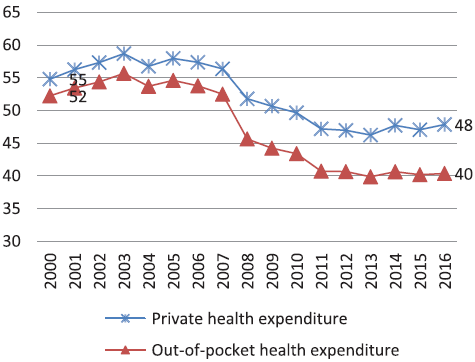
Public health insurance registered an important growth with PHI (Ordóñez Barba and Ramírez Sánchez, Reference Ordóñez Barba, Ramírez Sánchez, Campillo, Rangel and Servín2018). The proportion of people insured by a public scheme doubled from 40 per cent of the total population in 2000 to 82 per cent in 2017 (INEGI, 2019a). However, in spite of this expansion, private healthcare services still continue to perform a central role. As can be observed in Figure 2, in 2016 private spending still represented almost half of the country’s total health spending, and out-of-pocket spending amounted to 40 percent, the highest percentages among comparable Latin American countries like Argentina, Brazil or Chile (WHO, 2019).
Private and Out-of-pocket Health Spending, 2000-2016.

Even if insured by a public scheme, many people seek attention in the private sector. In 2017, 20 per cent of persons covered by public insurance reported a more frequent use of private services, more than in 2013 (INEGI, 2019a). In 2016, 55 per cent of all households registered health spending, only five percentage points less than in 2002, and, even worse, in the case of the poorest decile the proportion remained at 45 per cent (INEGI, 2019c). Limited access and low quality of public services are reasons given for preferring private services before and after the expansion of coverage through PHI (Zurita and Ramírez, Reference Zurita, Ramírez and Frenk2003; CESOP, 2017). Poor quality and access of public services that push people to private sector provision are consequences of the low levels of public spending, which grew after 2002 but have stalled after 2010. Per-capita public spending that in 2012 amounted to 500 US Dlls, by 2016 had only increased to 507 US Dlls, in contrast to other similar Latin American countries where it grew at a much higher rate (WHO, 2019).
Commodification is further enhanced with the deductibility of private healthcare spending from taxable income (SHCP, 2002). Through measures like this one, the public and private sector develop a symbiotic relation where public resources finance private services. The expansion of private services began in the 1970s (Zurita and Ramírez, Reference Zurita, Ramírez and Frenk2003), but today Mexico has the highest ratio of private to public sector facilities among OECD member countries, at the same time that private provision remains largely unregulated, practically lacking any integration with any of the public segments (OECD, 2016).
As in other Latin American countries, in Mexico unemployment has been the social risk less covered by the social policy system. Involuntary unemployment was not covered by social insurance until the 1997 reform for private sector employees, which introduced the possibility of withdrawing a percentage of the individual pension account managed by private administrators, that varied depending on the history of contributions. The amount was discounted from the balance along with the number of contribution weeks it would represent, affecting pension amounts and eligibility at the moment of retirement (IMSS, 1997). In practice more than an additional benefit, this transfer constitutes a loan that unemployed workers borrow from their own pension fund.
Notwithstanding the existence or not of unemployment benefits, the unemployment rate has been historically low in Mexico. The average of the 2000-2018 period was 3.7 per cent, much lower than other Latin American countries like Brazil, where it was 8.2 per cent, or Chile, with an average of 8.8 per cent (ILO, 2019). The explanation for such low rate lies in the size of the informal economy. Informal employment has remained at the same level throughout the present century; in 2005, workers in informal economic units represented 59.6 per cent of total employment, by 2018 that indicator had only decreased to 56.6 per cent (INEGI, 2019b). Low unemployment and high informality suggest a low decommodifying effect of the benefit introduced in 1997. When people find themselves unemployed, in the absence of government support, they rush to any type of employment in the informal economy.
Market mechanisms have also been used in the area of family support. Public education coverage is high, but the participation of the private sector has grown in recent years. Enrolment in private pre-school education passed from 8.7 per cent of total enrolment in 2002 to 16.4 per cent in 2017, and in basic education from 7.9 to 9.3 per cent (INEE, 2018). To offer government support to families that enrol their children in private education, the deductibility of tuition fees from income tax was introduced in 2011 (Presidency, 2011).
Childcare provision also incorporated the participation of the private sector. Childcare for children of working mothers has been part of social insurance for several decades, although in practice coverage has remained minimal. In 2000, only 1.3 per cent of children below four years old attended a public nursery. To expand coverage, the government used schemes of private provision in both social insurance and in a new targeted programme created in 2007 for children of poor women with no social insurance (Levy, Reference Levy2008; Gerhard, Reference Gerhard2013; Barba, Reference Barba, Valencia and Oróñez2016). Under the schemes, the government subcontracts a private nursery and pays a fee for every registered child. By 2017, coverage of public services had grown to 3.9 per cent. At the same time, coverage of private providers not incorporated into a public scheme has remained low, at one per cent of the total number of children in the age group between 2000 and 2017 (INEGI, 2019a). Although coverage of public services is still quite low, it is considered that it has been the utilisation of the private sector which has enabled their growth in recent years (Gerhard, Reference Gerhard2013), whilst fully commodified provision, namely where the user pays directly to the private provider, has not grown.
Changes in levels of (de)familialisation
Protection for the elderly has remained strongly familialised. The great majority of older adults who require care, which increased from 12 to 15 per cent between 2013 and 2017 (INEGI, 2019a), are cared for by a family member who lives in the same home. Public and private sector facilities, including those administered by civil society organisations, do exist but supply and quality are extremely limited (CIDE, 2017).
Non-contributory pensions represent an attempt to defamilialise financial support for the elderly with no social insurance pension. As mentioned above, their potential to deliver adequate protection levels is limited and many recipients are forced to remain active in the labour market. However, because labour earnings of older adults tend to be low – almost 40 per cent of employed older adults earn just one or less than one minimum wage (INEGI, 2019b) – even the sum of pension and labour earnings is insufficient to raise many people above poverty lines (CONASAMI, 2019; CONEVAL, 2019). Thus, many older adults require additional financial support from other sources, most likely from their families. If an older adult is not active in the labour market, reliance on family support could be higher. Interestingly, at the same time, as explained below, familial ties mean that older adults might also share their income with other family members.
In the case of healthcare, besides providing care for sick members, families intervene in two other ways: they provide the financial resources necessary to purchase private services, and kinship provides access to social insurance coverage, which is extended to spouses, siblings until they are twenty-five years old if still in education, and parents who are economic dependents (IMSS, 1997). Hence, 37 per cent of workers incorporated into a social insurance scheme extend coverage through kinship to 44 per cent of the population (INEGI, 2019a). Although PHI erases the need to have social insurance to access healthcare, its lower quality and limited supply of services, especially those related to several chronic degenerative diseases which require more intensive care and cause catastrophic health expenditures (Ordóñez Barba and Ramírez Sánchez, Reference Ordóñez Barba, Ramírez Sánchez, Campillo, Rangel and Servín2018), keeps it important to have family members employed in the formal sector.
On unemployment protection, the limited scope of government support forces people to rely on family relations to maintain their livelihoods during unemployment spells. The low unemployment rate does not reflect stable labour market conditions; in 2014, 44 per cent of people knew of family members who had lost their job (CESOP, 2014). The unemployed rush to join any type of employment, many times in the informal sector, but even if for short periods, their family’s financial support would be crucial to sustain their livelihoods. Additionally, just as important, the family provides the networks that facilitate finding employment. As an indicator of the role of the family as an employment service, a recent survey of university graduates showed that 28 per cent of them obtained their first job through a family member or a friend, the largest proportion among all the registered answers (UVM, 2019).
On welfare provision for families and children, conditional cash transfers (CCTs) represented a first and important effort to offer income support for raising children. Nonetheless, their design relies on a familistic logic that has generated undesired gender effects, as the programme over-burdens women because of the responsibility placed on them for collecting the transfers and guaranteeing that all members meet conditionalities (Molyneux, Reference Molyneux2006). The centrality of familistic arrangements are then maintained, affecting the programme’s potential to improve living standards. Regarding childcare, in spite of the expansion of public services, their coverage is still minimal and family arrangements represent by far the most frequent option. In 2017, 88 per cent of all children up to six years old were cared for by their mother or grandmother, and 76 per cent of working mother’s children by their grandmother or another unpaid person (INEGI, 2019a).
Discussion
The overview of the Mexican welfare regime presented here suggests that the expansion of social policy has not produced significant reductions in levels of welfare decommodification or defamilialisation. Two causes of such limited effects can be highlighted: the explicit and implicit role assigned to markets by the reforms, with uneven effects across population groups, and the persistent centrality of families promoted by economic liberalisation processes.
Governments can privatise welfare either implicitly or explicitly (Vargas Bustamante and Méndez, Reference Vargas Bustamante and Méndez2014). When it is explicit, public policy rules directly incorporate market mechanisms into processes of welfare provision or draw an opt-out option which people may choose or have to take (Martínez Franzoni and Sánchez Ancochea, Reference Martínez Franzoni and Sánchez-Ancochea2016). These are the cases of the administration of pension funds by private financial firms, childcare provision through private providers or tax deductions of private welfare spending. However, there are cases where public policy does not explicitly incorporate market mechanisms into formal design, but may implicitly incentivise their use through the setting of benefits and their implementation. Such can be the case of low pension amounts or poor healthcare quality and access. Evidence from Mexico suggests that in certain cases explicit measures – like the incorporation of private providers in childcare, which has allowed the expansion of public services, modest but hardly possible without them – may be preferable to implicit incentives, which leave people largely unprotected from market forces. Explicit commodification may enable a stronger regulation of the private sector, whilst implicit commodification could be interpreted as the resignation of the state to take steps towards the construction of a welfare system that delivers adequate levels of social protection.
The differentiated effects of the reforms across population groups must be noted. The institutionalisation of dual welfare systems represents one of the salient arguments made about Latin America and specifically Mexico (Barba, Reference Barba, Valencia and Oróñez2016; Garay, Reference Garay2017; Barrientos, Reference Barrientos and Cruz-Martínez2019): hence, it is important to analyse (de)commodification and (de)familialisation outcomes across segments of the population. For formal sector workers and their families, reforms have strongly relied on market mechanisms, explicitly institutionalising welfare commodification, as in the case of the privatisation of social insurance pension funds. On the other hand, families without social insurance coverage may now receive social assistance, which effectively represents a progress towards less dependence on markets, but low quality and generosity limit their decommodifying capacity. These limitations can be observed in all of the new programmes that have been created to expand welfare.
Secondly, the family continues to play a central role in welfare provision. Even if the design of conditional cash transfers applied a familistic logic, social policy expansion would be expected to reduce the centrality of familial arrangements in some degree, but this has not necessarily been the case. There is, however, an important caveat. The voluntary nature of familial welfare arrangements should not be minimised (Saraceno, Reference Saraceno1996). Perceptions of reciprocity play a fundamental role in the reproduction of familial arrangements (Arriagada, Reference Arriagada2007; Papadopoulos and Roumpakis, Reference Papadopoulos and Roumpakis2019). Yet, what is interesting about the Mexican case is that the role of families not only has not declined or remained stable, but it rather appears to have gained importance.
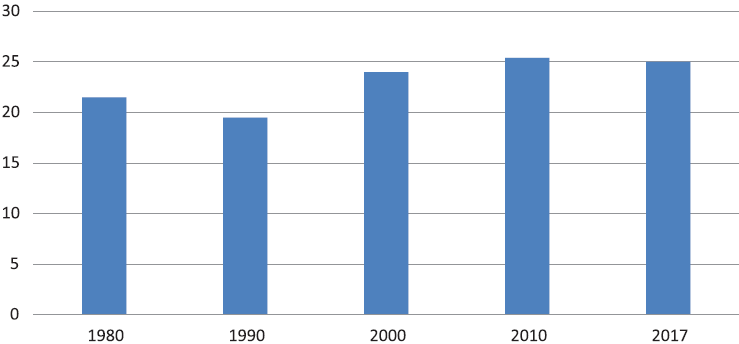
The number of households inhabited by extended families illustrates that trend. As shown in Figure 3, the proportion of households inhabited by more than two family generations has increased since 1990, from 20 per cent in that year to 25 per cent in 2017 (INEGI, 2019d).
Percentage of households inhabited by extended families, 1980-2017.

The effects of the liberalisation of the economy can be pointed out as one of the reasons for higher degrees of familialisation. Economic liberalisation has been accompanied by a steep drop in real wages, due to the export-oriented growth model that requires low labour costs to promote competitiveness (Krozer et al., Reference Krozer, Moreno Brid and Rubio Badan2015). In this context, families come together to face economic and social uncertainties, as suggested by the average number of earners per household, which increased from 2.03 in 2004 to 2.4 in 2014 (INEGI, 2019c). Both labour market insiders and outsiders are affected by economic liberalisation and by implicit or explicit welfare commodification. In both cases, the family acts as a decommodifying agent, without whom living standards could not be maintained (Papadopoulos and Roumpakis, Reference Papadopoulos and Roumpakis2019). As Polanyi (cited in Papadopoulos and Roumpakis, Reference Papadopoulos and Roumpakis2019) noted, the family cannot be viewed as a primitive form of economic organisation; on the contrary, as the Mexican case shows, the radical version of capitalism that neoliberalism is can underscore the fundamental role of the family as welfare provider.
Concluding remarks
Welfare provision is in constant transformation in response to political, economic and social changes, even more in these times of recurrent crises. The observations made here about the Mexican welfare regime could well be valid for other countries, not only in Latin America, but also in other regions.
The study of the role of the family is especially relevant. Families represent the basis of welfare provision in any society; welfare systems can only cover some forms of dependency (Titmuss cited in Sinclair, Reference Sinclair2016: 8). The difference between countries lies in how far can state action help families protect their members. If states do not act, families end up assuming the largest share of welfare responsibilities, which can obstruct the enhancement of social cohesion and solidarity, with negative consequences in all aspects of social life. In the context of current global crises, the understanding of how families are interacting with state and market spheres is crucial.
In the specific case of Mexico, a new left-wing government took office in December 2018, but in an unexpected path, rather than advancing towards the construction of an authentic universal welfare system that could promote equality and social solidarity, the government seems to have chosen a residual path that reinforces duality, draconian spending cuts in all areas – allegedly as a measure to combat corruption – and improvised formulation and implementation processes that open the door to clientelistic practices. These initiatives do not mirror a progressive model, which should emphasise the construction of solid institutions for a more just and equal (re)distribution of public goods and services (Huesca Reynoso and Velázquez Leyer, Reference Huesca Reynoso and Velázquez Leyer2019).
One final reflection points to the options available to protect people against market forces in an increasingly globalised economy. A temptation of the left is to try to withdraw to protected economies, closed societies and overly strong central governments. Yet, across the world, that path seems to have given rise to populist governments, from allegedly leftist or openly rightist orientations, that not only do not undo the evils of neoliberalism, but actually increase them. What may be needed today is not less globalisation, but better globalisation, with a stronger civil society capable of triggering the institutional changes necessary to protect families in these uncertain times.
Acknowledgments
Part of the research presented here was developed in the time spent at the University of Bath studying for a PhD in Social Policy, under the supervision of Dr. Theodoros Papadopoulos. I would like to thank him for his valuable insights during those years, as well as the two anonymous reviewers of this article.