Background
Child protection is a highly complex and ambiguous area of practice, and while protecting children from harm is a national priority, increasing numbers of children and families are subject to child protection interventions (Australian Institute of Health and Welfare [AIHW], 2018; Harrison, Harries, & Liddiard, Reference Harrison, Harries and Liddiard2018). In 2016–17, 168,352 Australian children (3.1% of the total Australian children) received child protection services (AIHW, 2018). Aboriginal and Torres Strait Islander children are overrepresented in child protection systems; they are seven times more likely than non-Indigenous children to be under investigation, care and protection orders and/or in out-of-home care (AIHW, 2018).
Overall, child protection systems are under strain and are widely criticised (Smith et al., Reference Smith, Cree, MacRae, Sharp, Wallace and O’Halloran2016). Criticisms include lack of evidence-based interventions, poor quality and ineffective services, culturally biased systems, inadequate prevention programs and interventions that do not necessarily ensure the safety of children (Child Protection Systems Royal Commission, 2016; Hart et al., Reference Hart, Lee and Wernham2011). Other concerns include risk-adverse cultures, overburdened staff and the burgeoning costs of the system (Carmody, Reference Carmody2013; Collins-Camargo, Ellett, & Lester, Reference Collins-Camargo, Ellett and Lester2011; Glisson, Dukes, & Green, Reference Glisson, Dukes and Green2006). Added challenges are the intersection of child protection issues with other concerns such as domestic violence, drug and alcohol misuse and mental health issues, and a lack of effective service collaboration due to often fragmented, siloed and competitive health and human services systems (Lonne, Harries, Featherstone, & Gray, Reference Lonne, Harries, Featherstone and Gray2016). Working in an overloaded and scrutinised system, child protection practitioners can feel ‘compromised in fulfilling the moral and emotional dimension of the job as a result of the demands of a neo-liberal state’ (Smith et al., Reference Smith, Cree, MacRae, Sharp, Wallace and O’Halloran2016, p. 973).
In Australia, each state and territory has responsibility for child protection legislation and intervention. Over the years, states and territories have run inquiries into child protection service delivery and injected increasing amounts of funding into the systems, often in response to adverse media coverage or the death of children in care (AIHW, 2017; Ainthworth & Hansen, 2016; Harrison et al., Reference Harrison, Harries and Liddiard2018). In Queensland, the Carmody Inquiry into the child protection system diagnosed systemic failure, which meant that it ‘is not ensuring the safety, wellbeing and best interests of children as well as it should’ (Carmody, Reference Carmody2013, p. 13). The Carmody report identified a lack of early intervention, a risk-averse culture and an overburdened Child Safety department as the main causes of the systems failure. Key recommendations focused on early intervention and family support, aiming to keep children outside the system, and providing better rehabilitative and therapeutic family support to build stronger families and ensure greater safety for children (Carmody, Reference Carmody2013). Thus, the emphasis was on providing more services by practitioners in non-government services.
In response to the Carmody report, the Queensland Government released A Roadmap to Queensland Child Protection. Its aim was to deliver a reformed child protection system that incorporated all recommendations from the Carmody report to ultimately move toward the adoption of a new framework for practice (Queensland Government, 2013). Recommendations accepted included a stocktake of current non-government services and working ‘with other levels of government, across agencies and with community organisations to build an integrated suite of services that provide families with support that is responsive, accessible and effective’ (Queensland Government, 2013, p. 6). Legislative changes, for example, included amendments to the Child Protection Act to progress permanency for children and additional provisions for placing Aboriginal and Torres Strait Islander children in care (Queensland Government, 2017). Five years after the Carmody report was accepted, the question arises: What changes and challenges are being observed by the child protection practitioners who are providing services to families?
One of the report recommendations was to adopt a safety-oriented approach to child protection through a program called ‘signs of safety’ (Carmody, Reference Carmody2013). The ‘signs of safety’ approach is grounded in Appreciative Inquiry and action research practice, which requires practitioners to develop a comprehensive risk assessment framework to explore concerns, strengths and next steps (Lonne et al., Reference Lonne, Harries, Featherstone and Gray2016). However, for this approach to be effective, it would be useful for practitioners to be able to use, access and engage in research to facilitate their adoption of a stance conducive to Appreciative Inquiry and to the development of skills that are essential for risk assessments within an action research practice framework. Research-informed practice improves the professionalism and reflexivity of practitioners, which is important for evaluation and for the improvement of service user outcomes and service quality (Lonne et al., Reference Lonne, Harries, Featherstone and Gray2016; McBeath & Austin, Reference McBeath and Austin2015).
While it is important that research informs practice, practitioners can often be research-reluctant, both in terms of undertaking research and actively seeking to integrate research findings into their work. Currently, there is limited engagement by practitioners in research – for example, only about 5% of research publications listed in the Public Administration review were from practitioners (Vrentas et al., Reference Vrentas, Freiwirth, Benatti, Hill and Yurasek2018). Issues such as lack of time, limited management support and organisational resources make practitioner research engagement difficult (Beddoe, Reference Beddoe2011; McBeath & Austin, Reference McBeath and Austin2015). Practitioners can also be research-anxious, have insufficient time, training and/or interest in research and lack access to engaging and relevant research training (Harvey, Plummer, Pighills & Pain, Reference Harvey, Plummer, Pighills and Pain2013; McBeath & Austin, Reference McBeath and Austin2015).
In addition, it can be difficult for practitioners to access research directly to inform their practice. For example, less than half of the social work research respondents in Harvey et al.’s (Reference Harvey, Plummer, Pighills and Pain2013) research had moderate or high experience of finding relevant literature, and only a third had moderate/high experience of critically reviewing the literature. Institutional and organisational barriers, such as research resistant and/or risk-averse organisational cultures, limited funding/accountability requirements, lack of incentive or professional requirement and lack of organisational funding discretion, can diminish the research engagement of practitioners (McBeath & Austin, Reference McBeath and Austin2015). Additionally, however, accessing research to inform practice can be challenged by limited access to journals due to a lack of library privileges and limited support from practitioners’ organisations, as well as by researchers not outlining the practice implications of their research in their publications (McBeath & Austin, Reference McBeath and Austin2015; Vrentas et al. Reference Vrentas, Freiwirth, Benatti, Hill and Yurasek2018).
The complexity of child protection practice, the review of child protection in Queensland and the importance of practitioners’ involvement in research prompted this query about child protection practitioners’ views regarding changes and challenges in the field and their research ideas. Hameed (Reference Hameed2018) indicates that further research regarding child protection practice and intervention is required and points to opportunities for active collaboration between researchers and practitioners. Consequently, it is timely to explore what research is pertinent to practitioners in the child protection field in North Queensland in the current contexts, and what knowledge, practice and policies they think need to be explored further.
Methodology
This study explored the research ideas of practitioners in the child protection field in Townsville. The research question posed was as follows: What are the current changes and challenges that practitioners in the child protection field are observing, and what knowledge, practice and policy do they think need to be explored further through research? The aims were to document the changes and challenges that the practitioners have observed over the past 5 years, identify the strategies they were using to deal with those, identify their hopes for the child protection practice field and collect their ideas for areas of knowledge, practice and policy that they felt need to be explored further through research. The research questions were developed based on a literature review that highlighted the changes in child protection in Queensland, the complexity of child protection practice and the need for research-informed practice. Data were gathered through surveys and structured interviews. The survey was pilot tested by two academic researchers and a practitioner in the field. Feedback was used to fine-tune the survey tool. The research was approved by the James Cook University Human Ethics Committee.
Design and sample
A list of programs that were providing services in the child protection field in Townsville was compiled using publicly available information from the Townsville community information directory and through practice contacts. Email invitations for participation were sent to 36 key contacts in 20 non-government organisations. Seventeen of those organisations delivered child protection programs directly funded by the Queensland Government, one service does not receive any funding and two services were funded through other government sources, although their programs were also accessed by people involved with child protection.
Data collection
Data were collected via online surveys and interviews in the second-half of 2018. One email invitation and two reminders were sent out to the group of identified potential respondents. Respondents had the option of completing a survey anonymously via Survey Monkey or by contacting the researcher to arrange a time to participate in a face-to-face interview. Both the survey data collection tool and the interview guide were identical. Interviews were conducted strictly following the interview guide, and questions were not explored further by the interviewer. The interviewer took notes during the interview and then entered the data into the online survey.
The survey questions explored demographic information about the participants and the service they were working in, the changes and challenges respondents identified in the field of practice over that last 5 years, strategies they were using to respond to changes, hopes for developments and changes, areas for research that might be useful and the respondents’ capacity to participate in research. This article reports on the changes and challenges identified, the hopes and areas for research that practitioners felt needed researching. Respondents’ capacity to undertake research will be reported elsewhere in a future publication.
Data Analysis
The data collected included both quantitative and qualitative data. The quantitative data were collated and presented as tables and graphs. The qualitative data were analysed thematically. Prior to coding the data in Nvivo, the qualitative responses to each question were carefully read for familiarisation with the data and to identify potential coding nodes. Nvivo was used for manually extracting the data and then to thematically reflect on and identify the emerging themes (Creswell, Reference Creswell2009).
Results
Seventeen surveys were completed via the online data collection tool Survey Monkey, and five practitioners participated in face-to-face interviews. The survey data were complemented by interviews, with the five interviewees representing 23% of the total number of respondents. There was no significant difference between the characteristics of the survey respondents and interviewees. The total number of respondents (n = 22) is potentially equal to a 61% response rate, but since the email contained an anonymous link that may have been forwarded to other individuals and organisations, this response rate could be lower. Given the regional location of the surveyed child protection practitioners and the limited number of possible respondents, the total of 22 responses was considered acceptable.
Characteristics of respondents
Twenty-one women and one man participated. The high proportion of women is normal for the social work and human services workforce, considering that more than 80% of social work professionals across all fields of practice in Australia are female (Healy & Lonne, Reference Healy and Lonne2010). Seventy-one percent of the respondents (n = 15) were 40 years and older, and the overall age spread of the respondents is reflective of the workforce average in this sector. The workforce sector is an ageing sector, with a significant proportion of those aged 55–64 in the occupational group (Healy & Lonne, Reference Healy and Lonne2010).
However, the average academic qualifications of the respondents were higher than the typical human services workforce. The majority (90%, n = 20) of respondents had completed tertiary studies, and of those, 36% (n = 8) had attained a bachelor degree with honours or higher. The remaining two respondents had attained an undergraduate diploma. This level of qualification was somewhat different to the overall workforce, as there is a high proportion of workers who have not obtained post-school qualifications in the community sector in general, compared with the related sectors of health or education (Healey & Lonne, Reference Healy and Lonne2010). This variance could be due to people who have been involved in tertiary studies being more interested in research and thus more likely to respond to survey and interview invitations or the fact that many of the contacts who received the invitation to participate in this research were team leaders or managers.
Service characteristics
Figure 1 identifies the services that the respondents were providing. Sixty-three percent of respondents (n = 14) indicated that they were providing more than one type of service. The most common services provided were parent support/counselling (n = 12), family support services (n = 9) and child support/counselling (n = 8).
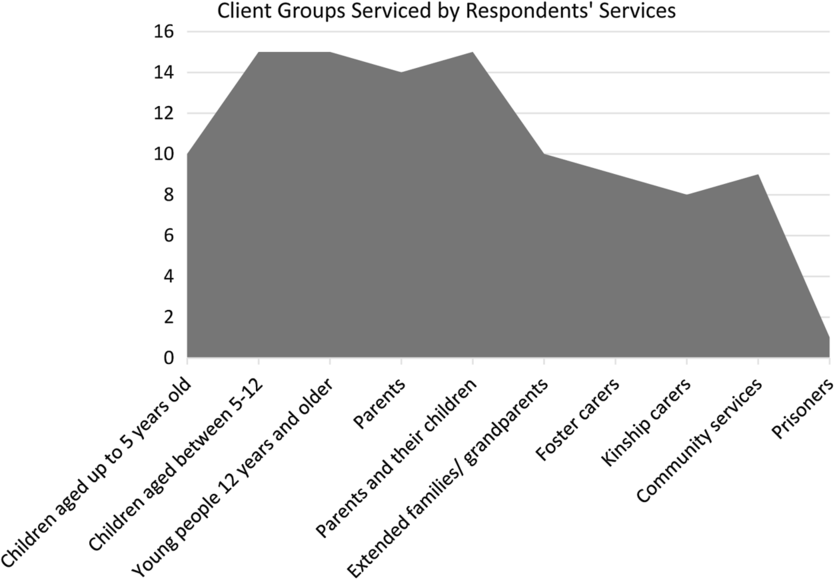
All but two respondents indicated that they were working with multiple clients groups. As Figure 1 shows, parents and their children were the main client groups serviced by the respondents. Figure 2 shows that children and young people were identified 38 times as a client group being serviced, and parents in combination with parents and their children were reported 28 times.
Type of service delivered by respondents’services.

Client groups serviced by respondents’services.

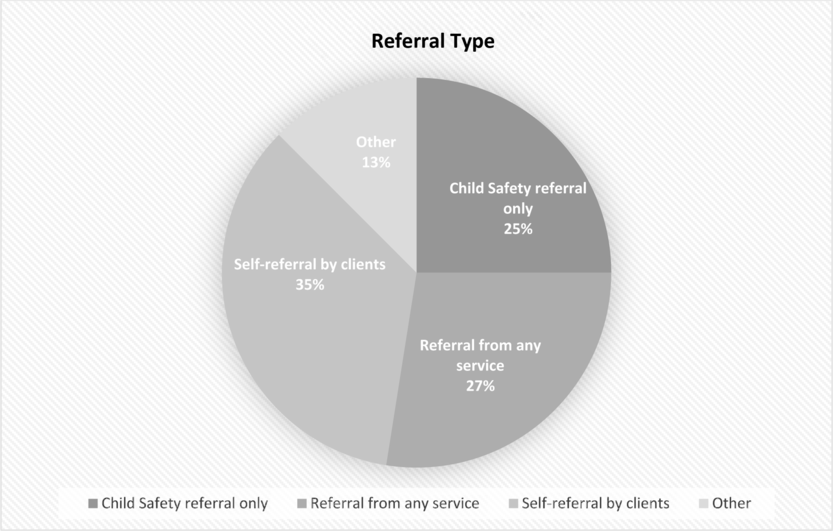
The services that respondents worked in accepted clients via several sources of referrals, as shown in Figure 3; 27% accepted referrals from any service, 35% accepted self-referral and 25% took on Child Safety referrals only. The referral sources identified as ‘other’ were ‘specific referral pathways (case management)’ (n = 1), ‘Child Safety referrals (as well as other referral paths)’ (n = 2), ‘organisational internal referral’ (n = 1) and ‘schools’ (n = 1).
Referrals accepted by the respondents’services.

Most respondents (n = 13) selected a number of referral categories. However, six respondents only accepted referrals from Child Safety, only one accepted self-referral and one received referrals only from ‘specific referral pathways (case management)’. A number of respondents selected ‘Child Safety referral only’ but then selected one or more other categories as well. This can be explained by respondents’ services offering a range of services in this field of practice.
The survey included 11 open-ended questions relating to participants’ practice in the child protection field in the previous 5 years. The themes developed from the analysis of the qualitative data were grouped under the headings: ‘Changes and challenges’, ‘Strategies and hope’ and ‘New knowledge and research’.
Changes and challenges
Among the recurrent themes that emerged from respondents’ comments were the ‘increasing complexity of cases’, ‘the gap between the Carmody recommendations and current practice’, ‘continued violence because of family court decisions’, ‘the increasing application of trauma-informed practice’ and ‘funding limitations’. Each of these themes are discussed below.
Increasing complexity of cases.
Twenty comments were made about the increasing complexity of the cases that practitioners dealt with, with respondents indicating that there were more appointments with families in acute crisis, and that families were presenting with multiple and highly complex issues. Practitioners were concerned about the impact of these complexities on their ability to deliver services.
One reoccurring challenge was the array of issues with which people presented when they came into contact with the child protection service, including poor mental health, domestic violence, and drug and alcohol misuse. While these issues impacted on people’s relationship with services, there were no appropriate referral pathways to address particular issues. One respondent who mentioned the ‘higher complexities of cases referred’ and ‘significant issues mental health and drug use’ attributed this to the shifting of complex cases from the Department of Child Safety to the practice field. ‘Before there was occasionally DV, drug use, and mental health. [But now we] see more what used to be on a Child Protection order on an IPA [Intervention with Parental Agreement]. Now the children stay at home, but there is an increased risk.’
Most notably, respondents identified a service gap in the area of mental health support, with one respondent stating that the ‘Majority of referrals for the family service generally have a combination of the ‘big 3’: DV, substance misuse and mental health concerns.’
A number of respondents highlighted the impact of high-risk cases on service delivery, describing reunification processes taking longer, higher demand for crisis intervention and greater risks to staff that necessitated the reduction of out-research services. There was also a sense among some respondents that they were seeing more high-risk cases due to attempts to get parents out of the statutory system. One respondent, for example, wrote:
100% agree that previous occasionally say DV, drug and mental impacting, now nearly always. … [W]orking with those at extreme high risk of being in the system and at risk of breaking down. Violence in the home, complex issues and drug use.
The gap between Carmody report recommendations and practice
Although no reference was made in the survey tool to the Carmody Inquiry or report, a prominent theme was the gap between what respondents were seeing in practice and what was recommended by the Carmody report. Respondents referred to the significant legislative changes that had occurred in Queensland and the changes in child protection services that the Roadmap accompanying the Carmody report outlined. There were two major issues that were highlighted; firstly, that there was a gap between the changes required and actual practice and, secondly, that in an attempt to improve the system, the Carmody report recommendations further overloaded the Department of Child Safety.
Overall there was concern that changes sought through the recommendations in the Carmody report were not evident in practice. There was some recognition that cultural change took time, but there was a sense that the new framework was not applied – yet. For example, one respondent referred to ‘Legislation/frameworks changes: gap between these and practice; evidence based research not evident in practice,’ and added ‘In spite of Royal Commission, inquiries, reports, frameworks and legislative changes, the experience for children and their families at the core of child protection practice is often less than satisfactory, remaining adversarial, deficit-focused and adult-centric.’
The second issue commented on by the respondents was the overload of the system (potentially associated with changes that were happening in the Department of Child Safety), and the constant turnover of Child Safety Officers (CSOs). One respondent, for instance, stated that there was ‘lots of changeover of CSOs in the system’ and that ‘who is left is overworked [and] can’t stay with that pressure.’ The respondent went on to say:
Before there was change-over, but [we] had core senior workers. [Now] People do the two-week training and quit. Before we could build relationships, but now we don’t know each other. Less sharing of information and less collaboration. We get more contact with CS as we supervise contacts, but the contact for FIS [Family Intervention Service] has declined. This is not planned by them. I feel they are swamped.
Continued violence because of family court decisions
When asked about changes and challenges, a third theme raised by a number of respondents (n = 5) was continued violence because of family court decisions. Respondents were concerned that there was in increase of 50/50 shared care and full custody arrangements through the family court and that this was resulting in continued violence for families involved with child protection where there were domestic violence concerns. Respondents expressed concern that there was a lack of understanding of domestic violence in the court. They highlighted the interconnections of child protection, domestic violence and family law and stressed that women and children continued to be affected by violence because of orders from the Family Law Court. One respondent highlighted the Child Safety system’s ‘lack of knowledge of DV and how sexual abuse links to that’ and said that ‘mothers break family court orders after sexual abuse of the child by the father.’
Funding Limitations
Five respondents raised concerns about funding levels not reflecting the increasing challenges of their work and limiting service provision. One person observed there was ‘Nil increase in the funding when service agreements are renewed despite information being provided and reported.’ Another comment made was ‘funding limits time we can work with families, both short term in the amount of support visits we can make, and the length of time we can undertake an intervention.’
Increasing application of trauma-informed practice
More positively, when asked about changes they had observed, a number of respondents (n = 7) described changes in their own and other practitioners’ practice, including an increased use of the trauma-informed practice in child-safe programs.
Strategies and hope
The second area explored using the open-ended questions was participants’ strategies for dealing with challenges and hopes they had for practice in their area. A prominent theme that emerged from the data was ‘collaboration’. Respondents described a number of strategies they employed to deal with the changes and challenges they had observed in the child protection field of practice. They emphasised the development and use of specific programs, individual advocacy and support, collaboration and systems advocacy. For example, one respondent, touching on the importance of collaboration, reported ‘Our service recognises that change happens in relational contexts; therefore, highlighting positive interactions and building a solid therapeutic alliance is an integral foundation upon which any other work is undertaken.’
Others highlighted the importance of being present in the departmental space and using systems’ advocacy to create change by, for instance, using the practice framework by Child Safety to request changes to interventions.
Respondents also expressed hopes for changes to child protection work, particularly in the form of more immediate responses, improved reunification planning, fewer removals and adaption of the new practice model in Child Safety. In addition, a few respondents highlighted the potential promise of a wrap-around service for families in domestic violence, exemplified by the respondent who wrote that:
Child Protection workers can work in accordance with their practice paper that is on their website. If they applied half, the problems would not be there. P. 11 has a wonderful paragraph: workers should be identifying the perpetrator of DV and holding that person to account – it spells this out. Anything involving child protection and DV, i.e. removal of children because of DV, use mother unable to protect.
New knowledge and research
The third area explored respondents’ ideas for new knowledge that was required and their ideas for research in this field of practice. Respondents mostly identified general areas for research, but some also suggested specific topics. Their ideas about new knowledge and research can be summarised under: ‘knowledge’, ‘practice’ and ‘policy’.
Knowledge
Although one respondent indicated that the interconnections between domestic violence and the family court are already well-researched, it was pointed out that the confidential nature of court meant that the eventual or longer-term outcomes of family court hearings are unknown. Other suggestions for areas that needed to be explored included the impact of child protection interventions on the physical and mental health of family members and the link between trauma and substance abuse. For example, one respondent indicated that it would be useful to know about the ‘impact on parents that have had their children removed – grief and loss and mental health in particular’ as well as how ‘the trauma of removal adds to complex trauma experienced etc.’
Respondents also suggested some specific and general research questions such as ‘Why are so many children left in unsafe environments and why are pregnant women with known risk left/abandoned to their own fate so many times?’ Another posed the question, ‘Magistrates might have never had anything to do with family matters[.] … independent children’s lawyers and family court workers – what is their background?’
Practice
The most prominent practice topic that respondents were interested in was how to develop culture as a protective factor. Other topics were related to upskilling Child Safety personnel, kinship care, best practice reunification processes, child development and risk assessment training needs, transitioning young people out of care and building engagement with parents/families. In addition, respondents wondered how best to monitor the impact of new legislation and posed the questions ‘How do we keep children safe in families?’ and ‘Is there a positive impact in regards to long-term planning?’
Policy
Respondents were interested to explore changes in the way that children were removed from families/carers and noted that understanding the deficits in the current child protection system was important. ‘What are the barriers to implementing policy and best practice knowledge into practice?’ wrote one respondent. Another asked in relation to the Carmody report recommendations: ‘wraparound DV and child safety: how is that working? What does that mean?’
Discussion
The present study highlighted a range of current changes and challenges observed by the practitioners in North Queensland, and there were clearly areas of knowledge, practice and policy that they considered useful to explore further through research. Despite the breadth of service delivery and the variety of primary clients with whom practitioners worked, a number of common themes were identified from respondents’ observations in the child protection field. The responses mainly indicate that the changes and challenges identified are of a systemic rather than program-specific nature. Significantly, practitioners observed that the complexity of cases had increased. They reported that they were required to work with families on multiple interrelated, yet distinct issues, making the progress of cases slower. While issues such as domestic violence, mental health and drug misuse have been highlighted as major issues in child protection previously (Darlington, Feeney, & Rixon, Reference Darlington, Feeney and Rixon2005; Lonne et al., Reference Lonne, Harries, Featherstone and Gray2016), there was a sense that these issues were now more entrenched. Working with complex cases also makes the practice context for practitioners themselves more dangerous and increases the risks for children.
There is more than one explanation for the increased complexity of the issues practitioners were dealing with. On the one hand, there is a reported increase in the severity and complexity of issues that families are experiencing, with media coverage and research literature highlighting the ice epidemic, high levels of mental health issues, and high rates of domestic and family violence (Bugeja et al., Reference Bugeja, Butler, Buxton, Ehrat, Hayes, McIntyre and Walsh2013; Chalmers, Lancaster, & Hughes, Reference Chalmers, Lancaster and Hughes2016; Lonne et al., Reference Lonne, Harries, Featherstone and Gray2016). However, practitioners also suggested that Child Safety officers were overworked and overstretched and that their workloads sometimes overflowed into non-government child protection services. In the wake of the Carmody Inquiry, the new framework of practice introduced for child protection aims to get people out of the statutory child protection system (Carmody, Reference Carmody2013; Queensland Government, 2013) and, by lightening the workload in Child Safety, free resources for early intervention. What practitioners indicated in this study is that funding has not flowed back into the non-government child protection sector. Respondents indicated that they were now working with families on Intervention with Parental Agreement orders that previously would have been under a Child Protection Order. In practice, it meant that, as practitioners in non-government organisations, they were referred more high-risk families who previously might have been in the caseload of Child Safety Officers in the Department of Child Safety. They reported that they are now seeing highly complex cases which in the past were dealt with by Child Safety or the specialist Evolve service. Respondents indicated that they documented these issues in their reporting. However, their funding was not adjusted, leaving limited resources for service delivery.
Related to this issue of resources is the gap between what is happening in practice and what ought, ideally, to be happening in child protection interventions in line with the legislation and practice framework changes for Child Safety that followed the Carmody Inquiry (Carmody, Reference Carmody2013; Queensland Government, 2013). Though staff turnover has been a problem for child protection systems across the globe, this study found that it has gotten worse, affecting practitioners’ ability to build relationships with child protection officers. There were concerns raised that services would not be able to meet the requirement for families to be ready for reunification after 2 years of intervention, as per the changes to legislation. Active reunification processes either start too late in terms of the time left on the order or too soon with too little support. Respondents raised these issues as challenges, but also suggested that research should explore practice issues such as best reunification processes, and how to build engagement with parents/families while also evaluating the implementation of the new practice framework for Child Safety, and how a cultural change within Child Safety can be achieved.
A third systemic issue that stood out in this research was the intersection of domestic violence with the family court and child protection. Respondents were deeply concerned that women and children experienced continued violence because of family court decisions that favoured 50/50 custody for parents. What practitioners observed in practice was continued violence and trauma as a result of court decisions that gave violent fathers shared access to or custody of children. While this was an area for research that respondents suggested needed more attention, one respondent pointed out that there has already been research conducted in this area. For example, Salem and Dunford-Jackson (Reference Salem and Dunford-Jackson2008) called for collaboration between the family court and domestic violence sectors, while noting that the ‘secretive’ processes of the courts do not permit scrutiny or evaluation of what is happening overall. Some respondents hoped for better DV education for family court judges. The issue seems to be about achieving a system’s change to ensure better and consistent protection of children through the Family Court. Research or another public inquiry is needed to review and evaluate family court judgements in cases of allegations of domestic violence and child abuse, to examine the processes that have been applied and to thematically analyse the judgements.
The practitioners in the present study identified a range of research areas that could benefit child protection, confirming their interest in research, and showing that they would like knowledge, practice and policy in the child protection field to be developed further. Practitioners’ identification of topics that are relevant to changes and challenges they have observed indicates that they view research as relevant to their work, just as other practitioners do elsewhere (Beddoe, Reference Beddoe2011; Harvey et al., Reference Harvey, Plummer, Pighills and Pain2013). Engaging with child protection practitioners and supporting their research ideas, skills and confidence is important for developing research-minded practitioners. This might require resources and avenues for collaboration, but as Hameed (Reference Hameed2018, p. 63) highlights, the ‘[d]evelopment and extension of collaborative relationships between government, research institutions and child welfare organisations also offers enormous opportunities for child abuse and neglect research in Australian welfare systems.’ Research-minded practitioner’s practice and their engagement in research can ‘improve organizational development routines by ensuring that organizational structures and processes are informed by analysis of diverse data’ (McBeath & Austin, Reference McBeath and Austin2015, p. 456). Harnessing social work practitioners’ enthusiasm for, and interest in, engaging with research will increase research confidence and skills (Beddoe, Reference Beddoe2011; Harvey, et al. Reference Harvey, Plummer, Pighills and Pain2013). There are multiple ways to engage practitioners in more research and develop their abilities to use research and knowledge in their practice. Smith et al. (Reference Smith, Cree, MacRae, Sharp, Wallace and O’Halloran2016) reported on a knowledge exchange project designed to enable child protection practitioners to explore their practice and facilitate cultural change in child protection systems. Other options are collaborative academic–industry research partnerships that engage practitioners in research that is relevant to them, while building their confidence and skills through participation, leadership and mentoring (Fouché, Reference Fouché2015). In addition, it can be hypothesised that the use of research in practice and engagement in research projects (such as this one) can make research relevant to practitioners’ practice and reflection. The use of a strength-based approach to facilitate the expert’s (practitioner) research-mindedness can perhaps also help them to actively pursue the desperately needed improvements to child protection. Importantly, engaging with practitioners about research in their practice area helps to gauge the issues and concerns that matter to them and the research that would be of value for the field. It might encourage them and the organisations to invest resources and time in research that is relevant and timely.
Limitations
There are limitations in the methodology as survey responses are generally brief, whereas responses in interviews are more expansive. As the focus of the research was on gaining an understanding of respondents’ capacities, general interests and ideas about research topics, a number of questions required the respondents to rate themselves and, while in-depth experiences were not sought, the more detailed comments of interviews elaborated on themes that were presented in both the surveys and interviews. Moreover, the limited survey design did not allow for clarification of what respondents took as a frame of reference for their responses beyond the 5 year timeframe given. A further limitation was that the respondents might have responded due to having a specific interest in research. As such, the findings cannot be generalised to the whole child protection field.
Conclusion
The Carmody report (2013) recommendations aimed to keep children outside the system and provide better therapeutic family support to build stronger families and ensure children’s safety. The respondents in this North Queensland study indicated that a shift of complex child protection cases to the non-government sector has happened as the Carmody report advocated, that legislative changes have occurred and that the Department of Child Safety has a new practice framework. However, at this point of time, 5 years after the Carmody report’s release, it appears that for non-government practitioners, the result may have been an increase in the complexity of cases they are handling, without the requisite additional resources. Moreover, there seems to be a sense that collaboration with Child Safety Officers has not improved, rather decreased, and that Child Safety Officers may not yet be able to work comfortably within the new practice framework. Ongoing research is required to explore whether the new strategies are achieving their intended aims. It is also important to continue monitoring what further support is required by practitioners in non-government child protection services and by practitioners in Child Safety in order to have a well-working child protection system that evidences the changes intended by the recommendations.
Author ORCIDs
Ines Zuchowski 0000-0002-1270-203X