The following is not an article but a map. The map describes regions of an individual creative history, that of the American artist kara lynch, as they emerge in connection to a collective history of African American cultural expression. In the map, history is positioned as a complex, dynamic system of interwoven memory networks; the mapmaker attempts to illuminate some of the points, lines, and spaces that make up these particular networks. Even while illuminated, however, these networks remain contingent, transient, and imagined: “moving continuities” that contain multiple discontinuities, ruptures, and slippages.Footnote 1
As with all maps, this one features incomplete and inaccessible regions (regions that are disappeared or disappearing), places of faulty shading, and problematic issues of scale. The responsibility for these inaccuracies lies with the mapmaker's limited vision and a history of mapmaking that has privileged certain kinds of vision and denied others. Visibility, invisibility, and their shadowy relationships to structures of power and dominance become keys to deciphering the map. Ralph Ellison, whose lifelong project was to illuminate the invisibility of blackness, writes:
I am invisible, understand, simply because people refuse to see me. That invisibility to which I refer occurs because of a peculiar disposition of the eyes of those with whom I come in contact. A matter of the construction of their inner eyes, those eyes with which they look through their physical eyes upon reality.Footnote 2
The significance of the positioning of points, lines, and spaces in the map is not fixed, but contingent upon the perspective—the inner eyes—of the user. Unlike most maps of the earth, elevation—or distance of landmass from the sun—is not designated here through coloring, shading, or other devices. There is no sun around which memory revolves, no point at which memory can be said to be closer or further away from truth. Truth revolves around memory; memory is the sun that pulls history and other objects towards itself.
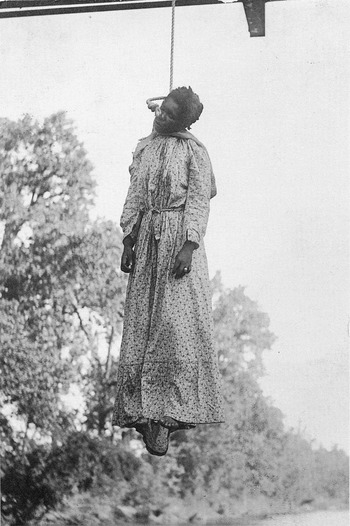
At the heart of the map there is not only a lynch but also a lynching. The lynching is that of Laura Nelson, who along with her son L. W. in April 1911, joined the ranks of thousands of African Americans who, through the terrifying power of mob frenzy fueled by the aspirations of white supremacy, became the subjects of exemplary violence in the early part of the century.Footnote 3Figure 1 shows a photograph of Laura Nelson's lynched body, suspended between a bridge and a river by a single piece of rope. The photograph provides the skin upon which the map is drawn; the mapmaker's conversations with lynch about her creative process provide the air.Footnote 4
The barefoot corpse of Laura Nelson, Okemah, Oklahoma, 25 May 1911. Photograph by G. H. Farnum © 1911.

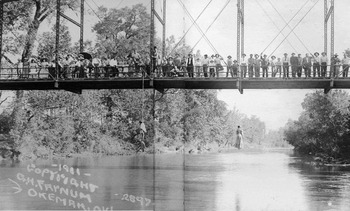
Figure 2 shows the lynching of Laura Nelson and her son L. W. with onlookers. The bridge and the river are metaphors for “an unrememberable past and an unimaginable future.”Footnote 5 They frame a dialectic of materiality and immateriality with which, according to Michelle M. Wright, all considerations of African American subjectivity must contend.Footnote 6 The present is also there in the map, as it is in the photograph; it can be described in general as a politics of suspension.
The lynching of Laura Nelson and her son, L. W., with several dozen onlookers, Okemah, Oklahoma, 25 May 1911. Photograph by G. H. Farnum © 1911.

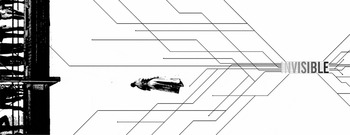
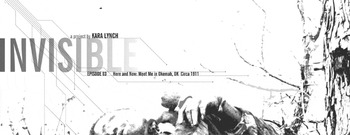
kara lynch calls the photograph of the lynching, and her subsequent setting of it, shown in Figures 3 and 4, the “calling card” to her work Invisible (2001–ongoing): a multilayered, episodic audio-visual installation that merges speculative fiction with conceptual performance, and that powers the map and its attendant network of illuminations. Bodies (specifically black bodies), bridges, rivers, and ghosts—their voices, their blood, and their haunted matter—populate the map more than any other form.
Invitation to kara lynch, Invisible, “Episode 03. Here And Now: Meet Me in Okemah, OK Circa 1911,” front. Design by Chris Ferreria. Courtesy of kara lynch © 2004.

Invitation to kara lynch, Invisible, “Episode 03. Here And Now: Meet Me in Okemah, OK Circa 1911,” back. Design by Chris Ferreria. Courtesy of kara lynch © 2004.

The map itself grows out of radical discourses that subvert and divert the relentless, linear, homophonic, amnesia-inducing flow of Eurocentrism. Specifically, it draws on the work of radical black thinkers who reorganize this transcendence-seeking flow, transforming it into multiple, complex grounded realities. The mapmaker's line of vision is ordered by the light of such critical voices as Octavia E. Butler, Angela Davis, Ralph Ellison, Saidiya V. Hartman, Langston Hughes, Jamaica Kincaid, George E. Lewis, Audre Lorde, Toni Morrison, Albert Murray, Alondra Nelson, Mendi+Keith Obadike, Adrian Piper, Olly Wilson, and Michelle M. Wright. Specifically, the map is constructed upon these voices' collective contention that definitions are not fixed property; that definitions can be recovered and reordered to reflect a multiplicity of perspectives. This is especially true here with reference to music. In opposition to discourses that frame music as the site of sound, through its consideration of kara lynch's Invisible, this map considers music instead as the product of memory and the result of lived experience.
The map is not only a map; it is also an imperative to map. Cultural histories that are forgotten, erased, or lost—and especially those that are haunted—necessitate mapping devices that can help us navigate their spectral terrains. The structures of these terrains cannot be predicted or even imagined; they reveal themselves only as they are traversed. The rhythm of the traversal is therefore as significant as the map itself.
Zones of Cultural Haunting
Was my hunger for the past so great that I was now encountering ghosts?
—Saidiya V. HartmanFootnote 7You wonder whether you aren't simply a phantom in other people's minds.
—Ralph EllisonFootnote 8In 1995, the critic Kathleen Brogan identified a literary genre that had emerged in recent African American writing: “the story of cultural haunting.”Footnote 9 As distinguished from the more familiar ghost story, “that genre of short fiction that blossomed during the nineteenth century, leaving us with thrilling fireside tales of haunted houses, graveyard revenants, and Christmases past,” the story of cultural haunting is concerned with the systematic erasure of collective histories.Footnote 10 The ghosts in these “haunted narratives” do not function merely as plot devices, as reflections of a character's repressed psyche or a character's brush with the taboo. Instead, they are communal ghosts that function as data-recovery devices; their appearance signals “an attempt to recover and make social use of a poorly documented, partially erased cultural history.”Footnote 11 According to Brogan, “As both presence and absence, the ghost [in stories of cultural haunting] stands as an emblem of historical loss as well as a vehicle of historical recovery. It offers writers who take as their subject the survival and transformation of ethnic cultures, who recognize disconnection even as they assert continuity, a particularly rich metaphor for the complexities of cultural transmission.”Footnote 12
Avery Gordon, who has constructed a sociology of haunting, finds similar resonances in African American communities. In Ghostly Matters—a text evolved from the premise that “[t]o study social life one must confront the ghostly aspects of it”—Gordon suggests that studying ghosts can transform ways of knowing, and knowledge about, forces like slavery and state terror that have shaped African American social life.Footnote 13 “Whatever can be said definitively about the long and varied traditions of African-American thought, writing, and radicalism,” she writes, “the social reality of haunting and the presence of ghosts are prominent features.”Footnote 14 As to why this should be the case, Gordon reasons that a community that “[cannot] amend the past, or control the often barely visible structuring forces of everyday life. . . is bound to develop a sophisticated consciousness of ghostly haunts and is bound to call for an ‘official inquiry’ into them.”Footnote 15
lynch's Invisible is such a consciousness and inquiry. It is an episodic work, and it is haunted in its episodic recall; its various episodes deal with traumatic historical events like mob lynching and the systematic enslavement, persecution, and neglect of black communities in the United States. As a haunted work, it emerges in uncanny ways. Since 2001, the year she finished her landmark documentary Black Russians, lynch has been working on Invisible, what she considers a “forever project.”Footnote 16 The forever-ness of Invisible is the forever-ness of memory and its infinite reflection in the lived environment. For lynch, it is more precisely the forever-ness of the memory of slavery, a memory mapped out in lynch's own lived environment in the United States in ways that she must continually process, negotiate, and re-reflect through this immense work.
The memory-processing that lynch undertakes in order to create Invisible is by no means linear or readily apparent. I first encountered the work in lynch's studio at the University of California, San Diego, in May 2003, where it existed in embryonic traces inside a busy room.Footnote 17 My most distinct memory of the work, as it appeared at the time, is of pieces of rope cluttering the space. Although subsequent exhibitions of Invisible would never feature actual pieces of rope, lynch, in order to conceptualize the work, became intimately familiar with the medium, learning how to tie a diverse repertoire of knots, how to gauge tensile strength, and how to otherwise read these historically loaded fibrous objects. As much as it can be said to be about any final product, Invisible—a work deemed to remain a work-in-progress—can be said to be about a gauging: a tying and untying of memories and meanings.
To date, two episodes of Invisible (and their myriad component parts) have been exhibited publicly: “Episode 03: Meet Me in Okemah, OK” and “Episode 12: 9th Ward.” The former connects the lynching of Nelson and her son L. W. in Okemah in April 1911 with lynch's trip to that site in the summer of 2003; the latter ties two traumatic events in African American history: the decimation of black bodies by a white mob in New Orleans in 1900 and the horrific fallout from Hurricane Katrina in 2005.
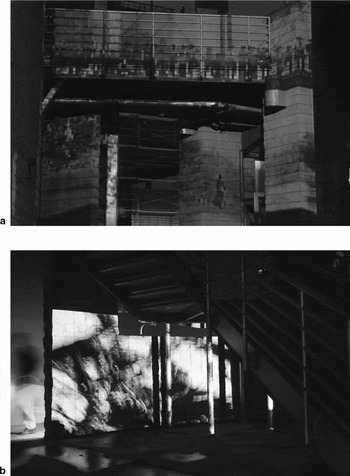
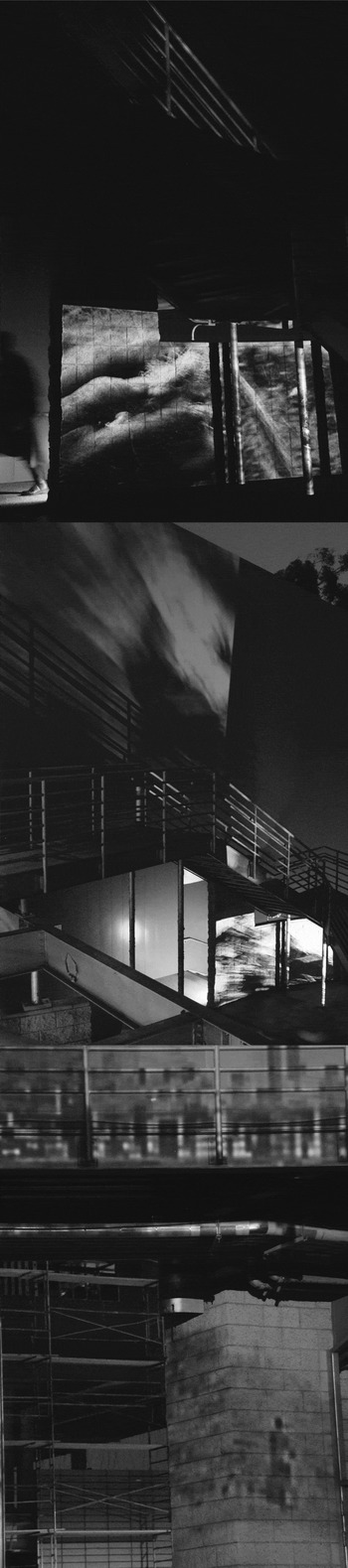
Although both episodes have been manifested in a number of forms—ephemera, sculpture, performance, etc.—their individual components are all somehow tied to sonic or musical structures. For example, some video components of “Episode 03” are visual responses to, or visual mappings of, audio components that may or may not be exhibited alongside them. In one exhibition of “Episode 03,” two massive video projections, shown in Figures 5a and 5b, were screened at dusk in two separate spaces, while four audio tracks played continuously in adjacent locations.Footnote 18 As lynch tells it, these audio tracks “stood in” for the video tracks that were not shown during the day. The video was absent during the day not for technical concerns of visibility but for symbolic ones. lynch wanted to stress the different ways a “Negro” woman like Laura Nelson would have experienced her environment traveling between an all-white and an all-black town during the day and at night.
“Episode 03” from Invisible, installed at Visual Arts Department, University of California, San Diego, 1–7 December 2003. Courtesy of kara lynch © 2003.

The privileging of sound as an organizing principle in Invisible is significant not only in terms of the way other media are negotiated in relation to it, but also because the presence of ghosts is often only sensed through the sounds they make.
At times, a component of Invisible might exist solely as audio. There is, for example, a nearly two-minute long electroacoustic “prelude” to Invisible called “Golliwog!” that can be heard as a stand-alone musical work and has also been exhibited as a sound sculpture (in which the same music is continuously looped).Footnote 19 “Golliwog!” assembles a dense collage of archival recordings—auctions, crowds, a rodeo, a wedding party in which someone remarks “Look at that cake!”, a bingo game, a windup music box, a wood block, laughter and cheers—and samples of recordings of music by the French composer Claude Debussy and the African American blues musician Taj Mahal.Footnote 20
“Golliwog!” is a macabre musical setting of the cakewalk, a satirical African American folk music and dance that predicted ragtime music.Footnote 21 Among other juxtapositions, the piece contrasts the sounds of celebration with the rhythmic speech-song of an auctioneer, whose alternately lulling and lifting voice is eerily inflected by the listener's suspicion that the item for sale is a black body.Footnote 22
“Golliwog!” uses only preexisting recordings which lynch gathered, processed, and collaged. In composing the work she cut and pasted, looped and layered, filtered and modified samples (often altering parameters like their duration, frequency, and amplitude); she arranged samples within multiple intricate and interweaving rhythmic patterns, and set them within a nuanced stereophonic interplay, such that individual voices seamlessly jump out of, and vanish back into, a chaotic but cohesive aural scene. lynch notes, however, that her conceptual synthesis of these sounds—her process of arranging, modifying, and filtering meanings into and out of a dense package of sonic information—is equally important as an organizational principle.
“Episode 03” from Invisible, installed at Visual Arts Department, University of California, San Diego, 1–7 December 2003. Courtesy of kara lynch © 2003.

All the other audio components of Invisible, with the exception of “strangemissotis,” combine archival recordings with field recordings made by lynch during her visits to the different sites referenced in the project.Footnote 23 These include the site of Laura Nelson's lynching in Okemah, Oklahoma, the city of New Orleans post–Hurricane Katrina, and the Juneteenth celebrations in Galveston, Texas.Footnote 24
This map retraces lynch's travels through these sites, following her footsteps and her mind-steps through their nonlinear, dynamic, polyphonic, and polymetric routes. It pauses at several “zones of cultural haunting,” places that feature extensively in these routes. Although these zones appear to be separate regions, they contain multiple areas of convergence. When zones (bodies) meet, passing through one another, fresh ghosts appear.
Zone 1: Polyvalent Media
Slavery has ended, but something of it continues to live on, in the social geography of where peoples reside, in the authority of collective wisdom and shared benightedness, in the veins of the contradictory formation we call New World modernity, propelling, as it always has, a something to be done. The ghost enters, all fleshy and real, with wants, and a fierce hunger, and she speaks, barely, of course, and in pictures and a coded language.
—Avery GordonFootnote 25We came across the story of a blues man from the 1930s. A guy called Robert Johnson. Now the story goes that Robert Johnson sold his soul to the devil at the crossroads in the deep south. He sold his soul, and in return, he was given a secret of a black technology, a black secret technology, which we know now to be the blues.
—John AkomfrahFootnote 26In her article “Aliens Who Are of Course Ourselves,” Alondra Nelson reminds us of the work of the cultural theorist and novelist Albert Murray, who “once remarked that the mandate of the black intellectual was to provide ‘technology’ to the black community. By this, Murray did not mean mechanics, new media, or the Internet; rather, he defined technology as those novel analytic approaches he believed necessary to understanding black life ‘on a higher level of abstraction.’”Footnote 27
Taking Murray's lead and Nelson's hand, but allowing for “technology” to also include mechanics, new media, and the internet, this zone gathers ways in which African American media (the slave narrative, the blues song, the spiritual, graffiti art, the remix, etc.) have constituted technologies of cultural transmission that function within culturally specific genealogies of coding and abstraction. Early African American media such as field hollers, work songs, spirituals, and blues songs are widely recognized as coding devices; they contained, masked, and abstracted levels and layers of meaning that on the surface appeared to be innuendo or jive.Footnote 28 Beneath the surface, however, the messages were muddier, more indecipherable, some would say blacker.
Four hundred years into the transatlantic slave trade and its descendants (disproportionate prison populations, limited access to health services and education, endemic poverty, and pointed government neglect and exploitation), there exist genealogies of African American media in which emergent media inherit the codes of previous generations and introduce new ones. These networks of media inheritance develop in such a way that these black technologies, these approaches to understanding black life on a higher level of abstraction, become paradoxically more abstract (more heavily coded) and simultaneously sharper (increasingly higher resolution) in their transmissions of cultural meaning.
These culturally specific and historically situated African American mechanisms of coding, abstraction, and inheritance apply to media forms as well as media modalities. Instances of cross-modal resonance are often noted, for example, with respect to the work of such celebrated African American painters as Romare Bearden and Aaron Douglas, whose paintings are said to function as music, acting as visual counterparts of jazz and blues forms. The art historian Richard J. Powell observes, for example, that “‘blues timbres, downhome onomatopoeia, urban dissonance, and cacophony’ can be seen as musical counterparts to the high-affect colors, improvisational patterning, and perspectival distortions of Bearden's art.”Footnote 29 With regard to the paintings of Douglas, Powell shows how a “formal quality of African-American musical expression—a tendency toward polyphonics and polymetrics—is visually achieved.”Footnote 30
In a similar vein, Keith Townsend Obadike explains his desire to identify as a “sound artist” instead of as a “composer” as rooted in the interdisciplinary context in which much African American art and music has developed, observing that “there is always sonic information to be gleaned from the performance and object-based work of [African American visual] artists.”Footnote 31 Likewise, Michelle-Lee White has identified what she calls “audio resonance in visual imagery” in the cultural productions of the African diaspora.Footnote 32
Add to this complexity of media structuring (memory coding, meaning coding) an “aesthetics of multidominance” that has featured prominently in the cross-modal, interdisciplinary expressions of this diaspora.Footnote 33 George E. Lewis characterizes this aesthetics as manifesting “extreme” and “simultaneous” multiplicities (of voice, color, patterning, perspective, etc.), and shows how such an aesthetics operates as an oppositional strategy within Eurological cultural traditions and Eurocentric systems of power and privilege. An aesthetics of multidominance can be traced within individual works, genres, and creative approaches; it can also be located within the cross-modal resonances of media forms that contain and couch “extreme and simultaneous” multiplicities of media languages and modalities.
I use the term “polyvalent” to describe media in which there exist extreme and simultaneous multiplicities; these include mechanisms of abstraction, coding, structuring, inheritance, and media language and modality. The term easily applies to lynch's Invisible, a richly variegated mulatto of media forms and platforms, memory containers, and cultural meaning transmitters. For example, there exists a “hidden” textual narrative backdrop to Invisible, a sci-fi story in which two time travelers go to the different sites that lynch investigates in the work. These time travelers provide the multiplicity of perspective that lynch then uses to frame the various audio and video components. This secret text does not ever appear in the public manifestations of Invisible, but is instead used as a processing device that allows lynch to develop the various story lines and points of view that inform the project. For example, “Episode 03” describes a complex of scenes in which Laura Nelson is taken from her cell in a courthouse to the site of her lynching, and in which lynch's sci-fi characters travel to the bridge where Nelson's body hangs. The audio and video components—an elaborate composite of images and sounds—describe what the two time travelers and Laura Nelson see and hear. In lynch's conception, the audience—privy to each perspective but not privy to the sci-fi backstory of Invisible—is “transported” simultaneously to each place, at once inhabiting the bodies of multiple social actors. The audience “becomes” the character standing on the bridge looking down, becomes the character standing at the foot of the riverbed looking up, becomes suspended flesh.
What is also significant about the secret text is that lynch does not treat it as text per se, but, in my interpretation, as digital video: she zooms in and out of the text; she focuses and defocuses its component parts; she flips through, fast-forwards, and rewinds it. She explains: “[The text] is multi-layered. Zoom out: there is the meta-project and time travel meta-narrative of [the characters who build] their stories out of traces and artifacts. Zoom in: we are in the woods along a riverbed staring at a spider's web pulling the focus ring of a digital video camera.”Footnote 34
Invisible is not unique within traditions of African American polyvalent media production in which cultural meanings are coded, inscribed, and transmitted along complex matrices that make it impossible to extricate them but simultaneously enable memories and histories to emerge that are otherwise too complex to exist as mere representation. These polyvalent media communicate meanings that evade categorization within conventional semiotic and syntactic systems; they are much too haunted for that.
Zone 2: Water
Water flows and laps and pools, and in the flowing it makes a sound—the sound of water. The sound—. Music. The sound of music is without language or the sense of language, yet it is not without sense. In this way, there is also a form of language that is without linguistic sense—a form of language without sense that is not nonsense and thus carries sense—the sense of music, or the sound of water. . . .
These sounds have meaning and sense, yet they are without linguistic sense. So there is an undercurrent in language of meaning and sense that is not linguistic sense. It is the sound of water, falling. It is the sound of language.
—Sherry BrennanFootnote 35It is also the sound of memory.
At the outset of John Akomfrah's 1996 sci-fi documentary on black music, The Last Angel of History, the narrator explains that “the first touch with science fiction came when Africans began playing drums to cover distance. Water carried the sound of the drums, and sound covered the distance between the old and the new world.”Footnote 36 This zone contains ways in which water—which features extensively in Invisible and in African American stories of cultural haunting—functions as an information carrier, a medium, a storage device.
During a visit with lynch at her home in Woodridge, New York, my first question was: “How did you end up here?” Her reply: “I liked the river.”
Invisible is filled to the brim with images and sounds of water, and it exhibits the special properties of water as a haunted medium. Water is ever-present in “Episode 03: Meet Me in Okemah,” as the site of the lynching of Laura Nelson and L. W. was the North Canadian river. Water carries even more valence, though, in “Episode 12: 9th Ward,” which takes place in the half-submerged city of New Orleans. “If there is any element that is guiding the work,” lynch notes, “it's water.”
In “Study 01,” one of the audio-video components of “Episode 12: 9th Ward,” water is that permeable membrane that connects this world to the next one.Footnote 37 lynch shot the video portion of “Study 01” at the Neversink River in Woodridge, but the water is meant to evoke New Orleans: it is murky, greenish-brown, swamplike, rushing—the river had flooded earlier that year. In the video, a large white cross, a found object, floats innocuously on the surface of the water. It reads “35 ACRES.” The cross is a real estate marker, but it evokes the slogan “40 acres and a mule,” the promise of financial security to freed slaves on which, however minimal, the US government famously reneged. The slogan is written in red and blue, and the cross is white. This makes it difficult not to read the cross as a symbol of death, specifically the death of the dream of reparation. After all, the contemporary real estate economy and the historical slave trade are not so different in the ways that they parcel out property according to race.
Another object, a white shirt inserted into the scene by lynch, floats near the cross. A large flock of black birds flies overhead, their increasingly present calls merging with the growing chorus of the black hymn “Good News” which loops in the background. All the while, water sips and laps away at the edges of the visual and the aural field. As the water approaches the listener and the viewer, so, too, does the sound of an ambulance, which soon becomes uncomfortably close. When this sound suddenly disappears, it continues to grow inside the listener, like the nagging of a phantom limb. This ghostly crescendo is interrupted by the sound of two gunshots that abruptly punctuate the scene.
When lynch first exhibited “Study 01,” she screened the video on a thirteen-inch monitor placed on the floor, screen facing upward.Footnote 38 Over the monitor she laid a piece of cloth, a shroud with a hole cut in it, which visitors could peer into. Next to the monitor she put a bowl of water, “an offering.” During the exhibition, the soundtrack and the video were not synched: rather, lynch multiplied the sound in the space by projecting it from multiple speakers, giving visitors the impression that they were being immersed. But an immersion in what?
“Study 01” was inspired by the events surrounding the decimation of New Orleans by Hurricane Katrina and the subsequent abandonment and decimation of black communities in New Orleans by the US government. lynch did not follow this news on television, only on the radio and through word-of-mouth. Her knowledge of these events was therefore sonically transmitted, and her understanding of them consequently shaped by an ethereal panoply of aural impressions. One news segment featured a well-known activist who pleaded with government officials to remove the body of a dead black man left behind for days in the commotion. The activist then spoke to the fact that whereas the mainstream news media was eager to broadcast stories about black people looting stores in the area, they willfully omitted stories of white vigilantes who had traveled to New Orleans to harass the black population left behind there. lynch recalls:
There was a question about confusion as to who was there to help. Was the national guard there to help? When those vigilante groups came in, could you recognize them as being national guard, or police, or good ol' boys coming in to harass black people? There was a question as to whether there were people who died from gunshots from these vigilantes. The gunshot [in “Study 01”] was really important to me. But there needed to be something that led up to it. Something that you couldn't entirely understand. This waiting. And the birds are birds passing overhead. They're these really small black birds that hang out and just take over a tree. They just sit there and squawk. It just sounds really threatening. There was something about that. The body left for dead and these birds of prey.
The lurking presence of water in Invisible is neither fortuitous nor isolated. In Invisible, as in other African American stories of cultural haunting, long-submerged coffers of memory invariably surface from the water, bringing with them a renewed understanding of “what is down there.”Footnote 39 In these stories, water invariably holds special meaning: it appears as a site of redemption, of emancipation, of escape, of crossing over; it is the symbolic River Jordan, the way of the wanderer, the path to the Promised Land; it is the sacred site of baptism; it is also the burial ground of African American slaves and their descendants; it is a place of imminent threat. In New Orleans, water was effectively used as a weapon against the black population—a fact that sheds new light on Langston Hughes's long ago memories:
In African American stories of cultural haunting, water functions as the connective tissue, the common blood, between one world and another. In Toni Morrison's Beloved, the ghost emerges from the river and returns to it upon departing the living world: “By and by all trace is gone, and what is forgotten is not only the footprints but the water too and what is down there.”Footnote 41 In Octavia Butler's Kindred, the black protagonist, having traveled through space and time for the first time, finds herself at the edge of a riverbank sucking the water out of her white ancestor's body, and thereby inserting life back into it.Footnote 42 In At the Bottom of the River, Jamaica Kincaid describes a stream that, “flowing perilously . . . falls over a ledge with a roar, a loudness that is more than the opposite of complete silence.”Footnote 43
How does water store and transmit the collective memories of a haunted community? How does collective memory get filtered, diluted, diffused, and refracted in water? How does collective memory travel through water, and where does it go? Does it flow into the blood?
Zone 3: Blood
If language can be said to be a virus that comes from outer space and infects the mind, then memory can be said to be a parasite that comes from the water and feeds off the blood.Footnote 45 Memory needs blood to survive. Memory inserts itself into the code of blood, growing there until it overcomes the body. When the body expires and blood dries, memory evaporates with it into the environment, becoming “blood on the leaves and blood at the root.”Footnote 46 When blood memory evaporates, it awaits new bodies to inhabit.
Does the manner of death of a person affect the manner in which his or her blood memory is redistributed into the environment? How did the lynching of Laura Nelson affect the redistribution of her blood memory? Langston Hughes speaks of rivers as “ancient as the world / and older than the flow of human blood in human veins.” Where did blood memory come from? Did it come from ancient rivers?
Traditional histories are concerned with the search of a common memory; haunted histories are in search of a blood memory.
GO: In recent criticism or theory on ideas of memory, the thing that comes up so often is Pierre Nora's idea of sites de mémoireas opposed to lieux de mémoire—sites of memory as opposed to environments of memory.Footnote 47But, if memory is a site, if it's a point, you cannot really access it. A point doesn't really exist, and the closer you get to a point the more it recedes into some kind of inaccessible space, into some kind of a black hole. So the closer you get to a remembered idea the more absent it becomes. . .
kl: Isn't it that what memory is? The process of not getting there . . .
GO: That's the thing . . . people talk about these sites of memory, but what about the stuff of memory? Let's say that there's memory in your blood. There is coding in the blood, and there is information in the blood, there is history in the blood, there is genealogy in the blood. Bloodlines are like memory lines. Even if you don't know your genealogy, it's in you. Lines don't really exist either, but they're where multiple points meet. . .
kl: I also think of collective memory. Like you showing me that article about Amiri Baraka's work. I'm familiar with Baraka and his work. I don't necessarily think of him as a reference, I've never met him, but there are these instances that tie us to the same place, the same memory. Why should we share it? But we do. And I do think that's something that black culture acknowledges. Synchronicity. I don't have to know George Lewis to have some common reference points that we're riffing off of, or maybe even come to the same place. I'd never met Saidiya Hartman. I'd heard her name, I'd seen a couple of articles, but I didn't meet her until her recently. But when I did, I thought, “Well here we are, doing the same thing.” And that can be a product of upbringing, but there's also another kind of . . . like you're programmed or something. . . .
GO: Also there is actually a physical thing that is memory, right? It occurs in our brain, a physical process that happens. There's a physical place of memory, but it's obviously not a place, you can't contain that place. But there's also a physical thing that is collective memory, which is the memory that is yours but not yours, not yours per se. For example birds have this collective memory—they remember to fly somewhere. It isn't a physical urge, it's actually information that's stored in their brain cells, or their blood . . . stored in bird-body. There is the actuality of collective memory, and in the case of those who don't know who their ancestors are, the collective memory can be distributed in ways that are different from those of a top-down genealogy. And that also plays into the idea of the multiplicity of perspective, because one might be able to access the memories of someone whose actual blood one doesn't share, but whose experiences were filtered through this same distribution network. . . .
kl: I'm not so interested in origin stories. When Saidiya Hartman talks about going to West Africa and what she's looking for, she's looking for the route and the traces—not necessarily where she came from, but wanting to track the movement of peoples. And that's just like being obsessed with the middle passage, but she's okay with hovering, which really is where I find myself . . .
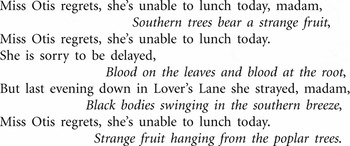
One of the most haunting sections of Invisible is an audio-video component of “Episode 12: 9th Ward” called “strangemissotis,” in which lynch overlays two well-known jazz songs about lynching: “Strange Fruit,” as sung by Billie Holiday, and “Miss Otis Regrets,” as sung by Ella Fitzgerald. She combines these songs such that their lyrics overlap thus:
kara lynch's setting of “Strange Fruit” (words and music by Lewis Allan, © 1939 renewed by Music Sales Corporation) and “Miss Otis Regrets” (words and music by Cole Porter, © 1934 renewed by Warner Brothers, Inc.) in “strangemissotis.” Excerpt adapted from kara lynch © 2005.

In “strangemissotis,” Holiday and Fitzgerald—towering figures generally thought to occupy opposing poles of an imagined “mainstream” social spectrum—are heard as one voice, a manifestation of lynch's idea that
the everyday tension of Stax v. Motown . . . propels culture, history and memory for Black people in the Americas. You cannot have one without the other. Denmark Vesey necessitates Frederick Douglass and vice versa. The Underground Railroad stays on track in dialog with maroon communities. Meanwhile each form lives within a construct of captivity and struggle.Footnote 48
In its merged state, the connected-yet-discontinuous voice of Holiday-Fitzgerald reveals a lineage of blood memory that confounds such constructed binaries as “Stax vs. Motown” and “Vesey vs. Douglass,” and that raises the question of how memory is stored in the blood and revealed through the productions of the body. In collapsing the time and space between Holiday and Fitzgerald, lynch implicitly collapses their bodies, directing their virtual blood flow into one another's veins. In this convergence of bodies, a new body appears. An apparition. A haunting.
Zone 4: Bodies
Invisible bodies, no doubt by definition, can be done away with much more easily than visible ones. Since . . . ghosts . . . and the like take up no physical space in our empirical world, the liquidation of them involves no bloodletting, leaves no corpses, and calls for no official inquiry.
—William LaFleurFootnote 49Getting rid of ghosts might not involve bloodletting, but creating them surely does.
In creating Invisible, lynch redistributes her own blood memory into multiple networks, mapping it out on the lived environment and redirecting it into her audience's veins to enable a “transformative recognition” of other—living and dead—black bodies.Footnote 50 As the vehicle through which the haunted matter of Invisible emerges, lynch's own body becomes, at times, a ghostly or bloodless medium. One of the central methodologies lynch employs in Invisible is détournement, the turning around of popular forms or conventions. In Invisible, a détournement of social, cultural, and historical forms occurs in and through the body. lynch writes, “[I]t is the repositioning that happens when you run ideas, images, etc. through your body that is powerful. Detournement . . . a working-through of lived experience coupled with political consciousness and a commitment to collective engagement.”Footnote 51
For lynch, Invisible is ultimately a philosophical question about the body. She says, “If there's a conception of reason, and reason is considered to be ‘of the mind,’ a [product of the mind's] coming-into-consciousness, what happens when you add the body into the equation? Does that then become irrationality?”
lynch possesses a love-hate relationship with G. W. F. Hegel, the German idealist whose concept of a master-slave dialectic uncritically positions the black body as the Other, which, lynch observes, “stands-in for, or dies for, this Self that gets to be a subject,” but in whose philosophy the black body nevertheless remains unseen.Footnote 52 She says:
In this philosophical discussion, black bodies are invisible. Hegel talks about it as though it's a theory, not a real person's body. Meanwhile you have this fight for liberation in Haiti, and Hegel's thinking about it in terms of “you fight until the death” to achieve consciousness—that is the struggle of “becoming.” But those black bodies are totally invisible in that discussion. I'm unwilling to be disciplined about staying in the philosophical realm. What does it mean that Laura Nelson and her son are strung up on a bridge? What does it mean that there's an audience and that there's a photograph? How is Laura Nelson a threat? How does that happen? There's part of me that's just unwilling not to see her. I think there are all kinds of responses to an image like that—of this young man and this 30-something woman hanging over a bridge—[an image] that's translated over time. But even if your response is horror, that doesn't mean that you're seeing them.
The most potent type of invisibility that lynch confronts in Invisible is what she calls the “conspicuous invisibility” of black bodies. This confrontation occurs, in part, through lynch's reconfiguration of these black bodies in relation to other bodies in space. Although the project is propelled by a narrative constructed using popular sci-fi idioms, the difference between Invisible and most sci-fi is as vast as the gulf between literary fiction and historical fact. The installational aspect of Invisible is central to this difference. Although sci-fi literature can conjure the most fantastical travels through time and space, it still typically exists as words wedded to a page, which a reader, wedded to real space, must typically follow in a prescribed fashion. Conversely, in exhibitions of Invisible, a secret sci-fi narrative is translated and projected onto an existing environment that the user must navigate without any active guidance on the part of the author. This new space straddles the line between the real and the immaterial, providing an altogether different kind of cultural experience: the kind that converges with, and becomes indistinguishable from, lived experience.
Siegfried Kracaeur has written that “[s]patial images are the dreams of society. When a spatial image is deciphered, the basis of social reality is revealed.”Footnote 53 When the interface with a work of art is space, the user fulfills the burden of lived experience, bringing to the table a personal and social history of how to navigate through and negotiate space. In affording the user/traveler this genre of experience, Invisible also provides a critical framework that reclaims the lost value of lived experience, historically considered “irrational” or trivial and therefore until recently located outside the scope of Western philosophy. Like the slave narrative and the blues song, Invisible stresses the point that the only accurate expression of history belongs to lived history.Footnote 54
If spatial images are the dream of society, then interactions with spatial images speak volumes about how social actors see themselves fitting into that dream. In regard to Invisible, lynch claims that not interacting with the work is as valid as any other kind of interaction: when a user/traveler comes into contact with Invisible but actively, or even unconsciously, ignores the work, such a response can be seen as an extension of national history in which institutional slavery has produced a systematic, “hysterical blindness” towards African Americans.Footnote 55 A denied interaction with Invisible also reveals that African Americans' otherness has resulted in multiple, coextensive spaces that make up “America.”Footnote 56 Only some of these spaces are accessible or visible to the majority of “Americans.” Others can only be made visible through a critical interaction that compels the “inner eyes” to shed light, however momentarily, upon them. When such a critical interaction takes place, it occurs within the realm of inconsistency, discontinuity, rupture, and slippage, and so its effects are literally immeasurable.
Why, then, do artists like kara lynch create sites that enable such tenuous and yet potentially disruptive interactions, if not for the sake of wearing down dominant constructions of space to the point of breaking? How do they achieve this, if not by using powers that are essentially magical in that they transform and transfigure not only the spatial productions of society but also the dreams of society?
A critical engagement with Invisible entails a kind of historical experience structured around the barely there productions of everyday life as they emerge in relation to social and national histories. During such a critical engagement, the user/traveler, mirroring the narrative structure of the work, is simultaneously propelled forward and backward, suspended in a “retrofuture” present. In this suspended state, the user/traveler's understanding of his or her role in the dreams of society is forever altered to further reflect the depths of this social dream and the endless possibility of nightmares within it.
The Boundary of the Map
The ghost or the apparition is one form by which something lost, or barely visible, or seemingly not there to our supposedly well-trained eyes, makes itself known or apparent to us, in its own way, of course. The way of the ghost is haunting, and haunting is a very particular way of knowing what has happened or is happening. Being haunted draws us affectively, sometimes against our will and always a bit magically, into the structure of a feeling of a reality we come to experience, not as cold knowledge, but as transformative recognition.
—Avery GordonFootnote 57Like the ghost in Toni Morrison's Beloved, lynch's Invisible is a kind of haunting, and it is itself haunted—a presence marked by loss and absence. What happens when a body that is simultaneously haunted and haunting is disappeared? Does its disappearance enable a particular kind of transformative recognition to occur, one that extends beyond normal or even critical acts of perception? Do the inner eyes of the user/traveler become inner ears, able to receive, filter, and reflect meanings and memories far past the point of human/historical recovery?
In recounting the story of Invisible, lynch often notes that many who have encountered the work seem to notice it more fully in its absence. When the literal and figurative music of Invisible is absented, its polymetric rhythms and polyphonic melodies removed from the environment, a haunting gap is left behind. As a repository of lost memories and a translation of these memories into lived space, Invisible, a music that is the music of history, is most audible when it is no longer there.