Introduction
Rice (Oryza sativa L.) is an important cereal crop consumed both as staple food and processed products. White rice is the most popular type in the market. However, some rice varieties have coloured grain (black, purple or red), that produce milled rice with slightly coloured grain (De Silva et al., Reference De Silva, Abeysundara and Aponso2017). Coloured rice is also popular among the consumers, who worry about health, because it contains high phytochemicals beneficial to health (Moongngarm et al., Reference Moongngarm, Daomukda and Khumpika2012).
Riceberry rice is a black-purple rice variety developed from the cross between Hom Nin and Khoa Dawk Mali 105. Both parental lines are aromatic, and Hom Nin has good eating quality and black grain, while Khoa Dawk Mali 105 provides the best fragrant white rice. According to Poosri et al. (Reference Poosri, Thilavech, Pasukamonset, Suparpprom and Adisakwattana2019), Riceberry bran contained high antioxidant compounds and grain contained high nutrients, chemical compounds and phytochemicals such as protein, gamma-aminobutyric acid (GABA), minerals, phenolic compounds, gamma oryzanol, tocopherols and tocotrienols. These compounds had antioxidant activity and health benefits such as reduction in the risk of heart disease, anti-cancer and anti-inflammatory (Moongngarm et al., Reference Moongngarm, Daomukda and Khumpika2012). The phytochemicals and the chemical compositions in the rice grain varied depending on growing conditions such as planting date, harvesting date, climate and rice variety (Wiset, Reference Wiset2012). Environmental factors such as crop season, location and agricultural practice also affect phytochemical compositions and antioxidant activity in rice grain.
The growing concern on the contamination of harmful agricultural chemicals in food products arouses the consumers to seek for more safety food produced from organic farming system. Chemical application is not allowed in organic rice production system, and the production areas must be free from the application of chemicals for some years (Settapramote et al., Reference Settapramote, Laokuldilok, Boonyawan and Utama-ang2018). Organic food is expected to provide more benefits than ordinary food with respect to food safety (Champagne et al., Reference Champagne, Wood, Juliano, Bechtel and Juliano2004). In addition, the use of organic fertilizers improves soil structure suitable for plant growth (Assefa and Tadesse, Reference Assefa and Tadesse2019).
With respect to food quality, the use of organic fertilizers in crop production has been reported to influence the accumulation of chemical compounds and phytochemicals in crop products. In wheat, the application of compost had higher polyphenols than the application of chemical fertilizers (Konopka et al., Reference Konopka, Tańska, Faron, Stępień and Wojtkowiak2012). In winter wheat, higher ferulic acid and total phenolic acid were obtained from organic production system compared to non-organic production system (Zuchowski et al., Reference Zuchowski, Jonczyk, Pecio and Oleszek2011). In rice, Kim et al. (Reference Kim, Cho, Lee, Lee, Jeong, Lee and Moon2017) found that organically grown brown rice showed higher levels of bioactive substances and enhanced antioxidative activity than chemically grown brown rice, although the differences were not statistically significant.
Previous investigations pointed out that the use of organic fertilizers affected the accumulation of active substances in different cereal crops. Riceberry rice is very popular among health-conscious consumers. It is positioned as an organic food and has excelled in premium markets, gaining a high price. However, the information on the accumulation of bioactive compounds in Riceberry rice grown under organic farming system is rare. Therefore, we hypothesized that growing Riceberry rice in organic systems can help increase the accumulation of chemical compositions and bioactive compounds in grains. The objective of this study was to evaluate the quantities of chemical compositions and bioactive compounds of Riceberry rice grown under organic farming system and chemical farming system. The results of the study will be beneficial to organic rice growers because the farmers will be able to increase the value of organic Riceberry products.
Materials and methods
Experimental site and agronomic practices
The experiment was conducted for 2 years during July–October 2019 and 2020 in Trat province, Thailand (12°14′37.10″N, 102°30′54.50″E). Two treatments consisted of organic farming system and conventional farming system, which were located in different fields. In each experimental site, the field was divided into four plots (n = 4) each of which had 10 m2. Therefore, the experimental design was a randomized complete block with four replications. Both experimental sites were located in the flat fields, and the soil series at both sites is Munoh (Mu), which is characterized by bad drainage and moderate soil fertility (Soil Resources Survey and Research Division, 2017).
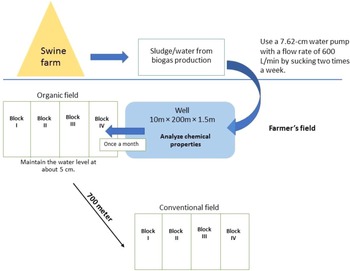
The organic experimental site was selected because it was under cultivation of organic rice for 5 years and obtained organic certificate from the Department of Agriculture, Thailand. For fertilization, organic farming system used liquid swine manure from a nearby farm (Fig. 1). The treated swine dropping sludge was used. Fresh dropping was refilled into the farmers’ well by sucking two times a week, and water was released from the well into the rice field once a month at the level of 5 cm. Liquid swine manure in the well had a pH of 6.99, electric conductivity (EC) of 1.01 dS/m, total nitrogen of 0.002%, P2O5 of 0.0015% and K2O of 0.0043% in 2019, whereas the chemical properties in 2020 included a pH of 6.65, EC of 1.31 dS/m, total nitrogen of 0.005%, P2O5 of 0.0014% and K2O of 0.004%.
(Colour online) Fertilizer management by farmers in organic field and layout of experiment.

The conventional experimental site was located at a distance of 700 m from the organic experimental site. Chemical fertilizer was applied to conventional plots twice. Nitrogen, phosphorus and potassium (NPK) 15-15-15 compound fertilizer was applied to conventional plots at the rate of 156.25 kg/ha at 25 days after planting. Nitrogen fertilizer in the form of urea (46-0-0) was applied to conventional plots at pre-heading stage at the rate of 62.5 kg/ha. Nitrogen rates in organic farming system and conventional farming system were calculated at the rates of 40.0 and 52.2 kg/ha, respectively.
Conventional tillage was practiced for transplanted rice of both organic farming system and conventional farming system. The soil was ploughed three times before planting. The 25-day-old seedlings were transplanted at a spacing of 25 × 25 cm2 and the rate of one seedling per hill in the same day for both organic and conventional plots. Agronomic practices in this study followed the instructions of organic farmer and non-organic farmer for organic rice and non-organic rice, respectively.
Data collection
Meteorological conditions and soil properties
Meteorological data including rainfall (mm), relative humidity (%) and maximum and minimum air temperatures were obtained from the nearest weather station. Soil samples from organic field and conventional field were analysed for soil chemical properties before planting.
Yield and yield components
Data were recorded for yield and yield components at harvest. Number of tillers per plant and number of panicles per plant were recorded from ten hills randomly chosen from middle rows in each plot. The number of seeds per panicle was measured from ten panicles in each plot. Ten hills in each plot were harvested, and grain yield was measured at approximately 14% of seed moisture content and calculated as grain yield per hill.
Chemicals and reagents
High performance liquid chromatography (HPLC) grade water, ethanol and methanol were obtained from RCL Labscan. Standard gallic acid and 2,2-diphenyl-1-picrylhydrazyl (DPPH) were obtained from Alorich. Folin–Ciocalteu's reagent was obtained from Sisco Research Laboratories Pvt. Ltd (SRL). All chemicals used in this study were of analytical grade.
Seed sample preparation
Rice seed samples from harvesting (50 g each) were husked by hand and, then, oven-dried at 70°C until constant weight. The whole grain sample was ground into powder by using a blender, and the grain powder was sieved through 100 mesh screens. Rice powder samples (2 g) were extracted with 10 ml of methanol by soaking the sample at room temperature for 24 h. The sample was further centrifuged at 2500 rpm for 5 min and filtered through Whatman no. 4 filter paper. The supernatant (sample extracted) was then stored at 4°C until further analysis for total phenolic content (TPC), anthocyanin content and DPPH activity.
Total phenolic content
The TPC of rice grain extracts was determined using the Folin–Ciocalteu's reaction method reported by Aninbon et al. (Reference Aninbon, Jogloy, Vorasoot, Nuchadomrong, Senawong, Holbrook and Patanothai2016). The crude extract (50 μl) was diluted to 3.0 ml with distilled water. Folin–Ciocalteu's reagent at the concentration of 250 μl was added to the sample and stirred thoroughly. The sample was further added with 20% sodium carbonate solution at the volume of 750 μl and the mixture was allowed to stand for 2 h. The mixture solution was measured at 765 nm using a UV–visible spectrophotometer. Gallic acid was used as a standard and the result was calculated as gallic acid equivalents (GAE) mg/100 g dry weight of rice grain.
Anthocyanin content
Anthocyanin content was determined by the pH differential method of WI-TMC-03 based on AOAC (2019). Briefly, 0.5 ml of the sample extract was mixed with 4.5 ml of potassium chloride buffer (pH 1.0) and set aside for 15 min. The absorbance was measured at 520 and 700 nm, respectively. The extract was also mixed with 4.5 ml of sodium acetate buffer (pH 4.5), and the absorbance was measured at 520 and 700 nm, respectively. The result was expressed as mg of cyanidin-3-glucoside equivalent/100 g dry weight of sample.
DPPH activity
The DPPH radical scavenging activity of each extract was determined using the method suggested by Kaur et al. (Reference Kaur, Asthir and Mahajan2017) with some modifications. Rice extract (0.1 ml) was added to 2.9 ml freshly prepared solution of 0.1 mmol/l methanolic solution of DPPH. The control sample contained 1 ml methanol without extract plus methanolic solution of DPPH (2.9 ml). After mixing, the sample was incubated for 30 min in the dark at room temperature. The absorbance was measured at 517 nm using the UV–visible spectrophotometer. The percent inhibition activity was calculated as

where A control is the absorbance of control sample and A sample is the absorbance of tested sample read at 517 nm.
Gamma oryzanol and GABA
Gamma oryzanol was analysed according to the method described by AOAC (2016). Briefly, the ground rice samples (2 g each) were weighted and then extracted with petroleum esters. The extracted samples were evaporated until the samples were dry. The dried samples were diluted with hexane, and the absorbance values were measured at a wavelength of 315 nm. Then, the amounts of gamma oryzanol to the dry weight of the oil were calculated by comparing the observed values with those in the standard graph.
GABA was analysed according to the method of WI-TMC-83 based on the Journal of Chromatography B. Briefly, ground rice samples (2 g) were added to 0.3% sulphosalicylic acid, and the mixed samples were stirred on a magnetic stirrer. After stirring, the samples were centrifuged, and the clear supernatants were pipetted. The supernatant samples were added with 0.01 m of NaHCO3 and 3.98 mm of Dabsyl-Cl and soaked in a water bath at 70°C. Then, ethanol and 0.025 K KH2PO4 were added to the samples, and the samples were filtered with nylon syringe filter and injected into the HPLC machine.
Protein
Ground rice samples (2 g) were loaded to the tubes for protein digestion. Then, the tubes were filled with copper sulphate and two seeds of crystal balls. After that, 20 ml of 95% concentrated sulphuric acid was added into the tubes, and the tubes were placed in the protein digester for protein digestion. Digestion was performed at temperature from 150 to 400°C for 4–5 h. Digestion reaction was continued until a clear green solution was obtained. Then, the samples were set aside to reduce the temperature until the temperature was dropped to room temperature. After cooling, 20 ml of distilled water was added to the samples followed by 40% NaOH 80 ml. The samples were titrated with a solution of 0.1 N HCl and a volume of 0.1 N HCl used in the titration was record (AOAC, 2016).
Iron and zinc
Rice powder samples (2 g each) were placed in the sample sub-tubes. Ten millilitres of nitric acid mixture containing perchloric ratio 2 : 1 was added to the samples, and the samples were set aside at room temperature for at least 1 h. Then, the samples were digested with digestion block until a clear sample solution was obtained. The contents of iron and zinc content were calculated and reported in mg/100 g dry weight (AOAC, 2016).
Sugar
Rice powder samples (10 g) were added to 50 ml of hot water and shaken. The samples were placed in an ultrasonic bath for 20 min and set aside to reduce heat until the samples were cooled to room temperature. After cooling, 1 ml of 15% K4FeCN613H2O was added to the samples for precipitation of protein, and the samples were shaken well. One millilitre of 30% ZnSO4H2O was filled into the samples, and the samples were shaken well. The volume of the samples was adjusted with 100 ml of deionized water, and then the samples were set aside for 15 min. The samples were filtered with filter paper no. 42, and the filtered samples were passed through 0.45 μm nylon syringe filter. Sugar content was measured with the HPLC method (AOAC, 2016).
Statistical analysis
The data of 2 years were tested for the homogeneity using the F test (Gomez and Gomez, Reference Gomez and Gomez1984). Combine analysis of variance across years was carried out based on a randomized complete block design. However, results in each year were reported separately because most interactions between agricultural practice and environment were significant. Means were separated by t test at the 0.05 probability level (Gomez and Gomez, Reference Gomez and Gomez1984). Only three replications were analysed for chemical parameters. Correlation coefficients among chemical composition, bioactive compounds and antioxidant activity were also calculated using Microsoft Excel.
Results
Meteorological conditions and soil properties
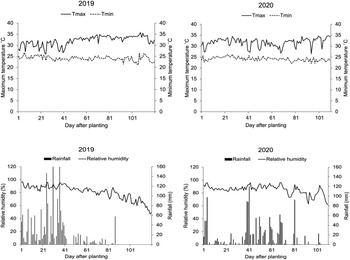
The years were similar for minimum and maximum temperature (Fig. 2). The minimum temperature was 24.1°C in 2019 and 24.1°C in 2020, whereas the maximum temperature was 32.1°C in 2019 and 31.8°C in 2020. The average percentage of relative humidity was 80.9% in 2019 and 84.9% in 2020, and rainfalls were 1905.4 mm in 2019 and 1497.8 mm in 2020.
Maximum and minimum temperature (°C), relative humidity (%) and rainfall (mm) of experimental sites during growing season in 2019 and 2020.

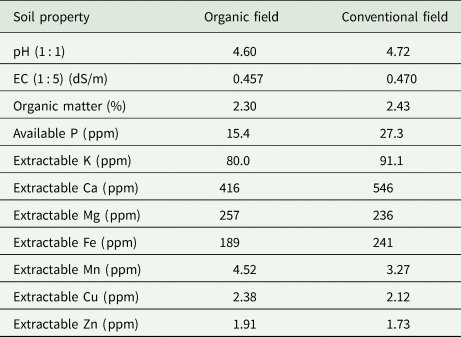
The details of chemical soil properties of the experimental sites are shown in Table 1. The soil of organic field was strongly acidic (pH 4.60) and clay soil with low EC (0.457 dS/m), medium organic matter (2.30%) and medium content of phosphorus, potassium, magnesium and zinc. The soil of conventional field was strongly acidic (pH 4.72) and clay soil with low EC (0.470 dS/m), medium organic matter (2.43%) and high content of phosphorus, potassium, magnesium and zinc.
Soil properties of the experimental sites

For the soil physical properties of Munoh soil series, the topsoil has clay particles and poor drainage. The upper soil is brown or taupe grey. The bottom soil has a clay texture or silty clay (Soil Resources Survey and Research Division, 2017).
Analysis of variance
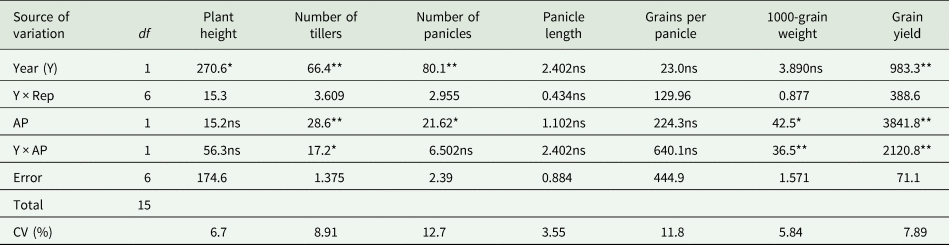
The years were significantly different (P ≤ 0.05 or 0.01) for plant height, number of tillers per plant, number of panicles per plant and grain yield, but they were not significantly different for panicle length, number of seeds per panicle and 1000-seed weight (Table 2). Agricultural practices were significantly different (P ≤ 0.05 or 0.01) for number of tillers per plant, number of panicles per pant, 1000-seed weight and grain yield, whereas the differences between agricultural practices were not significant for plant height, panicle length and number of grains per panicle. The interactions between year and agricultural practice were significant (P ≤ 0.05 or 0.01) for number of tillers per plant, 1000-seed weight and grain yield.
Mean squares for plant height (cm), number of tillers per plant, number of panicles per plant, panicle length (cm), number of seeds per panicle, 1000-seed weight (g) and grain yield (g/plant) of Riceberry rice across 2 years

AP, agricultural practice; CV, coefficient of variation.
ns, *, **, not significant and significant at 0.05 and 0.01 probability levels, respectively.
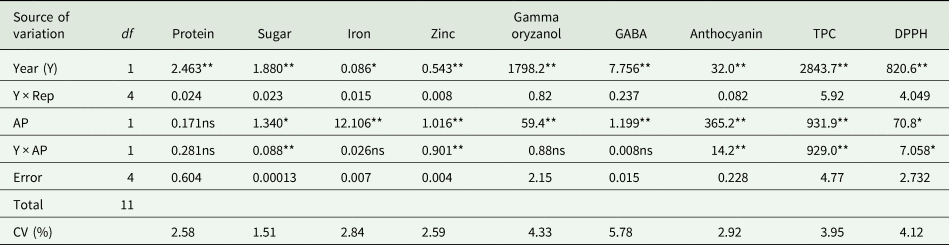
The years were also significantly different (P ≤ 0.05 or 0.01) for all chemical compositions under study (Table 3). Agricultural practices were significantly different (P ≤ 0.05 or 0.01) for most chemical parameters except for protein content. The interactions between year and agricultural practice were significant (P ≤ 0.05 or 0.01) for sugar, zinc, anthocyanin content, TPC and antioxidant capacity.
Mean squares for protein, sugar, iron, zinc, gamma oryzanol, GABA, anthocyanin, TPC and antioxidant capacity determined by DPPH method of Riceberry rice across 2 years

AP, agricultural practice; CV, coefficient of variation; GABA, gamma-aminobutyric acid; TPC, total phenolic content; DPPH, 2,2-diphenyl-1-picrylhydrazyl.
ns, *, **, not significant and significant at 0.05 and 0.01 probability levels, respectively.
For grain yield and agronomic traits, variation in years contributed to the largest portions of total variations in plant height, number of tillers and number of panicles, and variations due to agricultural practice were largest for 1000-grain weight and grain yield. However, the interactions between year and agricultural practice were also important for number of tillers, 1000-grain weight and grain yield.
For phytochemicals and antioxidant activity, year had the largest effects on protein, sugar, gamma oryzanol, GABA, TPC and antioxidant activity determined by the DPPH method (Table 3). Agricultural practice had the largest effects on iron, zinc and anthocyanin, whereas the interactions between year and agricultural practice were important in the variations in zinc, anthocyanin and TPC although the effects were small.
Yield and yield components
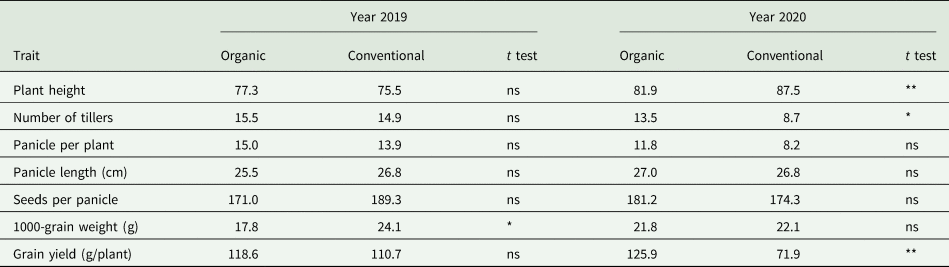
In 2019, variations between organic rice and conventional rice were not significant for most traits except for 1000-grain weight (Table 4). Chemical Riceberry rice had a higher 1000-seed weight (24.1 g) than organic Riceberry rice (17.8 g), and they were similar for grain yield and other agronomic traits. In 2020, significant differences between organic rice and non-organic rice were observed for plant height, number of tillers and grain yield. Organic rice was higher than non-organic rice for number of tillers and grain yield, whereas non-organic rice was higher than organic rice for plant height.
Comparison of yield and yield components of Riceberry rice planted under organic farming and conventional farming for 2 years

ns, *, **, not significant and significant at 0.05 and 0.01 probability levels, respectively.
Protein and sugar
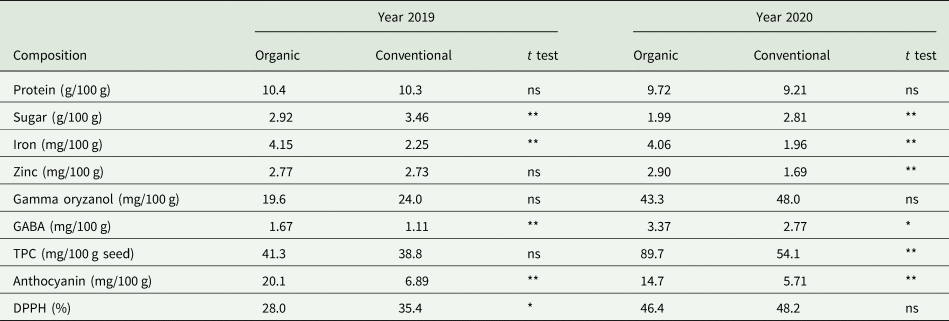
Protein content in rice seeds was similar between agricultural practices across 2 years (Table 5). Protein content ranged from 9.21 to 10.4 g/100 g seed. Sugar content was significantly different between two agricultural practices. The lowest sugar content was found in organic rice (2.92 g/100 g seed in 2019 and 1.99 g/100 g seed in 2020) compared to conventional rice (3.46 g/100 g seed in 2019 and 2.81 g/100 g seed in 2020).
Comparison of chemical composition and bioactive compounds of Riceberry rice planted under organic farming and conventional farming for 2 years

GABA, gamma-aminobutyric acid; TPC, total phenolic content; DPPH, 2,2-diphenyl-1-picrylhydrazyl.
ns, *, **, not significant and significant at 0.05 and 0.01 probability levels, respectively.
Iron and zinc
Iron content in organic rice was higher than that in non-organic rice in 2019 and 2020 (Table 5). Zinc content was not different between agricultural practices in 2019, but the content of this micronutrient in organic rice was higher than that in non-organic rice in 2020. The results might indicate that organic fertilizer was an important source of micronutrients.
Gamma oryzanol and GABA
The content of gamma oryzanol in non-organic rice was higher than that in organic rice in 2019 and 2020 although they were not statistically different, whereas the content of GABA in organic rice was significantly higher than that in non-organic rice in both the years (Table 5). The values of GABA in 2019 were 1.67 and 1.11 mg/100 g seed in organic rice and non-organic rice, respectively. In 2020, the values of GABA were 3.37 mg/100 g in organic rice and 2.77 mg/100 g seed in non-organic rice.
TPC, anthocyanin content and antioxidant capacity (DPPH)
TPC in organic rice were higher than that in non-organic rice in both the years (Table 5). However, significant difference was found in 2020 only. The values of TPC in 2019 were 41.3 and 38.8 mg/100 g seed in organic rice and non-organic rice, respectively. In 2020, the values of TPC were 89.7 mg/100 g seed in organic rice and 54.1 mg/100 g seed in non-organic rice. The anthocyanin content was significantly higher in organic rice than that in non-organic rice in both the years, and the differences were about three times higher. The values of antioxidant capacity were higher in conventional rice compared to organic rice in 2019, but the values were not statistically different in 2020 (Table 5).
Correlations among chemical and phytochemical compositions
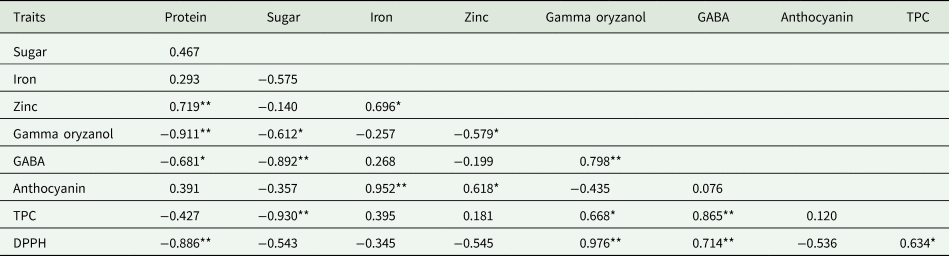
A better understanding on the relationships among chemical and bioactive compositions in rice might help rice breeding and rice production aiming to improve rice quality. In this study, protein was positively associated with zinc (0.719**) but it was negatively associated with gamma oryzanol (−0.911**), GABA (−0.681*) and DPPH (−0.886**) (Table 6). Improvement of rice with high protein and high zinc might be possible if genetic diversity for these characters exists in rice germplasm. However, this should be carried out in separate projects because the increase in protein can cause a reduction in antioxidant activity.
Correlation coefficient of chemical composition and bioactive compounds in Riceberry rice

GABA, gamma-aminobutyric acid; TPC, total phenolic content; DPPH, 2,2-diphenyl-1-picrylhydrazyl.
n = 16.
*, **, significant at 0.05 and 0.01 probability levels, respectively.
Iron was positively associated with zinc (0.696*) and anthocyanin (0.952**). Improvement of these parameters at the same time will be possible. Zinc was positively associated with iron (0.696*) and anthocyanin (0.618*), but it was negatively associated with gamma oryzanol (−0.579*). Improvement of rice with high protein, high zinc and high iron will be possible but it can reduce gamma oryzanol. Anthocyanin was positively correlated with iron (0.952**) and zinc (0.618*). The associations of these traits suggest that improvement of rice with high minerals and anthocyanin is possible.
TPC, gamma oryzanol and GABA were inter-related with correlation coefficients ranging from 0.668* to 0.865**, and these parameters were also associated with DPPH with correlation coefficients ranging from 0.634* to 0.976**. The results suggest that TPC, gamma oryzanol and GABA contributed to DPPH in Riceberry rice.
Discussion
In this study, the performance of organic crop was similar to that of non-organic crop for grain yield and other agronomic traits in the first year. However, grain yield of organic crop was higher than that of non-organic crop in the second year due to its higher tiller number and panicle number.
The reduction in grain yield of conventional rice in 2020 would be due to rainfall. From Fig. 2 although the total rainfall in 2020 was lower than that in 2019, the crop in 2020 received heavy rainfall, which continued for several consecutive days at 40–60 days after planting. Another possible cause of lower yield of conventional rice was poor drainage of the soil as the experimental site was located in lower land and the soil was poorly drained. The authors were not able to set-up the experiment at the same field because it was against the regulations for organic rice production. Long periods of rain caused flooding during the vegetative phase of rice for a period of time. The prolonged flooding caused taller plants because of stem elongation in response to high water level in 2020 (Table 4). As a result, the number of tillers per plant and the number of panicles per plant of conventional rice reduced in 2020 (Table 4). Chomchat and Rungrat (Reference Chomchat and Rungrat2020) also reported that rice had a high elongation in response to flood conditions, and this process used the accumulated energy. Therefore, the flooded crop had a low recovery and had some damaged and dead tillers. Therefore, the higher yield of organic rice in the second year would be due largely to environmental noise rather than the difference in agronomic practices.
Agricultural practice did not significantly affect protein content (Table 3). The protein range in this study (9.21–10.4 g/100 g dry weight) was somewhat higher than that reported previously. Kakar et al. (Reference Kakar, Xuan, Noori, Aryan and Gulab2020) found that the range of protein in rice grains was between 7.6 and 8.7%. The differences in protein ranges among different studies would be due to the differences in rice varieties and types of rice. Japonica rice and indica rice were different in protein compositions and ranges (Yang et al., Reference Yang, Zhu, Xia, Chen and Chen2014). Improvement of high protein in rice through breeding would be possible.
Sugar content was higher in rice grown under conventional practice than that grown under organic practice (Table 5). Low sugar content in organic rice would be due to low nitrogen levels as sugar content was associated with photosynthesis, which was dependent on nitrogen levels (Ibrahim et al., Reference Ibrahim, Jaafar, Rahmat and Rahman2011). Moreover, Mariem et al. (Reference Mariem, González-Torralba, Collar, Aranjuelo and Morales2020) found that the increase in nitrogen supply could increase soluble sugars in wheat grain.
In this study, zinc content in organic rice was higher than that in conventional rice. The increase in zinc content may be due to the higher soil zinc content of the organic plots (1.91 ppm in organic plot and 1.73 in conventional plot). Plants in organic plots could take up higher zinc and stored higher zinc in the grains.
Moreover, GABA content, TPC and anthocyanin content were high in rice grains produced under organic farming system (Table 5). Phenolic compounds are a group of substances that act as important antioxidants. Phenolic compounds are produced in many crop species including fruit crops, vegetable crops, medicinal crops and cereal crops. They are under genetic control and also produced in response to environmental stresses such as drought, saline soil, intensity light and nutrient deficiency (Sharma et al., Reference Sharma, Shahzad, Rehman, Bhardwaj, Landi and Zheng2019).
In this study, total phenolic compounds and anthocyanin in organic rice were higher than in conventional rice. Similar results were also reported in other crop species. In fruit crops, Asami et al. (Reference Asami, Hong, Barrett and Mitchell2003) reported that the levels of TPC in organically and sustainably grown food crops (marionberries, strawberries and corn) were higher than those produced by conventional farming system. Similar results were also found in wheat (Zuchowski et al., Reference Zuchowski, Jonczyk, Pecio and Oleszek2011) and rice (Bagchi et al., Reference Bagchi, Ghosh, Kumar, Chattopadhyay, Sanghamitra, Ray and Sharma2016). Bown and Shelp (Reference Bown and Shelp2016) also reported that GABA increased in response to stress environments. In this study, nutrient deficiency would be the cause of high GABA content and phenolic content in organic rice.
Elevated levels of GABA, phenolic compounds and anthocyanins and low level of sugar content in organic rice would be due to insufficient nitrogen. Nitrogen deficiency induces biosynthesis of phenylalanine ammonia lyase (PAL) enzymes, which are responsible for the synthesis of phenolic compounds. In chamomile (Matricaria chamomilla), a medicinal plant, Kováčik et al. (Reference Kováčik, Klejdus, Bačkor and Repčák2007) reported that PAL activity was significantly higher in N-deficient leaf rosettes compared to control leaves. Moreover, application of chemicals for disease control is not allowed for organic rice production, and, therefore, biotic stresses might also be the cause of high phenolic compounds in organic rice. Biotic stresses also induce phenolic production in plants (Sharma et al., Reference Sharma, Shahzad, Rehman, Bhardwaj, Landi and Zheng2019).
Low sugar content is preferable in high-quality rice as high sugar content can increase blood sugar levels. In this study, sugar content was negatively associated with gamma oryzanol (−0.612*), GABA (−0.892**) and TPC (−0.930**), and it is also negatively associated with DPPH (−0.543) although the association was not significant. Improvement of Riceberry rice with high antioxidant activity, and low sugar content is possible.
In this study, TPC, gamma oryzanol and GABA had high correlations with DPPH. The results in this study supported and were also contradict with previous findings for the contribution of these phytochemicals to antioxidant activity in rice and other crops species. TPC was positively and significantly correlated with DPPH in myrtle (Myrtus communis L.), a folk medicinal plant in Mediterranean region (Medda et al., Reference Medda, Fadda, Dessena and Mulas2021) and in rice bran of different varieties (Jung et al., Reference Jung, Shin, Kim, Choi, Lee, Lee, Park, Woo, Oh and Lee2017). According to Lin et al. (Reference Lin, Pao, Wu and Chang2015) DPPH had strong correlations with trolox equivalent antioxidant activity, gamma oryzanol, tocopherols and tocotrienols in germinated brown rice. However, GABA content and phenolic content were not correlated in paddy rice (Jirapa et al., Reference Jirapa, Jarae, Phanee and Jirasak2016), and Pramai et al. (Reference Pramai, Thongsook, Thanasukarn, Jannoey, Nuengchamnong, Chen, Maulidiani, Abas and Jiamyangyuen2019) did not found significant correlation between GABA content and DPPH. Our results were rather different from previous studies. To the best of our knowledge so far, the authors have not found the good reason for the discrepancy of the results.
Negative or non-significant correlations between anthocyanin and DPPH were found in this study (Table 6). The same results were also reported in myrtle (M. communis L.) (Medda et al., Reference Medda, Fadda, Dessena and Mulas2021). However, positive and significant correlations between anthocyanin and antioxidant activity such as DPPH, 2,2-azinobis (3-ethylbenzothiazoline-6-sulfonic acid (ABTS) in wild edible Boletus edulis mushroom (Vamanu and Nita, Reference Vamanu and Nita2013), DPPH in sweet potato (Ipomoea batatas L.) (Nakagawa et al., Reference Nakagawa, Ohmura, Toshima, Park, Narasako, Hirano, Otani and Kunitake2021) and ABTS in myrtle (M. communis L.) (Medda et al., Reference Medda, Fadda, Dessena and Mulas2021) were also reported.
In a previous study, phenolic content contributed antioxidant capacity in Riceberry rice, but anthocyanin content was not correlated with antioxidant capacity (Settapramote et al., Reference Settapramote, Laokuldilok, Boonyawan and Utama-ang2018). The results in this study were in agreement with those of the previous study. Differences in the results among different studies would be due to differences in the methods used and other methods should be explored in further studies.
Conclusions
Organic crop and conventional crop were similar for yield and yield components in the first year. Organic rice provided lower sugar content and higher nutrients such as iron and zinc, which are useful to health. Organic rice also had higher bioactive compounds such as gamma oryzanol, GABA and TPC, which contributed to high antioxidant activity in Riceberry rice. The results indicated that organic agricultural practice could increase the accumulation of minerals and bioactive compounds in Riceberry rice. Other rice varieties of healthy type should also be studied.
Author contributions
C. A., J. K. and P. T. conceived and designed the study. J. K. and C. A. conducted data gathering. C. A. and J. K. performed statistical analyses. C. A. and J. K. drafted the manuscript. C. A. and P. T. revised the manuscript and approved the final version. All authors read and approved the final manuscript.
Financial support
This work was supported by the Thailand Research Fund under Grant 6121096 and the King Mongkut's Institute of Technology Ladkrabang under Grant 2563-02-04-021.
Conflict of interest
The authors have no conflicts of interest to declare.