


Introduction
This paper reports a qualitative study looking at the experience of dialectical behaviour therapists who work in the NHS. Dialectical behaviour therapy (DBT) was initially developed by Linehan (Reference Linehan1993a) to work with women who engaged in suicidal and self-harm behaviours and met the criteria for borderline personality disorder (BPD). Its aims are to teach, strengthen and generalize skills in tolerating distress and regulating emotions, thus working towards the overarching goal of achieving a life worth living. DBT is now recommended in National Institute for Health and Care Excellence (NICE) guidelines as a frontline treatment for service users who display symptoms associated with a diagnosis of BPD (NICE, 2009).
The criteria for the diagnosis of BPD, as specified in the fifth edition of the Diagnostic and Statistical Manual of Mental Disorders (DSM-V), include unstable personal relationships, impulsivity, recurrent suicidal behaviours or threats, self-harm, dissociation, paranoid thoughts and unstable mood (American Psychological Association, 2013). Individuals with characteristics associated with BPD have often grown up in an invalidating environment, which contributes to the development of strategies to regulate emotions that are both harmful to the individual and challenging to services, such as self-harm and suicide attempts (Linehan, Reference Linehan1993a). DBT was introduced in the UK National Health Service (NHS) in order to work therapeutically to teach these individuals to develop skills to reduce their distress and reliance on more risky behaviours (Feigenbaum et al., Reference Feigenbaum, Fonagy, Pilling, Jones, Wildgoose and Bebbington2011).
As developed by Linehan (Reference Linehan1993a,Reference Linehanb), DBT is delivered via four modalities: individual therapy, telephone coaching and skills training groups, and consultation (‘consult’) groups for therapists. NICE (2009) guidelines state that DBT should be delivered as concurrent weekly individual psychotherapy and group skills training for a contracted length of time, as described by Linehan's (Reference Linehan1993a) model. Individual therapy focuses on changing problematic behaviour via problem solving, exposure, contingency management and skills training (Linehan, Reference Linehan1993a), with skills training groups teaching skills in distress tolerance, interpersonal effectiveness, emotion regulation and mindfulness (Linehan, Reference Linehan1993b). Telephone coaching aims to aid the generalization of skills use into the service users’ natural environment (Linehan, Reference Linehan1993a). Therapist consult groups bring the team of DBT therapists together, operating as a source of team supervision and support. In order to practise as DBT therapists, clinicians must have initial and ongoing training in the model. This includes learning to apply DBT techniques to themselves (Swales, Reference Swales2010a), analysing their own behaviour both inside and outside the therapy space. They are also expected to ‘practise, model and teach’ DBT principles and techniques (Swales, Reference Swales2009, p. 168).
Although research into the efficacy of DBT (e.g. Feigenbaum et al., Reference Feigenbaum, Fonagy, Pilling, Jones, Wildgoose and Bebbington2011) suggests that it is effective for people with BPD-related difficulties, in a real world service context, various barriers to its successful implementation have been identified. Linehan et al. (Reference Linehan, Cochran, Mar, Levensky and Comtois2000) found that therapists providing a range of therapies (including DBT) to service users who met criteria for BPD can find the work stressful, partly because of the demands of working with this population, but also because of the high expectations in terms of therapeutic outcomes, which were shown to be linked to a risk of burn-out. Working with individuals with difficulties associated with BPD can be particularly stressful, often leading to increased negative emotion for the professional, which can affect their work with clients (Fonagy et al., Reference Fonagy, Gergely, Jurist and Target2004). However, early DBT research showed that the core features of DBT organization such as teamwork, supervision and mindfulness can protect staff against the burn-out associated with working with this population (Perseius et al., Reference Perseius, Kaver, Ekdahl, Asberg and Samuelsson2007). This is supported by findings from more recent research. Crawford et al. (Reference Crawford, Adedeji, Price and Rutter2010) studied burn-out levels of staff in community personality disorder services, and found there were certain protective factors that can be built into service structures including strong team work, peer support, and whole team supervision. Regular, reflective forums for staff working with service users with BPD diagnoses have also been shown to be crucial in delivering effective services (Crawford et al., Reference Crawford, Price, Rutter, Moran, Tyrer, Bateman, Fonagy, Gibson and Weaver2008). All of these elements reflect the core features of DBT.
Other barriers to the successful implementation of DBT include lack of adherence to the principles of the model and adaptation of the programme for populations where efficacy has not been demonstrated (Swenson et al., Reference Swenson, Torrey and Koerner2002). These issues highlight the crucial role played by the staff who deliver DBT in optimizing its efficacy. DiGiorgio et al. (Reference DiGiorgio, Glass and Arnkoff2010) surveyed 116 DBT therapists to investigate how they delivered DBT and integrated it into other therapeutic approaches. The findings suggest that the way DBT is integrated into other approaches depends on the therapist's existing theoretical orientation. Where therapists had a behavioural orientation and intensive DBT training they were more likely to integrate the group skills, consult and telephone coaching aspects. Non-behavioural therapists favoured integrating mindfulness. They found greater model adherence when the service user had a diagnosis of BPD, perhaps due to the need for more containing treatment approaches when working with this service user group.
The service context
The study reported here was conducted in a single NHS trust in England. DBT was being delivered in the locality by 24 members of staff working in three DBT teams made up of social workers, community psychiatric nurses and clinical psychologists. This was a newly created service, with most teams being operational for less than two years. All team members also worked in adult Complex Care and Treatment Teams (CCTTs), but had been trained to deliver DBT and had protected time to do this for two days per week. The aim of the study was to develop an understanding of the experiences of staff delivering DBT whilst also having a role within secondary adult mental health services.
Method
Design
This study used a qualitative research design, utilizing semi-structured interviews and thematic analysis (Braun and Clarke, Reference Braun and Clarke2006), informed by a phenomenological epistemology (Giorgi and Giorgi, Reference Giorgi, Giorgi and Smith2003) in order to develop an understanding of how participants made sense of their roles.
Ethical approval
The project was reviewed and ethical approval granted by Lancaster University's University Research Ethics Committee.
Participants
The sample consisted of six professionals from different professional backgrounds who were working as both DBT therapists and practitioners in secondary mental health services. Participants were recruited from a pool of 24 staff, spread across the three local DBT teams. An email was sent, with participant information, to all DBT therapists in the participant pool (24 potential participants), asking them to opt in, by sending an email to the author who would be conducting the interviews. Six therapists opted in and six were interviewed, representing a spread from all three teams. Demographic or other identifying information, such as information about specific roles held in other teams, was not explicitly gathered in order to preserve anonymity within such a small participant pool.
Data collection
Individual interviews with participants were conducted between September and November 2013. Interviews were conducted by the first author, then a trainee clinical psychologist with training in conducting interviews for qualitative research and thematic analysis. Staff were initially asked to explain their role and were asked questions about their experience of delivering DBT in the NHS, their experience of working within the model and their views on the way DBT was being delivered. An interview schedule was generated by two members of the research team, one who was a practising DBT therapist, also considering the existing evidence base and research question. For example, some questions explored participants’ experience of DBT training (what was DBT training like for you?), their work life (can you tell me what a normal working week looks like for you?) and practical demands of being a care coordinator/ practitioner and a DBT therapist (what is your practical experience of fulfilling both roles?). The same questions were asked of all participants, although follow-up questions differed and in later interviews there was some refinement of questions to explore emerging themes.
Data analysis
Thematic analysis was used to analyse the data, based on Braun and Clarke's (Reference Braun and Clarke2006) six-step approach. This involved transcribing each interview verbatim, coding each line of transcript, grouping codes into themes, refining these themes and finally checking how well they represented the transcripts. This process was conducted by the first author, with the second author checking coding and theme development. This was achieved by the first and second authors coding sections of transcripts separately then comparing the codes generated, coming to consensus on the most appropriate codes to use. This was done at various points throughout the data collection period, with discussions around emerging themes and codes also threading through the data collection period. Finally the analysis was written up, selecting participant quotes to illustrate each theme.
Results
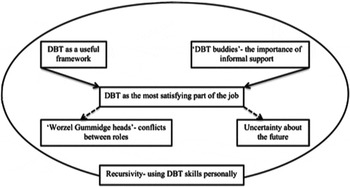
Analysis of the written transcripts revealed six themes: DBT as a useful framework; DBT as the most satisfying part of the job; ‘Worzel Gummidge heads’– conflicts in roles; ‘DBT buddies’– the importance of informal support; uncertainty about the future; and recursivity – using DBT skills personally.
Theme 1: DBT as a useful framework
This theme captures the value of the DBT approach for participants as a framework for practice, not just in their role as DBT therapists. For example, participant one said ‘It's helped me have a very clear idea of how to work with people with personality disorder and what's helpful and what isn't helpful’. They were talking about using DBT skills and the DBT approach in telephone coaching, for example, with service users who were not enrolled in a DBT programme, or using Linehan's biosocial model (Reference Linehan1993) to understand distress with service users beyond the DBT programme. There was a sense that DBT offered ‘a consistent approach’ (participant 1) in an often challenging and chaotic working life. There was some concern about using DBT as a framework for wider practice, following a serious untoward incident in the trust and a resulting directive that DBT therapists must not say they are ‘doing DBT’ unless under certain conditions, which caused confusion and frustration for participants. They felt that they could not turn off their knowledge of DBT in other working roles: ‘it's very difficult not to use that knowledge you've learned, it's difficult not to let that come into your care coordination work with people, because you can't unlearn what you've learned’ (participant 4).
Participants felt they finally had a tool that worked with a potentially high-risk population: ‘it's the first time I've come across anything in all my years of nursing that's [helpful in working towards recovery]’ (participant 1). The approach was so different to anything that had been done previously, particularly in sharing responsibility and risk with the service user and the team: ‘It's about letting some of that go, thinking yes it could be a risk but I'm not entirely responsible’ (participant 4) and ‘It's not just this big cloud of risk’ (participant 5). DBT was seen as offering a sense of certainty about what course of action to take: ‘I feel safest on those two days of the week. I feel like I know exactly what I'm doing’ (participant 6).
As well as offering a different approach, DBT was seen as representing a different philosophy and attitude towards service users:
Very different [to previous work] because it gave answers as to why people do things, rather than, in the care coordination days, people are in distress and you feel they must be manipulative, attention seeking, having a whole different understanding about why they're doing what they're doing (participant 5).
For most participants DBT was a completely new way of working, which most found ‘liberating’ (participant 4). Their evolution into DBT therapists also meant other influences, such as original discipline, was subsumed into a DBT informed approach: ‘we're becoming more DBT-ish as opposed to social worker-ish or nurse-ish. That's my feeling’ (participant 5).
Whilst it was a very new way of working, DBT also empowered participants to try out techniques that they had previously been aware of, but which they now had a more formal understanding of the evidence base for.
In the past, before using DBT I would use metaphors and stories to make points and I would get strange looks in my early years of nursing when I did that so I just stopped it! So that's kind of reignited that and it feels like, yeah this is quite good and I've found it easy to find stories to emphasize a point about something. (participant 4).
Participants tended to favour certain DBT techniques that fitted in with their previous ways of working or that were familiar to them, using the supervision of the consult to shift the focus of such an emphasis or reliance on the familiar: ‘I think the behavioural experiments, I've got no experience in doing that so it doesn't spring to mind when I'm thinking of solutions. That's something I'd pick up from consult’ (participant 4).
DBT offered a more boundaried way of working than other roles, ‘it's pretty predictable’ (participant 3). There was a sense that having a protocol to rely on, particularly when starting out as DBT therapists, was useful in relieving anxiety and providing some reassurance that they were doing DBT in the correct way: ‘there was a good structure and DBT is quite a concrete, skills-based approach’ (participant 3).
Theme 2: DBT as the most satisfying part of the job
This theme captures the sense that DBT was the role that was most ‘rewarding’ (participant 3) for participants, giving them the ‘most satisfaction’ (participant 6). However, this satisfaction was at times offset by the stress of the working environment.
It was clear that being able to see individual service users moving towards recovery and seeing the therapy through gave a certain ‘buzz’ (participant 1) to participants. Another aspect of the role that made it more satisfying than other roles was the peer support and the sense of shared responsibility and workload: ‘we take it in turns to do the skills group due to staff sickness and people being off for one thing or another’ (participant 1). DBT work was seen as ‘a breath of fresh air’ (participant 1) compared with other CCTT work, which was seen as isolating, stressful and bureaucratic. Participants were keen to stress that although they preferred their DBT role it was still challenging, but not as overwhelmingly stressful as their other roles. Furthermore, having DBT as a weekly escape made other parts of participants’ jobs seem less stressful: ‘DBT does feel like a calmness in a storm at times, it's felt like an escape, which has been really helpful for me because when the overwhelmingness of CCTT work is getting there, you know you have escapes coming’ (participant 5).
Unfortunately the stress of the many roles expected of participants undermined this job satisfaction: ‘I love DBT and wouldn't change that bit for the world but the rest of the job just makes it such hard work’ (participant 6). Participant 5 described feeling ‘resentful’ of work encroaching on personal life, with DBT making this more likely as it meant that participants were more thinly spread over each of the roles expected of them. Furthermore, becoming DBT therapists was also time consuming, with ongoing learning done in participants’ own time.
Theme 3: ‘Worzel Gummidge heads’– conflicts between roles
Participants had a number of different roles alongside their DBT role including specialist practitioner in personality disorder, care coordinator, social worker, nurse, approved mental health professional, best interests assessor and supervisor to other colleagues. It was clear that at times these roles conflicted in a number of ways.
The most obvious conflict was in terms of time pressure; participants felt that there was not enough time in their week to fulfil all roles to their desired standard. ‘A manageable workload’ (participant 5) was something that participants felt was needed but impossible given current demands: ‘It doesn't really fit into three days [laughs] to be perfectly honest’ (participant 6). An added complexity to this theme was that, when time pressures caused conflict between roles, it was mostly DBT that suffered: ‘it's difficult to keep that full two days out for just DBT’ (participant 1). Therefore in spite of DBT being the most satisfying part of the participants’ jobs, it was also the most difficult to prioritize.
There was a sense of frustration at the seeming lack of organizational commitment to their DBT work: ‘the job itself is not what I thought it would look like when I applied for it, it seemed thought through and now I'm in it it's clear it hasn't been thought through at all’ (participant 6). Participants reported being left to manage their own time, putting in their own boundaries with other staff and service users, often without support from their managers or colleagues. Trying to put in these boundaries with other staff caused anxiety for some participants: ‘for someone like me who doesn't always say no terribly easily it pushes me out of my comfort zone a bit but I've had to really stand my ground with it’ (participant 6).
The sometimes chaotic nature of the work and the need for telephone coaching in DBT often meant trying to ‘engage your brain into DBT mode’ (participant 2), which was not always easy when participants’ other roles were very different from their DBT role. Participant 5 used the metaphor ‘Worzel Gummidge heads’, referring to a children's television character popular in the 1980s in the UK, who was a scarecrow able to attach a number of different heads, endowing him with the skills he needed for the particular situation he was in:
I'll give you a good catchphrase, Worzel Gummidge heads. On DBT days you are thinking DBT, rather than care coordinator, they are very different roles. Care coordinator is trying to solve people's problems for them sometimes, whereas in DBT you're not, it's a whole different way of thinking. So it's difficult to have that mind-set. Sometimes I do get confused (participant 5).
There were also philosophical tensions between different roles, with participants reflecting on the fundamental differences between DBT, which is a therapy based on teaching and coaching individuals to help themselves, and the more traditional approaches used in their other roles: ‘it's hard doing things with different philosophical underpinnings’ (participant 5). Furthermore, these conflicts were evident not only in the different roles undertaken by participants but also in the different services they worked with: ‘it's about as much as possible trying to help people understand that when they go to places where people aren't trained in DBT they're not going to get DBT type interventions, subsequently that might kind of set them back’ (participant 1). Participants felt that rolling out DBT to all mental health teams in the trust would be a positive move but this would involve a lot of training and a massive practice shift: ‘it's like eating healthily, it's not just like picking at a salad leaf on a Wednesday. “Practising healthily!” [laughs]’ (participant 4).
Theme 4: ‘DBT buddies’– the importance of informal support
Participants placed very high value on the informal support they received from their DBT colleagues in terms of coping with the emotional and practical aspects of delivering DBT therapy: ‘I can always contact somebody else you know if the DBT therapist in my team isn't around, there's always someone around who I can contact’ (participant 2). Unfortunately not all participants had other DBT therapists in their workplace, leading them to feel isolated and lacking this informal support: ‘I haven't got any “DBT buddies” within easy access because it does help to have that informal, “have you just got five minutes”’ (participant 6). This was clearly something that was built up informally, within relationships, rather than being a formally set up system of ‘buddy’ support.
Moreover, the importance of this informal support was linked to dissatisfaction with the consult being the DBT therapists’ only form of supervision and all participants feeling that there was a need for formal individual supervision to allow them to reflect on and improve their DBT practice. Thus this informal support served to meet the needs that were not met in consult, or build on the work done in consult.
The difficulties with consult seemed to lie in its recursive nature: ‘In consult it's more about me, asking what's going on for me in the therapy. Not a whole story of I said this, they did that so it's very different’ (participant 5). This focus on the self also made participants feel exposed and so in some consults where there were ‘difficulties’ (participant 1) with team dynamics, for example feeling that there were power differentials between different professions, or simply not getting on with colleagues in consult, the consult did not provide an environment conducive to such exploratory and potentially exposing supervision. The result was that some participants avoided discussing issues in consult, instead discussing them informally:
I do think sometimes there are elephants in the group that we kind of skirt around . . . and you don't sometimes bring stuff because you think, you know, if I raise this will it result in a massive discussion which I don't really want . . . so you would deal with those in that more informal way (participant 2).
However, it was also evident that some consults were experienced as being more supportive than others. So whilst some participants acknowledged feeling inhibited they also felt supported by their colleagues to speak out: ‘I'm human, there are times when I want to keep my own secrets and not talk about things [. . .] but it doesn't mean you don't do it anyway’ (participant 5). Participants acknowledged that although consult was challenging this was a necessary and useful part of practising a therapy: ‘It feels good actually, because your practice improves as a result’ (participant 3). All participants, even those in supportive consults, felt individual supervision was lacking in the DBT model.
Theme 5: Uncertainty about the future
Despite the satisfaction gained from practising DBT, participants felt uncertain about the future of the DBT team and their role within it. Participants felt that DBT was a useful model that should be expanded out across teams but that a specialist team should also be created: ‘a stand alone, so we get referrals in and then we work with those people 24/7 or at least eight till eight, seven days a week’ (participant 1). Unfortunately participants felt that current resource constraints not only made any expansion of DBT highly unlikely but also prevented them from expanding their current roles, and created concern about the sustainability of DBT in the trust:
I'd like to have more than one client, have more days doing it, be doing it in the hospital. Be more interactive, have our own website, be more creative. But at the moment we are being forced or encouraged to do less, which then creates a fear of sustaining it (participant 5).
Concerns around sustainability also centred on a struggle to ‘demonstrate effectiveness’ (participant 3) of DBT, finding a sensitive enough measure for the changes DBT allows service users to make, particularly given that the service did not see many service users at any one time: ‘the future of DBT, well, unless it's invested in it's just not gonna continue [. . .] which worries me’ (participant 4).
Theme 6: Recursivity – using DBT skills personally
Theme 6 relates to participants’ experiences of the recursive aspect of DBT: their experience of the requirement to apply DBT techniques and analysis to themselves (Swales, Reference Swales2010a), scrutinizing their own behaviour both inside and outside the therapy space.
Participants reported benefiting personally from learning DBT skills such as mindfulness: ‘I've struggled with the stress of my job and I think using some of the mindfulness stuff really helps’ (participant 2); ‘when I've been at home, 2 am in the morning, worrying about work I've been able to kind of practise mindfulness and bring myself back to the moment – this is the moment when I have sleepy time. That's been really helpful’ (participant 5).
Using these skills themselves was seen as an important part of DBT, not only for the personal benefits but because this also gave them conviction about their efficacy: ‘They work. I can say with 100% conviction to my patients that I know they work as well. We always say we won't ask you to do anything we haven't experienced ourselves’ (participant 6).
Participants also used their DBT skills personally to cope with the uncertainty about the future of DBT: ‘I veer between being really worried and anxious about it and I end up using my skills otherwise I'd be in a permanent state of anxiety and make myself unwell’ (participant 6) and ‘using the DBT philosophy we just accept it, this is where we're at’ (participant 5).
Discussion
Interaction of themes
The six themes derived from this analysis reflect both the positive and negative aspects of the experience of being a DBT therapist whilst also working in other roles in community mental health teams. Figure 1 shows how these themes interact. It shows participants finding DBT the most satisfying part of their job at the centre, with the other themes adding to (continuous arrows) or detracting from (interrupted arrows) this satisfaction. Having DBT as a framework to use across their practice and having informal support from their colleagues were key factors contributing to participants’ satisfaction with their DBT role. However, the stress of juggling different roles and uncertainty about the future of DBT detracted from this satisfaction.
Interaction of themes

The recursive framework of DBT is depicted as encompassing the other five themes. This theme represents the essential, active ingredient of the DBT model for practitioners. Not only did this enable them to use their DBT skills for themselves, it also gave them common ground with their ‘DBT buddies’ and made them more resilient to the negative aspects of their work. However, in turn, the stress of work challenged their ability to practise DBT skills and undermined their job satisfaction.
Implications for service delivery
Certain aspects of participants’ experience were linked to the way the DBT service from which they were recruited had been set up. For example, consult was the main source of supervision and support for participants, but the inhibition felt by some participants led to them avoiding bringing cases to consult. It has been hypothesized that learning DBT skills would help therapists cope with the potentially anxiety-provoking situation of consult, particularly receiving feedback from peers (Swales, Reference Swales2010a). It is clear from these findings that this is not always the case in practice. It has been suggested that making practice more transparent, for example audio recording individual sessions for the consult to provide feedback on (Swales, Reference Swales2010a), might improve practice. However, these findings suggest that rather than improving practice, such an increase in the scrutinizing role of the consult could lead to even greater levels of anxiety and inhibition in practitioners. Thus before extending their role in scrutinizing individual practice, DBT consult groups should be encouraged to look at their processes and consider why consult is so challenging for some. Further research to understand the differences between consults where this is effective and where it is not would be helpful. Attention should also be paid to how supported DBT therapists feel in their role; feeling unsupported goes against one of the key principles of DBT: that therapists working with this service user group need personal and professional support (Linehan, Reference Linehan1993a).
Interestingly, participants did not speak about working with individuals with difficulties associated with BPD causing stress; rather their stress came from organizational and workload issues. This supports Crawford et al.’s (Reference Crawford, Adedeji, Price and Rutter2010) finding that working with individuals with difficulties associated with BPD does not have to be stressful and that a supportive team can effectively support the practitioner. In our study, participants reported the DBT framework to be containing and supportive, particularly when dealing with potentially stressful issues such as risk.
Therapist stress and resilience
Participants’ resilience in coping with work stress (coming partly from their use of DBT skills) and their clear passion for delivering DBT and working with this service user group seemed to ameliorate some of the negative aspects of their work. Of course a causal link cannot be made between participants’ apparent resilience and their use of DBT skills. It may be the case that these practitioners were initially more resilient, which is why they took on an additional role. Interestingly though, one participant discussed frustrations for the team when new team members joined who brought into the group the stresses of their other roles. This might indicate that while this is an issue initially, new members of consult soon learn to utilize their skills to cope with this stress.
Participants specifically reported using mindfulness skills learnt through their DBT training to deal with personal and professional stress. Mindfulness is a central tenet of DBT but mindfulness courses have also been more widely rolled out in the NHS to help staff cope with stress. Mindfulness interventions have been shown to increase work performance and improve wellbeing, enabling staff to decrease rumination about work-related issues (Cohen-Katz et al., Reference Cohen-Katz, Wiley, Capuano, Baker and Shapiro2005).
Further quantitative and qualitative research is needed to explore the apparent resilience of DBT trained staff in more detail, not just to find out whether having DBT skills leads to increased resilience in the workplace, but also to understand the role of specific elements of the DBT skills framework in that.
This study also raises an issue about the ethics of building staff resilience to cope with heavy workloads. Addressing time pressures and reducing workloads to enable therapists to integrate DBT into their existing roles should be part of organizational preparation for DBT, with managers supporting any changes to workload needed (Swales, Reference Swales2010b). This had not been done in the Trust in which our participants worked, leaving some feeling tricked into taking on a role that had not been realistically advertised. A perhaps accidental consequence of DBT has been to increase staff resilience so that they can cope with such demands, thus reducing the negative impact of this poor organizational preparation. However, in light of the recent Francis report (Francis, Reference Francis2013) which highlights how staff stress and burn-out lead to substandard and uncompassionate care, it might be necessary to consider further the implications of masking an unmanageable workload by boosting staff resilience. Qualitative research in this area could be a useful way to explore these issues.
Integrating DBT
The finding that participants tended towards using those elements of DBT that felt familiar to them mirrors the finding from previous research that DBT therapists integrate techniques of DBT into other areas of practice that are in line with their theoretical leanings (DiGiorgio et al., Reference DiGiorgio, Glass and Arnkoff2010). It suggests that the integration of DBT needs further attention in research and in practice. Recommendations for further research into adherence to the DBT model and the impact of therapists’ experience in delivering the therapy have been made previously (Feigenbaum et al., Reference Feigenbaum, Fonagy, Pilling, Jones, Wildgoose and Bebbington2011). Our findings suggest that the use of supervision through consult is key in enabling practitioners to develop confidence and understanding in how to use those elements of the approach that are not so instinctive. This further underlines the importance of attention being paid to ensuring that supervision and support structures are both well-planned and functioning in a way that meets the needs of therapists and their clients.
Identification with DBT
For all participants there was a sense of conviction when discussing DBT, a distinct belief in DBT as a helpful approach for all service users, whether formally accessing DBT or not. This was mirrored in the way DBT pervades some participants’ personal lives (with positive effect) and their feeling that this was the way every team should operate; perhaps a product of the expectation to ‘practice, model and teach’ DBT principles and techniques (Swales, Reference Swales2009, p. 168). It would be interesting, in future research, to examine this identification with the model. With hindsight, interviews could have focused on what participants knew about the evidence base for DBT and their views on any drawbacks to the model. However, given the support and containment that participants clearly found in the model, especially compared with their CCTT work, our findings suggest it is important to consider the evidence relating to clinical outcomes alongside the wider therapeutic benefits of the DBT service model.
Limitations
There were, of course, limitations to the current study that should be borne in mind. The small sample size of the study, recruiting six participants out of a pool of 24, means that the data may not be entirely representative of the population under investigation and caution should be observed in generalizing the results. Therefore this study aims only to describe the DBT therapists’ experience and draws careful connections between experience and the external environment.
Further, the limited demographic information collected and therefore reported about participants in the population sample also represents a limitation of the study. As discussed, this was a decision made in the interests of protecting participant anonymity. Any inferences from or interpretation of the study should take this limitation into account.
Conclusions
As participant 4 articulated, DBT is ‘a whole new way of being’. This new way of being was experienced by our participants as offering a supportive framework for their professional tasks and some supportive mechanisms to cope with work and personal stresses. DBT therapist was reported as being the most satisfying job role for participants, although this satisfaction could be negatively impacted by the stress of other roles and the impossibility of competing demands. This indicates that employers should pay attention to the complexity of staff experience and the factors that influence job satisfaction in the modern NHS. In addition, adjustments must be made when staff take on additional roles, to address the additional stress this can cause.
The interactions between the themes in this study indicate the importance of the recursive nature of DBT. Not only did it enable participants to use their DBT skills for themselves and increase their satisfaction with their work, it also gave strength to their relationships with other DBT therapists and made them more resilient to work-related stress. This explicit focus on practising of the skills that are taught in therapy is key in DBT and this research shows that it is a key influence on satisfaction of therapists delivering it.
It is clear that, despite competing demands on their time and requirements for unpaid work out of hours, participants in this study were so dedicated to this new way of being and practising, that they were able to face these issues with resilience. This suggests there is a hunger amongst front-line mental health staff, not only for more effective ways of working with a client group that has traditionally been experienced as difficult to work with, but also for ways of working that acknowledge and address the need for staff doing that work to be supported.
Main points
-
(1) For qualified mental health professionals, taking on an additional role as DBT therapist can be both rewarding and challenging.
-
(2) A supportive team set-up and balance between all roles can help to balance out the rewards and challenges.
-
(3) There are some aspects of DBT that need to be carefully considered and their efficacy monitored in real world settings.
Acknowledgements
We thank the dedicated therapists who participated in this study.
Financial support
This research received no specific grant from any funding agency, commercial or not-for-profit sectors.
Conflicts of interest
None.
Ethical standards
The authors assert that all procedures contributing to this work comply with the ethical standards of the relevant national and institutional committees on human experimentation and with Helsinki Declaration of 1975, as revised in 2008.
After reading this paper readers will be able to:
-
(1) Understand some of the issues for mental health practitioners taking on therapist roles, alongside other roles in adult mental health.
-
(2) Understand how DBT teams are set up in adult mental health in the locality specific to the study.
-
(3) Understand important considerations for the delivery of DBT in NHS adult mental health services.



Comments
No Comments have been published for this article.