Implantable loop recorders are a useful tool for long-term continuous heart rhythm evaluation. They have been in use for nearly two decades in the adult and paediatric populations.Reference Bloemers and Sreeram 1 , Reference Krahn, Klein, Yee and Norris 2 Historically, these devices were large and required subcutaneous implantation – below the adipose tissue either just above or below the muscular fascia – or submuscular implantation. With the advent of next-generation devices, Medtronic (Minneapolis, Minnesota, United States of America) has released the Reveal LINQ™ – a minimally invasive insertable device that is 87% smaller than the previous model. The Reveal LINQ™ is implanted subcutaneously just ~8 mm below the skin using a specialised scalpel and tool to tunnel a small pocket for the device. The small incision can then be closed easily with a topical skin adhesive or adhesive tape. Given the smaller size and ease of insertion, the Reveal LINQ™ is more ideal for paediatric use. The device has been used in neonates as well.Reference Hutchinson, Stuart and Walsh 3 Complications in the older-generation implantable loop recorders were rare with infection and migration reported in the adult population and no significant complications reported in paediatric studies.Reference Rossano, Bloemers, Sreeram, Balaji and Shah 4 , Reference Seidl 5 In this study, we report a complication in a child in whom a LINQ™ was inserted and evidently eroded.
Case report
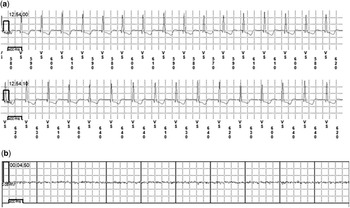
A 6-year-old boy was referred for implantation of a Reveal LINQ™ device for a diagnosis of left ventricular non-compaction with dilated phenotype and incidental accelerated ventricular rhythm found by 24-hour ambulatory electrocardiogram. At the time of implantation, he weighed 20.3 kg, and the procedure was performed under general anaesthesia. The incision was placed in the left parasternal region at the level of the third rib, and the device was implanted at a 45° angle to the sternum towards the left nipple. There were no complications with the implant. The ventricular sensing was 1.5 mV (Fig 1a), and the skin was closed using a topical skin adhesive (DERMABOND™, Ethicon LLC, Somerville, New Jersey, United States of America). The patient was discharged home without complications.
( a ) Initial interrogation. The R-wave measured 1.5 mV. ( b ) Example of transmission after postoperative day 33 with no R-waves present.

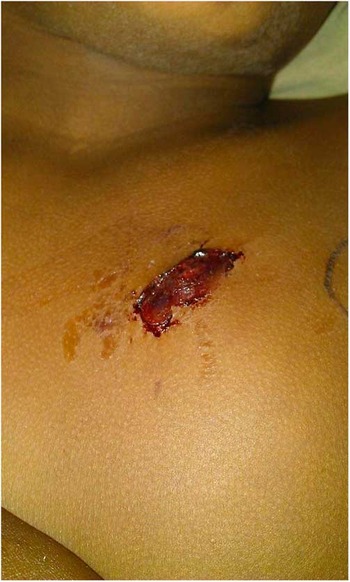
An initial transmission was sent on his fourth postoperative day, and the device was functioning normally; 9 days after implant, the patient’s mother was concerned about bleeding through the adhesive and sent a photo of the incision site (Fig 2). There was no concern for a skin reaction to the adhesive. The bleeding improved, and the patient was seen at the clinic 12 days after implant. The device was in place, and the scar was healing with an eschar and no erythema, bleeding, or discharge, with no residual adhesive. There were no other reported issues with healing after this visit. The patient’s device was programmed for automatic 30-day transmission but there were no transmissions. The patient’s mother was urged to send manual transmissions, but did not send any after the initial test transmission. A low-amplitude transmission was sent automatically with no QRS complexes (Fig 1b) 122 days after implant. The patient’s mother was contacted and she informed the staff that she could no longer palpate the device on the patient’s chest and that she could not send a transmission successfully.
Incision site on postoperative day 4 with dried blood under the skin adhesive.

The patient presented to the clinic 133 days after implant. The device was not present on chest X-ray. After discussion with radiology, further imaging of the shoulders and abdomen were performed to evaluate for migration with no identification of the device. He was then examined with a handheld metal detector over his entire body again with no detection of the device. On further investigation, there were no data recorded since post-implant day 33. Given these data, we concluded that the device eroded out of the skin or was physically removed by the patient. We hypothesised that the device was no longer in place after day 33, but must have been within the household. It is possible that the device came into close-enough proximity to the home monitor on day 122 in order to send a summary transmission. After discussion with the family and the cardiomyopathy specialist, a decision was made to implant a new device, but the family chose not to replace the device.
Discussion
Although Medtronic describes erosion through the skin as a potential complication, there are no known reports of this complication. This patient likely had erosion of his device 33 days after implant. The device was detected on the 122nd day after implant, suggesting that the device was brought within the detection zone of the transmitter device, while outside the patient’s body. The newer-generation implantable loop recorders are particularly appealing for use in children because of the ease of implantation and miniaturisation of the device. Care must be taken specifically in this patient population because of difficulty with physical manipulation of the device by patients. The device is also placed in a more superficial location, and if only skin adhesive is used, wound integrity may be an issue.
In addition, given the recent increase in the use of these devices, a reliable mode of follow-up should be implemented. Although we typically set our devices to send summaries every 30 days, if the device does not come into close-enough proximity to the home monitor, a summary cannot be sent. Although it is straightforward to request a manual transmission for symptoms and discover that there is lack of success in transmission, a family may not realise that summaries are not being sent successfully and a follow-up mechanism should be in place. This particularly becomes an issue if the electrophysiologist who implanted the device is not primarily following-up the patient.
Patient manipulations of implanted devices have been described for almost 50 years since the first publication of “the pacemaker-twiddler’s syndrome”.Reference Bayliss, Beanlands and Baird 6 Since then, this has been reported in the paediatric population as well;Reference Abrams and Peart 7 one can easily imagine the ease with which a tiny loop recorder can be dislodged by picking at the skin adhesive and manipulating the device. We have also found that the pocket in younger children can be tighter, and the device tends to migrate back towards the incision site.
The use of these devices is increasing and is foreseen to continue to expand, particularly in the older population with cryptogenic strokes and monitoring for atrial fibrillation.Reference Tomson and Passman 8 Similarly, it is likely that its use will grow in children as well. Since this patient’s complication, we have begun suturing the subcutaneous layer with one to two interrupted sutures before using the topical adhesive. We feel this improves wound integrity, especially in patients where the pocket is tight and the device may migrate towards the incision. Other unconventional approaches may be considered in the future, such as axillary implantation to avoid device manipulation and may add stability to the device in children. In conclusion, device erosion secondary to trauma or device manipulation is possible, and subcutaneous sutures should be considered to prevent such complications in the paediatric population.
Acknowledgement
The authors would like to thank Diane Proctor, MSN, APRN, CNS for assisting with remote monitoring as well as Timothy Knilans, MD and Jeffrey Anderson, MD.
Financial Support
This research received no specific grant from any funding agency, commercial, or not-for-profit sectors.
Conflicts of Interest
A.S.C. – Medtronic-funded Fellowship; D.S., R.C. – Medtronic-funded Research.
Ethical Standards
The patient was informed of the design and the purposes of the procedures according to Declaration of Helsinki Principles.