INTRODUCTION
In recent years, it has frequently been stated that variationist sociolinguistics and dialect research tend to ignore mobility and speakers’ dynamic and manifold ways of relating to local places (Auer Reference Auer2013; Britain Reference Britain and Coupland2016; Quist Reference Quist, Östman, Sandström, Gustavsson and Södergård2017). Blommaert targets his critique at the Labovian variationist tradition, in which, he argues, ‘the object of study… remains a “snapshot”, in which things are in place’ (Blommaert Reference Blommaert2010:5). Instead, he pleads for a sociolinguistics of mobility that ‘focuses not on language-in-place but on language-in-motion, with various spatiotemporal frames interacting with each other’ (Blommaert Reference Blommaert2010:5). While acknowledging that the study of dialect and variation needs to develop more sophisticated ways to include mobility as a fact of speakers’ lives and experiences, the aim of the study here is to recoup the role of more continuous and historical, as well as practical, ties that connect speakers to their local communities in various ways and to various degrees. Seeing places and mobility as co-constitutive of speaker experiences and practices, this article presents an empirical examination of how speakers’ attachments to places are linked to uses of dialect and nonstandard registers. Based on a comparison of linguistic variation in relation to speakers’ historical and practical connections to the places they live in, we suggest a more sensitive focus on the role of place in dialect research, as we argue here that languages, speakers, and places still appear to be linked in a historically conditioned relationship. Employing a quantified measure, an index of local attachment, a speaker's attachment to their local area is compared to degrees of locally associated nonstandard language use. This index of local attachment (ILA) is an attempt to empirically operationalize (some aspects of) speakers connections to places in terms of mobility histories, local practices, and future orientations.
In the first section of this article, we present and discuss the theoretical ramifications of place attachment and local language use. In the second and third sections, we present in more detail two sites of investigation and the data and methods employed in the study. In the fourth section, we present an account of the results, followed by a discussion and a conclusion.
PLACE AND MOBILITY IN DIALECTOLOGY AND SOCIOLINGUISTICS
In dialectology, the relationship between speakers and places has traditionally been assumed rather than theorized (as argued by e.g. Britain Reference Britain, Auer and Schmidt2010a,Reference Britain, Lameli, Kehrein and Rabanusb, Reference Britain and Coupland2016; Quist Reference Quist, Östman, Sandström, Gustavsson and Södergård2017). Particularly in a European context, dialectology has from its onset been invested in ideologies of national romanticism (as e.g. formulated by von Herder Reference von Herder1772), with the underlying assumption that people, places, and languages are naturally and closely linked (I. Pedersen Reference Pedersen, Gudiksen, Hovmark, Quist, Scheuer and Sletten2009; Quist Reference Quist, Auer and Schmidt2010; Auer Reference Auer2013). Within this tradition, places were treated as—in Auer's words—‘containers’ in which speakers stayed and dialects belonged, making it possible to construct isoglosses on maps (Auer Reference Auer2013:5). This linking together of people, places, and dialects was reflected in the (later much criticized) principles for choosing ‘authentic’ speakers for study (Milroy Reference Milroy2002; Bucholtz Reference Bucholtz2003; Coupland Reference Coupland2003, Reference Coupland, Llamas and Watt2010). The speakers of interest to dialectological analysis were typically those who were born and raised in the same place (farm or village) and had lived there their entire life (Chambers & Trudgill Reference Chambers and Trudgill1980:33). Dialectology's view on places as ‘containers’ (see also Löw Reference Löw and Goodwin2016) and speakers as historically tied to their birthplaces was in many ways adopted by and carried on into social dialectology and variationist sociolinguistics in the 1970s (Labov in the US in the 1970s and Trudgill and others in Europe; cf. Eckert Reference Eckert2003, Reference Eckert, Auer and Schmidt2010; Britain Reference Britain, Lameli, Kehrein and Rabanus2010b:143). However, the inclusion of life-style orientation as in Labov's study of speakers on the island of Martha's Vineyard (Labov Reference Labov1972) and Milroy and Milroy's adoption of network theory (Milroy & Milroy Reference Milroy and Milroy1985, Reference Milroy and Milroy1992) also brought in more nuanced treatments of speakers’ positions and identities relative to their communities. Since it was speaker's relations to (orientation or types of tie in) networks that were the focus, these studies did not directly address or theorize ‘place’ and ‘mobility’ as factors influencing linguistic variation.
Today, the era of globalization has occasioned an increased awareness of the role of place and mobility in sociolinguistics (e.g. Milroy Reference Milroy2002; Johnstone Reference Johnstone, Auer and Schmidt2010a; Britain Reference Britain, Schreier and Hundt2013; Skovse Reference Skovse2018). Although, ‘all the world seems to be on the move’ as the first words of Sheller and Urry's influential article on ‘new mobilities’ reads (Sheller & Urry Reference Sheller and Urry2006:207), a significant line of sociolinguistic research has emphasized the continued importance of speakers’ senses of belonging to places (e.g. Montgomery & Moore Reference Montgomery and Moore2017; Cornips & de Rooij Reference Cornips and de Rooij2018). Johnstone (Reference Johnstone2010b) and others (e.g. Maegaard, Monka, Mortensen, & Stæhr Reference Maegaard, Monka, Mortensen and Stæhr2019) have shown that globalization does not necessarily result in dialect levelling and language loss. On the contrary, Johnstone points to a tendency towards increased dialect awareness that can be seen as speakers’ responses to globalization (Johnstone Reference Johnstone and Fought2004, Reference Johnstone2010b). Others, such as Quist (Reference Quist2018), Thissen (Reference Thissen2018), and Monka (Reference Monka2018), studied how speakers employ traditional dialect and other nonstandard registers to create coherent and meaningful attachments to places. Such studies argue for place and sense of belonging to places as meaningful contexts for speakers in their everyday practices, thus concluding that dialects associated with localities might still prove useful as meaningful resources by some speakers (cf. also Monka Reference Monka, Maegaard, Monka, Mortensen and Stæhr2019).
One way to draw the line between current sociolinguistic positions with regard to place and mobility could be to highlight—as Blommaert (Reference Blommaert2010) does—a contrast between, on the one hand, a linguistics of mobility, which emphasizes the fact that many speakers are not place-stable in the traditional sense, and, on the other hand, a linguistics of place, which emphasizes place as a necessary and meaningful context for speakers. Such a contrast, however, dissolves within the paradigm that in social sciences has been called new mobilities (Cresswell Reference Cresswell2006; Sheller & Urry Reference Sheller and Urry2006). Based on insights from new mobilities, Britain (Reference Britain and Coupland2016) calls for a critical scrutiny of both aspects—mobilities and speakers’ attachments to places:
the ongoing geographical critique of how mobility is imagined, conceptualised and ‘managed’ at two opposing poles—at one end ‘the propensity to see the world in fixed and bounded ways’, at the other ‘a way of seeing that takes movement as its starting point’ (Adey Reference Adey2010:40)—pointing to contemporary mobility theorists’ attempts to carve out a more nuanced middle path between the two, sensitive to the concerns of each. (Britain Reference Britain and Coupland2016:218)
The present study is an attempt to empirically apply such a ‘middle path’ perspective between seeing everything as fixed and ordered in relation to places on the one hand, and everything as movement on the other hand. Rather than seeing them as opposing perspectives, we understand both place and mobility to be central aspects of the factors that shape speaker experiences and practices. Speakers’ linguistic choices are results of complex configurations of past histories (including migration histories), present practices, and mental orientation regarding the future (Monka Reference Monka2018; Skovse Reference Skovse2018) and the past (Fix Reference Fix2014; Carmichael Reference Carmichael2017). Such configurations can play out very differently depending on macro level (power) dynamics, local place histories, physical surroundings, architecture, and other types of affordances—for example, demographic compositions of the local neighborhood, opportunities available and means to move around (public transportation, cars, bikes, mopeds, etc.), and access to education and sport facilities. As a way of operationalizing the complex interplays of place and mobility and their effect on speakers’ present linguistic practices, we thus apply a temporal, dynamic approach aiming to include past, present and future aspects of speakers’ relations to places. We take as our starting point the local community of practice in two different places that contrast in terms of their affordances, that is, where different place and mobility affordances lay out different contexts for young people to engage in local practices. We have studied and compared linguistic variation in an urban, ethnically heterogeneous social housing estate, where regional dialect and multiethnic youth styles are used alongside standard Danish, and a rural, ethnically homogenous village, where traditional dialect and standard Danish are used.
AN INDEX OF LOCAL ATTACHMENT
Operationalizing place attachment
The present study developed from a collaborative research project whose overall aim was to investigate place as a sociolinguistic factor in a time period characterized by globalization and increased mobility.Footnote 1 The research presented in this article is the outcome of a need to develop methods through which we could compare the sociolinguistic findings in the project's two field sites, and at the same time build on and incorporate our theoretical view on places, speakers, and mobilities as co-constitutive. For this, we deployed the notion of place attachment.
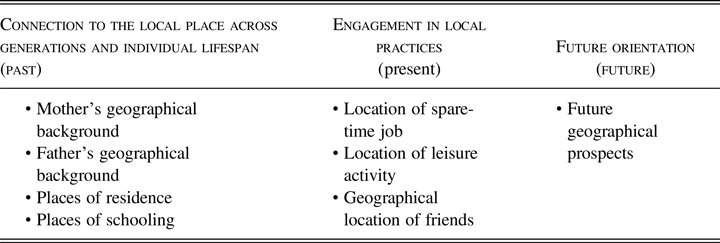
Place attachment is used in different academic approaches, resulting in a plethora of definitions emphasizing different aspects of place (for an overview see Lewicka Reference Lewicka2011). We adopt a definition proposed by environmental psychologists Hidalgo and Hernández, who, in an influential article from 2001, describe a consensual understanding of place attachment as ‘an affective bond or link between people and specific places’ (Hidalgo & Hernández Reference Hidalgo and Hernández2001:274). However, they themselves criticize this definition for being too ambiguous and difficult to operationalize in empirical research. They therefore also propose a narrower definition of place attachment as ‘a positive affective bond between an individual and a specific place, the main characteristic of which is the tendency of the individual to maintain closeness to such a place’ (Hidalgo & Hernández Reference Hidalgo and Hernández2001:274). Several studies within environmental psychology and sociology have shown a positive correlation between the length of residency in a particular place, the time spent in a given location, and the degree of place attachment (e.g. Hidalgo & Hernández Reference Hidalgo and Hernández2001; Gustafson Reference Gustafson2002; Anton & Lawrence Reference Anton and Lawrence2014; cf. also Lewicka Reference Lewicka2011). Departing from this array of research, the index of local attachment in the present study is the tangible outcome of our operationalization of place attachment. In short, the index of local attachment (ILA) is a quantitative measure of individuals’ past, present, and future attachment to the place they lived in at the time they participated in our study. It is calculated for each participant by seven specific questions, each of which was chosen to indicate a relation to a present, past, or (imagined) future place of living (see Table 1). The way each question is operationalized in relation to the data is presented in detail below.
Factors included in the index of local attachment.

Indexes of local attachment in previous sociolinguistic studies
Although indirectly, via the introduction of network theory into the study of language variation and change, Milroy and Milroy developed a more sophisticated approach to the role of place as an explanatory factor for linguistic variation than variationist sociolinguistics had had up to that point (Milroy Reference Milroy1980; Milroy & Milroy Reference Milroy and Milroy1985). In their study of linguistic change in Belfast in Northern Ireland, Milroy and Milroy found that the type of ties that individual speakers had to other speakers in their local community affected their language. The more close-knit and multiplex network ties, the more local speech forms. Their model builds on the assumption that close-knit networks corresponded with integration into the local community (Milroy & Milroy Reference Milroy and Milroy1985:359). A close-knit network was seen to ‘function as a conservative force, resisting pressures to change from outside’ (Milroy & Milroy Reference Milroy and Milroy1985:362). Mobile speakers, by contrast, were observed to have less dense ties to the local place and were thus more prone to adopting linguistic innovation and using the standard prestige forms. In other words, mobility meant less integration into a local place and therefore reduced use of local forms. The use of network structures to explain language variation and change was adopted in numerous studies (to name a few, Bortoni-Ricardo Reference Bortoni-Ricardo1985; Lippi-Green Reference Lippi-Green1992; Lenker Reference Lenker2000; Watt Reference Watt2002) and has subsequently been developed, discussed, and also criticized (e.g. Murray Reference Murray1993; Türker Reference Türker1995). Particularly relevant to the study presented in this article is Marshall's investigation of sixty-four speakers in the rural village of Huntsley in northern Scotland (Marshall Reference Marshall2004). Marshall found that ‘mental urbanization’ was a more robust predictor of speakers’ linguistic choices than their positions in the local network structure. He developed an index of mental urbanization (the MENURB index) that was a measure of the extent to which speakers oriented towards urban life modes and away from local, rural practices and culture. Among other things, he concluded that ‘the presence of network norms is perhaps a stimulus, but the response the individual makes will be mediated by other factors, such as attitudes’ (Marshall Reference Marshall2004:232). Mental orientation in terms of imagined future prospects was also a central factor in a study of language change over real time by Monka (Reference Monka2013). Using an ‘index of social integration’ Monka investigated the relationship between local attachment and language change among geographically and socially mobile people in three different places. She compared the speech of mobile speakers (who as young adults moved away from the town where they grow up and went to school) to nonmobile speakers (who as adults stayed in the same place they grew up in). Monka found that mobile speakers changed their speech towards the national standard norm already when they were young adolescents, that is, before moving, which made her conclude that their mental orientation away from their local town influenced their language even before they were mobile.
A number of other sociolinguistic studies have employed numerical indices of local attachment with the aim of investigating correlations between place, mobility, and language. In an interdisciplinary collaboration, human geographer Roger Andersson and sociolinguist Mats Thelander developed an ‘index of social integration’ to investigate correlations between geographic mobility and adaptation of new local dialect features among twenty-four speakers who had moved approximately 700 km from Västerbotten to Eskilstuna in Sweden (Andersson & Thelander Reference Andersson and Thelander1994). The questions generating the index related to the geographic background of the speaker's spouse, and whether he/she had raised children locally, worked full-time and had locally born colleagues, was invested in the local community in leisure activities, and also how willing he/she was to move (Reference Andersson and Thelander1994:83). Andersson & Thelander's study showed that a high index score correlated with adaptation of the local dialect in Eskilstuna. Speakers who scored highest on social and cultural integration in Eskilstuna changed their language in the direction of the local dialect (Reference Andersson and Thelander1994:86). Sundgren (Reference Sundgren2002) used a slightly modified version of the social integration index to investigate language change in real time among thirteen nonmobile inhabitants from Eskilstuna in Sweden. Sundgren left out questions regarding full-time job and added instead questions about the geographic background of participants’ parents-in-law and ‘feeling at home’ in Eskilstuna. Sundgren's results showed some interesting differences between male and female speakers: while male and female speakers scored equally high on the index, local integration only correlated with the use of one local dialect variant for the women, whereas the male speakers’ index scores correlated with a whole array of local linguistic features. Thus, Sundgren concluded that local attachment seemed to have a greater effect on men's speech than on women's. In Monka's study (Reference Monka2013, cf. above), gender also turned out to be a significant factor, with female speakers changing their way of speaking more than their male peers, but with less correlation between the integration index scores and their language choices compared to the male speakers. As we see in the following sections, the present study also reveals gendered differences in the ways speakers’ attachments to their localities (as measured by the index) correlate with variation in language use.
A slightly different version of an attachment index was developed in an investigation of the Quebec dialect in Canada by Chambers (Reference Chambers2000). The study used an index of regional attachment based on four questions concerning the speakers’ place of birth, the place where they grew up (from age eight to eighteen), the place they lived in at the time of the study, and the birthplace of their parents. The index made it possible to include migrant histories in the study, and Chambers concluded that a long regional attachment is decisive for speakers’ use of dialect. Burbano-Elizondo (Reference Burbano-Elizondo2008) showed something similar in a study of language and identity in Sunderland, UK. Information about speakers’ self-reported local identity was calculated in terms of self-defining labels, attitudes towards Sunderland, social activity, and attitudes towards the local dialect. Burbano-Elizondo found some correlation between the use of local variants and the index scores. As in Sundgren's, Marshall's, and Monka's studies, correlations turned out to be greatest among male speakers. Moreover, the study indicated that the index was useful as a tool for operationalizing subjective factors in a comparison with ethnographic observations.
Most of the studies mentioned in this section focus on adult speakers, which means speakers who have stayed in the same place or moved to different places over many years of their lives. The study presented in this article, however, focuses on young speakers who are still attending school and who have had little chance, compared to adults, to be mobile (although some of them do have quite extensive mobility histories). As in the above-mentioned studies, we used a set of predefined factors to calculate the ILA. Some of these are the same as those applied by Andersson & Thelander, Sundgren, and Monka, although we left out questions that target factors related to adult speakers, for example, number of locally born colleagues, siblings living in the local community, and the birthplaces of spouses. The following two sections present the study in more detail, its participants, data and methods.
PARTICIPANTS AND PLACES
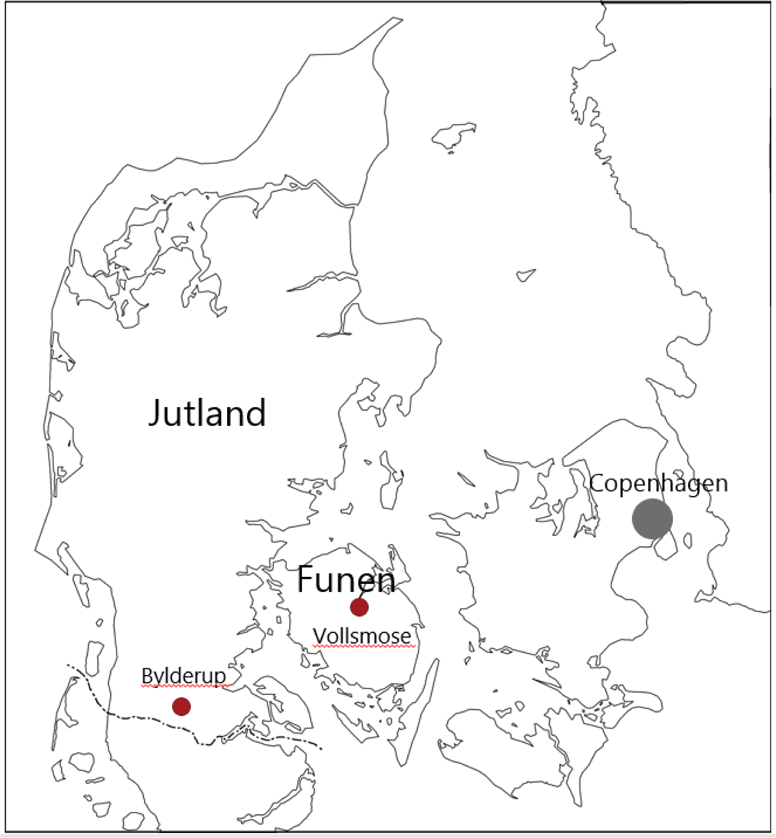
This study investigates the relationship between language use and place attachment among seventy boys and girls (see Table 2) between fourteen and sixteen years of age in the local state schools in Bylderup and Vollsmose in Denmark (see Figure 1). All participants attend the ninth grade, that is, the final year of compulsory schooling. They differ with regard to migration histories, family ties to their communities, engagement in local practices, and their future geographic orientation.
Map of Denmark showing the field sites Bylderup and Vollsmose.

Participants.

Bylderup and Vollsmose are very different in terms of their physical environments, histories, and demographic compositions. Furthermore, they contrast with regard to the types of linguistic resources speakers have access to, that is, the local linguistic ‘feature pools’ that make up the possibilities for creating and displaying different styles and registers (cf. Mufwene Reference Mufwene2001; Cheshire, Kerswill, Fox, & Torgersen Reference Cheshire, Kerswill, Fox and Torgersen2011; Wiese Reference Wiese2013). Bylderup is situated in a traditional dialect-speaking area, with dialect and Standard Danish as the two dominating varieties. In Vollsmose, the linguistic situation is considerably more complex due to the ethnic and linguistic heterogeneity among the speakers. Consequently, regional dialect and Standard Danish are used alongside many different immigrant languages. Additionally, young people in Vollsmose use multiethnic youth style, which is a way of speaking that is associated with young, urban youth with an immigrant heritage (Quist Reference Quist, Kerswill and Wiese2020b; Quist & Svendsen Reference Quist, Svendsen, Putnam and Page2019).
Vollsmose
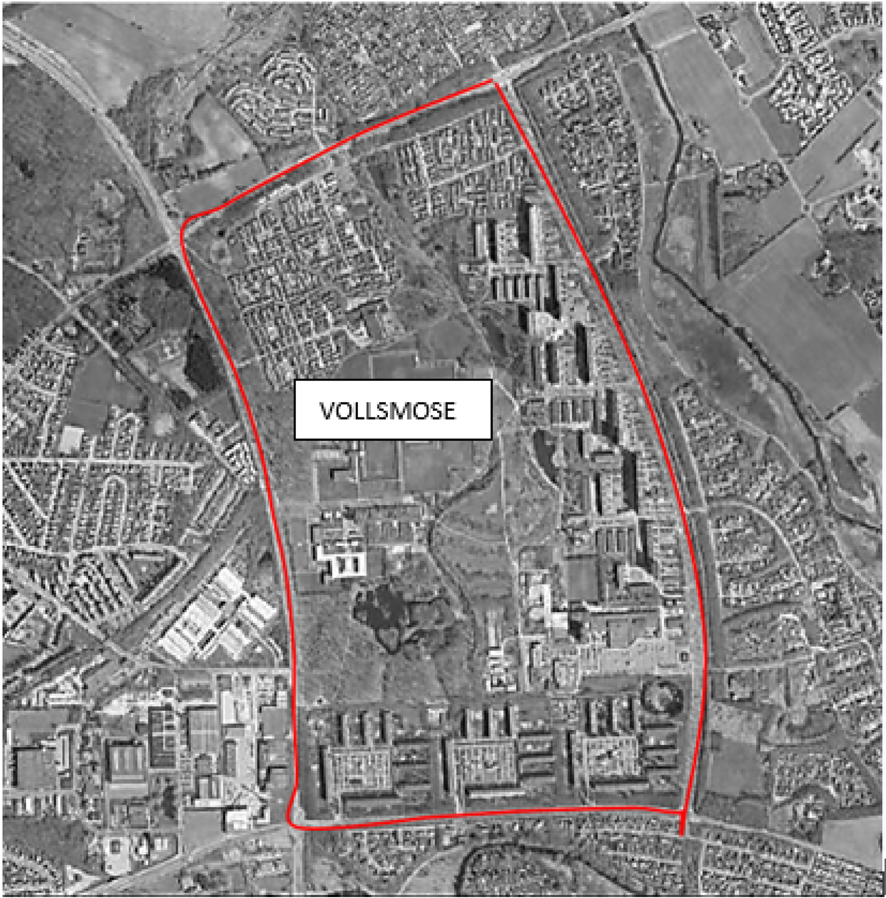
Vollsmose is one of the largest social housing areas in Denmark, built in the late 1960s, with approximately 9,500 inhabitants living in an area of two square kilometers. Most of the buildings are concrete apartment blocks. From its early days, Vollsmose attracted socioeconomically disadvantaged people in need of affordable and spacious housing, causing more affluent people to avoid settling in the area (cf. Mehr Reference Mehr1986). Today, approximately 70% of the inhabitants are from minority ethnic backgrounds, most of them first-generation immigrants and refugees and their children. More than eighty different nationalities live in Vollsmose, the largest ethnic groups consisting of people from Somalia, Iraq, Palestine/Lebanon, Turkey, and Vietnam. With a majority of adult residents dependent on social benefits and with little or no connection to the labor market, Vollsmose is one of the most deprived areas in Denmark (cf. Larsen Reference Larsen and Andersen2008). This fact is reflected in the group of participants, whose parents, with only a few exceptions, are unemployed. Vollsmose has attracted much negative press coverage and has developed a highly stigmatized reputation in Denmark (e.g. Larsen Reference Larsen and Andersen2008). Even though Vollsmose is situated just a few kilometers east of the center of Odense, Denmark's third largest city, the area is commonly referred to as detached from the city for several reasons: the infrastructural organization (Vollsmose is for instance ‘blocked out’ from the surrounding city of Odense by highways that make it difficult to walk or bike out of Vollsmose; see Figure 3), the low employment rate of the inhabitants, and the fact that there are few opportunities to find employment in the local area. This limited interchange with the surrounding areas, together with the heterogeneous linguistic situation caused by the highly ethnically and linguistically diverse group of inhabitants, makes Vollsmose different from the neighboring areas. This does not mean, of course, that people in Vollsmose cannot acquire linguistic features traditionally associated with the region of Funen (the name of the island where Odense and Vollsmose is situated is Funen, and the dialect of the region is likewise called Funen (fynsk)). It might mean, however, that people living in Vollsmose are not exposed to Funen dialect to the same degree as people living elsewhere in Odense, due to the limited contact with people there (cf. also Skovse Reference Skovse2018; Quist & Skovse Reference Quist and Skovse2019).
Bylderup
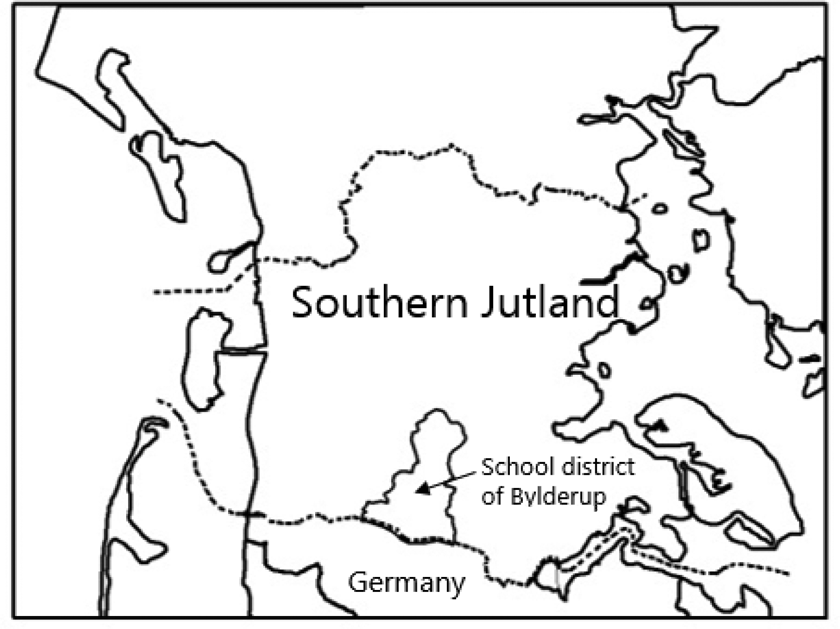
Bylderup is a relatively small village with 1,350 inhabitants in the southern part of Denmark (Southern Jutland). The participants in the study live in the school district of Bylderup, which encompasses a larger geographic area spanning twenty-five kilometers from one end to the other (see Figure 2), including three smaller villages. The school district has a population of 3,680 people, 414 of whom have immigrant backgrounds. Seventeen of these were born outside of Europe. Bylderup is rural and peripheral in the sense that it is situated far from the capital, and there are no urban centers in the vicinity. Socioeconomically, the area is characterized by the fact that—compared to the Danish average—more people are employed in the agricultural sector and fewer have a higher education. The parents of the participants included in the study reflect this: most fathers are self-employed farmers and owners of small enterprises or employed in small manufacturing companies, and most mothers work in the service sector and are mainly public employees.
Map of the region of Southern Jutland and the school district of Bylderup.

With its rural location, Bylderup is part of the so-called Danish periphery, a phrase that does not merely describe a geographical position but also has symbolic and social implications. The dominant discourse in Danish politics and media gives priority to the larger cities, first and foremost Copenhagen, while marginalizing rural areas, whose inhabitants are largely left out of the public discourse, or only mentioned in negative accounts (cf. Beck & Ebbensgaard Reference Beck and Ebbensgaard2009; Winther & Svendsen Reference Winther and Svendsen2012:466; Andersen Reference Andersen2016).
Overall, despite the fact that Vollsmose is more deprived than Bylderup in sociodemographic terms, staying in Vollsmose after finishing primary school may provide more opportunities for further education than staying in Bylderup, since Vollsmose is situated close to high schools, universities, and other educational institutions. In Bylderup, young people have to travel relatively long distances to attend high school, and to pursue higher education they have to move away from the local area altogether (Yndigegn Reference Yndigegn2003). Thus, they are subject to what Farrugia (Reference Farrugia2015) has dubbed ‘the mobility imperative’ for young people from rural areas. In this sense, Vollsmose provides more affordances for its young inhabitants regarding socioeconomic and educational choices. By contrast, history shows that once inhabitants in Vollsmose become socioeconomically upwardly mobile, this is most often followed by geographical mobility. Put plainly, only those who cannot afford to move elsewhere stay in Vollsmose, maintaining the imbalance between the area and the rest of the region (cf. Vollsmosesekretariatet 2001:19). We might therefore speculate that staying in Vollsmose is incompatible with upward social mobility.
The linguistic situations in Vollsmose and Bylderup need to be understood in the context of the Danish speech community in general. Denmark is one of the most linguistically standardized societies in Europe (I. Pedersen Reference Pedersen2003, Reference Pedersen, Auer, Hinskens and Kerswill2005), leaving little room and tolerance for regional variation (I. Pedersen Reference Pedersen, Gudiksen, Hovmark, Quist, Scheuer and Sletten2009; Maegaard et al. Reference Maegaard, Monka, Mortensen and Stæhr2019). When we refer to Standard Danish in this article, it is the Copenhagen standard variety (Kristensen Reference Kristensen2003), which is omnipresent throughout the country in schools, at work, in the media, and so on. We reserve the term dialect for speech that traditionally (by dialectologists and laypeople alike) is associated with a geographic location. However, regional differences in speech are mainly prosodic (Grønnum Reference Grønnum1998), and some even argue that we do not have dialects left in Denmark apart from some regional differences in ‘supra-segmental coloring’ (Kristiansen Reference Kristiansen2009:168). In most parts of the country, this is indeed the case. One exception, however, is the region of Southern Jutland where Bylderup is situated (see Figure 2). People in Southern Jutland still use dialect features that differ from Standard Danish in terms of lexicon, grammar, and phonology (K. Pedersen Reference Pedersen1986; Monka Reference Monka2013, Monka & Hovmark Reference Monka and Hovmark2016; Skovse Reference Skovse2018).Footnote 2 The situation in Odense is more similar to the country as a whole. Here the traditional dialect of the area, Funen, is much more levelled (or standardized). Except from a few segmental and morphological features it is the specific Funen intonation that makes Funen dialect easily recognized and saliently different from Standard Danish (K. Pedersen Reference Pedersen1986; Skovse Reference Skovse2018). Thus, intonation is a central part of the study in Vollsmose (but not in Bylderup where lexicon, grammar, and segmental features appeared to be more salient).
As mentioned, Vollsmose speakers also use features associated with multiethnic youth styles, which are markedly different from Standard Danish and Funen dialect. Across Europe, sociolinguists have documented the emergence of urban speech styles in multilingual neighborhoods (for a recent overview of studies, see Quist & Svendsen Reference Quist, Svendsen, Putnam and Page2019),Footnote 3 and the style features used in Vollsmose are similar to the ones that have been described in studies from Copenhagen (Quist Reference Quist2000, Reference Quist2008; Maegaard Reference Maegaard2007; Madsen Reference Madsen2015). We did not find any usage of multiethnic youth style in Bylderup.
DATA AND METHODS
Over a period of six months, we frequently visited Vollsmose and Bylderup. At each site, we conducted ethnographical research by participating in classes, school breaks, and extracurricular activities. We conducted semi-structured individual interviews with each of the participants and recorded focus group interviews and student counselling sessions. When calculating the ILA, we draw on all available data, but particularly data from the semi-structured interviews and participant observation.
Calculating the ILA
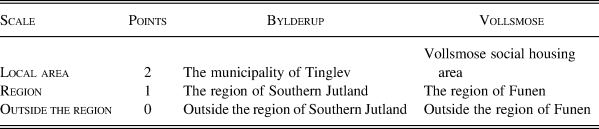
For each participant we calculated an ILA score based on eight factors (see Table 1). Each participant was assigned two, one, or zero points per factor depending on the degree of local connectedness in relation to the eight factors (see Table 3). If, for instance, a participant's mother was born in the ‘local area’, the participant was assigned two points. If the mother was born in the ‘region’, but outside the local area, one point was assigned. If she was born outside the region and the local area, zero points were assigned, and so on for all eight factors. All of the points were added up, divided by eight (the number of factors), and multiplied by fifty, so as to result in a total index score between zero and 100 for each individual speaker.
Points assigned according to geographic delineations.

The ‘local area’ and the ‘region’ are defined individually for Bylderup and Vollsmose. ‘Local area’ in Vollsmose is defined as the housing area called Vollsmose, delineated by highways to the south and east (cf. Figure 3). This area is similar to the participants’ own perception of which areas are included in the neighborhood of Vollsmose. By contrast, we define ‘Region’ as the entire island of Funen (cf. Figure 1), which is the old administrative unit amt (county).
Aerial photo of Vollsmose in Odense with surrounding roads highlighted.

As for Bylderup, previous studies (K. Pedersen Reference Pedersen1986; Monka Reference Monka2013) have shown that the relevant geographic delineation of the ‘local area’ is the kommune (the local municipality), something that was confirmed during our fieldwork. The ‘region’ we define as Southern Jutland (Sønderjylland), which, like Funen, is the old administrative unit amt (county) (see Figure 2).
Information about factors regarding present practices (Table 1) was mainly drawn from the ethnographic fieldwork, whereas information about past mobility and future orientation mainly come from the interviews and the recordings of student counselling sessions. For instance, all interviewees were asked questions about what their plans were after finishing school and where they envisaged themselves living in the future. These questions were asked in slightly different ways in each interview, as illustrated with the examples in (1) and (2), but all together and combined with information from the ethnographic fieldwork and student counselling sessions it was possible to assign an adequate score for each ILA factor for each participant.
(1) Researcher: Where would you like to live when you leave home?
Interviewee: I would say some place in Jutland. That is probably where most of my friends live.
(2) Interviewee: I am not going to stay in Vollsmose when I get older.
Researcher: No? Where would you like to live?
Interviewee: Well, it depends on where I will be studying, in Copenhagen perhaps.
Linguistic variables
In order to compare the ILA scores to language variation, we carried out quantitative analyses of three variables in Vollsmose (one phonological, two suprasegmental; see below), and three variables in Bylderup (one phonological, one lexical, and one morphosyntactic). We transcribed all semi-structured interviews and coded the chosen variablesFootnote 4 using Praat.Footnote 5 As we discuss below, the variables chosen for the analyses are quite different in Vollsmose and Bylderup. In Bylderup, the variables include traditional dialect features that are either present in speech or not, which makes quantification simple. In Vollsmose, the variables comprise features associated with two different registers, the regional Funen dialect and a multiethnic youth style. Moreover, they include nonbinary suprasegmental variables as well as one segmental, phonological variable.
For each speaker then, we added up the number of nonstandard variants and calculated a total score, a ‘nonstandard score’ that we could compare to the ILA score.
Linguistic variables in Bylderup
In the selection of variables for the present study, we draw on the results from Monka & Hovmark (Reference Monka and Hovmark2016) who conducted quantitative analyses of seven linguistic variables in Bylderup (see also Monka Reference Monka, Maegaard, Monka, Mortensen and Stæhr2019). Three variables were chosen for further quantitative analysis and comparison to the ILA scores.
(i) OLD DANISH K: The pronunciation of Old Danish K is [ç] or [x] in medial and terminal position, depending on the preceding vowel, for example, piger [ˈpiːçə] ‘girls’ and kage [ˈkɑːx] ‘cake’.
(ii) JEG: In Standard Danish the first personal pronoun ‘I’ is jeg [jɑj]; in the dialect it is æ[ɛ].
(iii) ARTICLE: In Standard Danish the definite article is a postdeterminer, realised by the suffix -en, e.g. møllen ‘mill-the’; in the dialect the definite article is the predeterminer [ɛ], for example, [ɛ ˈmøl], ‘the mill’.
These three variables were chosen for this study because they represent the traditional dialect of the area (K. Pedersen Reference Pedersen1986; Monka Reference Monka2013; Monka & Hovmark Reference Monka and Hovmark2016), and they were frequent enough in our recordings to analyze quantitatively (i.e. there were more than five tokens in the interview with each individual).
As a previous study in the 1980s in a neighboring town to Bylderup showed extensive use of code switching by participants between a Southern Jutlandic dialect and Standard Danish (K. Pedersen Reference Pedersen1986), the speakers in the present study were interviewed twice: first by an interviewer who spoke the dialect, and then again by an interviewer who spoke Standard Danish. Unsurprisingly, interviewees used more local dialect features when interviewed by another dialect speaker, and fewer in interviews with the standard Danish-speaking interviewer. For the present study, we use data from the interviews with the dialect-speaking interviewer since these provide clearer insights into which participants do and do not use the local dialect (see Monka & Hovmark Reference Monka and Hovmark2016 for results for both settings).
Linguistic variables in Vollsmose
The three features chosen for quantification in Vollsmose arguably form part of two different varieties: one traditionally associated with the region of Funen and one associated with ethnically diverse urban areas (i.e. multiethnic youth style).
(i) T: Palatalization of prevocalic /t/ as [tj] rather than Standard Danish [t]. This is a recurrent feature in linguists’ descriptions of the Copenhagen-based multiethnic youth style (Maegaard Reference Maegaard2007; Ag Reference Ag2010; Stæhr Reference Stæhr2010; Madsen Reference Madsen2015), and was found to be prevalent in Vollsmose as well.
(ii) FUNEN INTONATION: This variable concerns regional intonation. The exact characteristics of Funen intonation have only been mentioned in passing in previous studies, but have been described as displaying a rising fundamental frequency (F0) on the tonic syllable, with an even fall in F0 applying to the post-tonic syllable (Pharao, Kristiansen, Møller, & Maegaard Reference Pharao, Kristiansen, Møller;, Maegaard, Gregersen and Kristiansen2015:111; Skovse Reference Skovse2018).
(iii) STACCATO: A number of studies on language use among youth in urban, ethnically diverse areas in Denmark (Quist Reference Quist2000, Reference Quist2008; Ag Reference Ag2010; Christensen Reference Christensen, Quist and Svendsen2010; Madsen Reference Madsen2015) point to a ‘staccato-like’ prosody as characteristic of multiethnic youth style. The impression of ‘staccato’ has been linked to a smaller contrast between phonologically short and long vowels than in Standard Danish, combined with a tendency to omit stød (phonetically a form of creaky voice), and a stress pattern that differs from Standard Danish. Staccato-like prosody is also reported as a feature of multiethnic youth styles in other Scandinavian countries (Svendsen & Røyneland Reference Svendsen and Røyneland2008; Bodén Reference Bodén, Quist and Svendsen2010). On the prosodic characteristics of multiethnic youth styles in Sweden, Bodén comments: ‘Regardless of their original functions, they may now serve primarily as markers of multiethnolect’ (Bodén Reference Bodén, Quist and Svendsen2010:76).
The choice of these three specific features for the present study is based on Skovse (Reference Skovse2018) and (Quist & Skovse Reference Quist and Skovse2019). We found them suitable for quantification in this study because of their saliency as well as frequency. The Funen intonation is the most important indicator of the Funen dialect (see above), the few segmental Funen features being used too infrequently in our recordings to quantify.
Quantifying INTONATION and STACCATO entails some inherent dilemmas, for instance, regarding the length of the passages that are coded. While intonational patterns adhere to stress groups in Danish (i.e. the stressed syllable and the following unstressed syllables) (cf. Grønnum Reference Grønnum1998), the impression of staccato prosody typically adheres to longer stretches of speech since this is the result of an amalgam of different suprasegmental features present at the same time (see above). Thus, the ‘potential’ number of FUNEN codes is higher than the ‘potential’ number of STACCATO codes in passages of comparable length. However, this does not affect the scatter plots and correlation calculations, since what is calculated is the relative connection between each linguistic feature and the attachment scores, not the relation between the linguistic features. It does mean, though, that we cannot include a mean nonstandard score in Vollsmose as we do in Bylderup.
The two suprasegmental variables were coded in a different manner than the segmental ones. When coding for Funen intonation and staccato prosody, we coded an interval of ten minutes of consecutive speech in each interview, adding a code each time a passage was uttered with a regional intonational pattern (using the code FUNEN) or in staccato prosody (using the code STACCATO). This results in an absolute count for these two variables, rather than in a percentage of nonstandard language use as for binary variables.
CORRELATIONS BETWEEN ILA SCORES AND LINGUISTIC VARIATION IN BYLDERUP AND VOLLSMOSE
After calculating the ILA scores and ‘nonstandard’ scores for each participant, results were combined in an x-y scatter plot, in which the data points represent the intersection between each individual participant's ILA score and ‘nonstandard’ scores. When all data points were plotted, a regression line (trend line) was calculated and added to the plot, showing whether any correlations existed between attachment and ‘nonstandard’ scores (see the appendix for results per individual).
Scatter plots for Bylderup
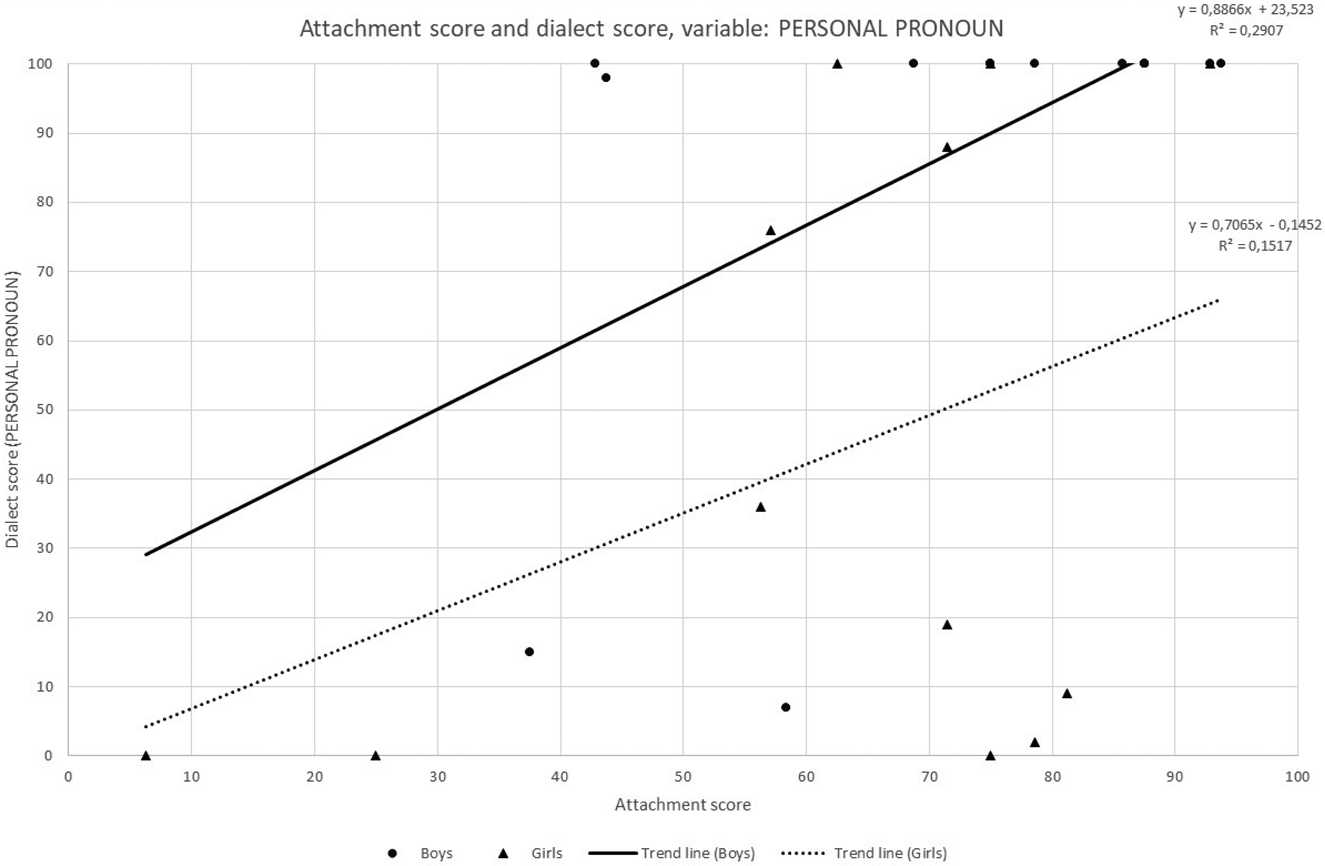
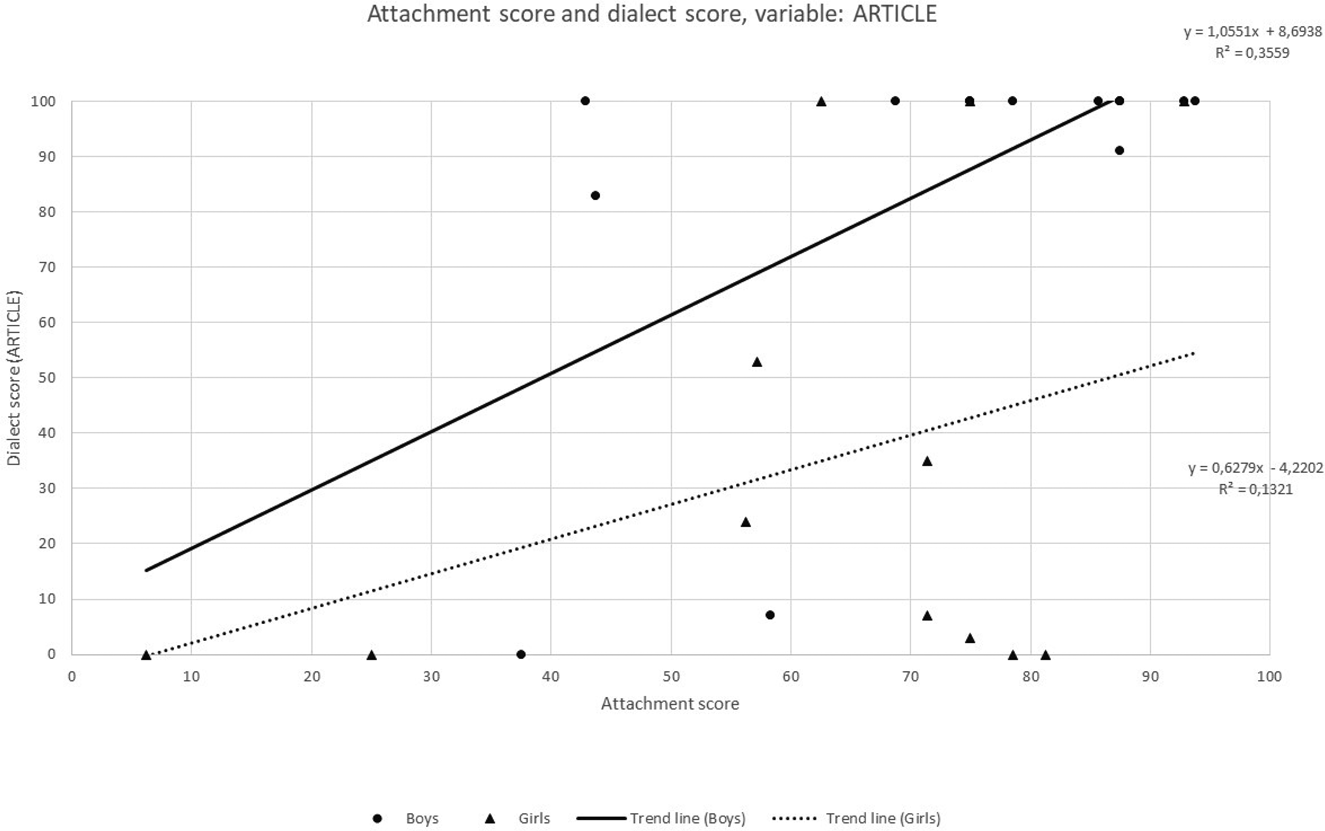
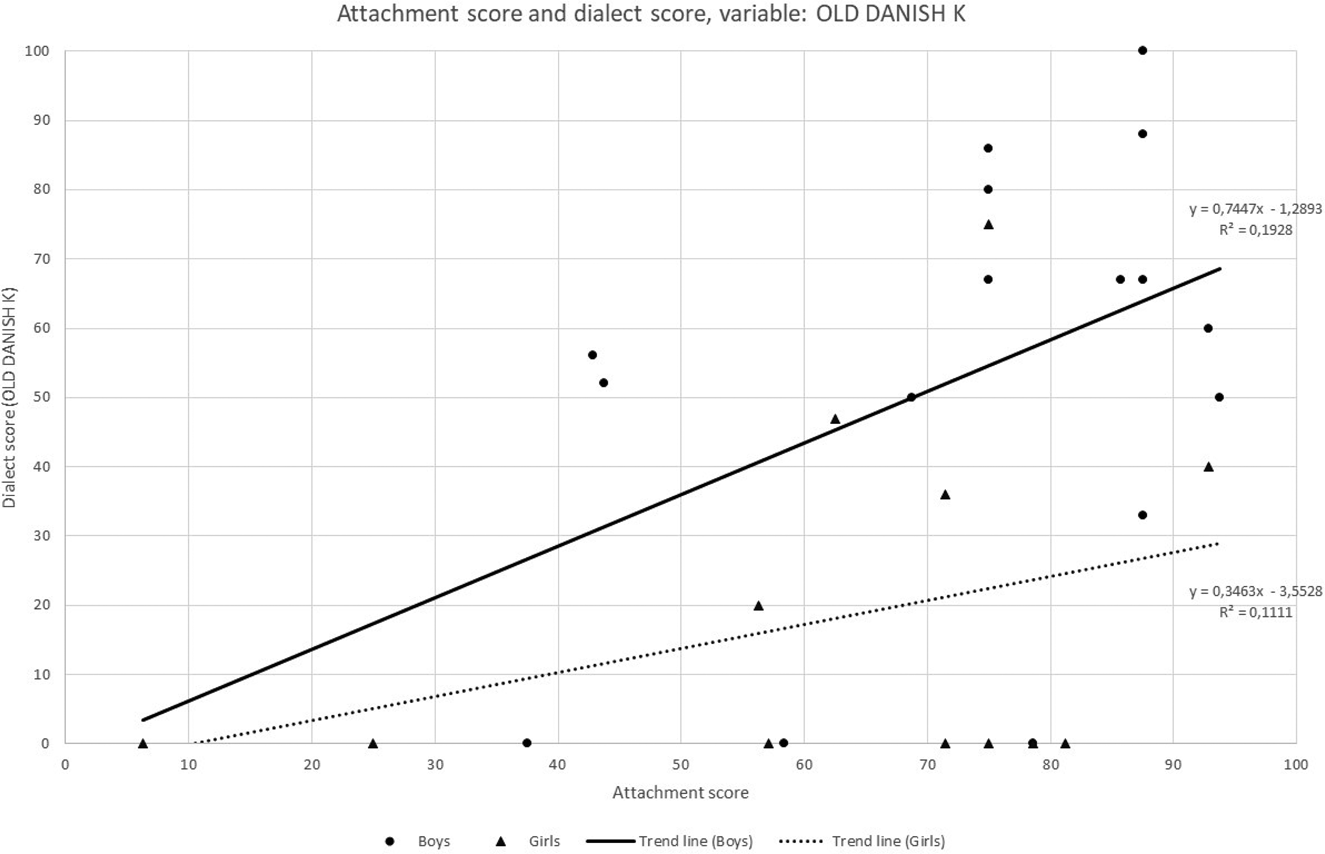
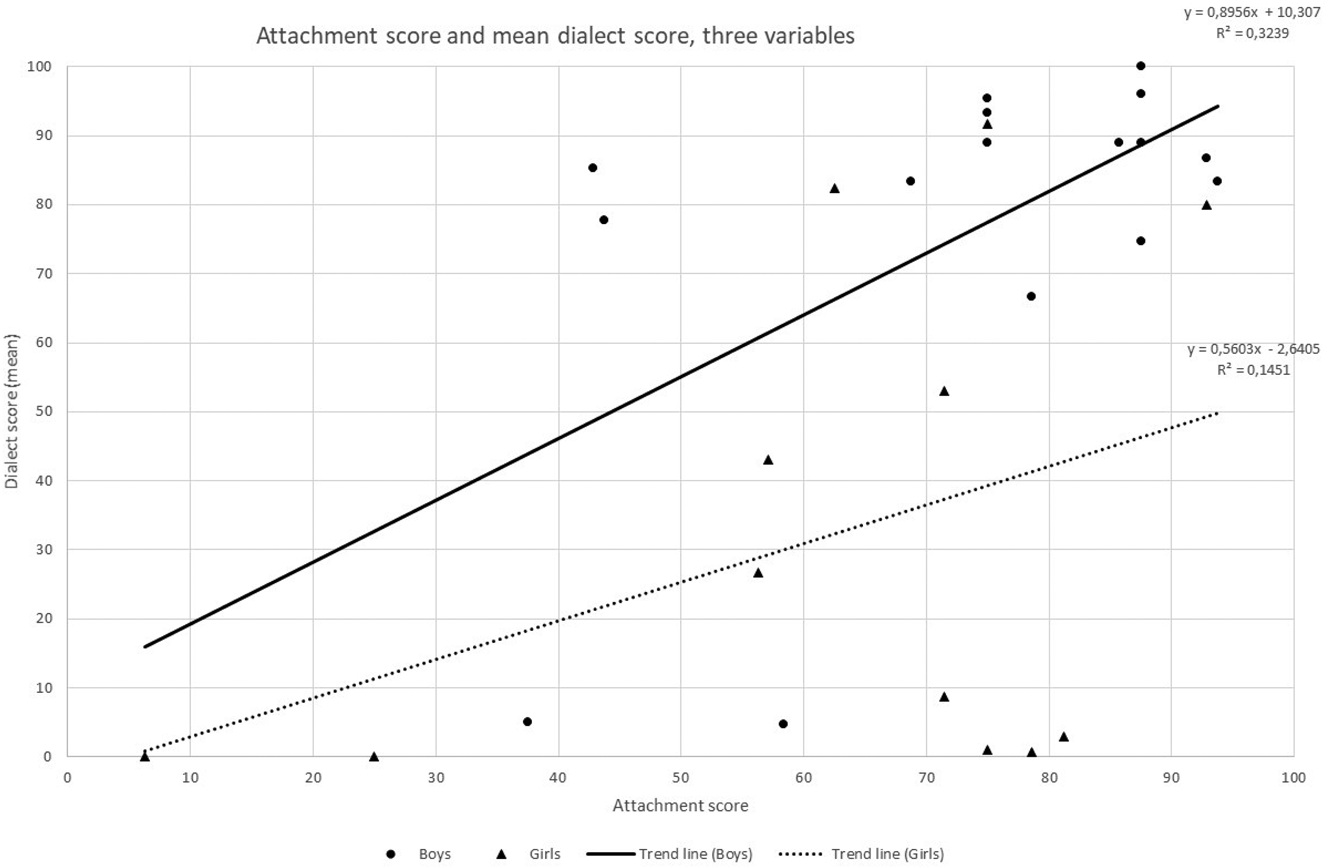
Figures 4–7 below display the results from Bylderup. The scatter plots show the connection between the attachment score and dialect score for each linguistic variable (Figures 4–6) as well as mean dialect score for all three variables combined (Figure 7). As there is a statistically significant difference between the boys’ and girls’ use of dialect variants (p < 0.01; see Skovse Reference Skovse2018), the category of gender has been applied to the scatter plots.Footnote 6
Scatter plot of attachment scores and PERS.PRON with overlaid trend lines.

Scatter plot of attachment scores and ARTICLE with overlaid trend lines.

Scatter plot of attachment scores and OLD DANISH K with overlaid trend lines.

Scatter plot of attachment scores and mean dialect scores for all three variables in Bylderup with overlaid trend lines.

Figure 4 shows the points of intersection between the attachment scores and dialect percentages for the variable PERS.PRON. An overlaid trend line shows a positive correlation between the attachment and dialect scores among both girls and boys. However, the trend line is steeper for boys than girls, indicating a stronger correlation between place attachment and use of the dialect variant for PERS.PRON for boys. Among the girls, four participants show a relatively high attachment score (above seventy) along with no or very low use of the dialect variant of PERS.PRON. This combination—high attachment score and low dialect percentage—does not show up among the boys. In their case, there are two participants with a relatively low attachment score (below fifty) along with a categorical use of dialect variants, a combination that does not appear among the girls. All girls using this dialect variant also have high attachment scores. None of the participants with low attachment scores (below thirty five) uses the dialect variant.
Figure 5, for the variable ARTICLE, shows a similar pattern. While the overall use of the dialect variant in the group as a whole is a little lower than for the variable PERS.PRON, the data points still plot along similar lines to Figure 4. The discrepancy between the boys’ and girls’ trend lines is a little larger than in the case of the variable PERS.PRON.
For the variable OLD DANISH K, shown in Figure 6, we find that participants’ dialect scores are generally lower compared to the other two variables, and there is more gender-internal variation. Only one participant uses the dialect variant categorically. Still, the overall pattern resembles Figures 4 and 5, with a positive correlation between attachment scores and dialect scores, and a stronger correlation among boys than girls.
Figure 7 shows the mean dialect scores for all three variables (the percentages for the variables are added and divided by three), combined with the attachment scores. Unsurprisingly, the pattern is the same as for the individual variables, as they all show the same tendency. For Bylderup, the results thus confirm a positive correlation between place attachment and dialect use for all three variables, as can be seen from the overlaid trend lines in the scatter plots in Figure 7. As is readily apparent, boys in Bylderup use more dialect than girls. There is, moreover, a stronger correlation between boys’ attachment scores and dialect use compared to the girls.
Focusing on the individual speakers, we want to draw attention to two girls and two boys who for different reasons stand out from the other speakers. The triangle in the upper right corner represents Trine,Footnote 7 who has an attachment score of 92.9 and a mean dialect score of 78 (but 100% dialect variants of PERS.PRON and ARTICLE). She has strong historical ties to the local area, as her parents were born close to Bylderup, and she is highly engaged in the local community through leisure activities (handball) and a job delivering newspapers in her neighborhood. Moreover, she expresses a wish to stay in the region when she grows older. At the other extreme, the triangle in the lower left corner, we find Anna, who has the lowest attachment score of all of the participants. She moved to the area six months prior to the fieldwork, and has no previous connection to Bylderup. She only scored two points because of her participation in the local football team. Among the boys, the data points cluster into three different groups. In the group in the upper right corner, the majority (twelve of sixteen) show a positive correlation between dialect scores and place attachment. Four participants stand out as exceptions to this general pattern. Despite having attachment scores in the middle of the spectrum (between thirty-five and sixty), their linguistic behavior is remarkably different. Two of the boys use many local variants, and the other two use next to none. The boys with high dialect scores and relatively low attachment scores both have parents from other countries. Their parents do not use dialect, and the boys therefore must have acquired it from their peers. Below the trend line, we find two other boys, Oliver and Benjamin. Oliver stands out as using next to no dialect variants, even though he has lived in the area all of his life and has always attended the local school. Oliver scores low on one of the factors involved in the lifespan dimension, as his father is from Zealand (Eastern part of Denmark) and he does not wish to stay in the area in the future. The same goes for Benjamin, whose mother is from Poland, and who in the interview expresses a desire to leave the area and pursue a higher education.
Scatter plots for Vollsmose
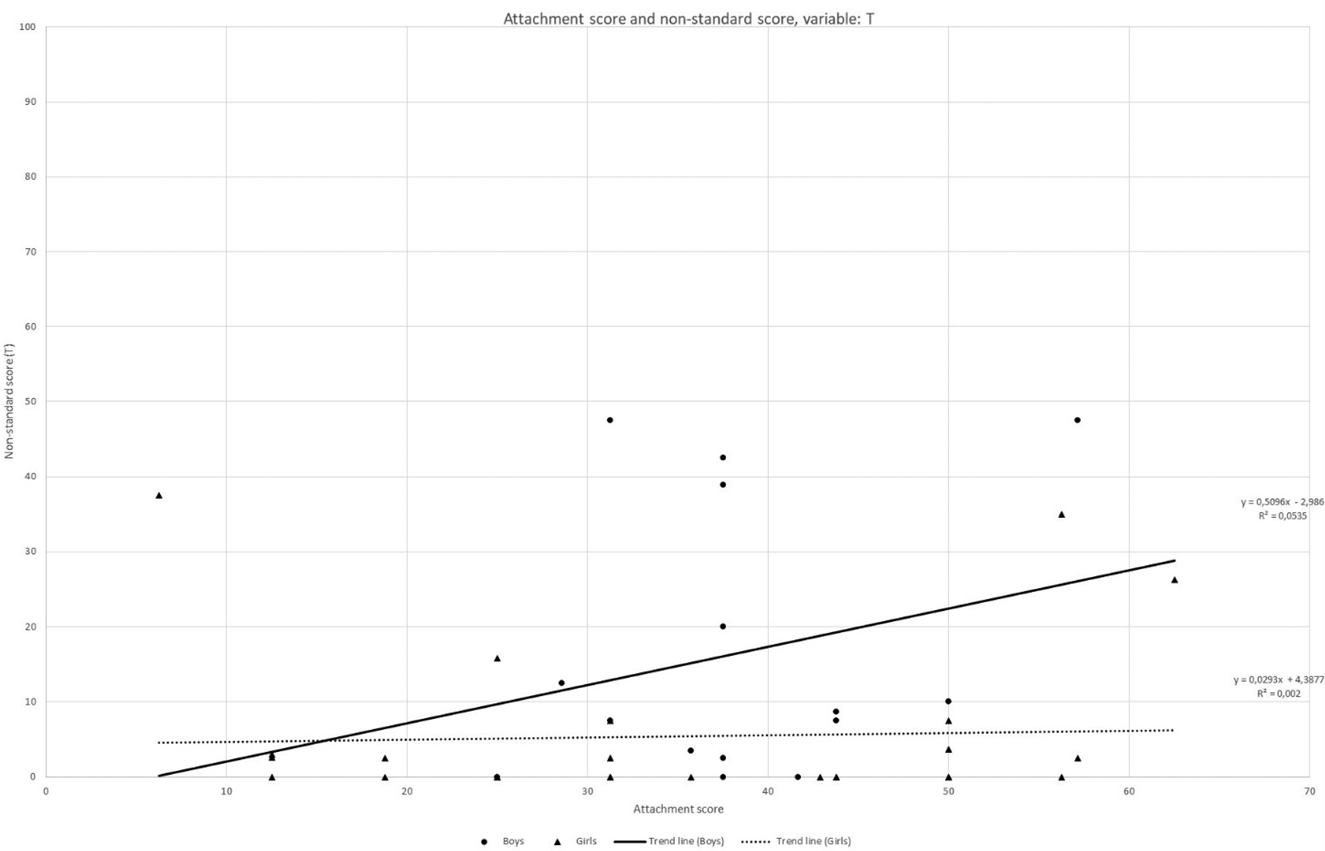
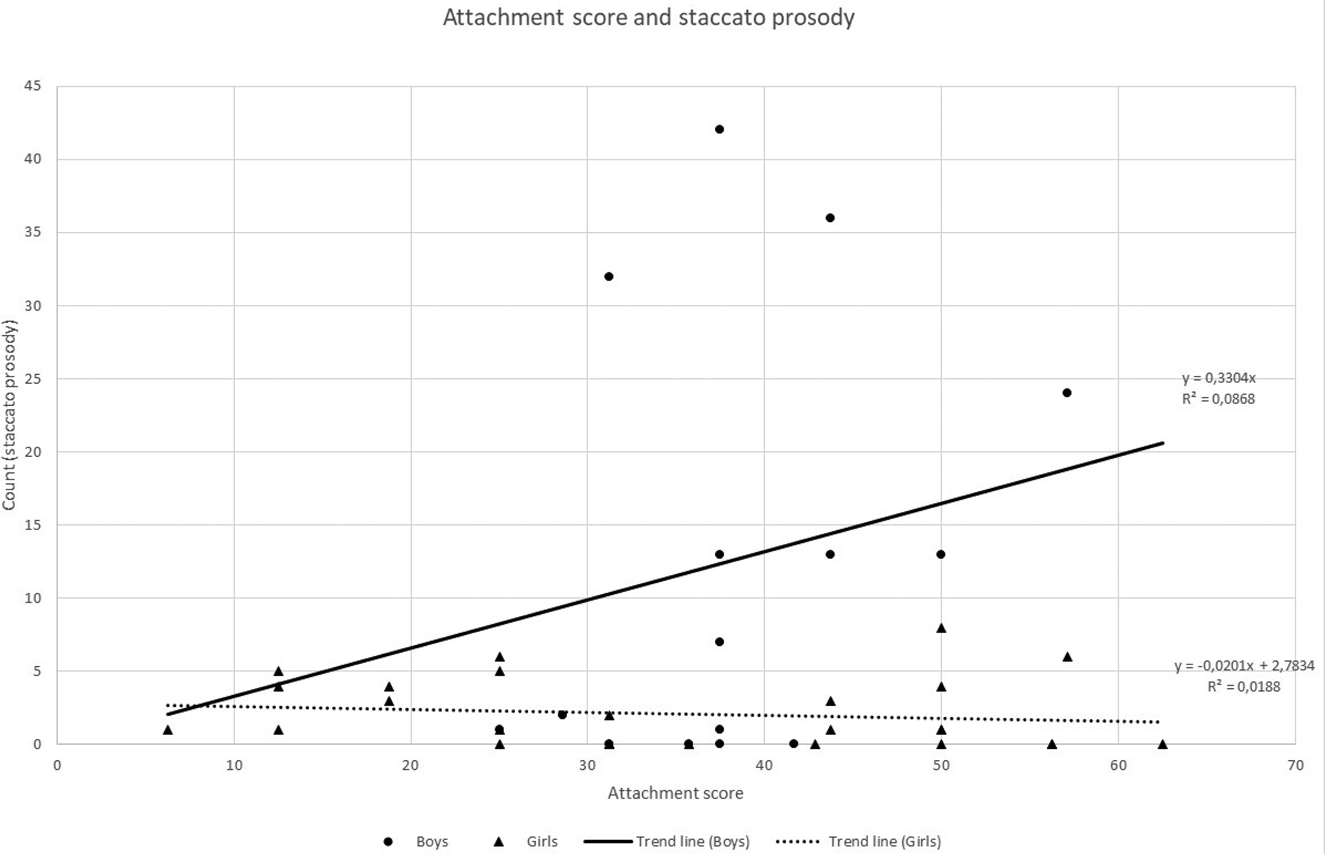
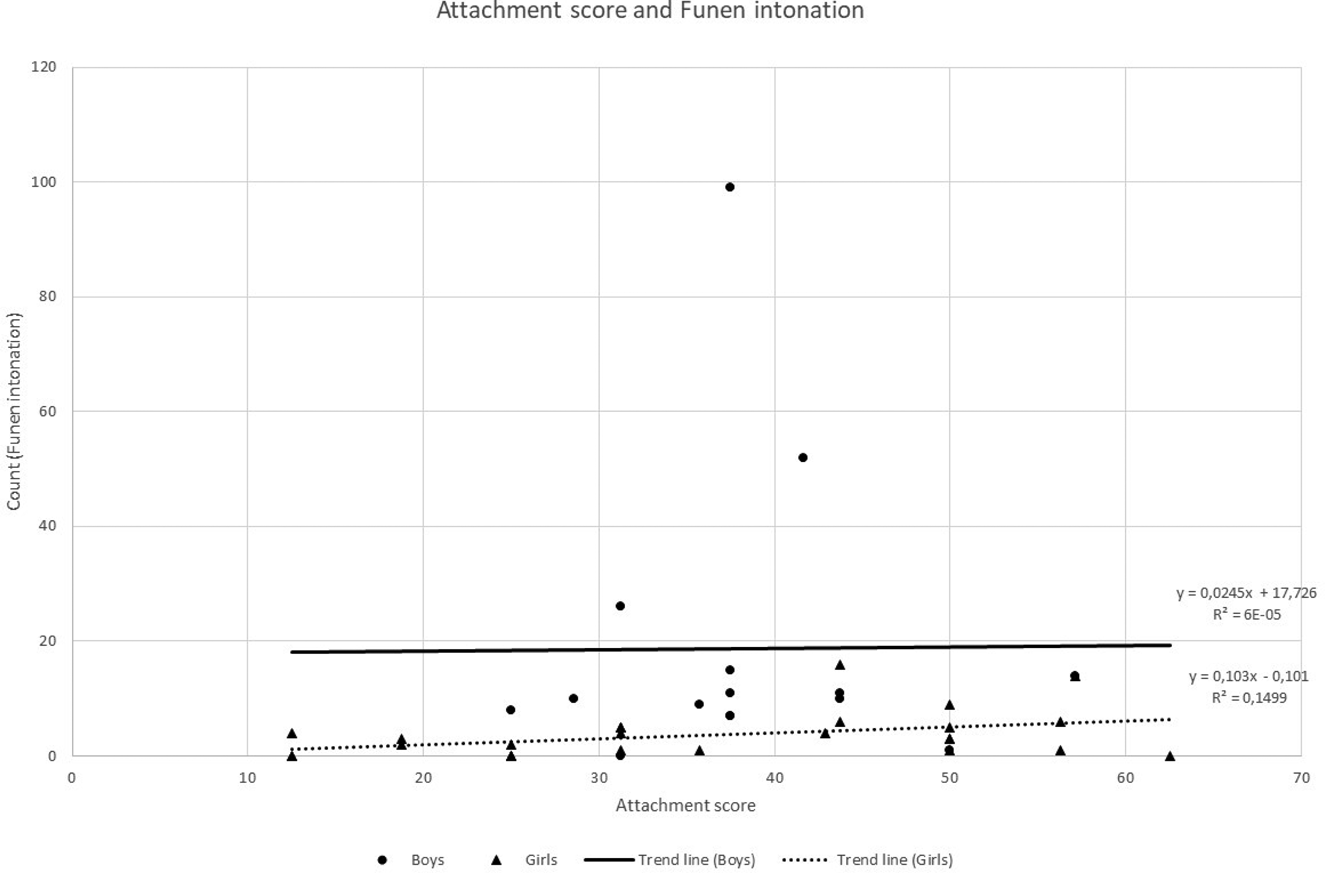
Figures 8–10 below show the results from Vollsmose. As can be seen from the scatter plots, there is a less straightforward relation between the ILA scores and nonstandard scores in Vollsmose than in Bylderup. Figures 8 and 9 show a positive correlation between the scores, but only among boys. Figure 10 shows no correlation, either among boys or among girls.
Scatter plot of attachment scores and the T variable.

Scatter plot of attachment scores and staccato prosody.

Scatter plot of attachment scores and Funen intonation.

Figure 8 shows the points of intersection between the participants’ attachment scores and the nonstandard variant of the variable T. This particular variable was counted in the same manner as the variables shown in Figures 4 to 6. As with Bylderup, the plot shows rather different tendencies for boys and girls: among boys, there is a positive correlation between place attachment and use of the nonstandard variant. Compared to Bylderup, however, the correlation is not as strong. In the group of girls, we see no correlation. As such, the use of the nonstandard [tj] pronunciation and place attachment seems to be unrelated among the girls.
Focusing on the individual participants in Figure 8, we find that a group of boys display similar attachment scores (between thirty and forty) while at the same time showing very different degrees of [tj] use. While these boys show similar aggregated scores, their total scores mask differences regarding the compositions of the scores. It turns out that the boys achieve similar scores based on two kinds of parameters: one regarding engagement in local practices, and one regarding future orientation. Three of the boys achieve a high score with regard to future orientation: they express a wish to stay in the local area or region in the future. At the same time, their scores regarding local engagement are low, as none of the boys have spare-time jobs or participate in local leisure activities. The other three boys, by contrast, are locally engaged due to having spare-time jobs and participating in sports activities. However, they are clearly oriented away from the local area as they all express a wish to go to Copenhagen after finishing higher education.
Interestingly, these differences (with regard to future orientation and everyday engagement in local communities of practice, respectively) match up with differences in the use of the nonstandard variant [tj]. In a number of contemporary Danish studies based in Copenhagen, the [tj] variant has been found to index a streetwise, tough, masculine persona (Maegaard Reference Maegaard2007; Ag Reference Ag2010; Stæhr Reference Stæhr2010; Pharao, Maegaard, Møller, & Kristiansen Reference Pharao, Maegaard, Møller; and Kristiansen2014; Madsen Reference Madsen2015). It is probably no coincidence that the three boys aspiring to going to Copenhagen in the future all use this feature extensively, while the three boys oriented towards the local and the regional area refrain from using the feature. Thus, the similar attachment scores cover differences with regard to engagement in local practices and future orientation—and this in turn relates to differences in linguistic practices regarding the T variable among the participants.
Figure 9 shows the points of intersection between attachment scores and impressionistic codings of instances of staccato prosody (see above). There is a clear gender difference, as there is a positive correlation for boys and not for girls. In that respect, Figure 9 resembles Figure 8. Moreover, the same split is found among the boys with an attachment score between thirty and thirty-five, as for the T variable. Once again, the boys oriented towards Copenhagen use the nonstandard feature a lot, while regionally and locally oriented boys use little staccato prosody.
Figure 10 shows the results for the impressionistic codings of the use of Funen intonation (see section above). There seems to be no correlation between the use of Funen intonation and place attachment, either among the boys or among the girls.
The three data points above the boys’ trend line represent Marley, Bo, and Nhung, all regionally oriented boys who use no or very few of the features associated with the multiethnic youth style (i.e. [tj] and staccato prosody). Two boys in particular, Bo and Nhung, stand out from the rest of the participants as having many instances of Funen intonation. When we examine the components of these two boys’ attachment scores, it becomes readily apparent that they serve as exceptions to the common patterns. Bo is the only participant with a Danish ethnic background: his parents were both born and raised in the region of Funen, and as such, he may have had access to regional Funen features at home, as the only participant in the study who did. Furthermore, Bo is an avid fan of shooting as a sport, taking part in biweekly training events in a small town close to Odense. The other boy, Nhung, attended a school outside of Vollsmose for two years before returning to the school in Vollsmose for the eighth grade. In the individual interview, Nhung describes how this has given him “Danish” friends, whom he still meets regularly, and how the pupils at the other school spoke “differently” from the children in Vollsmose—“better Danish”, as Nhung phrases it. This means that both Nhung and Bo have potentially experienced rather different linguistic and social environments than most of the other participants in Vollsmose.
Summary of results from Bylderup and Vollsmose
Table 4 shows the mean values of the attachment scores. The average ILA score is higher for the young people in the rural village of Bylderup than for the young people in the suburban social housing area of Vollsmose, namely 68.9 and 36.4 respectively. Overall, correlations between local attachment and the use of nonstandard variables are stronger for participants from Bylderup than for participants from Vollsmose. In both places, however, we see the same tendency that correlations are stronger for boys than for girls. In Bylderup, we found that all girls who scored high on dialect use also had a high ILA relative to the other participants. At the same time, we found that some of the girls who scored high on ILA did not use many dialect features, while two of the boys (whose parents had immigrated from other countries) who scored low on ILA, used the dialect features relatively much. In Vollsmose, only two of the linguistic variables—T and staccato-like prosody—correlated with ILA, and then only among the boys. Girls’ use of the three tested variables did not correlate with their ILA scores. The regional feature, FUNEN intonation, only correlated with ILA for two of the boys, both of whom had particular histories involving activities outside of Vollsmose. In both places, future orientation appeared to influence the use of some of the variables. In Bylderup, two of the boys who did not envisage themselves staying in the region after finishing school used relatively little dialect. In Vollsmose, we saw that some of the boys who dreamed of a future life outside of Vollsmose, in Copenhagen, used more of the multiethnic youth style features, [tj] and staccato-like prosody, compared to the boys who had no plans to leave Vollsmose and Odense.
Mean attachment scores.

CONCLUSION AND DISCUSSION
The results of the ILA correlated with the variation in use of the linguistic variables may be compared horizontally across the two field sites and vertically between participants in each place. Both ways offer hints about which aspects may serve as differentiating factors in terms of which speakers use the local speech forms, how much and why/why not. Comparing the results from Bylderup and Vollsmose, the most obvious finding is the large difference in the mean ILA scores, as shown in Table 4. Some of the explanation is of course to be found in the fact that most participants in Bylderup have longer historical ties to the place through previous generations, whereas the parents of most of the participants in Vollsmose were born outside the local area, as they are immigrants from other countries. Generational ties to a place is surely a factor that has shown to influence the degree to which participants choose to speak the local dialect (Andersson & Thelander Reference Andersson and Thelander1994; Chambers Reference Chambers2000). But the effect of generational ties cannot stand alone.
The rather large difference in the average ILA scores between Bylderup and Vollsmose is also linked to the different opportunities participants have to engage in the local community by taking a local spare-time job. In Bylderup, the majority of participants work for local businesses, for example by helping out a couple of hours every week at the local grocery shop, in the timber yard, or at local farms. Only a few of the participants in Vollsmose have spare-time jobs in the local area (or spare-time jobs at all). Even though many of them expressed ambitions of getting a spare-time job, local jobs were just not available for them. There are only a few small businesses in Vollsmose, so if a young person wants a spare-time job, he/she needs to go to other parts of the city to places that are unfamiliar and perhaps appear unsafe to them (Skovse Reference Skovse2018). Thus, the differences between the Bylderup and Vollsmose index scores also reflect different consequences of the local affordances and socioeconomic structures of the two places.
Overall, we found similar tendencies in Vollsmose and Bylderup: participants with the highest attachment scores were also those who used more of the nonstandard features, although the tendency is stronger in Bylderup than in Vollsmose. Altogether, the results in Vollsmose appear to be more complex—something that reflects the more complex linguistic situation in Vollsmose. As can be seen in Figures 7–10, Funen dialect features and Standard Danish occur in parallel and in combination with features associated with multiethnic youth styles.Footnote 8 In Bylderup, there are only two dominating registers to choose between (Standard Danish and dialect). Thus, the specific histories and demographic compositions of the two places affect the linguistic situations and the source of available linguistic features.
In both places, the correlation between the ILA and the use of nonstandard features was higher for boys than for girls. We may speculate that boys have ‘more to gain’ by signaling local orientation by the use of local features, as the local might hold more status among boys than girls. Furthermore, it appears that there is a stronger norm for using dialect features among boys than among girls, regardless of the boys’ ILA—especially when compared to differences in future orientation. Aspiring to move to Copenhagen after finishing school does not necessarily entail speaking Standard Danish among boys in either Bylderup or Vollsmose, as it does among girls. This is interesting considering the studies that have shown that mental orientation away from one's present place of residence makes speakers avoid the local nonstandard forms in favor of a more standard register (Marshall Reference Marshall2004; Monka Reference Monka2013).Footnote 9 For the boys in Bylderup, it appears that speaking the local dialect does not conflict with ambitions of moving to another part of the country to pursue higher education after finishing school. The same goes for the Vollsmose boys, but only if we look at the two features associated with multiethnic youth style. If we compare the boys who plan to leave Vollsmose in the future, who also frequently use T and staccato-like intonation, to the two boys who use Funen intonation the most (who happen to plan to stay in the local area in the future), it seems that Funen intonation indexes localness more than multiethnic style features do. These latter features may in turn index more supralocal values such as ‘urban’.
The linguistic practices of girls in Bylderup in general confirm previous sociolinguistic studies of dialect and place orientation. They use less dialect compared to the boys, and a relatively large proportion of them aspire to leave Bylderup in the future. Moreover, the (few) girls who do use quite a lot of dialect, also score highest among the girls on the local attachment index. Such differences between boys and girls in Bylderup may be linked to the lifestyle associated with living in rural areas. As suggested by Skjekkeland (Reference Skjekkeland2009) and Hansen (Reference Hansen2014), for example, rural lifestyles might appeal more to boys than to girls. This is also reflected in the movement and settlement patterns in a Danish context, where more young women than young men move to the larger cities to pursue higher education and tend to stay there in their adult life, leading to imbalanced gender compositions in rural as well as urban areas (Ritzau 2013; Sand Reference Sand2014). However, when we look at the girls in Vollsmose, something else seems to be going on. First of all, very few of them use the features that we analyzed, giving the impression that they do not use nonstandard language at all. Still, there is significant variation in their ILA scores—mostly reflecting different present and future perspectives. However, the study indicates that such variation is not related to their speech practices. How can we explain this? Our ethnographic observations in Vollsmose support the picture that the girls mostly use standard Danish. However, it needs to be mentioned that Skovse (Reference Skovse2018) did in fact study one feature in Vollsmose that was shown to be used more by girls than boys: the prevocalic devoiced R. Variation in the use of this feature did correlate with future orientation such that those with aspirations to leave Vollsmose would use fewer instances of devoiced R (Skovse Reference Skovse2018:159–60). Thus, despite the fact that we do not find correlations between nonstandard speech and ILA among the girls in this study, we do find indications that girls who plan to leave Vollsmose after finishing school would avoid using nonstandard speech. In this sense, the urban, minority-ethnic girls behave in the same way as the rural, ethnic Danish girls (confirming Kristiansen's studies of processes of standardization that show that speakers adapt to the Danish standard norm all over the country; Kristiansen Reference Kristiansen2009).
Surely, the many factors that influence the use of local speech forms interact in complex ways, making it both a risky and challenging endeavor to apply quantitative measures of local attachment. Still, the benefits of operationalizing place attachment in relation to language use provides insights that we would not have been able to glean otherwise: the index gives an overview of the group of participants in each field site, which makes outliers readily visible. In this way, index scores serve as fruitful starting points for further investigations into patterns of place attachment. In our case, these investigations have been based on insights from interviews and ethnographic fieldwork. We do not claim that the index suffices as a means of inquiring into relations between local attachment and language use. On the contrary, an index of local attachment only captures the quantifiable aspects of place attachment, and not the ‘warm feeling of being at home’ or ‘place-belongingness’ (Antonsich Reference Antonsich2010). Moreover, it does not tackle all aspects regarding power and legitimacy, or ‘the politics of belonging’ (Yuval-Davies Reference Yuval-Davis2006; Antonsich Reference Antonsich2010). For this, further qualitative and ethnographically sensitive analyses are needed. Working with the ILA index has, however, served as a way to operationalize the inherently temporal aspect of practices that shape relations between speakers and places. These relations can easily be lost in ‘snap-shot’ variationist descriptions of variation in a given locality (Blommaert Reference Blommaert2010:8) or in situated moment-to-moment interaction analysis. The index targets the participants’ past, present, and future attachments to place and compares them to their language use. The method thus gives a view of the dynamic speaker-place-relations that is so often left out of sociolinguistic and dialectological enquiries, even though it is increasingly called for in the field.
APPENDIX>
Overview, Vollsmose

Overview, Bylderup