INTRODUCTION
Hard surfaces submerged in marine waters are colonized by benthic organisms including both free-living and tubiculous polychaetes. Polychaetes are usually one of the abundant groups in benthic communities (Marzialetti et al., Reference Marzialetti, Nicoletti and Ardizzone2009) and act as representative species in the analysis of environmental conditions (Dean, Reference Dean2008). Polychaetes also play a major role in the functioning of benthic communities in terms of the recycling and reworking of benthic sediments, the bioturbation on the sediments and the burial of organic matter (Hutchings, Reference Hutchings1998). Benthic communities colonizing hard surfaces may show temporal variability in response to various biotic and abiotic factors. The understanding of the temporal and spatial distribution of the fauna is important in order to establish the natural causes responsible for benthic community fluctuations (Underwood & Peterson, Reference Underwood and Peterson1988). The colonization process on a substratum may depend on factors such as the intensity of propagule production in communities, their species composition and the pattern of currents in the area under investigation and the season (Railkin, Reference Railkin2004). Benthic community structure may change from season to season, especially in temperate regions. However, in tropical waters, this may not be the case due to an extended breeding season and a possible prolonged recruitment (Sastry, Reference Sastry, Thompson, Sarojini and Nagabhushanam1986). There have been relatively few studies of recruitment and succession of benthic communities in tropical regions and it is important to understand whether diversity and distribution of benthic fauna on hard substrata in tropical waters is seasonally dependent (Machado et al., Reference Machado, Chapman and Coutinho1992; Kaehler & Williams, Reference Kaehler and Williams1997; Rajagopal et al., Reference Rajagopal, Nair, Van der Velde and Jenner1997; Satheesh & Wesley, Reference Satheesh and Wesley2008).
Polychaetes are one of the abundant fouling communities on surfaces of anthropogenic origin in marine waters (Bagaveeva & Zvyagintsev, Reference Bagaveeva and Zvyagintsev2001). However, polychaetes inhabiting hard surfaces have been less studied than their soft-bottom counterparts. In a previous paper (Satheesh & Wesley, Reference Satheesh and Wesley2011), we have reported the influence of test panel submersion season on the development of biofouling communities (including tubiculous polychaetes) on the Kudankulam coast. The present paper describes the seasonal distribution of motile polychaetes in the fouling assemblage developed on hard substratum. The objectives of the present study were: (1) to observe the diversity and distribution of polychaetes in sub-tidal fouling assemblage; (2) to analyse whether the polychaete abundance on test panels shows temporal variability on a tropical coast; and (3) to observe the role of environmental factors on polychaete abundance. Since very little has been documented on the distribution of polychaetes from Indian waters, results of the present study will expand our understandings on the ecology of polychaetes in this region and enhance our knowledge on community dynamics in coastal ecosystems. Results observed in this study will also provide details regarding the applicability of hard bottom polychaetes in environmental monitoring approaches.
MATERIALS AND METHODS
Description of the study area
The study was conducted from May 2003 to July 2005 on the Kudankulam coast (8°9′N and 77°39′E), approximately 25 km north-east of Kanyakumari on the south-east coast of India. Seasons in Kudankulam may be classified into pre-monsoon (June.–Sep.), monsoon (Oct.–Jan.) and post-monsoon (Feb.–May.). The wind direction is north–north-easterly from June to December and changes to westerly during the rest of the period (Satheesh & Wesley, Reference Satheesh and Wesley2008).
Test panel preparation and submersion
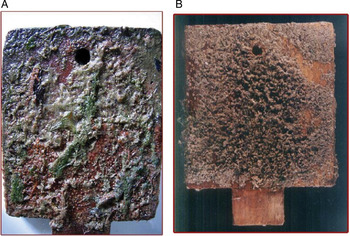
Teak wood test panels (10 × 10 × 2 cm, Figure 1) were placed vertically on wooden rafts (28 panels per raft) with a distance of 10 cm between panels. Teak wood was selected as the test substratum based on its ability to withstand harsh environmental conditions. The rafts were submerged at a depth of about 2 m (the water depth at the panel submersion site is 18 m) below mean sea level using nylon rope with sufficient weight and floats. Three series of panels (three rafts in each series; 28 panels in a raft) were submerged during this study period. The first series of panels was submerged in May 2003 (post-monsoon, ‘A’ series) and this series could be observed only for 150 days due to technical problems. The second series of panels was submerged during November 2003 (monsoon, ‘B’ series) and the third series in July 2004 (pre-monsoon, ‘C’ series). These two panel series were observed for up to 360 days. Hydrobiological parameters such as surface water temperature, salinity, pH, and dissolved oxygen of the coastal water were also monitored throughout the study period using standard methods and the results were described (Satheesh & Wesley, Reference Satheesh and Wesley2011).
Wooden test panels used for this study: (A) test panel submerged for 15 days during monsoon season; (B) test panel submerged for 30 days during pre-monsoon season.

Analysis of test panels
The test panels (in replicate, N = 2, randomly selected from the same raft) were retrieved from the raft at fortnightly intervals using a country fishing craft (catamaran). Retrieved panels were fixed in 5% neutral formalin and later analysed for species composition and abundance of the polychaete community (both sides were analysed separately). The abundance was expressed as numbers dm−2 area of panel surface. The specimens were identified to the species level wherever possible using monographs and published works.
Data analyses
Nested ANOVA (analysis of variance) was used to find out the variation in the abundance of free-living polychaetes on three panel series. For the nested ANOVA, days (panels were observed two days in a month), month (number of months in a panel series) and season (panel submersion season) were considered as factors. The factor ‘month’ was nested within the season. The nested ANOVA was initially carried out for the 150-day data obtained from pre-monsoon, monsoon and post-monsoon season panels to maintain uniformity between treatments (post-monsoon season panels were observed only up to 150 days). Alternatively, separate nested ANOVA was carried out for the entire data collected from monsoon and pre-monsoon season panels. A multiple correlation analysis was performed between the environmental factors (water temperature, salinity, pH and dissolved oxygen) and polychaete abundance on ‘B’ and ‘C’ series panels.
RESULTS
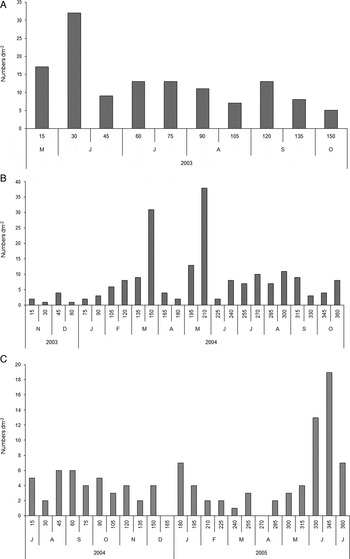
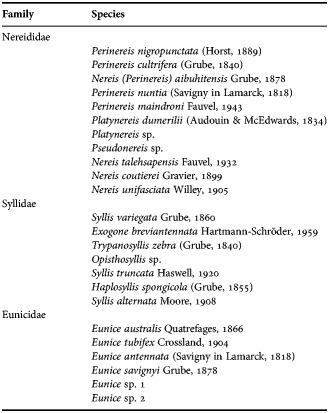
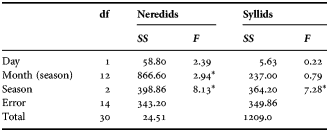
A total of 24 free-living polychaete species belonging to the three families were observed from the test panels (Table 1). Perinereis cultrifera, Platynereis dumerilii, Syllis variegata, Syllis truncata, and Eunice australis were the common species encountered. The abundances of the major polychaete species varied considerably between the panel series submerged in May 2003 (‘A’ series), November 2003 (‘B’ series) and July 2004 (‘C’ series) with low abundances of nereidids on C-series panels and the eunicids on ‘A’ and ‘B’ series panels. A total of 11 species of Nereididae were recorded from the test panels. On ‘C’ series panels, nereidids had a maximum abundance of 19 individuals dm−2 on 345-day-old panels. On ‘B’ series panels, there was a maximum of 38 individuals dm−2 on 210-day-old panels, with the minimum abundances was observed on the 30 and 60-day-old panels (Figure 2). Nereidid abundance on ‘A’ series panels showed a maximum of 32 individuals dm−2 after 30 days of panel exposure (Figure 2). Nested ANOVA of initial 150 days data showed a significant seasonal and monthly variation on the abundance of nereidids between the ‘A’, ‘B’ and ‘C’ series panels (Table 2). Nested ANOVA between ‘B’ and ‘C’ series panels also revealed a significant variation in the abundance of nereidids in relation to sampling months and panel submersion season (Table 3).
Recruitment of neredids on test panels: (A) panels submerged during post-monsoon (May 2003); (B) panels submerged during monsoon season (November 2003); (C) panels submerged during pre-monsoon season (July 2004).

List of polychaete species colonized on the test panels submerged during pre-monsoon, monsoon and post-monsoon seasons.

Nested ANOVA (analysis of variance) of polychaete abundance on ‘A’ (post-monsoon), ‘B’ (monsoon) and ‘C’ (pre-monsoon) test panel series for the initial 150 days of submersion. Days (panels were observed two days in a month), month (number of months in a panel series) and season (panel submersion season) were considered as factors. The factor ‘month’ was nested within the season. Eunicids were not considered for analysis due to the low abundance during this period.
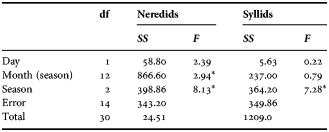
*, P < 0.05.
Nested ANOVA (analysis of variance) of polychaete abundance on ‘B’ (monsoon) and ‘C’ (pre-monsoon) test panel series for the period of 360 days of submersion.

*, P < 0.05.
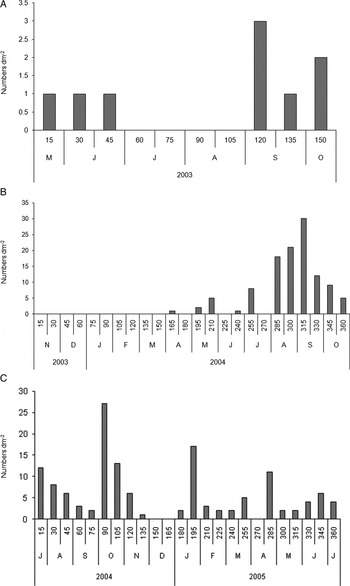
Syllids were represented by seven species on the test panels and their abundance also showed variations between the three panel series. Syllids were commonly observed on the ‘C’ series (pre-monsoon) panels from the initial exposure period with a maximum of 27 individuals dm−2 after 90 days (Sep. 2004). On the ‘B’ series panels, syllids were observed only after 165 days of panel exposure and the peak abundance was observed during 285–315 days of exposure (Aug.–Sep. 2004). The ‘A’ series panels also recorded low density of syllids up to 150 days with a maximum of 3 individuals dm−2 (Figure 3). Nested ANOVA showed that panel submersion season has a significant effect on the abundance (up to initial 150 days) of syllids in the fouling assemblage (Table 2). However, nested ANOVA carried out for the abundance data of entire ‘B’ and ‘C’ series panels did not show significant variability in relation to panel submersion season (Table 3).
Recruitment of syllids on test panels submerged during post-monsoon (A), monsoon (B) and pre-monsoon (C) seasons. Syllids were not observed on the test panels during certain months in ‘A’ and ‘B’ series.

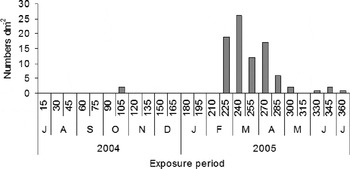
A total of six species of eunicidae were collected from the test panels. Eunicids were abundant on the ‘C’ series panels between 225 and 270 days of exposure with a maximum of 26 individuals dm−2 (Figure 4). On the ‘A’ series panels, eunicids were very low in abundance with a maximum number of 2 individuals dm−2. Eunicids were also rarely observed on the ‘B’ series panels and the panel submersion showed a significant effect for the abundance between ‘B’ and ‘C’ series panels (Table 3).
Recruitment of eunicids on the panels submerged during pre-monsoon season (C series panels). On post-monsoon and monsoon season panels, the abundance of eunicids was very low and hence the data are not shown in the figure.

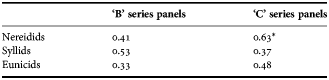
From our previous paper (Satheesh & Wesley, Reference Satheesh and Wesley2011), the surface water temperature of the study area showed a maximum value of 30.5°C and the minimum of 26.2°C. The salinity of the coastal waters varied from 30 to 35.2 and the pH showed the range of 7.9–8.4. Multiple correlation analysis of the polychaete abundance with environmental parameters such as dissolved oxygen, salinity, pH and temperature is given in Table 4. Significant correlation was observed between nereidids abundance on ‘C’ series panels and environmental parameters (r = 0.634, P < 0.05). The abundance pattern of other groups in both ‘B’ and ‘C’ series did not show any significant relationship with environmental parameters.
Multiple correlation analysis of polychaete abundance on ‘B’ (monsoon) and ‘C’ series (pre-monsoon) test panels. Correlation analysis was performed between the polychaete abundance and hydrological parameters of the coastal waters (dissolved oxygen, salinity, temperature and pH).
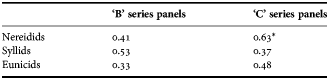
*, P < 0.05.
DISCUSSION
Polychaete community on the submerged hard substrata varied between the three panels series. Results showed that nereidids were abundant on the monsoon and post-monsoon panels and eunicids and syllids on pre-monsoon panels. The tubiculous polychaetes (mainly belonging to the family Sabellariidae) recruitment in the present study area was high in monsoon season and low during pre-monsoon and post-monsoon seasons (Satheesh & Wesley, Reference Satheesh and Wesley2011). This indicates the influence of season on the recruitment of motile polychaetes in tropical waters. Seasonal variability of fouling community recruitment in Indian coastal waters was also previously observed by Rajagopal et al. (Reference Rajagopal, Nair, Van der Velde and Jenner1997) and Satheesh & Wesley (Reference Satheesh and Wesley2008). Benthic polychaetes in Marmugao harbour area (west coast of India) also showed seasonal variations (Sivadas et al., Reference Sivadas, Ingole and Nanjakar2010). Artificial substrata submerged in the marine waters are colonized by the methods such as the larval recruitment from the plankton and migration of adults from the adjacent habitats (Chapman, Reference Chapman2002; Smith & Rule, Reference Smith and Rule2002). In the present study area, polychaete larvae were found in the coastal waters throughout the year and the abundance was high during the monsoon season (Satheesh, Reference Satheesh2006). Results indicate that nereidids were abundant on the test panels during the monsoon months. A study conducted by Srikrishnadhas & Ramamoorthi (Reference Srikrishnadhas and Ramamoorthi1975) at Porto-Novo waters (east coast of India) showed a peak breeding activity in polychaetes during monsoon months. However, the breeding biology of polychaetes from Indian waters is poorly known.
Environmental factors such as salinity, temperature and concentration of nutrient levels of the coastal waters are believed to play an important role in the distribution of benthic populations (Satheesh & Wesley, Reference Satheesh and Wesley2008). Hydrological factors of the study area did not show much variation during this period except some peak values immediately after the December, 2004 Indian Ocean Tsunami (Satheesh & Wesley, Reference Satheesh and Wesley2011). Multiple correlation analysis with environmental factors showed significant positive relationship of nereidids abundance on ‘C’ series (pre-monsoon) panels with environmental factors. This observation is of particular interest as Nereidae is one of the important polychaete families abundant in almost all marine bottoms and some species can be used as indicators of water quality parameters (Wu et al., Reference Wu, Ruiping and Yang1985).
The composition of 24 polychaete species in the fouling assemblage developed on the artificial substratum with limited space indicates the diversity of this group in the Gulf of Mannar region. The genus Perinereis was the most numerically abundant one on the test panels and was observed throughout the study period. A previous study by Dev & Muthuraman (Reference Dev and Muthuraman1988) also reported the year round occurrence of Perinereis in the fouling assemblages developed on hard surfaces submerged in Kurusadai island (Gulf of Mannar). Another group commonly found on the test panels was the syllids. The abundance of syllids on test panels was expected as they are most frequent in epibenthic assemblages of shallow water hard substrata especially coral reefs (Kohn & Lloyd, Reference Kohn and Lloyd1973; Gobin, Reference Gobin2010). Syllids are also one of the most diverse families distributed on hard bottom littoral fringe (San Martín, Reference San Martín, Ramos, Alba, Belles, Gosalbez, Guerra, Macpherson, Martin, Serrano and Templado2003). The settlement of seaweeds and other invertebrates may offer better microhabitat for the colonization of syllids on test panels since these worms prefer holes or crevices.
Ecological information on epibenthic polychaetes inhabiting the hard surfaces is scarce from the Indian coast. However, soft bottom polychaetes are well studied in different Indian coastal regions mainly for benthic environmental monitoring programmes (Sarkar et al., Reference Sarkar, Bhattacharya, Giri, Bhattacharya, Sarkar, ChandraNayak and Chattopadhaya2005; Sivadas et al., 2010). Some information is also available on the polychaete fauna associated with sea grasses and seaweeds in Indian waters (Ansari et al., Reference Ansari, Ramani, Rivonker and Parulekar1990, Reference Ansari, Rivonker, Ramani and Parulekar1991). From the results, it is evident that hard bottom free-living polychaetes showed strong temporal variations in response to seasonal environmental factors on a tropical coast. Results also showed the continuous distribution of polychaetes on test panels submerged on a tropical coast. This indicates that most of the polychaete species breed throughout the year in Indian coastal waters due to the favourable environmental conditions. Further studies on the lifecycles of each species and their relationships with the prevailing environmental conditions may provide more detailed ecological features of the free-living polychaete associated with the artificial substrata submerged in coastal waters.
FINANCIAL SUPPORT
We thank the Ministry of Earth Sciences, Government of India, for providing financial assistance.