

The description ‘Cheney Flute Sonatas Manuscript’ will ring no bells with readers. It is a newly coined one that refers to a volume owned by the musician and music historian Jeremy Barlow (Salisbury, UK). He acquired it from a second-hand bookshop in 1981 as part of a music collection that, with periodic accretions, had passed down successive generations of the Cheney family, starting with John Cheney I (1733–1808), founder of a printing press in Banbury in 1767 and very likely an amateur flautist himself.Footnote 1 The volume came to my notice when its owner invited me to inspect it, primarily with a view to ascertaining the authorship and possible concordances of the 24 anonymous sonatas (‘solos’) for transverse flute (traverso) contained in it, of which only the first three, by Arcangelo Corelli, had a known composer.
The Cheney Flute Sonatas Manuscript is noteworthy on at least three counts. Most important is the fact that it was copied, so far as can be gauged from the clues to hand, during the period 1710–20, a time in England when the traverso was still a novelty instrument played mostly by professional musicians whose main instrument was the common flute (recorder) and/or the oboe and who predominantly hailed from the Continent.Footnote 2 These players were already taking pupils, who certainly included amateurs; but the critical mass had not yet been reached where there was a ready market in England for purpose-written solo sonatas for the traverso or even for ones naming the traverso as the preferred instrument. Consequently, the sonata repertory played on the traverso consisted overwhelmingly of pieces originally written for other treble instruments: the violin in particular, but also the oboe and recorder. In some instances, the existing notation needed no changes at all; in others, simple expedients were adopted to customize a piece for the new instrument. The Cheney Manuscript provides good illustrations of these techniques of adaptation.
Of the 21 sonatas in the volume not by Corelli, three turn out, on the basis of attributed concordances, to be definitely by Johann Christoph Pepusch, while the remainder, save one, are possibly also by him, albeit with varying degrees of likelihood. The commanding presence of Pepusch in London in the decade and a half prior to George Frideric Handel’s definitive settlement there in 1714 – a prestige and influence that persisted in certain musical circles (of which the Academy of Ancient Music is the best known) right up to Pepusch’s death in 1752 – is often overlooked. The sonatas by, or potentially by, him in the volume offer the ideal opportunity to investigate his musical language further.
Finally, the Cheney Manuscript is a particularly good example of the fitting of a homogeneous collection of similarly scored and structured pieces (24 being a simple multiple of the more conventional six or 12) into a predetermined bibliographical-cum-notational format: in this instance, precisely 96 pages ruled with 12 staves. Such deliberately engineered combinations of musical and bibliographic regularity are surprisingly common in music published in eighteenth-century England, suggesting a close liaison between composer, publisher, and engraver,Footnote 3 but less often encountered in the manuscript repertoire unless the pages are very few in number. They remind us how practical (in the artisanal sense of that word) the world of eighteenth-century music was: maximum efficiency in the use of paper served the interests of composer, publisher, and user alike.
Structure, Notation, and Content of the Manuscript
The manuscript is classifiable as an album in the narrow, technical sense of a volume possessing a predetermined number of pages, originally void except for a regular pattern of staves inked on each page, and probably acquired already in bound state, most likely from a music dealer. Such manuscript books were often used in eighteenth-century England and elsewhere by music teachers and/or their pupils, who entered their content by hand progressively over a sometimes considerable period of time (not infrequently working towards the middle from both ends). If their capacity was right for the purpose, these books could equally well serve to accommodate a unified collection (whether a personally selected anthology or a set of works by a single composer) that was functionally a close equivalent to a published volume – and could in extreme instances be a manuscript copy of a print that mimicked the latter’s layout with extraordinary fidelity.Footnote 4 It is to the second kind of album, widely used by professional musicians and amateurs alike, that the Cheney Flute Sonatas Manuscript belongs.
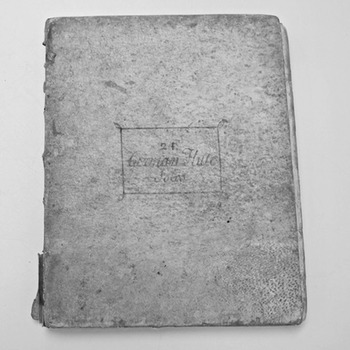
The severely utilitarian covers of the volume measure 255 (vertical) by 200 (horizontal) mm. They are formed from stiff board covered in a low-grade calf that has over time become darker and in places mottled. There are seven evenly spaced bands on the original spine.Footnote 5 On the front cover a hand identical in lettering style with that responsible for the textual inscriptions (such as tempo directions) accompanying the notation of the music has written a title in ink: ‘24. | German Flute | Solos’ (Figure 1).
Front cover of the Cheney Flute Sonatas Manuscript. © Tim Evans.

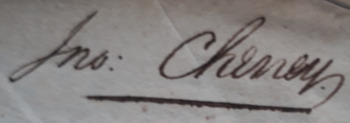
The volume has one paste-down and one free endpaper inside each cover. The endpapers are thin and light-coloured, blank except for two signatures indicating ownership. The first, printed on a small rectangular label affixed to the centre of the front paste-down, reads ‘I. Cheney’; the second, written more boldly in the top right-hand corner of the free endpaper, reads: ‘Ino: Cheney.’ (Figure 2). The signatures are identifiable as those of John Cheney III (1814–87) and his grandfather, John Cheney I, respectively.
The signature of John Cheney I at the front of the volume containing the sonatas. © Jeremy Barlow.

Like the endpapers, the original 48 folios used for the music, which bore original page numbers running from 1 to 96, measure approximately 250 by 200 mm after trimming. The paper is thick, creamy-white in colour, and semi-opaque. The folios have been gathered in eights, which means that there are six gatherings in all.Footnote 6 One folio, used for pages 17 and 18, has become detached from the volume and lost, robbing two compositions (Sonatas 4 and 5) of essential content. Each page is ruled with an identical pattern of 12 medium-brown staves drawn within two faint vertical guidelines by a multi-nibbed rastral. The vertical span from the highest to the lowest staff line is a constant 218 mm, while the horizontal span varies between 170 and 175 mm.
As already intimated, the number of pages chosen for the volume by its manufacturer was far from fortuitous. Ordinary four-movement solo sonatas or continuo-accompanied chamber cantatas, both belonging to widely cultivated genres customarily notated on two-stave systems, were during this period almost always easily accommodated within the four pages making up a bifolio. So it was simple for any scribe to calculate beforehand that two dozen such compositions would fit neatly into 96 pages, provided that a simple rule was observed: any piece that in the copy text occupied five pages had to be balanced by one occupying three pages, or the reverse. This modus operandi seems to have been adopted very successfully. All the sonatas occupy four pages except nos. 1, 19, and 24 with five pages and nos. 8, 11, and 12 with three. Since, as will shortly be explained, this was an anthology requiring the scribe to forage in several manuscripts or prints instead of taking his material from a single source, it must have been reassuring to have such a simple guiding principle that made elaborate advance planning unnecessary. Each sonata begins on a new page, indifferently recto or verso, and each constituent movement begins on a new system, preferably at the top of a page. Void staves occasionally occur at the foot of a page, or else part of the final system of a movement is left unused.
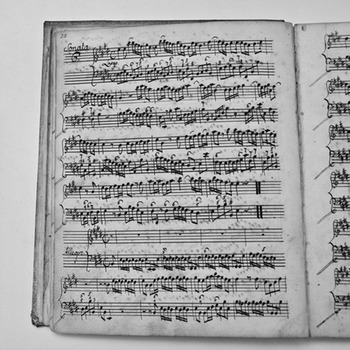
The notation of the music, illustrated in Figure 3, is well above the average in terms of calligraphic attractiveness and textual accuracy. One struggles to find an incorrect note or evidence of the correction of a scribal error. Italian or French titles and performance directions (with one interesting exception, to be discussed later) are given in perfectly orthodox form for the period. This fact may simply reflect a scrupulous respect for the copy texts, but given the frequency with which many English music copyists of the early eighteenth century deliberately anglicize (or inadvertently mangle) foreign terminology, the regularity is noteworthy, suggesting that the unidentified scribe, if British, had a cosmopolitan outlook. His or her notational habits are unremarkable except for one peculiarity that, with luck, will at some future date lead to identification. This idiosyncrasy, displayed in Figure 3, is the consistent practice of concluding even the briefest verbal element with a full stop. Thus the sixth sonata opens not with ‘Sonata | 6’ and ‘Largo’, but with ‘Sonata. | 6.’ and ‘Largo.’.
Page 22 of the Cheney Flute Sonatas Manuscript, showing the first movement and the opening of the second movement of Sonata 6. © Tim Evans.

The diverse provenance of the Cheney collection already becomes evident from the fact that the presence or absence of bass figuring varies, in apparently haphazard fashion, over the series of sonatas. The fully or partially figured sonatas are nos. 1–3, 5–7, 10–11, 17, and 19–24, and the unfigured ones are nos. 4, 8–9, 12–16, and 18. While totally unfigured basses are quite common in solo sonatas intended for professional use – there were effective rules of thumb for accompanists, and in any case, visibility of the treble part enabled the desired harmonic content to be deduced quickly by practised musicians – it is normal for works grouped into sets, even in manuscript sources, to practise far more consistency over the matter than one finds here. Moreover, the notational style of figuring employed by the Cheney copyist varies, sometimes even within single sonatas. For the chromatic raising of a figure such as ‘6’ or ‘5’ there is a choice between the Italian convention, which is to place a sharp alongside the numeral to either the right or left, and the space-saving northern European convention, where the numeral is slashed. It appears, however, that in the matter of figuring the copyist wrote down faithfully no more and no less than what he encountered in his copy texts, making no attempt to regularize it in any way.
Amid all this care over small things, it seems a glaring omission that not one of the 24 sonatas is headed by the name of its composer. The omission is so total as to suggest a deliberate decision rather than casualness, negligence, or a similar omission in the copy texts. True, the cultivation of music in the public sphere was at that time what we, from a present-day perspective (in relation specifically to Western classical music), would call performer-centred rather than composer-centred.Footnote 7 Tellingly, when we read in a newspaper advertisement of the period that a sonata in the programme is ‘by’ musician X, this is normally a reference in the first instance to the performer, who is not necessarily also the composer. But for members of the musical profession themselves, and for more serious musical amateurs, composer identity was even then rarely a trivial matter. This is why so many eighteenth-century sources guess or invent an attribution rather than leave a blank, or at least do their best to supply a name wherever they can.
In the case of the present manuscript, one can only speculate over the reason for the total absence of composers’ names – including that of the famous Corelli, whose authorship of the first three sonatas would, for many contemporary readers, have leapt from the page at first sight.Footnote 8 If the scribe who copied out the manuscript was also its first owner and user, which on balance looks unlikely,Footnote 9 he or she would in theory have been in a position to commit to memory the authorship of all or most of the pieces by reference to their copy texts. Conversely, if the scribe was a different person, the owner could have instructed him or her specifically not to disclose the identity of the composers. A partial parallel to the Cheney Manuscript is offered by a manuscript in the Universitäts- und Landesbibliothek in Bonn.Footnote 10 Probably dating from the 1730s, this volume contains 14 compositions for one or two traversos. These are mostly solo sonatas, the majority anonymous despite being by composers as eminent as Handel, Pepusch, and Tomaso Albinoni. While the nonattribution of the several pasticcio sonatas among them that were created by combining movements taken from different parent works (usually by more than one composer) is understandable, to find an arrangement for traverso and continuo of Albinoni’s extremely well known E minor concerto from op. 2 (1700) or one for two traversos and continuo of ‘A’ teneri affetti’, Handel’s final duet from Ottone (1723), without mention of the respective composer’s name is harder to explain. Beyond the obvious tendency for copies made from sources that themselves omitted the composer’s name not to have it restored, there seems to be no discernible general pattern in the high incidence of anonymous transmission found in manuscripts from this period.
Dating the Cheney Manuscript is difficult, although all the relevant indices point to a year within the range 1710–20 mentioned earlier. Besides Corelli and one other person (the author of Sonata 19), the sole composer represented in the album whose identity can be established with reasonable certainty from concordant sources is Pepusch. This man’s vast output of solo sonatas, seemingly unparalleled for the period, appears to have come to a rather abrupt end around the year 1713, after which time he increasingly turned his attention to vocal music, musical pedagogy, and theoretical studies.Footnote 11 The main reason for doubting that the volume was copied during the 1720s or later is the absence from it (with one possible exception) of sonatas or movements clearly composed ab initio for the traverso. We have to remember that in the third decade of the eighteenth century the traverso made a rapid ascent to universal popularity in England, a development that quickly led to the publication of tutors for the instrument as well as published collections for which it was the sole or preferred main instrument.Footnote 12 Consequently, writing for the traverso grew more distinctive in style and increasingly specialized in its technical demands. The transformed status of the traverso vis-à-vis the recorder is symbolized at the end of the decade in Daniel Defoe’s passionate but thoughtfully argued proposal for a national academy of music (in the modern sense) ‘to prevent the expensive Importation of Foreign Musicians’. One of the three classes to which a designated section of the academy’s 30 boys is to be assigned is ‘for Wind-Instruments, such as the Hautboy, Bassoon and German-Flute’.Footnote 13 Defoe’s omission of the ‘common flute’ is eloquent.
Before moving on to discuss the volume’s music and composers, it will be appropriate to set the scene by inserting an inventory of the 24 sonatas (Table 1) containing musical incipits for each movement, some basic information (location, key, composer, and concordances), and supplementary notes as needed. This inventory is largely self-explanatory, but it will help to point out that double bar lines are used in the incipits to separate the successive movements, and that where concordant sources are multiple, only the most relevant are listed.
Inventory of the Twenty-Four Sonatas in the Cheney Flute Sonatas Manuscript.

The Sonatas by Corelli
The three Corelli chamber sonatas with which the Cheney Manuscript opens provide the perfect object lesson of what the adaptation for traverso of a pre-existing sonata – in this instance for violin, but extendable in principle to other treble-register instruments – entailed. Sonata 1 is Corelli’s op. 5 no. 10, transposed up a tone from F to G major; Sonata 2 is op. 5 no. 9, transposed up a fifth from D to A major; Sonata 3 is op. 5 no. 8, left in its original key of E minor.
The interplay of two separate factors governed the main process of adaptation. First, the principal key, and to a smaller degree the other keys passed through in the course of the composition, had to be satisfactory for the new instrument in terms of technical facility, strength of sound, and intonation. By coincidence, the violin and the traverso both have their tonal ‘centre of gravity’ slightly to the sharp side of C major (in contrast to the treble recorder, whose tonal centre of gravity lies in the other direction). For the violin, this comfortable area is determined by the pitch of its open strings; for the flute, by its basic scale. In a fairly wide zone stretching (for major keys) from C major to E major there is an overlap between what is convenient for violin and traverso, respectively. This is why op. 5 no. 8 is allowed to stay in its original key, whereas op. 5 no. 10 exchanges one flat for one sharp in its (modern) key signature.
The second factor is that of compass. In Corelli’s solo and trio sonatas (as distinct from his op. 6 concertos) the ‘summit’ of the violin’s notated compass is d′′′, which takes the player into third position. The traverso, for the generality of its players, had a similar summit, except for a possible – but in this period not always utilized – extension to e′′′. The real difference came at the lower end of the compass. The violin goes down fully chromatically to g, whereas the traverso has to stop at d′. Unless the violin part makes no use at all of the G string (as does indeed sometimes happen), the arranger, in the absence of a general upward transposition that solves the same problem in a different way, needs occasionally to take individual notes or phrases up an octave, even if this alters the melodic contour in a less than ideal manner. A skilful arranger will assess both factors – key and compass – in relation to each other and choose options that are grateful to performers and entail the fewest changes to the original. There is, of course, no compulsion to exploit as fully as possible the available compass of the instrument: many are the sonatas in the Cheney volume that stop well short at either or both ends.Footnote 14
Naturally, there is a third factor to consider, at least in theory: that of technical facility per se. The wide arpeggiations across the strings that are so idiomatic and effective for the violin may not translate easily, especially at speed, into comfortable woodwind figuration, while multiple stopping, whether for simple percussive emphasis or in a genuinely polyphonic manner, is obviously nontransferable without radical modification. Bowing marks for a stringed instrument cannot truly be regarded as the exact equivalent of slurs for a woodwind instrument since they arise from different needs and involve different physical actions, even if arrangers usually reproduce the original articulation symbols indiscriminately. In general, the arrangers for the traverso and other treble woodwind instruments active in the early part of the eighteenth century simply avoided violin music that posed technical challenges. This is why the solo sonatas by Corelli selected for arrangement as recorder or traverso sonatas – the former as early as 1702 in an edition by Walsh and Hare – are predominantly the chamber sonatas making up the second half of the op. 5 collection.
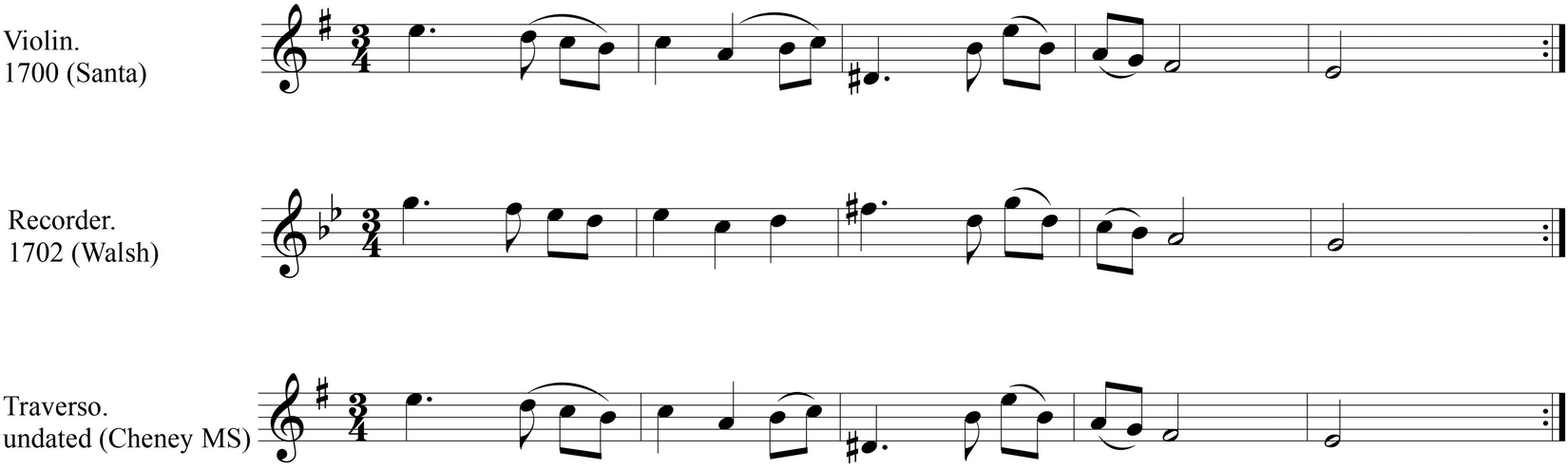
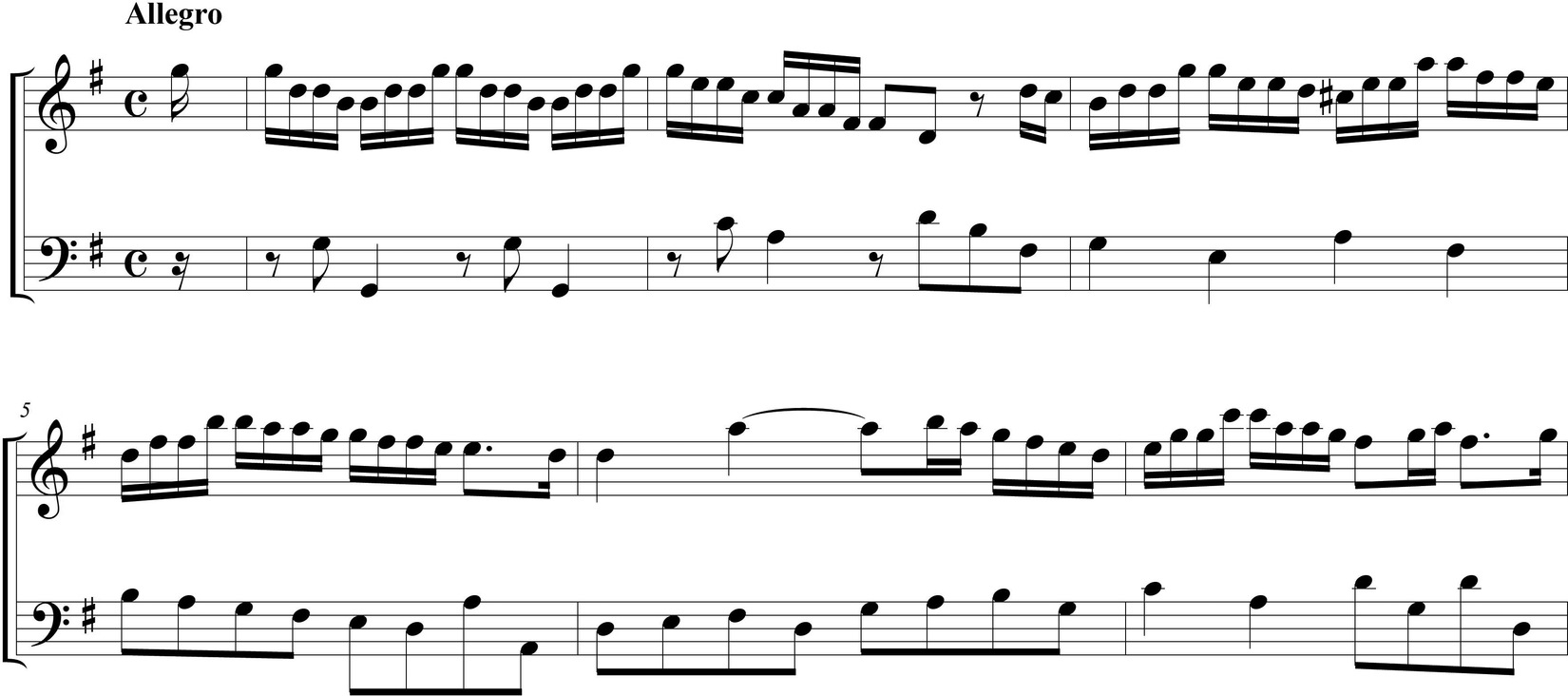
There was also much direct exchange of repertoires between recorder and traverso. Because the treble recorder is an F instrument and the traverso a D instrument, and the two basic compasses have an equal span (two octaves and a tone), there is some validity in the rule of thumb according to which the transference of a part from one type of flute to the other requires no more than transposition, upwards or downwards, by a minor third; this conveniently mirrors the pitch relationship between the French (G1) and Italian (G2) violin clefs. But there is one small difference, seen in Cheney Sonata 3, that can upset the apple cart. Thanks to its single key, the traverso is fully chromatic. In contrast, the treble recorder in its pre-modern form cannot satisfactorily obtain the note a semitone above its lowest note. This is the background to an interesting divergence at the end of its first movement (Preludio) between the arrangement for recorder of Corelli’s op. 5 no. 8 in Walsh’s edition of 1702 and the version for traverso in Cheney Sonata 3, shown in Example 1. The traverso is able to follow Corelli’s line all the way to d♯′, but the recorder version in G minor lacks the equivalent note, f♯′, and is forced, first, to sacrifice a quaver (because an augmented second is unacceptable melodically, whereas its inversion, a diminished seventh, is fully acceptable) and second, to rise to f♯′′, disfiguring the melodic line. This case shows that Sonata 3, like most of the rest of the volume, was arranged not from an ‘intermediate’ version for recorder of the sonata in question, but directly from the original version for violin.
Comparison of bars 38–42 of the Preludio from Corelli’s Sonata op. 5 no. 8 in the original edition of 1700 (Santa), the edition for recorder of 1702 (Walsh), and the version for traverso in the Cheney Flute Sonatas Manuscript (Sonata 3).

There is no need here to describe or evaluate these well-known sonatas, nor to comment further on their arrangement, which is competent and straightforward.
The Sonatas Definitely by Pepusch
The three sonatas in this category, nos. 13, 14, and 16, can be considered authentic with confidence on the basis of their listing in the Cook catalogue and their preservation in reliable sources elsewhere.
It will be useful to preface their discussion with some general remarks on Pepusch’s solo sonatas as a whole. Sir John Hawkins’s acute observation that Pepusch ‘became a teacher of music, not the practice of any particular instrument, but music in the strict sense of the word, that is to say, the principles of harmony and the science of composition’Footnote 15 is the key to understanding why, despite being not only an excellent harpsichordist but also a very able violinist, he deliberately refrained from putting into his solo sonatas described as for violin anything idiomatic enough to inhibit their successful performance (after possible small adjustments of the kind described earlier) by alternative treble instruments such as the oboe, recorder, and traverso. There are no double stops, widely spaced broken-chord figurations, or special effects such as bariolage. In fact, Pepusch constantly betrays his antiquarian bent and indebtedness to vocal polyphony by an emphasis on linear motion and a preference for a densely imitative, quasiconversational relationship between treble and bass. He does his best to purge his instrumental music of strongly idiomatic qualities. This characteristic, limiting and even potentially stultifying though it was, ensured the wide circulation of his instrumental works throughout northern Europe as a valuable repository of Gebrauchsmusik.
In one particular respect, however, the option for a neutral idiom was liberating. Pepusch was a pioneer in the use of ‘extreme’ keys for nonkeyboard music. Whereas other composers chose (but sometimes struggled) to give each of the dozen works making up a typical collection a different major or minor key, Pepusch had a personal system, inspired by his investigations into music theory, of constructing extended cycles of 16 works in the fixed key sequence C, d, e, F, G, a, b, c, D, E, f, g, A, B, B♭, E♭.Footnote 16 (None of this richness survives, of course, in the selection found in the Cheney album, which – after transposition in many cases – remains within the normal tonal limits for traverso music: its 24 sonatas comprise seven in D major and G major alike, six in E minor, and one each in A major, E major, A minor, and B minor.)Footnote 17
Pepusch had an equally systematic method of archiving his solo sonatas. His sets, generally of 16 works and designated for a violin and a bass viol or harpsichord,Footnote 18 most often bear the name of a person (such as Mr Hamilton or Madam Greggs) whom one imagines to have been the original commissioner or recipient of the newly composed sonatas; there is never any overlap of content between the archival sets. But this name could also have served Pepusch and his assistants as the equivalent of a shelf mark, since these fair copies were evidently retained by him until the unfortunate dispersal of his library after his death. Once archived, the sets became the point of origin of innumerable secondary manuscripts and prints, ranging from exact copies of entire sets, via extracts from sets (including amalgams marrying items from more than one set), down to individual sonatas. A good number of the surviving sonatas credibly attributed to Pepusch are not found within the preserved archival sets, but it would be reasonable to assume that over the years several such sets have perished, disappearing from sight. Pepusch had many pupils to whom he could entrust copying tasks, and it is also possible that, like Handel, he allowed privileged visitors to rummage in his library and make copies to suit their own needs.
The complexity of the situation emerges immediately when we examine the three Cheney items definitely by Pepusch. Sonata 13 is Cook I: 025, the first ‘Hamilton’ sonata from the set of 16, transposed up a tone from C to D major.Footnote 19 Sonata 16 is Cook I: 030, the sixth ‘Hamilton’ sonata, transposed up a tone from A to B minor. But Sonata 14 (Cook I: 163) has no known manuscript concordances. It first appeared in print under Pepusch’s name in June 1704 in a short-lived periodical publication by Walsh and Hare that each month delivered to subscribers a solo sonata and a trio (or multivoice) sonata written in the Italian style. These compositions were by different composers and are often identifiable as pieces performed at recent London concerts. Interestingly, the reprints of this particular sonata also include a version for recorder transposed from the original D major to F major. Sonata 14 was probably taken from the 1704 edition or a later print. But it might conceivably go back to a manuscript version contained in a no longer extant archival source once housed in Pepusch’s library.
The Sonatas Probably or Possibly by Pepusch
The five sonatas (nos. 7, 17, 18, 20, and 23) partially concordant with works in Cook’s catalogue are a mixed bunch about which it would be hazardous to generalize, except to say that they reinforce one’s growing suspicion that Pepusch is the author of the great majority of the sonatas following Corelli’s three. One must remain cautious, however. Many eighteenth-century works with partial concordances are pasticcios created artificially by persons other than the composer of the concordant portion either for personal use or for institutional needs. This is the case with numerous works, including solo sonatas, formerly belonging to the Saxon Hofkapelle in Dresden, where the assembly of such unacknowledged pasticcio sonatas and concertos from highly diverse sources became almost a local industry. But partial concordance, as one knows so well from Vivaldi’s music, can arise equally when a composer replaces an individual movement with a newly composed one or a movement imported from elsewhere in his own oeuvre. This second version is obviously no less authentic than the earlier one. Cook’s study and catalogue show that Pepusch was a composer very prepared on occasion to tinker in exactly this way with his sonatas, mixing and matching movements with considerable freedom exactly as Vivaldi did (to the great frustration of his future cataloguers).Footnote 20 Therefore, where there is at least one fully concordant movement, it may be justified to accept a work provisionally as his, provided that other relevant indices are consistently positive, or at least neutral. This requires above all a diligent search for idiolectal features to bolster the case.
First, some information about Pepusch’s general habits in solo sonatas as gleaned from Cook’s study and my own observation will be useful. There is only one instance, Cook I: 133, where this composer deviates from a four-movement layout. Cook I: 133, which has five movements, may be an exceptionally early work, if the title ‘The Grove’ prefaced to its first movement is not a programmatic description, but, as seems more credible, a record of its performance in association with John Oldmixon’s play The Grove; or, Love’s Paradise (Drury Lane, 1700), for which Daniel Purcell is credited with the music.Footnote 21 The four movements are nearly always configured slow–fast–slow–fast, using allegro, or less often presto and vivace, as indicators of quick tempo, and adagio or largo, or less often grave or andante, as ones of slow or slower tempo. A few sonatas introduce small modifications to this pattern: Cook I: 028, 108, 199, and 133 reverse the tempo sequence of the opening two movements; Cook I: 040, 124, 149, 150, and 164 insert presto episodes à la Corelli into the opening slow movement; Cook I: 130 and 150 supply variations (doubles) for fast movements.
In his archival sets Pepusch is very sparing with the use of dance titles, even where a movement clearly in allemanda or corrente rhythm cries out for one, although some of the secondary copies are much more liberal in this regard. The movements most likely to feature them are less common dance types such as the Hornpipe (Cook I: 068) or Ciaccona (Cook I: 148). Like so many composers of his time, Pepusch appears to maximize the presence of dance titles on occasions when he seeks to lend the composition or the collection a courtly, da camera patina, but conversely, to minimize it when the abstract formality of the traditional sonata da chiesa is referenced. There remains, however, a high degree of arbitrariness in the conferral or withholding of dance titles.Footnote 22
As regards movement structure, Pepusch employs both binary form with double sectional repeats and unitary (through-composed) form in the majority of cases. The two forms are not distinct in reality, given their common tonal trajectory (for major keys, always tonic–dominant–mediant and/or submediant minor–tonic) and pattern of thematic development. The use of variation and rondeau form is by comparison very limited. True to his German origins, Pepusch is notably economical in his use of material, but he only rarely introduces literal reprises of the opening material at the point where the music returns definitively to the tonic, which can perhaps be taken as another sign of a date of composition not far advanced beyond 1700. He is a composer whose instincts are motivic rather than melodic.Footnote 23 Compactness is an ever-present attribute of his style: unlike Handel, he does not often make use of techniques of cadence avoidance to spin out his musical periods to great lengths, and the prevailing dignitas is rarely ruffled by rhetorical outbursts.
Interestingly, in Pepusch’s archival sets one often sees efforts to impose common regular patterns on the full series (or sometimes only a subgroup) of contiguous works, mostly in relatively trivial matters such as the choice of metre or tempo direction for a given movement, but occasionally applied to something more substantial. No two sets follow exactly the same pattern of uniformity: it seems that Pepusch wished to lend, at least in notation if not always in perceptible sound, a distinct ‘personality’ to each set that in some slight way set it apart from other sets. Perhaps this was a private, self-imposed discipline: an obbligo, as Italians called it. One salient feature of Pepusch’s notation is his use of the cut time signature (‘barred C’) not only for Alla Breve movements but also in ordinary ‘four crotchets to a bar’ contexts where the common time signature would have appeared more logical. This is in fact quite a widespread phenomenon among northern European composers and scribes of the time. It has been suggested that the cut time signature is mere shorthand for a quicker than usual tempo, but this interpretation cannot apply to Pepusch’s Largo or Adagio movements, where that signature likewise occurs in a clearly crotchet-beat context.
As previously observed, one thoroughly pervasive feature of Pepusch’s movements, particularly the fast ones, is the presence of imitation or dialogue between treble and bass (with either partner leading). In fact, imitation and dialogue shade into one another: dialogue, after all, is often only imitation where the first interlocutor falls temporarily silent while the second speaks, instead of continuing to talk over him. The interval of imitation is most often the octave or double octave, but other intervals, such as the fifth/twelfth or fourth/eleventh, are frequently used. Pepusch has a special liking for imitation with displaced accents (‘per arsin et thesin’, as the old contrapuntists described it). In fact, this particular form of erudite homage to the past acts almost as a trademark feature betraying his authorship.Footnote 24
Sonata 17, in D major, has concordances in unexpected places. In 1725 Pepusch’s gifted pupil William Babell (c.1690–1723) was given the posthumous honour by Walsh and Hare of a collection in two volumes together comprising ‘XII Solos for a Violin, Hoboy or German Flute with a Bass figur’d for the Harpsicord […] Compos’d by M:r W:m Babell’. Sonata 10, in the second volume, is a lightly embellished version in B♭ major (a better key for oboe than for traverso) of the same sonata, except for a different fourth movement. However, the first and last movements of the sonata in its Cheney version are found, anonymously and separately, at the much lower pitch of F major (for keyboard?) in a binder’s collection of miscellaneous musical manuscripts of both vocal and instrumental music held by the Royal Academy of Music in London that appears to contain items from Pepusch’s library.Footnote 25 The same piece, the prototype for Babell’s elaboration (leaving aside the different finale), appears complete (but again anonymously) in B♭ major and prescribed for ‘Hauboi solo’ elsewhere in the volume.Footnote 26 One possible inference is that the D major Cheney version is the original, by Pepusch, and that the Royal Academy of Music’s versions, likewise by him, are stepping stones towards Babell’s elaborated version. One should point out that Babell’s entire oeuvre is bedevilled by many uncertainties arising from his dual role as composer and elaborator.Footnote 27 It seems very possible, however, that Babell composed the final Presto movement of the published version as a replacement for Pepusch’s Puoco Allegro movement in the Cheney volume, which is very oddly christened a Siciliana in the Royal Academy of Music’s volume.Footnote 28 For diminutives of Italian tempo directions Pepusch does not use the suffixes ‘-ino’ and ‘-etto’, preferring instead to preface the direction with ‘poco’. But the appearance, uniquely here, of the dialectal (or antique?) ‘puoco’ puzzles. This could have been the choice of the scribe, or perhaps the composer could have opted for this variant to produce a slightly droll effect.Footnote 29 I think that on balance the overall context and the music’s style favour Pepusch’s authorship of the Cheney version of this sonata, but there is nothing that absolutely rules out Babell, so caution is advisable.
The first movement of Sonata 18 appears in the third sonata for recorder (Cook I: 125) published in the collection issued by Estienne Roger in 1705 (and reprinted by Walsh in 1707) as Pepusch’s op. 1. It is one of many movements, usually in slow tempo, in Pepusch’s solo sonatas – appearing in about one in 12 of the latter – that employ a favourite formula describable as the ‘Pepusch Opening’. Its typical melodic and rhythmic shape is shown in the first four notes of the incipit in Table 1.Footnote 30 The remaining three movements in the Roger edition differ from those in the Cheney manuscript, which in fact appears to have used a tried and tested opening movement as the springboard for an essentially new sonata probably from Pepusch’s own pen. Its second movement, with much less contrapuntal activity than normal for him, seems for once tailored exquisitely to the traverso, judging from its grateful semiquaver figuration and generally high tessitura, as Example 2 illustrates. One strongly suspects that for this movement, though not the others, Pepusch borrowed material from another composer, perhaps one with more experience in idiomatic writing for the traverso.Footnote 31
Opening of movement 2 in Sonata 18 of the Cheney Flute Sonatas Manuscript.

But there is a further appearance of the same opening movement that this time belongs unquestionably to a pasticcio assembled by another hand. In the Bonn manuscript anthology S2981 mentioned earlier the sixth item, clearly a pasticcio, is an anonymous four-movement sonata in G major. Its first movement is that of Cook I: 125, but its second movement comes from an allemande originally in B♭ major published as the opening movement of Michele Mascitti’s violin sonata op. 2 no. 4 (Paris: Foucaut, 1706), while its third movement, a Siciliana, is preserved in the Sing-Akademie archive at the Deutsche Staatsbibliothek in Berlin in a manuscript containing five violin sonatas by Johann Jakob Kress.Footnote 32 The same Bonn manuscript contains as its eleventh item another anonymous four-movement traverso sonata, in E minor, that introduces the final Allegro in 6/8 of Cheney Sonata 15, now headed simply ‘Giga’, as its last movement. In this instance, one cannot be certain whether the sonata in Bonn is one, conceivably composed in its entirety by Pepusch, that happens to share its final movement with a work wholly or partly by him preserved in the Cheney volume, or whether, just like the sixth item (and many other items) in the Bonn volume, it is a pasticcio using music by other composers as well. The compiler of the Bonn anthology certainly looked upon Pepusch’s music with favour, for its eighth item, an otherwise unknown duet in G minor for two flutes headed ‘A due Traversse [sic] senza Basso’, is closely related in content to the trio sonata Cook 2: 025.
A different German source containing individual movements shared with, respectively, Cheney Sonatas 20, in E minor, and 23, in G major, presents a comparable challenge to the investigator. This is a manuscript in the Biblioteca Fürstenbergiana, today housed at Schloss Herdringen (Westphalia), which was inherited from the collection of Freiherr (Baron) Friedrich Otto von Wittenhorst-Sonsfeld (1680–1755).Footnote 33 This manuscript purports to be of a set of six solo sonatas for recorder by Benedetto Marcello extracted from his op. 2, first published in Venice in 1712 by Giuseppe Sala and three years later reprinted by Estienne Roger in Amsterdam. But only Sonatas 4–6, in fact, belong to that collection: Sonatas 1–3 – all of which, interestingly, are stated to be for flautino (sopranino or descant recorder) rather than flauto (treble recorder) – are foreign to it, immediately calling into question Marcello’s authorship. The dubiousness of their attribution is recognized in Eleanor Selfridge-Field’s Marcello catalogue, where they are allotted the respective catalogue numbers (determined by key) C769, C770, and C773.Footnote 34 The first two movements of Sonata 3, allowing for a transposition to G minor from the presumable original key (for violin and/or traverso) of E Minor, correspond to movements 1–2 of Sonata 20 in the Cheney volume, while its third movement, transposed in identical manner to B♭ major, is that of the latter’s Sonata 23. Only the fourth movement in Herdringen, which betrays the pasticcio nature of the sonata conspicuously by being in G major instead of the more orthodox G minor, has no known concordance among the Cheney sonatas attributable (albeit tentatively) to Pepusch – and, moreover, has an unambiguously Italian and even ‘Venetian’ character, to judge from its incipit. It is worth noting that the former Sonsfeld collection also contains two manuscript items attributed to Pepusch – the first 15 of the 16 ‘Madam Greggs’ violin sonatas and an oboe concerto in D minor unknown from elsewhereFootnote 35 – so there must have been some form of connection, direct or otherwise, between Pepusch and this music-loving German nobleman.
I have left until now Sonata 7, the first three of whose movements provide, to a varying extent, the material for another Sonsfeld item: an anonymous ‘Sonata à 2. Violino solo & cembalo’.Footnote 36 The latter’s first movement, expanded from 14 to 15 bars, deviates at several points; it is noticeable how the added or substituted material is both musically weaker and less thematically congruent than the original. Superficial small alterations to the first two bars suggest a weak attempt to disguise the fact of the borrowing. For its first ten bars the second movement proceeds in Herdringen exactly as in Sonata 7 but then makes intermittent deviations like those in the first movement. It is important to mention at this point that the second movement of Sonata 7 shares an important property (described in the next paragraph) with movements in the four other works joining with it to make up a well-defined subgroup running from Sonata 6 to Sonata 10; this common element supports a belief in Pepusch’s authorship of these contiguous sonatas. The third movement in Herdringen preserves the key (F♯ minor), the metre (3/2), and the opening notes in each part (c♯′′, f♯) of Sonata 7, but then goes its own way until the final four bars, which are substantially the same. The fourth movement has a character (that of a bourrée with a crotchet upbeat) similar to what we find in Sonata 7 but employs different thematic material throughout. One cannot tell whether this movement, which is unpretentious but competently written, was newly composed in its entirety by whoever confected the preceding movements or was based on an alternative version made by the original composer. The overall impression given by the Herdringen version is that it was produced by a musician, perhaps a violinist, in Sonsfeld’s service – someone who had access to the music of Sonata 7 in one form or another, but not the ambition, time, or talent to write a sonata completely his own.
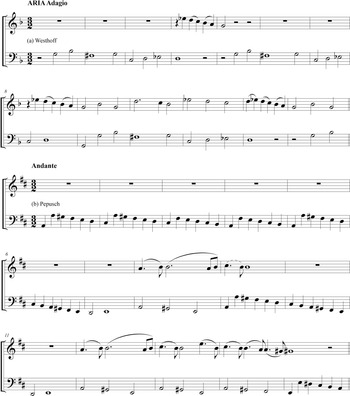
Sonatas 6–10, unlike any other of their companions in the Cheney volume, all open at least one of their movements, most often the second, with an introduction for continuo alone (the appearance of the bass clef in Table 1 pinpoints the instances, and Figure 3 shows an example occurring in Sonata 6). This device obviously derives from similar ritornellos appearing in Italian continuo-accompanied arias in cantatas and operas from the late seventeenth century onwards. Another feature borrowed from Italian vocal music that sometimes appears at the head of a solo sonata movement – a formula that often follows on from an introductory ritornello but can also be utilized independently – is the so-called ‘double Devise’ (or simply ‘Devise’ for short). This is a repeated motto phrase whose statements are separated by a continuo link, which is often a cut-down version of the ritornello, if there is one. Pepusch’s authenticated sonatas draw occasionally on both devices, separately, or in conjunction. A continuo introduction appears in Cook I: 109, 117, 119, 120, 133, 156, and 161, the Devise in Cook I: 105, 115, and 117. The highest incidence of their use occurs in his op. 2, published in 1707 by Estienne Roger in two books (so that his standard sequence of 16 keys becomes split into two equal segments), and this unusually frequent occurrence could possibly reflect an anticipation that the bulk of the sales would occur in continental Europe north of the Alps, where the importation of these quasi-vocal elements into instrumental music had become much more normalized than in either Italy or England. It appears that it was German and Central European, not Italian, violinist-composers who spearheaded their spread in the late seventeenth century, before Corelli’s violin sonatas, which quickly imposed themselves as models for the younger generation to follow, arrived in 1700 and to some extent placed a brake on the proliferation of this trend. Looking at the English scene, it is noticeable how it was predominantly resident German musicians (in the wider definition) starting with Gottfried Finger and continuing with Pepusch, Johann Ernst Galliard, and Handel – versus immigrant or visiting Italians – who continued to cultivate these ‘vocal’ ways of opening an instrumental movement.Footnote 37 Example 3 shows for comparison two instances of the combined use of introductory ritornello and Devise: one (a) from a violin sonata by Johann Paul von Westhoff (Dresden: author, 1694); the other (b) from one of Pepusch’s op. 2 sonatas (Cook I: 117). The continuity of practice is evident.Footnote 38
Comparison of the opening of Sonata 6 from J. P. von Westhoff’s Sonate a violino solo (Dresden: author, 1994) with the opening of Sonata 13 (Cook: 117) from J. C. Pepusch’s Sonates à un violon seul (Amsterdam: E. Roger, 1707).

Almost by default, and in the perspective of their conformity to the general stylistic features already identified, Pepusch is the most credible composer for these five works, Finger having departed from England soon after 1700. Given Pepusch’s perceived habit, described earlier, of increasing both the regularity and the individuality of his sets by devising unique plans for them within the fixed key sequence, it could well be that the use of continuo introductions – there are even two of them in Sonata 6 – was part of such a plan. This could explain why the five sonatas appear contiguously, given that the copyist would obviously do his best to avoid constantly skipping back and forth between different volumes, or sections of the same volume. Moreover, one senses more than a hint of planning in the fact that Sonata 6 is in E major, Sonata 7 in A major, Sonata 8 in D major, and Sonata 9 in G major (Sonatas 10 and 11 remain in G major). If this key sequence is significant – and it may of course not be – one might initially infer from its pattern that these particular four sonatas, at least, were written ab initio for traverso, since any transposition (which, as explained, is needed in many instances when violin sonatas are turned into traverso sonatas) would have disrupted the pattern. But the fact that the concordance of Sonata 7 in Schloss Herdringen is assigned to violin gives pause for thought. Could all four sonatas have been written originally for violin, but then simply left in their existing keys when transferred to traverso? These speculations, however, come up against a quite separate problem with regarding Sonatas 6–10 as a discrete subgroup: the bass in nos. 6, 7, and 10 is figured, whereas that in Sonatas 8 and 9 is not. This is a situation that would ordinarily point to a dual or even more diverse provenance. In the end, there are more questions than answers: the reality of the subgroup is hard to deny, but its origin remains elusive.
Sonata 11 is interesting for ending with a pair of minuets (labelled in excellent French ‘Menuet 1.r’ and ‘Menuet 2.e’), which in combination make up the final fast movement.Footnote 39 French gives way to Italian, however, when the repeat of the first minuet is prescribed: we find here the instruction ‘da capo’, widely used by Pepusch, so we can at least be fairly sure that the composer was not French.
Of Sonatas 4 and 5, both mutilated by the loss of pages 17–18, there is little to say other than that the surviving portions contain nothing inconsistent with Pepusch’s authorship. Sonata 12 is a little more problematic. While it otherwise conforms well to Pepusch’s normal style, it contains a few uncharacteristic solecisms of harmony and part-writing.Footnote 40 Could this be an instance of Homer nodding? Perhaps so. Otherwise, one might speculate whether Pepusch, who, unlike Handel, was a team player who relished both collaboration with his peers and teaching others, could have allowed a pupil to stand in for him. In contrast, Sonata 15 looks wholly typical of him; one is encouraged by the presence, at the head of the opening Adagio, of a classic application of the Devise. Footnote 41
Sonatas 21, 22, and 24 need not detain us. They look suitable candidates for Pepusch’s authorship, though possessing no visible trademark features to clinch the attribution.
The Sonata by Galliard
Sonata 19 appears note for note as the third sonata for recorder in the VI Sonatas for Flute & a Through Bass by Pepusch’s fellow countryman (and colleague at the Lincoln’s Inn Fields theatre and later in the Academy of Ancient Music) Galliard (d. 1747) and was first published privately in London in 1711 in a handsome edition engraved by Thomas Cross.Footnote 42 Galliard was in many ways a kind of brother-in-arms to Pepusch, with similar antiquarian leanings and an equal eagerness to engage on many different fronts in English musical life, although his background was as a woodwind player rather than a keyboard player like his mentor. It is likely that this printed source was used as copy text for Cheney Sonata 19, although one cannot absolutely rule out a manuscript predating the print, conceivably one in Pepusch’s personal collection.
The sonata has five movements, ending with a giga-like Allegro and a Vivace whose stateliness appears to contradict its tempo direction. A five-movement structure is as unusual for Galliard as for Pepusch: all the other sonatas in Galliard’s set follow the same four-movement model. Very tellingly, the sonatas follow a hexachord-based upward progression of keys (C, d, e, F, G, a), which proves that they are not a group thrown together haphazardly. E minor is intrinsically a rather unfavourable key for the recorder (equivalent to C♯ minor for the traverso),Footnote 43 but since g′ is the lowest note required (leaving the lowest three diatonic notes of the traverso unused), it seems very possible that the work was initially conceived for the end-blown instrument – in which case the Cheney sonata, despite its appearance to the contrary, is in fact an opportunistic assignation of a textually unaltered work to a new instrument. There are other conceivable scenarios: the sonata could have begun life before 1711 as a traverso sonata and been co-opted later to plug a gap in the sequence of keys in Galliard’s collection; or the work could even have been planned from the start as a dual-purpose sonata suited equally to the end-blown and side-blown varieties of flute.Footnote 44
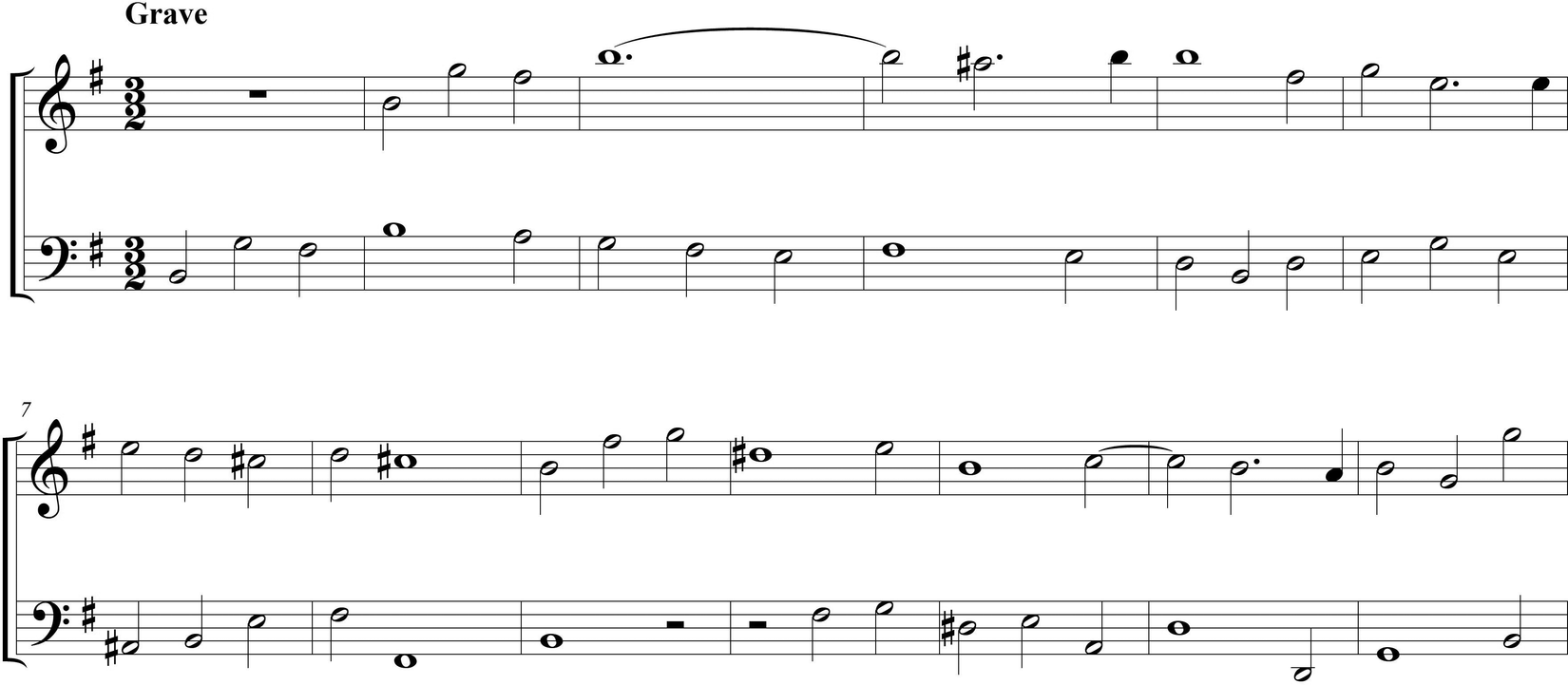
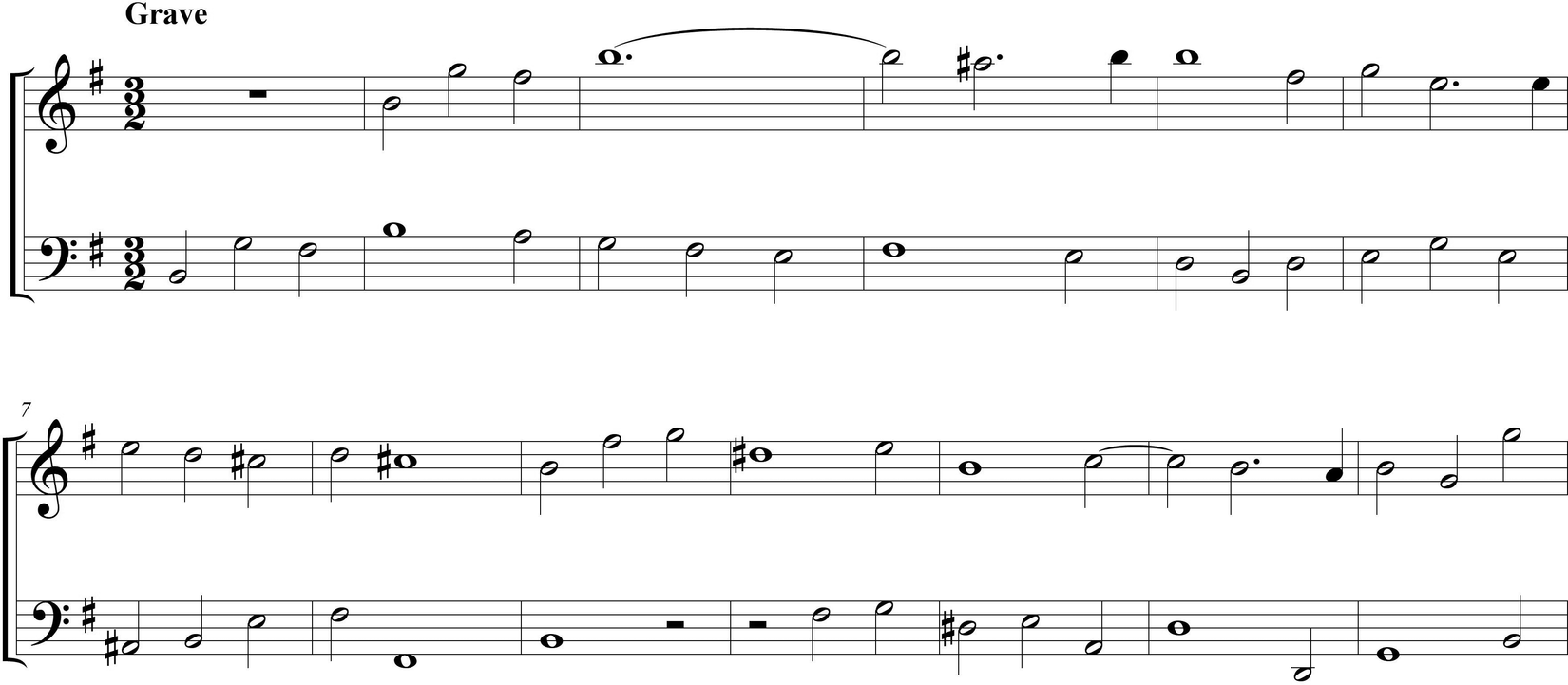
If one searches in this sonata for stylistic features contrasting with Pepusch’s usage, one discovers at least two. Except in the central Grave, there is a paucity of contrapuntal interaction between treble and bass, and there are also some rhetorical pauses à la Handel for both parts simultaneously that do not belong to Pepusch’s usual armoury of devices. But this Grave, in 3/2 metre, has so much of the unapologetically scholastic cast marking out Pepusch’s music that it must be reckoned a particularly good imitation revealing the affinity of the two men. Its opening bars, shown in Example 4, begin with a point of imitation taken to a cadence in the dominant, B minor, in bar 9. The new point of imitation, starting in the same bar, at first sight looks different, but in fact employs a rather sly inverted version of the same subject (compare bass notes 2–5 in bars 1–2 with traverso notes 2–5 in bars 9–10).
Opening of movement 3 in Sonata 19 from the Cheney Flute Sonatas Manuscript (bass figures omitted).
Conclusion
The Cheney Flute Sonatas Manuscript, linked in so many different ways to Pepusch, reminds us that, rather like Handel but much more comprehensively and in a more collegial manner, this musician operated less as a lone individual than as the benevolent master and guiding spirit of an entire atelier devoted variously to the theory, learning, composition, and performance of music. It is noteworthy how many of the major manuscripts transmitting Pepusch’s music, some of which can be traced back to his personal library, additionally contain works by his colleagues or members of his circle.Footnote 45 So the presence in the Cheney Manuscript of a work by Galliard and another possibly by Babell conforms to a familiar pattern. It is not out of the question that the volume acquired by John Cheney I was among the items from Pepusch’s library bequeathed to his pupil John Travers and eventually auctioned in July 1766.Footnote 46 That would make Pepusch himself the first owner for whom we are searching, even if the suggestion is admittedly a shot in the dark.
It would be safe to say that the volume is the earliest-known organized collection, manuscript or printed, of sonatas assigned expressly and exclusively to traverso and continuo produced on English soil. It provides a valuable snapshot of the kind of music available to traverso players in the second decade of the century, a transitional period when the instrument was already a familiar presence – hence the replacement of the earlier term ‘flûte d’Allemagne’ by its indigenous equivalent ‘German flute’ – but not yet truly popular among both professionals and amateurs.
As for the musical value of the items in the volume that appear to be unique to it, time will tell. The negative view of Pepusch expressed by Hawkins (‘a learned, but a dry composer […] apparently deficient in the powers of invention’) and echoed by Charles Burney (‘possessed of so little invention, that few of his compositions were ever in general use and favour’) have coloured critical views ever since.Footnote 47 Undoubtedly, there is a grain of truth in these statements, but the accusation of a lack of imagination and especially the claim, on Burney’s part, of a poor contemporary reception for these works (absurd in the case of The Beggar’s Opera and the chamber cantata Alexis) appear more than a little overstated. We learn from an account by a German visitor of a concert he attended in London in 1710 that Pietro Chaboud, an Italian player of the traverso (active there since 1702, if not earlier), teamed up with Pepusch at the harpsichord to play a solo for traverso.Footnote 48 Could it be that, alongside his many other initiatives and innovations, Pepusch was a pioneer in the arrangement (and even the composition) of solo sonatas for traverso in England? The Cheney Flute Sonatas Manuscript does not prove this, but it certainly nods in that direction.
Acknowledgments
This article owes most to Jeremy Barlow, its prime instigator. I would like to thank in addition Robert Bigio, Rainer Birkendorf, John Cunningham, Tim Evans, Markus Henneke, Peter Holman, Rashid-Sascha Pegah, Rudolf Rasch, Robert Rawson, and Andrew Woolley for information, assistance, and advice received during the preparation of this article.