There are several studies in the literature describing differences according to gender in reporting of physical symptoms.Reference Barsky, Peekna and Borus1–Reference Kroenke and Spitzer3 These differences are seen in community samples, as well as medical patients ranging from adolescence through adulthood.Reference Barsky, Peekna and Borus1–Reference Kroenke and Spitzer3 Based on these studies, women report physical symptoms significantly more commonly than do men. Furthermore, women with coronary arterial disease more commonly present with atypical chest pain.Reference Kimble, McGuire and Dunbar4–Reference Kyker and Limacher6 There has been no data describing the differences according to gender in the reporting of physical symptoms potentially related to the heart among healthy adolescent athletes. In the recent years, echocardiographic screening of young athletes organized by non-profit organizations is gaining in popularity. We used retrospective data from questionnaires that were completed prior to such screening in young student athletes in different locations, mainly in California.
Methods
A total of 1,465 teenage athletes, mainly from California, and aged between 13 and 19 years, participated in a mass screening for cardiac abnormalities. Echocardiograms were performed on site by experienced sonographers. The screenings were organized by “A Heart for Sports”. The athletes were recruited through advertisements, and by contacting local schools. Echocardiograms were interpreted onsite by volunteer cardiologists, specifically adult and paediatric cardiologists in close communication during the screening in order to discuss each potentially abnormal case, with recommendations for follow-up available on site if needed. The screening was focused on detecting abnormalities of ventricular wall motion, hypertrophic cardiomyopathy, and valvar disease. The use of colour Doppler permitted detection of any significant intracardiac shunting. Due to constraints of time, a more thorough protocol was not used. The sonographers, and the interpreting cardiologist, were instructed to record any significant cardiac abnormalities, which were analysed and followed at the discretion of the interpreting cardiologist.
The screenings were free of charge, and were sponsored by various donations from the community. Physical examination was not performed during screening. The screening was conducted using a hand-carried cardiac ultrasound device (OptiGo, Philips). All interpreting cardiologists were board certified, or eligible, in cardiovascular disease. The data was collected in the last 5 years in California. All participants were actively involved in a high school sport programme. Each athlete was required to give informed consent, and fill out a questionnaire before the screening. They were asked to report their demographics, such as height, weight, age, and race, and the occurrence of physical symptoms when they were active, or with exercise prior to the echocardiographic screening. Symptoms investigated by the questionnaire were shortness of breath, chest pain, fatigue, dizziness, palpitations and symptoms with walking, or oedema of the legs. The degree and severity of reported physical symptoms were not independently verified. We evaluated the frequency of reporting physical symptoms based on gender. Furthermore, we correlated the presence of physical symptoms with cardiac abnormalities detected echocardiographically. We used SPSS statistical program version 14 for analysis of data. The institutional review boards at the University of California, Irvine, and University of Arizona all approved this study.
Results
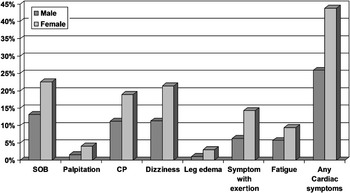
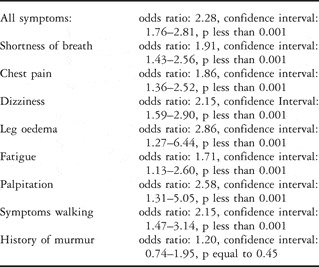
There were 1,031 (70.4%) male, and 434 (29.6%) female participants. Significantly more female teenage athletes reported physical symptoms (190/434, 43.8% versus 267/1,031, 25.9%, odds ratio: 2.28, confidence interval: 1.76–2.81, p less than 0.001). Symptoms did not correlate with any of the cardiac structural abnormalities identified by echocardiographic screening for either gender. Significant valvar abnormalities, defined as more than a trace of valvar regurgitations, or significant valvar stenosis, did not differ between the genders. Of 1031 male athletes, 22 (2.1%) had significant left-sided valvar abnormalities, as opposed to 8 of 434, female athletes (1.8% – p equal to 0.72, odds ratio: 1.16, confidence interval: 0.51–2.62). The differences in the reporting of symptoms were significant for all physical symptoms that were asked in the questionnaire. Thus, shortness of breath was reported by 21.9% of females versus 13.5% of males, odds ratio: 1.91, confidence interval: 1.43–2.56, p less than 0.001. Chest pain was reported by 19.1% of females versus 11.3% of males, odds ratio: 1.86, confidence interval: 1.36–2.52, p less than 0.001. Dizziness was reported by 20.9% of females versus 10.7% of males, odds ratio: 2.15, confidence interval: 1.59–2.90, p less than 0.001. Symptoms with walking were reported by 14.3% of females versus 6.3% of males, odds ratio: 2.15, confidence interval: 1.47–3.14, p less than 0.001. Leg oedema was reported by 3.4% of females versus 1.3% of males, odds ratio: 2.86, confidence interval: 1.27–6.44, p less than 0.001. Fatigue was considered present by 11% of females versus 6.2% of males, odds ratio: 1.71, confidence interval: 1.13–2.60, p less than 0.001. Finally, palpitations were reported by 6.7% of females versus 2.3% of males, odds ratio: 2.58, confidence interval: 1.31–5.05, p less than 0.001 (see Figure 1 and Table 1). As a control, we used a history of murmur, which was not different between the two groups, with a history of murmur reported by 6.0% of females versus 5.1% of males, odds ratio: 1.20, confidence interval: 0.74–1.95, p equal to 0.45.
The figure shows the significant differences between the genders in reporting physical symptoms. SOB = shortness of breath, CP = Chest pain.

Odds ratios, and confidence intervals, for more frequent reporting of physical symptoms by female teenage athletes in comparison to their male counterparts.

Discussion
First, we found that the incidence of physical symptoms in young athletes is similar to that found in the general population. In our study, 32.5% of the study population reported one or more symptoms, this being similar to the findings of Poikolainen and colleaguesReference Poikolainen, Kanerva and Lonnqvist7 in a cross-sectional study of 1,429 adolescents. This suggests that being an athlete does not reduce the incidence of physical symptoms potentially emanating from the heart. Furthermore, we found striking similarities to the general population in regard to reporting of physical symptoms.Reference Rhee, Miles, Halpern and Holditch-Davis8 Kroenke et al.Reference Kroenke and Spitzer3 found similar differences with respect to gender in a retrospective study of 1000 patients seen in centres for primary care. Poikolainen et al.,Reference Poikolainen, Kanerva and Lonnqvist7 in their study, found that two-thirds of female adolescents reported sympstoms, compared to just under half of their male counterparts. Barsky et al.,Reference Barsky, Peekna and Borus1 in a comprehensive review of several studies, found significantly higher prevalence of physical symptoms reported in females compared to males. Depression and anxiety are also known to be reported 2 to 3 times more frequently by females.Reference Barrett, Barrett, Oxman and Gerber9, Reference Weissman and Klerman10 These disorders are prominently associated with increased somatic features, which may contribute significantly to the differences between the genders noted in reporting of physical symptoms.Reference Katon, Kleinman and Rosen11–Reference Piccinelli and Simon13 Psychosocial factors in adolescents have also been found to be associated with increased physical symptoms.Reference Rhee, Holditch-Davis and Miles14 There are several proposed theories explaining these differences between the genders. The biological theory postulates that anatomical, physiological, and biological differences exist between the genders in perception of somatic and visceral stimuluse.Reference Fillingim and Maixner15 Certain neurotransmitters including gamma amino butyric acid, which play a significant role in perception and inhibition of pain, are hormonally dependent, and are modulated by oestrogens and other sex hormones.Reference Berkley16, Reference Derbyshire17 Males and females may also differ in the central processing of sensory information. Moreover, differences in assessment and recall of physical symptoms may contribute.Reference Pennebaker18–Reference Verbrugge20 According to the socialization theory, males are taught to be less expressive about discomfort and illness, and have a higher threshold for pain compared to females.Reference Mechanic21–Reference Verbruggev23 Socialization influences females to have a lower threshold for seeking medical attention, and to disclose their distress.Reference Verbrugge24 In consequence, females have higher use of health services per head of population. Even in healthy populations, similar differences were found, with females reporting more physical symptoms than males.Reference Gijsbers van Wijk, van Vliet, Kolk and Everaerd25–Reference Waldron28
We have confirmed, therefore, the physical symptoms referable to the heart are common in young athletes in the absence of cardiac disease. Such physical symptoms are reported more frequently by young healthy female athletes than by their male counterparts. The physical symptoms reported, however, were frequent in the young healthy teenage athletes regardless of gender. Our results do not imply, therefore, that women have less serious conditions when presenting with physical symptoms. There is a significant gender bias in the management of female patients with angina, which is associated with worse long-term outcome.Reference Daly, Clemens and Lopez Sendon29 A complete medical work should be performed in every patient with symptoms, regardless of gender, before considering psychological issues as the cause of complaint. The knowledge that a significant proportion of teenage athletes, particularly females, will have complaints does not detract from the need to evaluate each individual completely, regardless of age or gender.