


INTRODUCTION
The Crown Estate owns most of the mineral rights to the UK seabed out to the 12 mile limit and, acting as landowner, issues prospecting consents and licences for commercial extraction of marine minerals. The minerals are mainly sand and gravel, often collectively called marine aggregates. The control of marine aggregate dredging in the UK under the Government View Procedure dates back to 1968. Under this non-statutory system, the Crown Estate issued a dredging licence only if the Government was satisfied that predicted impacts on the environment were viewed to be acceptable. The information required to assess these impacts has increased as more has become known about the marine ecosystem (Campbell, Reference Campbell1993; Office of the Deputy Prime Minister (ODPM), 2002), and as a result of increased stakeholder interest in dredging activity and its environmental consequences. The Government View Procedure was revised in 1989 and requires an Environmental Impact Assessment (EIA) from the dredging company as part of the application process for a dredging licence. The introduction of statutory measures to control marine aggregate dredging activity through The Environmental Impact Assessment and Natural Habitats (Extraction of Minerals by Marine Dredging) (England and Northern Ireland) Regulations 2007 (the Marine Minerals Regulations), which came into force on 1 May 2007 (Office of Public Sector Information (OPSI), 2007), has increased the need for better predictions of the consequences of marine aggregate extraction operations before the award of dredging licences.
Before deciding whether to grant or refuse a dredging licence in UK waters, the regulator ‘carefully considers each proposal according to its individual circumstances’ (Marine Minerals Guidance (MMG) Note II, 2007). Specifically, the regulator takes into account ‘the proposed tonnage to be extracted; the rate and duration of extraction; the area to be affected; the proximity of sensitive areas such as areas of nature conservation importance and fish feeding and breeding areas; and all other existing dredging operations’. In reaching this judgement, the regulator draws upon a wide range of scientific and technical expertise available from statutory consultees and Government advisors. These procedures are in line with agreed international best practice and, in particular, are in accordance with the principles for the sustainable management of mineral extraction detailed in the ‘ICES Guidelines for the Management of Marine Sediment Extraction’ (ICES, 2003).
As part of an EIA, models are used to simulate the predominant hydrodynamic and sedimentological processes affected by dredging activity (van Rijn et al., Reference van Rijn, Soulsby, Hoekstra and Davies2005). Predicting the potential impact of dredging on marine biota is more difficult, largely on account of the lack of scientific knowledge regarding cause–effect relationships. The current approach to assessing the ecological consequences of marine aggregate extraction therefore relies on a thorough evaluation of the licence application in terms of its site-specific impact. This depends on the expertise and experience of the individuals/organizations charged with reviewing the EIAs. However, even with rigorous quality assurance checks, it can be difficult to apply standardized criteria consistently from one application to the next. Thus, there is the potential for the evaluation to be a subjective process, with different personnel and/or different local issues influencing the quality and outcome of the assessment. There is clearly a need to develop tools to aid decision-making and to reduce the scope for subjectivity.
Most studies concerned with assessing the biological consequences of marine aggregate dredging in UK waters are focused on detecting changes in the abundance, number of species or biomass of benthic organisms. Benthic assemblages are a logical target for investigations of the effects of aggregate extraction because:
1. They may be valued in terms of their links with other resources, as well as containing representative organisms that are commercially harvested (e.g. crabs, shrimps and flatfish). They may also have intrinsic value in terms of their rarity and hence conservation status (which may also apply to individual species). Furthermore, because of the open nature of the marine environment, evaluations of benthic biodiversity, productivity and trophic interactions may all bear upon wider ecosystem integrity.
2. They are consistent features of the seabed, and vary depending on the nature of the physical habitat and in response to environmental changes, including those due to anthropogenic activities. In addition, unlike shifting populations of planktonic organisms or many fish species, adults of most benthic invertebrate species are either sessile or mobile within narrow spatial ranges. Thus they are good indicators of locally induced environmental changes.
To predict the impact of marine aggregate extraction on the marine benthos, it is necessary to understand both the effects of the initial disturbance and predicted rates of faunal recovery. Available evidence indicates that dredging causes an initial reduction in the abundance, species diversity and biomass of the benthic community (Kenny et al., Reference Kenny, Rees, Greening and Campbell1998; van Dalfsen et al., Reference van Dalfsen, Essink, Toxvig Madsen, Birklund, Romero and Manzanera2000; Sardá et al., Reference Sardá, Pinedo, Grémare and Taboada2000; van Dalfsen & Essink, Reference van Dalfsen and Essink2001; Newell et al., Reference Newell, Seiderer, Simpson and Robinson2004). Differences in the type of dredger and characteristics of the seabed environment could influence the spatial scale of impact on the benthic fauna, both in terms of the direct effect of removal of sediments and the indirect effects of extraction associated with the deposition of suspended sediments. The estimated time required for ‘recovery’ of the benthic fauna following marine aggregate extraction will also depend on the habitat, the scale and duration of disturbance, the intensity of dredging, hydrodynamics and associated bed load transport processes, the topography of the area, and the similarity of the habitat with that which existed before dredging (for a review see Newell et al., Reference Newell, Seiderer and Hitchcock1998).
In recent years, greater consideration has been given to identifying mitigation measures to reduce the impact of aggregate extraction; these measures are then translated into appropriate licence conditions (ODPM, 2002; OPSI, 2007). To ensure that such licence conditions are effective in minimizing environmental disturbance and that predictions regarding the extent and environmental significance of effects are sound, a benthic monitoring programme is usually initiated (Boyd, Reference Boyd2002). Monitoring is undertaken to document both pre- and post-extraction conditions at dredging sites and to determine whether unacceptable impacts are occurring, or if conditions that could lead to an unacceptable impact are developing. The outcome of monitoring programmes can therefore usefully contribute to judgements on the acceptability of continued dredging within an extraction site. Monitoring can also improve the basis on which future dredging applications are assessed by improving knowledge of field effects. Underwood & Chapman (Reference Underwood, Chapman, Elefheriou and McIntyre2005) provide an excellent summary of survey designs to detect impacts and Underwood & Chapman (Reference Underwood and Chapman2003) describe different types of impact and how monitoring programmes can be designed accordingly.
The capacity to quantitatively predict the effects of proposed dredging operations would both improve the quality of decision-making and enhance the effectiveness of sampling designs for any post-dredging monitoring programmes (Underwood, Reference Underwood1993). Despite the straightforward rationale for quantitative predictions (see e.g. Underwood, Reference Underwood1990), formulating satisfactory ecological models to underpin these predictions can be difficult. This is because the results from different studies may be incomparable or insufficient to cover all the dredging scenarios that need to be considered. Furthermore, the effects of dredging will depend on both the magnitude and intensity of dredging and on the composition and spatial variability of the benthic assemblage.
In this paper, we model the initial impacts of marine aggregate extraction on the benthic fauna, taking into account the densities and spatial patterns of the community. We begin by developing a simple model that looks at impacts at the individual organism and species levels, but assumes spatial randomness of individuals. We then make the model more realistic by allowing spatial clustering of individuals (Neyman & Scott, Reference Neyman and Scott1958; Matern, Reference Matern1986). We then apply our methods to a field experiment off the Norfolk coast to the east of the UK (see Kenny & Rees, Reference Kenny and Rees1994, Reference Kenny and Rees1996) that tracked the consequences of dredging disturbance on a benthic assemblage. We use Kenny & Rees' data to assess our model and to estimate the number of species eliminated by dredging, as opposed to being missed in the post-dredging surveys. This estimation is a non-trivial statistical and computational exercise and involves modelling the underlying spatial patterns of the individual species. All computing was done using the free statistical package R (R Development Core Team, 2006). R functions to carry out the computations described in this paper are available from the authors.
A BENTHIC IMPACT MODEL FOR POPULATIONS WITH A RANDOM SPATIAL DISTRIBUTION
Here, we introduce a simple model for predicting benthic impact when all individuals are randomly distributed over the dredging area. The probability that an individual is lost is therefore independent of whether any other individual is lost. Two types of impact are considered. The first is at the individual level, when a whole species is lost only if all individuals in that species are killed. The second is at the species level, where each species has a given probability of being lost. Specifically, for a given impact, define:
p j = probability that an individual of species j (j = 1, … , S 1) is lost and
πj = probability that species j is lost (j = 1, … , S 1)
where S 1 is the total number of species before the impact. We envisage that species impact will be due to the indirect effects of the dredging activity associated with deposition and re-suspension of suspended sediments. Such effects can be significant, for example, in gravelly habitats dominated by encrusting epifaunal taxa over the medium to long-term due to the abrasive impacts of the suspended sediments. In contrast, individual impact would be due to the direct removal of sediment and the resident fauna during dredging. Some basic algebraic results that follow quantify how the impact affects the abundance and number of species.
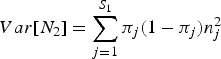
If the impact is only at the individual level, the expected values and variances of the number of individuals (N 2) and species (S 2) after the impact are given by:


where N 1 and S 1 are the numbers of individuals and species respectively before the impact and n j is the abundance of species j before the impact. A species is lost only if every individual in that species is killed and from equation (2) this is only likely if p j is close to one or if the species is rare (i.e. n j is small). Later, we see that a species is more likely to be lost if it has a clustered distribution.
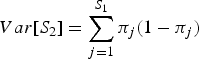
If the impact is only at the species level we obtain:


If the impact is at both the species and the individual level, we assume that the impact on the species happens first, followed by the impact on the individuals. This can be thought of as a double impact where the numbers of species and individuals before the impact (time 1) are reduced by the species impact (time 2) and then the individual impact (time 3). The expected value and variance of the number of individuals at time 3 require the standard results

To calculate the expected value and variance of the number of species at time 3, we note that S 3 is the sum of Bernoulli random variables with probabilities (1−p jn j)(1−πj). Thus we get


We now illustrate the impacts defined in equations (1) to (12) with some stylized examples. We use an artificial population with 100 species, where the abundances of the species go from 1–100 (i.e. species 1 has abundance 1, species 2 has abundance 2, etc.). This allows our population to have both rare and common species. Each species is assumed to have individuals that are randomly distributed and independent of members of other species. For simplicity, we assume that the individual (p) and species (π) impacts are common across species (i.e. p = p 1 = p 2 = … = p 100 and π = π1 = π2 = … = π100).
Figure 1A & B show the individual impact on abundance and number of species, as defined in equations (1) to (4). The solid lines are the expected impact and the dashed lines are approximate 95% confidence intervals assuming a Normal distribution. When the individual impact p is low, all individuals in a species are unlikely to be killed (and hence few species lost); however, as p approaches about 0.9, many species start to be lost. Expected abundance declines linearly with p. Figure 1C & D show the equivalent plots for impact at the species level, as defined by equations (5) to (8). Both expected abundance and number of species decline linearly with π. The confidence intervals for species impact are wider than for individual impact.
Illustration of individual and species impact for a simulation study based on an artificial population with 100 species, where the abundances of the species go from 1–100 (i.e. species 1 has abundance 1, species 2 has abundance 2, etc.). Each species is assumed to have individuals that are randomly distributed and independent of members of other species. Specifically, we show the effect of: (A) individual impact p on the number of species; (B) individual impact p on abundance; (C) species impact π on the number of species; (D) species impact π on abundance.

Figure 2A & B show the combined effect of individual and species impacts on abundance and number of species, as defined by equations (9) to (12). Each plot shows how expectations and 95% confidence intervals for p = 0.3 and p = 0.95 vary with π. The level of individual impact has little effect on the number of species, but a much greater affect on abundance.
Illustration of the situation where individual and species impact occur together—for a simulation study based on an artificial population with 100 species, where the abundances of the species go from 1–100 (i.e. species 1 has abundance 1, species 2 has abundance 2, etc.). Each species is assumed to have individuals that are randomly distributed and independent of members of other species. Specifically, we show the effect of species impact π on: (A) number of species; (B) abundance—for two levels of individual impact (P = 0.3 and P = 0.95).

SPATIAL CLUSTERING OF INDIVIDUALS
The theory above assumes that individuals are randomly distributed over the dredging area. However, benthic species typically have a clustered distribution. The extent and scale of the clustering depends upon the species. For example, many species associated with gravelly substrates such as Balanus crenatus, Sabellaria spinulosa, Pomatoceros lamarcki and Crepidula fornicata are gregarious settlers and would be expected to occur in patches.
To investigate clustered population, we need a statistical model that can describe the different types of clustering present in benthic assemblages. For this we use a Matern process (Matern, Reference Matern1986), one of a family of spatial models introduced by Neyman & Scott (Reference Neyman and Scott1958). The Matern process has three components:
i. parent events form a Poisson process with intensity T (i.e. ‘parents’ are randomly distributed over the area with mean T per unit area);
ii. each parent produces a Poisson number of offspring with intensity C;
iii. the positions of the offspring relative to their parents are randomly chosen within a circle of radius R.
The point maps formed by the process consist only of the locations of the offspring. If T is low and C is high, then the process is clustered (Figure 3A). Conversely, if T is high and C is low, the process is more random (Figure 3B). Increasing R can change a clustered process into a more random-looking one (Figure 3C & D). Use of the Matern model requires the pragmatic assumption that all clusters are independent of each other.
Four realizations of offspring distribution derived from the Matern process with different parameter combinations (see text): (A) T = 1, C = 100, R = 0.2; (B) T = 100, C = 1, R = 0.2; (C) T = 15, C = 30, R = 0.1; (D) T = 15, C = 30, R = 0.4.

We used simulations to investigate the effect of dredging on a clustered population of 100 species. For the purposes of the simulation, species were assumed to be located independently of one another. We repeatedly generated individuals on a 10 by 10 square using a Matern process, slightly modified so that the number of clusters was fixed and the mean total number of points over all clusters for each species was 100 (i.e. C was 100 divided by the number of clusters). The parameter R was set at 0.05. Dredging was simulated by placing vertical strips of width 0.5 units over the area, with the number of strips chosen to cover a proportion p of the area. All individuals in a dredged strip were assumed to be killed. In terms of the theory above, this corresponds to an individual impact of p and a species impact π of zero. However, the fates of individuals are no longer independent due to the combined effects of clustering and dredging in strips. Figure 4 shows that with high clustering (i.e. when there are few clusters with lots of individuals), more species are lost for a given level of dredging. This is intuitively sensible because if all members of a species are in a few clusters, they are more vulnerable to being removed by one pass of a dredger.
Effect of clustering on the expected number of species remaining in the simulated population after dredging with vertical strips such that the overall proportion of the area dredged is 0.7 and 0.9.

ESTIMATING SPECIES IMPACT FROM THE NORFOLK DATA
We now apply the Matern model to data from a dredging study off the Norfolk coast of the UK. We extend the methods of the previous section to consider the sampling properties of estimators from grab samples and their ability to make inferences about the underlying population. In particular, we estimate the number of species that were eliminated by dredging.
Introduction to the Norfolk data
The data are from an experimental dredging study initiated off the Norfolk coast in 1992 (Kenny & Rees, 1994, 1996). The study area was 135,000 m2. Dredging took place over three days in April 1992, resulting in the removal of 50,000 t of marine aggregate. According to Kenny & Rees, this corresponded to dredging 70% of the area. Surveys of the marine benthos were carried out pre (March 1992) and post (May 1992) dredging. Although further surveys were conducted to look at the early stages of recolonization of the site and also at a control site, we will use data from only the March and May 1992 surveys. The surveys consisted of species counts from five randomly-placed 0.25 m2 Hamon grabs. Numbers of individuals per grab were recorded for each species found.
Table 1 shows the mean number of individuals per grab for the five most abundant species in the pre-dredging survey and their corresponding densities in the post-dredging survey. Also shown are estimates of the individual impact on these species:

where  j(post) and
 j(pre) are the post- and pre-dredging mean abundances of species j respectively. (Theoretical estimates of individual impact based on the Matern model are found later in this section.) Combining all 64 species gives an estimate of overall individual impact of 0.94, with approximate 95% bootstrapped confidence limits (e.g. Manly, Reference Manly1998) of 0.90–0.96. Thus, the individual impact appears to be greater than would be expected from the direct effects of dredging (since Kenny & Rees say that only 70% of the area was dredged). This may be due to indirect individual impacts outside dredged areas or to species elimination.
Pre- and post-dredging densities for the five most abundant species in the pre-dredging survey. Also shown are the estimates of: the individual impact p from equation (13); the mortality parameters p j(dredge) and p j(clear); the probability of being missed by the five grabs in the post-survey given that the species was not eliminated, q j; and the estimated parameters of the Matern model.

Of particular interest here are the species that were absent from the post-dredging survey. Assuming that no new species arrived between the pre- and post-dredging surveys, we can say that species were either:
i. present in both surveys;
ii. present in the pre-dredging survey but absent from the post-dredging survey, either because:
(a) the species had been eliminated by dredging, or
(b) the species was missed in the post-dredging survey;
iii. missed in the pre-dredging survey but present in the post-dredging survey;
iv. missed in the pre-dredging survey and eliminated by dredging;
v. missed in both surveys.
In the Norfolk study, 64 species were found in the pre-dredging survey and 26 in the post-dredging survey, three of which were new ones. Thus, 41 species found in the pre-dredging survey were absent from the post-dredging survey. Species are more likely to be missed in the post-dredging survey because densities are generally lower after dredging, but how many of the 41 species were missed and how many had been eliminated?
Answering this is non-trivial and requires considerable modelling and computer simulation. Our approach was as follows:
i. The spatial patterns of the 64 species observed in the pre-dredging survey were modelled using the Matern process. Parameters for each species were estimated by maximum likelihood.
ii. A model was developed with parameters representing individual impact in the dredged and the non-dredged parts of the area. The parameters were estimated for the 23 species found in both surveys by maximum likelihood.
iii. The models in i and ii were used to estimate the number of species eliminated by dredging.
We only consider the numbers of species eliminated that were observed in the pre-dredging survey. A good summary of methods to estimate the number of species missed in the pre-dredging survey is given by Chao (Reference Chao, Balakrishnan, Read and Vidakovic2004).
Fitting the Matern model to species found in the pre-dredging survey
The Matern process was used to model the spatial distribution of each species found in the pre-dredging survey. For each species, the parameters T, C and R were estimated from the five grab counts by a pseudo maximum likelihood approach. However, to simplify the estimation, the estimates of T and C were constrained so that the mean of the Matern process was equal to the mean observed count. Thus, for species j

where a is the grab area (0.25 for our data) and T^j and C^j are the estimates of T j and C j. The likelihood then only had to be maximized over the radius parameter R j and one of T j and C j (we chose T j).
For any set of parameters θj = (T j, C j, R j)T the likelihood was calculated by simulating the Matern process m times (we used m = 1000) and each time counting the number of points falling within an area of 0.25 m2; i.e. the area of the grab in the Norfolk study. Frequency distributions of the simulated counts were used to assign probabilities to the observed counts from the pre-dredging survey and hence to calculate the likelihood. Any observed counts that did not occur in the simulations were assigned an arbitrary low probability of (2m)−1. The maximum likelihood was found using a grid search over the two parameters (R j and T j). Formally, define n ij(sim) = number of individuals of species j in the i th simulated grab (i = 1, … , m)

where I[X] is an indicator function such that I[X] = 1 if the event X occurs, 0 otherwise. Assuming independence between the five grabs (which is reasonable given the large sampling area relative to the grab size), the log-likelihood is given by:

where n j(1), n j(2), … , n j(5) are the observed counts for species j from the five grabs. Maximizing l(n j(1), n j(2), … , n j(5); θj) over different values of θj gives the maximum likelihood estimates. Because of the intensive computations, we maximized over a 5 by 5 grid of potential values for T and R.
Parameter estimates for the five most abundant species in the pre-dredging survey are shown in Table 1. With only five grabs, the estimates are of low precision, but they generate data that are realistic compared to the observed data. For the rarer species (e.g. those where only one individual was observed in the pre-dredging survey), there is very little information with which to estimate the parameters. However, the estimation method ensures that the Matern process has a mean that is consistent with the data and provides a reasonable basis for further modelling.
Modelling mortality in the dredged and non-dredged areas
The fitted Matern models are now used to estimate the individual impact of dredging for the 23 species found in both surveys. We depart slightly from the theory of the previous section by conditioning on whether an individual is in a dredged or non-dredged area and assuming that an individual of species j is killed with probability p j(dredge) or p j(clear) respectively. This is more realistic because although most individuals in the path of the draghead will be killed or removed, dredged sediments can be rapidly recolonized by some benthic species (Cooper et al., Reference Cooper, Boyd, Aldridge and Rees2007a) so in the post-dredging survey we would still expect to find many individuals of some species (see e.g. Cooper et al., Reference Cooper, Boyd, Eggleton, Limpenny, Rees and Vanstaen2007b; Barrio Froján et al., 2008). However, dredging can also have an indirect impact on the fauna away from the path of the draghead, particularly on more sensitive species (Newell et al., Reference Newell, Seiderer, Simpson and Robinson2004). This could be due to the suspension or redeposition of sediments disturbed by the draghead, of material washed out from the spillways of the vessel hopper, or of rejected sediment fractions, e.g. sands rejected by screening activities (Robinson et al., Reference Robinson, Newell, Seidener and Simpson2005). Since the densities of species in the dredged areas will be less than or equal to that in the non-dredged zones, we assume that p j(dredge) ≥ p j(clear).
For each of the 23 species found in both the pre- and post-dredging surveys, we estimated the mortalities p j(dredge) and p j(clear) as follows.
i. Trial values of p j(dredge) and p j(clear) such that p j(dredge) ≥ p j(clear) were chosen.
ii. A spatial realization was simulated using the Matern process and the parameter estimates found in an earlier subsection.
iii. Dredging was simulated by randomly placing 2.5 m dredging strips onto the spatial realization. The gaps between the strips were chosen so that 70% of the area was dredged (as reported by Kenny & Rees, Reference Kenny and Rees1996).
iv. Each point from the spatial realization was thinned according to a Bernoulli random variable with probability p j(dredge) if the point was in a dredged strip and p j(clear) if in a non-dredged strip. The number of individuals in a 0.25 m2 grab placed randomly onto the thinned realization was recorded.
v. Steps ii–iv were repeated 1000 times to give a probability distribution for the number of individuals in a grab.
vi. The observed counts in the post-dredging survey and the probability distribution from step v were used to calculate the log-likelihood in a similar manner to equation (14). Observed counts that did not occur in the simulation were assigned a nominal probability of 1/2000.
The process was repeated for a grid of values of p j(dredge) ≥ p j(clear), and the maximum likelihood estimates p^j(dredge) and p^j(clear) found. These are shown in Table 1 for the five most common species in the pre-survey. Over all 23 species, the mean value for p j(dredge) was 0.80 and its range was 0.1–1; the mean for p j(clear) was 0.67 and its range was 0.0–0.9.
We cannot estimate p^j(dredge) and p j(clear) for the species that were unobserved in the post-dredging survey because it is not possible to disentangle the effects of elimination and individual impacts from the data. However, in the next section we require estimates of p^j(dredge) and p^j(clear) for all species. Our pragmatic approach was to randomly allocate a pair of p^j(dredge) and p^j(clear) from the observed species to each unobserved species.
Estimating the number of missed and the number of eliminated species
We now estimate how many of the unobserved species in the post-dredging survey were missed and how many were eliminated. Note that, because the area sampled is negligible when compared to the survey area, we assume that the probability that a species is eliminated due to the effects of individual impact alone is also negligible. Let
π = probability that species j is eliminated, assumed common across species.
q j = probability that species j is missed in the post-dredging survey given it was not eliminated.
The probability that species j is unobserved in the post-dredging survey is then the probability that it was eliminated or missed: i.e. π+(1−π)q j.
To estimate π and hence the number of eliminated species, we first need estimates of the q j. These were obtained by using p j(dredge) and p^j(clear) and the parameters of the Matern process to simulate the frequency distribution of the number of individuals in a post-dredging grab assuming the species was not eliminated. This gives an estimate q^j0 of the probability that species j is absent from a post-dredging grab given individual impacts alone. Assuming independence between grabs, the probability that the five post-dredging grabs all fail to detect species j is then q^j = (q^j0)5. These are shown in Table 1 for the five most common pre-dredging species. Note that Amphipoda and Pisidia longicornis have low probabilities of not being detected because they have less clustered spatial distributions than Belanus crenatus and Dendrodoa grossularia but are less affected by the dredging than Sabellaria spinulosa.
To estimate π, note that the log-likelihood of the presence/absence of each species in the post-dredging survey is

on the assumption that presence/absence is independent across species. This can be maximized to give π^ML = 0.092. A 95% likelihood interval is given by the values of π satisfying 2(l(π^ML)−l(π)) ≤ χ12 (0.95) where χ12 (0.95) is the 95 percentile of a χ12 distribution; i.e. π could lie between 0 and 0.35 with 95% likelihood.
An estimate of the number of species eliminated is given by 41π^ML. This suggests that 4 species were eliminated (and hence 37 missed) with a 95% likelihood interval of 0–14 species.
DISCUSSION
In commercial deposits, trailer dredging creates furrows along the seabed (ICES, 1992). There are undisturbed deposits between dredged furrows, so the immediate effect on benthic populations is one of local depletion rather than uniform reduction. The undisturbed areas may provide an important source of colonizing species (Newell et al., Reference Newell, Seiderer and Hitchcock1998), allowing faster recolonization in less heavily dredged sediments. In a local context, controlling the area and intensity of dredging and allowing undisturbed deposits to act as refuges between dredged furrows may be an effective measure for enhancing the rehabilitation of the seabed.
Rates of faunal recovery in commercial extraction sites are likely to depend on the frequency of dredging. In particular, recovery rates will be influenced by whether there is sufficient time between dredging events for organisms to reproduce and for new recruits to settle. It remains to be established whether intermittent dredging improves the rehabilitation of extraction sites in the long-term. There may be environmental benefits from rotating dredging operations across different zones and leaving ‘fallow’ areas to rehabilitate for several years before reworking. However, the wider environmental and operational implications of adopting this practice would need to be examined before its routine introduction.
Species will vary in their response to dredging. Some species will not survive an impact, for example, due to the removal of a particular substrate, changes to the nature and stability of sediments following the exposure of underlying strata, or the increased turbidity and redistribution/redeposition of fine particulates in the non-dredged areas. Other species will survive with only directly affected individuals being lost. Using specific information on the robustness of the set of species present pre-dredging could improve future models and predictions. We do not yet have sufficient understanding of the proportion of a habitat or assemblage that must remain undisturbed to ensure its sustainability.
The preliminary analysis of the Norfolk data showed that the overall impact of dredging on the abundance of benthic invertebrates could be higher than accounted for by just looking at the proportion of the area dredged. This is most likely because the fauna were exposed to the indirect effects of dredging, i.e. the effects of sediment deposition and re-suspension affecting individuals not directly removed by the draghead. Such effects can be important in gravelly habitats dominated by encrusting epifaunal taxa due to the abrasive impacts of suspended sediments (Desprez, Reference Desprez2000; Boyd & Rees, Reference Boyd and Rees2003).
Our model of the initial impact of dredging accounts for clustering of individuals and allows for different types of impact (i.e. two types of individual impact and a species impact). From the Norfolk data, we have estimated parameters for the Matern clustering process for the 64 species found in the pre-dredging survey and individual impact parameters for the 23 species found in the post-dredging survey. We have also estimated the number of species that were eliminated in the dredged area to be between 0 and 14 with 95% likelihood, but most likely to be 4. Our estimate is of low precision because there were only five grabs in both pre- and post-dredging surveys. However, the study has progressed our understanding of the ecological effects of marine aggregate extraction and has provided methodology that can be used, for the first time, to explore the effects of dredging on different assemblages with different degrees of clustering. The methodology could also be used to aid sampling design. Our experience from working with these data is that more post-dredging grabs are needed to make robust inferences about species that are rare following dredging.
We needed to make several assumptions to develop our models. For example, we assumed that cluster locations both within and between species were independent.
However, in practice species will interact through, e.g. mutual preferences for a sediment type (more clustered), contrasting preferences for different sediment types (more regular) or competition. Note that some species may also have some sort of biological association or ‘partnership’ with others (commensalism, parasitism, mutualism, etc.). Developing models to allow for these dependencies is an area for future work. We also had to generalize about the nature of the dredging activity. We assumed that dredging was carried out in even strips across the area, whereas in practice dredging tends to be targeted to particular deposits.
The small number of grabs in the Norfolk study severely limits our ability to validate our model. There are few reports in the literature on the effects of marine aggregate extraction on benthic assemblages in UK waters. The validation of models and their refinement to account for a wide range of biological responses to marine aggregate extraction is essential if such models are to be used routinely in impact assessments. This is particularly true given the site-specific nature of extractions in terms of the biological and geological environment, and the associated dredging pressures and practices.
Our understanding of links between various ecosystem elements and overall ecosystem functioning is far from complete, so there is much uncertainty about the implications of short-term local changes due to marine aggregate extraction. For a fuller understanding, we must determine how the effects of dredging differ in various habitats and at different spatial and temporal scales. To complement this information, we need to understand better the ecology of individual species associated with gravel habitats so that we might better represent the dynamics of populations following disturbance. In this paper, we modelled the initial disturbance following marine aggregate extraction. Future case studies are needed on the consequences of marine aggregate extraction on marine biota over sufficiently long time-scales to underpin the derivation of reliable and scientifically credible models.
ACKNOWLEDGEMENTS
We thank Hubert Rees and the referees for their comments on the manuscript. This research was carried out using funding awarded to Cefas from the Defra Marine Environmental Indicators Project M4118.



