INTRODUCTION
Most parasites with complex life cycles require the use of one or more intermediate hosts (those harbouring the larval stages) and a definitive host (harbouring the adults) to complete their life cycle. Reproduction occurs in the definitive host (which usually eats the intermediate host), and the parasite's eggs are then released into the environment with the host's faeces. The selection of these hosts in a predator–prey system could be critical in determining parasite success.
Optimal foraging models assume that natural selection favours the strategy that maximizes reproductive success (Stephens & Krebs, Reference Stephens and Krebs1986). A suboptimal foraging decision is potentially more risky for parasites than for free-living animals, given that a mistake in choosing the host could lead to no potential offspring. However, rejecting a potential host could lead to a similar outcome (Lewis et al., Reference Lewis, Campbell, Sukhdeo, Lewis, Campbell and Sukhdeo2002). Nevertheless, it is common that at any stage of their life cycle, parasites use several sympatric host species belonging to either the same taxonomic group or ecological guild. Moreover, several co-existing parasite species with the same definitive hosts can potentially use the same intermediate host species (see Koehler & Poulin, Reference Koehler and Poulin2010). The abundance and distribution of alternative host species as well as non-hosts (e.g. predators of infective larval stage) may affect infection levels in second intermediate hosts (Thieltges et al., Reference Thieltges, De Montaudouin, Fredensborg, Jensen, Koprivnikar and Poulin2008). The resulting flow will depend on a variety of biotic (availability of hosts) and/or abiotic (salinity, temperature, tidal amplitude) factors and to interspecific interactions among parasite species (e.g. Kuris, Reference Kuris, Esch, Bush and Aho1991; Skirnisson et al., Reference Skirnisson, Galaktionov and Kozminsky2004; Byers et al., Reference Byers, Blakeslee, Linder, Cooper and Maguire2008; Faltýnková et al., Reference Faltýnková, Valtonen and Karvonen2008).
Soft bottom intertidals (and salt marshes) of the Mar Chiquita Coastal lagoon (Argentina: 37°32′–37°45′S 57°19′–57°26′W) are dominated by the semi-terrestrial crab Neohelice granulata (Dana, 1851; Grapsidae) (Iribarne et al., Reference Iribarne, Martinetto, Schwindt, Botto, Bortolus and Garcia Borboroglu2003). They are mainly deposit feeders in intertidal mud flats (creeks and channels) but herbivorous in salt marshes (Iribarne et al., Reference Iribarne, Bortolus and Botto1997; Bortolus & Iribarne, Reference Bortolus and Iribarne1999). The crab Cyrtograpsus angulatus (Dana, 1851; Grapsidae) is similar in size (Boschi, Reference Boschi2000) but is mainly a subtidal species, while N. granulata inhabits the intertidal zones, and the two species overlap only during high tides in this area (Martinetto et al., Reference Martinetto, Valiñas, Palomo and Iribarne2007). Neohelice granulata is extremely well adapted to exposure to atmospheric air, whereas C. angulatus shows a high degree of osmoregulatory capability (Spivak et al., Reference Spivak, Anger, Luppi, Bas and Ismael1994). Due to these physiological differences, C. angulatus is able to inhabit areas of the lagoon with salinities varying from fresh to seawater, whereas N. granulata is able to occupy the uppermost parts of the intertidal zone of brackish waters (Spivak et al., Reference Spivak, Anger, Luppi, Bas and Ismael1994). One particular difference between the distributions of these two crab species is that N. granulata is found in discrete high-density patches (Crab beds) across the lagoon, while C. angulatus stability through time is less predictable because of their high mobility.
Both crab species harbour metacercariae of the digeneans Microphallus szidati (Martorelli, Reference Martorelli1986) and Maritrema bonaerensis (Etchegoin & Martorelli Reference Etchegoin and Martorelli1997; Microphallidae), and cystacanths of the acanthocephalan Profilicollis chasmagnathi (Holcman-Spector, Mañé-Garzón & Del-Cas, 1977; Profilicollidae) (Etchegoin, 1997). The three species are parasitic in birds as adults (seagulls of the genus Larus and the white-backed stilt Himantopus melanurus (Viellot, 1817) for P. chasmagnathi and M. szidati). Crabs become infected by digeneans when the cercariae, after leaving the snail first intermediate hosts (Heleobia australis d'Orbigny, 1835 and H. conexa Gaillard, 1974), encyst as metacercariae in the body cavity (M. bonaerensis) or in the hepatopancreas (M. szidati). In the case of P. chasmagnathi, crabs ingest the parasite eggs (containing the acanthor stage) deposited in bird faeces. After ingestion, the eggs hatch and the larval worms reach the crab body cavity where they develop to the acanthella stage and, finally, to the cystacanth stage. Metacercariae and cystacanths need to be eaten by a suitable definitive host to complete their life cycles (Etchegoin, Reference Etchegoin and Martorelli1997, Reference Etchegoin and Iribarne2001; Alda, Reference Alda2011; Alda et al., Reference Alda, La Sala, Marcotegui and Martorelli2011).
Given the distribution differences between crab species across the lagoon, and that local factors may affect digenean infection success, the objective of this work is to describe the spatial differences in parasite infection levels and their preference on the host.
MATERIALS AND METHODS
Study site
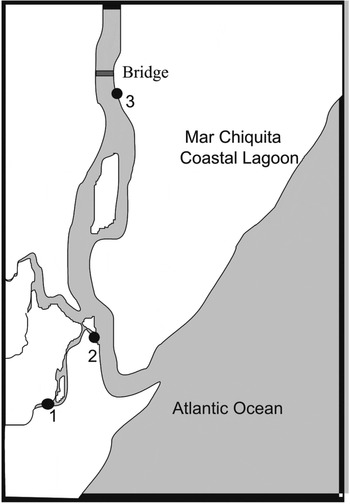
The Mar Chiquita coastal lagoon (Figure 1) can be divided into a freshwater zone, characterized by continental water discharge without tidal effects, and an estuarine zone that communicates with the open sea. The estuarine zone is characterized by mixo-euryhaline waters and is greatly influenced by marine water (Reta et al., Reference Reta, Martos, Perillo, Piccolo, Ferrante and Iribarne2001) while the freshwater zone receives fresh water and sediment from a drainage basin of approximately 10,000 km2 (Fasano et al., Reference Fasano, Hernandez, Isla and Schnack1982). Nevertheless, the limits between the two zones and the levels of salinity are extremely variable (Reta et al., Reference Reta, Martos, Perillo, Piccolo, Ferrante and Iribarne2001). The sampling areas (Figure 1) were selected in the estuarine zone where crab beds are more stable in time. Site 1 is a very shallow creek, while site 2 and 3 show deeper and extensive intertidals. In this area only H. australis is present (Parietti, Reference Parietti2011). These zones vary in salinity from the mouth of the lagoon to the inner part, and both species of crabs are present.
Mar Chiquita Coastal Lagoon map showing the sampling places.

Sampling procedures
To determine possible spatial differences in parasitism levels between sites and crab species across the lagoon, three areas dominated by Neohelice granulata were selected and adult specimens (considering same proportion of males and females) of N. granulata and C. angulatus were collected randomly by hand during summer (January–February) of 2012. These sites were selected based on the N. granulata crab presence stability across time (Lomovasky et al., Reference Lomovasky, Mendez Casariego, Brey and Iribarne2006; Botto et al., Reference Botto, Mendez Casariego, Valiñas and Iribarne2008). All sampling sites are practically devoid of humans: Site 1 is a shallow creek with private access to people; Site 2 is a deep creek surrounded by a crab bed which makes people avoid this area (see Botto et al., Reference Botto, Mendez Casariego, Valiñas and Iribarne2008) and site 3 is accessible only by boats.
To avoid differences in prevalence and mean intensity with size (Etchegoin, 1997) only adult crabs (carapace width [CW] >22 mm) were sampled. The prevalence represents the number of parasitized crabs/number of collected crabs × 100, and the mean Intensity represents the total number of parasites of a particular species found in a sample divided by the number of hosts infected with that parasite (Bush et al., Reference Bush, Lafferty, Lotz and Shostak1997). Once collected, crabs were transported to the laboratory and maintained in aerated water. Tetra Min Pro Tropical Crisps was provided as food.
In the laboratory, CW of each crab was measured with a Vernier caliper (precision: 0.1 mm). Later, crabs were dissected under a stereo-microscope in order to detect the presence of parasites, and each species of parasite was identified and quantified. Some metacercariae released spontaneously from their cysts and others were helped to release from their cyst through use of dissecting needles. Larval digeneans were identified according to Martorelli (Reference Martorelli1986) and Etchegoin & Martorelli (Reference Etchegoin and Martorelli1997) and cystacanths were identified according to Vizcaíno (Reference Vizcaino1989).
Data analysis
To rule out the influence of the size range of crabs selected on parasitism levels, correlation analysis between CW and prevalence, and intensity values were performed. For prevalence values, correlation was performed between ranges of 2 mm. For each sample (N range = 20–70) prevalence and mean intensity was calculated for the three parasites best represented. Prevalences were compared with proportion z-tests after angular transformation (Zar, Reference Zar1999). For each parasite species, differences in mean intensity between zones and crab species were performed with a two-way ANOVA after log transformation to meet the assumptions. When differences were detected, a Fisher LSD a posteriori test was performed.
RESULTS
Both crab species harboured metacercariae of the digeneans Microphallus szidati and Maritrema bonaerensis (Microphallidae), and cystacanths of the acanthocephalan Profilicollis chasmagnathi (Profilicollidae). Sex ratios (m:h) were 0.6:0.4 for N. granulata and 0.53:0.47 for C. angulatus. No differences in mean intensity were found between sexes so they were pooled in the subsequent analysis. The correlation analysis for N. granulata showed no effect of the sizes selected and prevalences for M. bonaerensis (r = 0.35, F (1,11) = 1.56, P = 0.23), P. chasmagnathi (r = 0.17, F (1,11) = 0.33, P = 0.57) and M. szidati (r = 0.59, F (1,11) = 1.56, P = 0.23). There were no correlations between crab size and intensity values for P. chasmagnathi (r = 0.2, F (71) = 2.76, P = 0.1), M. bonarensis (r = 0.05, F (160) = 0.42, P = 0.5) or M. szidati (r = 0.363, F (27) = 3.98, P = 0.56).
Correlation analysis for Cyrtograpsus angulatus showed no effect of size for prevalence values for each parasite species (M. bonaerensis: r = 0.36, F (7) = 1.07, P = 0.33; P. chasmagnathi: r = 0.44, F (7) = 1.72, P = 0.23; M. szidati: r = 0.5, F (7) = 3, P = 0.13). Intensity values showed no correlation for P. chasmagnathi (r = 0.06, F (56) = 0.19, P = 0.65) and M. bonaerensis (r = 0.22, F (34) = 1.79, P = 0.19). For M. szidati, there was a significant correlation (r = 0.5, F (82) = 29.9, P < 0.01). So, in order to detect possible differences in crab sizes between samples a one-way ANOVA was performed between mean sizes collected at the different sites. No differences between sizes of crabs was detected (F (2,85) = 1.02, P = 0.36).
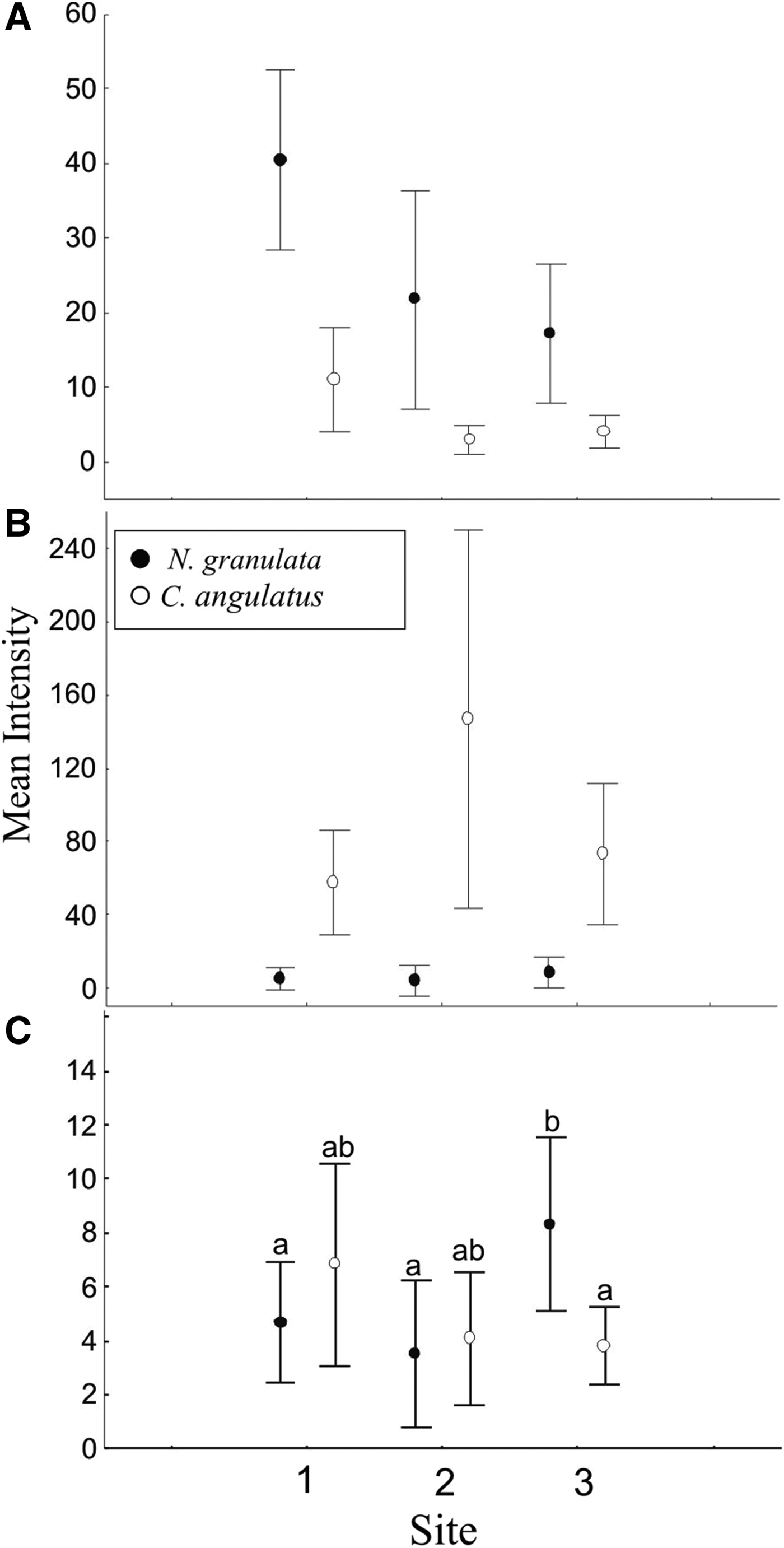
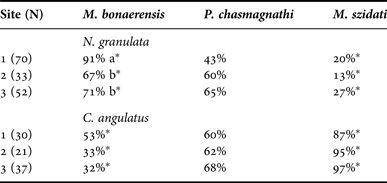
Prevalence values of M. bonaerensis showed differences between sites only for N. granulata, and were higher in N. granulata than in C. angulatus (Table 1). The comparisons between mean intensity values in the three sites and crab species showed no interaction for M. bonaerensis (F (2,154) = 0.38; P = 0.68), but there were differences between sites (F (2,154) = 4.35; P = 0.01) and between crab species: N. granulata had higher mean intensity values than C. angulatus (F (2,154) = 13.8; P = 0.0003; Figure 2A).
LSD results comparing mean intensity between crab species and sites for Maritrema bonaerensis (A), Microphallus szidati (B), and Profilicollis chasmagnathi (C). Points represent means and vertical bars denote 0.95 confidence intervals. Same letters indicate no differences between intensity values.

Prevalence values for Neohelice granulata and Cyrtograpsus angulatus in the different sampled zones. Same letters indicate no differences for prevalence values between sites. Asterisks show differences between crab species from the same site.

Prevalences of M. szidati were always higher in C. angulatus, and showed no differences between sites (Table 1). Mean intensity values for M. szidati showed no interaction between sites and crab species (F (2,110) = 0.6; P = 0.56). No differences were found between sites (F (2,110) = 0.5; P = 0.6), but there were higher levels for C. angulatus (F (2,110) = 54.5; P < 0.0001; Figure 2B).
Prevalence values for the acanthocephalan P. chasmagnathi showed differences between sites only for N. granulata, and no differences were found on prevalence values between crab species (C. angulatus and N. granulata; Table 1). Mean intensity values for P. chasmagnathi showed interaction between crab species and sites (F (2,132) = 3; P = 0.05; Figure 2C). There were differences in sites for N. granulata (site 3), and there were also differences between crab species at different sites (Figure 2C).
DISCUSSION
Digenean species showed differences between the two crabs. Maritrema bonaerensis mean intensity and prevalence was higher in N. granulata than in C. angulatus, while the opposite trend was found for M. szidati. These results, nevertheless, depended on the study site. For P. chasmagnathi the highest values of mean intensity depended more on the site than on the crab species. These variations could be the result of several variables such as the availability of previous and final hosts (Etchegoin et al., Reference Etchegoin, Merlo and Parietti2012), the particular microhabitat of the crabs (Lei & Poulin, Reference Lei and Poulin2011), and the type of intertidal of each site. The particular microhabitat occupied by a potential host can affect their susceptibility to parasitism. For example, salinity influences the number of larvae stages produced, the time they need to encyst, how many succeed at encysting and how long encysted metacercariae survive (Lei & Poulin, Reference Lei and Poulin2011). Differences in temperature among sites may be also important because the rate at which larvae are produced (and released) is affected by temperature (Fredensborg et al., Reference Fredensborg, Mouritsen and Poulin2005; Thieltges & Rick, Reference Thieltges and Rick2006; Poulin, Reference Poulin2006). This also may be important at each site as well at a micro-scale level. Both crabs differ in their behaviour and in the frequency and abundance of the three species of parasites they share. Even though both crab species come into contact with water inhabited by Heleobia conexa and Heleobia australis (Cochliopidae), the snail first intermediate hosts of the trematodes, C. angulatus is more a subtidal species, changing, in consequence, the probability of being infected by cercariae. Neohelice granulata is extremely well adapted to exposure to atmospheric air, whereas C. angulatus shows a high degree of osmoregulatory capability. Due to these physiological differences, C. angulatus is able to inhabits areas of the lagoon with salinities varying from fresh to seawater, whereas N. granulata is able to occupy the uppermost parts of the intertidal zone of brackish waters (Spivak et al., Reference Spivak, Anger, Luppi, Bas and Ismael1994). Site 1 is a very shallow creek where differences in habitat use by both crabs across the intertidal could be less important, while site 2 and 3 show deeper and extensive intertidals. Therefore, these physiological differences seem to become less important in areas where the intertidal zone is narrow, with lower slopes and depths. This also changes the probability of becoming infected by P. chasmagnathi, since the more time spent in the intertidal, the more chances to acquire acanthocephalan eggs (they lie on the mud with the faeces of the bird definitive host). Moreover, these differences in habitat use of the intertidal by crabs, and the particular differences that may affect the presence and habitat use by the final hosts (birds) can change the infection levels of both intermediate hosts.
We compared our results with the data obtained by Etchegoin (1997). The crabs were collected from the mouth of the lagoon to site 1. Mean intensities for C. angulatus showed similar trends but lower values: presenting maximum values in M. szidati (44 vs 139 founded here) and lower values for M. bonarensis and P. chasmagnathi (2.7 and 9.7 respectively vs 5.9 and 4.1 in this work). Nevertheless, for N. granulata the maximum values were recorded also for M. szidati (7.5) differing from the values presented here (2.4) and M. bonaerensis showed very low intensity (2.9) compared with the maximum values obtained here (38.3). These differences could be due to differences in sampling sites, either in the physical conditions or the availability of first intermediate and/or final host. Even though three sites were sampled here and in all of them values in N. granulata were higher for M. bonaerensis than for M. szidati, and could indicate some level of preference (resulting from some level of specificity with the host, or by the physical factors within or surrounding the host). These contrasting data could be showing that either that preference switched, or most likely depends on the study site.
In the Bahia Blanca estuary, no presence of M. szidati was found in either N. granulata or C. angulatus (Alda et al., Reference Alda, La Sala, Marcotegui and Martorelli2011). In this zone, the prevalence of M. bonaerensis in C. angulatus is more than double (94%) the values found here (35%) and for N. granulata 100 vs 74% found here. The values found here compared with Bahia Blanca values (Alda, Reference Alda2011, Alda et al., Reference Alda, La Sala, Marcotegui and Martorelli2011), suggesting that besides the spatial heterogeneity, interspecific competition between parasites could explain differences observed. The fact that M. szidati is not found in Bahia Blanca seems to favour M. bonaerensis being hosted in C. angulatus, since the highest intensity and prevalence values were found in this crab. For N. granulata, the prevalences and mean intensities of M. szidati found here seem to be too low to affect values of M. bonaerensis. The values obtained in this work for the acanthocephalan P. chasmagnathi, showed the opposite trend for C. angulatus (71 vs 20% in Bahia Blanca), and in N. granulata 68 vs 47%. As we have shown here, this contrast seems to be the result of differences in sampling sites.
The data presented in this work gives another example of the benefit of studying how parasites use available hosts within their community. This improves the knowledge of ecological interactions, such as degrees of host specificity, which can be overlooked when looking only at a single host or parasite species.
FINANCIAL SUPPORT
This work was supported by Universidad Nacional de Mar del Plata (J.A.E., grant number EXA 583/12 15/E531) and FONCyT-Agencia (A.M.C PICT #1451).