


I. Introduction
The extraordinary rise in international portfolio investment stands as a hallmark of financial globalization. Data from the IMF’s Coordinated Portfolio Investment Survey indicate that global equity holdings by foreign institutional investors (FIIs) have increased ninefold to $45 trillion over the past two decades, approaching 40% of global stock market capitalization. With FIIs now a dominant class of shareholders in many countries, the manner in which they exercise their voting rights has become a pressing issue for domestic corporate insiders, shareholders, and policymakers.Footnote 1
Yet, we know relatively little about how FIIs vote. Prior studies focus mainly on cross-country differences in laws and regulations that support shareholder monitoring (Ferreira and Matos (Reference Ferreira and Matos2008), Aggarwal, Erel, Ferreira, and Matos (Reference Aggarwal, Erel, Ferreira and Matos2011), and Iliev, Lins, Miller, and Roth (Reference Iliev, Lins, Miller and Roth2015)). Less understood are the information-based barriers that FIIs face when voting. By their nature, FIIs are located far from their portfolio firms, restricting their ability to acquire information for effective monitoring. When institutional investors have limited capacity to invest in shareholder engagement, attention to governance issues of distant firms is likely to be a highly scarce resource.Footnote 2
How does proximity—a well-established determinant of information flows—affect the allocation of monitoring effort across a large, globally diverse portfolio? Even though distance is a defining feature of cross-border investment, this question has not been subject to systematic investigation. We fill this gap by examining how proximity affects FII voting behavior.
Our main challenge is that proximity itself is an investment choice variable. It has been well established that foreign investors prefer investing in nearby countries (Chan, Covrig, and Ng (Reference Chan, Covrig and Ng2005)). As such, any comparison of investor voting behavior across firms by their proximity is likely to be confounded by portfolio allocation decisions. To address this challenge, we examine variations in proximity within a firm-investor pair over time. Specifically, we analyze instances where an existing portfolio firm decides to expand into the home country of an FII, thereby bringing the firm’s operations closer to the investor (operational proximity). This empirical approach allows us to bypass factors influencing the initial decision to select a firm into a portfolio and instead focus on whether an increase in operational proximity alters voting behavior.
The conceptual framework underpinning our study is the information-based theories of voting. Specifically, the model of “the swing voter’s curse” by Feddersen and Pesendorfer (Reference Feddersen and Pesendorfer1996) suggests that uninformed voters may not vote actively because of concerns about the potential negative consequences of their votes. Persico (Reference Persico2004) further shows that uninformed voters may not choose to become informed because collective action problems limit their incentives to acquire costly information. Proxy advisors cannot fully resolve these frictions: Malenko and Malenko (Reference Malenko and Malenko2019) show that their presence induces excessive conformity with recommendations and dampens incentives for independent research. Applied to our setting, these theories imply that, when FIIs are ex ante uninformed about firm-specific issues, they may refrain from active voting.
We argue that such information dynamics shift with operational proximity. When a firm establishes operations in a new country, foreign investors from that country gain an information advantage: they possess superior knowledge of their domestic economy, which has become important to the firm, and they can monitor the nearby operation more closely than investors based elsewhere. In the theoretical work of Van Nieuwerburgh and Veldkamp (Reference Van Nieuwerburgh and Veldkamp2009), this initial advantage generates a specialization benefit, incentivizing the investor to keep learning more about the firm rather than other firms in the portfolio.Footnote 3 With better information, the investor is less reliant on others’ monitoring and is more likely to strengthen their own engagement through active voting.
Testing our hypothesis requires detailed voting records of individual investors. To this end, we examine U.S. mutual funds, which are required to vote and disclose their voting records on (U.S. and non-U.S.) portfolio firms. Following Aggarwal, Erel, and Starks (Reference Aggarwal, Erel and Starks2014) and Iliev et al. (Reference Iliev, Lins, Miller and Roth2015), who show that voting in support of management is the default “box-ticking” approach, we define active voting based on the tendency to cast dissenting votes; that is, any vote other than a “For” vote. To capture changes in operational proximity, we examine operational expansions of non-U.S. firms into the United States, using subsidiary establishment/acquisition data compiled by Moshirian et al. (Reference Moshirian, Pham, Tian and Wu2023). After merging these data sets, our analysis covers 16,360 non-U.S. firms from 46 countries.
To illustrate the empirical design, consider a U.S. mutual fund
$ f $
 currently investing in two non-U.S. firms,
$ i $
 and
$ {i}^{\prime } $
 . Firm
$ i $
 then decides to expand into the United States, while firm
$ {i}^{\prime } $
 does not. The timing of the expansion is crucial to our analysis, allowing us to compare the change in fund
$ f $
 ’s active voting stance toward firm
$ i $
 (from before to after the expansion) with the contemporaneous change in fund
$ f $
 ’s voting toward firm
$ {i}^{\prime } $
 . This setting mitigates portfolio selection factors that drive fund
$ f $
 to invest in firm
$ i $
 in the first place by considering only variations within a given fund-firm pair after the initial investment. The granular data also make it possible to incorporate fund-firm fixed effects to control for all time-invariant characteristics of a fund-firm pair that influence fund
$ f $
 to vote more or less actively in firm
$ i $
 than in firm
$ {i}^{\prime } $
 (e.g., distance to firm headquarters, language/cultural barriers, and local voting and governance regulations), as well as fund-year fixed effects that capture time-varying changes in a fund’s overall voting practices.
Our analysis indicates that U.S. mutual funds indeed vote more actively (by casting dissenting votes) after a foreign firm expands into the United States. The effect is equivalent to about 8% of the unconditional probability of dissent voting. It remains robust after controlling for firm performance and corporate governance ratings and is not sensitive to fund type or firm entry mode (acquisition or greenfield investment). Our analysis also explicitly controls for foreign firms’ U.S. listing status, suggesting that the effect of operational proximity is distinct from the “bonding effect” of cross-listing (Doidge, Karolyi, and Stulz (Reference Doidge, Karolyi and Stulz2004)).
Even though our analysis controls for fund-year and fund-firm fixed effects, the results may still be driven by unobservable factors that vary within a fund-firm pair. For example, pressure from a U.S. fund may influence a firm’s U.S. expansion decision. To address this possibility, we rely on an identification strategy based on trade policy changes, similar to Lileeva and Trefler (Reference Lileeva and Trefler2010) and Fresard (Reference Fresard2010). We utilize variations in the import tariffs that the United States imposes on a foreign firm’s products to create an instrument for the timing of the firm’s U.S. expansion. Our rationale for the instrument is twofold: i) lower tariffs provide significant incentives for market entry, and ii) this correlation creates variations in operational proximity within a fund-firm pair that are unlikely to affect the voting behavior of individual funds. After implementing this strategy, we continue to find that U.S. mutual funds increase their dissenting votes after a firm’s U.S. expansion.
It is also possible that an increase in dissenting votes simply reflects worsening firm performance following a U.S. expansion. To disentangle active monitoring from this mechanical effect, we move beyond the level of dissent and examine the sensitivity of dissent to (poor) firm performance, following Cai, Garner, and Walkling (Reference Cai, Garner and Walkling2009), Iliev and Lowry (Reference Iliev and Lowry2015), and Aggarwal, Dahiya, and Prabhala (Reference Aggarwal, Dahiya and Prabhala2019). Our analysis indicates that such sensitivity indeed increases in the post-expansion period. As another way to rule out contemporaneous firm conditions, we study close-call proposals, where aggregate support and opposition (among all shareholders) are nearly balanced. Within this subset of proposals, variations in individual votes are unlikely to be driven by firm performance (Brochet, Ferri, and Miller (Reference Brochet, Ferri and Miller2021), He, Huang, and Zhao (Reference He, Huang and Zhao2019)), yet we still find that U.S. funds are more likely to vote in dissent in the post-expansion period.
To demonstrate the role of information acquisition as the channel through which operational proximity influences voting, we provide three pieces of evidence. First, after a firm expands into the United States, U.S. funds’ votes deviate more from both ISS recommendations and the aggregate vote outcomes. Such low correlations are indicative of U.S. funds conducting independent governance research (Iliev and Lowry (Reference Iliev and Lowry2015), Iliev, Kalodimos, and Lowry (Reference Iliev, Kalodimos and Lowry2021)). Second, the rise in dissent is concentrated in proposals that require specific assessments of operational matters, such as approving major investments, rather than in routine governance items, such as director re-elections and auditor appointments. Third, the exact locations and scale of operation of a foreign firm within the United States also matter. The increase in dissent voting is more pronounced when the operation i) is located close to the fund’s U.S. head office and ii) accounts for a relatively large share of the firm’s revenue—precisely the settings where information is more accessible and more salient.
After establishing that operational proximity leads to more active voting by FIIs, we explore the implications of this relationship. In particular, it is important to understand whether such active voting delivers any meaningful long-term governance changes. To this end, we analyze whether a firm’s future agenda-setting becomes more shareholder-centric. We find that a high level of dissenting votes is indeed associated with a disciplining effect, as it reduces the likelihood that firms subsequently bring forward proposals that face high shareholder opposition. Importantly, this relationship becomes particularly more pronounced after a firm establishes operations in the United States.
Another implication concerns the choice between “voice” and “exit.” As an alternative to ballot voting, FIIs can vote with their feet. We examine this trade-off by comparing instances in which U.S. mutual funds completely exit from a portfolio firm with those in which funds stay and vote in dissent. Our analysis indicates that operational proximity influences the substitutability between these two actions, with the exit decision becoming relatively less sensitive to poor firm performance in the post-expansion period. This indicates that information advantages motivate a considerable portion of funds to stay and vote in dissent rather than voting with their feet.
Finally, we investigate where operational proximity matters most by exploring heterogeneity in the corporate governance environment surrounding a firm. According to Iliev et al. (Reference Iliev, Lins, Miller and Roth2015), poor institutions exacerbate expropriation risk, incentivizing FIIs to vote more actively. Consistent with their study, we find that the post-expansion rise in active voting is mainly concentrated in countries with poor legal protection for minority shareholders. Similar cross-sectional differences are observed when we examine a broader set of external, disclosure-based governance mechanisms—media scrutiny, analyst coverage, and cross-listing reporting requirements—following Dyck and Zingales (Reference Dyck and Zingales2004), Chen, Harford, and Lin (Reference Chen, Harford and Lin2015), and Doidge et al. (Reference Doidge, Karolyi and Stulz2004). Taken together, the evidence points to a substitution effect: proximity-driven improvements in information flows are most consequential where governance institutions are weakest.
Our study makes three important contributions. First, we expand the body of evidence on the effect of proximity on investment monitoring. Prior studies have examined this relationship in other contexts, such as within-firm resource allocation (Giroud (Reference Giroud2013)), bank lending (Sufi (Reference Sufi2007), Jang (Reference Jang2017)), and venture capital investments (Bernstein, Giroud, and Townsend (Reference Bernstein, Giroud and Townsend2016)). There is limited evidence on distance barriers in shareholder voting. Calluzzo and Kedia (Reference Calluzzo and Kedia2019) show that mutual funds’ votes are more informed when they share directors with portfolio firms, especially when both operate in close proximity. Using a relatively short sample period (2003–2004), Das (Reference Das2011) also finds that funds make informed voting decisions in local firms. These studies are confined to U.S. domestic investment and focus on static variations in distance between headquarters. In contrast, our study examines international portfolio investment, where geographical constraints are much more binding. Instead of examining distances between headquarters, we exploit variations in proximity driven by the actions of existing portfolio firms. This unique approach allows us to better distinguish the effect of monitoring from that of investment selection.
Second, our study contributes to the growing literature on institutional investors’ voting behavior, which has increasingly established the important role of information in voting decisions (e.g., Iliev and Lowry (Reference Iliev and Lowry2015), Aggarwal et al. (Reference Aggarwal, Dahiya and Prabhala2019), Calluzzo and Kedia (Reference Calluzzo and Kedia2019), Iliev et al. (Reference Iliev, Kalodimos and Lowry2021), Huang (Reference Huang2023), and Becht, Franks, and Wagner (Reference Becht, Franks and Wagner2026)). However, most past studies focus on the domestic investment context, and only Iliev et al. (Reference Iliev, Lins, Miller and Roth2015) have explored corporate voting as a form of monitoring foreign portfolio firms. Their analysis focuses on how local governance environments affect cross-border voting. Complementing their findings, our study shows that firms’ cross-border expansions act as catalysts for information acquisition, which further improves FII voting activity.
Most importantly, our study contributes to the current understanding of the causes and consequences of rising international portfolio investments. Previous studies (e.g., Chan et al. (Reference Chan, Covrig and Ng2005), Ferreira and Matos (Reference Ferreira and Matos2008), and Andrade and Chhaochharia (Reference Andrade and Chhaochharia2010)) have identified various geographical, cultural, and economic factors that impact the investment decisions of FIIs. In addition, Moshirian et al. (Reference Moshirian, Pham, Tian and Wu2023) highlight that FIIs’ portfolio allocation decisions can be driven by firms’ cross-border expansions. Building on these previous findings, we show that improved information flows not only facilitate more investment but also more active monitoring by FIIs. As rising international portfolio investment is critical to promoting good governance around the world (Ferreira, Massa, and Matos (Reference Ferreira, Massa and Matos2010), Aggarwal et al. (Reference Aggarwal, Erel, Ferreira and Matos2011), Iliev et al. (Reference Iliev, Lins, Miller and Roth2015), and Dyck, Lins, Roth, and Wagner (Reference Dyck, Lins, Roth and Wagner2019)), our findings imply that actions and policies aimed at lowering information barriers can play a pivotal role in harnessing this important benefit.
II. Background: Information Acquisition in Corporate Voting
Over the past two decades, proxy voting for institutional investors has evolved from a box-ticking exercise into a more complex, engagement-driven process. Investors are now expected to act as “stewards” of corporate governance and to articulate this role through formal voting policies. Mandated by regulations (e.g., SEC Rule 206(4)-6 and the EU Shareholder Rights Directive II) or encouraged by “comply or explain” stewardship codes (Fukami, Blume, and Magnusson (Reference Fukami, Blume and Magnusson2022)), these policies set out the principles and procedures for voting decisions, generally requiring investors to assess proposals in light of firm-specific circumstances rather than applying a one-size-fits-all approach. This makes information acquisition a central input into the voting process.Footnote 4
A recent study by Becht et al. (Reference Becht, Franks and Wagner2026) on the operations of a large U.K. fund manager highlights the extensive information required for its shareholder engagement (including voting) activities. This involves detailed research by the Governance and Stewardship team and additional input from internal buy-side analysts. The two teams regularly interact with portfolio firms’ management and collaborate to review proxy materials and proxy advisor recommendations (e.g., ISS). Similar complexities can also be seen in BlackRock’s stewardship disclosure, where voting information is actively sourced from company disclosures, third-party research, peer comparisons, and engagement with companies and fund managers (BlackRock ((2022), p. 49)). These descriptions align with empirical evidence from Iliev et al. (Reference Iliev, Kalodimos and Lowry2021), who document a surge in online views of SEC proxy-related filings by mutual funds during the proxy voting season.
With respect to foreign portfolio firms, information acquisition can be restricted by the sheer size of a global portfolio. Large institutions such as BlackRock, Vanguard, and Norges Bank vote on hundreds of thousands of proposals in a given year (Norges Bank Investment Management (2020), BlackRock (2022), and Vanguard (2022)). Geographic and language barriers also make it more challenging to engage with distant portfolio companies, further restricting information flows. Consistent with these frictions, Vanguard’s Investment Stewardship team reports that while 75% of assets under management in North America are associated with portfolio companies it actively engages with, this figure drops to 54% in Europe, 21% in Asia, and 7% in the Middle East/Africa (Vanguard (2022)). Cross-border investment in infrastructure adds another layer of friction. FIIs rely on global and local custodians for trading and settlement, so they often face information delays during proxy voting seasons as disclosure materials must travel through multiple intermediaries (Norges Bank Investment Management (2020)).
Against this backdrop, limited stewardship resources further magnify the difficulty of obtaining relevant and timely information for cross-border voting. A Financial Times survey shows that, even after recent expansions, the world’s 30 largest asset managers had on average only 21 staff dedicated to stewardship as of 2020 (Mooney (Reference Mooney2020)). Consistent with this, survey evidence from McCahery, Sautner, and Starks (Reference McCahery, Sautner and Starks2016) identifies insufficient personnel as the main impediment to engagement activities. Bebchuk and Hirst (Reference Bebchuk and Hirst2019) argue that such small teams relative to portfolio size reflect a persistent under-investment by institutional investors in shareholder engagement capacity. Taken together, these findings imply that many FIIs operate under tight resource constraints, making it particularly costly to acquire the firm-specific information required for active cross-border voting.
These institutional backgrounds support the rationale for our main hypothesis. We argue that because of costly information acquisition and resource constraints, FIIs ration their monitoring attention when managing large, globally diverse portfolios. Thus, active voting is likely to be concentrated among firms where FIIs already possess information advantages. Operational proximity helps investors build such advantages, ultimately influencing the way they vote.
III. Data and Variables
A. Mutual Fund Voting Data
Since 2003, U.S. mutual funds, including ETFs, have been required by the SEC (under Rule 30b1-4) to disclose their votes on all proposals of portfolio firms through Form N-PX filings. Our study analyzes U.S. funds’ votes on non-U.S. portfolio firms, as provided by ISS Voting Analytics. We only examine management proposals, given that shareholder-sponsored proposals only make up a negligible fraction of the data. ISS Voting Analytics provides two layers of data coverage for non-U.S. firms. The first is fund-reported votes, available from 2003. The second is proposal-level attributes—including harmonized proposal identifiers, aggregate voting outcomes, and ISS recommendations—and only becomes available from 2013. Accordingly, our analysis employs two samples: the baseline tests utilize the full sample beginning in 2003, and the proposal-level tests examine the subsample beginning in 2013.
In addition to ISS Voting Analytics, we obtain fund location data from original NPX filings in EDGAR, fund characteristics from CRSP Mutual Funds, and equity holdings from FactSet Ownership. We match funds across the aforementioned data sets using a process similar to that outlined in Fich and Xu (Reference Fich and Xu2025), which relies on a combination of fund names, fund tickers, and NPX filing identifiers.
B. Cross-Border Expansions
We link fund voting data to cross-border expansion data compiled by Moshirian et al. (Reference Moshirian, Pham, Tian and Wu2023) to examine changes in operational proximity between firms and their U.S. investors. That data set covers listed firms from 47 stock markets and is constructed using snapshots of firms’ foreign subsidiaries obtained from the annual historical versions of Orbis and Osiris (provided by Moody’s Bureau van Dijk), supplemented with M&A data from Refinitive SDC Platinum and additional hand-collected data. Moshirian et al. (Reference Moshirian, Pham, Tian and Wu2023) track individual subsidiaries to identify the timing of each cross-border expansion, defining it as the year in which a firm establishes or acquires the first subsidiary in a given country. We apply the same sample restrictions as Moshirian et al. (Reference Moshirian, Pham, Tian and Wu2023) (i.e., excluding listed investment funds and firms with market capitalization of less than U.S.$1 million) and extend the data set to cover up to 2018. Our final sample thus consists of firms from 46 non-U.S. countries and their voting outcomes from 2003 to 2018.
C. Measures of Active Voting
As a starting point, we capture a U.S. fund’s propensity for active voting by focusing on dissenting votes that do not support management proposals. Our approach is motivated by the fact that most corporate voting is routine and strongly pro-management (in our data, “For” votes average 88% of votes cast). In such an environment, any increase in additional support is often uninformative about monitoring intensity and has limited scope to affect outcomes on an unconditional basis. By contrast, casting a non-For vote typically reflects a decision to deviate from the default option and is therefore more likely to be preceded by proposal-specific evaluation. Consistent with this idea, prior work shows that increases in dissent can have meaningful governance consequences (e.g., director turnover) even when proposals pass (Aggarwal et al. (Reference Aggarwal, Dahiya and Prabhala2019)).
Our approach is closely related to Iliev et al. (Reference Iliev, Lins, Miller and Roth2015). They examine the tendency to cast “For” votes, whereas we construct our measure based on “non-For” votes (including “Against,” “Abstain,” “Withhold,” and “Do Not Vote” votes), purely for ease of exposition. In robustness tests, we also focus on just Against votes to capture a stronger form of dissent.
Even though we can observe detailed fund-level voting records, constructing measures of dissent at the fund-firm level is not straightforward. Each firm puts forward multiple proposals for voting in a given year, and a key issue that we need to address is the varying frequencies of such proposals. Some categories of proposals appear with high frequencies because they are routine in nature. Iliev et al. (Reference Iliev, Lins, Miller and Roth2015) show that the most dominant category of proposals among non-U.S. firms concerns director voting. Even within this category, there are significant variations in proposal frequencies. For example, in Greece, the norm is to vote on directors as a single slate (one proposal), whereas in most other countries, directors up for election are voted on individually. Such variations can create potential biases, as firms with very high numbers of director election proposals, where voting tends to be a box-ticking exercise, may appear to have relatively smaller fractions of dissenting votes.
To address this issue, we split up proposals into seven categories and assign them equal weights so that no single category in a given firm dominates the others when constructing our dissent voting measures at the fund-firm level. The seven proposal categories reflect the typical agendas that firms put forward in shareholder meetings, including matters related to i) Capital, ii) Operations, iii) Disclosure, iv) Compensation, v) Constitution, vi) Director/Auditor, and vii) Board structure. This classification is based on the general descriptions of proposals provided in the ISS Voting Analytics database. Panel A of Table A1 in the Supplementary Material presents a breakdown of proposals by category, and Panel B provides examples for each category. Among the seven categories, there are substantial variations in proposal frequency, with director election proposals being the most popular category.
With these categories, we construct our main dependent variable as the simple average (across categories) propensity of fund
$ f $
 to cast a dissenting vote on firm
$ i $
 ’s proposals in year
$ t $
 :

where
$ {Dissent}_{f,i,t,p} $
 equals 1 if fund
$ f $
 casts a non-For vote on proposal
$ p $
 of proposal set
$ {\mathcal{P}}_{i,a,t} $
 (with a being the index for the seven categories), and
$ {A}_{i,t} $
 denotes the number of proposal categories put forward for shareholder consideration in a given firm-year. For ease of exposition, we will simply interpret
$ {Dissent}_{f,i,t} $
 as reflecting the probability of a fund casting dissenting votes on a firm’s proposals in a given year.
It is important to note that our analysis focuses on funds’ voting positions rather than voting turnout as a measure of active voting. The main reason is that U.S. mutual funds have a fiduciary duty to vote on behalf of clients. SEC Rule 206(4)-6 (requiring funds to have formal voting policies) and Rule 30b1-4 (requiring funds to disclose voting records) make it difficult for funds to shirk their voting responsibilities. Therefore, a common assumption in prior studies, such as Iliev et al. (Reference Iliev, Lins, Miller and Roth2015) and Malenko and Malenko (Reference Malenko and Malenko2019), is that U.S. mutual funds almost always turn out to vote.Footnote 5
D. Summary Statistics
Table 1 provides the summary statistics. After matching with the U.S. expansion data, our final sample comprises 16,360 unique firms, representing 70% of all non-U.S. firms covered by ISS Voting Analytics. The reported statistics indicate that there has been a substantial expansion of U.S. funds’ global voting activity (see columns 2–4), consistent with the growth of U.S. portfolio investment abroad. Despite this expanding level of activity, we observe no clear trend in the average voting stance of U.S. funds. Specifically, column 5 reports the median of
$ {Dissent}_{i,t} $
 —computed as the average of
$ {Dissent}_{f,i,t} $
 across reporting funds in a given firm-year. This variable fluctuates over time, with the median rising up to about 10% in 2014 but declining thereafter.Footnote
6

TABLE 1 Long description
Starting from the top row, each year from 2003 to 2018 is listed in the first column. The next columns, moving left to right, are: No. of Firms in ISS Data, No. of Firms in the Sample, No. of U S Funds in the Sample, No. of U S Funds Voted per Firm (Median), Dissent sub i comma t (Median), Percent Aggregate Dissenting Votes (Median), Percent Firms with U S Operations, and Percent New U S Expansion. For example, in 2003, there were 326 firms in ISS data, 173 in the sample, 219 U S funds, a median of 2 U S funds voted per firm, Dissent sub i comma t median of 0.00 percent, 50.87 percent of firms with U S operations, and 4.71 percent new U S expansion. Aggregate dissenting votes data begins in 2013, with 1.03 percent in that year. Across years, the number of firms and funds increases, median dissent fluctuates between 6.25 and 10.36 percent, and the proportion of firms with U S operations remains around 41 to 50 percent. Percent new U S expansion varies from 1.84 to 5.26 percent. Each column is consistently ordered for all years.
Table 1 also reports the proportion of dissenting votes cast by all shareholders. This is based on proposal-level data, where the coverage in ISS Voting Analytics only starts from 2013. Because aggregate vote results are drawn from sources other than fund reporting (e.g., company disclosures) and are constructed without weighting the proposal categories, this series is not directly comparable to the U.S. mutual fund’s dissent voting measure (
$ {Dissent}_{f,i,t} $
 ). Nevertheless, the statistics in column 6 indicate that aggregate dissent is generally low, with medians hovering around 1%, suggesting that the average shareholder votes less actively than a U.S. mutual fund.
The last two columns in Table 1 report U.S. expansion statistics. In any given year, 2%–5% of existing portfolio firms of U.S. mutual funds establish U.S. operations for the first time. Cumulatively, about 23% do so at some point during our sample period. These expansions generate substantial within-firm variation, which we exploit in our empirical tests.
IV. Effect of Operational Proximity on Dissent Voting
A. Empirical Specification
In the baseline analysis, we estimate the following fund-firm panel regression model:

where
$ {Dissent}_{f,i,t} $
 is obtained from equation (1). U.S. Expansion
$ {}_{i,t} $
 takes the value of 1 if firm
$ i $
 has already expanded into the United States by year
$ t $
 , and 0 otherwise.
$ {X}_{i,t-1}^{\prime } $
 is the set of control variables, measured at 1-year lag, and
$ {\gamma}_{f,i} $
 and
$ {\mu}_{f,t} $
 are the fund-firm and fund-year fixed effects.
The fixed effects play critical roles in our model. The term
$ {\gamma}_{f,i} $
 captures all time-invariant characteristics specific to a fund-firm pair, including factors that may influence fund
$ f $
 to vote more or less actively on firm
$ i $
 compared to another firm
$ {i}^{\prime } $
 , such as cultural, governance, and language differences, as well as their country-level geographical distance. In other words, including
$ {\gamma}_{f,i} $
 allows us to examine variations in proximity within a fund-firm pair, derived through the expansion of firm
$ i $
 ’s operation into the United States. The term
$ {\mu}_{f,t} $
 enables our analysis to account for factors affecting a fund’s voting practices over time, such as the development of internal voting (or shareholder engagement) policies and time-varying fund characteristics such as fund size.
Our standard control variables include a binary indicator for cross-listing (ADR), profitability (ROA), the logarithm of total assets (Size), debt-to-asset ratio (Leverage), and book-to-market ratio (BTM), following prior studies that have examined international fund ownership and voting (Iliev et al. (Reference Iliev, Lins, Miller and Roth2015), Moshirian et al. (Reference Moshirian, Pham, Tian and Wu2023)).Footnote 7 It is important to control for profitability (ROA) as active voting can arise in response to a given level of poor performance (Cai et al. (Reference Cai, Garner and Walkling2009), Iliev and Lowry (Reference Iliev and Lowry2015), and Aggarwal et al. (Reference Aggarwal, Dahiya and Prabhala2019)). Another important control is whether a firm has an active ADR program in a given year. Doidge et al. (Reference Doidge, Karolyi and Stulz2004) argue that ADR firms “bond” to stronger U.S. governance and disclosure standards and may, therefore, be more transparent. Firms may also establish subsidiaries in countries where they are cross-listed (Sarkissian and Schill (Reference Sarkissian and Schill2016)). Cross-listing can, therefore, confound the relation between our expansion measure and voting outcomes.
We also incorporate the aggregate percentage ownership of U.S. institutional investors (U.S. Inst Holding), obtained from FactSet Ownership, to capture the general constraints and incentives associated with cross-border monitoring of U.S. mutual funds. In our baseline model, we do not directly control for the holdings of individual U.S. funds in a given firm. While this would be a more direct measure of voting incentive of the specific fund that votes, incorporating it would significantly reduce the sample size as it is difficult to match funds across ISS Voting Analytics and FactSet. Instead, we will explore fund-specific ownership in a robustness check.
Finally, our analysis also controls for the strength of firm-level governance (CG Score), as measured by the corporate governance pillar score provided by LSEG/Refinitiv ASSET4. This score (scaled from 0 to 1) is the composite rating of five dimensions of a firm’s governance: board structure, compensation policies, board functions, shareholder rights, and vision and strategy. Because ASSET4 only covers a subset of international firms, controlling for CG Score reduces our sample size by about 30%. We thus incorporate this variable in a separate specification.
B. Baseline Results
Table 2 reports the estimates from equation (2). The first 3 columns show the specifications with different fixed effects, starting with fund, firm, and year fixed effects included as individual terms (column 1), then fund-firm and year fixed effects (column 2), and finally both fund-firm and fund-year fixed effects (column 3). The results in all 3 columns point to a significant increase in active voting, as captured by the level of dissent, in the post-expansion period. Specifically, following the establishment of operations in the United States by an existing foreign firm in a U.S. fund’s portfolio, the probability of the fund casting a dissenting vote, on average, increases by up to 0.9 percentage points in comparison to other foreign portfolio firms that do not undergo an expansion during the same period. This difference represents an 8% increase in the unconditional probability of casting a dissenting vote. The relationship is unlikely to be simply driven by corporate governance, as it remains significant after including CG Score as an additional control (column 4).Footnote 8

TABLE 2 Long description
Beginning at the top, the table lists variables in the leftmost column: U S Expansion, ADR, Size, Leverage, R O A, B T M, U S Inst Holding, C G Score, and fixed effects. For each variable, coefficients and t-statistics are shown in four columns labeled 1 to 4. U S Expansion coefficients are 0.006, 0.009, 0.006, and 0.005, all with triple asterisks indicating significance at the 1 percent level, and t-statistics of 5.64, 6.34, 4.12, and 2.93. ADR coefficients are minus 0.000, minus 0.003 double asterisk, minus 0.001, and minus 0.003 double asterisk, with t-statistics minus 0.19, minus 2.33, minus 1.07, and minus 2.29. Size coefficients are 0.007 triple asterisk, 0.002 double asterisk, minus 0.002 double asterisk, and minus 0.002 double asterisk, with t-statistics 14.00, 2.36, minus 2.35, and minus 2.52. Leverage coefficients are 0.026, 0.036, 0.031, and 0.030, all triple asterisk, with t-statistics 11.56, 12.52, 11.29, and 8.73. R O A coefficients are minus 0.034, minus 0.045, minus 0.036, and minus 0.041, all triple asterisk, with t-statistics minus 11.04, minus 12.73, minus 10.37, and minus 9.92. B T M coefficients are 0.007, 0.007, 0.005, and 0.003, all triple asterisk, with t-statistics 13.72, 11.05, 7.70, and 3.52. U S Inst Holding coefficients are minus 0.069, minus 0.047, minus 0.034, and minus 0.016, all triple asterisk, with t-statistics minus 17.89, minus 9.68, minus 7.15, and minus 2.95. C G Score is only reported in column 4, with coefficient minus 0.012 triple asterisk and t-statistic minus 8.51. Fixed effects are indicated for Fund, Firm, Year, Fund-firm, and Fund-year, with ‘Yes’ or ‘No’ in each column. Number of observations decreases from 2,521,837 in column 1 to 1,376,603 in column 4. Adjusted R squared increases from 0.31 in column 1 to 0.53 in columns 3 and 4. Statistical significance is denoted by single, double, and triple asterisks for 10 percent, 5 percent, and 1 percent levels, respectively.
Hereafter, we discuss a battery of robustness checks on the aforementioned baseline analysis. For the sake of brevity, these additional results are tabulated in the Supplementary Material.
C. Alternative Dissent Voting Constructions
Our main measure,
$ {Dissent}_{f,i,t} $
 , assigns equal weights to the seven proposal categories discussed earlier. To ensure that our results are not driven by this empirical choice, we re-estimate equation (2) using an alternative construction of
$ {Dissent}_{f,i,t} $
 , which pools all proposals without any weighting (see column 1 of Table A3 in the Supplementary Material). We also construct
$ {Dissent}_{f,i,t} $
 using only Against votes (see column 2 of Table A3 in the Supplementary Material). Our baseline results are unchanged with these measures.
D. Alternative Specifications
As an alternative to equation (2), we estimate the same regression by adding country-year fixed effects to control for local shocks that may correlate with both expansion and voting decisions. In another specification, we exclude fund-firm pairs that are already treated (the firm has already expanded into the United States) before the start of our sample period. This mitigates the issue that already treated observations may serve as controls, potentially confounding the analysis. The results of these alternative specifications are reported in columns 1 and 2 of Table A4 in the Supplementary Material, showing that the coefficient of U.S. Expansion remains positive and statistically significant. Next, to ensure that our baseline results are not sensitive to a particular mode of firm entry into the United States, we categorize U.S. expansions into two types: based on the acquisition of an existing local firm (U.S. Expansion: M&A) or the establishment of a new subsidiary (U.S. Expansion: Incorporation). The results in column 3 show that the post-expansion rise in dissenting votes is present in both types of expansion.
E. Alternative Controls
In our baseline model, ROA is used to proxy for firm performance, following Iliev et al. (Reference Iliev, Lins, Miller and Roth2015). However, it is possible that investors place greater weight on market-based performance than on accounting profitability. In Table A5 in the Supplementary Material, we include excess stock returns either as an alternative proxy for firm performance to replace ROA (column 1) or as an additional control variable alongside ROA (column 2). Our main results remain unchanged.
We also consider ISS voting recommendations as another control. In later (proposal-level) tests, we directly control for proposal-level recommendations. For the current baseline analysis, we aggregate these recommendations to the firm level by computing the fraction of positive (For) recommendations issued by the ISS in a given firm-year (these data are available only from 2013 onward). Column 4 of Table A5 in the Supplementary Material reports the results, showing that incorporating ISS recommendations actually strengthens the coefficient on U.S. Expansion.
F. Fund Types
To explore heterogeneity across fund types, we classify funds along three dimensions: i) actively managed versus index funds, ii) ETFs versus traditional mutual funds, and iii) Big-3 (BlackRock, Vanguard, and SSGA) versus all other fund families. It is possible that index funds, ETFs, and Big-3 funds may possess weaker incentives or fewer resources for firm-specific monitoring and engagement due to their low-cost (low-attention) business models (Edmans, Levit and Reilly (Reference Edmans, Levit and Reilly2019)). Table A6 in the Supplementary Material reports the results, showing that the coefficient on U.S. Expansion remains positive, indicating that dissent voting increases following a firm’s U.S. expansion for each fund type considered. We then pool the data and examine the interaction between U.S. Expansion and the indicator for the relevant fund-type category. We only observe a significant difference (at 10% level) between Big-3 and non-Big-3 funds. This difference is not robust when we use the dissent voting measure based on Against votes (not reported). We conclude that the operational proximity effect is broad-based and not driven by fund types.
G. Controlling for Fund Ownership
Our last robustness test examines fund-level ownership. As discussed, this exercise requires matching funds between ISS Voting Analytics and FactSet Ownership, which tends to be imprecise and reduces sample coverage by 62%. As a result, this robustness check trades off precision for richer controls. Within the matched subsample, we construct three alternative measures of the relative size of a fund’s position in a foreign portfolio firm: scaled by the fund’s portfolio value, the fund’s total net assets (TNA), and the firm’s market capitalization. Panel A of Table A7 in the Supplementary Material shows that the estimated effect of U.S. Expansion on dissent voting becomes weaker but remains statistically significant for two of the three measures.
There are two empirical challenges with the aforementioned analysis. First, the large loss in coverage and potential mismatches may substantially reduce statistical power and attenuate estimates. Second, fund ownership may itself adjust in response to voting behavior, increasing with a fund’s active voting stance to increase voting power or to internalize governance gains. To address these concerns, we exploit heterogeneity in predetermined ownership by focusing on a fund’s holdings before a firm’s U.S. expansion. If operational proximity is still the relevant mechanism, the incremental effect of U.S. Expansion should be stronger in scenarios with weak ex ante incentives. The analysis in Panel B of Table A7 in the Supplementary Material supports this prediction. The increase in dissent voting following U.S. Expansion is concentrated among fund–firm pairs with low pre-expansion ownership. This pattern alleviates the concern that our baseline results are solely driven by fund ownership incentives.
V. Identification Strategy: Changes in Tariffs
In our baseline model, we incorporate fund-firm and fund-year fixed effects to control for time-invariant relationships between funds and firms and for time-varying characteristics of funds. However, this does not entirely rule out the possibility that both voting behavior and firm decisions may correlate with unobservable factors within a fund-firm pair. For example, U.S. funds might exert pressure on a firm to expand its operations into the U.S. market. In addition, the occurrence of an international expansion may reveal underlying corporate governance issues (e.g., empire-building by CEOs), prompting existing FIIs to monitor more actively.
To address this concern, we adopt an identification strategy based on changes in trade policies, similar to Lileeva and Trefler (Reference Lileeva and Trefler2010) and Fresard (Reference Fresard2010). Specifically, we utilize variations in import tariffs imposed by the United States on the products of a foreign firm to construct an instrument for the timing of the firm’s expansion into the United States.
This instrument likely meets the relevance condition because previous research has documented a high correlation between tariffs and the establishment of foreign subsidiaries (Conconi, Sapir, and Zanardi (Reference Conconi, Sapir and Zanardi2016)). When trade barriers imposed by a country are lowered, imported goods become more competitive, and foreign firms have incentives to set up local operations to support the on-shore assembly and distribution of their products. In our context, non-U.S. firms that experience U.S. tariff reductions are more likely to make a U.S. expansion than those that do not.
Regarding the exclusion condition, we note that our IV regression specification continues to control for fund-firm and fund-year fixed effects. In this setup, the role of the instrument is to generate variations in operational proximity without directly inducing changes in voting behavior within a fund-firm pair. We argue that such direct effects are unlikely to materialize. Tariff changes are largely shaped by competitive and uncertain trade negotiations that reflect countries’ relative trade positions across multiple industries, making it difficult for individual firms to influence tariff outcomes (Fresard (Reference Fresard2010)). It is even less plausible that the mutual funds whose votes we study would have incentives or capacity to lobby for tariff changes on behalf of portfolio firms. Moreover, because the tariff changes are imposed by a foreign jurisdiction (the United States), they lie outside the control of the affected non-U.S. firms and cannot plausibly be offset through shareholder voting. Accordingly, aside from their role in shifting firms’ incentives to establish U.S. operations (our main channel), tariff changes should not directly influence mutual funds’ voting stance.
To construct the instrument, we obtain the product segment data for each firm from Worldscope and industry-level tariff rates from the UNCTAD World Integrated Trade Solution platform. Using this information, we calculate the weighted average tariff rate that a foreign firm is likely to face in the U.S. market, as follows:

where
$ k $
 denotes one of the 4-digit SIC product segments of firm
$ i $
 in year
$ t-1 $
 and
$ {W}_{i,k,t-1} $
 indicates the proportion of sales attributed to segment
$ k $
 out of the firm’s total sales across all product segments.
$ {T}_{H,k,t} $
 is the import tariff rate in year
$ t $
 imposed by the United States on products within segment
$ k $
 originating from the country
$ H $
 where firm
$ i $
 is located. In cases where product segment data for a firm are missing, we use its primary SIC code. Following the approach of Lileeva and Trefler (Reference Lileeva and Trefler2010), we create four nonoverlapping indicator variables based on the quartiles of
$ {\tau}_{i,t} $
 (
$ {\tau}_{i,t}^q $
 with
$ q $
 = 1,…, 4). The first and second quartiles turn out to have zero tariff rates, so they both serve as the excluded categories in the analysis.
The results are reported in Table 3. The first-stage regression in Panel A confirms that the instrument meets the relevance condition: a reduction in the relevant U.S. tariffs increases the likelihood of firms expanding into the United States. In the second stage (see Panel B), the coefficient estimate for U.S. Expansion remains positive and significant in 2 out of 3 specifications originally tested in Table 2, including the main specification given by equation (2) (column 3).Footnote 9 Our IV analysis thus suggests that U.S. funds increase their dissenting votes in a foreign portfolio firm when the firm is induced to expand into the United States by a tariff reduction. Nevertheless, as with most identification exercises, our IV analysis does not benefit from truly random variations. There are, therefore, possible alternative explanations for why fund voting behavior may change with firms’ international trading conditions. Subsequently, we address these alternative explanations to further strengthen our causal interpretation.

TABLE 3 Long description
Panel A, titled First-Stage Regressions, presents results for the dependent variable U S Expansion across three columns. The first row lists tau sub i comma t to the 3 power, with coefficients negative zero point zero zero nine, negative zero point zero zero six, and negative zero point zero zero four, all with three asterisks indicating significance at the 1 percent level. The corresponding t-statistics are negative fourteen point three nine, negative seven point zero four, and negative four point nine zero. The next row lists tau sub i comma t to the 4 power, with coefficients negative zero point zero zero six, negative zero point zero zero three, and negative zero point zero zero zero, the first two with three asterisks. Their t-statistics are negative eight point seven eight, negative three point seven zero, and negative zero point zero six. Firm-level control variables are included in all columns. Fund fixed effects and firm fixed effects are included only in column 1. Year fixed effects are included in columns 1 and 2. Fund-firm fixed effects are included in columns 2 and 3. Fund-year fixed effects are included only in column 3. The number of observations is one million three hundred ninety-seven, seven hundred twenty-six thousand eight hundred fifty-four, and seven hundred sixteen thousand eight hundred fifty-five for columns 1, 2, and 3, respectively. F statistics are two hundred twenty point two three, sixty-one point six two, and twenty-seven point eight eight. Panel B, titled Second-Stage Regressions, presents results for the dependent variable Dissent. The first row lists U S Expansion with coefficients zero point one two three, zero point seven nine six with three asterisks, and zero point seven eight nine with three asterisks. The corresponding t-statistics are one point four one, three point nine five, and three point four nine. The inclusion of control variables and fixed effects follows the same pattern as in Panel A. The number of observations matches Panel A for each column.
VI. Do Increased Dissenting Votes Reflect Active Monitoring?
In this section, we address the possibility that the observed pattern of dissenting votes simply reflects underlying firm conditions. Specifically, if portfolio firms tend to experience deteriorating performance following each expansion, funds could mechanically cast more dissenting votes even if their incentives to acquire information and engage in active voting remain unchanged. Hereafter, we provide two complementary analyses that directly address this issue.
A. Voting-Performance Sensitivity
Instead of inferring active voting from variations in the level of dissent, we examine its sensitivity to poor performance, following past studies such as Cai et al. (Reference Cai, Garner and Walkling2009), Iliev and Lowry (Reference Iliev and Lowry2015), and Aggarwal et al. (Reference Aggarwal, Dahiya and Prabhala2019). We re-estimate equation (2), adding the interaction term U.S. Expansion
$ \times $
 ROA. Columns 1–3 of Table 4 report the results, showing that U.S. mutual funds’ dissenting votes on a portfolio firm indeed become more sensitive to poor performance after the firm expands into the United States. When comparing the magnitudes of ROA with that of the interaction term, a U.S. expansion more than doubles the effect of ROA on the tendency to cast dissenting votes.

TABLE 4 Long description
From left to right, columns 1 to 3 use R O A as performance, columns 4 to 6 use Adjusted R O A. The U.S. Expansion coefficient is positive and significant in all columns, ranging from 0.006 to 0.011, with t-statistics from 3.96 to 7.43. Performance coefficients are negative and significant, from minus 0.016 to minus 0.047, with t-statistics from minus 3.23 to minus 10.40. The interaction term U.S. Expansion times Performance is negative and significant in all columns except column 4, ranging from minus 0.010 to minus 0.031, with t-statistics from minus 1.69 to minus 5.04. Firm-level controls are included in all models. Fund fixed effects, firm fixed effects, year fixed effects, fund-firm fixed effects, and fund-year fixed effects vary by column. Number of observations ranges from 1,851,759 to 2,500,465. Adjusted R squared values are 0.31, 0.50, and 0.53 for both performance measures. Statistical significance is denoted by one, two, or three asterisks for 10 percent, 5 percent, and 1 percent levels, respectively.
In addition to using raw ROA, we adjust ROA by its median within the same country and industry in a given year to account for the possibility that shareholders evaluate firms against their industry peers within the same country. Columns 4–6 of Table 4 show that the results are similar when this relative performance is used. As an alternative to ROA, we also interact U.S. Expansion with stock returns. This test is reported in column 3 of Table A5 in the Supplementary Material, again showing that dissent voting becomes more sensitive to poor performance following U.S. expansion. Overall, the voting-performance sensitivity results suggest that the observed increase in dissent cannot be simply attributed to a possible performance deterioration after a U.S. expansion.
B. Closely Contested Proposals
Similar to prior studies such as Ertimur, Ferri, and Oesch (Reference Ertimur, Ferri and Oesch2015), Brochet et al. (Reference Brochet, Ferri and Miller2021), and He et al. (Reference He, Huang and Zhao2019), we use close-call proposals—those that pass or fail by a small margin—to mitigate concerns that our results simply reflect variations in contemporaneous firm performance. The key idea is that, within this narrow margin band, proposals form a relatively homogeneous set of highly contested votes in which the voting environment already embeds shareholders’ overall assessment of the firm. Importantly, in this setting, the need for active voting is elevated because individual votes are more pivotal to the final outcome (Persico (Reference Persico2004)). Therefore, if a firm’s U.S. expansion increases operational proximity and thereby facilitates active voting by U.S. funds, the post-expansion increase in dissent should be especially pronounced for close-call proposals.
To operationalize the idea, we move to individual proposal-level analysis. As noted earlier, this involves a sample reduction as proposal-level data for non-U.S. firms are only available in ISS Voting Analytics from 2013. We categorize close-call proposals as those that narrowly pass or fail by a margin of 5%, using the aggregate vote tally and the applicable passing threshold where such information is available.Footnote 10 We estimate the following regression:

where
$ \mathrm{Close}\hskip0.4em {\mathrm{Proposal}}_{i,t,p} $
 equals 1 if proposal
$ p $
 (of firm
$ i $
 in year
$ t $
 ) passes or fails by a margin of 5%, and 0 otherwise. Consistent with all of the analyses up to this point, the aforementioned specification includes fund-firm and fund-year fixed effects (
$ {\gamma}_{f,i} $
 and
$ {\mu}_{f,t} $
 ). Our coefficient of interest is the interaction term,
$ {\beta}_3 $
 , which captures whether the post-expansion increase in dissent is disproportionately concentrated in close-call proposals. As reported in column 1 of Table 5, the estimate of
$ {\beta}_3 $
 is indeed positive and statistically significant. Its magnitude implies that the effect of U.S. Expansion is close to twice as large for close-call proposals as for other proposals.

TABLE 5 Long description
Starting from the top, the table displays six columns labeled 1 through 6. The dependent variable is Dissent. For U S Expansion, coefficients are 0.010, negative 0.048, and negative 0.130 in columns 1, 3, and 5, all statistically significant at the 1 percent level, with t-statistics 3.80, negative 10.40, and negative 5.64. Close Proposal shows coefficients 0.458 and 0.463 in columns 1 and 2, both significant at the 1 percent level, with t-statistics 54.49 and 54.91. The interaction U S Expansion times Close Proposal yields coefficients 0.083 and 0.082 in columns 1 and 2, both significant at the 1 percent level, with t-statistics 10.58 and 10.52. I S S For Recommendation has coefficients negative 0.726 and negative 0.727 in columns 3 and 4, significant at the 1 percent level, with t-statistics negative 87.87 and negative 88.84. The interaction U S Expansion times I S S For Recommendation yields coefficients 0.058 and 0.060 in columns 3 and 4, significant at the 1 percent level, with t-statistics 12.31 and 12.86. Percent Aggregate For Votes has coefficients negative 2.075 and negative 2.199 in columns 5 and 6, significant at the 1 percent level, with t-statistics negative 68.62 and negative 71.31. The interaction U S Expansion times Percent Aggregate For Votes yields coefficients 0.138 and 0.201 in columns 5 and 6, significant at the 1 percent level, with t-statistics 5.81 and 8.30. Firm-level control variables are included in all columns. Fund-firm fixed effects are present in columns 1, 3, 5, and 6. Fund-year fixed effects are present in columns 1, 3, 5, and 6. Fund-firm-year fixed effects are present in columns 2 and 4. Number of observations ranges from 17,546,664 to 22,121,246. Adjusted R squared values range from 0.32 to 0.70.
Expanding our analysis to the fund-proposal level allows us to incorporate fund-firm-year fixed effects, which control for a fund’s overall assessment of a firm’s contemporaneous conditions. We can, therefore, disentangle whether a fund’s dissenting votes in close-call proposals are driven by their increased attention to these contested proposals, rather than by less pressing issues. The estimates reported in column 2 confirm that the coefficient on the interaction term is again positive and statistically significant. Thus, similar to the aforementioned voting-performance sensitivity analysis, our findings on close-call proposals indicate that firm conditions alone cannot explain the observed pattern of dissenting votes in the post-expansion period.
VII. The Role of Information Acquisition
Our next set of analyses evaluates whether information acquisition indeed serves as a key mechanism underpinning the relationship between operational proximity and active voting. For this purpose, an ideal experiment would require comprehensive and precise measures of the information acquired by foreign investors in their governance research. The closest proxy for such measures is considered in Iliev et al. (Reference Iliev, Kalodimos and Lowry2021), who infer information acquisition from the way funds access proxy materials online through the SEC EDGAR system. However, such data are challenging to obtain in a cross-country context. As a result, we provide alternative evidence by examining the heterogeneity of our baseline results across settings where the importance of information is expected to vary.
A. Proxy Advisory Recommendations
First, we examine the extent to which U.S. funds’ votes at the proposal level are correlated with proxy advisor (ISS) recommendations. Prior studies (Iliev and Lowry (Reference Iliev and Lowry2015), Iliev et al. (Reference Iliev, Kalodimos and Lowry2021)) show that excessive reliance on ISS recommendations is common among funds that conduct limited independent research on portfolio firms’ proposals. In this context, deviations from ISS recommendations can be interpreted as evidence of more intensive information acquisition, reflecting funds’ own due diligence and independent assessment.
To analyze such deviations, we create a variable, ISS For Recommendation to indicate if ISS recommends voting “For” on a given proposal. Because recommendations are proposal-specific, the analysis is conducted at the fund-proposal pair level. The results are presented in Table 5. The coefficient for ISS For Recommendation in column 3 implies that, before a U.S. expansion, the probability of a U.S. fund casting a dissenting vote declines by 73% if ISS recommends voting For. This dependence is reduced after a U.S. expansion. The positive coefficient on the interaction term (U.S. Expansion
$ \times $
 ISS For Recommendation) indicates that when the ISS recommends voting For, funds exhibit a 6 percentage-point increase in the probability of casting dissenting votes in the post-expansion period. This represents an 8% reduction in funds’ ISS recommendation dependency and a 50% increase in the unconditional probability of a fund casting a non-For vote.
The negative coefficient for U.S. Expansion is also noteworthy. It indicates that, among proposals with unfavorable (non-For) ISS recommendations, a U.S. expansion actually decreases the tendency of funds to dissent. This further reinforces the notion that, following a portfolio firm’s U.S. expansion, U.S. funds engage more in their own research to make informed voting decisions independent of ISS recommendations. In column 4, we report alternative specifications that incorporate fund-firm-year fixed effects. These fixed effects control for a firm’s conditions in a given year as well as contemporaneous factors that drive the general tendency of ISS to make “For” recommendations on the firm’s proposals. Even with such stringent fixed effects, we still find the same results.
B. Aggregate Voting Outcomes
Next, we investigate the extent to which U.S. mutual funds vote in alignment with other shareholders. This helps us assess whether the observed increase in dissenting votes is driven by U.S. expansions selectively improving information flows to only U.S. funds. Similar to the rationale behind our analysis of proxy advisory recommendations, a low correlation would suggest that U.S. funds have a strong tendency to engage in independent governance research. To operationalize this analysis, we construct the variable %Aggregate For Votes as the proportion of For votes among all shareholder, votes cast on a given proposal using aggregate vote outcomes data (available from 2013). While U.S. funds are part of the aggregate, they only make up a small proportion on average. Other shareholders who are not “treated” by a U.S. expansion include domestic institutions, foreign (including non-U.S.) institutions, and other local investors.
The results are presented in Table 5 in columns 5 and 6, which present different fixed effects specifications. The negative coefficients on %Aggregate For Votes indicate that, in general, U.S. funds vote in alignment with other shareholders: an increase in the average proportion of “For” votes corresponds to a decrease in the tendency of a U.S. fund to cast a dissenting vote. However, this correlation is moderated after the firm has expanded into the United States, as indicated by the positive coefficient on the interaction term U.S. Expansion
$ \times $
 %Aggregate For Votes. In short, the results suggest that operational proximity facilitates U.S. funds’ independent information acquisition and differentiates their voting stance from that of other shareholders.
C. Proposal Categories
If information acquisition is an important mechanism driving the relationship between operational proximity and active voting, this relationship should strengthen for proposals that are relatively more difficult to evaluate. We argue that votes on firms’ operational decisions fit this description. They tend to be less frequent and more specialized, thereby requiring shareholders to have a detailed understanding of the firm’s activities and strategic objectives to support the voting decision process. We, therefore, re-estimate equation (2) separately for the proposal categories discussed earlier (see Panel B of Table A1 in the Supplementary Material). Table 6 reports the results. The coefficients for U.S. Expansion are positive and significant for operations, capital, and compensation-related proposals. Notably, operations-related proposals exhibit the highest economic significance, equivalent to a 23% increase in the dissenting voting tendency relative to the unconditional mean. We do not observe a post-expansion increase in dissent voting for proposals on disclosure, constitution, and board structure. These types of proposals are arguably more routine and structured, so their merits can often be evaluated using established governance standards and fund voting policies, leaving less scope for information acquisition to affect voting.

TABLE 6 Long description
The table consists of nine columns representing proposal categories: Capital, Operations, Disclosure, Compensation, Constitution, New Director Election, Director Re-Election, Auditor Appointment, and Board Structure. The first row shows U S Expansion coefficients: 0.009 triple asterisk for Capital, 0.025 triple asterisk for Operations, negative 0.001 for Disclosure, 0.012 triple asterisk for Compensation, 0.006 for Constitution, 0.006 single asterisk for New Director Election, negative 0.009 triple asterisk for Director Re-Election, negative 0.014 triple asterisk for Auditor Appointment, and negative 0.002 for Board Structure. The second row lists t-statistics: 4.62 for Capital, 4.90 for Operations, negative 0.62 for Disclosure, 4.53 for Compensation, 1.27 for Constitution, 1.89 for New Director Election, negative 2.93 for Director Re-Election, negative 3.15 for Auditor Appointment, negative 0.24 for Board Structure. Firm-level control variables, fund-firm fixed effects, and fund-year fixed effects are present in all columns. Observation counts range from 1,472,483 for Capital to 281,005 for Board Structure. Adjusted R squared values range from 0.60 for Capital to 0.38 for Board Structure. Mean of dependent variable ranges from 0.06 for Disclosure to 0.14 for Constitution and Board Structure. Statistical significance is indicated by asterisks: single for 10 percent, double for 5 percent, triple for 1 percent.
For the directors and auditors category (the largest among the seven categories), we further distinguish between: i) new director elections, ii) re-elections of existing directors, and iii) auditor appointments. We do so because these subcategories are not equally information-intensive. Elections of new directors often reflect substantive governance choices and may coincide with board refreshment, control contests, and restructuring episodes. By contrast, re-elections and auditor appointments are often uncontested and closer to routine votes. Consistent with these rationales, our findings again indicate that dissenting votes on new director proposals increase after a firm expands into the United States. In contrast, dissenting votes on re-elections of existing directors and auditor appointments decrease following an expansion, suggesting that better information makes U.S. funds more likely to prefer the status quo. For example, re-elections of existing directors may simply reflect strong firm performance and satisfaction with the board.Footnote 11
D. Distance Between Funds and Firms’ U.S. Locations
If operational proximity matters because it improves information flows, then where a firm expands within the United States should matter, not just whether it expands. Previous studies have consistently demonstrated a strong link between geographic proximity within the United States and better access to information (Coval and Moskowitz (Reference Coval and Moskowitz2001), Malloy (Reference Malloy2005), Calluzzo and Kedia (Reference Calluzzo and Kedia2019)). In our setting, this implies that among firms in a given U.S. fund’s portfolio that establish U.S. operations, those locating closer to the fund should confer a larger informational advantage. As a result, the fund should have stronger incentives to gather firm-specific information and, following the initial U.S. expansion, be more likely to cast dissenting votes for these geographically closer expansions.
To measure proximity within the United States, we calculate the average distance between a fund and a portfolio firm’s U.S. subsidiaries. Fund addresses are obtained from NPX filings, while the addresses of portfolio firms’ U.S. subsidiaries are obtained from the Orbis database.Footnote 12 We then apply the great circle distance formula to their ZIP codes to calculate the distance between a fund and a subsidiary, and we take the average (across subsidiaries) for each fund-firm pair. Based on this average distance, we split U.S. Expansion into two variables, U.S. Expansion: Short (Long) Within-U.S. Distance, which indicate the period after a firm has expanded into the United States and whether the average distance between a U.S. fund and the firm’s U.S. subsidiaries is below (above) the median.
The result in column 1 of Table 7 confirms that the locations of subsidiaries within the United States matter. Both of the above indicator variables are positive and significant, but the coefficient for the indicator of below-median-distance fund-firm pairs is larger, as confirmed by the Wald test. For this category, the post-expansion increase in dissenting votes is equivalent to 12% of the unconditional mean or more than doubling the effect obtained from the baseline analysis. The results thus reaffirm the information-based explanation by showing that the intensity of the treatment (where exactly a firm sets up its U.S. operations) matters.

TABLE 7 Long description
The table contains three columns labeled 1, 2, and 3. The dependent variable is Dissent. The first section lists U S Expansion variables: Short within-U S distance (column 1: coefficient 0.014, triple asterisk, t-statistic 4.48), Long within-U S distance (column 1: coefficient 0.005, single asterisk, t-statistic 1.87), Large U S operations (column 2: coefficient 0.014, triple asterisk, t-statistic 5.61), Small U S operations (column 2: coefficient negative 0.001, t-statistic negative 0.46), Year 0 (column 3: coefficient 0.006, triple asterisk, t-statistic 3.67), Year 1 (column 3: coefficient 0.008, triple asterisk, t-statistic 4.80), Year 2 (column 3: coefficient 0.000, t-statistic 0.15), Year 3 (column 3: coefficient 0.005, triple asterisk, t-statistic 2.45), Year 4 plus (column 3: coefficient 0.012, triple asterisk, t-statistic 6.09). Wald test P-values are 0.03 for column 1, 0.00 for column 2, N A for column 3. Firm-level control variables, fund-firm fixed effects, and fund-year fixed effects are all marked Yes in each column. Number of observations: 1,054,633 in column 1, 777,677 in column 2, 1,868,749 in column 3. Adjusted R squared values are 0.53, 0.52, and 0.53 respectively. Statistical significance is indicated by asterisks: single for 10 percent, double for 5 percent, triple for 1 percent.
E. Scale of U.S. Operations
In addition to firm locations within the United States, we analyze the intensity of treatment through the scale of their U.S. operations. Under the information-based explanation, expansions that establish the United States as a more economically salient geographic market for the firm should generate larger initial information advantages for U.S. funds. To capture the scale of U.S. operations, we use FactSet Revere estimates of a firm’s U.S. revenue share (U.S. revenue divided by total revenue), often referred to as geographic exposure, during the window of up to 5 years after each expansion. U.S. revenue is based either on actual figures disclosed by the firm or, when only North America revenue is reported, on FactSet Revere’s GDP-weighting adjustment to infer the U.S. component. To alleviate disclosure biases within geographic segment data, we exclude firms that do not disclose foreign sales or those that only report revenue breakdowns at very broad “super-regional” levels (e.g., Asia or Europe).
Using the U.S. geographic exposure estimates, we split U.S. Expansion into two indicator variables. U.S. Expansion: Large (Small) U.S. Operations equals 1 if the firm has a U.S. subsidiary in a given year and its average post-expansion U.S. geographic exposure is above (below) the sample median, and 0 otherwise. Re-estimating our baseline specification with these indicators shows that the increase in dissent voting is concentrated among firms with relatively larger U.S. operations, as shown in column 2 of Table 7. Again, using the scale of operations to indicate treatment intensity, we obtain results consistent with the information-based explanation.
F. Persistence of Operational Proximity Effect
The information-based explanation also implies certain time dynamics in how funds’ active voting stance should respond to greater operational proximity. In the Van Nieuwerburgh and Veldkamp’s framework, because of investor attention constraints, an initial information advantage generates a specialization benefit that makes the investor keep learning more about the same firm. This implies that any observed effect associated with operational proximity should be persistent. We divide the indicator variable for the post-expansion period (U.S. Expansion) into five indicator variables: one for the year of the expansion, three for each of the following 3 years, and the last one for the fourth year and beyond. In column 3 of Table 7, we show that the coefficients of these indicator variables are all positive and statistically significant, except for year 2. The magnitude of the coefficient is largest for year 4 and beyond, suggesting that U.S. funds indeed become increasingly active voters on portfolio firms that expand into the United States.
G. Other Explanations
In addition to the aforementioned tests that highlight the importance of information acquisition, we explicitly evaluate other noninformation-based explanations for our results. For the sake of brevity, we discuss these tests briefly and report the results in the Supplementary Material.
First, we consider whether the observed change in dissent voting is tied to certain inherent firm characteristics. Firms that are able to expand into the United States may have governance or financial attributes that would shift dissent even in the absence of improved information flows to investors. Although our baseline analysis includes several important controls, it does not reveal whether increases (or decreases) in dissent voting may be associated with particular firm types. Table A9 in the Supplementary Material addresses this by splitting expanding firms according to whether dissent increases or decreases on average after each expansion. Panel A shows that most expanding firms experience an increase in dissent, yet observable characteristics are broadly similar across the two groups. To further mitigate potential confounding impact of pre-expansion firm conditions, we re-estimate equation (2) after excluding up to 3 years before each expansion; Panel B shows the results are unchanged. We also check governance-related trends. Table A10 in the Supplementary Material shows that governance ratings improve only after the expansion (not before), while ISS recommendations are relatively stable. Overall, these diagnostics do not support a firm-type explanation for our main results.
Second, we explore the possibility that a U.S. expansion may lead to increased organizational complexity. U.S. funds may monitor more aggressively due to concerns about inefficiencies of geographically diversified conglomerates (Shin and Stulz (Reference Shin and Stulz1998), Rajan, Servaes, and Zingales (Reference Rajan, Servaes and Zingales2000)). If such concerns matter, then one would expect that U.S. funds also vote more actively whenever their portfolio firms expand into any major economy. This is not what we observe in the data. In Table A11 in the Supplementary Material, we examine (as an additional control) the variable capturing cross-border expansions into one of the following markets: the United Kingdom, Europe, Japan, Mexico, or Canada. The results show that the positive effect of a U.S. expansion remains significant. However, with the exception of Canada (which is a neighbor and shares strong language and cultural ties), no other non-U.S. country generates a similar effect.
Third, we consider a possible salience effect in voting. Funds may devote less monitoring attention to relatively small portfolio firms, so a U.S. expansion could mechanically lead to more active voting simply because it also expands the size of a previously small firm. To address this possibility, we follow Gilje, Gormley, and Levit (Reference Gilje, Gormley and Levit2020) and rank firms according to their market capitalization weights in the fund’s portfolio. We split expanding firms into two groups based on whether their pre-expansion portfolio weights are above or below the median for a given fund-year. Column 1 of Table A12 in the Supplementary Material shows that the expansion effect is not primarily driven by the smaller-firm group. This casts doubt on the possibility that our baseline results are mostly driven by the aforementioned salience effect.
Fourth, we address potential concerns about industry exposure. It is conceivable that a fund’s votes reflect the broad interests of its fund family. A family with a high concentration of U.S. portfolio investments (through other funds) in a particular industry may oppose aggressive U.S. expansions by foreign portfolio firms in the same industry. Such actions may reduce diversification and/or put competition pressure on its domestic (U.S.) portfolio firms. To address this possibility, we construct a measure of fund families’ U.S. industry exposure. For each fund–firm–year combination, we compute the fund family’s share of holdings in U.S. firms that operate in the same two-digit SIC industry as the focal (foreign) firm, adjusted by the industry’s share of total U.S. market capitalization. We then split treated observations based on whether this exposure (measured pre-expansion) is above or below the within-fund median. Column 2 of Table A12 in the Supplementary Material shows that the expansion effect is driven primarily by low-exposure pairs, suggesting our results are unlikely to reflect funds’ concerns about excessive industry exposure.
Lastly, we consider whether our results may be driven by institutional home bias in voting. U.S. funds may begin treating foreign firms that have U.S. operations like other U.S. firms, specifically by applying the same U.S.-based voting policies and standards. Thus, an increase in dissent voting may be more consistent with institutional “home” practices rather than improved information flows. To address this concern, we compute for each fund family, the proportion of dissenting votes cast on U.S. portfolio firms’ proposals in a given year and re-estimate equation (2) by adding the interaction between this measure and U.S. Expansion. In column 3 of Table A12 in the Supplementary Material, this interaction is insignificant, indicating that the positive effect of U.S. Expansion is observed regardless of fund-family voting patterns in the U.S. market. It is, therefore, unlikely that the observed increase in dissenting votes following a firm’s U.S. expansion is driven by U.S. funds’ domestic voting practices.
VIII. Implications of Proximity-Induced Changes in Voting Behavior
A. Quality of Future Proposals
We now move from documenting voting responses to a change in operational proximity to evaluating their implications. Specifically, if improved information flows lead to more active voting, one should observe that such actions generate positive governance outcomes (Cai et al. (Reference Cai, Garner and Walkling2009), Fischer, Gramlich, Miller, and White (Reference Fischer, Gramlich, Miller and White2009), Ertimur et al. (Reference Ertimur, Ferri and Oesch2015)). In exploring this possibility, we are conscious of the challenges in quantifying the long-term effects of shareholder votes, as typical firm outcome variables (e.g., ROA, stock return) are noisy and influenced by many unobservable factors. Therefore, our empirical objective here is modest: we focus on changes in how firms manage the shareholder voting process. Specifically, we examine whether a higher level of dissenting votes today is associated with a reduced likelihood that management puts forward contentious proposals in the future. Because such proposals indicate management’s willingness to tolerate shareholder pushback, a reduction in their frequency would suggest that dissenting voting disciplines firms’ agenda-setting and shareholder engagement practices (Brochet et al. (Reference Brochet, Ferri and Miller2021)).
To examine such outcomes, we construct the variable Contentious to indicate whether a firm presents proposals that receive more than 25% dissenting votes at the subsequent shareholder meeting.Footnote 13 This variable is regressed on %Dissent: All Funds, which represents the percentage of dissenting votes cast by all U.S. funds in a given firm-year, and the interaction term between this variable and U.S. Expansion. We note that this regression analysis is necessarily conducted at the firm-year level. The results are presented in Panel A of Table 8, showing dissenting votes cast by U.S. funds are associated with a disciplining effect by limiting the frequency of future contentious proposals. Although we are unable to establish causality here, this result is consistent with the interpretation that active voting by U.S. funds can bring about positive changes in governance and shareholder engagement. Importantly, the reduction in contentious proposals following U.S. funds’ dissenting votes becomes more pronounced after a firm expands into the United States, suggesting that improved information flows make firms more responsive to monitoring by U.S. funds.

TABLE 8 Long description
Panel A, titled Quality of Future Proposals, has three columns labeled 1, 2, and 3 for U.S. Expansion Yes, No, and All. The dependent variable is Contentious Proposal. The first row shows percent Dissent: All Funds with coefficients: minus 0.120 triple asterisk (t-statistic minus 3.51) for Yes, minus 0.055 double asterisk (minus 2.51) for No, and minus 0.047 double asterisk (minus 2.28) for All. U.S. Expansion in column 3 has coefficient 0.009 (0.45). The interaction U.S. Expansion times percent Dissent: All Funds in column 3 is minus 0.063 single asterisk (minus 1.76). Firm-level control variables, firm fixed effects, and country-industry-year fixed effects are all marked Yes. Number of observations: 14,803 for Yes, 17,255 for No, 34,011 for All. Adjusted R squared: 0.25, 0.28, 0.28. Panel B, titled Fund Exits, has columns 1 for Voting For and columns 2 and 3 for Dissent Voting. The dependent variable is Complete Exit. U.S. Expansion coefficients: 0.018 triple asterisk (3.32) for Voting For, 0.020 triple asterisk (3.73) for Dissent Voting, 0.006 (0.98) for All. U.S. Expansion times R O A in column 3 is 0.165 triple asterisk (6.18). R O A coefficients: minus 0.376 triple asterisk (minus 24.14), minus 0.306 triple asterisk (minus 18.79), minus 0.408 triple asterisk (minus 17.82). Firm-level control variables, fund-firm fixed effects, and fund-year fixed effects are all marked Yes. Number of observations: 604,857 for Voting For, 540,722 for Dissent Voting and All. Adjusted R squared: 0.52, 0.51, 0.51. Statistical significance is indicated by single, double, and triple asterisks for 10 percent, 5 percent, and 1 percent levels respectively.
B. Active Voting Versus Taking the Wall Street Walk
Thus far, we have assumed that funds always hold shares in a given portfolio firm and are therefore required to vote (voice). However, at certain thresholds, funds may consider the option of voting with their feet (exit), that is, taking “the Wall Street Walk” by disposing of all their shares. Existing theories suggest that the ability to exit may make active voting less dependent on access to information. Specifically, Admati and Pfleiderer (Reference Admati and Pfleiderer2009) and Edmans (Reference Edmans2009) argue that shareholders with private information can effectively discipline management with the threat of exit, while Kahn and Winton (Reference Kahn and Winton1998) show that access to information may generate a share trading advantage, reducing the incentive of shareholders to discipline management through voice.
To explore this trade-off, we adopt the approach used in Duan and Jiao (Reference Duan and Jiao2016) and compare three alternative voting outcomes for a given fund, firm, and year combination, conditional on the fund holding shares in the firm in the previous year. The first scenario is labeled Complete Exit and occurs when the fund does not vote in the focal firm in the current year, but it continues to vote in other firms.Footnote 14 The second scenario is labeled Voting For, corresponding to the fund voting “For” in all of the firm’s current proposals. The third scenario is labeled Dissent Voting and corresponds to cases in which the fund casts at least one dissenting vote.
In Panel B of Table 8, we analyze variations in the frequency of Complete Exit relative to Voting For (column 1) and to Dissent Voting (column 2). Across both columns, the coefficient on U.S. Expansion is significantly positive, indicating that operational proximity increases the frequency of funds completely liquidating their positions, relative to voting. This evidence is consistent with the Kahn and Winton model, pointing to a general preference among U.S. funds to utilize improved information flows for active trading over active voting.
Next, we delve into conditions underpinning fund exits, for the reason that not all exits can be considered “voting with feet.” Some exits may occur because of funds’ liquidity requirements or responses to beliefs about over-valuation. By contrast, both voting with feet and dissent voting represent specific monitoring actions taken to address firm performance issues. To compare these alternatives, it is therefore important to condition the analysis on firm performance. In column 3, we add to the model the interaction term between U.S. Expansion and ROA. We find a negative main effect for ROA, suggesting that funds prefer exit over dissent voting in response to poor firm performance. However, the coefficient on the interaction is positive, indicating a shift in relative importance back toward voice when funds face poor firm performance following a U.S. expansion. In other words, operational proximity actually reduces the extent of performance-driven exits. As poor performance situations that demand governance attention, information advantages raise the marginal benefits of ballot voting relative to vote with feet.
C. Interaction with Legal and Extra-Legal Governance Environments
Finally, we explore heterogeneity in external governance environments. In another study of cross-border voting, Iliev et al. (Reference Iliev, Lins, Miller and Roth2015) show that U.S. funds are more likely to dissent in weak-governance countries as a way to protect against expropriation risk. Building on this insight, we investigate how proximity-induced information flows interact with other governance mechanisms.
One possibility is a substitution effect. This arises if strong governance facilitates more effective monitoring by all shareholders. Such improvements may actually reduce the marginal incentives of U.S. funds to vote actively because they can rely on other well-informed voters. Strong governance may also promote value-enhancing managerial decisions, with better information flows translating into greater support for management. Both cases imply a weaker effect of operational proximity in strong governance environments.
The alternative is a complementarity effect. This arises if U.S. funds can exploit better proximity-induced information advantages in a strong governance environment. Such a setting may allow them to leverage stronger shareholder rights and/or the ability to coordinate with other informed shareholders to achieve meaningful governance outcomes.
The prior literature views governance environments from different perspectives. While the classic work in law and finance (see La Porta, Lopez-de Silanes, Shleifer, and Vishny (Reference La Porta, Silanes, Shleifer and Vishny2000) for a summary) emphasizes the need for strong legal frameworks, other studies point out that extra-legal governance mechanisms also play important roles. For instance, Dyck and Zingales (Reference Dyck and Zingales2004) show that media scrutiny can generate reputation concerns that deter expropriation. Chen et al. (Reference Chen, Harford and Lin2015) show that financial analysts play an additional monitoring role through the production of information. In a cross-country setting, firms can also commit to lowering expropriation risk by “bonding” to the strict disclosure standards of another country through cross-listing (Doidge (Reference Doidge2004)). Our study adopts elements of both of these perspectives.
We capture legal governance environments using the index of minority shareholder protection (MSP Index) constructed by Guillén and Capron (Reference Guillén and Capron2016), which quantifies provisions that legal scholars view as central to supporting shareholder rights. It is also more up-to-date than early cross-country governance indicators, with coverage through 2011. As the index is for the most part static over our sample period, we use the average value of the index for each country. In column 1 of Table 9, we re-estimate equation (2) by adding the interaction between U.S. Expansion and MSP Index (note that the main effect of MSP Index is subsumed by our model’s fixed effects). Consistent with Iliev et al. (Reference Iliev, Lins, Miller and Roth2015), we find that the post-expansion rise in active voting is mainly concentrated in countries with low minority shareholder protection (the coefficient on the interaction term is negative and significant). This is also consistent with a substitution effect.

TABLE 9 Long description
Beginning at the top left, the dependent variable is Dissent. Four columns represent models 1 to 4. For U S Expansion, coefficients are 0.101, 0.005, 0.008, and 0.008, all with three asterisks indicating significance at the 1 percent level. Corresponding t-statistics are 7.91, 3.56, 5.28, and 5.79. The interaction U S Expansion times M S P Index in column 1 is negative, minus 0.014 with three asterisks and a t-statistic of minus 7.48. Media Intensity in column 2 is 0.001 with three asterisks and a t-statistic of 5.41. The interaction U S Expansion times Media Intensity in column 2 is minus 0.002 with three asterisks and a t-statistic of minus 6.00. High Analyst in column 3 is 0.000 with a t-statistic of 0.36. The interaction U S Expansion times High Analyst in column 3 is minus 0.003 with three asterisks and a t-statistic of minus 3.00. A D R in column 4 is 0.006 with three asterisks and a t-statistic of 3.98. The interaction U S Expansion times A D R in column 4 is minus 0.010 with three asterisks and a t-statistic of minus 5.84. Firm-level controls, fund-firm fixed effects, and fund-year fixed effects are included in all models. The number of observations ranges from 1,764,612 to 1,868,749 across columns. Adjusted R squared is 0.53 in all models.
We then turn to extra-legal governance mechanisms. We proxy for media scrutiny using Media Intensity, defined as the number of news articles covering a firm in a given year (obtained from the RavenPack database) scaled by total assets. We capture the extent of analyst monitoring using High Analyst, an indicator equal to 1 if the number of analysts following the firm exceeds the median among firms headquartered in the same country. Cross-listing is captured by ADR, which is already defined. In columns 2–4 of Table 9, we re-estimate equation (2) and include interactions between U.S. Expansion and the one-year lag of each of these variables.
Two patterns emerge from these tests. First, the coefficients on Media Intensity, High Analyst, and ADR are positive, although the estimate for High Analyst is not statistically significant. Interpreted as baseline effects (i.e., evaluated when U.S. Expansion = 0), the estimates suggest that the extra-legal governance mechanisms incentivize U.S. funds to vote more actively in firms that have not established U.S. operations. Similarly, in weak governance environments, a U.S. expansion has a significant effect on active voting. Thus, any improvement in information flows, whether through governance or operational proximity, strengthens shareholder monitoring.
Second, the interaction terms between U.S. Expansion and the extra-legal governance proxies are significantly negative, indicating that the post-expansion increase in dissent voting is attenuated when firms already face stronger media coverage, greater analyst following, and strong disclosure requirements associated with cross-listing. These patterns again point to a substitution effect. Operational proximity provides informational advantages specifically to U.S. funds in the spirit of Van Nieuwerburgh and Veldkamp (Reference Van Nieuwerburgh and Veldkamp2009) and encourages them—more than other investors—to concentrate their information acquisition effort on the firm and vote more actively. In contrast, stronger governance generates broad-based transparency, but this effect may weaken private information production.Footnote 15 In the context of corporate voting, as all shareholders become more informed and are more willing to vote actively, the marginal impact of improved information flows for a single group of investors (U.S. funds in our case) necessarily declines.
IX. Conclusion
This article demonstrates a significant governance benefit of cross-border economic activities—specifically, how bringing firm operations closer to international investors enhances their monitoring through “voice.” To disentangle monitoring actions from investment selection decisions, our analysis focuses on changes in operational proximity triggered by actions taken by existing portfolio firms. After a portfolio firm expands its operations into the United States, U.S. funds exhibit a greater tendency to cast dissenting votes on the firm’s proposals, especially in response to poor performance and highly contested issues. These patterns are consistent with improved information acquisition: U.S. funds’ votes increasingly diverge from both proxy advisor recommendations and aggregate shareholder voting outcomes, and the effects are stronger when the expansion is more intensive in location and scale. Information advantages also appear to strengthen funds’ ability to influence future governance practices and reduce, in relative terms, the likelihood of funds voting with their feet in response to poor performance.
Our study contributes to a better understanding of the transformative impact of financial globalization. Despite the phenomenal growth of international portfolio investment in recent decades, geographic barriers between FIIs and their portfolio firms remain a significant concern. Our evidence demonstrates that operational proximity created by firms’ cross-border expansions can alleviate distance barriers and improve access to information, enabling investors to make more informed voting decisions. More broadly, our findings suggest that actions and policies aimed at improving information flows between firms and investors can redress weaknesses in local governance environments and facilitate the dissemination of best-practice shareholder activism around the world. Such dynamics are crucial in a landscape where the stewardship responsibilities of institutional investors are increasingly being recognized and formalized.
Supplementary Material
To view supplementary material for this article, please visit http://doi.org/10.1017/S0022109026102932.

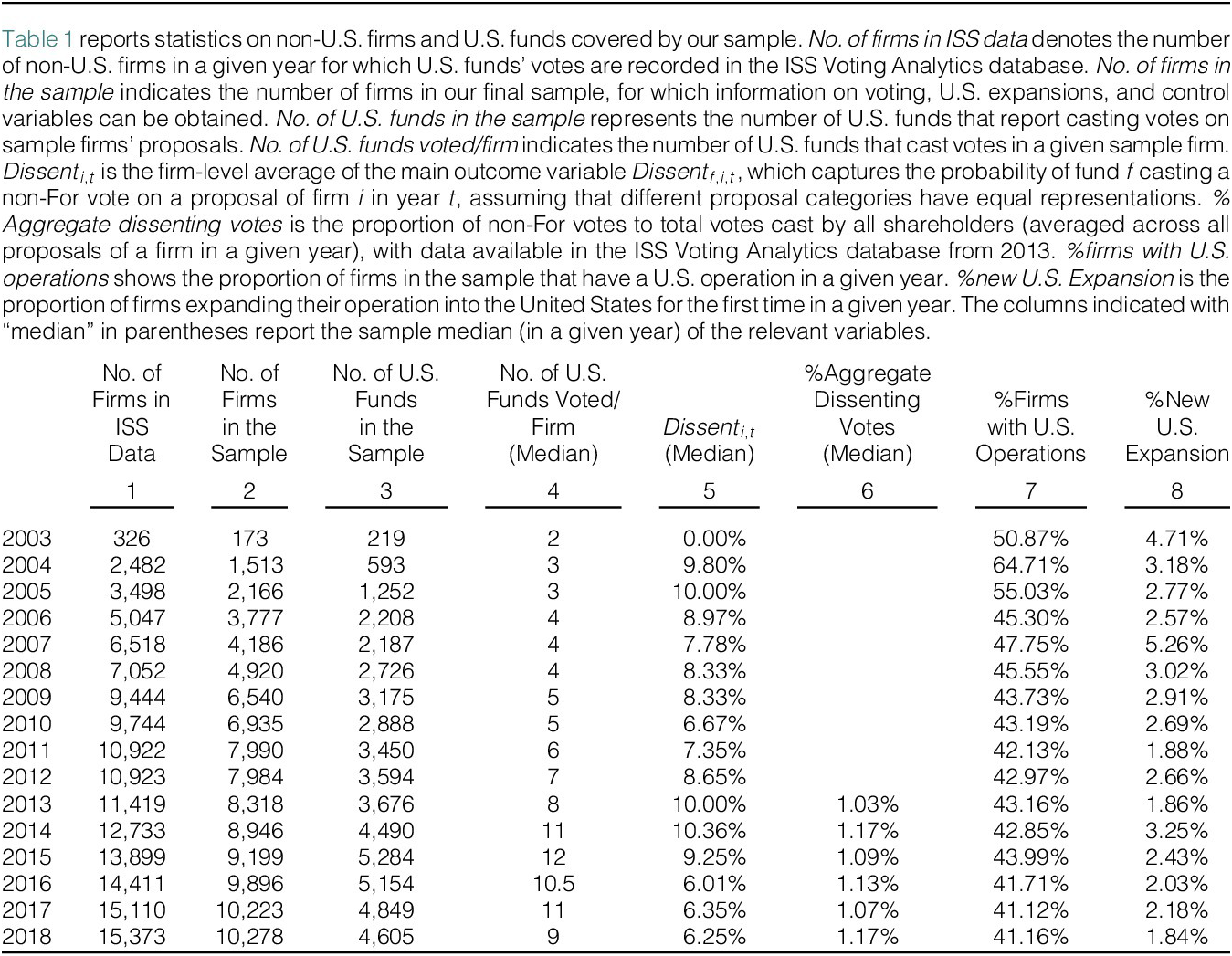
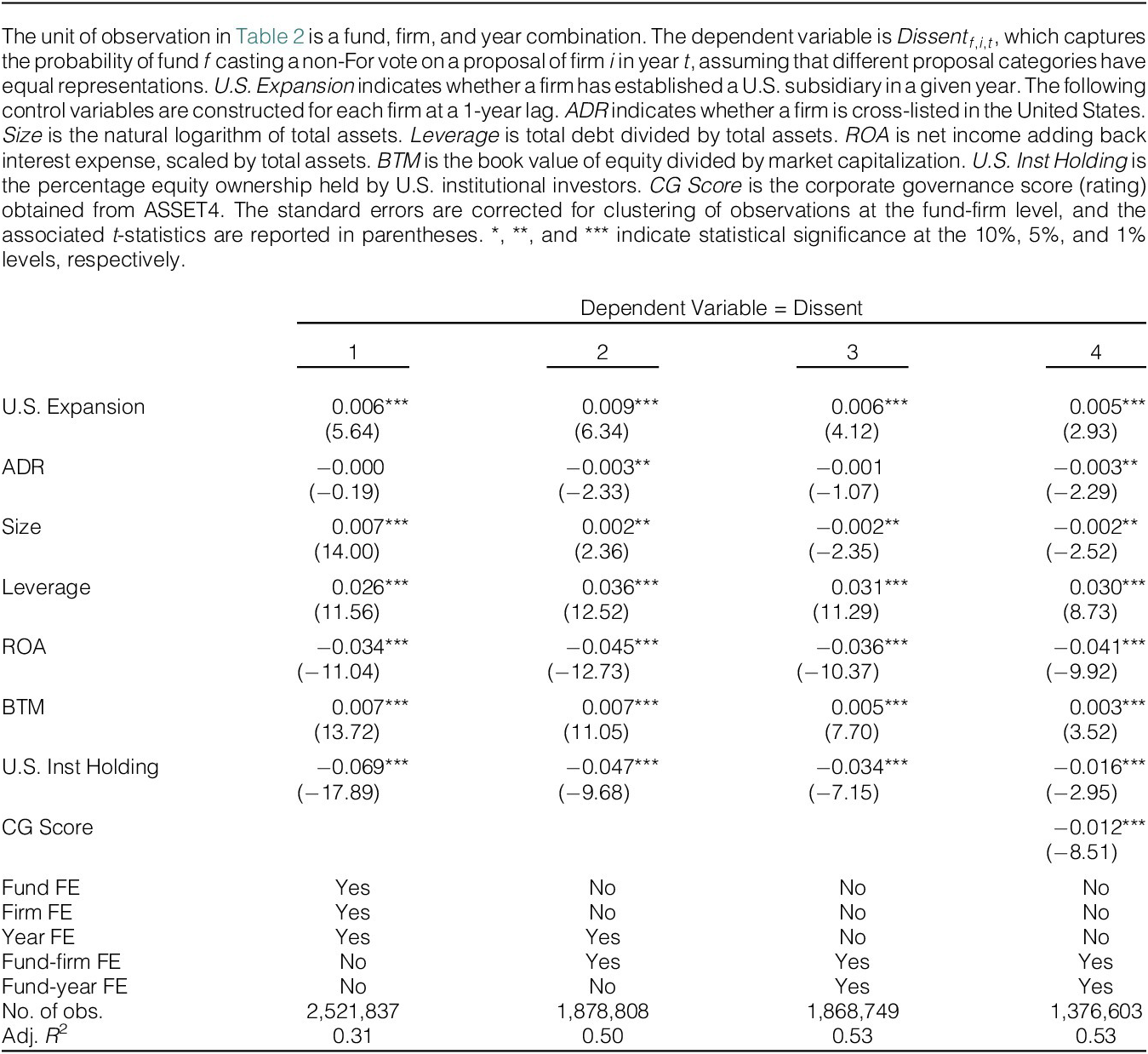
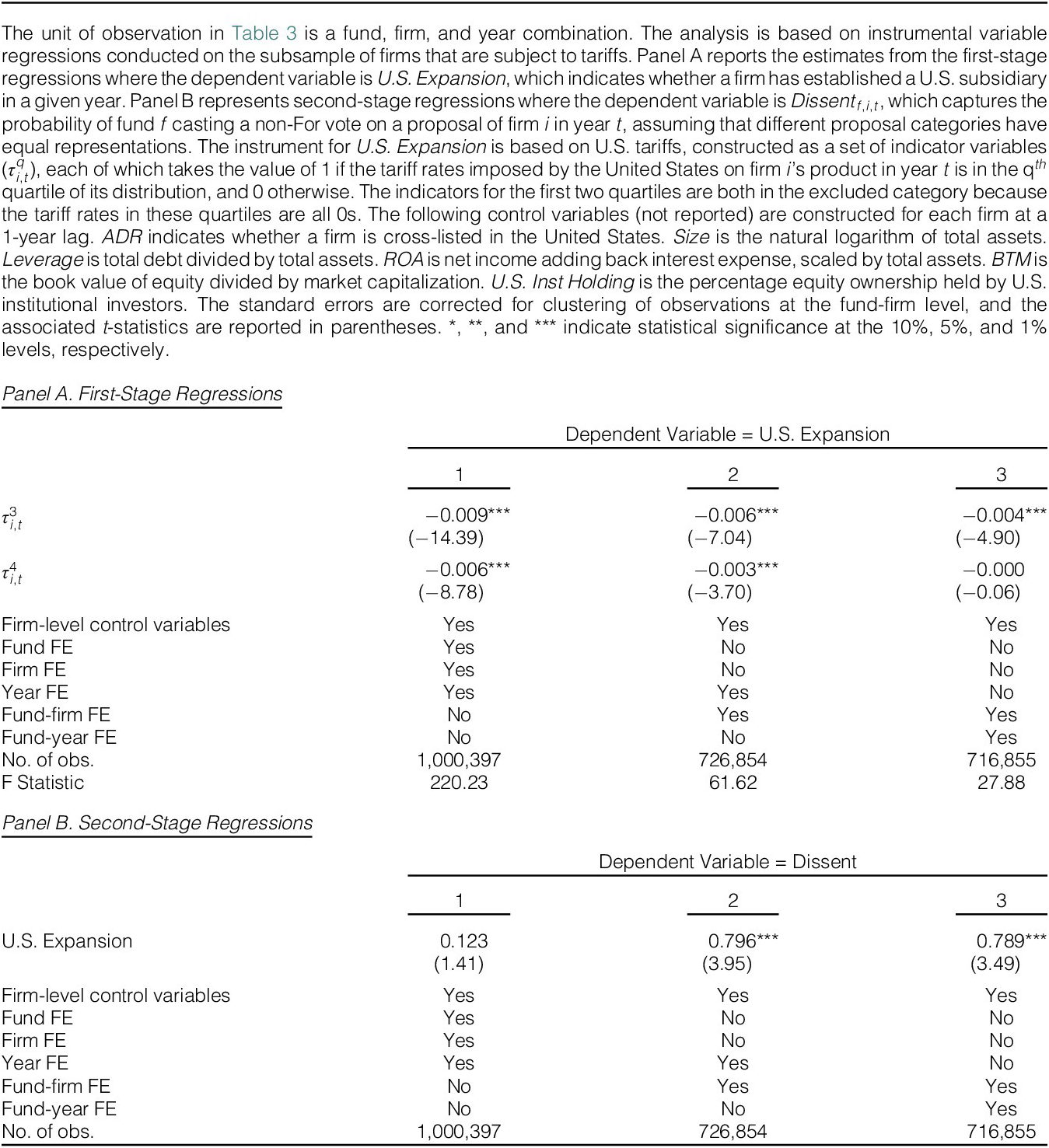
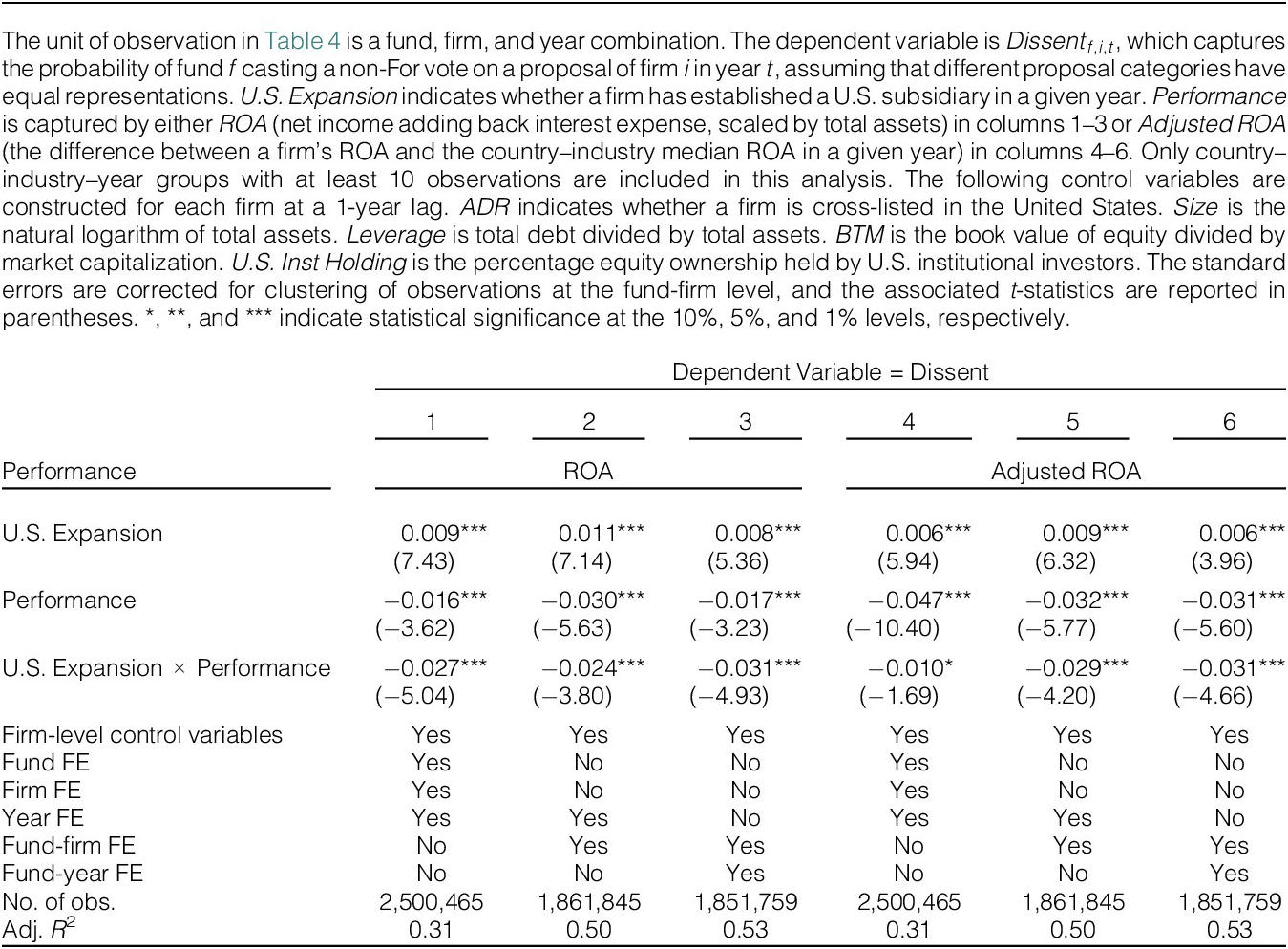
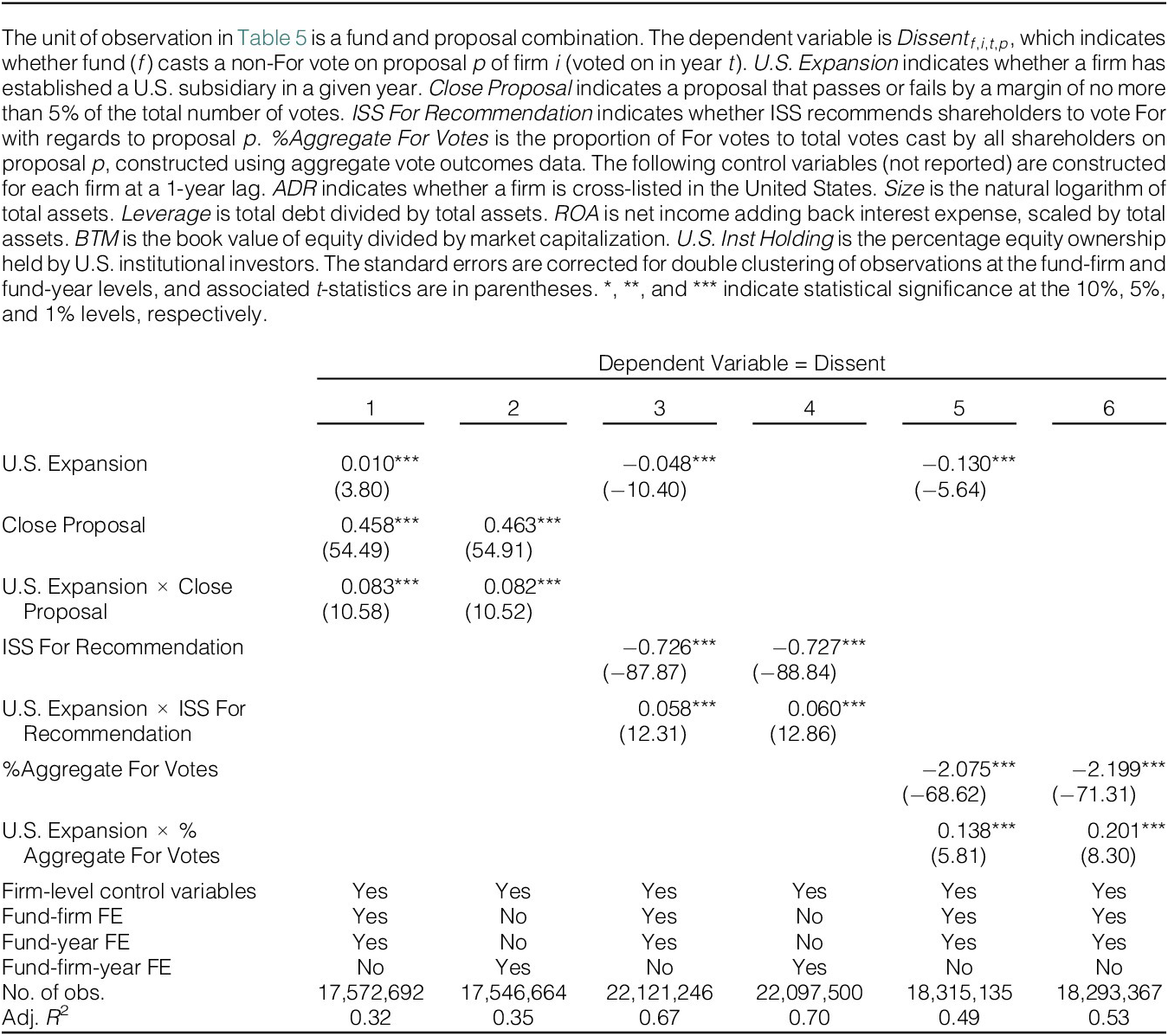
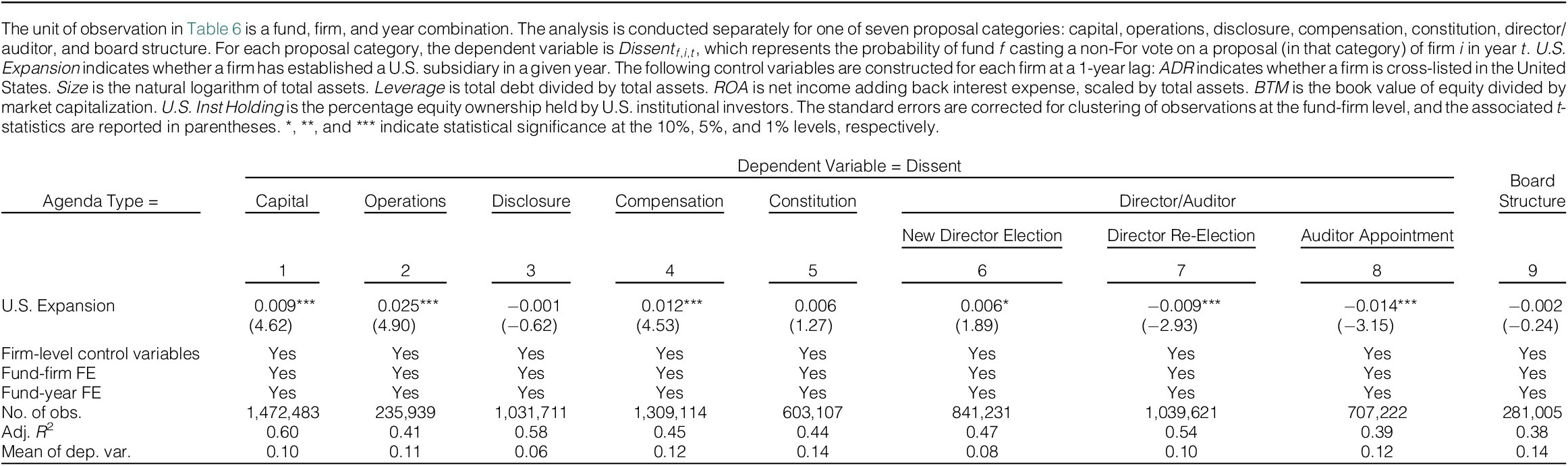
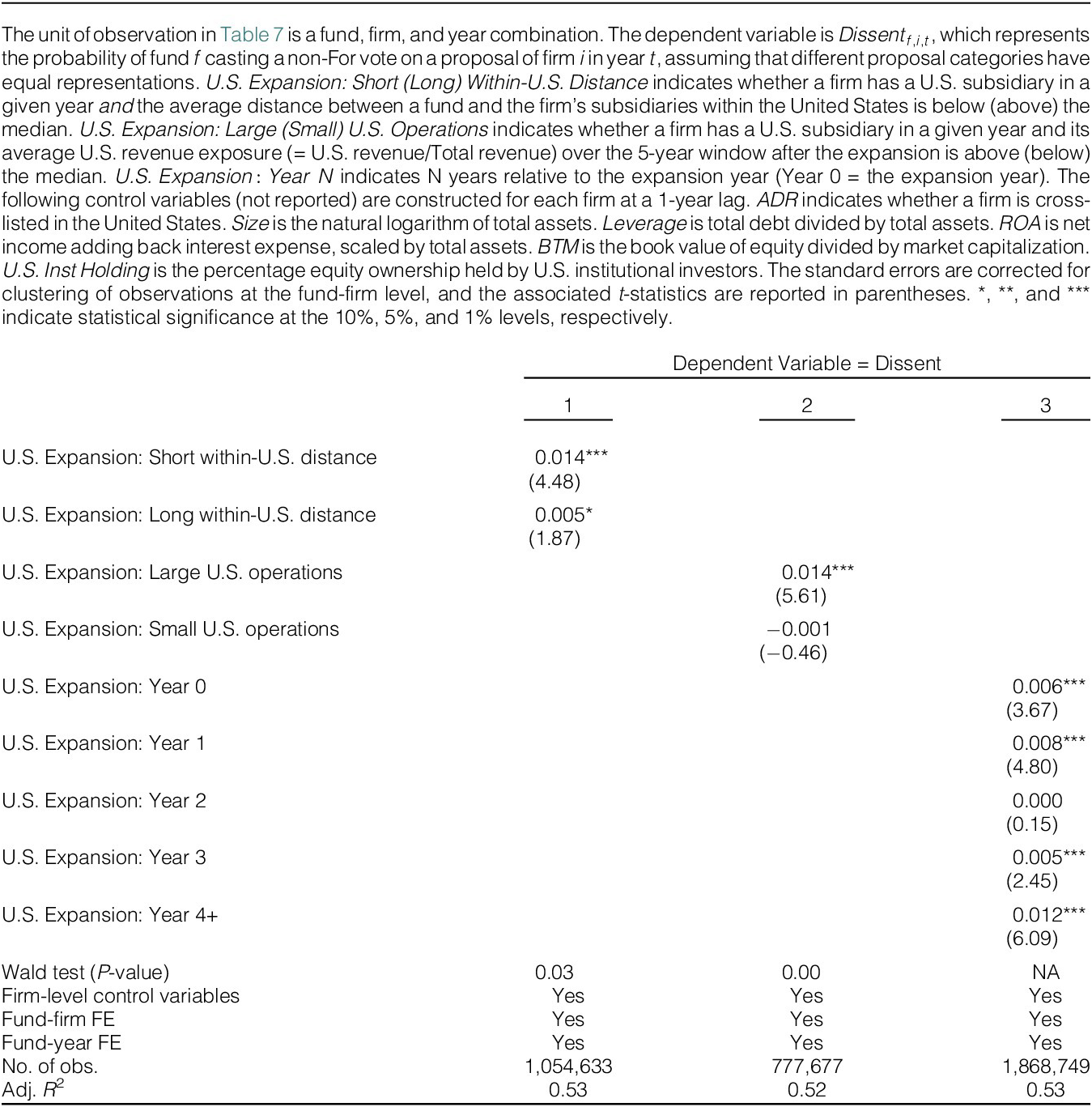
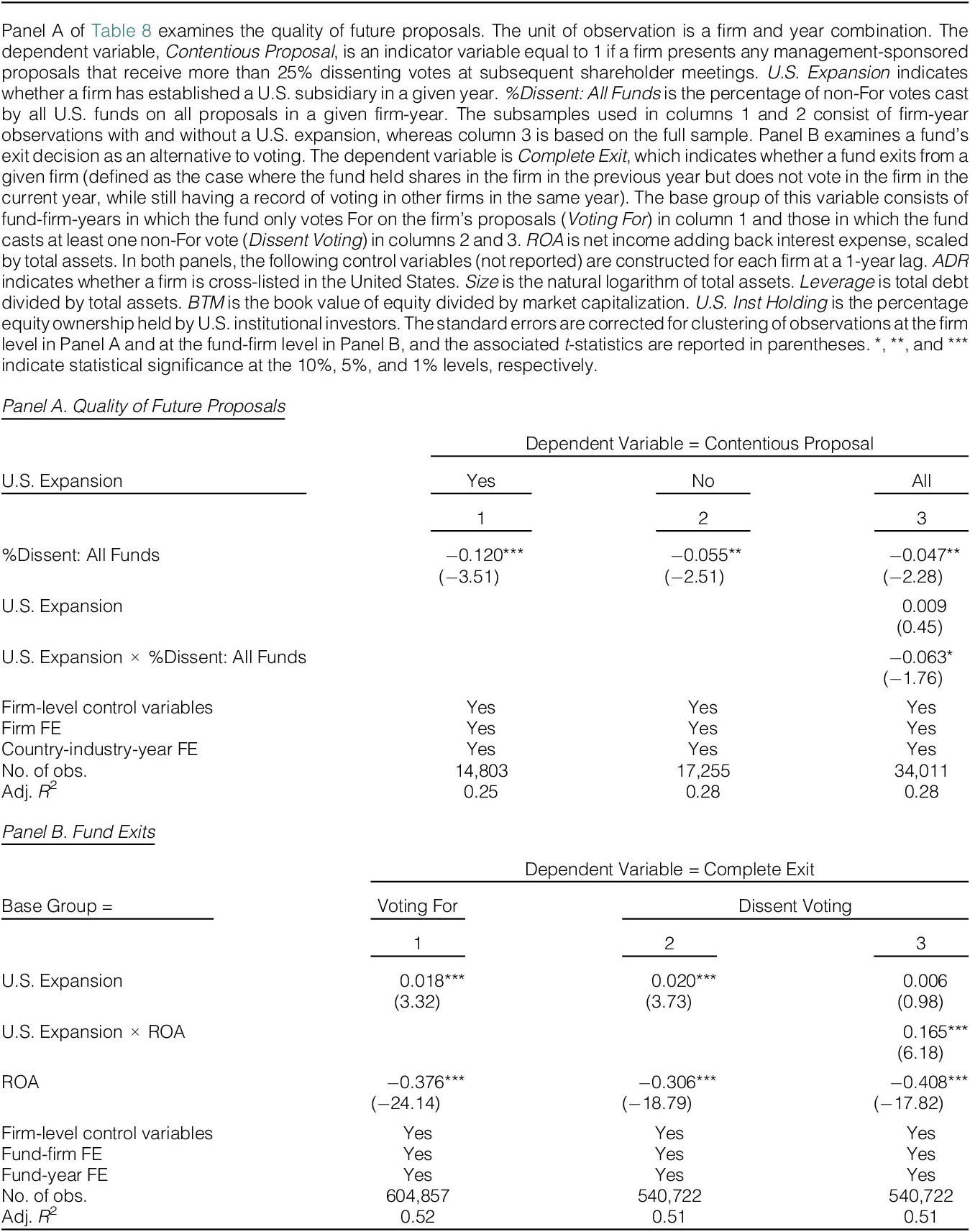
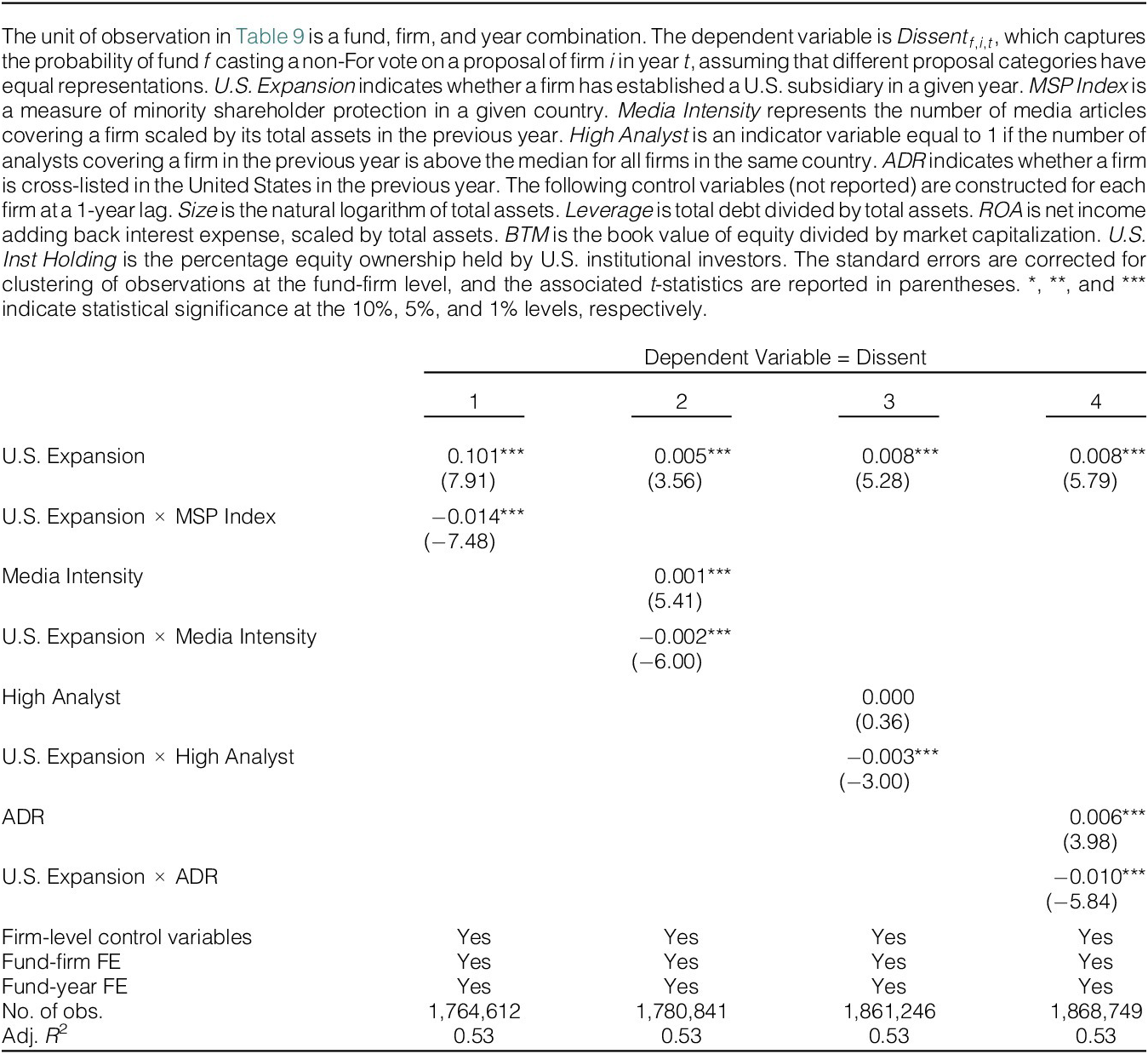


 Open access

