Kharkiv, Ukraine's hip-hop capital
Kharkiv's largest claim in Ukraine's popular music sphere is the wide-held national belief that it is the birthplace of hip-hop in Ukraine. More than a decade ago, Kharkiv's first hip-hop group Tanok Na Maidani Kongo (‘Dance on Congo Square’) rose to nationwide fame when it won the ‘Dance Music’ award at the prestigious Ukrainian-language popular music festival, Chervona Ruta.Footnote 1 This 1997 song was titled ‘Zroby meni hip-hop’ (‘Make Me a Hip-Hop’) and is acknowledged as the first public performance of a hip-hop song in a national music competition in Ukraine.
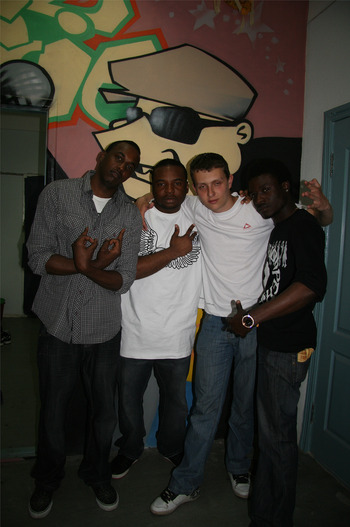
Borrowing from a variety of influences within hip-hop from the United States, Russia, Ukraine and throughout Africa, hip-hop musicians in Tanok Na Maidani Kongo's hometown have developed the genre in directions that were unforeseeable a decade ago. Numerous small multiracial hip-hop scenes associated with amateur hip-hop recording studios in Kharkiv have been created by local university students and students from African countries such as Uganda, Kenya and Nigeria who study at Kharkiv National University and share an interest in hip-hop music and culture.
Notions of place, as tied to representations of city life, are a very important characteristic of Kharkiv's hip-hop styles. Scholar Murray Forman, among others, identifies place as a defining trope through which hip-hop musicians in the United States personalise individually represented experiences in song lyrics and hip-hop videos (Forman Reference Forman2002). In Kharkiv, hip-hop songs and videos draw on what Ian Maxwell refers to as a US-informed ‘social imaginary’ – local representations of place that align with US-based images that local artists have not experienced first-hand (Maxwell Reference Maxwell, Bloustein, Peters and Luckman2008, p. 80). For instance, young hip-hop musicians who have the financial means to film accompanying videos to their songs in Kharkiv do so against the backdrop of dilapidated Soviet-era high-rise apartments. Such video representations emphasise not only local experiences of economic deprivation but simultaneously index an awareness of how such tropes function in US-based hip-hop.
Taking into consideration a variety of discursive elements within hip-hop music in Kharkiv, this article first takes a step back from the music itself and focuses on the ways the scenes function, paying specific attention to the roles African musicians play in the production and, as will become evident from the ethnographic data, legitimisation of hip-hop in Kharkiv. Ethnographic research conducted in the summers of 2007 and 2008 based on interviews with musicians, producers and recording studio technicians, as well as on observations of hip-hop events such as breakdance and rap competitions, reveals that Kharkiv's hip-hop scenes are delineated by networks of young men associated with particular recording studios. At the time of research, these studios, close to 15 in number, were not professionally established to the degree where they might be known for a particular style of hip-hop. Significant in this early stage of studio developments are the interpersonal and interracial relationships forged among young male musicians who work to foster new modes of entrepreneurship in a post-socialist economy. Generally speaking, their professional goals focus on strengthening local music industries to help guarantee an income from music.
Coming from diverse cultural and class backgrounds, participants bring a wide variety of understandings and opinions as to what constitutes ‘hip-hop’ in Kharkiv. At hip-hop parties in clubs throughout Kharkiv, DJs commonly play a wide variety of US hip-hop, Russian- and Ukrainian-language hip-hop, and hip-hop music from countries in Africa that African students incorporate when asked to deejay. Local media, entrepreneurs, musicians and producers within Ukraine's music industries categorise all forms of rap-based music as ‘hip-hop’. Such processes have been observed by Andy Bennett and others who argue that definitions of hip-hop culture are continuously ‘re-made’ by people who appropriate the genre across the world (Bennett Reference Bennett, Bloustein, Peters and Luckman2008, p. 133).
My ethnographic research at events marketed as ‘hip-hop’-related reveals that local hip-hop culture broadly encapsulates rapping, MC-ing, DJ-ing, breakdancing, graffiti, skateboarding and, increasingly as a result of growing corporate sponsorship of hip-hop events, BMX biking. BMX bikes are expensive and are marketed, alongside other forms of hip-hop culture, for young men of relative financial means. In Kharkiv's social context, hip-hop functions as an articulation of growing middle-class identity and a sense of urban cosmopolitanism influenced by and determined by one's access to Western cultural knowledge. Amidst rising post-socialist consumerism, African students in Kharkiv capitalise on certain aspects of African American identity associated with American hip-hop in Ukraine and use the genre as a critique against increasing racism in the post-Soviet sphere as well as a mode of socio-economic integration.
Soviet/post-Soviet ‘African’ identities
The growing number of migrants from East Asia, Central Asia and the African continent has contributed to rising racial discrimination throughout Ukraine (Ruble Reference Ruble2005, Reference Ruble2008). Contemporary race relations, however, are strongly rooted in Soviet-era race discourse (Matusevich Reference Matusevich and Matusevich2007). The Soviet Union viewed itself in global political discourse as a racially blind society in contrast to the United States. Soviet officials emphasised racially motivated economic inequality in the United States as an example of exploitation within the capitalist system where one group benefits at the expense of another.Footnote 2 In contrast to segregation policies in the United States, the Soviet government extended opportunities for free education to citizens from developing countries with the intent of teaching and spreading socialist ideology. Beginning in the 1950s, students came from Uganda, Kenya, Nigeria and other socialist countries throughout Africa with whom the Soviet Union had good relations. Kharkiv, with its well-known medical and technological university programmes, drew a significant number of African students, as did universities in Leningrad and Moscow. Prior to the Soviet Union's collapse, there were approximately 50,000 African students living and studying in the USSR (Quist-Adade Reference Quist-Adade and Matusevich2007, p. 158).Footnote 3
Historian Maxim Matusevich explains that Africans were perceived differently from other foreigners. They came to the Soviet Union to gain an education that would contribute to social and economic advancement in their home countries. Because the opportunity for economic and social mobility was not possible for citizens of the Soviet Union, this general attitude set Africans apart ideologically from other students (Matusevich Reference Matusevich and Matusevich2007, p. 362). Africans, unlike students who were Soviet citizens, also had the right to travel outside the Soviet Union for summer break, often to Western countries such as the UK. They returned with hard currency and Western goods including jeans, which were not readily available in the Soviet Union (Matusevich Reference Matusevich and Matusevich2007, p. 362). Realities and perceptions of access to Western commodities helped imbue African students with a certain social status within the university context.
Today this relationship differs due to changed attitudes among Ukrainian citizens regarding their own class status and a self-conscious awareness of Ukraine's economic status in relation to developing countries. During my first fieldwork trips in the early 2000s, people often expressed their anxiety over Ukraine's economic collapse in relation to their perceptions of poverty on the African continent. Ironically, many African exchange students claim that they are financially better off than their non-African university colleagues.Footnote 4 Such imbalances in wealth and perceptions of wealth contribute to a racism couched in economic discourse.
Close to 20 years after the fall of the Soviet Union, new class positions have solidified with a significant division between those with money, power and privilege, and those with significantly less access to new forms of social status (Patico Reference Patico2008). Due to the growing division between classes, foreigners in Ukraine are perceived by the government and by local populations as economic competitors (Ruble Reference Ruble2008) and are cast into newly reconstituted racially marked economic identities of white and black.Footnote 5 When I asked local non-African interlocutors to elaborate on their understandings of what it means to be white, middle-aged and college-aged, people repeated an often-heard phrase that they want to be treated like bili liudy (‘white people’). It appears that whiteness is a Western-mediated identity that demands dignity, fairness and respect. In the Soviet era, whiteness was not articulated as a racial category but was embedded within divisions of political and economic power among ethnic groups within the Soviet Union. The Russian and Ukrainian designator chernyi/chornyi (‘black’) was applied throughout Soviet history to various non-European groups such as Roma (Fikes and Lemon Reference Fikes and Lemon2002, p. 498).Footnote 6 The Soviet-era Russian-language term for perceived racial identity, Neger (‘Negro’), is still often used in colloquial conversation, but students from Africa are quick to contradict such a term in conversation due to its negative (for them) association with slavery in the United States. They do, in turn, answer to the nominator ‘African American’, a term alongside ‘African’, ‘Afro-Ukrainian’, and the biracial designator, mulat, that non-Africans use to socially reference Africans in Ukraine.
The incorporation of new terms is directly related to the continued presence of African students, the growing number of African migrant workers, and the recent increase in familiarity with African American figures in post-Soviet media. Scholars Jessica and Eric Allina-Pisano have noted that the term ‘African’ functions as a separate discursive category in relation to people's uses of the term ‘black’ in the Soviet era and reflects the development of a separate relationship within post-Soviet society toward people from Africa in relation to other dark-skinned groups (Allina-Pisano and Allina-Pisano Reference Allina-Pisano, Allina-Pisano and Matusevich2007, p. 191).
Post-socialist relationships between race, racism and music
Some scholars argue that a black-and-white framework can only be related specifically to America and not to other geographic contexts (Bourdieu and Wacquant Reference Bourdieu and Wacquant1999, p. 51). However, the post-Soviet influx of hip-hop music and videos from the United States has fostered articulations of a black-and-white framework and has dramatically changed Soviet-era attitudes toward race relations. A popular hit from Russia by the group Zapreshchennye Barabanshchiki (‘Banned Drummers’) from 1999, titled ‘Ubili Negra’ (‘They killed a Negro’), reveals that the hidden racism that existed in the Soviet Union increased and became overt in the US-influenced post-Soviet cultural media.
The video for ‘Ubili Negra’ features the Russian members of the band playing in an upscale lounge bar. In an adjacent room, an African is seated at a desk and attempts to study. Corresponding to the lyrics, the African student forgoes his studies to shoot hoops and dance in the lounge with the band. The identity of the African as intellectual is overshadowed by layers of stereotypes gleaned from US music videos and television programming that began to circulate on Russian television by the mid-1990s. The calypso-style accompaniment and the sonic punctuation added by steel drums index an aural sense of pan-Africanness. As global hip-hop scholar Lee Watkins observes, ‘the experiences of memory and trans-local exchanges are inscribed in the African body's musical expressions and musical behaviour’ (Watkins Reference Watkins, Whiteley, Bennett and Hawkins2004, p. 135). Though the African in the Russian video is clearly made to represent an African American, the calypso rhythm reinforces local notions of globalised ‘African’-based identity as physically mediated and embodied.
Despite a disclaimer at the beginning of the song that it does not promote violence against Africans, the song was very popular and people sang it with an alternative chorus: ‘They killed the Negro, it's ok, we don't care’ (Reitschuster Reference Reitschuster2004). Racial violence against Africans has risen dramatically in Russia and Ukraine. Eighty-eight per cent of Africans who were surveyed by researchers from the Kennan Institute for Advanced Russian Studies in 2001 stated that they would not have moved to Ukraine had they known ‘what experiences were in store’ (Ruble Reference Ruble2005, p. 164).
African students in Kharkiv use hip-hop to fight back against this type of racism and to gain a voice and presence in a city that is unwelcoming of them. Their efforts are fruitful to the extent that popular music's formative role in public politics has a long history on the territories of Ukraine. In the Soviet Union, ethnic Ukrainian popular musicians fought against Moscow's linguistic and political oppression by using the Ukrainian language and various anti-government topics in their lyrics (Bahry Reference Bahry and Ramet1994; Wanner Reference Wanner and Slobin1996). This Soviet-era ideology about the power of popular music has carried over into the first decades of Ukraine's independence and casts musical genres within political frameworks and ideological camps. This imbues all forms of popular music with a great deal of power to influence the direction of various social and political movements as evidenced by the role of music during Ukraine's movement for independence (Bahry Reference Bahry and Ramet1994) and the anti-government corruption campaign in 2004, commonly known as the Orange Revolution (Helbig Reference Helbig2006; Klid Reference Klid2007). In post-independence civil discourses, political leaders representing the Roma minority (Helbig Reference Helbig2005) and the Crimean Tatars (Sonevytsky Reference Sonevytsky2009) have used music to draw attention to minority rights agendas. Various forms of identity politics regarding ethnicity and gender have also been called into play by Ruslana Lyzhychko, winner of the 2004 Eurovision Song Contest, who frames notions of female strength and beauty within an exoticised search for ethnic Ukrainian musical roots (Wickström Reference Wickström2008).
As regards issues of race, my research points to a direct correlation between the increased use of the highly charged term ‘Afro-Ukrainian’ in political discourse and the growing participation of African students in Ukraine's popular music scenes, hip-hop among them. The prefix ‘Afro’ is much more commonly used in Ukraine than in other post-socialist countries such as Russia. I propose two possible reasons for this occurrence. First, as witnessed by the 2004 Orange Revolution, citizenship is not defined by ethnicity in Ukraine and the nominator ‘Ukrainian’ is understood as both an ethnic and civic category. This understanding is greatly influenced by continued cultural and political conflicts among Ukrainian-speaking Ukrainians, Russian-speaking Ukrainians and ethnic Russians as to which group, if any, can function as the dominant representative of Ukraine's population (Bilaniuk Reference Bilaniuk2006). Differences in religion, language and customs throughout the country allow for strong regional identities but a less cohesive national identity.
The second factor that has contributed to the use of the nominator ‘Afro-Ukrainian’ is the number of popular figures in the Ukrainian media who have a biracial identity. During the Soviet era, African men who married or had children with Russian and Ukrainian women were forced to leave their families because Soviet bureaucrats did not allow African students to overstay student visas and forbade Soviet citizens to emigrate (Quist-Adade Reference Quist-Adade and Matusevich2007, p. 155). Mothers and their biracial children suffered great prejudice during the Soviet era. Myroslav Kuvaldin and Karolina Ashion, children of such mixed unions, among others, work as lead announcers on Ukraine's music television station M1, founded in 2001. Karolina Ashion, daughter of a Nigerian father and a Ukrainian mother, leads a Hollywood gossip show and reads business news for M1. Myroslav Kuvaldin, who met his Nigerian father only recently with the help of a reporter from the BBC, is a strong proponent of Ukrainian music. In the mid- to late 1990s, he was part of the musical group, The View, which mixed reggae with Ukrainian folk sounds.
Public figures such as Kuvaldin and Ashion, categorised as mulat (‘mixed-race’) in Ukraine, have established a voice for racialised Others, including African students, within the niche opened by the influx of African American music videos onto Ukrainian television. Cultural images of African Americans circulated via global music industries add many complex layers to how Africans and people of African heritage residing in Ukraine today express themselves through music and how their social positioning is perceived by others. For instance, certain upscale clubs in Kiev hire Africans as bartenders to authenticate their status as a hip-hop/R&B club. According to club owners, the physical presence of black bodies reinforces the cultural and material status of the club itself and the club's visitors.Footnote 7 African DJs are sought after and there are many Africa-themed dance events throughout the city. In Kharkiv, producers feel it is important for the small local hip-hop recording studios to have musicians from any African country signed to their label as a sign of hip-hop legitimacy. According to Mayne G, a rapper from Uganda who studies electronics at Kharkiv National University:
When you get on a stage, of course, Ukrainians love a black, you know, it's something new … You go to different cities where blacks are very rare. So you can get really applauded on stage, of course if you are good. (Interview, Kharkiv, 1 June 2007)
While African students and migrants by no means constitute a majority population in any part of Ukraine, US music videos and Hollywood movies that feature African Americans are a regular part of programming on Ukrainian television and airwaves. As Anatoly Alexeyev, a producer at Age Music explains:
American hip-hop is the fashion legislator [zakonodatel' mody]. To be the best here, we have to know the newest releases from the United States. Earlier it was more difficult, but now it is easier with the development of the Internet, and so on. As soon as something fresh is released, we hear it here immediately. (Interview, Kharkiv, 1 June 2007)
US hip-hop influences popular culture in Ukraine beyond specific hip-hop milieus as well. Popular Ukrainian television shows such as Tantsiujut Usi (‘Everybody Dances’) now feature a hip-hop dance category. In episodes of the show in 2008, African American hip-hop dancers such as Kenny Marcus were hired as judges and as dance trainers. Interviews with these persons regularly appeared in various types of media during the duration of the show's season.
To a certain extent, the media in Ukraine fosters an indexical relationship between African Americans and music, and positions hip-hop musicians as people who are held to different rules and norms from the rest of society. These tropes are naturalised and play out in everyday interactions among Africans and non-Africans in Ukraine. When pulled over by traffic police in Kiev, some African students feign to be popular reggae or African American hip-hop musicians.Footnote 8 More often than not, the police believe their claims and excuse them from fines. On the one hand, this exchange between alleged musicians and local authority figures attests to the strong influence that US-based music genres have on interracial relations in post-Soviet society. On the other, it shows that certain stereotypes regarding ‘being black’ carry over as well. Racial profiling by police is a typical occurrence, as is racially motivated violence by skinheads.
Perhaps the most commonly articulated stereotype regarding African hip-hop musicians, however, is that they are rich, because that is how African Americans are primarily depicted in hip-hop videos featured in the Ukrainian media. This racial stereotype among Ukrainian citizens has shifted significantly from the 1990s, when the dominant belief was that all Africans were poor.Footnote 9 This stereotype was based on and reiterated through development statistics that placed Ukraine alongside African countries near the bottom of the world economic spectrum immediately following the collapse of the Soviet Union. Today, there is a general feeling that Ukraine has reinstated its relative position ‘above’ African countries and is moving towards an economic and political status that would contextualise it as a ‘European’ state. This is articulated in the cultural sphere through music projects such as ethno-pop singer Ruslana Lyzhychko's visit to South Africa during which the singer's webpage featured her dancing in plainclothes with people in traditional Zulu dress.Footnote 10 The Ukrainian media positioned the singer as an ‘explorer’ of a far-away land who finds a common language with a local tribe through a rhythmic dance. Similarly, Ruslana's 2008 album Amazonka, recorded at the Hit Factory in Miami, features collaborations with hip-hop artist T-Pain and rapper Missy Elliot. While the song with T-Pain ‘Moon of Dreams’ is one of lost love, it is not a song of biracial romantic intimacy. Despite his greater global fame, T-Pain takes a background role in terms of physical representation in the music video and vocals. Ruslana sings the verses and T-Pain's rap is confined to an aural framework determined by the Ukrainian singer's eclectic ethno-dominatrix style. As much a commentary on race as it is on gender and East/West expressions of financial mobility, this example reinforces the argument that in the post-Soviet sphere, people determine their relationships to each other in terms of money and status within racialised frames.
Post-Soviet economics of hip-hop
In the last 10 years, the revived Ukrainian music industries have become centralised in Kiev.Footnote 11 Though the majority of popular musicians from large cities have relocated to Kiev, student hip-hop musicians in Kharkiv try to uphold the city's image as a place for musical innovation. Hip-hop scenes find representation on local radio stations, but are not promoted on the national television channels accessible in the city. The national music television station, M1, plays a variety of hip-hop and R&B music videos from the United States and Russia. Since the Orange Revolution in 2004, musicians with political connections such as Tanok Na Maidani Kongo receive the most airplay. For the most part, however, information regarding breakdance, graffiti and rap competitions in Kharkiv, dance parties, and access to recording studios is spread via word of mouth, personal connections, ties among school friends and posters that announce hip-hop-related events throughout the city. Despite his enthusiasm for working as a hip-hop musician in Kharkiv, DJ Vas-sabi, a 22-year-old musician of Ukrainian–Rwandan descent, contributes the small scale of local hip-hop scenes to a general lack of resources among student musiciansFootnote 12:
In Kharkiv, when you advertise an R&B/hip-hop party … the DJ who is invited might not really know how to play the music well, meaning that they don't always get a smooth transition between songs. People who are dancing shouldn't hear the mistakes of the DJ – the beats should flow one into another. It's hard to find places that can afford good technology. Most DJs still use compact discs rather than records because the places can't afford them. And not every DJ gets the chance to really practice because they don't have regular access to good equipment. (Interview, Kharkiv, 6 June 2008)
Each hip-hop scene comprises groups of friends and student acquaintances who produce music in makeshift studios. Studios organise hip-hop parties and rap competitions throughout the city, featuring performers associated with their socio-musical networks. As studios grow in influence and professional status, scenes become increasingly split, focusing on a small number of more professional and talented rappers who offer promotional capital for studio-organised hip-hop parties. Studios and their accompanying scenes are diverse for many reasons. Each rapper, whatever his ethnic background, brings to his respective group a different personal relationship and individual experience. His musical influences on local hip-hop are usually tripartite. Musicians/audience members contribute: (1) a personal relationship to African American hip-hop through a history of listening influenced by where he grew up and what types of music he has access to; (2) an individualised experience with local hip-hop traditions in his country of origin; and (3) a socio-aural style of music/dance expression that takes into account local conditions of his experiences in Ukraine.
More established rappers share their music at competitions sponsored by hip-hop clothing and accessory shops in Kharkiv such as Stuff Skateshop. The corporate element within Kharkiv's hip-hop scenes limits participation to teens and university students who visibly display financial means. They buy clothes at newly established hip-hop shops rather than at the Barabashova BazaarFootnote 13 because bazaar clothes carry the stigma of sameness, low quality and lack of critical choice of personal adornment, a crucial marker of post-Soviet status. Other expenses include breakdancing lessons, graffiti paint, studio recording time and computers for recording/mixing music. The price of admission to hip-hop parties, usually free for women, varies for men from US$5–10 depending on the club's reputation. This fee constitutes a half-day's wages for a young professional in Kharkiv. It seems that in the early 2000s African students relied on their financial means to gain access to the scenes. Today, the cultural capital associated with ‘blackness’ plays a much more important role in determining the relative ease through which African musicians are integrated into Kharkiv's hip-hop milieu.
Kharkiv's hip-hop studios as sites of socio-racial agency
The majority of hip-hop recording studios in Kharkiv are small establishments that students have put together in basements of buildings on the outskirts of town. Most consist of a home computer and a sound booth with a microphone, along with makeshift studio controls for sound. For example, the walls of the small Boombox Records studio are soundproofed with 20 pairs of old jeans. Most studios are funded through personal financial means. Increasingly, certain studios have received support from corporate sponsors such as local radio stations, local hip-hop shops and national political parties that seek youth support in the region. The young men who run the studios purchase recording equipment, set up sound studios, record, produce and distribute CDs, market and organise various hip-hop parties, competitions and other events. The Internet has also increasingly become a viable resource for music distribution in Ukraine (Helbig Reference Helbig2006). Several studios with greater financial capital have websites and list-servers through which new artists and music are advertised. Male musicians who run small independent hip-hop recording studios in Kharkiv learn from each other how to produce, market and earn profits from the music they record and release. Better produced CDs may be picked up for distribution by hip-hop labels such as Moon Records in Kiev for further nationwide distribution. The distribution of Ukrainian-made CDs abroad, however, is still quite minimal.
Many songs composed by African and local hip-hop groups associated with the small hip-hop studios have made it onto nationally and internationally distributed compact discs such as ‘Ukrainskymy slovamy: Zbirka Ukrainsko-movnoho hip-hopu’ (With Ukrainian words: a collection of Ukrainian-language hip-hop) produced by Age Music Studios in 2006. Other CDs circulate locally and are distributed via hand-to-hand networks at bazaars and at various rap, graffiti and breakdance competitions. Rappers from Kharkiv perform with musicians from abroad at corporate and politically sponsored hip-hop events in Ukraine's larger cities such as Kharkiv, Kiev, Dnipropetrovsk, Odesa, as well as Yalta. Some are also invited to participate in hip-hop events in Russian cities close to the Ukrainian border. Many hip-hop musicians believe St. Petersburg offers greater financial opportunities, but most express hopes for local investments into Kharkiv's music industries so they may make a living from music in their home town.
African students rarely travel outside Kharkiv for fear of racially motivated violence. Fears of racial attack among Nigerians, Kenyans and Ugandans influence the local hip-hop culture with a strong civil rights stance. According to Gomez and Dami, two Nigerian hip-hop musicians studying at Kharkiv National University, the rising number of racially motivated murders are rarely reported in the national media:
Sometimes when we are in a hip-hop club, our friends say, don't go out now, don't go out. There are some crazy people out there who can hurt you. Skinheads. So most of the time, we walk in groups. So if anyone wants to attack us, our friends provide security for us. They killed nine Nigerians. They killed a Ghanaian girl. Right in front of the police, the police won't do anything. It's important to bring attention to the Ukrainian government that this is happening to us. Just last week I had a fight with a Russian boy. He said they don't want innostrantsi (foreigners) in the country. In Kharkiv they beat you. In Kiev, they kill you. (Interview, Kharkiv, 5 June 2008)
African student groups such as AfroRasta sing about interracial communication, as evidenced by their English-language reggae/hip-hop song ‘Peace and Love’, issued on a reggae compilation album by Age Music in 2006 (Figure 1).
The relationship between ‘da blond, da noir, da mama, da papa’ points to the growing number of interracial marriages, though from a male perspective. African women's experiences are marginalised in local hip-hop, perhaps explained by the significantly smaller number of female students from Africa and attitudes among African men that deem participation in hip-hop culture inappropriate for middle-class African women. Non-African women sing back-up on hip-hop recordings and participate in other aspects of hip-hop culture in Kharkiv such as graffiti and breakdancing.
Nigerian hip-hop musicians and their Ukrainian producer at Kharkiv's Age-Music recording studio. Photograph by author, June 2008.

African musicians' attitude regarding hip-hop as a political and socially conscious musical expression are made clear in the song ‘Peace and Love’ by AfroRasta. The group's emphasis on racial relations mirrors the equal rights discourse evident within the genre throughout the African continent.Footnote 14 Mixing English, Swahili, Russian and Ukrainian, song texts speak out against racial intolerance and focus on the beauty of black bodies, evidenced by an excerpt from the English-language song ‘Club Fever’ sung by the Black Beatles,Footnote 15 a hip-hop group comprised of students from Kenya who recorded it at Kharkiv's youth-run Age Music Studios in 2006:
In this song and many others, the debate is physical, with an accent on black male bodies from Africa. The singers exhibit strength and confidence and offer an ‘accept me or move out of my way’ alternative to audiences who accept the singer in sonic if not always in physical form. It seems that very few local listeners, the majority of whom I interviewed in Russian, understand the rapper's English-language lyrics. Though many Africans also rap in Ukrainian and Russian, my interviews with them were in English. The group Black Beatles comprises students who have just begun their studies in Kharkiv and have not gained fluency in either Russian or Ukrainian. This gives space for the singers to say what they wish while not directly engaging in antagonistic racially charged exchanges with their supporters. Local hip-hop listeners respond positively to English lyrics because it makes the songs sound more like American hip-hop.Footnote 17 The use of English by African hip-hop musicians, however, blurs the lines between African and African American identity.
‘Club Fever’, as an example of musically mediated racial exchange, brings forth many questions regarding scholarly approaches to analysing hip-hop in global contexts. Much of global hip-hop scholarship is rooted in case studies that analyse processes through which US hip-hop styles are localised in non-Western contexts, with emphasis on genre appropriation and innovation (Mitchell Reference Mitchell2001; Basu et al. Reference Basu, Lemelle and Kelley2006; Condry, Reference Condry2006; Barrer Reference Barrer2009; Pasternak-Mazur Reference Pasternak-Mazur2009). While much research points to the global circulation of music via recordings, Andy Bennett identifies impromptu rap performances in clubs by African American GIs stationed in Frankfurt am Mein, Germany as an influential factor in the development of the city's hip-hop scenes (Bennett Reference Bennett2000, pp. 216–17). Similarly, African students produce hip-hop in Kharkiv while performing within a liminal space of negotiated identities influenced by local race relations and multinational interpretations of US hip-hop.
African musicians attempt to forge connections with local musicians in Kharkiv through hip-hop music as a black-identified genre within which they have something to say. Black skin colour itself – rather than musical experience or even interest in DJing and rapping – is enough of a way to enter into the Kharkiv hip-hop scenes. All are welcome to participate in recording sessions and if a musician exhibits less skill, the local person who runs the computer-controlled recording equipment assists the musician by supplying beats and various sonic elements. This process recalls issues raised by Louise Meintjes regarding the agency of the recording engineer in the recording studio (Meintjes Reference Meintjes2003). Meintjes shows that the recording engineer has an understanding of the broader media sphere for which the recordings are intended, a situation that differs greatly when the rapper is a foreigner. Though the recording engineer exhibits a formidable role in relation to local rappers, often suggesting different ways of mixing beats or articulating and accenting various words in Russian or Ukrainian, his role (the engineer is almost always male) differs greatly during a recording session with Africans. First, he does not understand the language, whether English, Swahili or other and thus will not comment on vocal inflection or the rhythmic structure of the text. Second, drawing on a broader deejay-based cultural discourse that ‘Africans mix better beats’,Footnote 18 he takes recording cues from the musicians themselves, allowing the musicians full control over all aspects of the music recording process. Third, because students from Africa have relatively more financial means than local students involved in hip-hop, they can afford to buy more time in the recording booth. The extended time within the recording studio leads to more carefully balanced recordings.
The power shifts are clear and carry from the studio to other aspects of hip-hop experience such as dancing. At hip-hop dance parties, whether the DJ is African or not, a person of African heritage is almost always invited to dance on stage in front of the audience. His dancing validates the skills of the DJ but concurrently places the black body on display. Such actions and processes make club attendees aware of Africans ‘in the house’ and continuously circulate the indexical relationship between black bodies and hip-hop.
Socio-racial networks of hip-hop entrepreneurship
The social networks within Kharkiv's hip-hop scenes facilitate interracial exchange and create modes of socio-racial agency for African students in a post-Soviet context where discrimination against dark-skinned people is on the rise. Influenced by regional, African and US musical elements, the scenes serve as spaces where locals interact, befriend, and create musical and cultural bonds with people from different backgrounds. On the one hand, the genre develops in new ways that draw from a multitude of personal and musical experiences. On the other, it is highly dependent on interpretive frameworks of racial and musical identities mediated by hip-hop culture from the United States. Musical meanings are rooted in histories of Soviet–African and Soviet–US, post-Soviet Ukrainian–African and Ukrainian–US as well as (broadly defined) African–US cultural exchanges.
Competing notions of ‘blackness’ determine the ways in which and the extent to which participants are racialised within multinational processes of interpretation that simultaneously support and limit interracial exchange. A further element within such exchanges is the notion of mutual financial benefit for African in relation to other local hip-hop musicians within Ukraine's transition economy. To some degree, both groups use operative notions of ‘blackness’ as it relates to hip-hop to gain agency within the scenes. Local hip-hop musicians turn to African musicians to validate the efforts of recording studios and to legitimise the genre on a local level. Africans draw on African American cultural capital to position themselves as closer to the origins of the genre via racial identity. As the music industries in Kharkiv develop, significant will be the ways in which the relationships between music and racial identity play out within a more professionalised hip-hop milieu. How will talent be interpreted as studios develop their own sounds? Will racial identity be so obviously marked as scenes expand, perhaps, to include migrant musicians of East Asian or Central Asian descent, growing populations in Kharkiv? Will financial wealth continue to be a factor that determines entrance to the scenes? How will Kharkiv's hip-hop scenes relate to hip-hop in other cities within the developing nationwide distribution network? Though such questions fall well beyond the purview of this article, they provide a broader context within which Kharkiv's hip-hop scenes presently function. At least for the time being, it seems that the relationship between race, music and financial affluence is generally acknowledged by participants to be mediated via interpretations of images from US hip-hop industries. In turn, it has created opportunities for young men of different racial backgrounds to make music together and to respond creatively to contemporary social issues through globalised perspectives on interracial friendship.
Acknowledgements
The research presented here has been funded by generous grants from the National Endowment for the Humanities, the American Councils for International Education and the International Research and Exchange Board (IREX). The article was written during the author's tenure as Title VIII Supported Research Scholar in 2009 at the Kennan Institute (covering Russia and surrounding states) in Washington, DC. Special thanks go to Naila Ceribasic for her insightful comments regarding the earlier stages of fieldwork and analysis. Thanks are also due to Jane Sugarman, Lauren Ninoshvili and Daphne Carr for their helpful comments on an earlier version of this article. The author is also grateful to Tamara Polyakova, her research assistant at the Woodrow Wilson International Center for Scholars, for her assistance with Russian song translations.