INTRODUCTION
As a consequence of the ozone layer depletion that has been observed during the last 30 years, increasing levels of ultraviolet radiation (wavelengths from 280 to 320 nm, referred to as UV-B) reach the earth's atmosphere. Plant response to the stress produced by UV-B radiation includes several chemical and physiological changes, including irreversible and reversible (acclimation) modifications. Studies carried out in both the southern and northern hemispheres have shown that solar UV-B induces a reduction in biomass accumulation (Sullivan et al. Reference Sullivan, Howells, Ruhland and Day1996; Rousseaux et al. Reference Rousseaux, Ballaré, Scopel, Searles and Caldwell1998; Mazza et al. Reference Mazza, Boccalandro, Giordano, Battista, Scopel and Ballaré2000) and stem and leaf elongation (Ballaré et al. Reference Ballaré, Scopel, Stapleton and Yanovsky1996; Li et al. Reference Li, Zu, Chen, Chen, Yang and Hu2000). Other effects, such as changes in number, thickness and nitrogen content of leaves, have also been reported in response to UV-B manipulation (Barnes et al. Reference Barnes, Flint and Caldwell1990; Bornman & Teramura Reference Bornman, Teramura, Young, Björn, Moan and Nultsch1993; Hatcher & Paul Reference Hatcher and Paul1994).
UV-B effects on crops have been recently reviewed by Kakani et al. (Reference Kakani, Reddy, Zhao and Sailaja2003) and Hidema & Kumagai (Reference Hidema and Kumagai2006), showing contrasting results. In wheat, different results of increased UV-B on grain yield have been found. Li et al. (Reference Li, Yue and Wang1998, Reference Li, Zu, Chen, Chen, Yang and Hu2000) found increased UV-B radiation had a negative effect on grain yield, which decreased between 18 and 57%, assuming stratospheric ozone depletion by 12–25%. Li et al. (Reference Li, Yue and Wang1998, Reference Li, Zu, Chen, Chen, Yang and Hu2000) found that increased UV-B radiation diminished both grain number/m2 (up to 50%) and 1000-grain weight (up to 30%) when the crop was supplemented with UV-B radiation between the 3-leaf stage and ripening. In addition, studies carried out in rice showed that UV-B decreased grain yield and grain size (Hidema et al. Reference Hidema, Zhang, Yamamoto, Sato and Kumagai2005; Hidema & Kumagai Reference Hidema and Kumagai2006). In contrast, Teramura et al. (Reference Teramura, Sullivan and Ziska1990), Yue & Wang (Reference Yue and Wang1998) and Hakala et al. (Reference Hakala, Jauhiainen, Hoskela, Kayhko and Vorne2002) found no effect of increased UV-B on grain yield of wheat or rice. Contrasting results of increased UV-B radiation on grain yield were also reported for barley and oat (Kakani et al. Reference Kakani, Reddy, Zhao and Sailaja2003). Therefore, more studies are required before coming to a conclusion on the sensitivity of these crops to increased UV-B radiation.
Most of the available data on the effects of UV-B radiation have been obtained in the experiments carried out either at intermediate/high latitudes of the northern hemisphere or at intermediate latitudes of the southern hemisphere. However, little is known about the impacts of UV radiation on crops in the latitudes of those areas with the highest levels of ozone layer depletion, such as Southern Chile, where wheat is one of the most important crops. Reports of UV-B data over a 5-year period (1998–2003) of continuous solar radiation measurements in Southern Chile (40°S) have shown a strong seasonal variation, which was less pronounced with radiation of longer wavelengths. Daily maximum dose rates (cloudy and sunny days) averaged over the winter–summer period were: UV-B (290–320 nm) 0·70–3·7 and UV-A (320–400 nm) 224–1501 kJ/m2/day. In these measurements, photosynthetically active radiation (PAR) was 2008–13 308 kJ/m2/day (Huovinen et al. Reference Huovinen, Gomez and Lovengreen2006).
Taking into account that the most probable scenario for UV-B increase will occur during the spring and summer in Southern Chile (Lovengreen et al. Reference Lovengreen, Fuenzalida and Villanueva2000; Huovinen et al. Reference Huovinen, Gomez and Lovengreen2006), it is expected that increases of UV-B radiation will affect phenological phases of wheat at different magnitudes. In other words, spring wheat would be exposed to high UV-B radiation when biomass is accumulating at its highest rate during the reproductive stages (between November and January). Therefore, key phases for determination of main grain yield components would be more affected than others, i.e. (i) the period bracketing anthesis, when grain number is determined (Fischer Reference Fischer1985; Savin & Slafer Reference Savin and Slafer1991; Ortiz-Monasterio et al. Reference Ortiz-Monasterio, Dhillon and Fischer1994; Abbate et al. Reference Abbate, Andrade and Culot1995, Reference Abbate, Andrade, Culot and Bindraban1997), and (ii) the grain filling period, when grains are growing (Asana & Williams Reference Asana and Williams1965; Sofield et al. Reference Sofield, Evans, Cook and Wardlaw1977; Chowdhury & Wardlaw Reference Chowdhury and Wardlaw1978). In addition, grain weight is also sensitive to environmental conditions during the pre-anthesis period (between booting and anthesis) as recently reported (Calderini et al. Reference Calderini, Abeledo, Savin and Slafer1999; Ugarte et al. Reference Ugarte, Calderini and Slafer2007). However, little is known about the effect of increased UV-B radiation at different stages of the wheat cycle, especially during key phases for grain yield components. The present study focuses on evaluating the sensitivity of wheat at these key stages.
In addition to grain yield, grain quality (i.e. the protein and gluten concentration of grains) is an important objective of wheat production systems. Taking into account the reported effect of UV-B radiation on the nitrogen content of leaves (He et al. Reference He, Huang, Chow, Whitecross and Anderson1993; Alexieva et al. Reference Alexieva, Sergiev, Mapelli and Karanov2001), grain protein could be affected as leaves are one of the main sources of nitrogen for growing wheat grains. Recently, Hidema et al. (Reference Hidema, Zhang, Yamamoto, Sato and Kumagai2005) showed that increased UV-B radiation modified grain protein concentration in rice. To the best of our knowledge, there are no studies assessing the effect of higher UV-B radiation on quality traits of wheat grains.
In the present study, UV-B treatments were imposed at pre- and post-anthesis to field plots of two high-yielding spring wheats in Southern Chile: (1) to evaluate the response of grain yield and its main components at increased UV-B radiation at different times, and (2) to study the effect of UV-B radiation on grain quality traits such as protein and gluten content.
MATERIALS AND METHODS
Site, experimental design and crop management
A field experiment was carried out at the Institute of Plant Production and Plant Protection of the Universidad Austral de Chile, Valdivia (39°62′S, 73°08′W, 19 m asl), in the 2004/05 and 2005/06 growing seasons, hereafter termed Year 1 and Year 2, respectively. In both years, treatments consisted of two spring wheat cultivars (Huañil and Pandora) exposed to two levels of UV-B radiation, 280–320 nm (control and supplemented UV-B) at two phenological phases (between booting and anthesis, c. 20 days and during the linear increase of grain growth, between 10 days after anthesis and physiological maturity, c. 40 days). Plots were arranged in a split-plot design with three replicates; the main plot was assigned to the phenological phases (pre- and post-anthesis) of supplemented UV-B. Cultivars were randomly distributed within them. UV-B was increased by UV-B lamps, Q panel UV-313 (Q Lab Corporation, Cleveland, OH, USA). Lamps were set in plastic framed structures similar to that described by Manetas (Reference Manetas and Rozema1999). Briefly, each frame (1·55×0·82 m) supported three lamps (each 1 m long) placed longitudinally, 100 mm apart. The frames were supported at each corner by plastic tubes with holes to regulate the height of the lamps. One frame was suspended horizontally 200 mm above the canopy in each plot and kept at this distance during the whole treatment period. Controls at both phenological phases consisted of similar plastic frames to provide an equivalent shading environment but no electricity was connected. In Year 1, supplemented UV-B radiation was 3·8 (±0·5) kJ/m2/day above the environmental UV-B level. Increases of UV-B were carried out for 5 h/day around noon. In Year 2, supplemented UV-B radiation was increased to 4·9 (±0·5) kJ/m2/day above environmental UV-B for 7 h/day around noon. The UV-B intensity at plant level was measured once a week with a spectroradiometer (Opto-electronica, Icalma, Santiago, Chile). To avoid wavelengths shorter than 280 nm reaching the canopy, the lamps were wrapped in a cellulose acetate filter in Year 2 and checked once a week.
Cultivars Huañil and Pandora were chosen, taking into account that both cultivars are high-yielding spring wheats widely sown by farmers, with similar phenology to avoid confounding effects due to environment×phenology interaction. The experiments were sown on 19 August and 24 August in 2004 and 2005, respectively. In both experiments, the seed rate at sowing was 320 plants/m2. Plots were 1·2 m long with 7 rows 0·15 m apart. The rows in the plots, as well as the frames holding up the lamps, were oriented north–south. The central lamp of each frame was aligned with the central row of each plot.
In both growing seasons, plots were fertilized with nitrogen and phosphorus as follows: 80 kg N/ha and 60 kg P2O5/ha at sowing; 60 kg N/ha at tillering (GS 23; Zadoks et al. Reference Zadoks, Chang and Konzak1974); 60 kg N/ha at onset of stem elongation (GS 31; Zadoks et al. Reference Zadoks, Chang and Konzak1974).
Experimental units were periodically irrigated during the growing season to avoid water shortages. Weeds were controlled by hand. Insecticides and fungicides were used to control or prevent biotic damages at the rates recommended by their manufacturers.
Measurements and analysis
Dates of emergence, booting, anthesis and maturity were recorded using the scale proposed by Zadoks et al. (Reference Zadoks, Chang and Konzak1974). At maturity, aboveground biomass was sampled in the central row of each plot (0·5 m). Samples were divided into three categories: ears, leaves and stems. These plant samples were weighed with an electronic balance (Mettler, Germany) after drying for 48 h at 60°C. Spikes were threshed. Then, grain yield was recorded and harvest index was calculated as the ratio between grain yield and aboveground biomass. Average grain weight was estimated using three random subsets (100 grains each) per plot and grain number was calculated as the ratio between grain yield and average grain weight.
Nitrogen concentration and gluten of grains from 0·5 m samples were measured as follows: 35 g seed samples were adjusted to 150 g water/kg fresh weight moisture over 18 h and milled on a Perten 120 laboratory mill (Huddinge, Sweden). Flour protein was estimated by using a Kjeldahl procedure to determine total nitrogen and multiplying by 5·7. Wet gluten, dry gluten content and gluten index were determined in a Perten Glutomatic System (Huddinge, Sweden) using ICC methods.
The effect of UV-B treatments and cultivars on key response variables were assessed by analysis of variance. Regression analyses were used to assess the degree of association between variables.
RESULTS
Crop phenology, grain yield and biomass
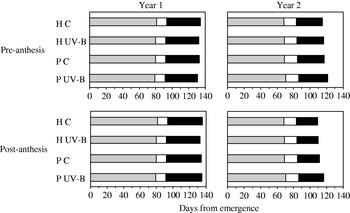
As expected, wheat cultivars showed similar phenology. Anthesis occurred on the same day in both cultivars in Year 1. In Year 2, Huañil reached anthesis one day earlier than Pandora (Fig. 1). The increase of UV-B radiation at pre-anthesis did not affect (P>0·10) the anthesis date in either cultivar (Fig. 1). In addition, physiological maturity was similar both in pre- and post-anthesis UV-B treatments (Fig. 1). During Year 2, a delay of only 3 days was found under increased UV-B radiation in Pandora but no effect was found in Huañil.
Duration of phenological phases after seedling emergence in control (C) and increased ultraviolet-B (UV-B) treatments at pre- and post-anthesis of Huañil (H) and Pandora (P) cultivars in experimental Years 1 and 2. Bars show the length of each developmental phase: SE-Bo (grey bars), Bo-At (white bars) and At-PM (black bars). Abbreviations for phenological stages are: SE (seedling emergence), Bo (booting), At (anthesis) and PM (physiological maturity).

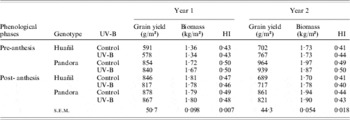
Grain yield was affected by cultivar (P<0·01) and phenological phases of treatments (P<0·01) in both years but grain yield was not modified (P>0·10) by increased UV-B radiation (Table 1). Pandora showed higher grain yield (896 and 860 g/m2 averaged in Years 1 and 2, respectively) than Huañil (719 and 708 g/m2 in Years 1 and 2, respectively). The effect of exposure at different phenological phases (pre- and post-anthesis) showed contrasting results, since lower grain yield was found in pre-anthesis treatments in Year 1 (715 v. 852 g/m2 averaged across cultivars at pre- and post-anthesis, respectively) but the opposite was found in Year 2 (843 v. 772 g/m2 averaged across cultivars at pre- and post-anthesis, respectively). Differences between phenological phases could be ascribed to the source-sink ratios at pre- and post-anthesis resulting from the use of frames.
Grain yield, aboveground biomass and harvest index (HI) of cultivars Huañil and Pandora under control and increased UV-B radiation (UV-B) treatments between the booting-anthesis (pre-anthesis) and between 10 days after anthesis-physiological maturity (post-anthesis) periods in experimental Years 1 and 2. s.e.m.=standard error of the means

As mentioned previously, grain yield was not affected by UV-B radiation (P>0·10) in the present study. This was true for each genotype and both phenological phases in Years 1 and 2 (Table 1). Likewise, no interaction between UV-B and cultivar (P>0·10) or between UV-B and the phenological phase (P>0·10) was found.
As with grain yield, aboveground biomass was not affected (P>0·10) by UV-B radiation (Table 1). In addition, both leaf and stem biomass showed similar values (P>0·10) at increased UV-B and control treatments (data not shown). Cultivar effect on biomass was found in Years 1 (P=0·05) and 2 (P<0·01). Phenological phases affected biomass in Year 1 (P<0·01), while no effect was found in Year 2 (P>0·10).
In addition to grain yield and aboveground biomass, partitioning of biomass at maturity (harvest index) was not affected (P>0·10) by UV-B treatments (Table 1). The treatments' clearest impact on biomass partitioning was associated with cultivar (P<0·01). Throughout the UV-B treatments, Pandora averaged a higher harvest index than Huañil in both years: 0·49 and 0·45, respectively, in Year 1 and 0·47 and 0·41, respectively in Year 2.
Grain yield components
Grain number was the component most strongly associated with grain yield in both years (r=0·99, P<0·01 and r=0·79, P<0·05 in Years 1 and 2, respectively). In contrast, no relationship was found between grain yield and grain weight (r=0·39, P>0·10 and r=0·03, P>0·10 in Years 1 and 2, respectively).
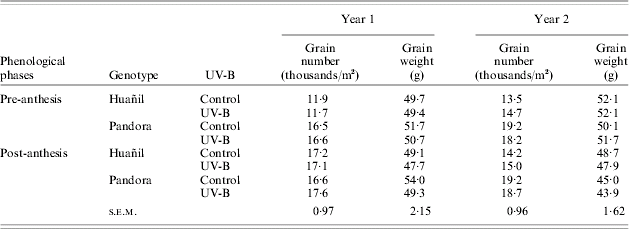
Grain number was affected by genotype in Years 1 (P<0·05) and 2 (P<0·01). Pandora reached a higher grain number in Year 2 (Table 2). In Year 1, this trait was also modified by phenological phases (P<0·01), mainly because of the lower grain number showed by Huañil in pre-anthesis treatments (Table 2). Also, interaction between phenological phases and genotype was significant (P<0·05) in Year 1. Although grain number showed variability in response to genotype and phenological phases, the increase of UV-B radiation did not affect (P>0·10) this trait in either year (Table 2).
Grain number and one thousand grain weight of cultivars Huañil and Pandora under control and increased UV-B radiation (UV-B) treatments between the booting-anthesis (pre-anthesis) and between 10 days after anthesis-physiological maturity (post-anthesis) periods in experimental Years 1 and 2. s.e.m.=standard error of the means
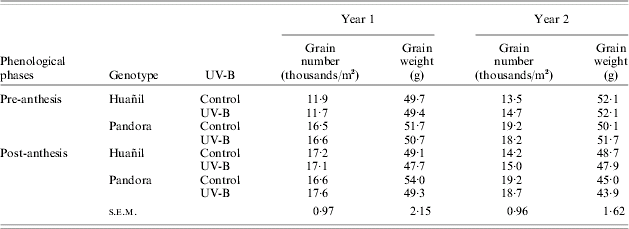
Similarly, UV-B radiation had no effect (P>0·10) on grain weight (Table 2). In addition, cultivars showed similar grain weight values (Table 2). The lower grain weight found in the post-anthesis treatment in Year 2 (7·4 and 12·6% decrease in Huañil and Pandora relative to pre-anthesis treatments, respectively) could be due to the lower source-sink ratio associated with solar radiation intercepted by frames, as was mentioned above for grain yield. This explanation is reinforced by the fact that both increased UV-B and control treatments showed grain weight decrease, while grain number showed no difference (P>0·10) between pre- and post-anthesis in this year.
Grain quality
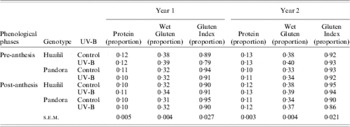
Phenological phase (P<0·05) and cultivar (P<0·01) effects on protein concentration were found in Years 1 and 2, respectively (Table 3). In contrast, increased UV-B radiation at pre- and post-anthesis did not significantly affect this important quality trait of wheat grains (Table 3). The effects of phases and cultivars were almost completely explained by the negative association between protein concentration of grains and grain yield (r=−0·87, P<0·01 and r=−0·91, P<0·01 in Years 1 and 2, respectively). Therefore, the higher the grain yield, the lower the protein concentration of grains.
Protein and dry gluten concentration of grains and gluten index of cultivars Huañil and Pandora under control and enhanced UV-B radiation (UV-B) treatments between the booting-anthesis (pre-anthesis) and between 10 days after anthesis-physiological maturity (post-anthesis) periods in experimental Years 1 and 2. s.e.m.=standard error of the means

As with protein concentration, wet gluten concentration showed no differences between UV-B and control treatments, with the exception of cultivar Pandora at post-anthesis in Year 2, where a higher wet gluten concentration (P<0·05) was found under increased UV-B radiation (Table 3). In addition, it was found that wet gluten levels tended to be higher under increased UV-B radiation in both years (Table 3). A negative association between wet gluten and grain yield was found in Years 1 (r=−0·87; P<0·01) and 2 (r=−0·98; P<0·001). Similar results were found for dry gluten (data not shown).
The gluten index showed that only one out of eight cases evaluated was significantly (P>0·05) affected by increased UV-B radiation. The gluten index of the Huañil cultivar at pre-anthesis was 11% lower under increased UV-B radiation in Year 1 (Table 3). In addition, cultivar and phenological phase had no effect on this trait (Table 3).
DISCUSSION
The present study was aimed at evaluating the effect of increased UV-B radiation at the later stages of the crop cycle on the phenology, grain yield and grain quality of wheat. One of the traits evaluated was the length of phenological phases. Although a significant effect of pre-anthesis UV-B treatment on anthesis date was not expected, because the flag leaf was already expanded when pre-anthesis treatments were set at booting, a delay of anthesis date could be found in response of stem elongation sensitivity to UV-B (Ballaré et al. Reference Ballaré, Scopel, Stapleton and Yanovsky1996). In the present experiment, anthesis date was not modified by UV-B treatments. This result differs from previous reports, which showed that increased UV-B radiation delayed the date of anthesis (Li et al. Reference Li, Yue and Wang1998). The timing at which UV-B treatments were imposed (3-leaf stage in Li et al. (Reference Li, Yue and Wang1998) and booting in the present experiment) might explain the differences between these studies. However, Li et al. (Reference Li, Yue and Wang1998) did not show differences between the duration of grain filling of wheat under increased UV-B and control treatments. The present results agree with the increasingly accepted idea that UV-B radiation has little effect on crop phenology (Kakani et al. Reference Kakani, Reddy, Zhao and Sailaja2003).
Effects of phenological phases on grain yield, biomass and yield components (strongly interacting with genotypes) have been found in the present study. For example, Huañil was more sensitive to the pre-anthesis treatments than Pandora in Year 1 and Pandora was more sensitive to the post-anthesis treatments in Year 2. These effects could be related to the shadowing of frames during the grain number and grain weight determination as the effects were consistently similar in magnitude in both increased and control UV-B treatments (Tables 1 and 2). Despite these interactions, the response (or lack of response) to UV-B radiation of traits associated with grain yield were clear throughout genotypes and years.
Reports of the effect of UV-B radiation on biomass and yield in wheat (Kakani et al. Reference Kakani, Reddy, Zhao and Sailaja2003) and other small grain cereals (Teramura et al. Reference Teramura, Sullivan and Ziska1990; Yue & Wang Reference Yue and Wang1998; Hakala et al. Reference Hakala, Jauhiainen, Hoskela, Kayhko and Vorne2002; Kakani et al. Reference Kakani, Reddy, Zhao and Sailaja2003; Hidema & Kumagai Reference Hidema and Kumagai2006) have been inconsistent. The lack of effect of increased UV-B found in the present study is in agreement with some of them (Teramura et al. Reference Teramura, Sullivan and Ziska1990; Yue & Wang Reference Yue and Wang1998; Hakala et al. Reference Hakala, Jauhiainen, Hoskela, Kayhko and Vorne2002). The fact that biomass was unaffected by UV-B could be due to adaptive biochemical responses involved in UV-B acclimation of plants to protect them from this harmful radiation. Increases of antioxidant compounds such as anthocyanins and phenolic sunscreens (Becwar et al. Reference Becwar, Moore and Burke1982; Tosserams et al. Reference Tosserams, Pais De Sa and Rozema1996, Bornman Reference Bornman and Rozema1999; Day et al. Reference Day, Ruhland, Grobe and Xiong1999) and accumulation of free and bound phenolic compounds such as flavonoids and hydroxycinnamic acid in leaf epidermis have been reported (Sullivan et al. Reference Sullivan, Teramura and Ziska1992; Visser et al. Reference Visser, Tosserams, Groen, Magendans and Rozema1997).
However, the present results differ from the studies carried out by Li et al. (Reference Li, Yue and Wang1998, Reference Li, Zu, Chen, Chen, Yang and Hu2000) where biomass and grain yield of wheat were reduced between 18 and 57% when UV-B radiation was increased between 2·5 and 5·3 kJ/m2 above the environmental UV-B level. It seems probable that the decrease in biomass and grain yield found by Li et al. (Reference Li, Yue and Wang1998) could be due to increased UV-B at early stages of the crop cycle (from the 3-leaf stage to booting) since UV-B increases used in the present study (3·8 and 4·9 kJ/m2 in Years 1 and 2, respectively) are within UV-B range assessed by Li et al. (Reference Li, Yue and Wang1998), i.e. between 2·5 and 5·3 kJ/m2. However, the present results are in agreement with studies where UV-B radiation was supplemented during most of the crop cycle (e.g. Hakala et al. Reference Hakala, Jauhiainen, Hoskela, Kayhko and Vorne2002). In addition, environmental UV-B levels could also be involved in differences between experiments by affecting both control and increased UV-B plants and interactions between UV-B and PAR radiation. Li et al. (Reference Li, Yue and Wang1998) reported environmental UV-B values of 8·8 kJ/m2/day during summer. In the present experiments, these values were 5·5 kJ/m2/day.
Considering the fact that differences among cultivar response to UV-B have been shown in wheat (Li et al. Reference Li, Zu, Chen, Chen, Yang and Hu2000) and rice (Hidema & Kumagai Reference Hidema and Kumagai2006), it is possible that cultivars evaluated in the present study are less sensitive to UV-B radiation than others. Li et al. (Reference Li, Zu, Chen, Chen, Yang and Hu2000) found that 7 out of 20 wheat cultivars did not show a significant biomass decrease when UV-B was increased by 5 kJ/m2. To the best of our knowledge, no studies have been published evaluating wheat sensitivity to UV-B at different phenological phases.
The response of grain yield components to UV-B has been reported less in the literature than that of biomass and yield (see review by Kakani et al. Reference Kakani, Reddy, Zhao and Sailaja2003). However, inconsistent results have been found. For example, Hakala et al. (Reference Hakala, Jauhiainen, Hoskela, Kayhko and Vorne2002) concluded that increased UV-B radiation had no impact on grain number and weight in wheat, barley and oat in an experiment carried out in pots. On the other hand, field experiments have shown grain number and weight decreases in wheat (Li et al. Reference Li, Yue and Wang1998) and rice (Hidema et al. Reference Hidema, Zhang, Yamamoto, Sato and Kumagai2005). Li et al. (Reference Li, Yue and Wang1998) found that grain number was more responsive to UV-B treatments (between 26 and 50% decrease relative to the control) than grain weight (between 10 and 35% decrease relative to the control) when UV-B was increased from 2·5 to 5·3 kJ/m2/day. Although key periods for both grain number and grain weight determination were evaluated in the present study, it was found that UV-B radiation had no effect on these yield components.
Taking into account the fact that crops such as wheat and rice grown under increased UV-B radiation have shown lower chlorophyll content in leaves (e.g. He et al. Reference He, Huang, Chow, Whitecross and Anderson1993; Alexieva et al. Reference Alexieva, Sergiev, Mapelli and Karanov2001), it could be hypothesized that grain quality traits associated with proteins could be affected by UV-B radiation, especially if UV-B is increased during the grain filling period. This hypothesis is supported by data recently reported by Hidema et al. (Reference Hidema, Zhang, Yamamoto, Sato and Kumagai2005), who found higher protein concentration in grains of rice in response to increased UV-B radiation. In the present study, the grain quality of wheat plants was determined by evaluating the protein and gluten concentration of grains and the gluten index, which are commonly accepted as main traits associated with the bread quality of this crop. Although the hypothesis stated above is based on previous reports, it is likely that the increased protein concentration of rice grains found by Hidema et al. (Reference Hidema, Zhang, Yamamoto, Sato and Kumagai2005) was associated with the grain yield decrease due to UV-B effect on that experiment, i.e. UV-B reduced the dilution effect of proteins in dry biomass that is commonly found in cereals (Calderini et al. Reference Calderini, Torres-León and Slafer1995; Stone & Savin Reference Stone, Savin, Satorre and Slafer1999).
The main conclusion from the present work is that the expected increases of UV-B radiation in Southern Chile could not compromise wheat yield, at least, if increases of UV-B radiation are reached at the latter stages of the crop cycle. In addition, very little effect of UV-B radiation on quality traits such as protein and gluten concentration of grains has been found in the present study but gluten concentration seems to be more responsive than other traits. Taking into account the reported variability in sensitivity to UV-B among cultivars, more work is necessary to confirm these results in Southern Chile.
We especially thank Magda Lobnik, Jose Perez, Jorge Perez and Luis Vargas for technical assistance. We are also grateful to the personnel of the Tissue Culture Laboratory for providing facilities to carry out measurements. This work was funded by the Chilean Technical and Scientific Research Council (CONICYT), Project FONDECYT 1040125 competitive grant.