1. INTRODUCTION
High-energy class solid-state lasers with high repetition rates are emerging for worldwide industrial and scientific applications. In order to provide highly efficient laser sources, special care has to be taken with the design of the laser system. In order to increase the output energy of a laser and maintain its repetition rate, many different techniques are used including beam combining methods such as stimulated Brillouin scattering phase conjugate mirrors (Kong et al., Reference Kong, Shin, Yoon and Beak2008; Omatsu et al., Reference Omatsu, Kong, Park, Cha, Yoshida, Tsubakimoto, Fujita, Miyanaga, Nakatsuka, Wang, Lu, Zheng, Zhang, Kalal, Slezak, Ashihara, Yoshino, Hayashi, Tokizane, Okida, Miyamoto, Toyoda, Grabar, Kabir, Oishi, Suzuki, Kannari, Schaefer, Pandiri, Katsuragawa, Wang, Lu, Wang, Zheng, He, Lin, Hasi, Guo, Lu, Fu, Gong, Geng, Sharma, Sharma, Rajput, Bhardwaj, Zhu and Gao2012).
Also, flash lamp pumping which has been used for a long time because of its well-known technology and low price has been gradually replaced by laser diode pumping. Because the emission band of laser diodes is narrow, all their light is used for pumping and the entire optical system is more efficient in comparison with the traditional flash lamp pumped system. The heat generated in the gain medium is still one of the most limiting factors in scaling high-energy class solid-state lasers. Novel techniques have been applied to cool the gain medium efficiently. For example, a thin disk of laser material can be glued to a large heat sink (Giesen & Speiser, Reference Giesen and Speiser2007) or the gas flow is forced between thin slabs (Banerjee et al., Reference Banerjee, Ertel, Mason, Phillips, Siebold, Loeser, Hernandez-Gomez and Collier2012) to remove the heat efficiently. Additionally, the performance of high-energy class lasers is limited by the generation of amplified spontaneous emission (ASE), which is an unavoidable process in any laser system and has been shown to limit drastically the energy stored in an active medium.
The problem of ASE and parasitic oscillations has been extensively described in rod (McMahon, Reference McMahon1974) and disk amplifiers (McMahon et al., Reference McMahon, Emmett, Holzrichter and Trenholme1973; Trenholme, Reference Trenholme1972; Contag et al., Reference Contag, Karszewski, Stewen, Giesen and Hügel1999). Detailed analysis of the parasitic modes propagating in disk-shaped media and active mirrors can be found in Brown et al. (1972).
To suppress the ASE and parasitic oscillations in Nd:YAG disk lasers, solid state cladding (Glaze et al., Reference Glaze, Guch and Trenholme1974), and liquid cladding (Dubé & Boling, Reference Dubé and Boling1974; Guch, Reference Guch1976) have been proposed. Recently, absorption cladding made of Cr:YAG was proposed for Yb:YAG (Ertel et al., Reference Ertel, Banerjee, Mason, Phillips, Siebold, Hernandez-Gomez and Collier2011; Lucianetti et al., Reference Lucianetti, Albach and Chanteloup2011). However, the influence of the Cr:YAG layer on ASE and stored energy has not been investigated in detail.
Goren et al. (Reference Goren, Tzuk, Marcus and Pearl2006) has analytically described the problem of ASE in a slab in one and two dimensions and has presented simulation results for three-dimensional systems. In the paper, the influence of ASE on the spatial distribution of the population inversion (small signal gain) has been shown, but only partially explained. The same problem was investigated in Albach et al. (Reference Albach, Chanteloup and le Touze2009), in which the authors have explained the influence of gain on the spatial distribution of the population inversion.
In this paper, we examine and compare the influence of the slab architecture, pump parameters, and operating temperature on ASE and stored energy. In addition, the influence of the absorption cladding for the suppression of ASE is analyzed in detail.
2. DESCRIPTION OF THE MODEL AND THEORETICAL BACKGROUND
To assess quantitatively ASE and energy storage within a laser active medium in slab and multi-slab geometry, a numerical model has been developed (Sawicka et al., Reference Sawicka, Divoky, Novak, Lucianetti, Rus and Mocek2012). In this paper, the updated simulation program includes new physical features and capabilities intended to improve ASE calculations.
At the beginning of each time step the temperature of the operation is read. The program retrieves spectrally resolved emission and absorption cross-sections from a specially prepared data base. In a second step, fit functions of emission and absorption cross-sections for given temperatures are generated.
Moreover, the laser medium (Yb:YAG) has been modeled as a three-level system. Based on the temperature, the population of the ground state, the lower laser level, and the upper laser level are calculated from the Boltzmann statistics. Reabsorption of the ASE photons is included in the simulations.
In the new version of the program, scattering functions or Fresnel losses can be included at the edges of the absorptive layer. Photons that were not absorbed in the cladding can propagate to the side edge of it and then, the angle of incidence of these photons is randomly generated. The probability of reflection is calculated from the Fresnel equations. A random number is generated for each ray and, if the number is higher than the probability of reflection, the ray undergoes reflection. If the number is lower than that probability, the ray is transmitted through the wall. If photons are reflected back, they pass through the absorptive layer again and, if they are not absorbed, they can propagate back to the gain medium and decrease the stored energy.
Moreover, if the gain of ASE photons overcomes the reflection losses, the paths of amplified photons will be closed and parasitic oscillations will occur.
Depending on the active medium architecture and storage energy distribution, different types of parasitic modes can propagate in the gain medium. Modes that are typical for disk-shaped media (circular geometry) were extensively discussed (McMahon, Reference McMahon1974; Trenholme, Reference Trenholme1972; Contag et al., Reference Contag, Karszewski, Stewen, Giesen and Hügel1999; Brown, Reference Brown1973; Soures et al., Reference Soures, Goldman and Lubin1973).
Here, we briefly summarize the parasitic modes that might occur and influence ASE losses in laser slabs.
2.1. Bulk Modes
Lossless bulk modes might occur in the slab-shaped media if all reflections are generated by the total internal reflection. To fulfill this condition, the angle of incidence on the face walls θ and the angle of incidence on the side walls Φ should be higher than the critical angles:
 $${\rm \theta}\gt {\rm \theta} _c=\arcsin \left({\displaystyle{{n_1 } \over {n_2 }}} \right)\comma \; \Phi\gt \Phi _c=\arcsin \left({\displaystyle{{n_3 } \over {n_2 }}} \right)\comma$$
where n 1 is the refractive index of the surrounding material (air, for example), n 2 is the disk refractive index, and n 3 is the refractive index of the cladding.
If a slab is coated with an absorptive layer that prevents total internal reflections at the edges, the propagation of the lossless bulk modes is no longer possible. However, the slab faces are typically in contact with air and as long as θ > θc, the Lossless bulk modes might propagate inside the gain medium. The condition for propagation of the Lossless bulk modes was derived by Trenholme (Reference Trenholme1972) for disk architecture:
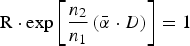 $${\rm R} \cdot {\rm exp}\left[{\displaystyle{{n_2 } \over {n_1 }}\left({\bar {\rm \alpha} \cdot D} \right)} \right]=1$$
where R is the maximal Fresnel coefficient at the edges of a crystal and R < 1, n 2 is the refractive index of a disk, n 1 is the refractive index of a surrounding material (air), ᾱ is the average gain coefficient, and D is the transverse size of the slab (Fig. 1a).
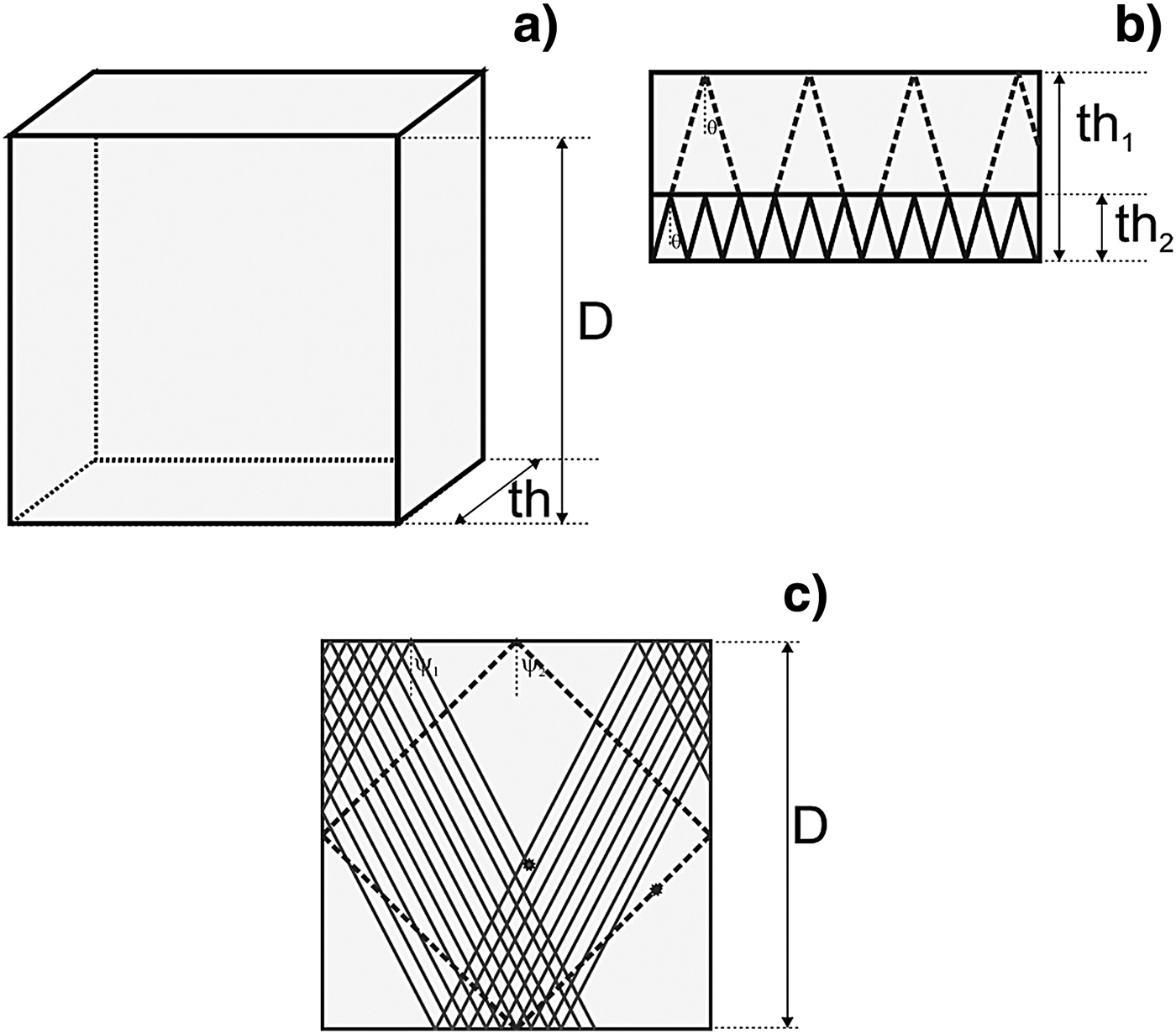
Slab geometry: 3D view (a), side view for two different thicknesses th 1 and th 2 (b), front view (c) with indicated paths of some ASE photons.

In the best case, when the side walls of the slab are clad with the index matched material, R → 0 and the maximal stored energy is obtained.
It can be easily calculated that the path of spontaneously emitted photons in the gain medium does not depend on the thickness of the slab (the path for both slab thicknesses th1 and th2 is the same), but depends on the angle of incidence (Fig. 1b). Therefore, the total ASE losses caused by the lossless bulk modes will not depend on the thickness of the slab. However, for Lossless bulk modes, a fraction of ASE radiation escapes the gain medium when photons are reflected at the surface. The thinner the slab, the more often radiation is partially reflected inside the gain medium and thus, the number of photons travelling through the gain medium is reduced. Therefore, overall ASE losses depend on the thickness.
2.2 Ring Modes
Modes that were described as ring modes in a disk geometry arise in a bare crystal or in a crystal with refractive index higher than the index of cladding n 2 > n 3. These modes propagate parallel to the faces of disk and do not depend on n 1. In disk-shaped geometry, it is possible to calculate the radius R of the non-depleted region, the volume of the mode and the non-depleted fraction of the disk, which all depends on the n 3/n 2 ratio (Brown, Reference Brown, Jacobs and Nee1978). However, the behavior of the ring modes in a slab (rectangular geometries) is different (Fig. 1c).
Parasitic modes in a slab gain medium occur because of the same total internal reflection as in case of a disk-shaped media. However, the paths of the photons depend on the slab geometry and on the place where the photons are generated. Therefore, it is not possible to predict the non-depleted volume of the slab from the n 3/n 2 ratio.
A ring mode in a slab-shaped medium might turn into face mode propagating along the slab diagonal after a few bounces between the slab edges.
2.3. Face Modes
The most popular method for pumping slabs in high-energy diode-pumped solid-state lasers is face pumping. If doping concentration of active ions in laser slabs is high, the population inversion distribution can be highly inhomogeneous and the gain near surface might greatly exceed the average gain in the slab. Therefore, face modes bouncing between face surfaces might occur in the slab earlier than in the bulk modes.
The threshold condition for face mode propagation was derived by Brown (Reference Brown1973):
 $${\rm R}_{\rm N} \cdot {\rm exp}\left({{\rm \alpha} _S \cdot D} \right)=1\comma$$
where R N is the normal reflection coefficient at the slab edge, αS is the gain at the slab surface, and D is the square of the slab.
The condition for the surface mode to predominate over the bulk mode can be found in Brown (Reference Brown, Jacobs and Nee1978):
 $${\rm \alpha} _S \cdot D\gt \displaystyle{{n_2 } \over {n_1 }}\left({\bar {\rm \alpha} \cdot D} \right)+\ln \left({\displaystyle{R \over {R_N }}} \right).$$
2.4. Transverse Modes
The transverse modes that oscillate between the faces of a slab can occur if the transverse gain is sufficiently high and other types of modes are suppressed.
The threshold condition for the transverse mode is (Brown, Reference Brown, Jacobs and Nee1978).
 $${\rm R}_{\rm T} \cdot {\rm exp}\left({\bar {\rm \alpha} \cdot th} \right)=1\comma$$
where R T is the reflection coefficient of the slab faces, ᾱ is the transverse gain, and th is the slab thickness.
In the next section, the model was used to show the influence of different slab parameters on ASE radiation and energy storage capabilities.
3. RESULTS
3.1. Slab Dimensions and Pump Parameters
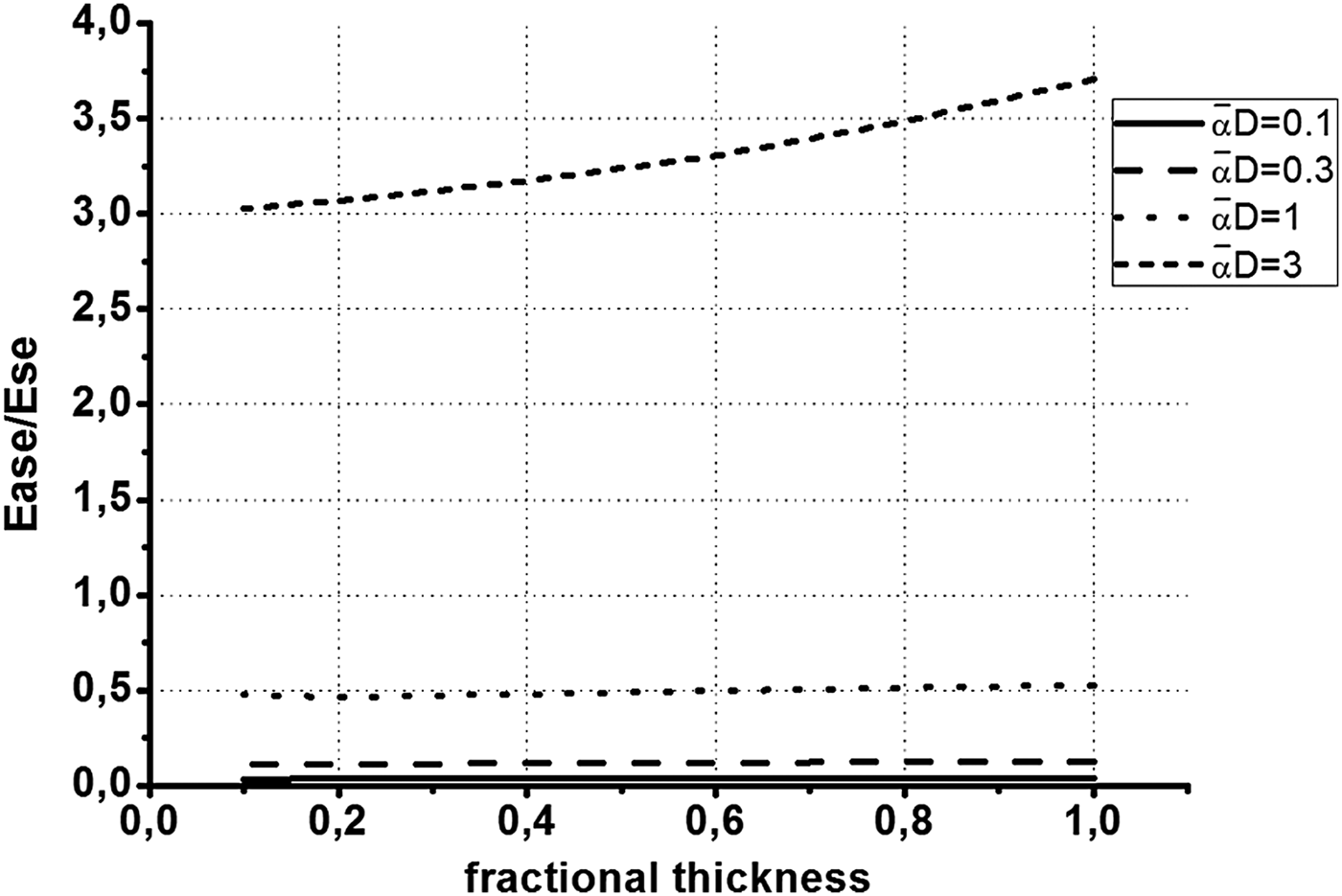
The influence of the slab thickness on parasitic bulk modes was described in Section 2.1. In order to find those modes that are dominant in a laser slab, the ASE radiation was modeled in a Yb:YAG laser crystal with constant small gain coefficient. Figure 2 shows the ratio of ASE energy to SE as a function of the fractional thickness (the ratio of the slab thickness to its transverse size) for four different ᾱD coefficients. When ᾱD is low, the increase of A = E ASE/E SE is very slow, which corresponds to the presence of lossless bulk modes. However, for higher gain values (ᾱD = 3), the ASE/SE ratio strongly depends on the thickness of the slab, and the increase is more pronounced for thicker slabs.
Ratio of the amplified spontaneous emission to the spontaneous emission as a function of the fractional thickness.
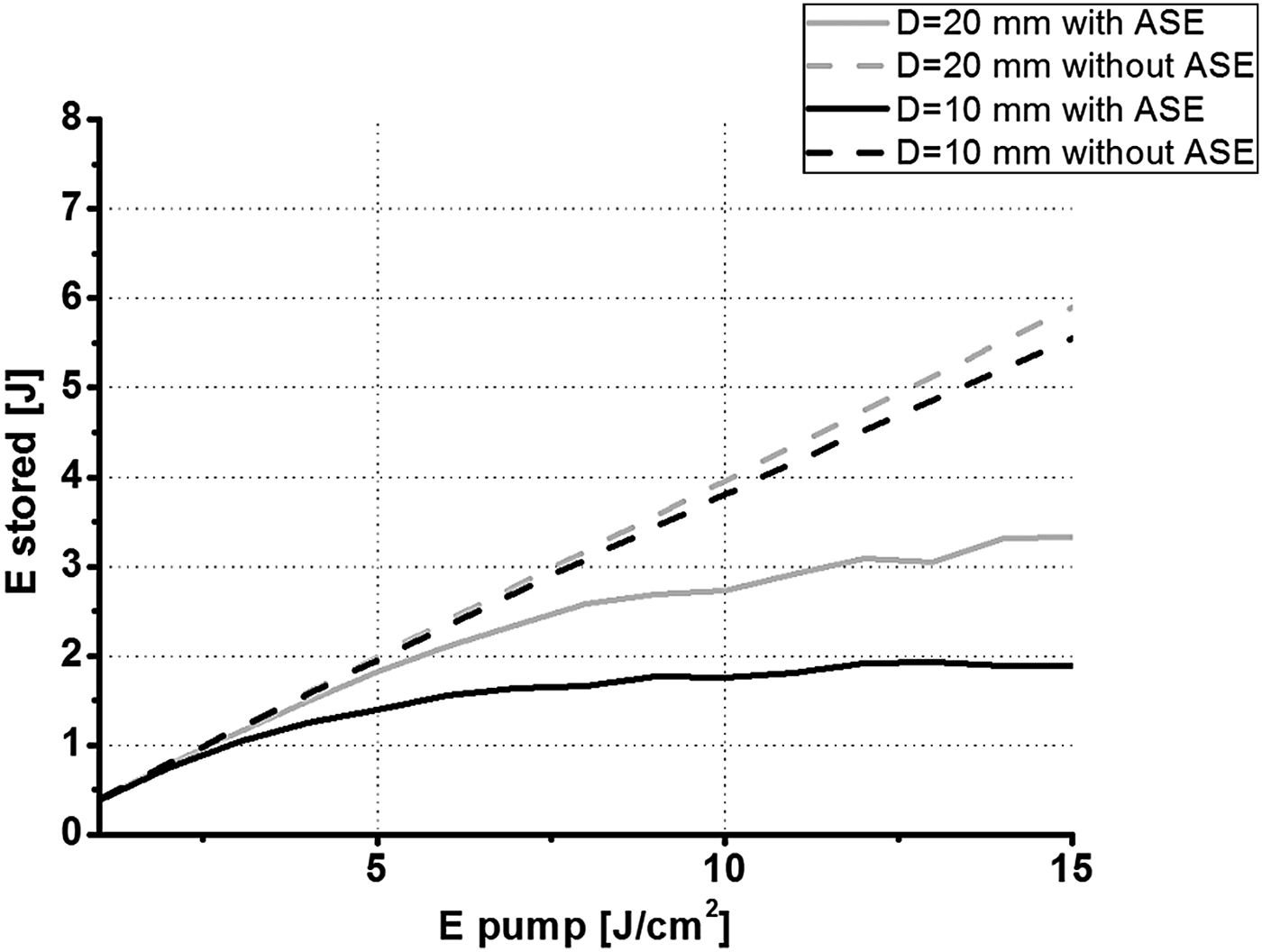
To determine the critical value of ᾱD for which parasitic oscillations might occur, we have simulated two Yb:YAG slabs with apertures of 10 × 10 mm and 20 × 20 mm and a thickness of 10 mm. We estimated that the mean reflection coefficient for the roughened surface is 0.5. Thus, in both cases, the slabs edges were assumed to have reflectivity of 50%. The concentration of Yb3+ ions was 0.4 at. %. The slabs were pumped from both sides by a polychromatic pump source with pulse duration of 1 ms. The pump fluence was varied from 1 J/cm2 to 20 J/cm2. The reflection probability at the slabs faces was calculated from the Fresnel equations. The stored energy as a function of pump energy is shown in Figure 3. Amplified spontaneous emission was allowed to be included (straight lines) or not (dashed lines).
Stored energy as a function of pump energy for different slab sizes.
If the amplification of spontaneously emitted photons is low (without ASE), an increase of the pump energy will cause a linear increase of the storage energy in the gain medium. However, if the small signal gain is significant (with ASE), then the increase of stored energy will be much smaller for the same change of pump energy.
The maximal stored energy obtained in the simulations allowed a conclusion that the parasitic oscillations will occur for ᾱD > 0.85, which agrees well with Eq. (3).
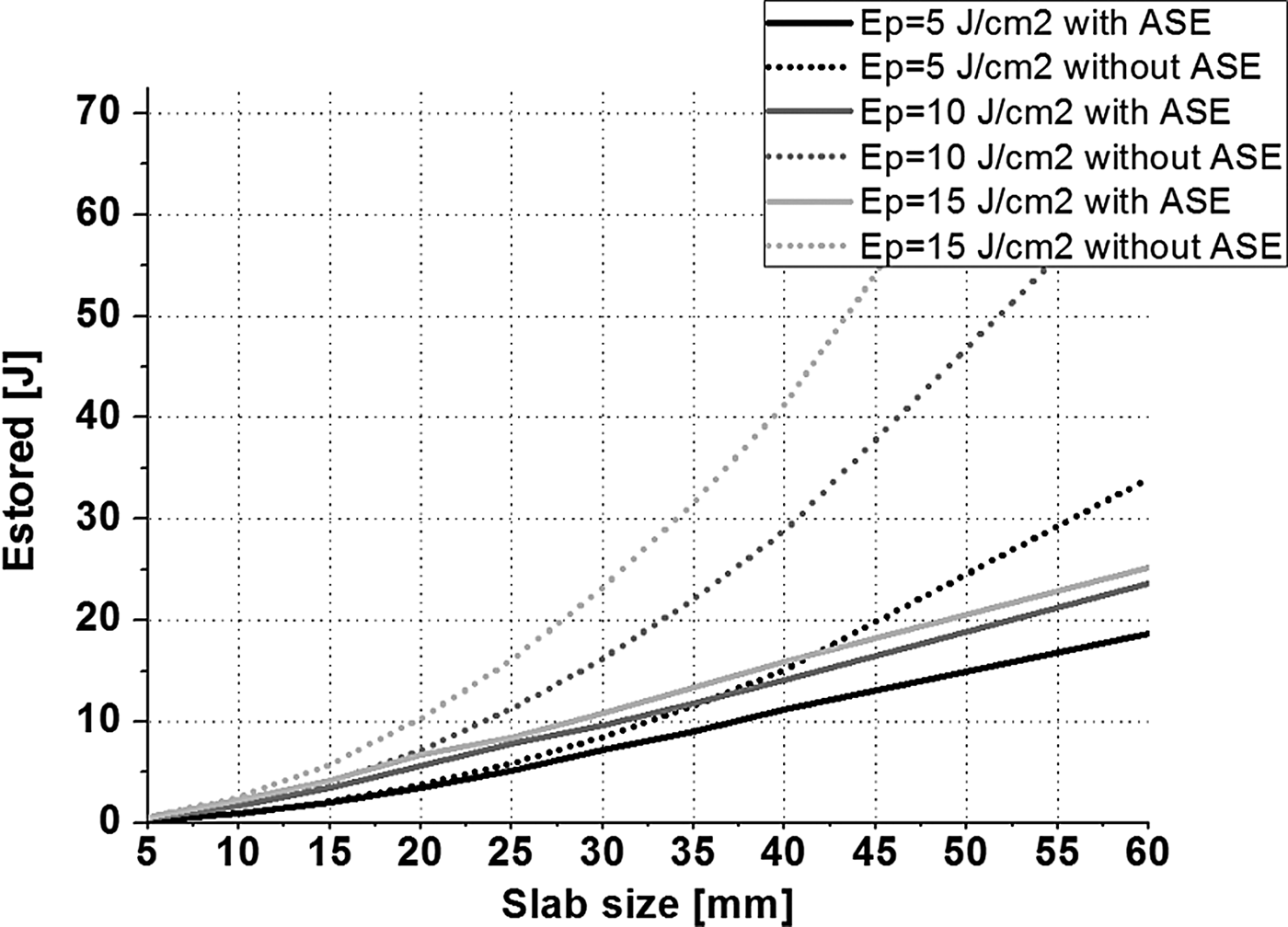
In order to extend the obtained results, we have calculated the stored energy as a function of slab aperture size for three different pump fluences of 5 J/cm2, 10 J/cm2, and 15 J/cm2 (Fig. 4). Thickness of a slab was 10 mm and doping concentration of active ions was 0.4 at. %. The reflectivity of slab side walls was 50%. If ASE radiation is not taken into account, the energy storage increases significantly for larger slab apertures and pump fluences. However, if amplification of SE photons is included, then the energy storage is severely limited in the case of large apertures due to the longer beam paths of the photons. Note that the significant drop in energy storage corresponds to the same level of ᾱD > 0.85, as was calculated in Figure 3.
Stored energy as a function of slab size for different pump energies.
Our results confirmed that the ASE also has an impact on the spatial distribution of the population inversion (Sawicka et al., Reference Sawicka, Divoky, Novak, Lucianetti, Rus and Mocek2012). Depending on the aspect ratio of the slab, the maximal population inversion density is located in the central part or in the peripheries of the slab, as shown in Goren et al. (Reference Goren, Tzuk, Marcus and Pearl2006).
3.2. Reflections on the Edges and Faces of a Slab
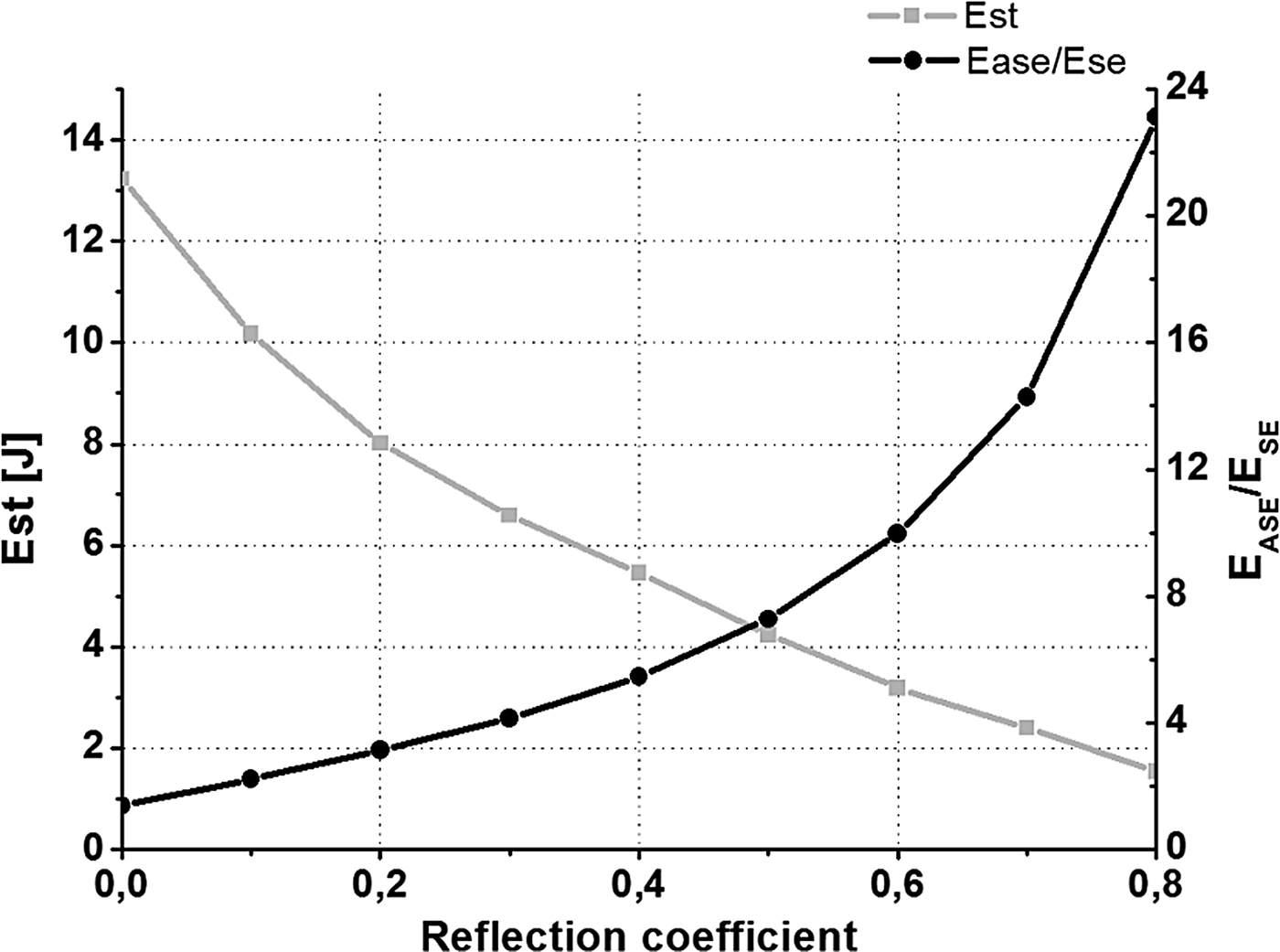
Reflectivity of faces and edges of slabs has a great impact on the onset of parasitic oscillations, as can be seen in Eqs. (2), (3), and (5). In order to see the influence of the edges reflectivity on ASE losses, we have simulated a Yb:YAG slab with thickness of 5 mm and aperture size of 20 × 20 mm. The concentration of active ions was 8 at. % and the slab was pumped from both sides by a total pump fluence 10 J/cm2 with 1 ms pulse. Depending on different index matching liquids, the reflectivity of the roughened edges varied between 0.8 and 0. The results are shown in Figure 5. When the side walls of the slab are assumed to be totally absorptive (R = 0), the stored energy is more than six times higher than in case of R = 0.8. The amplification of spontaneous emission is higher for higher values of edge reflectivity and it can reach an E ASE/E SE value of 23 for R = 0.8.
Stored energy and ASE/SE ratio for different side wall reflectivities of slab.
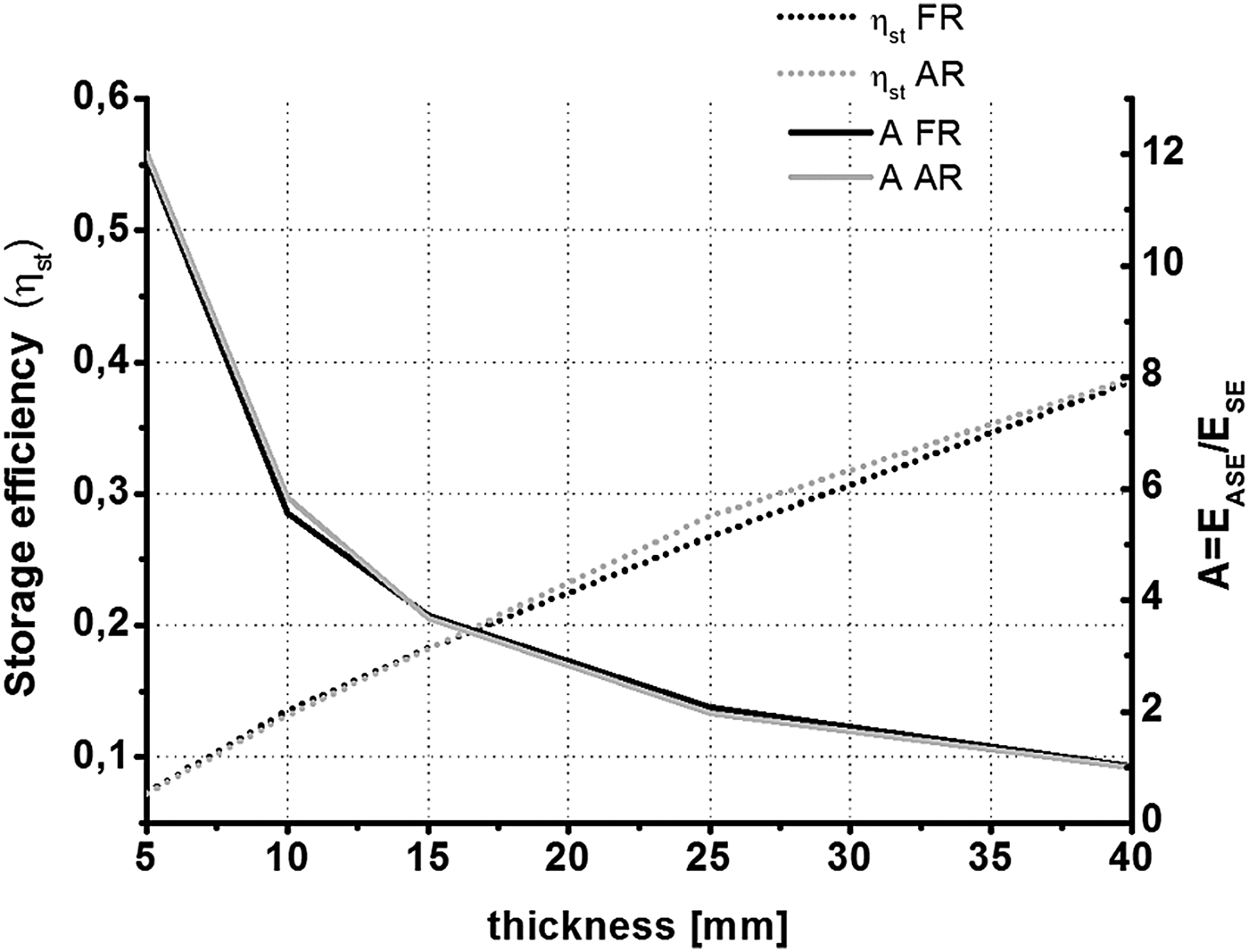
The influence of the faces reflectivity on the ASE losses has been investigated in detail. In order to show the impact of ASE on the energy storage, the thickness was varied over a broad range between 5 and 40 mm (Fig. 6). We have modeled a Yb:YAG slab with an aperture of 50 × 50 mm, which was pumped from both sides by a total fluence of 10 J/cm2 for a duration of 1 ms. The concentration was changed from 2 at. % to 0.25 at. % to keep the absorption coefficient at the same level; the reflection coefficient at the roughened edges was 0.5.
Storage efficiency and ASE/SE ratio for slabs coated with AR layer and without it.
The reflection values on the polished faces were calculated for two different cases. In the first case, the probability of reflection was simply calculated from the Fresnel equations. In the other case, the reflection probability was given for a specially designed anti-reflection coating with R ~ 0 for angles lower than the critical angle, and the results are summarized in Figure 6.
We have found no significant difference in energy storage efficiency and ratio of ASE to spontaneous emission for both cases. Therefore, it can be concluded that transverse parasitic modes will not occur in these low doped gain media; thus, having no impact on the overall ASE losses.
The impact of ASE cannot be completely avoided, but it is possible to suppress the losses it causes. To prevent the generation of photons oscillating inside of the gain medium, index-matching materials are commonly used as absorptive claddings (Dubé & Boling, Reference Dubé and Boling1974; Guch, Reference Guch1976).
In order to investigate how the absorptive layer affects ASE losses and the energy storage efficiency, we have simulated a one slab amplifier head. The aperture of the gain medium was 50 × 50 mm and the thickness was 10 mm. The doping concentration was 5 at. %. The slab was clad with 10 mm of Cr:YAG with the absorption coefficient α = 1.13 cm−1. The head was pumped from both sides by a polychromatic pump source with the central wavelength at 938 nm and full width at half maximum of 6 nm. Pump pulse duration was 1 ms and the total pump energy fluence was 10 J/cm2.
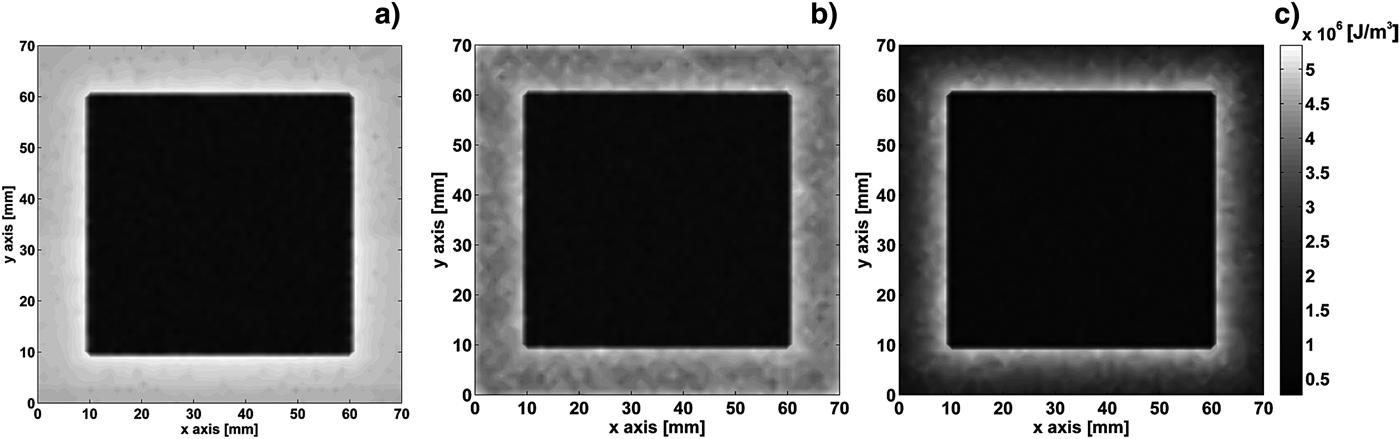
Figure 7 shows the heat distribution for three different treatments of the Cr:YAG edges. First, we have modeled the absorptive layer with edges that reflect incoming photons with the probability proportional to Fresnel losses (Fig. 7a). A large number of photons will propagate through the gain medium more than once. These photons will be amplified, which decreases the stored energy. Because the photon flux of ASE radiation is high, Cr:YAG is saturated and only a small fraction of radiation is absorbed. The remaining radiation will be trapped in the crystal leading to a decrease of the stored energy. We have calculated that the amplification of spontaneously emitted photons is higher than 10, and the corresponding storage efficiency is 0.06.
Transverse heat distributions of the slab amplifiers and absorptive layer with Fresnel losses (a), scattering (b), and total absorption (c) at the edges.
In the second case, the surface of the Cr:YAG edges is roughened and will randomly scatter the photons (Fig. 7b). By introducing the scattering, the probability that photons will be reflected back to the gain medium is slightly reduced in comparison with the Fresnel losses, and the calculated amplification of SE photons is four. The storage efficiency is slightly increased to 0.2.
In the third case (Fig. 7c), we assume that the edges are blackened and that the radiation will be totally absorbed. Due to the absorption, the ASE is minimized and the ratio of ASE photons to SE photons is only 2.5.
We have conducted a similar investigation for a 100 J laser amplifier head designed for the HiLASE project. The head consists of eight Yb:YAG slabs each 8-mm thick. The aperture of the gain medium is 60 × 60 mm. The doping concentration varies along the amplifier head in order to produce a homogeneous distribution of population inversion (Sawicka et al., Reference Sawicka, Divoky, Novak, Lucianetti, Rus and Mocek2012). Slabs are clad with 30 mm of Cr:YAG having an absorption coefficient α = 0.38 cm−1. The head is pumped from both sides by a polychromatic pump source with the central wavelength of 938 nm and full width at half maximum of 6 nm. Pump pulse duration is 1 ms and the total pump energy fluence is 10 J/cm2.
Because the absorption of the Cr:YAG cladding is high and ASE is low, almost all the ASE radiation is absorbed after a double pass through the cladding, and the treatment of the Cr:YAG surface does not affect the energy storage efficiency and ASE. We have calculated that ηst is 0.53 for all three different surface treatments, and that the ratio between ASE and SE photons is less than 0.3.
3.3. Temperature
To investigate the influence of temperature on the overall ASE losses, a 5-mm-thick slab with aperture size of 20 × 20 mm was modeled. The concentration of active ions was 2 at. % and the slab was pumped from both sides by a polychromatic diode source with total pump fluence of 5 J/cm2. The edges of the slab were assumed to be partially reflective (R = 0.5) and the faces of the slab were coated with an anti-reflection layer having R = 1 for θ > θc and R = 0 for θ < θc. No clad edges were included. Simulations were performed for temperatures in the range between 140 and 300 K.
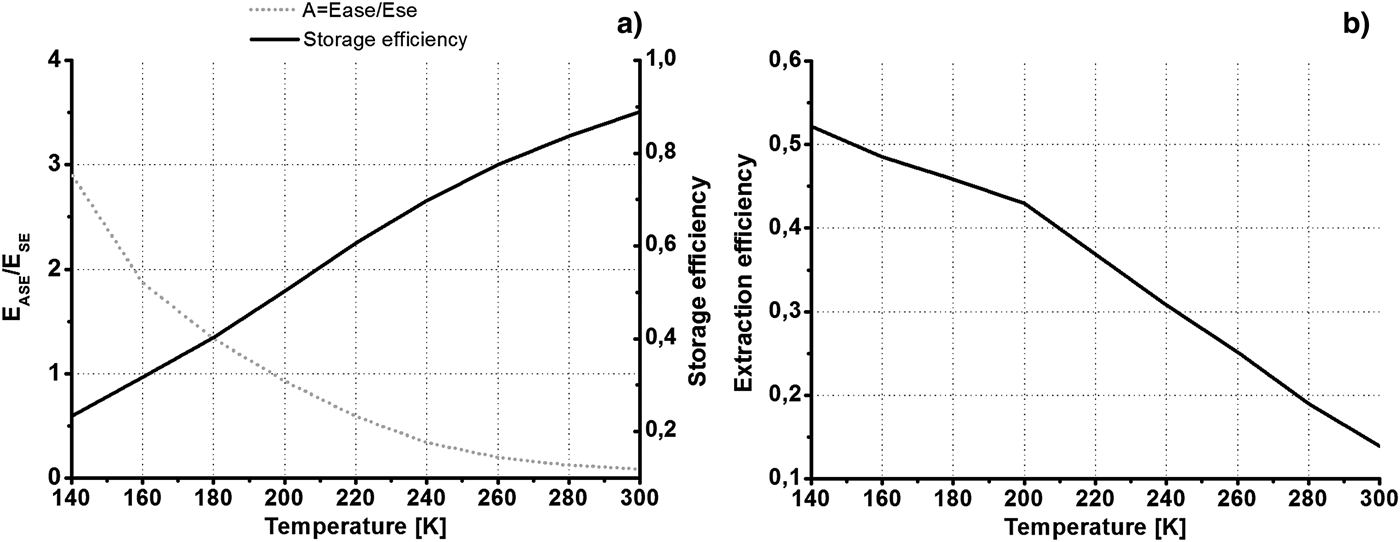
Yb:YAG is a quasi-three-level system that can act as a four-level system when cooled down to cryogenic temperatures. Thermal population at the lower laser level is 4% at 160 K and it will rise by a factor of 100 at 300 K. If there is any population at the lower laser level, reabsorption of spontaneously emitted photons will occur, which reduces the total ASE losses. Temperature dependence of the absorption and emission cross-section will also influence the ASE losses. The emission cross-section decreases with increasing temperature (Koerner et al., Reference Koerner, Vorholt, Liebetrau, Kahle, Kloepfel, Seifert, Hein and Kaluza2012) and the correspondingly small gain coefficient is lower. For higher temperatures, spontaneously emitted photons will be amplified less resulting in higher storage efficiency and a lower ASE to SE ratio (Fig. 8a). Decreased emission cross-section and higher reabsorption will decrease the energy extraction efficiency for higher temperatures. Figure 8b shows the extraction efficiency as a function of temperature in the range between 140 and 300 K. An amplification process has been performed using a 20 × 20-mm slab with input beam energy of 1.25 J/m2 and eight passes through the slab. It can be seen that although the energy stored in the amplifier at 300 K was relatively high, only a small fraction was used for the amplification. The rest of the energy was converted into heat. For 140 K, the energy stored in the amplifier was lower, but the extraction efficiency was 0.52 (about 3.5 times higher than for 300 K).
Temperature dependence of the ASE/SE ratio, storage efficiency (a) and extraction efficiency (b).
3.4. Multi-Slab Configuration
To see the influence of single- and multi-slab configurations, two different laser amplifier heads were simulated. The first laser head consisted of a single 25-mm-thick slab with an aperture size of 50 × 50 mm and Yb3+ ion concentration of 2 at. %. The second laser head consisted of five 5-mm-thick slabs with an aperture of 50 × 50 mm and constant doping concentration of 2 at. %. In both cases, the slabs were pumped from both sides with the total pump fluence of 15 J/cm2. Reflectivity of the edges of the slabs was assumed to be 50% and the faces of the slabs were modeled with the reflection probability calculated from the Fresnel equations.
The results of the simulations showed that the storage efficiency is slightly decreased in the case of five slabs (ηST = 0.10) compared with the case of the single slab (ηST = 0.11).
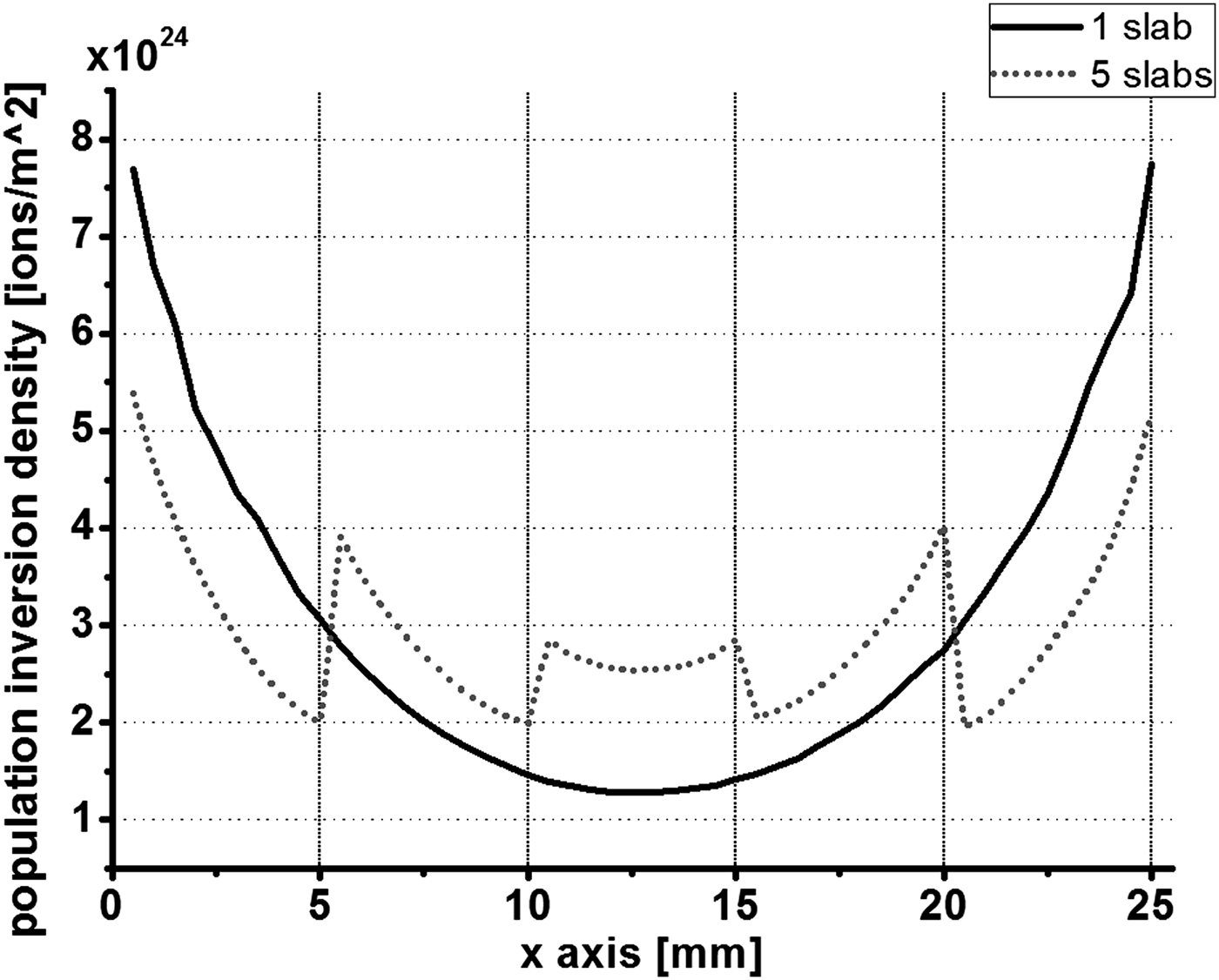
The longitudinal population inversion density of the two configurations is shown in Figure 9. It can be seen that the distribution of population inversion (and gain) for five slabs is more homogeneous than that for the single slab. After the pumping process, the population inversion is very similar in both cases and the maximal values are located in the peripheries of the laser heads. When spontaneous emission radiation is generated, the probability of the generation of photons is proportional to the population inversion. This means that the highest probability that the photon will be irradiated is located at the peripheries of the slab.
Longitudinal distribution of population inversion density for one-slab and multi-slab architecture.
It was calculated that only 1.5% of photons will be radiated out of the single slab due to the reflections at the edges and Fresnel losses at the faces of the slabs. In the case of the single-slab laser head, the longitudinal distribution of the population inversion density is not affected, because photons can propagate through the whole slab and will deplete the slab with the same probability in each place.
However, in the case of the five slab laser head, the photons will be generated inside the peripheral slab with a greater probability than in the central slab of the head. Moreover, the radiation that stays trapped inside the slab will depopulate only this particular slab and will not affect the rest of the laser head. The result will be a lower population density in the peripheral part of the head and a higher population density in the center compared with the case of the one slab laser head.
3.5. Spectral Evolution of ASE
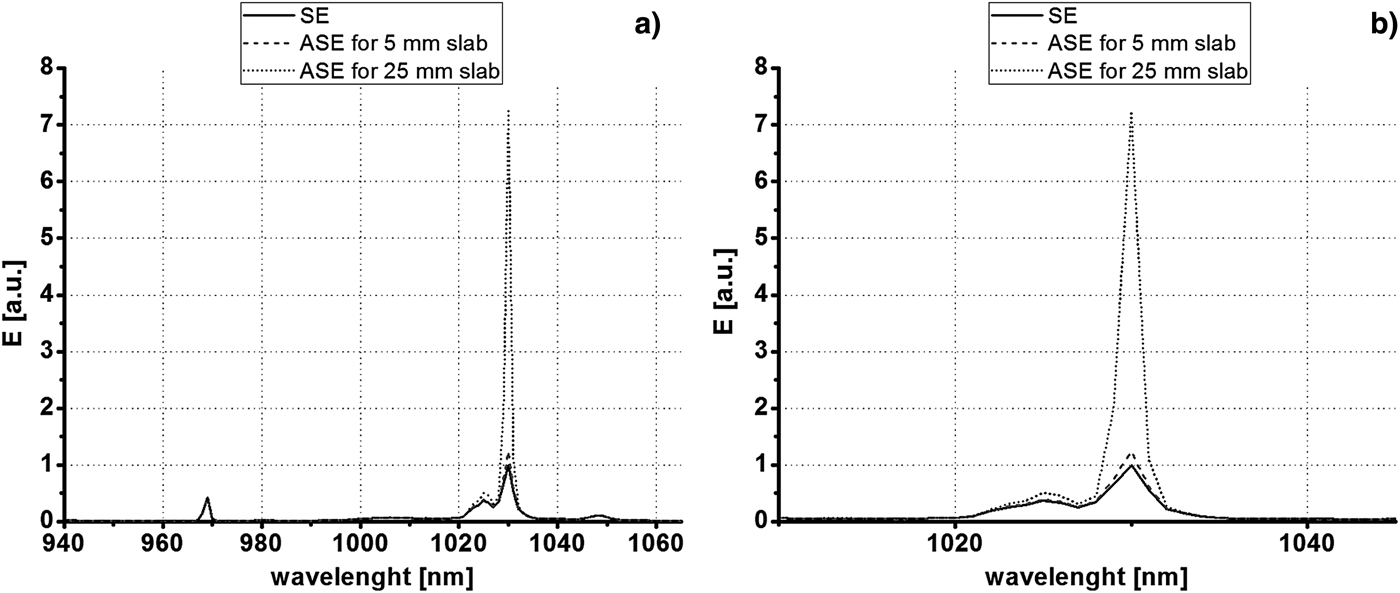
As was shown in Section 3.3, the emission and absorption cross-sections have a great influence on the amplification of spontaneous radiation. The wavelength dependence of these two material properties will result in the narrowing of the ASE spectrum. Rays with wavelengths at which the emission cross-section is high and the absorption cross-section is relatively low (reabsorption) will be amplified more than the rest of the rays in the spectrum. Figure 10 shows the spontaneous and the amplified spontaneous emission energies in the wavelength range between 920 and 1060 nm. The higher the ratio of amplified to spontaneous emission, the bigger is the attenuation of the rest of the spectrum compared with the main peak. It can be seen in Figure 10 that for a smaller slab size of 5 mm, the amplification of the main peak at 1030 nm is 1.2. The level of ASE is higher all over the spectrum in the case of a larger slab diameter of 25 mm, and the main emission peak at 1030 nm is amplified by a factor of ~7, whereas the peak at 969 nm is only slightly amplified by less than 0.5. If no amplification of the spontaneously emitted photons occurs, then the ratio between the two emission peaks in the spectrum is roughly 2.4, and the ratio increases to 14.5 in the 25-mm slab.
Evolution of ASE spectrum for slab sizes of 5 mm and 25 mm (a), zoomed in wavelength range from 1010 to 1045 nm (b).
4. CONCLUSIONS
Amplified spontaneous emission is a harmful and unavoidable process in every solid-state laser system. For that reason, special care should be taken when designing slab and multi-slab amplifiers. In this paper, we have investigated the most important parameters affecting ASE and their influence on the overall performance of the amplifier. In particular, we have investigated how the parasitic modes propagating in a slab-shaped gain media depend on the pumping conditions, slab geometry, and slab face and edge reflectivities.
We have shown that the higher the temperature of operation, the higher the energy stored in the gain medium. However, for higher temperatures, the energy extraction efficiency drops significantly.
We have confirmed that in order to suppress parasitic oscillations and to reduce the influence of ASE on storage efficiency, the elimination of all multiple reflections within the slab is necessary. Finally, we have shown that absorptive layers can significantly increase the storage efficiency. Further improvement of storage efficiency could be obtained by additional treatment of clad edges.
ACKNOWLEDGMENTS
This work benefitted from the support of the Czech Republic's Ministry of Education, Youth and Sports to the HiLASE (CZ.1.05/2.1.00/01.0027) and DPSSLasers (CZ.1.07/2.3.00/20.0143) projects co-financed from the European Regional Development Fund. This research has been supported by the grant RVO 68407700.