INTRODUCTION
Radiocarbon (14C) dating is widely used to constrain timing of deposition of sediment, peats, swamp material and other terrestrial archives. Applications include paleoclimate reconstructions (Vandergoes et al. Reference Vandergoes, Newnham, Denton, Blaauw and Barrell2013b, Reference Vandergoes, Howarth, Dunbar, Turnbull, Roop, Levy, Li, Prior, Norris and Keller2018), past earthquake and tsunami events (Clark et al. Reference Clark, Hayward, Cochran, Wallace, Power and Sabaa2015; Howarth et al. Reference Howarth, Fitzsimons, Norris, Langridge and Vandergoes2016; Cochran et al. Reference Cochran, Clark, Howarth, Biasi, Langridge, Villamor, Berryman and Vandergoes2017) and archaeology (McWethy et al. Reference McWethy, Whitlock, Wimshurst, McGlone, Fromont, Li and Dieffenbacher-Krall2010; Maxwell et al. Reference Maxwell, Howarth, Vandergoes, Jacobsen and Barber2016).
Terrestrial macrofossils are usually considered the most reliable targets for 14C dating in these terrestrial environments (Olsson Reference Olsson1986; Taylor Reference Taylor1987; Oldfield et al. Reference Oldfield, Crooks, Harkness and Petterson1997). Terrestrial macrofossils such as leaves and small twigs take their carbon from the atmosphere and are not subject to any hard-water or other lake reservoir effects. Being fragile, they are unlikely to survive reworking intact. They are often identifiable by species or genus, further ensuring that they are appropriate dating targets for a particular environment. Yet because they are fragile, only small fragments of such macrofossils are usually available, and they are easily damaged during coring, core sampling, and 14C pretreatment.
Improvements in the ability to measure smaller samples at many 14C laboratories have expanded possibilities for dating small, fragile terrestrial macrofossils. Yet measurement of small samples usually requires preparation of additional standards and processing blanks (Santos et al. Reference Santos, Southon, Griffin, Beaupre and Druffel2007) and typically results in higher measurement uncertainties and possible biases. Thus, larger samples are generally preferable if possible.
Pretreatment is required to remove contaminating material and isolate the original macrofossil material. Acid-alkali-acid (AAA), sometimes called acid-base-acid (ABA), pretreatment is commonly used to pretreat terrestrial macrofossils. The method was developed in the early days of 14C dating and is widely believed to be sufficient to remove contaminating material (De Vries and Barendsen Reference De Vries and Barendsen1954; Olsson Reference Olsson1976; Taylor Reference Taylor1987). AAA starts with an acid wash intended to remove carbonates as well as acid soluble humic material such as fulvic acids. This is followed by alkali wash(es) to remove humic acids. The final acid wash is primarily aimed at removing any carbon absorbed into the solution and onto the sample during the alkali washes.
While AAA is very commonly used, there is a wide variation in how AAA pretreatment is applied, and surprisingly little literature documenting why the particular choices have been made. Most laboratories use hydrochloric acid (HCl) at molarities of 0.5–1 M, and sodium hydroxide (NaOH) at molarities of 0.1–0.5 M, although a few use stronger solutions and a potassium hydroxide (KOH) is occasionally used in place of NaOH. Most laboratories heat each solution to 80 or 90°C, although some use room temperature, and the duration of each step also varies widely from 15 min to several hours (Andree et al. Reference Andree, Oeschger, Siegenthaler, Riesen, Moell, Ammann and Tobolski1986; Tornqvist et al. Reference Tornqvist, Jong, Oosterbaan and Borg1992; Bradley and Stafford Reference Bradley and Stafford1994; Kitigawa et al. Reference Kitigawa, Fukuzawa, Nakamura, Okamura, Takemura, Hayashida and Yasuda1995; Kretschmer et al. Reference Kretschmer, Anton, Bergmann, Finckh, Kowalzik, Klein, Leigart, Merz, Morgenroth and Piringer1997; Hajdas et al. Reference Hajdas, Bonani, Zolitschka, Brauer and Negendank1998; Brock et al. Reference Brock, Higham, Ditchfield and Ramsey2010; Dunbar et al. Reference Dunbar, Cook, Naysmith, Tripney and Xu2016; Crann et al. Reference Crann, Murseli, St-Jean, Zhao, Clark and Kieser2017; Knowles et al. Reference Knowles, Monaghan and Evershed2019). Some repeat the alkali wash several times, often using the color of the supernatant liquid to determine how many washes to perform. Many laboratories (including our own) use less rigorous pretreatment for fragile or small macrofossils (< 5 mg), typically using shorter duration washes at lower temperatures, and sometimes omitting the alkali step altogether. Yet these less rigorous pretreatments appear to be applied based on expert opinion and there is little information on whether they are sufficient to remove contamination. One study (Santos and Ormsby Reference Santos and Ormsby2013) investigated the effect of several different AAA procedures and showed that room temperature or short duration pretreatment may not be sufficient for very old wood samples, whereas another study showed that AAA is most often sufficient to remove contamination even in very old wood samples (Hajdas et al. Reference Hajdas, Hendriks, Fontana and Monegato2017). However, both of these experiments were limited to testing the effectiveness of AAA on very old wood samples.
This paper aims to determine the rigor of AAA pretreatment required for terrestrial plant macrofossils to ensure removal of contamination, while retaining as much sample material as possible. We aim to understand whether the less rigorous pretreatments commonly applied to small or fragile macrofossils are sufficient to remove contamination and provide reliable ages. We test a series of samples collected from lake sediments and swamps representing the range of environments of interest for 14C dating and spanning Holocene to Last Glacial Maximum in age. In this experiment we focus on the effect of different temperatures and the extent of alkali washes.
METHODS
Sample Selection
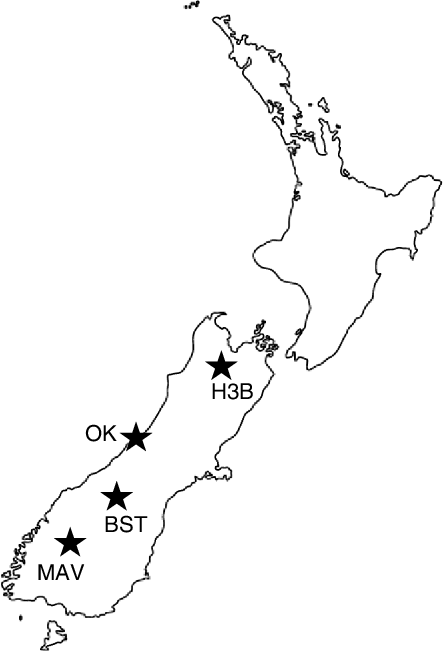
The objective was to test a range of pretreatment methods on macrofossil samples that are typically recovered from peat bogs and lake sediments. Ideally for this experiment, we would have tested known age samples, but obtaining known age samples of fragile macrofossils from authentic depositional environments is challenging. An alternative of deliberately contaminating known age fragile macrofossils could be used but is likely to become an experiment in how well a laboratory-created contaminated sample can represent authentic depositional contamination, rather than addressing the problem at hand. Therefore, we chose to use authentic samples recovered from New Zealand locations that were readily available to us, and with approximate ages known from the depositional environment and other information. The chosen environments have high humic loading and varying carbonate content. We expect that they reasonably represent the range of terrestrial macrofossil environments that are encountered globally. We selected a total of six samples recovered from a range of depositional environments. In the New Zealand context, most geological and archaeological studies are primarily focused on the Holocene, so we choose a set of test samples expected to be of Holocene age and included one much older (Last Glacial Maximum) sample as any unremoved younger contamination is expected to be more apparent in an older sample. All sites would have been bordered by forest for the duration of the Holocene prior to human occupation (Vandergoes et al. Reference Vandergoes, Fitzsimons and Newnham1997, Reference Vandergoes, Dieffenbacher-Krall, Newnham, Denton and Blaauw2008, Reference Vandergoes, Newnham, Denton, Blaauw and Barrell2013b). Grassland/herbfield and low forest probably dominated around the Howard Valley site during the Last Glacial Maximum (Callard et al. Reference Callard, Newnham, Vandergoes, Alloway and Smith2013). Descriptions of the sites, deposits and expected ages are as follows and summarized in Table 1 and the locations are shown in Figure 1.
Samples tested in this study.

Map of New Zealand showing the sampling locations used in this study.

At Howard Valley in southeast Nelson (41°46'38"S, 172°39'43"E, 480 m asl, H3B), an alluvial sequence exposed in a river terrace edge contains 10 cm of the Kawakawa/Oruanui tephra (KOT) enclosed above and below by brown organic-rich silt (Callard et al. Reference Callard, Newnham, Vandergoes, Alloway and Smith2013; Vandergoes et al. Reference Vandergoes, Hogg, Lowe, Newnham, Denton, Southon, Barrell, Wilson, McGlone and Allan2013a). Well-preserved heath macrofossils (species Styphelioideae), in-situ and flattened during burial by the KOT, were collected from the base of the KOT providing a close pre-eruption age of the KOT. An age for the KOT based on 22 14C ages from optimal materials directly above, within, or directly below KOT eruptives consistently range between ca. 20,400 and 21,700 14C yr BP with a previously dated plant macrofossils from below KOT at Howard Valley providing an age of 21,100 ± 110 (Vandergoes et al. Reference Vandergoes, Hogg, Lowe, Newnham, Denton, Southon, Barrell, Wilson, McGlone and Allan2013a).
At Mavora Lakes bog in Southland (45°19'08"S, 168°10'46"E, 830 m asl, MAV), 3 m of fibrous and compact ombrotrophic peat overlay silt deposits from the last glaciation (Turner et al. Reference Turner, Howarth, de Gelder and Fitzsimons2015) The MAV leaf macrofossil selected from this sequence relates to the expansion and dominance of Lophozonia menziesii (Silver beech) in this region during the early to mid Holocene and is supported by regional pollen evidence (McGlone and Bathgate Reference McGlone and Bathgate1983).
At Boundary Stream Tarn in inland Canterbury (44°02'S, 170°07'E, 830 m asl, BST), 3 m of organic lake mud overlay inorganic silty lake mud dated to the last glacial transition (Vandergoes et al. Reference Vandergoes, Dieffenbacher-Krall, Newnham, Denton and Blaauw2008). The two samples were selected from the sequence at ~3.15 m and pollen analysis from this sequence identifies that the upper 3 m of mud represent Holocene accumulation since ~11,000 14C yr BP. The position of leaf macrofossils within these silts compared to the current age model and previously dated material are likely to fall within ~8000–9000 14C yr BP (Vandergoes et al. Reference Vandergoes, Dieffenbacher-Krall, Newnham, Denton and Blaauw2008). Both BST samples were from the same 1-m core section collected from about 3-m depth. The BST leaf was from the top 3 cm of this core section, and the BST twig is expected to be slightly older as it was from the 16–18 cm section of this core section.
At Okarito bog (43°14'30"S, 170°13'E, 70 m asl, OK), 3 m of fibrous and compact sedge peat overlay silt deposits dated to the last glaciation and glacial transition. These ages and pollen analysis from this sequence identify that these peats represent Holocene peat accumulation since ~11,000 14C yr BP (Vandergoes et al. Reference Vandergoes, Newnham, Preusser, Hendy, Lowell, Fitzsimons, Hogg, Kasper and Schlüchter2005). The OK twig is expected to be ~5000 14C yr BP (Vandergoes et al. Reference Vandergoes, Newnham, Preusser, Hendy, Lowell, Fitzsimons, Hogg, Kasper and Schlüchter2005) and younger than the OK wood, which was collected from a deeper section of the same core and has an expected age of ~8000 14C yr BP (Newnham et al. Reference Newnham, Vandergoes, Hendy, Lowe and Preusser2007).
Leaf samples of heath, silver beech and celery pine were selected as they are unlikely to survive reworking intact. Therefore, they are likely to have fallen directly into the depositional environment and should not have inherited age. New Zealand species typically hold their leaves for up to two years before dropping. The other three samples are twigs and a wood fragment. The twigs are small enough that they represent only one or two years of growth, and the wood is likely manuka, which has a lifetime of 25–50 yr. These are less ideal dating targets since they are more robust and thus more likely to be reworked before ending up in sediment. The wood could also have an inherited age. However, their greater robustness means that they are commonly dated from sediment and peat bog samples. Some carbonate may be present in the terrain for some samples, potentially biasing the samples to older ages, although no effervescence was observed during the acid pretreatments, indicating that this kind of contamination was likely minimal in all samples. More significant contamination is likely to come from humic material that can translocate within the depositional environment. This is of particular concern in the peat bog environments where humic loading is high, but also possible in the sediment cores. Humic contamination may be younger or older than the sample itself.
Although wood and twigs are ideally pretreated to extract cellulose (Gaudinski et al. Reference Gaudinski, Dawson, Quideau, Schuur, Roden, Trumbore, Sandquist, Oh and Wasylishen2005; Southon and Magana Reference Southon and Magana2010), the amount of sample material recovered from sediment cores and its preservation state is commonly insufficient to perform cellulose extraction. Therefore, AAA is usually performed on this type of sample, and in our experiment we treated the wood and twig samples in the same manner as the fragile leaf and heath macrofossil samples.
Physical Pretreatment
All samples were picked or sieved from the host sediment. They were ultra-sonicated to remove residual sediment and non-target macro-organics were removed by picking under microscopic examination. Almost no residual sediment remained on any sample. Samples were then dried at 50ºC. Once dry, each individual macrofossil was sectioned to produce five subsamples with approximately equal masses of material. The fifth subsample was kept in reserve to allow for additional future experiments.
AAA Chemical Pretreatments
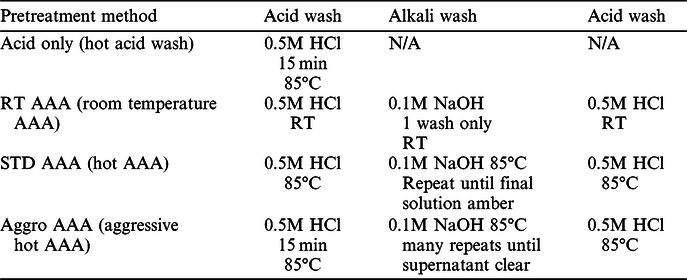
Four different variations of the acid alkali acid (AAA) method were trialled (Table 2). All pretreatment methods were performed in 15-mL polypropylene centrifuge tubes. Acid was 0.5 M hydrochloric acid solution, and alkali was 0.1 M sodium hydroxide solution. Where heating was required, the tube was immersed in a water bath to a level that the liquid in the tube was covered. For each wash, the solution was added, the sample immersed in the water bath (except for room temperature) for 15 min. After 15 min the sample was removed from the water bath and the liquid decanted off with a pipette. Following acid and alkali washes, the remaining solid sample was rinsed to neutral with deionized water.
Chemical pretreatment methods.

The acid only treatment used only a single acid wash, intended to remove carbonate material and any acid soluble material such as fulvic acids. In this method, there is no serious attempt to remove humic material. The acid solution was heated to 85°C.
The room temperature AAA (“RT AAA”) method is a room temperature variant of the commonly used AAA method. The first acid wash is intended to remove carbonate and acid soluble material. It is followed by a single alkali wash intended to remove humic material. Finally, a last acid wash is intended to remove any carbon absorbed during the alkali step. All steps were done at room temperature.
The standard AAA (“STD AAA”) method is the version of AAA pretreatment that has most commonly been used in our laboratory, consisting of acid and alkali washes done at 85°C. The solutions are the same as for RT AAA except that (a) the sample and solution are heated to 85°C, and (b) the alkali step is repeated until the supernatant solution is amber in color, pipetting off and replacing the alkali solution between each 15-min 85°C wash. In all cases in this experiment, only one alkali wash needed to be applied to meet the color criteria. In fact, all were pale yellow in color after the single alkali wash, likely in part due to the small mass of these samples relative to the volume of the solution.
The aggressive AAA (“Aggro AAA”) method is the same as STD AAA except that the alkali washes are repeated until the supernatant liquid is completely colorless. The alkali solution is pipetted off and replaced between each 15-min 85°C wash. In this experiment, all samples required three or four alkali washes to meet this criteria.
Dried samples were weighed before and after pretreatment to determine the mass loss during the pretreatment process. We arbitrarily estimate the uncertainty in the pretreatment yield as 10% for all samples.
Combustion, Graphitization, and AMS Measurement
The remaining solid sample material after AAA pretreatment was dried in a 50°C oven and weighed to determine the mass loss during pretreatment, then combusted to CO2 gas by sealed tube combustion (Baisden et al. Reference Baisden, Prior, Chambers, Canessa, Phillips, Bertrand, Zondervan and Turnbull2013). Each sample was reduced to graphite using hydrogen reduction (Turnbull et al. Reference Turnbull, Zondervan, Kaiser, Norris, Dahl, Baisden and Lehman2015). The graphite amount was determined manometrically from the CO2 pressure in the graphite reactor. Samples were measured by AMS at the Rafter Radiocarbon Laboratory and data reduced to determine the 14C content (Zondervan et al. Reference Zondervan, Hauser, Kaiser, Kitchen, Turnbull and West2015). Results are reported as conventional 14C age (CRA) (Stuiver and Polach Reference Stuiver and Polach1977; Donahue et al. Reference Donahue, Linick and Jull1990). Total 14C measurement precision is typically 25–35 yr BP at 1σ for Holocene samples, and larger for the Late Glacial samples. The fractionation correction is performed using the 13C content measured in the AMS (Zondervan et al. Reference Zondervan, Hauser, Kaiser, Kitchen, Turnbull and West2015), δ13C was also measured by IRMS on a split of CO2 gas from each combusted sample, except for three samples for which insufficient CO2 was available for this measurement. Nominal IRMS δ13C precision is 0.3‰.
The mass loss during the more aggressive AAA pretreatments meant that a few samples produced less than 0.3 mg carbon (mgC). These < 0.3 mgC samples were treated as small samples and their CRA determined following the protocols of Santos et al. (Reference Santos, Southon, Griffin, Beaupre and Druffel2007). In this protocol modern known age materials and blank materials spanning the size range of the small samples are measured concurrently with the small samples and used to diagnose the modern and dead carbon contamination amounts which were then used to correct the 14C results. The overall uncertainty in these small samples in much larger than for > 0.3 mgC samples, not only because fewer 14C counts are obtained, but because the relative contribution of contamination is larger and the amount of contamination is also uncertain.
RESULTS AND DISCUSSION
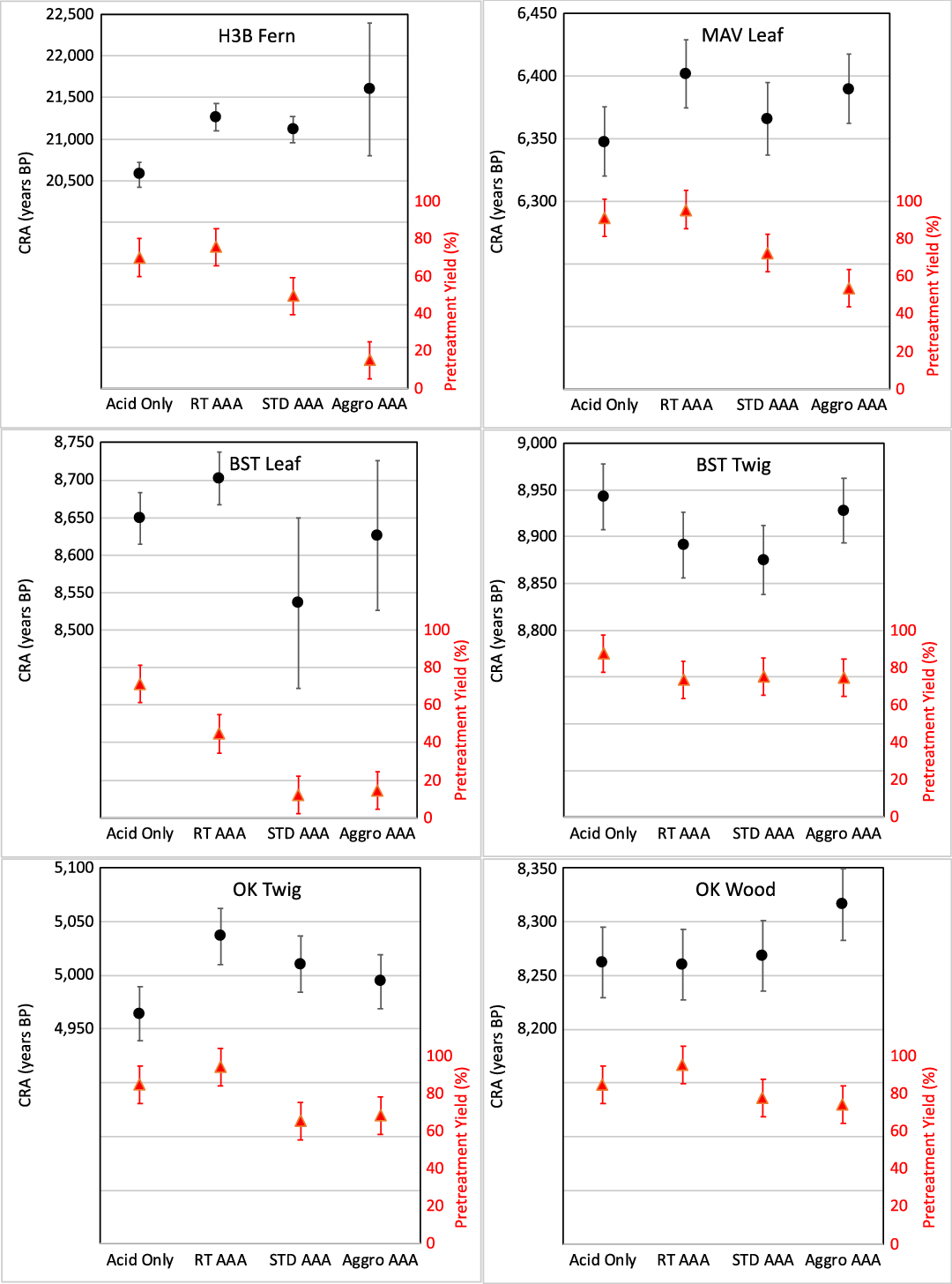
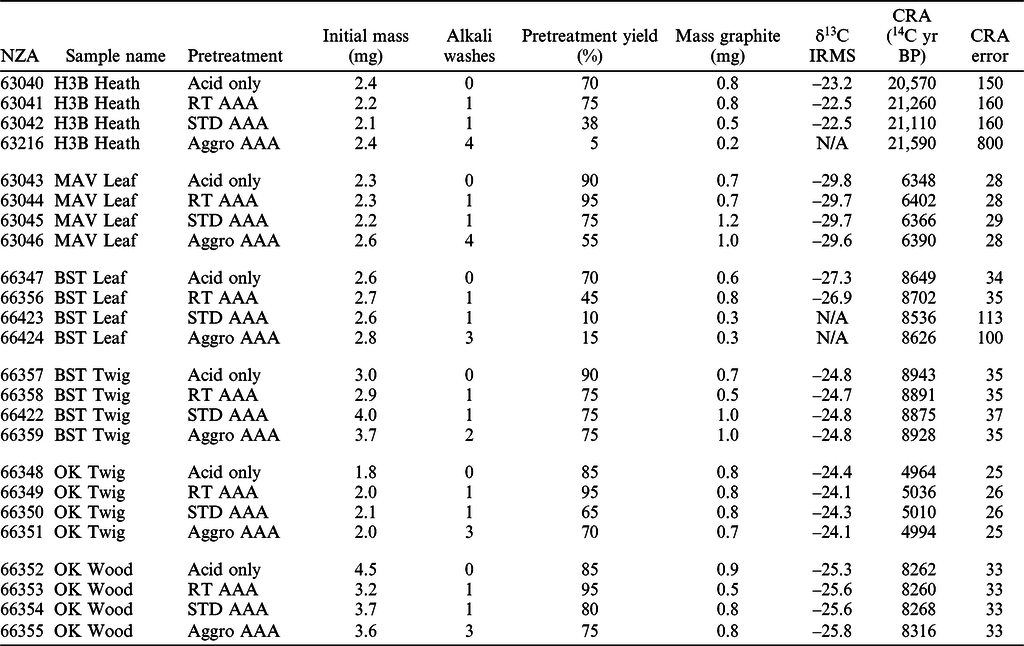
14C content, mass loss during pretreatment and other results are shown in Figure 2 and Table 3.
14C results presented as conventional 14C age (left axis) and pretreatment yields (right axis) for macrofossil samples pretreated by various methods. Error bars are as described in the text.

Results for pretreatment test samples. NZA is the unique Rafter Radiocarbon Laboratory measurement identifier. Initial mass is the mass prior to the beginning of chemical pretreatment. Pretreatment yield was determined from the initial mass and dry mass after pretreatment. Graphite mass not directly related to pretreatment yield but is included to indicate where samples needed to be treated as small samples (see text). 14C results are given as conventional radiocarbon age (CRA), and 13C content as δ13C.

In all cases, there is a clear progression towards increased mass loss with more aggressive pretreatment. As might be expected, the fragile heath and leaf samples lost substantially greater mass than the twigs or wood fragment. In some cases, 85–90% of sample mass was removed during STD AAA and Aggro AAA pretreatments, both of which involve heating the sample to 85°C. This dramatic mass loss meant that those samples had to be treated as small samples during AMS measurement, resulting in much larger measurement uncertainties than for the larger samples (Figure 2).
STD AAA (85°C) also resulted in substantially more mass loss than RT AAA, even though only one alkali wash was required in all cases. The most fragile sample, BST Leaf, lost substantially more mass in RT AAA than in acid only pretreatment, but for the other samples the mass loss was similar for RT AAA and acid only pretreatments. We hypothesize that performing the acid only pretreatment at room temperature rather than 85°C would result in smaller mass loss, but insufficient material from these samples was available to test this.
The acid only pretreatment gives younger ages than the various AAA pretreatments in several, but not all, cases. This is most apparent in the case of the H3B heath, for which the acid only pretreatment gives a CRA four standard deviations younger than the weighted mean of the other three pretreatments. This result is reasonable given that the H3B heath has a much lower 14C content (21,000 yr BP) than any of the other samples (5000–9000 BP), and therefore the effect of unremoved, younger contamination will be more apparent in this sample than in the others. The MAV Leaf and OK Twig also show slightly, but not significantly, younger ages for the acid only pretreatment than for the other pretreatments. All three of these samples came from swamp settings, where there is greater potential for vertical movement of humic laden fluids of different age than the sample.
There is some variability amongst results for the various AAA methods, but none show statistically significant differences, and there is no consistent pattern amongst the different samples. The largest difference is in the Aggro AAA for the OK Wood sample, which is 53 ± 37 yr BP older than the weighted mean of the other three pretreatments of the same sample. In all other cases, the differences between AAA pretreatment methods for a given sample are within one standard deviation of each other.
It is apparent from the greater mass loss in the STD AAA and Aggro AAA pretreatments, that more material was removed than in the RT AAA pretreatment, yet the 14C content is similar after any of these treatments. We suspect that while the alkali step is intended to remove contaminating humic material, in fragile and degraded samples, it also breaks down the sample material itself. Some of this may remain in solution as small particulates that are lost during subsequent rinsing and/or sample transfer.
CONCLUSIONS
This study focused on AAA pretreatment methods for fragile terrestrial plant macrofossils and did not consider the well-known reservoir effects that may be encountered with aquatic macrofossils. Nor have we attempted to address the more rigorous pretreatments for more robust wood samples for which there is ample evidence that isolation of the cellulose component may give more reliable ages (e.g. Olsson Reference Olsson1980; Hoper et al. Reference Hoper, McCormac, Hogg, Higham and Head1998; Gaudinski et al. Reference Gaudinski, Dawson, Quideau, Schuur, Roden, Trumbore, Sandquist, Oh and Wasylishen2005; Southon and Magana Reference Southon and Magana2010).
Our results indicate that for terrestrial plant macrofossil samples from sediment and peat bog contexts, room temperature acid-alkali-acid (RT AAA) pretreatment is likely to be sufficient to remove contaminating materials and produce a reliable 14C age. In many cases, a simple acid wash (acid only) is likely to be sufficient, but in some samples it appears that alkali washes may be needed to effectively remove contamination. Heating the solutions, and repeating the alkali washes multiple times often results in substantial sample mass loss but does not significantly change the measured 14C age. Therefore, we recommend use of RT AAA for sediment and swamp macrofossil pretreatment. Our samples span Holocene ages and into the Last Glacial Maximum. Although all are from New Zealand, they are from a range of paleo-archive contexts. These results can therefore be expected to be generalizable for pretreatment of fragile terrestrial plant macrofossils from geological contexts.
ACKNOWLEDGMENTS
Thanks for the support of the Rafter Radiocarbon Laboratory staff for assistance with sample preparation and measurement. Thank you to two reviewers for their helpful comments that have improved the paper.