Introductions of several notable nonnative forest insects and diseases have been detected in North America in the past few decades (Haack Reference Haack1997, Reference Haack2001, Reference Haack2003, Reference Haack2004, Reference Haack2006; Smith and Hurley Reference Smith and Hurley2000; Allen and Humble Reference Allen and Humble2002; Haack et al. Reference Haack, Jendek, Liu, Marchant, Petrice and Poland2002; Hopkin et al. Reference Hopkin, de Groot and Turgeon2004; Hoebeke et al. Reference Hoebeke, Haugen and Haack2005; de Groot et al. Reference de Groot, Nystrom and Scarr2006; Langor et al. Reference Langor, DeHaas and Foottit2009; Haack et al. Reference Haack, Hérard, Sun and Turgeon2010). Among these species are some exotic wood-boring insects, such as the emerald ash borer (Agrilus planipennis Fairmaire) (Coleoptera: Buprestidae) and the brown spruce longhorn beetle Tetropium fuscum (Fabricius) (Coleoptera: Cerambycidae), whose damage has resulted in important tree mortality and led to drastic and sometimes irreversible alterations of urban and rural landscapes (Colautti et al. Reference Colautti, Bailey, van Overdijk, Amundsen and MacIsaac2006; Poland and McCullough Reference Poland and McCullough2006; Kovacs et al. Reference Kovacs, Mercader, Haight, Siegert, McCullough and Liebhold2011). The interval of time between the first interception of an alien species at a port of entry or at post-entry sites, and the time an established and invasive population is discovered can span anywhere from a few years to a little more than a decade (Gill et al. Reference Gill, Parker and Grebennikov2008). With the objective of shortening that interval, high-risk pathway-based surveys have been developed and implemented to detect forest invasive alien species (IAS) in both Canada (R. Favrin, Canadian Food Inspection Agency, personal communication) and the United States of America (Jackson et al. Reference Jackson, Molet and Smith2006). To complement its semiochemical-based trapping survey, the Canadian Food Inspection Agency began in 2006 the practice of acquiring logs from live or recently dead trees exhibiting signs and symptoms of declining health from high-risk sites (e.g., industrial zones, current and historic landfills, and disposal facilities where large volumes of international wood packaging material and dunnage are stored for extended periods of time) through municipal hazard tree removal programs. It is through this survey, which targets wood-boring insects travelling in nonmanufactured wood packaging material and loose wood dunnage, that the presence of an alien species was confirmed in Ontario, Canada.
Trichoferus campestris (Faldermann) (Coleoptera: Cerambycidae), a species still referred to as Hesperophanes campestris by some North American authors (Miller Reference Miller2011), is native to eastern Asia (e.g., China, Japan, Korea, and Russia; European and Mediterranean Plant Protection Organization 2009; Grebennikov et al. Reference Grebennikov, Gill and Vigneault2010). In its native range, this beetle attacks healthy or slightly stressed mature trees (European and Mediterranean Plant Protection Organization 2009) and although it has been recorded in over 40 genera of broadleaf trees and conifers (Iwata and Yamada Reference Iwata and Yamada1990), seems to prefer apple (Malus Miller (Rosaceae)) and mulberry (Morus Linnaeus (Moraceae)) (European and Mediterranean Plant Protection Organization 2009). Feeding by the beetle is not believed to cause tree death, but can result in important losses of vigour, wood marketability, and fruit yield in orchard settings (European and Mediterranean Plant Protection Organization 2009). This beetle has been intercepted frequently in dunnage (Allen and Humble Reference Allen and Humble2002) and wood packaging material (Haack Reference Haack2006). It can colonise and fully develop in dry logs of various species when bark is still present (Iwata and Yamada Reference Iwata and Yamada1990). The first detection of T. campestris in Canada occurred in Repentigny, Québec, in 2002 when an adult was hand-collected from a window screen; a second specimen, also without any host record, was collected similarly in 2006 from the same location (Grebennikov et al. Reference Grebennikov, Gill and Vigneault2010). In the United States of America, the first adult T. campestris was detected in 1999 on the exterior of a high-risk warehouse site in New Jersey (Jackson et al. Reference Jackson, Molet and Smith2006). Since then, adults have been captured in Lindgren funnel traps deployed in Illinois, Ohio, Minnesota, and Utah by the Cooperative Agricultural Pest Survey (National Agricultural Pest Information System 2013); but, also with no host records.
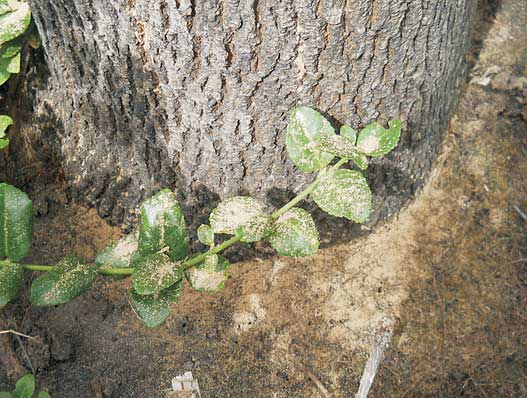
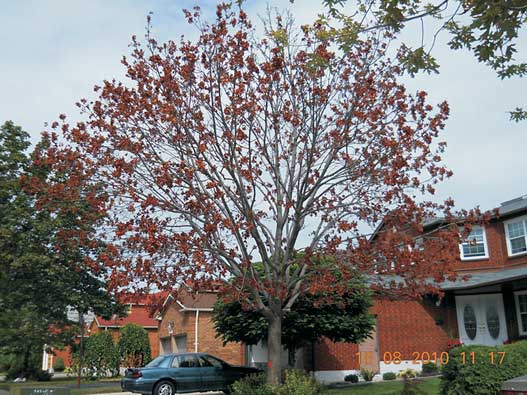
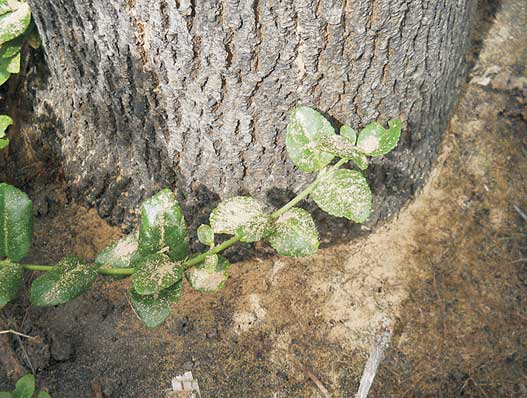
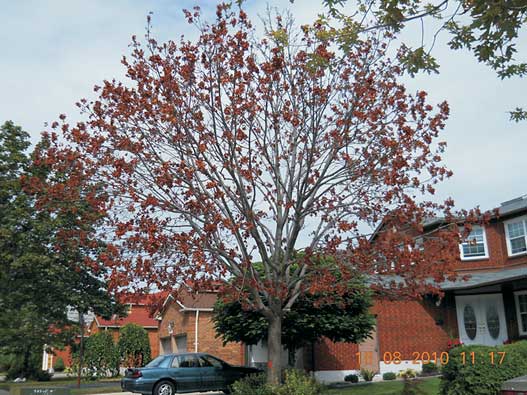
On 18 August 2010, city staff from Mississauga, Ontario, Canada, located a Norway maple, Acer platanoides Linnaeus (Sapindaceae), on Fairwind Drive that exhibited several signs of injury by insects (e.g., pin holes in the bark made by scolytines (Coleoptera: Curculionidae); fine frass at the base of the tree (Fig. 1)) and symptoms of declining health (e.g., small cracks in the bark; twig and branch dieback; dried up brownish-red leaves (Fig. 2)). The 7-m-tall tree was removed by Mississauga's forestry staff in September 2010. As per the Canadian Food Inspection Agency-IAS survey protocol, two 1-m-long logs were removed from the tree. One was taken from the mid-canopy of the tree (A; basal diameter 12.7 cm) and the second one from the lower trunk (B; basal diameter 26.5 cm), where signs of insect injury were most prominent.
Sign of insect injury: presence of fine frass at the base of a Norway maple. Mississauga, Ontario, Canada (18 August 2010).
Symptom of health decline: presence of dry brownish-red leaves on a Norway maple. Mississauga, Ontario, Canada (18 August 2010). Note: leaves on other trees are green.
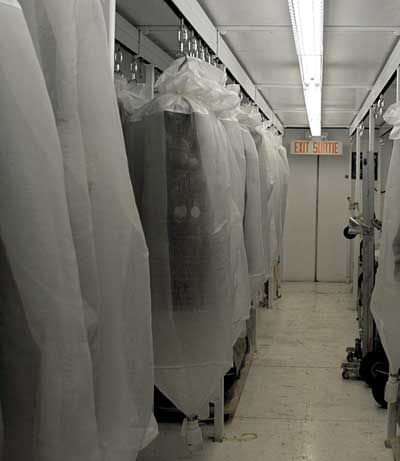
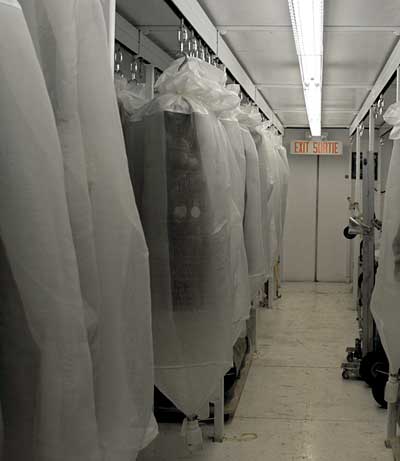
Both logs were brought to a 12-m- long steel transport container that had been modified specifically for this survey (Kimoto and Humble Reference Kimoto and Humble2008). This climate-controlled container was located at Emery Yard in Toronto, Ontario, which was one of the four sites set up across Canada: similar containers are located in Dartmouth (Nova Scotia), Montréal (Québec), and North Vancouver (British Columbia). Each selected log was processed as follows: both cut ends were coated in paraffin to reduce desiccation; a screw-in hook (about 22-cm long) was fastened to one extremity of the log; a mesh sleeve (circumference × height: 132 × 128 cm) made of polyethylene screen (hole size = 266 × 818 μm; L. Humble, Natural Resources Canada, Canadian Forest Service, personal communication) was slipped over the log and secured around the base of the hook with duct tape to prevent insects from escaping; the other end of the sleeve was fitted with a plastic jar half filled with propylene glycol (Fig. 3). All logs were kept under a 16:8 light:dark photoperiod at 20–25 °C and 40–60% relative humidity for 10 months and at 0–4 °C for two months in winter.
Inside view of a steel container modified by the Canadian Food Inspection Agency to incubate logs from trees in declining health. Mesh cages, each enclosing a 1-m-long log from a live or recently dead tree with signs of insect activity and symptoms of decline. A hook is screwed in one end of the log and used to hang it from the ceiling. A jar is secured at the base of the cage to collect emerging insects.
Two adults emerged from log B; one on 18 July 2011 and another on 3 August 2011. On 6 January 2012, B. Gill of the Canadian Food Inspection Agency Plant Laboratory-Entomology in Ottawa (Ontario, Canada) identified the specimens as T. campestris based on a comparison of morphological characters with voucher specimens. Following identification, the logs were removed from the container and transferred to the Great Lakes Forestry Centre in Sault Ste Marie, Ontario, Canada, for dissection. The purpose of this dissection was to describe the type of injury caused by T. campestris and to determine whether the tree had been killed by this alien wood borer, which thus represented a serious threat, or if the beetles had colonised an already stressed and dying tree.
We examined the bark of each log and noticed the presence of about a half dozen oval-shaped holes only on one side of log B. The size of these holes (diameter 6–8 mm) was consistent with the size of T. campestris feeding larvae reported by Grebennikov et al. (Reference Grebennikov, Gill and Vigneault2010). Insertion of a plastic tie wrap, about 20-cm long, into several of these oval-shaped holes suggested that the gallery or tunnels associated with these holes were parallel to the bark surface. We also noted the presence of many much smaller circular pin holes characteristic of ambrosia beetles (Solomon Reference Solomon1995).
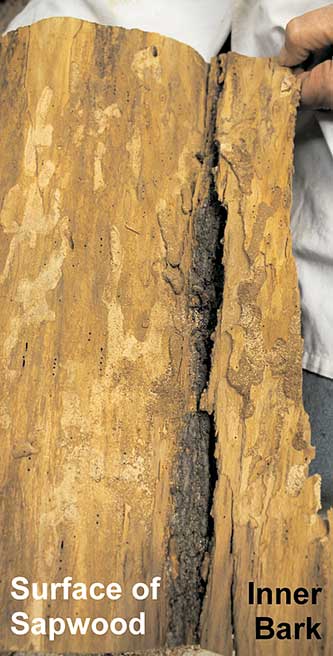
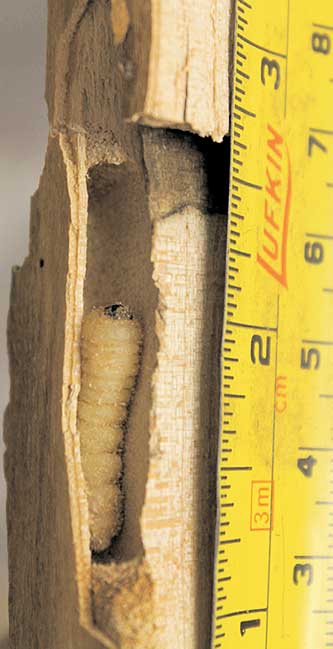
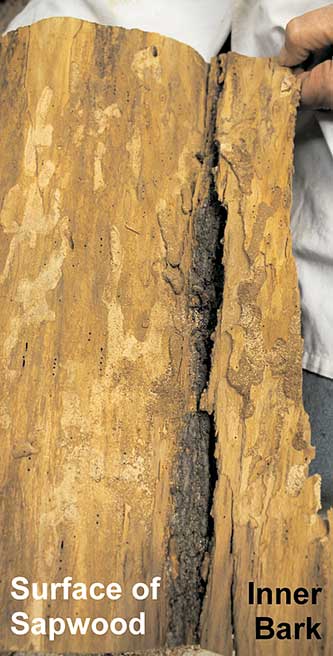
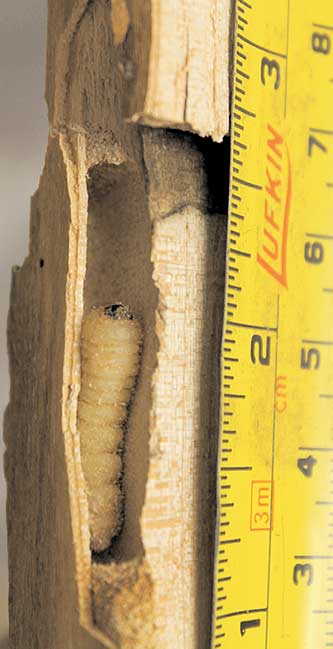
We peeled the bark and noted that the oval-shaped holes were connected to winding and frass-packed feeding galleries etched in the surface of the sapwood and the inner bark (Fig. 4). We observed galleries on only one half of the circumference of the log. We could not find a single tunnel within the heartwood. We recovered one dead adult beetle under the bark and two live larvae hidden by frass in galleries <3 mm below the surface of the sapwood (Fig. 5); all three specimens were later identified as T. campestris. We used standard sterile isolation techniques on a suite of artificial media and failed to detect any pathogenic fungi associated with T. campestris galleries. We employed the same techniques on 2% malt agar taken from a mycelial fan located at the base of log B and confirmed the presence of Armillaria (Fries) Staude (Physalacriaceae) root rot (probably Armillaria ostoyae (Romagnesi) Herink). We interpret the presence of Armillaria as an indication the tree was stressed at the time of removal. These observations suggest that T. campestris was not the primary causal agent of tree decline. The presence, in February 2012, of live mature larvae in a tree felled in September 2010 is consistent with previous information (European and Mediterranean Plant Protection Organization 2009), suggesting that this insect may require one or more years to complete its life cycle in Canada.
Frass-packed feeding galleries constructed by Trichoferus campestris larvae on the sapwood surface of a Norway maple. Mississauga, Ontario, Canada (30 January 2012).
Cross-section of debarked log showing a live larva of Trichoferus campestris at surface of sapwood (<3 mm deep) of a Norway maple. Mississauga, Ontario, Canada (30 January 2012). Note: surface of sapwood is on left of image.
The presence of live T. campestris larvae under the bark of a Norway maple in Mississauga, and the emergence of adults from that tree, is evidence that this species can complete its development in North America. These results substantiate the hypothesis put forth by Grebennikov et al. (Reference Grebennikov, Gill and Vigneault2010) that T. campestris would likely become successfully established in the New World. Therefore, the capture of this species in traps deployed at high-risk sites should no longer be interpreted automatically as evidence of interception, especially when adults are captured over a period of several years.
These findings highlight the detection capacity of this survey method and its complementary value to other pathway-based survey methodologies used in urban landscapes. Without this survey, the presence of trees infested by T. campestris in a residential area could have gone unnoticed for much longer given the limited abundance of signs of attack, a factor known to influence detectability (Turgeon et al. Reference Turgeon, Pedlar, de Groot, Smith, Jones and Orr2010). Indeed, traps used in conventional semiochemical-based surveys are typically not deployed in residential areas surrounding high-risk sites because of potential tampering, inter-trap spacing requirements, and safety concerns of residents.
Norway maple is a commonly planted tree within the Canadian urban landscape (Anonymous 2011; Pedlar et al. Reference Pedlar, McKenney, Lawrence, Lawrence and Campbell2012). Although, T. campestris was not the primary cause of decline in the Mississauga maple tree, this discovery highlights the potential risk of all Canadian urban maple trees to colonisation by nonnative, wood-boring insects.
Acknowledgements
The authors thank G. Longmuir and staff (City of Mississauga); C. Grant, M. Orr, and inspection staff of the Canadian Food Inspection Agency (CFIA), Toronto Regional Office, for assistance with sample collection; J. Doyle, S. Matsumoto, and J. Ric (City of Toronto) for collaboration in this survey; C. Davis, R. Fournier, C. Jones, and A. Keizer (Natural Resources Canada-Canadian Forest Service [NRcan–CFS]) for technical assistance with fungus identification and log dissection; B. Gill for insect identification and comments on an earlier version; and P. de Groot, P. DesRochers, K. Harrison, A. Hopkin, L. Humble, J. Sweeney (NRCan–CFS), R. Favrin, B. Gill, and D. Holden (CFIA) for assistance in developing this survey protocol. Funding for this project was provided by the CFIA.