INTRODUCTION
Phenotypic plasticity is often seen as an adaptive strategy in highly variable environments (Anurag, Reference Anurag2001). Host exploitation by parasites generally results in rapid evolutionary responses of hosts for defence purposes, resulting in a situation where parasites face a constantly changing environment and have to co-evolve with their hosts (Van Valen, Reference Van Valen1974). Furthermore, the fitness of a parasite completely depends upon host-parasite interactions; infection and reproduction rates in a particular host-determining parasite success (Paterson and Piertney, Reference Paterson and Piertney2011). Parasite phenotypic plasticity and alternative growth strategies should thus be expressed in precise context-dependent ways, depending on the parasite's environment/host (Thomas et al. Reference Thomas, Brown, Sukhdeo and Renaud2002a; Parker et al. Reference Parker, Chubb, Roberts, Michaud and Milinski2003).
The environment of a parasite is often not restricted to a single host since multiple species, parasites and/or hosts, are frequently encountered in a parasite life cycle (Fredensborg and Poulin, Reference Fredensborg and Poulin2005; Gower and Webster, Reference Gower and Webster2005; Rauch et al. Reference Rauch, Kalbe and Reusch2005). This is especially true for trematodes, their complex life cycles involving up to 4 widely different hosts and countless potential intra- and interspecific parasite competitors (Poulin, Reference Poulin2007). Although in the majority of trematodes a three-host life cycle is maintained, several species have lost a host from their cycle (Poulin and Cribb, Reference Poulin and Cribb2002). This life-cycle abbreviation is often realized by dropping the definitive host, maturing and reproducing in the second intermediate host through progenesis and self-fertilization. In some species, life-cycle abbreviation remains facultative and both strategies are observed concurrently in parasite populations (Poulin and Cribb, Reference Poulin and Cribb2002).
For example, the digenean trematode Coitocaecum parvum is able to adaptively adopt progenesis or the normal 3-host life cycle in response to different environmental factors (MacFarlane, Reference MacFarlane1939; Holton, Reference Holton1984a,Reference Holtonb; Lagrue and Poulin, Reference Lagrue and Poulin2007, Reference Lagrue and Poulin2008a). Adult C. parvum colonize the digestive tract of fish definitive hosts where they sexually reproduce. Eggs are released with fish feces and hatch into free-swimming miracidiae. After entering the first intermediate host, the snail Potamopyrgus antipodarum, they develop into cercariae-producing sporocysts. Cercariae leave the snail and must infect an amphipod second intermediate host where they encyst as metacercariae. The parasite can then adopt one of two alternative life strategies; either wait for a fish definitive host to consume the infected amphipod host or undergo progenesis while still inside the amphipod intermediate host and reproduce by selfing (Poulin and Cribb, Reference Poulin and Cribb2002; Lefèbvre and Poulin, Reference Lefèbvre and Poulin2005). Progenetic individuals produce viable eggs released into the environment upon the death of the amphipod host. A previous study showed no evidence for heritability of progenesis or negative effects of selfing on offspring fitness (Lagrue and Poulin, Reference Lagrue and Poulin2009a). However, many factors influence adoption of the abbreviated life cycle by individual C. parvum. For example, progenesis rate increases when fish definitive hosts are absent from the environment (Lagrue and Poulin, Reference Lagrue and Poulin2007). Time spent in the amphipod host also increases the likelihood of progenesis adoption (Lagrue and Poulin, Reference Lagrue and Poulin2009b). Finally, co-infecting parasites and intra-host competition in the second intermediate host (the amphipod Paracalliope fluviatilis) strongly affect the adoption of progenesis in C. parvum (Lagrue and Poulin, Reference Lagrue and Poulin2008a; Lagrue et al. Reference Lagrue, Poulin and Keeney2009).
Although C. parvum uses 2 different amphipod species as intermediate hosts, how its life-history strategy (abbreviated or normal 3-host cycle) may differ between these two hosts remains unknown. The two amphipod species often co-exist in the field despite profound ecological differences. While Paracalliope fluviatilis is demersal and free-swimming, Paracorophium excavatum is a purely benthic, sedentary, burrow-dwelling amphipod; this may increase its exposure to the non-swimming cercariae of C. parvum (Holton, Reference Holton1984a). Paracorophium excavatum is also larger, may provide more resources to trematode parasites and thus affect the adoption of progenesis by C. parvum and/or egg production in progenetic individuals. Most studies have only considered P. fluviatilis as C. parvum intermediate host even though P. excavatum was early documented as a potential host in which progenesis occurred (Holton, Reference Holton1984a; Luque et al. Reference Luque, Bannock, Lagrue and Poulin2007). However, potential differences in progenesis rates and egg production between C. parvum individuals infecting co-existing P. fluviatilis and P. excavatum are still unknown.
While intra-host (intra- and interspecific) competition among parasites is known to affect both life strategy and egg production in C. parvum, these effects have been studied only in P. fluviatilis (Lagrue and Poulin, Reference Lagrue and Poulin2008a). Intraspecific competition between co-infecting C. parvum individuals strongly affects progenesis rates and decreases egg production in P. fluviatilis, the smaller of the two amphipod host species (Lagrue and Poulin, Reference Lagrue and Poulin2008a). It is possible that such effects are dampened by the larger size and higher available resources of P. excavatum hosts. Similarly, Microphallus sp. is known to infect both amphipods species (Luque et al. Reference Luque, Bannock, Lagrue and Poulin2007). It is also capable of manipulating amphipod host behaviour to enhance its transmission to bird definitive hosts (Hansen and Poulin, Reference Hansen and Poulin2005; Coats et al. Reference Coats, Nakagawa and Poulin2010). Because C. parvum and Microphallus sp. do not share definitive hosts, conflicting interests over transmission routes and/or developmental strategy are likely to arise (Brown, Reference Brown1999; Thomas et al. Reference Thomas, Fauchier and Lafferty2002b; Poulin et al. Reference Poulin, Nichol and Latham2003). Coitocaecum parvum might thus benefit from adopting progenesis in the presence of Microphallus sp.; its transmission probabilities being likely reduced by Microphallus sp. host manipulation. Microphallus sp. prevalence and abundance are also much higher in P. excavatum than P. fluviatilis (Luque et al. Reference Luque, Bannock, Lagrue and Poulin2007). Furthermore, P. excavatum is host to a large fish nematode (Hedruris spinigera) while P. fluviatilis is not (Luque et al. Reference Luque, Bannock, Lagrue and Poulin2007; Lagrue and Poulin, Reference Lagrue and Poulin2008a,Reference Lagrue and Poulinb). Metacercariae of C. parvum infecting P. excavatum are consequently more likely to compete with other parasites than conspecifics in P. fluviatilis. Natural prevalence and/or abundance variations in parasitic infections between P. excavatum and P. fluviatilis may consequently influence progenesis adoption in C. parvum in its two intermediate host species.
In this study, we examined parasite prevalences and abundances in the two amphipod host species and gave particular attention to the frequency of progenesis in C. parvum infecting P. excavatum and P. fluviatilis to detect possible species-specific intermediate host-induced effects on the parasite strategy. For C. parvum individuals that adopted progenesis, we determined whether parasite size and/or egg production was higher in P. excavatum than in the smaller P. fluviatilis. Finally, we examined potential effects of interactions with co-infecting parasites on size and egg production of progenetic C. parvum.
MATERIALS AND METHODS
Study site and animal sampling
Naturally infected Paracalliope fluviatilis and Paracorophium excavatum amphipods were collected in Lake Waihola (46°01′S, 170°05′E), South Island, New Zealand, using dip nets (500 μm nylon mesh). All amphipods were collected during February and April 2012 and both species were collected at the same time and location to avoid potential spatial or temporal effects on parasite prevalences and/or abundances. Paracorophium excavatum were captured by dredging the fine surficial sediment where this species burrows. The retained sediment with associated organisms was placed in sorting trays from which P. excavatum individuals were collected (Schnabel et al. Reference Schnabel, Hogg and Chapman2000). Paracalliope fluviatilis were collected from the same area by dragging dip nets in patches of macrophytes (Elodea canadensis). Amphipods were separated from macrophytes using a 5 mm mesh sieve and collected in sorting trays. All amphipods were kept alive in plastic containers filled with local water and brought back to the laboratory for later dissection. Amphipods were dissected within 3 days of capture.
Parasite prevalences and abundances, and Coitocaecum parvum strategy, size and egg production
Amphipods were killed in 70% ethanol and rinsed with distilled water to allow for easy manipulation (measurement and dissection) without affecting data collection on parasites (Lefèbvre and Poulin, Reference Lefèbvre and Poulin2005). Before dissection, amphipods were identified (species) and measured (total body length) to the closest 0·1 mm under a binocular microscope (×20 magnification) as host size can influence parasite prevalence and abundance in naturally infected amphipods (Lagrue and Poulin, Reference Lagrue and Poulin2008b). For each amphipod, the species (C. parvum, Microphallus sp. and/or H. spinigera) and number of parasites were recorded to determine parasite prevalences (proportion of infected hosts) and abundances (number of parasites per host). Metacercariae of C. parvum were also classified as either normal (non-egg producing) or progenetic (egg producing) according to the presence of eggs in the cyst or still in utero. Each metacercaria was measured (total length) and its eggs counted.
Statistical analysis
Potential differences in parasite prevalences and/or proportion of progenetic C. parvum between the two amphipod species were tested in a pair-wise manner using Fisher's exact tests. Effects of intermediate host species (P. fluviatilis and P. excavatum) on specific parasite abundances (C. parvum, Microphallus sp. and H. spinigera) and possible differences in host size between the two amphipod species and between infected and uninfected hosts were examined using non-parametric tests (Mann-Whitney U test), as data did not follow normal distributions. Potential relationships between host size, parasite abundance, and C. parvum size and egg production were also tested using linear regressions. Non-parametric tests and linear regressions described above were performed using STATISTICA Software 6.0 (StatSoft Inc., France).
General Linear Models (GLM) were used to test for the effects of multiple factors on the probability of C. parvum metacercariae adopting progenesis, and on the size and/or egg production of progenetic metacercariae. Factors potentially affecting the probability of progenesis in C. parvum and included in the models were host species, host size, number of co-infecting Microphallus sp., number of co-infecting non-egg producing C. parvum metacercariae and/or presence of the fish nematode H. spinigera. The dependent variable was treated in a binomial manner with C. parvum metacercariae coded either as 1 (progenetic/egg-producing) or 0 (non-egg producing). GLMs were also performed to determine the factors affecting the size and egg production of progenetic metacercariae. Host species, host size, number of co-infecting Microphallus sp., number of co-infecting non-egg producing C. parvum metacercariae and/or presence of H. spinigera were included as factors in those GLMs. The size of progenetic metacercariae was also included as a factor when egg production was the response variable. In GLMs testing for the factors affecting C. parvum egg production, only amphipod hosts containing egg-producing C. parvum were included. Log-transformation before analyses was used when necessary to normalize the data. All factors were initially included in the GLMs to determine the most appropriate model using the Akaike Information Criterion (AIC), with the model awarded the lowest AIC having the highest explanatory power for the observed data. Only factors remaining in the best models are presented in the GLM result tables. In all models, effect size was determined using t-values and degrees of freedom. GLMs were performed using R Software 2.15.0 (R Development Core Team, 2011).
RESULTS
Host species, host size and parasite prevalences and abundances
Overall, 812 amphipods were measured and dissected, 219 P. excavatum and 593 P. fluviatilis. Parasite prevalences were significantly higher in P. excavatum than P. fluviatilis (Fisher's exact tests, χ 2 = 57·64, 47·65 and 224·54, all P < 0·0001 for C. parvum, H. spinigera and Microphallus sp., respectively; see Table 1 for details). Similarly, parasite abundances were significantly higher in P. excavatum than P. fluviatilis (Mann-Whitney U test, Z = 8·284, 7·056 and 17·396, all P < 0·0001 for C. parvum, Microphallus sp. and H. spinigera respectively; Table 1).
Prevalences (proportion of infected amphipods) and abundances (mean number of parasites±s.e. per individual amphipod) for the three species of parasites (Coitocaecum parvum, Microphallus sp. and Hedruris spinigera) in the two amphipod host species (Paracorophium excavatum and Paracalliope fluviatilis) sampled in Lake Waihola

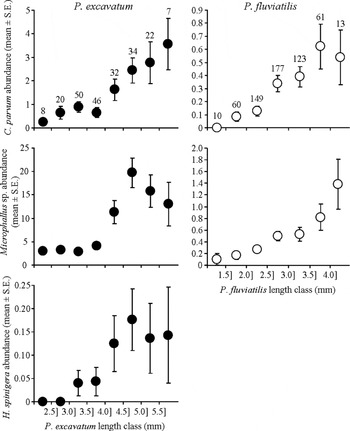
Host size was significantly different between the two amphipod species (Mann-Whitney U test, Z = 15·916, P < 0·0001); P. excavatum being larger than P. fluviatilis (Table 2). Amphipod size was also different between infected and uninfected individuals. In P. excavatum, infected individuals were significantly larger than their uninfected conspecifics for the three parasites species (Mann-Whitney U test, Z = −3·479, −2·42 and −3·046, P = 0·0005, 0·016 and 0·002 for C. parvum, Microphallus sp. and. H. spinigera, respectively; see Table 2 for details). The same trend was observed in P. fluviatilis with C. parvum and Microphallus sp. infected amphipods being significantly larger than uninfected individuals (Mann-Whitney U test, Z = −5·393 and −3·059, P < 0·0001 and P = 0·002, respectively; Table 2); note that H. spinigera was never found infecting P. fluviatilis. There was also a significant effect of host size on parasite abundances (number of parasites per individual host). Larger P. excavatum individuals tended to be more heavily infected than their smaller conspecifics (r = 0·338, 0·436 and 0·207, n = 219, P < 0·0001, P < 0·0001 and P = 0·002 for C. parvum, Microphallus sp. and H. spinigera, respectively; Fig. 1). Again, similar trends were detected in P. fluviatilis; parasite abundances were significantly correlated to amphipod host size (r = 0·208 and 0·180, n = 593, both P <0·0001 for C. parvum and Microphallus sp., respectively; Fig. 1).
Abundances (mean±s.e.) of Coitocaecum parvum (top graphs), Microphallus sp. (middle) and Hedruris spinigera (bottom graph) in relation to host size (amphipod length class) in Paracorophium excavatum (left graphs) and Paracalliope fluviatilis (right). Sample size (i.e. number of amphipods) per host size class is indicated above each data point on the top graphs. Note that P. fluviatilis was never infected by H. spinigera.

Host size (mean amphipod body length in mm±s.e.) for the two amphipod species (Paracorophium excavatum and Paracalliope fluviatilis) sampled in Lake Waihola according to their infection status (infected or uninfected (i.e. uninf.))

Coitocaecum parvum strategy, size and egg production
A total of 488 C. parvum metacercariae were recovered; 311 found in P. excavatum and 177 in P. fluviatilis. The proportion of progenetic metacercariae was not significantly different between the two host species (12·8% and 14·7% for P. excavatum and P. fluviatilis, respectively; Fisher's exact test, χ 2 = 0·32, P = 0·570). This is consistent with results from GLMs showing that only host size had a significant effect on C. parvum strategy (Table 3). Host species and the number of co-infecting non-progenetic C. parvum were included in the model with the lowest AIC score although their effect size was small and not statistically significant (Table 3). The presence of Microphallus sp. metacercariae had no detectable effect on C. parvum strategy.
General Linear Model testing for the effects of host species (Paracorophium excavatum and Paracalliope fluviatilis), host size (total body length), number of co-infecting parasites (Microphallus sp. and/or non-progenetic Coitocaecum parvum metacercariae) and presence of the nematode Hedruris spinigera on C. parvum life strategy (occurrence of progenetic individuals) in amphipod hosts

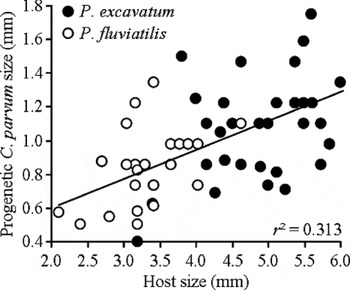
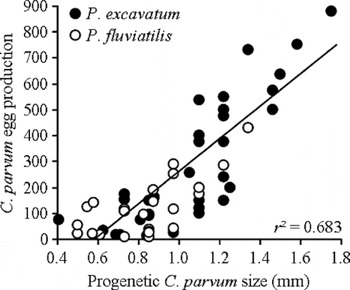
Similarly, host species did not influence the size of progenetic metacercariae (Table 4). The only factor significantly influencing C. parvum size was the host size; larger amphipod hosts tending to harbour larger egg-producing C. parvum metacercariae, regardless of host species (r = 0·559, n = 57, P < 0·0001; Fig. 2). Again, host species had no effect on C. parvum egg production. The number of eggs produced by progenetic C. parvum was clearly influenced by the size of the metacercaria (Table 5); egg production increasing with C. parvum size, regardless of host species (r = 0·826, n = 57, P < 0·0001; Fig. 3). Intra-host interactions between parasite species seemed to play a major role on C. parvum egg production (Table 5). Furthermore, these effects are likely to be species-specific. Progenetic C. parvum egg production was clearly higher in the presence of Microphallus sp. (mean egg production±s.e. = 306·9 ± 50·2 and 151·7 ± 38·4 with and without co-infecting Microphallus sp., respectively; Mann-Whitney U test, Z = −1·993, P = 0·046). However, there was no significant effect of the presence of non-progenetic C. parvum (241·4 ± 50·4 and 219·9 ± 41·9 with and without co-infecting non-progenetic C. parvum, respectively; Mann-Whitney U test, Z = 0·176, P = 0·868), possibly because of a density-dependent effect, rather than just presence or absence (Table 5; Lagrue and Poulin, Reference Lagrue and Poulin2008a). Contrastingly, co-infection with H. spinigera significantly reduced C. parvum egg production in P. excavatum (61·2 ± 19·1 and 367·2 ± 54·3 with and without co-infecting H. spinigera, respectively; Mann-Whitney U test, Z = 2·724, P = 0·004); P. fluviatilis was not considered here since it was never infected by H. spinigera.
Relationship between amphipod host size (body length in mm) and the size of progenetic Coitocaecum parvum metacercariae (body length in mm) in the two amphipod species, Paracorophium excavatum and Paracalliope fluviatilis. Line of best fit and coefficient of determination are shown on the figure.

Relationship between the size of progenetic Coitocaecum parvum metacercariae (body length in mm) and egg production in the two amphipod host species, Paracorophium excavatum and Paracalliope fluviatilis. Line of best fit and coefficient of determination are shown on the figure.

General Linear Model testing for the effects of host species (Paracorophium excavatum and Paracalliope fluviatilis), host size (total body length), number of co-infecting parasites (Microphallus sp. and/or non-progenetic Coitocaecum parvum metacercariae) and presence of the nematode Hedruris spinigera on the size of progenetic C. parvum metacercariae (body length)

General Linear Model testing for the effects of host species (Paracorophium excavatum and Paracalliope fluviatilis), host size (total body length), number of co-infecting parasites (Microphallus sp. and/or non-progenetic Coitocaecum parvum metacercariae), presence of the nematode Hedruris spinigera and C. parvum size (body length) on the number of eggs produced by progenetic metacercariae in amphipod hosts

DISCUSSION
The main goal of the study was to explore potential factors influencing the frequency of progenesis in C. parvum metacercariae in their amphipod second intermediate hosts. In particular, we tested whether the parasite adjusted its life strategy to the species of amphipod host. Results show that host species per se did not influence C. parvum's strategy; the proportion of progenetic metacercariae was similar in P. excavatum and P. fluviatilis, the two amphipod host species. Furthermore, intermediate host species per se had no effect on progenetic C. parvum size or egg production.
Overall, P. excavatum was more heavily infected than P. fluviatilis. Both prevalence and abundance of the three parasite species were higher in P. excavatum. Whether this difference was due to the larger size of this species compared to P. fluviatilis or different biological characteristics between the two amphipod species (benthic versus demersal and/or sedentary burrowing versus free-swimming, respectively) cannot be determined with certainty from our study. However, since larger individuals tend to be more heavily infected than smaller individuals in both amphipod species and P. excavatum is significantly larger than P. fluviatilis, it is likely that host size plays a significant role in parasite infection levels. Nevertheless, C. parvum cercariae cannot swim and instead crawl on the substrate to find a suitable intermediate host while H. spinigera is transmitted through the ingestion of the parasite eggs by amphipod hosts. It is thus possible that the benthic and detritivore life style of P. excavatum leads to higher exposure to infections in this species compared to P. fluviatilis. Information on Microphallus sp. transmission mode is lacking and interpretation of our results is difficult but similar trends are plausible.
Larger host size may also be linked to higher levels of within-host resources availability to parasites allowing for higher parasite abundance, growth and/or egg production (Saad-Fares and Combes, Reference Saad-Fares and Combes1992; Grutter and Poulin, Reference Grutter and Poulin1998; Johnson et al. Reference Johnson, Bush and Clayton2005). Although host species per se did not affect the likelihood of C. parvum adopting progenesis, our results show that host size and thus possibly within-host space/resources significantly affected parasite abundances and C. parvum strategy, size and egg production. The size of C. parvum progenetic metacercariae, and subsequently egg production, are known to be correlated with intermediate host size (Lagrue and Poulin, Reference Lagrue and Poulin2007). Since P. excavatum is significantly larger than P. fluviatilis, C. parvum metacercariae adopting progenesis in P. excavatum are on average larger and produce more eggs, a result consistent with an effect of host resource availability on C. parvum size and egg production.
Alternatively, parasite infections may induce differential mortality rates in the two host species. Interspecific differences in parasite prevalences and abundances between the two amphipod hosts may be explained by a higher parasite-induced mortality in P. fluviatilis following infection and/or parasite accumulation. Our results tend to show that differential mortality is unlikely since parasite abundances increased with host size, indicating that both species accumulate parasites as they grow with no apparent increased mortality (Thomas et al. Reference Thomas, Renaud, Rousset, Cézilly and de Meeüs1995; Rousset et al. Reference Rousset, Thomas, de Meeüs and Renaud1996). Larger, hence older, individual hosts thus contain higher parasite abundances, because of longer time for infections to accumulate (Read and Taylor, Reference Read and Taylor2001). They may also contain older progenetic metacercariae that have had more time for growth and/or egg production.
Several factors tend to indicate that host size rather than host age influences C. parvum growth and egg production. First, there is no seasonal variation in C. parvum prevalence, proportion of progenetic metacercariae or size/age distribution in amphipod hosts (Lagrue and Poulin, Reference Lagrue and Poulin2008b). Infection by C. parvum is most likely constant over time and host age/size; large/old amphipod hosts should not necessarily contain older metacercariae. Second, growth and egg production can be very rapid in C. parvum; individuals adopting progenesis can quadruple in size in 5 weeks, having produced over 20 eggs by that time and egg production then increasing exponentially with parasite size, unless limited by within-host resources (Lagrue and Poulin, Reference Lagrue and Poulin2007, Reference Lagrue and Poulin2009b). Coitocaecum parvum metacercariae of the same age also show a clear bimodal distribution in size, progenetic individuals being much larger than normal ones while individuals of intermediate sizes are rare (Lagrue and Poulin, Reference Lagrue and Poulin2009b). Size and/or egg production of C. parvum metacercariae is thus unlikely to depend solely on the size of individual parasites. Finally, for an equivalent size, female amphipods are older than males but C. parvum prevalence, proportion of progenetic metacercariae, as well as egg production, are similar in these hosts (Lagrue and Poulin, Reference Lagrue and Poulin2008a). Amphipod host size, rather than age, likely drives C. parvum strategy, size and egg production although host age may eventually have some influence on C. parvum strategy (Lagrue and Poulin, Reference Lagrue and Poulin2009b).
Coitocaecum parvum and Microphallus sp. were also found in higher prevalence and abundance in P. excavatum than in P. fluviatilis and the nematode H. spinigera was found to infect P. excavatum only. Intra-host competition is thus more common and probably more intense in P. excavatum. The presence of co-infecting parasites can have variable effects on C. parvum life strategy, size and/or egg production, possibly due to species-specific and abundance related intra-host competition effects. Intra- and interspecific parasite competition can apply to transmission routes and/or host resources (Lagrue and Poulin, Reference Lagrue and Poulin2008a). In P. fluviatilis, the presence of Microphallus sp. did not induce higher progenesis rates but clearly increased egg production in C. parvum. Microphallus sp. manipulates intermediate host behaviour to reach bird definitive hosts while C. parvum must infect a fish host or use progenesis to reproduce (Hansen and Poulin, Reference Hansen and Poulin2005; Lagrue and Poulin, Reference Lagrue and Poulin2008a). Conflicts over transmission pathways may thus induce progenetic C. parvum to produce as many eggs as possible, eventually killing its host, before Microphallus sp. host manipulation succeeds. Our results suggest that this trend is similar and probably exacerbated since Microphallus sp. abundance, and hence host manipulation (Brown et al. Reference Brown, De Lorgeril, Joly and Thomas2003), is much higher in P. excavatum. In contrast, co-infection with H. spinigera or non-progenetic C. parvum, both needing to reach a fish definitive host, seemed to reduce C. parvum size and/or egg production. Since there is no conflict over transmission in these situations, host resource limitations most likely induce reductions in size and egg production in progenetic individuals (Lagrue and Poulin, Reference Lagrue and Poulin2008a).
Although all parasites probably use similar host resources, results indicate that intra-host competition with H. spinigera induces the most drastic reduction in C. parvum egg production. This is not surprising since H. spinigera larvae are very large compared to progenetic C. parvum (around 8 times larger) and host size (Luque et al. Reference Luque, Bannock, Lagrue and Poulin2007, Reference Luque, Vieira, Herrmann, King, Poulin and Lagrue2010). Hedruris spinigera likely uses more host resources than the proportionally smaller non-progenetic C. parvum or Microphallus sp. metacercariae (around 33% and 20% of progenetic C. parvum size, respectively; Lagrue and Poulin, Reference Lagrue and Poulin2008b), thus exerting stronger competition pressure on co-infecting progenetic C. parvum. Coitocaecum parvum's strategy, size and egg production seemed to be influenced by the presence of other parasites in species- and intensity-specific ways. Resource availability in general, be it within-host space or energy, is likely to have strong influences on the size and egg production of progenetic metacercariae.
Overall, the frequency of progenesis did not vary between amphipod host species. However, host size had a small but significant effect on the probability of metacercariae becoming progenetic, regardless of host species. Similarly, host species per se did not strongly influence egg production compared to host size, and thus possibly host age. Disentangling host size and host age effects on C. parvum strategy, growth and/or egg production could be achieved by experimentally infecting amphipod hosts of equivalent age but different size, either males and females of the same species or individuals of the two species used in our study. Alternatively, amphipods of similar size and thus contrasting age could be infected using the same methods (Lagrue and Poulin, Reference Lagrue and Poulin2007).
Within-host resource availability is probably an important factor influencing parasite life strategy, size and egg production and this is largely determined by host size. Since P. excavatum hosts are significantly larger than P. fluviatilis, apparent host species effects on C. parvum strategy, size and egg production are most likely due to interspecific size differences between intermediate host species. However, further experiments should look at the relative effects of within-host resource (i.e. energy, nutrients) and space (host size) limitations on C. parvum metacercariae. This may be tested by experimentally infecting amphipod hosts of similar sizes that are subsequently fed with diets of contrasting nutritive value, or hosts of contrasting sizes fed on an energetically equivalent diet.
In conclusion, results suggest that factors other than host species have more important effects on C. parvum's strategy. These include previously documented factors such as definitive host presence or time since infection, and factors tested herein like intermediate host size or intra-host interactions between co-infecting parasites. Overall, the plasticity offered by facultative progenesis may allow parasites to adjust their developmental strategy in a context-dependent way in response to an array of environmental variables (host size/resources, species-specific intra-host competition, transmission probability) but regardless of host species. Since progenesis acts as a reproductive insurance, allowing individuals to produce at least a few eggs, what maintains progenesis as a facultative strategy is not yet known and would deserve further investigation.
ACKNOWLEDGEMENTS
This project was funded by an Erasmus Mundus Program ‘European Master in Applied Ecology’ (EMAE) grant to R.R.D. The authors would also like to thank Richard Sydney Taylor (University of Bristol) for his help during the process and Mathieu Sicard (University of Poitiers) for his administrative assistance. We thank an anonymous reviewer for constructive comments on a previous version of the manuscript.