Introduction
The first decade of the twenty-first century has been characterised in Irish English studies by a diversification of research agendas. Whereas studies before 2000 were largely concerned with internal issues in the development of Irish English, more recent research has been marked by the desire to view Irish English in the context of international varieties of English, as demanded by Barker and O'Keeffe (Reference Barker and O'Keeffe1999). Much has changed in the study of Irish English in the last decade or so. This is in part due to a broader perspective adopted by researchers and also to the emergence of new ways of looking at Irish English: see Barron and Schneider (eds) Reference Barron and Schneider2005; Hickey, Reference Hickey2005, Reference Hickey2007a; Corrigan, Reference Corrigan2010; Amador-Moreno, Reference Amador-Moreno2006, Reference Amador-Moreno2010. There seems to be a less exclusive concern with Irish English within the strict orbit of British English and the effects of contact with the Irish language. This is perhaps aided by looking at Irish English in the context of English as a global language (Kirkpatrick ed. Reference Kirkpatrick2010). A function of this globalisation is variation and that in itself brings richness and diversity. In the context of English language teaching, Irish English is one of many types of English.
Particularly since the mid-1980s, we have seen the emergence of technology which allows us to build empirical computerised samples of Irish English, whether written or spoken, resources not imaginable before that. The emergence of corpora and related tools, such as the Irish English component of the International Corpus of English project (ICE-Ireland, Kirk et al., Reference Kirk, Kallen, Lowry and Rooney2003; Kirk and Kallen, Reference Kirk, Kallen and Tristram2007; Kallen and Kirk, Reference Kallen, Kirk, Beal, Corrigan and Moisl2007), The Limerick Corpus of Irish English (Farr, Murphy and O'Keeffe, Reference Farr, Murphy and O'Keeffe2004), The Corpus of Irish English (Hickey, Reference Hickey2003, Reference Hickey, Beal, Corrigan, Moisl and Beal2007b), mark major leaps in how and what research can be done. The availability of Irish English data, as never before, in electronic form, via the internet means that the study of Irish English has moved firmly into a largescale empirical era (see McCafferty and Amador-Moreno in preparation).
How then does this development relate to the topic of Irish English and teaching? While we cannot point to any revolution in the development of materials for the teaching of Irish English, we can identify other significant trends in research into Irish English which have a bearing on teaching and English language teacher education in Ireland. These trends relate to the development of a greater teacher awareness in relation to Irish English and, in particular, the development of an awareness of the cross-cultural dimension of Irish English. This manifests itself in the research into pragmatics and the emerging insights into how pragmatic variation goes hand-in-hand with more general linguistic variation.
In other words, by looking outwards, research that compares Irish English in an international context has brought into relief pragmatic differences relating to Irish English and this greater understanding is of benefit to Irish teachers of English as a foreign or second language.
Teaching Irish English?
The study of Irish English, within areas such as sociolinguistics (Hickey, Reference Hickey2005), stylistics (e.g. Amador-Moreno, Reference Amador-Moreno2006) or historical linguistics (Hickey, Reference Hickey2007a), continues apace. However, we cannot say that there is an enterprise in the teaching of ‘Irish English’ in Ireland, or internationally. While Irish English is the object of study by many, both in Ireland and around the world, describing and understanding it rather than ‘learning’ it is their primary focus. In other words, the study of Irish English remains an academic endeavour. However, emergent studies at an intercultural level do have a bearing on the study of the English language in a global sense. That is, the emergence of a greater understanding of Irish English at a pragmatic level feeds into our understanding of the cultural differences that belie the variation in the language that we use when interacting with speakers of other Englishes. Therefore, while there are no widely-used pedagogical materials or course books for the teaching of Irish English specifically and there is no critical cohort of ‘learners of Irish English’, there is a growing body of research into how the variety differs from other Englishes. The findings from this relatively new line of research are important for anyone interested in using the English language in an Irish context or with Irish people in an international context. Concrete examples of such contexts are found in Martin (Reference Martin, Barron and Schneider2005) and Cacciaguidi-Fahy and Fahy (Reference Cacciaguidi-Fahy, Fahy, Barron and Schneider2005) who look at interactions in the business and financial services contexts.
Conceptually, it is worth noting Grundy's (Reference Grundy2008: 232) distinctions about when cross-cultural communication occurs (when a non-native member operates in someone else's culture), when intercultural communication occurs (when interactants communicate outside their own cultures, often using a lingua franca that isn't the first language of either), when intracultural communication occurs (when interactants share a common culture and (first) language) and finally trans-cultural communication (a term coined by Grundy, referring to any communication that is not intracultural). Within these terms, we need to consider learning about Irish English from the perspective of intracultural communication as well as the more overarching concept of trans-cultural communication.
Learning about how our ways of communicating might differ pragmatically and knowing how this might differ from our non-Irish interlocutor(s) is important in a more globalised context. The work of Schneider and Barron (Barron and Schneider eds, Reference Barron and Schneider2005; Schneider and Barron eds, Reference Schneider and Barron2008) on the pragmatics of Irish English (see Vaughan and Clancy this volume) has led to numerous insights at an intercultural level and has inspired a worthwhile research framework within which such research can be conducted. In particular, the notion of variational pragmatics, a term which they coined (Barron and Schneider eds, 2005; Schneider and Barron eds, Reference Schneider and Barron2008) allows for a paradigm shift from solely looking at Irish English in terms of sociolinguistics. Variational pragmatics is at the intersection of sociolinguistics and pragmatics. An example is the work of Murphy (Reference Murphy2010) which brings together the dimensions of sociolinguistics and pragmatics by looking at the factors of gender and age in Irish English. Her work focuses on the use of pragmatic features such as hedges, boosters, response tokens, etc. across females of different age groups. Her methodology is corpus-based, whereby she recorded and transcribed everyday conversations of Irish women across different age groups. Of note, she does not flag this as a study of Irish English, rather as a study of language, age and gender in one particular variety of English.
A number of works provide insights into how Irish English is used in particular institutional contexts, each of which has pedagogical implications, for example Farr (Reference Farr, Barron and Schneider2005) looks at teacher education contexts, Martin (Reference Martin, Barron and Schneider2005) looks at indirectness in business negotiation. Binchy (Reference Binchy, Barron and Schneider2005) considers Irish English politeness strategies in service encounters. Kelly-Holmes (Reference Kelly-Holmes, Barron and Schneider2005) focuses on Irish English in advertising, taking a pragmatics-relevance approach.
Using a corpus
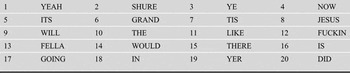
Barker and O'Keeffe (1999) lauded the moves to build corpora of Irish English and saw these as having pedagogical relevance in that they would allow for a descriptive approach to the grammar of Irish English. Now that we have corpora of Irish English, let us gather together what is pedagogically salient in terms of what we have learnt from them. As a starting point, we look at the top 30 key words from the one-million word Limerick Corpus of Irish English (LCIE) (Farr, Murphy and O'Keeffe, Reference Farr, Murphy and O'Keeffe2004). This corpus represents casual conversation in mostly everyday contexts of families and friends chatting. Note that key words are not necessarily the most frequent words in a corpus but are those with the most unusual frequency. They are calculated using software, in this case Wordsmith Tools (Scott, Reference Scott2009), which statistically compares them to a reference corpus (for more on key words, see Scott, Reference Scott, O'Keeffe and McCarthy2010 and Evison, Reference Evison, O'Keeffe and McCarthy2010). Therefore, when we compared the LCIE corpus word frequency list with the word frequency list of a larger corpus (in this case the five-million word Cambridge and Nottingham Corpus of Discourse in English), we were able to establish a keyword list based on Irish English casual conversation. Table 1 below lists the top 20 items. Vocalisations, typographical inconsistencies, extralinguistic information, proper and subject-specific nouns have been removed (e.g. aam, Limerick, laughs)
Most frequent 20 lexical items in the Limerick Corpus of Irish English

From this we can find some empirical pointers for English Language teaching in an Irish context. For example, we see items which we would expect such as ye, the Irish English form of you, which is commonly used in casual conversation. Examples from LCIE are the following:
(1) Have ye lucky bags Johnny?
Ye could have stayed no problem…
Can't believe it took ye five hours to get here.
Would ye not stay in Roscrea?
We see the discourse marker shure (note that in LCIE the Irish English usage of sure is spelt shure to make it readily distinguishable from sure in concordance searches). This is used as a mitigator or hedge in initial position. Its most common pattern of use being but shure, used to soften the effect of but in the introduction of a counter point:
(2) A: … I wasted my whole time in Dublin like. B: I know I know but shure what age was Deirdre when she started going out with Tom?
A: But that's different because I don't know … They're going out three years now so she was twenty two.
We also see the discourse marker now which has additional pragmatic functions in Irish English. Apart from its lexical use as a temporal marker and its standard uses as a discourse marker (see Aijmer, Reference Aijmer2002; Defour, Reference Defour2008), for example, marking a new phase of discourse, usually in clause initial position, it is used very often in Irish English in clause final positions within specific contexts. Research into the use of now in standard British English refers to its use predominantly in formal contexts. Aijmer (Reference Aijmer2002) notes that the largest number of examples of now are more formal than ordinary conversation and contain more structure and Defour (Reference Defour2008) notes that now is more likely than well to occur in formal contexts. However, Vaughan and Clancy (Reference Vaughan and Clancy2010) find that in LCIE, it is predominantly found in conversations between families and friends. It is within these more relational contexts that we find it used in clause-final positions, performing such functions as:
(3) Downtoning assertions: it has a softening effect on the assertion.
A:… I'd say he'd be a lot better on radio.
B: Oh he's good at current affairs now and he's very knowledgeable like …
Marking events: functioning in a deictic way to point to an event's completion.
(4) [In a shop]
Shop attendant: < sound of till > … I've all the drinks gone in there now
(5) [Family chatting about not hearing their doorbell, then the doorbell rings]
A: …t'was very awkward to be without the bell but even the other day we proved it we were inside in the kitchen … the radio was on and the television was on and we were eating and I says Joe can't you hear the doorbell there's no one there he said I said go out to the door will you? out with him and shure there was someone outside <door bell rings>.
B: Shure there you are now.
(6) Approximator: it often clusters with expressions of time in clause-final position where it operates as an approximator, marking the vagueness of the time reference.
…that's a good spell ago now
…seem like a long time ago now
…It's a good while ago now
…this is going back a while ago now
…a number of years ago now
…at least five years ago now
…some years ago now
…it must be nearly six years ago now
Evident also are the use of taboo items such as jesus and fuckin (as well as other forms in the top 50 key words). The high tolerance of taboo language in Irish English is discussed by Farr and Murphy (Farr and Murphy, Reference Farr and Murphy2009; Murphy, Reference Murphy2009). O'Keeffe and Adolphs (Reference O'Keeffe, Adolphs, Schneider and Barron2008) also allude to it in their discussion of response tokens in Irish and British English. Religious references and swearwords appear in both the British and Irish data as response tokens. However, their use in the British data is limited to God and oh God, while the Irish data comprises God, oh God and oh my God and the swear words Jesus and Jesus Christ. Here is an example from LCIE:
(7) [Friends are looking at an old school team photo and are trying to identify the people in it]
A: Ryan the oldest guy Tom Hartnett John Rodgers +
B: Oh yeah.
A: + Brian Fitz.
B: Paul Regan. [laughing].
A: Jesus Christ
B: What year is this?
A: The late nineties
Referring to the differing use and frequency of religious references O'Keeffe and Adolphs comment that it points to greater informality within the Irish data where it seems more acceptable to use Jesus as a response token.
There are two modal verbs in the top 20 key words. On exploring these in the corpus, we can audit their additional functionality in Irish English. These are will and would. Will performs its standard English functions in Irish English, such as marking certainty in the future, making predictions, expressing conditionality, expressing willingness and in the speech acts of offers and promises, requests and commands, and so on (see Carter et al, Reference Carter, McCarthy, Mark and O'Keeffe2011). However, there seems to be a very high frequency in the use of will in simple household commands and requests in family (i.e. intimate) settings. Where in another variety of English one would say Would you mind, we find in Irish English [vocative] will you…?
(8) Sean will you turn it down a bit.
Will you try and organise some B&B tomorrow or ring the hotel.
Michelle will you write on Joanne's birthday card “happy birthday from”= damn it <laughs> will you come over here and write it.
…will you wake me
Will you, will you carry them feckers away; don't leave em after you there will you?
On close examination of will in the corpus, we also find its high occurrence in the context of offers and this is attributed to the offer-refusal-reoffer sequence in Irish English, especially in the offers relating to food. O'Keeffe, McCarthy and Carter (Reference O'Keeffe, McCarthy and Carter2007) and Barron (Reference Barron, Barron and Schneider2005) have looked at this in greater detail through corpus-based analyses and discourse completion tasks, respectively. The following exchange from LCIE shows how this reoffering manifests and hence the use of will in its manifestation:
(9) A: Will you drink a sup of tea will you? Will you drink a sup of tea will you? Do you want orange or milk?
B: Who said I don't want no ice-cream?
C: I don't want ice-cream.
A: You don't want no ice-cream. Do you not like ice-cream?
C: No.
B: Is there wafers? Is that plain ice-cream?
A: Tis.
B:That's nice ice-cream. Grand now. Mairead that's fine. <baby playing in the background >
A: Will you eat a bit of ice-cream? Come here and I'll give you some ice-cream. Come on.
We see a directness about the offering and reoffering. As O'Keeffe et al. (Reference O'Keeffe, McCarthy and Carter2007) and Barron (Reference Barron, Barron and Schneider2005) note, it is a cultural norm of politeness in Irish English to refuse a first offer. This poses a challenge for offers of food, etc. in trans-cultural contexts.
The uses of will point to directness or baldness in relation to commands, requests and offers in family discourse in Irish English which is consistent with Clancy's (Reference Clancy, Barron and Schneider2005) study of Irish English in family contexts. As a counterpoint to this seeming directness in family contexts, we find the opposite in relation to the use of would. As has been noted by Farr and O'Keeffe (Reference Farr, O'Keeffe, Reppen, Fitzmaurice and Biber2002) in an in-depth corpus-based study of the use of would, its use in Irish English exceeds that of British or American English and they account for this in its use as a hedge to mitigate or downtone the force of assertions. Most specifically, there is a strong usage pattern for would within Irish English to downtone uncontroversial facts. Hence it is the downtoning of non-disputed propositions. Here are some examples from the corpus and we compare them with their unhedged versions:
(10) Lahinch would be a good surfing beach. Unhedged: Lahinch is a good surfing beach (Lahinch is the largest surfing beach in Ireland)
[referring to the location of a coffee shop] It would be across the road from say Ryan's … Unhedged: It is across the road from Ryan's.
Our boys would be big into sports… Unhedged: Our boys are big into sports.
She would be eleven years dead now. Unhedged: She is eleven years dead now.
In a pedagogic sense, this use of would with propositional assertions which are not in doubt may be quite confusing for non-native speakers of English who will associate this use of would with uncertainty. Farr and O'Keeffe also noted its use in face-threatening situations such as teaching practice critiques, where the teacher trainer uses I would when she really means you should:
(11) Trainee: …[is] it a good idea to leave them where they are?
Trainer: It depends on what you're doing like ah for this oh if [they] had finished this exercise I would have have told them they could go +
Another word on the key word list which we will focus on in terms of its importance, in a pedagogical sense of raising awareness of the differences between Irish and other varieties of English, is the definite article. To put it in context, the is usually the first or second most frequent word in any corpus so its appearance in the top 20 keywords points to some salience or extra functionality in Irish English. On perusal of the corpus data, one finds it frequently used in place of other determiners. For example, in other varieties, your would be more likely in this example:
(12) Do you want cash back off the Laser? [Laser is a type of bank card]
Or a pronoun would be used in the following:
(13) …did she say anything about Bridín and the boyfriend in the letter?
And I says, “How's the new girlfriend?”
The following nouns (chemistry and dinner) would have no determiner (zero determiner):
(14) I'm not even sure what's on the course this year. Apparently, the chemistry and physics is dropped.
…he must be on the dinner duty…
Finally, we look at tense and time reference. One of the signature, if not caricaturing, forms in Irish English is the be + after + Verb-ing structure which is used in certain contexts where the present perfect would ordinarily be used. Examples from LCIE:
(15) …I'd say tonight is after getting colder.
(British English equivalent: I'd say tonight has just got colder.)
O'Keeffe and Amador-Moreno (Reference O'Keeffe and Amador-Moreno2009) explored its use in LCIE. They found the form to be very prevalent and they outline its main functions as;
1) The immediacy/recency of outcome function: This has been well-documented (Filppula, Reference Filppula1999; McCafferty, Reference McCafferty2004, and Ronan, Reference Ronan, Filppula, Klemola, Palander and Penttilä2005; Hickey, 2007a) and it refers to actions, events or changes of state that have happened in the very recent past. 32% (n = 30) of all uses of the structure fall into this category:
(16) [talking about a baby]:
He's after getting up a load of wind
…Your tart is just after falling down your lap.
2) The narrative function: Kallen (Reference Kallen and Cheshire1991) noted the frequent use of the structure in narrative situations. O'Keeffe and Amador-Moreno found 32% (n = 30) of all occurrences of the be after + V-ing structure in narratives:
(17) They were coming out there by Kiely's cross. They were just after coming up the main road, next thing they saw these legs sticking out across the road…
These crowds were going down from Ennis they were after leaving a christening in Ennis. The fella who was coming up against him he veered across the road. …
3) The news marking function: O'Keeffe and Amador-Moreno found 26% (n = 25) of all occurrences of the be after + V-ing structure in a news marking context. That is where it marked new, often surprising information between the speaker and the listener(s). Rather than functioning as a narrative device they argue, it operates more akin to a discourse marker because it flags up new information for the listener. Harris (Reference Harris1984) encapsulates this by referring to this as the ‘hot news’ function. The structure therefore acts as a pragmatic marker in this context, both marking new information and also intensifying it for the listener.
(18) …my Dad's over there and my sister's over there [‘over there’ refers to the United States of America] and my brother's after moving to San Francisco so I'll be at home on my own.
I’m after having two driving lessons this week and I could go for another one tonight.
Conclusion
In summary, while we cannot conclude that there is a thriving cohort of learners of Irish English, there are a lot of English language teachers who are Irish around the world and there are a lot of learners who come to Ireland to learn English, among them the immigrants from Eastern Europe who came in the mid-2000s to avail themselves of work opportunities. Even more so, much of the Irish economy involves global trade and interaction with people through English in a global context. In the light of these factors, the overarching point of this article has been to highlight that:
1) Irish English is one of many robust native varieties of English
2) Its nuances manifest themselves in the spoken rather than written domain and most of all in relation to the pragmatics of what we say (or don't say).
This last point is the most important. Irish English is English spoken by Irish people and they bring with them their cultural code for how to interact along with their own politeness norms. These norms often involve choice of lexis or grammar but what underlies them is pragmatic meaning. Pragmatics is a minefield in a trans-cultural context and the better we understand the nuances of Englishes (or any other language used trans-culturally), the less we are prone to pragmatic failure (Thomas, Reference Thomas1983).
One of the main ways in which students of English around the world encounter Irish English forms is through the Irish literary canon (Joyce, Yeats, Beckett, Heaney and other major writers). Speech representation within the canon of Irish English literature is a very good starting point for the study of Irish English in class and it is through this route that most international scholars of Irish English first came to be interested in this variety. A mature example of this approach is Amador-Moreno (Reference Amador-Moreno2010), which offers some innovative classroom tasks based on Irish English literature, texts and corpus data, all illustrating the richness of Irish English and the cultural context it encodes.
 ANNE O'KEEFFE, senior lecturer at Mary Immaculate College, University of Limerick, Ireland, is author of numerous publications, including: Introducing Pragmatics in Use (2011) with Brian Clancy and Svenja Adolphs; English Grammar Today (2011) and English Grammar Today Workbook (2011) with Ronald Carter, Michael McCarthy and Geraldine Mark (Cambridge University Press); From Corpus to Classroom: language use and language teaching (2009) with Ronald Carter and Michael McCarthy (Cambridge University Press); The Vocabulary Matrix (2009) with Michael McCarthy and Steve Walsh (Heinle); Investigating Media Discourse (2006 Routledge) and The Routledge Handbook of Corpus Linguistics (2010), co-edited with Michael McCarthy. Email: Anne.okeeffe@mic.ul.ie