Introduction
Research into code switching traditionally focuses on either its sociolinguistic or its grammatical aspects. Early research focusing on grammatical aspects of code switching investigated the possibility of constraints governing where in a sentence codes may be switched (see Lance, Reference Lance, Hernandéz-Chavéz, Cohen and Beltramo1975; Timm, Reference Timm1975; Lipski, Reference Lipski and Paradis1978; Pfaff, Reference Pfaff1979). Subsequent investigations into this possibility led to the proposal of a number of specific constraints on code switching. Poplack (Reference Poplack1980), for example, proposed the Free Morpheme Constraint, which holds that codes may be switched after any constituent which is not a bound morpheme, and the Equivalence Constraint, according to which codes will tend to be switched at points in the discourse where the syntactic rules of neither language are broken by the juxtaposition of the two codes; in other words, where the word order of both languages remains intact. Di Sciullo, Muysken and Singh (Reference Di Sciullo, Muysken and Singh1986) proposed the Government Constraint, by which a governed category must have the same language index (i.e., be of the same language) as its governor. Belazi, Rubin and Toribio (Reference Belazi, Rubin and Toribio1994) proposed the Functional Head Constraint, by which “the language feature of the complement f-selected by a functional head . . . must match the corresponding feature of that functional head” (Belazi et al., Reference Belazi, Rubin and Toribio1994, p. 228). These and other studies leading to the proposal of grammatical constraints on code switching have typically been carried out within the framework of particular (sometimes implicit) theories of grammar, the theory differing somewhat from one researcher to the next. Thus, in the literature, one finds that researchers apply different theories, or different interpretations of the same theory. Furthermore, the manner in which the theory is applied may differ from one researcher to another. The proposals of constraints have also typically been based on the study of a particular code-switching corpus, and have upon later testing against other corpora of the same or another language pair been found to provide a less than adequate account of the data.
Besides failing cross-linguistic empirical testing, such proposals have been subject to much debate regarding their theoretical validity. The argument against the theoretical validity of constraints specific to code switching is that they necessitate the postulation of a so-called “third grammar”, i.e., a set of rules over and above those of each language which governs the mixture of the two in code switching. In the interests of theoretical simplicity, the proposal of such a third grammar should be avoided unless forced by the data under analysis. In this regard, Pfaff (Reference Pfaff1979) was among the first to argue against the need to posit a third grammar, and Clyne (Reference Clyne1987, p. 762) suggests that code switching may be “governed by the kinds of structural constraints applying to monolingual performance”. The above-mentioned research leading to the Government and the Functional Head Constraints, for example, instantiate attempts to apply grammatical theory developed to account for monolingual phenomena to code-switching data. However, neither proposal remains in line with current developments. In the first instance, the notion of Government no longer features in current Chomskyan syntax (see Cook and Newson, Reference Cook and Newson1996), and in the second, a language feature never did. MacSwan (Reference MacSwan1999, Reference MacSwan2000) adopts what he terms a “minimalist approach” to the analysis of code switching – where the aim is to make use of the minimal theoretical apparatus – and concludes that fruitful research into structural aspects of intrasentential code switching can be carried out within the framework of minimalist syntax (see also MacSwan, Reference MacSwan, Bhatia and Ritchie2004, Reference MacSwan2005; Gonzalez, Reference Gonzalez2007). Such research, aiming to avoid the postulation of constraints specific to code switching, or a third grammar, is in line with Chomsky's (Reference Chomsky1995a, Reference Chomsky, Martin, Michaels and Uriagereka2000) central aim in the minimalist program, namely to eliminate mechanisms that are not necessary on conceptual grounds, to make only the minimal theoretical assumptions to account for linguistic data. The work presented here is in line with such a research program.
The present study investigated the possibility of accounting for the structure of English–Afrikaans intrasentential code switching within the framework of feature checking theory, a theory associated with minimalist syntax. The proposal was that the assumptions and devices associated with minimalist syntax (specifically, feature checking and related principles and operations) would provide an adequate framework within which to characterise and explain the structural aspects of English–Afrikaans intrasentential code switching. In terms of such a proposal, the same grammatical principles that account for monolingual phenomena may also account for intrasentential code-switching phenomena. The present study focused on six constructions in which surface word order differs between English and Afrikaans, namely constructions containing adverbs, focalisation and topicalisation constructions, that and wh embedded clauses, and yes-no questions. These surface word-order differences were analysed within the framework of feature checking theory, where syntactic movement is proposed to be driven by the need to check strong features. The differences, all involving verb position, were reduced to differences in the strength of certain features and the ability of the verbs of either language to check these features. On the basis of these analyses, predictions were made for the well-formedness of constructions in which English and Afrikaans are switched. The constructions tested contained intrasentential code switching, this type of switching being considered more problematic for syntactic theory than inter- or extrasentential switching, in that the two languages are mixed within such circumscribed linguistic units as the clause or even the word. Before considering the syntactic analyses and predictions, the methodology employed, and the results for each construction, a brief overview of the South African context is given below.
The South African context
With eleven official languages, as well as many more languages and varieties besides, bilingualism is the norm in South Africa, with language contact phenomena such as code switching, borrowing, and interference being commonplace. English may be regarded as the country's dominant language, being the lingua franca in political and economic spheres, and being regarded as the mechanism for upward social and educational mobility, allowing access to the global arena. Afrikaans traditionally enjoyed a strong presence in the political arena and for government-related functions, but recent efforts have been aimed at increasing the use of the nine official Bantu languages (particularly isiXhosa, isiZulu, and seSotho) for government-related functions such as legal services and education. With regard to English–Afrikaans bilingualism, such bilingualism is widespread among certain sectors of the population. The present study was conducted on the campus of Stellenbosch University, a historically Afrikaans University which has retained Afrikaans as a primary language of instruction, in conjunction with English (see Language Policy and Plan of the Stellenbosch University, 2002). In the Western Cape Province, where Stellenbosch University is located, most secondary schools use either English or Afrikaans, or both, as the primary language(s) of instruction, with some schools offering isiXhosa as a subject and/or using isiXhosa for some instruction. The majority of students entering Stellenbosch University have some degree of bilingualism in English and Afrikaans. The present study was conducted among students of the Arts faculty, which has followed a dual language policy since 2002, by which undergraduate instruction is carried out in both English and Afrikaans. (Every lecturer is required to use both languages in every class, with the aim of adequately covering the work in both languages. Afrikaans is used for at least 50% of the lecture.) In this bilingual campus environment, code switching is common in conversation among lecturers and students alike. Typical examples, recorded in spontaneous conversation among fluent English–Afrikaans bilinguals, are given in (1) and (2), illustrating intrasentential and intersentential code switching, respectively. (Switch points are indicated in this paper by means of a switch from regular to italicised script, with no suggestion that one or the other language is in any way dominant.)
(1)

“You have no idea how quickly I've been throwing this together.”
(2)
“Thank you for giving me money”
“It's like, thank you for giving me money, now here's your money.”

A number of studies have focused on sociolinguistic aspects of code switching between and among a variety of languages in South Africa. Some have investigated its functions in various communities (Finlayson and Slabbert, Reference Finlayson and Slabbert1995, Reference Finlayson, Slabbert and Pütz1997; Finlayson, Calteaux and Myers-Scotton, Reference Finlayson, Calteaux and Myers-Scotton1998), whereas others have focused on the educational setting (Adendorff, Reference Adendorff1993; Kieswetter, Reference Kieswetter1995; Ncoko, Osman and Cockroft, Reference Ncoko, Osman and Cockroft2000; Ramsay-Brijball, Reference Ramsay-Brijball2004; Rose and Van Dulm, Reference Rose and Van Dulm2006). Relatively little research has focused on grammatical aspects of code switching among South African languages, with no comprehensive study of the structural aspects of English–Afrikaans intrasentential code switching. This language pair is interesting as an object of code-switching research because (i) the two languages have been used side by side (and mixed) in a wide range of sociolinguistic contexts and population groups since the birth of Afrikaans around the turn of the 18th century (Raidt, Reference Raidt, Botha, Ponelis, Combrink and Odendal1989; Ponelis, Reference Ponelis1993; Roberge, Reference Roberge1993); and (ii) despite being typologically similar, the two languages exhibit some morphosyntactic differences, for example in verb position and the overt (phonological) realisation of grammatical features such as tense and agreement. Such morphosyntactic differences between the two languages in a code-switching pair make the analysis of its structural aspects all the more interesting.
Analyses and predictions
To provide the background for the syntactic analyses developed in the present study, and the resulting predictions for code switching, a brief introduction to the relevant mechanisms and devices of minimalist syntax is given here. Chomsky (Reference Chomsky1995a) proposes that a language consists of two components, namely a lexicon and a computational system for human language (CHL). The lexicon specifies the lexical items with their idiosyncratic features. CHL derives a linguistic expression, also termed a “structural description” (SD), on the basis of a selection of lexical items, the Numeration N (more recently termed the “lexical array”) (Chomsky, Reference Chomsky1995a; Reference Chomsky, Martin, Michaels and Uriagereka2000). The derivation proceeds as the operation Merge strings the lexical items together in binary fashion, and the operation Move carries out the necessary movement of lexical items in CHL, the so-called “narrow syntax”. A linguistic expression of a language L is then a pair (π, λ), where π is a phonetic form (PF) representation, and λ a logical form (LF) representation. The PF representation contains elements relevant at the articulatory–perceptual (A–P) interface, while the LF representation contains elements relevant to the conceptual–intentional (C–I) interface, the A–P and C–I systems being the two performance systems with which the language faculty must interact (Chomsky, Reference Chomsky1995a), i.e., for which the linguistic expression, the output of the language faculty, must provide instructions. Chomsky (Reference Chomsky and Webelhuth1995b) posits that π and λ are “differently constituted”, implying that elements interpretable at the PF interface are not interpretable at the LF interface, and vice versa. At Spell-Out, the elements relevant only to PF are stripped away and mapped onto π, while the remainder continue in the computation to LF to be mapped onto λ (Chomsky Reference Chomsky and Webelhuth1995b). A distinction is made between the so-called “overt syntactic component”, operating before Spell-Out, and the “covert syntactic component”, operating after Spell-Out. Thus, for instance, movement that occurs in overt syntax will be visible (spelled out) at PF, while movement that occurs in covert syntax will not be reflected in the structure produced.
On the basis of universal and invariant principles and fixed language-specific parameter settings, a language L determines an infinite set of SDs, each a (π, λ) pair. A derivation is said to “converge” if it produces a legitimate SD, and to “crash” if it does not (Chomsky, Reference Chomsky1995a). Within the principles and parameters framework, there exists what may be referred to as a “convergence framework”, in that the checking of uninterpretable features occurs in order that a convergent derivation may be reached, i.e., in order that features which cannot be interpreted at the relevant interface are deleted in the course of the derivation, thereby satisfying the principle of Full Interpretation (Hornstein, Nunes and Grohmann, Reference Hornstein, Nunes and Grohmann2005). With regard to feature checking, Move is the operation whereby lexical items can move in order that feature checking can take place. Specifically, elements are moved in order that the uninterpretable features associated with functional categories may be checked. A central notion is that of feature strength. Chomsky (Reference Chomsky and Webelhuth1995b) proposes that a strong uninterpretable feature necessitates movement in the narrow syntax (overt movement, visible at PF), whereas a weak uninterpretable feature does not. In the case of a weak feature, the principle of Procrastinate entails that checking is postponed until the covert syntactic component (covert movement, not visible at PF). The parameters of the principles and parameters framework are proposed to lie in the strength of uninterpretable features, as movement occurs in order that strong features may be checked. To illustrate, language A may differ from language B in terms of the strength of feature x; this parametrical difference between the two languages will be reflected by a difference in movement requirements, i.e., language A with strong feature x on functional head X will require movement of a lexical item to the specifier (Spec) or head position of the XP, while language B with weak feature x requires no such movement. Thus, a difference in the strength of feature x results in a difference in surface word order between languages A and B. Movement for the purposes of feature checking is said to be triggered by the need to eliminate strong uninterpretable features from the computation (Hornstein et al., Reference Hornstein, Nunes and Grohmann2005).
The present study adopts the above-mentioned principles and parameters, and convergence frameworks, according to which feature checking is the device which brings about convergence, and parametric differences between languages lie in differences in feature strength. Feature checking theory is thus the core theory. In terms of its application to code-switching data, feature checking theory would predict that the functional category operates as a determinant of well-formedness in code-switched constructions, in that the feature checking requirements of each functional category must be met in order for the derivation to converge. The implication in the case of code switching, where the functional category systems of two languages are involved, is that a functional category has a language-specific identity which plays a role in code switching. The suggestion is not that there is a language feature associated with a functional category, but that a functional category must possess a language-specific identity in order that parametric variation between languages may be proposed to lie in the feature checking requirements of their functional categories. Every functional category therefore has certain language-specific feature checking requirements which must be met in order that a particular derivation may converge. An Afrikaans finiteness phrase (FinP), for example, may be proposed to possess a strong finiteness feature requiring overt movement for checking, whereas an English FinP may not. As a further example, an English tense phrase (TP) may be proposed to possess a weak tense feature, and so a verb moving to T would cause the derivation to crash.
Note that, in addition to the above-mentioned parametric differences in the relative strength of features associated with functional categories, parametric differences in terms of syntactic features associated with particular lexical items need to be recognised. As mentioned by Hornstein et al. (Reference Hornstein, Nunes and Grohmann2005), a lexical item consists of a set of phonological, semantic, and formal (syntactic) features. Thus, the formal feature make-up of a particular lexical item in language A may differ from its counterpart in language B, rendering the two different in their feature checking capabilities. For the code-switched constructions under investigation here, the proposal is that an Afrikaans verb differs from an English verb in terms of its formal feature make-up, such that the verbs of the two languages differ in their ability to carry out particular checking operations.
The predictions for each of the code-switched constructions discussed in the subsections below suggest what would constitute well-formed and ill-formed code-switched structures. In each case, a prediction of well-formedness corresponds to a structure in which the necessary feature checking has taken place, while a prediction of ill-formedness corresponds to a structure in which the requisite feature checking has not taken place. The features involved in the analyses and predictions include the finiteness feature of the head of the Finiteness phrase (FinP), the tense feature of the head of the Tense phrase (TP), and the Q feature of the head of the Question phrase (QP). For that and wh embedded clauses, the N-feature of the Agreement-Object phrase (AgrOP) is also involved in the analysis. These features, all associated with functional categories, may be checked, if necessary (i.e., if strong), by the movement of a lexical item capable, in terms of its formal feature make-up, of carrying out the checking operation (i.e., a lexical item of the appropriate language, in the case of verbs). The movement of a lexical item may entail the movement of an XP into the Spec position, or the movement of a head into the Head position, of the functional projection. Within this model, a strong feature remaining unchecked will cause the derivation to crash, as will the movement of a lexical item not driven by the need to check a feature. Such a crash implies a code-switched structure predicted here to be ill-formed.
Before continuing with the predictions, a number of assumptions relevant to the present work must be explicated. Firstly, it is assumed that the complementiser system, the CP, may be split into various subcategories (see Rizzi's Reference Rizzi and Haegeman1997 analysis of the CP into a Force phrase (ForceP), Topic phrase (TopP), Focus phrase (FocP), and FinP). The whP or QP is assumed to be one of the projections in this left periphery (Hoekstra and Zwart, Reference Hoekstra and Zwart1994; Rizzi, Reference Rizzi, Cinque and Salvi2001). Secondly, the head of each of these categories in the Afrikaans CP is assumed to possess strong tense and finiteness features, while the head of each of these categories in the English CP is assumed to possess weak tense and finiteness features. Thirdly, it is assumed that adverbial phrases (AdvPs) are adjuncts, subject to the operation Adjoin, rather than Merge, and that AdvPs adjoin to the verb phrase (VP) (see Adger, Reference Adger2003, for an exposition of this view). Finally, it is assumed that Afrikaans is, like English, an SVO language (see Kayne, Reference Kayne1994, who argues that all languages are underlyingly Spec–Head–Comp, of which SVO is a more surface-oriented interpretation).Footnote 1 Zwart (Reference Zwart1997) offers an analysis of Dutch as SVO, on the basis of which Afrikaans may also be argued to be SVO (see also Oosthuizen, Reference Oosthuizen1998, who presents an analysis of Afrikaans as SVO). Specifically, Zwart (Reference Zwart1997) suggests that the object DP raises to Spec of AgrOP in both main and embedded clauses (see (3) and (4) below, respectively), leaving the verb in its base-generated position, and yielding an SOV structure. This movement of the object DP is triggered by the presence of a strong N-feature in AgrO. The parametric difference between English and Afrikaans, in this case, is that English possesses a weak AgrO feature (see also Koster and Zwart, Reference Koster, Zwart, Hoop and Wouden2000).
(3)
(4)
Constructions with adverbs
The position of the verb differs between English and Afrikaans in constructions with adverbs, where the verb moves to the left in Afrikaans but not in English, as exemplified in (5) and (6).
(5) He often buys sweets.
(6)
This difference in verb position between English and Afrikaans may be accounted for by the proposal that, in Afrikaans adverbial constructions, the main verb raises to check the strong tense and finiteness features of the heads of TP and FinP. In both the English and the Afrikaans structures, there is left adjunction of the AdvP to the VP. Regarding constructions with adverbs in which there is code switching between English and Afrikaans, the prediction is that an Afrikaans verb must raise to the left of the adverb to check the strong tense and finiteness features of TP and FinP, respectively, whereas an English verb must remain in situ to the right of the adverb, and may not raise to the left. Thus, the position of the verb in code-switched constructions with adverbs is determined in the same manner as in monolingual constructions, namely by the strength of the tense and finiteness features of TP and FinP, respectively, and by the ability of the verb to check these features. The relevant predictions are reflected in (7) and (8), where the verb must be in its language-appropriate position in order for the construction to be well-formed.
- (7)
a.
b. *My elderly grandfather gewoonlik kies the soft white meat.
- (8)
a.
b. *Daardie prokureur hates clearly sy lui sekretaresse.
Focalisation constructions
Focalisation entails the preposing of a constituent expressing new information, pronounced with focal stress, followed by constituents expressing shared information in the open sentence (Crystal, Reference Crystal1991; Rizzi, Reference Rizzi and Haegeman1997). English and Afrikaans differ with regard to the position of the verb in focalisation structures, as exemplified in (9) and (10).
(9) With my change I buy sweets.
(10)
The difference in verb position between English and Afrikaans in these constructions is proposed to arise from the same differences in feature strength as apply in the adverb constructions discussed above. Specifically, it is proposed that, in Afrikaans focalisation structures, the main verb moves leftward to check the strong tense and finiteness features of the heads of TP and FinP, respectively, finally landing in the head of FocP. The heads of English TP and FinP, on the other hand, possess no such strong features, hence no movement of the English verb occurs. Turning to focalisation structures in which there is code switching between English and Afrikaans, the prediction is that an Afrikaans verb must raise first to TP and then to FocP to check their strong tense and finiteness features, respectively, whereas an English verb must remain in situ as the TP and FocP possess no strong tense and finiteness features. Thus, the position of the verb in code-switched focalisation structures is once again determined in the same manner as in monolingual constructions, namely by the strength of the tense and finiteness features of the CP heads, in addition to the ability of the verb to check these features. The relevant predictions are reflected in (11) and (12), where the verb must be in its language-appropriate position in order for the construction to be well-formed.
- (11)
a.
b. *The tall plastic containers daardie kok gebruik or brown sugar.
- (12)
a.
b. *Die helder rooi blomme grows she onder in haar tuin.
Topicalisation structures
Topicalisation involves the preposing of a constituent which expresses so-called “old information”, i.e., information which is somehow known to the speaker-hearers involved, in order that it functions as the topic of the sentence (Crystal, Reference Crystal1991; Rizzi, Reference Rizzi and Haegeman1997). For purposes of the present study, the topicalisation constructions generated for testing consisted of two sentences; the first sentence introduced a piece of information, the second topicalised this information. The position of the verb in topicalisation structures differs between English and Afrikaans, as exemplified in (13) and (14).
(13) Do you see the girl with the glasses?
That girl I know.
(14)
This difference in verb position in topicalisation structures is proposed to arise in the same way as in the focalisation structures discussed above.Footnote 2 Specifically, it is proposed that, in Afrikaans topicalisation structures, the main verb moves to check the strong tense and finiteness features of the heads of TP and TopP. English, on the other hand, requires no such verb movement in topicalisation structures, as the tense and finiteness features of the heads of the CP functional categories are weak. Concerning verb position in topicalisation structures containing English–Afrikaans code switching, the relevant predictions appear in (15) and (16), where once again the surface word order is derived from movement for purposes of feature checking; the Afrikaans verb moves to check the strong tense and finiteness features of the CP projections, whereas the English verb does not.
- (15)
a.
b. *My favourite shop is in the old district
That shop ek besoek every week.
- (16)
a.
b. *Die soldate het die grenspos aangeval.
Daardie noodlottige aanval regret the leaders elke dag.
Embedded that clauses
The position of the verb in an Afrikaans embedded dat “that” clause differs from that in an English embedded that clause, as exemplified in (17) and (18).
(17) I know that he sees the students.
(18)
Recall the assumption outlined above that Afrikaans patterns like Dutch in terms of its underlying SVO structure and the movement of objects to AgrOP due to the presence of a strong N feature in AgrO. The difference between English and Afrikaans, in this instance, is that English AgrO has a weak N feature. Note that the strong tense and finiteness features of the heads of the Afrikaans CP projections are in this case checked by dat.Footnote 3 In embedded that and dat clauses where English and Afrikaans are switched, it is predicted that both English and Afrikaans verbs must remain in situ. Furthermore, the Afrikaans object DP must move to the left of an Afrikaans verb, while the English object DP may not move. The predictions appear in (19) and (20).
- (19)
a.
b. *The author said that the youngster lees die boeke.
- (20)
a.
b. *Die uitslae dui aan dat die mense the sympathetic president like.
Embedded wh clauses
Embedded wh clauses also reflect the different verb positions in English and Afrikaans, as can be seen in (21) and (22).
(21) I wonder when he washes his car.
(22)
The case of embedded wh clauses is the same as that of embedded that clauses discussed above, in accordance with the assumption that Afrikaans is underlyingly SVO and the Afrikaans object moves to AgrOP due to the presence of a strong N feature in AgrO, whereas the English object remains in situ to the right of the verb.Footnote 4 Note that the strong tense and finiteness features of the heads of the Afrikaans CP projections are in this case checked by wanneer.
It is important to note at this point that an alternative embedded wh structure occurs commonly in spoken Afrikaans, as reflected by the sentences in (23). The acceptability of such V2 constructions in spoken Afrikaans is attested in Oosthuizen (Reference Oosthuizen1996) and Biberauer (Reference Biberauer2002, Reference Biberauer2003). Such constructions have also been found to occur in Belfast English (Henry, Reference Henry1995) and Hiberno English (McCloskey, Reference McCloskey, Zanuttini, Campos, Harburger and Portmer2005). The predictions below, however, are based on the standard Afrikaans structure reflected by (22).
- (23)
a. Ek wonder wanneer was hy sy motor.
b.
The predictions for embedded wh clauses in which English and Afrikaans are switched are similar to those for that embeddings, in that both English and Afrikaans verbs must remain in situ, and the Afrikaans object DP must move to the left of the Afrikaans verb, while the English object DP may not move. The predictions appear in (24) and (25).
- (24)
a.
b. *His divorce lawyer asks him why he verkies daardie tipe kontrak.
- (25)
a.
b. *Die gaste vra wanneer die restaurante in the evening close.
Yes-no questions
Verb position in yes-no questions also differs between English and Afrikaans. An Afrikaans yes-no question is formed by movement of the main verb to the sentence-initial position, whereas an English yes-no question is formed by do-insertionFootnote 5 (see Adger, Reference Adger2003, for an exposition of do-insertion). This difference is exemplified in (26) and (27).
(26) Do you understand the work?
(27)
The difference between the English and Afrikaans yes-no question constructions is proposed to follow from a difference in the manner in which the strong Q feature of the QP is checked – by do-insertion in English and by verb movement in Afrikaans – the verb moves leftward in Afrikaans in order to check the strong tense and finiteness features of the heads of the CP projections, as well as the strong Q feature of the QP. Concerning yes-no questions in which switching occurs between English and Afrikaans, it is predicted that the strong Q feature of the English QP must be checked by the insertion of do; movement of an English verb into this position is predicted to be ill-formed. Furthermore, the strong tense and finiteness features of the Afrikaans TP and FinP, and the strong Q feature of an Afrikaans QP, may only be checked by an Afrikaans verb, and not by an English verb. The relevant predictions appear in (28) and (29).
- (28)
a.
b. *Drive daardie inwoners the same small vehicles?
- (29)
a.
b. *Does the book on animals verduidelik hulle kommunikasiesisteme?
Data to inform the predictions outlined above were gathered by means of experimental techniques which tapped participants’ receptive judgements of well-formedness in both visual and auditory modalities, as well as their production of code-switched sentences. The data gathering procedures are briefly outlined below.
Data gathering procedures
While much research on code switching is based on spontaneously occurring naturalistic data, the ability of such data to inform questions or predictions regarding specific constructions such as those discussed above is limited, in that a large corpus of spontaneous data may yield very few, if any, utterances containing the target constructions. The motivation for code-switching research targeting such specific constructions lies in the possibility of applying syntactic theories developed to account for monolingual phenomena to code-switching phenomena. Such research is essential to the extent that any theory accounting for monolingual language use must account for bilingual language use as well. For the purposes of such research, focused on particular code-switched constructions, it is necessary to turn to experimental techniques in order to generate data on the basis of which the merit of specific predictions may be evaluated. A further motivation for the use of experimental methodologies lies with the Chomskyan distinction between competence and performance (Chomsky, Reference Chomsky1965), in that the linguistic performance of a speaker does not necessarily accurately reflect his/her underlying knowledge.Footnote 6 In its most basic form, such an experimental methodology involves judgements of well-formedness (or “acceptability”), similar to the grammaticality judgements often applied in the field of syntax to monolingual structures. A typical grammaticality judgement task may, for example, require a participant to consider the sentence I likes dogs and label it as either “grammatical” or “ungrammatical”. As noted by Cornips and Poletto (Reference Cornips and Poletto2005, p. 941), “questions about the (un)grammaticality of syntactic features may provide insight into a speaker's competence far more readily than spontaneous speech data do”. Furthermore, the elicitation of well-formedness judgements opens a window on participants’ reactions to sentence types that do not readily occur in corpora of naturalistic data (Cornips and Poletto, Reference Cornips and Poletto2005). Schütze (Reference Schütze1996) also notes the advantages of well-formedness judgements, for example that they allow one to examine sentences that seldom occur in spontaneous speech, and that they allow one to gather negative evidence.
A typical well-formedness judgement task requires absolute judgements, where the participant assigns a category to a given construction, typically choosing one of two categories, for example, “acceptable” or “unacceptable”. A shortcoming of such absolute judgements is that the informant's response is constrained by the categories available, and possible differences among members of a particular category cannot be indicated. The use of relative judgements overcomes this problem, where a participant is required to judge the relative well-formedness of a sentence in relation to one or more other sentences (Sorace, Reference Sorace, Ritchie and Bhatia1996).
The experimental paradigm for the present study was formulated on the basis of the issues discussed above. The following sub-sections briefly describe the participants and the tests they were required to complete in order to generate data on the structural aspects of English–Afrikaans intrasentential code switching.
Participants
The participants were 30 students in the Arts faculty at Stellenbosch University, varying in age between 18 and 26 years, with an average age of 20.2 years. All participants were fluent in standard South African English and standard Afrikaans. Their bilingual proficiency was evaluated by means of (i) self-evaluation, (ii) informal evaluation by the researcher, (iii) idiom completion items in a pre-test, and (iv) grammaticality judgement items in the pre-test. Of the 30 participants, 9 were English mother-tongue speakers and 21 Afrikaans. The identification of “mother tongue” was based on which language a particpant used most at home while growing up. Every effort was made, however, to ensure that participants were fluent bilinguals (see (i)–(iv) above), in cognisance of the fact that the linguistic competence of even a near-native L2 learner in his/her L2 may not resemble that of a fully bilingual speaker. Indeed, statistical analysis of the results revealed no consistent effect of the mother tongue of the participant (see the “Results” section below). Participants were further required to exhibit a neutral or positive attitude toward code switching, as a negative attitude may confound the validity of results (see Pfaff, Reference Pfaff1979, according to which speakers have been known to reject as impossible the sentences they themselves have uttered). Attitude toward code switching was also evaluated by means of items in the pre-test. Finally, participants had followed at least one year of General Linguistics, and/or Applied English Language Studies, and/or English Studies (with an English Linguistics module), and so had some knowledge of bilingual phenomena such as code switching. Further instruction as to the nature of the study and the specific tests was given to all potential participants during a training session preceding the pre-test.
Relative judgement task: visually-presented sentence pairs
Participants carried out the visual well-formedness test on WebCT, the online learning and teaching environment on the Stellenbosch campus. The test consisted of 52 items. The first two items presented the written instructions for the test. Following this, 50 sentence pairs were presented. The first two sentence pairs were practice items, and did not target any of the predictions. The following 48 pairs consisted of eight pairs for each of the six predictions, presented in randomised order. Of the eight pairs for each prediction, four contained Afrikaans verbs and four contained English verbs. In each pair, one was the code-switched structure predicted to be judged well-formed and the other the code-switched structure predicted to be judged ill-formed. The order of well- and ill-formed structures was also randomised. Each sentence pair was presented individually and could not be re-visited. For each pair, participants had to select which sentence was in their opinion “more well-formed”. Participants were instructed to ignore what they thought might be “right” or “wrong”, and to make their selection on the basis of which of the two sentences they would be more likely to consider acceptable in informal conversation between fluent bilinguals. In this way, attention was shifted away from the notion of grammaticality, often a confounding factor in well-formedness judgements (Schütze, Reference Schütze1996). Content lexical items in all test items were selected from the middle range of the lemmatised frequency list generated by Kilgarriff (Reference Kilgarriff1998) on the basis of the British National Corpus. Homonyms and cognate pairs were avoided, as were established loanwords. The composition of the test items was varied to the extent possible without affecting the target structure. For example, within each set of eight items per target structure, some items contained a pronominal subject and others a full DP, some items contained an adverbial phrase and others a direct object, and still others a prepositional phrase. This variation in item composition was considered necessary so as not to restrict the judgements elicited to a specific instantiation of each target structure. The length of items, in terms of number of lexical items, was kept as constant as possible. Example pairs for each of the six predictions are given in (30)–(35), with the predicted well-formed structure first in each case.
(30) Adverbs
a.
b. The crazy policeman skielik gryp his partner's gun.
(31) Focalisation
a.
b. Such friendly neighbours sy nooi to all her parties.
(32) Topicalisation
a.
b. Die gebou veroorsaak probleme. Daardie probleme handles the developer tydens vergaderings.
(33) That embeddings
a.
b. The auctioneer reports that the sculptures verkoop teen ‘n hoë spoed.
(34) Wh embeddings
a.
b. The crew ask why their vessel bly in die hawe.
(35) Yes-no questions
a.
b. Enjoy jou getroude vriende such old music?
Relative judgement task: auditorily-presented utterance pairs
The auditory well-formedness test was also completed online, and also consisted of 52 items, structured as described above for the visual test. Each test item consisted of a pair of links labelled “sentence 1” and “sentence 2”. Participants were instructed to click on each link in order to hear the utterance played via Windows Media Player. Participants could listen to the utterances as many times as they wished, and then had to select which of the two in the pair they considered “more well-formed”. The composition of items was the same as that described above for the visual test, with homophones avoided. Example pairs for each of the six predictions appear in (36) to (41) below, with the predicted well-formed structure first.
(36) Adverbs
a.
b. Die interessante kunstenaar prefers usually kleurvolle olieverf.
(37) Focalisation
a.
b. Hot tomato soup ons bestel at our favourite restaurant.
(38) Topicalisation
a.
b. The banks lend money to anyone. High interest hulle verdien from big loans.
(39) That embeddings
a.
b. Die uitslae dui aan dat die mense the sympathetic president like.
(40) Wh embeddings
a.
b. The girl asks her mother why her grandmother meng sulke sterk drankies.
(41) Yes-no questions
a.
b. Does much of the population woon op die kus?
Sentence construction task
The sentence construction test was presented in the form of a Microsoft Word document in which participants used the “drag-and-drop” function to manipulate sentence fragments. The test consisted of 50 items, two practice items and eight items per prediction, four containing English verbs and four containing Afrikaans verbs. Each item consisted of the beginning of a sentence, and three further sentence fragments in text boxes. Participants were required to complete the test by arranging the sentence fragments in the order which they considered to render the most well-formed sentence possible with the available sentence fragments. The sentence construction test thus aimed at recording participants’ production of code-switched sentences, from a closed set of sentence fragments, to supplement the judgement data from the tests described above. The order of items was randomised in terms of the predictions targeted, and the order of sentence fragment presentation was randomised in terms of the predicted well-formed fragment order for each construction. The composition of items was the same as that described above for the visual judgement test. Example items appear in (42) to (46), with the sentence fragments in their predicted well-formed order and separated by forward slashes (/).
(42)
(43)
(44)
(45)
(46)
Results
In the analysis of the results, a score of 1.00, was allocated to a predicted well-formed response, and a score of 0 to a predicted ill-formed response. In other words, a mean score of 1 for an item indicates that responses for that item corresponded with the relevant prediction across all participants. A mean score of 0.50 may indicate either that participants behaved randomly in terms of their judgements or sentence construction, or that participants were genuinely divided in their opinions as to which structure was more well-formed. A mean score of 0 for an item indicates that responses for that item did not correspond with the relevant prediction in the case of any single participant. For purposes of using the data to inform the predictions, 0.80 was taken as a borderline – if an item had a mean score of 0.80 or higher, this result was taken to be a straightforward confirmation of the relevant prediction and analysis. A mean score between 0.60 and 0.80 was taken as a weak confirmation of the relevant prediction and analysis. A mean of 0.40–0.60 was taken to reflect performance at chance level, offering no support for the prediction, but not refuting the prediction either. A mean of 0.20–0.40 was considered to provide weak evidence against the prediction, and a mean below 0.20, as providing strong evidence against the prediction.
The results for the three tests are set out in the subsections below. Each construction type is covered in a separate section, revealing the clustering of results for each construction across the three tests. In each section, the support for the predictions as revealed by the mean scores across items is briefly discussed and graphically represented. Following this, the significant effects as revealed by statistical analysis are discussed. For each test, a two-way analysis of variance (ANOVA) (split-plot design) was carried out, with the language of the verb (English or Afrikaans) as the within-subjects factor, and the language of the participant (English or Afrikaans) as the between-subjects factor. The dependent variable was the number of ill-formed scores (0s). A further ANOVA was carried out for the three tests together, with the test modality as an additional factor.
A number of complications in the testing phase must be noted before considering the results. Firstly, in the case of the sentence construction test, the instructions were not sufficiently clear to ensure that participants responded correctly to the yes-no question items. The majority of responses across participants to these items were statements, either with or without an emphatic do, as illustrated by the construction in (47). The results for yes-no questions in the sentence construction test are therefore not reported here, as there were insufficient target responses to reliably determine the extent of support for the predictions.
(47)
Secondly, one participant did not confirm that she had read and understood the instructions for the sentence construction test, and her performance in this test was vastly different from her performance in the other tests, as well as from the performance of the other participants in the sentence construction test. The results for this participant for this test were excluded from the analysis of results, and so N = 29 for the sentence construction test. Thirdly, in the results for all three tests, those for a particular item were excluded from statistical analysis if (i) its performance was vastly different from that of the remaining items for the particular construction across participants, and (ii) a non-test factor appeared to have played a role in performance. (An item had to meet both these criteria in order to be omitted from analysis.) For example, despite the care taken in the construction of test items, a small number of items contained English words which may have been interpreted as loanwords in the Afrikaans lexicons of many participants, such as start and challenge. One item in the auditory judgement test was omitted from analysis as it contained the potentially homophonous English word wander, which may have been misheard as the Afrikaans wandel [vɑndəl]. Furthermore, there was a small number of items which were ambiguous, as in the focalisation item in (48), which could be understood as a SVOPo sentence, meaning that the thieves accuse the police of crime, rather than a topicalisation construction, meaning that it is the thieves whom the police accuse of crime.
(48)
Constructions with adverbs
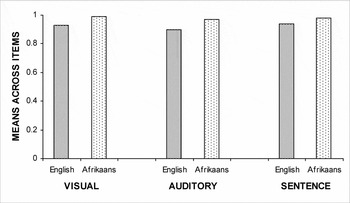
For the visual judgement test, the item means for English items ranged from 0.86 to 0.97, with an overall mean of 0.93. (“English item” refers here to an item containing an English verb, “Afrikaans item” to one containing an Afrikaans verb.) The item means for Afrikaans items ranged from 0.97 to 1, with an overall mean of 0.99. These means are well above the 0.80 borderline for confirmation of the relevant predictions and analyses. For the auditory judgement test, the mean range for English items was 0.87 to 0.97, and the overall mean was 0.90. For Afrikaans items the mean range was 0.93–1 and the overall mean 0.97. Once again, these means are well above the 0.80 borderline. The sentence construction test also yielded means well above the 0.80 borderline. For English items, the mean range was 0.86 to 1 and the overall mean 0.94. For Afrikaans items, the mean range was 0.96 to 1 and the overall mean 0.98. Thus, the support for the predictions for adverb constructions was almost perfect, with means for Afrikaans items slightly higher across the three tests. The overall means are presented in graphic form in Figure 1.
Overall means assigned to items targeting constructions with adverbs in the visual judgement, auditory judgement, and sentence construction tests.

The ANOVA for the results of both the visual and the auditory tests revealed no significant effects, not for the language of the verb, the language of the participant, or for the interaction of these two factors. The ANOVA for the sentence construction test revealed one significant effect, namely for the language of the verb (F(1,28) = 5.697, p = .024). Finally, the ANOVA for the three tests together also revealed a significant effect for the language of the verb (F(1,27) = 4.787, p = .038). The fact that there was only this single effect indicates that the three tests delivered similar results. The low number of significant effects was not surprising, given the low number of ill-formed responses. The analysis across participants revealed no outlying participants. The uniformity of the results for constructions with adverbs across the three tests is striking. The predictions are supported throughout, with the means for Afrikaans items slightly higher than those for English items.
Focalisation constructions
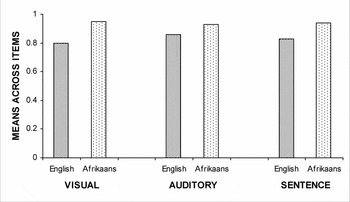
The item means for English focalisation items was 0.60 to 0.90, with an overall mean of 0.80. The means for Afrikaans items were higher, ranging from 0.83 to 1, with an overall mean of 0.95. Turning to the auditory test, the mean range for English items was 0.79 to 0.93, with an overall mean of 0.86; the mean range for the Afrikaans items was 0.83 to 0.97, with an overall mean of 0.93. Finally, in the sentence construction test, the mean range for English items was 0.69 to 0.93, with an overall mean of 0.83, whereas the mean range for Afrikaans items was 0.89 to 1, with an overall mean of 0.94. As is clear from Figure 2, the means for Afrikaans items are somewhat higher than those for English items, and indicate strong support for the predictions. The means for English items are closer to the lower border of strong support for the predictions.
Overall means assigned to items targeting focalisation constructions in the visual judgement, auditory judgement, and sentence construction tests.

The ANOVA for the visual test revealed a significant effect for the language of the verb (F(1,28) = 9.632, p = .004), but no significant effect for either the language of the participant or the interaction of the two factors. The ANOVA for the auditory test revealed no significant effects, whereas that for the sentence construction test revealed a significant effect for the language of the verb (F(1,28) = 5.001, p = .033). Finally, the ANOVA for the three tests together, with test modality as an extra factor, also revealed a significant effect for the language of the verb (F(1,28) = 7.346, p = .011). There was no effect of test modality, which indicates that all three tests delivered similar results. In terms of an analysis across participants, there was no indication that the number of ill-formed responses was related to the language of the participant.
Topicalisation constructions
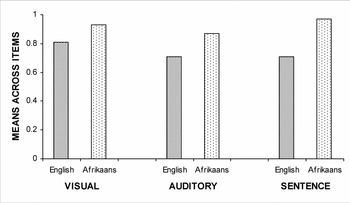
The means for English topicalisation items ranged from 0.57 to 0.97, with an overall mean of 0.81. The Afrikaans items in the visual test had a mean range of 0.83–1, and an overall mean of 0.93. These overall means indicate strong support for the predictions. With regard to the auditory judgement test, the means for English items ranged from 0.50 to 0.83, with an overall mean of 0.71, indicating weak support for the predictions. The mean range for Afrikaans items in the auditory test was once again higher than that for English, namely 0.83–0.93, with an overall mean of 0.87, indicating strong support for the predictions. Finally, in the sentence construction test, the mean range for English items was 0.41–0.97, with an overall mean of 0.71, reflecting weak support for the predictions. The Afrikaans items in the sentence test yielded a mean range of 0.96–0.97, with the overall mean of 0.97 indicating strong support for the predictions. As is clear from Figure 3, the predictions for topicalisation constructions were supported by the results of the visual and auditory judgement and sentence construction tests, and responses to Afrikaans items were more robust in this support.
Overall means assigned to items targeting topicalisation constructions in the visual judgement, auditory judgement, and sentence construction tests.

The ANOVA for the visual test revealed a significant effect for the language of the verb (F(1,28) = 9.664, p = .004), whereas that for the auditory test revealed a significant effect for the language of the participant (F(1,28) = 5.321, p = .029) (English participants having more well-formed scores than Afrikaans participants). The ANOVA for the sentence test revealed a significant effect for the language of the verb (F(1,28) = 14.953, p = .001). The ANOVA for the three tests together allowed a test of the consistency of these effects, and indicated that only the language of the verb effect was significant (F(1,28) = 15.069, p = .001). Regarding the performance across participants, most participants had zero ill-formed responses for Afrikaans items, whereas almost all participants had at least one ill-formed response for English items, and a number of participants had quite high scores for ill-formed responses. There was no evidence of an effect of the language of the participant.
Embedded that clauses
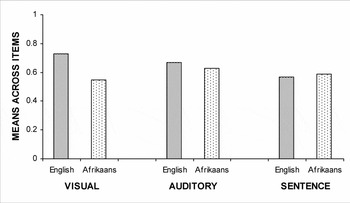
The mean range for English that items in the visual test was 0.60–0.80, with an overall mean of 0.73. The means for Afrikaans items ranged from 0.43 to 0.73, with an overall mean of 0.55, somewhat lower than that for the English items. For the auditory test, the means for English items ranged from 0.40 to 0.83, with an overall mean of 0.67, while the means for Afrikaans items ranged from 0.43 to 0.83, with an overall mean of 0.63, again lower than that for English items. Finally, for the sentence test, the means for English items ranged from 0.31 to 0.72, with an overall mean of 0.57, whereas the means for Afrikaans items ranged from 0.48 to 0.79, with an overall mean of 0.59, slightly higher than that for English. The means are presented in graphic form in Figure 4. Overall, the English items yielded slightly more well-formed responses than did the Afrikaans items in terms of support for the predictions, in contrast to the cases of focalisation, topicalisation, and adverb constructions. The wide ranges in the means across both English and Afrikaans items suggest that performance varied widely from one particular verb or item to the next. Item analysis revealed a number of possible explanations for the discrepancies. For example, responses appeared to vary between Afrikaans verbs which could occur in an objectless passive construction (see (49) below) and those which could not. Furthermore, the items targeting that embeddings appeared to be vulnerable to potentially counter-intuitive semantic content of constructions like that in (50), where the sequence of the English feminine possessive pronoun + noun combination and the (phonetically similar) Afrikaans feminine possessive pronoun + noun combination may have interfered with participants’ performance. Finally, it appeared that performance varied between verbs with inherent semantic differences, such as in the case of sentence construction items which contained verbs referring to ongoing events (see (51) and (52), in which school pupils habitually hate difficult maths problems and the woman habitually buys interesting toys), as opposed to verbs referring to a particular one-off event (see (53), in which the car is presently driving fast, according to the clock on which it is being timed).
Overall means assigned to items targeting embedded that clauses in the visual judgement, auditory judgement, and sentence construction tests.

(49)
(50)
(51)
(52)
(53)
Note that the semantic differences mentioned above have no syntactic implications, and it is not suggested that structural aspects played a role in the judgements in these cases. The suggestion is rather that the semantic factors may have introduced a processing load in these items which may not have been present in other items. Note that the issue here is to account for the wide variation in means across items, and not for a clear preference for either the predicted well-formed constructions or the predicted ill-formed constructions.
An alternative explanation for the wide variation in means across Afrikaans that items may be that participants were truly divided in terms of the well-formed position of the Afrikaans verbs. The high incidence of means close to chance level for English items, for which no clear linguistic reasons could be postulated, would support this possibility. The apparent acceptance of English verbs in the Afrikaans position may represent an exaggeration of the pattern in the adverb, focalisation, and topicalisation results discussed above, where means for English items tended to be slightly lower than those for Afrikaans items, indicating that English verbs were more often accepted and placed in their predicted ill-formed position, i.e., in the position of the Afrikaans verb. This tendency will be further discussed below.
The ANOVA for the results of both the visual and auditory tests revealed no significant effects, whereas that for the sentence test revealed a significant effect for the language of the participant (F(1,28) = 5.834, p = .022). The ANOVA for all three tests together revealed that the language of participant effect remained significant (F(1,28) = 7.806, p = .009), with Afrikaans participants having higher ill-formed scores than English participants.
Embedded wh clauses
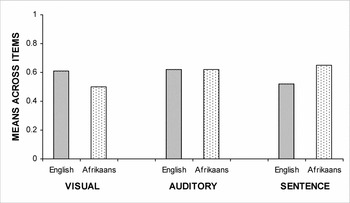
The item means for English wh items in the visual test ranged from 0.41 to 0.90, with an overall mean of 0.61. The Afrikaans items in the visual test yielded means ranging from 0.23 to 0.72, with an overall mean of 0.50, slightly lower than that for English items. For the auditory test, the means for English items ranged from 0.50 to 0.70, with an overall mean of 0.57, while those for Afrikaans items ranged from 0.27 to 0.83, with an overall mean of 0.62. Finally, in the sentence test, the means for English items ranged from 0.22 to 0.65, with an overall mean of 0.50, while the Afrikaans items yielded means ranging from 0.44 to 0.79, with an overall mean of 0.62. Thus, for both the auditory and the sentence tests, the Afrikaans items yielded overall means slightly higher than those for English (see Figure 5), and the mean ranges are wide for both English and Afrikaans items across the three tests. As in the case of that items, it may be that processing effects played a role in participants’ performance. For example, there was a tendency toward higher means for items whose verbs could not plausibly occur immediately after the subject without being followed by the given object or adverbial or prepositional phrase (see (54)), and lower means for items whose verbs could occur in this position, where participants may have “ignored” the given object or adverbial or prepositional phrase, even if only temporarily during processing (see (55)), leading them to accept the verb in its predicted ill-formed position.Footnote 7
- (54)
a.
b. Predicted ill-formed
The boy asks his mother why the other boys
pla hulle oulike juffrou.
c. Impossible construction
The boy asks his mother why the other boys pla.
- (55)
a.
b. Predicted ill-formed
His uncle asks him why the concert musician
glimlag vir die toeskouers.
c. Possible construction
His uncle asks him why the concert musician
glimlag
Overall means assigned to items targeting embedded wh clauses in the visual judgement, auditory judgement, and sentence construction tests.

The ANOVA for the visual test revealed a significant effect for the language of the participant (F(1,28) = 11.478, p = .002), with Afrikaans participants having higher well-formed scores than English participants. For the auditory test, the ANOVA revealed a significant effect for both the language of the participant (F(1,28) = 6.194, p = .019) and the interaction of language of the verb and language of the participant (F(1,28) = 13.944, p = .001), again with Afrikaans participants having higher well-formed scores than English participants, especially for Afrikaans items. The ANOVA for the sentence test revealed no significant effects, whereas the ANOVA for all three tests together again revealed a significant effect of the language of the participant (F(1,28) = 7.831, p = .012), confirming the consistency with which Afrikaans participants yielded more well-formed scores.
Yes-no questions
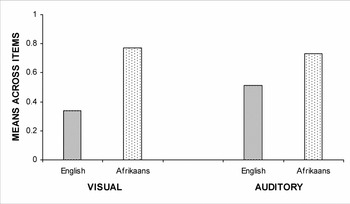
The means for the items targeting yes-no questions indicate that there was little support for the predictions as tested by English items (see Figure 6). The mean range for English items in the visual test was 0.14–0.79, with an overall mean of 0.34, and the mean range for English items in the auditory test was 0.36–0.80, with an overall mean of 0.51. The support for the predictions as tested by Afrikaans items was higher than that for English items, ranging from 0.57 to 0.93 for the visual test and from 0.50 to 0.87 for the auditory test, with overall means of 0.77 and 0.73, respectively, which both indicate weak support for the predictions. These results suggest that participants considered both English and Afrikaans verbs in sentence-initial position in yes-no questions to be well-formed, but considered Afrikaans verbs combined with sentence-initial do to be ill-formed. This result indicates once again the pattern noted above for adverb, focalisation, topicalisation, and that constructions, namely the apparent acceptance of English verbs in the Afrikaans position.
Overall means assigned to items targeting yes-no questions in the visual judgement, auditory judgement, and sentence construction tests.

The ANOVA for the results of the visual test revealed a significant effect for the language of the verb (F(1,28) = 16.290, p = .001), whereas that for the auditory test revealed no significant effects for the language of the verb or for the language of the participant, but a significant effect for the interaction of the two (F(1,28) = 4.417, p = .045). The ANOVA for the two tests together revealed a significant effect of only the language of the verb (F(1,28) = 12.579, p = .001).
Discussion
The present study investigated the possibility of accounting for the structure of English–Afrikaans intrasentential code switching within the framework of feature checking theory. The predictions tested here were based on analyses of verb position differences between English and Afrikaans in six construction types, in terms of differences in the strength of tense and finiteness features of CP heads, and in the ability of verbs of either language to check these features, as well as the Q feature of the QP.
The results of the three tests reveal strong support for the predictions for adverb, focalisation, and topicalisation constructions. Throughout the results for these three constructions, the support is slightly stronger for the predictions for Afrikaans verbs than those for English verbs. This asymmetry, according to which English verbs are more readily accepted in Afrikaans positions than vice versa, may be explained in terms of a borrowing asymmetry. As noted by Branford and Claughton (Reference Branford, Claughton and Mesthrie2002, p. 208), “both established and ad hoc borrowings from English abound” in informal Afrikaans. Even in more formal contexts, it is more common to insert English lexical items into Afrikaans constructions than vice versa. Such a tendency may account for the slight English vs. Afrikaans asymmetry in the nevertheless strong support for the predictions for adverb, focalisation and topicalisation constructions. Note that the suggestion is not that the results for particular items (i.e., particular verbs) can be “explained away” in this manner, or should be omitted from analysis for this reason. Rather, the suggestion is that this acknowledged tendency in the English–Afrikaans context may have played a role in the slight asymmetry evident in the overall results for adverb, focalisation, and topicalisation constructions. The support for the predictions across the three construction types may be taken to indicate support for the original analyses, according to which differences between English and Afrikaans in the strength of tense and finiteness features associated with CP heads, and in the ability of verbs of either language to check these features, play a role in determining well-formedness in code-switched constructions. The implication is that well-formedness in these code-switched constructions is determined by the same feature checking mechanisms as in the monolingual case, offering support for the main hypothesis underlying the present study.
Turning to the results for yes-no questions, the above-mentioned asymmetry between English and Afrikaans items is substantially more pronounced. These results reveal weak support for the predictions for Afrikaans verbs, and no support for those for English verbs. English verbs were clearly regarded by the participants as largely acceptable in the sentence-initial position without do-support. In terms of the theoretical framework adopted here, these results suggest that the English verb in these cases raised to the left to check the strong Q feature of the English QP, usually checked by do-insertion. Note that the analyses of English and Afrikaans yes-no questions proposed here entail no difference in the strength of the Q feature associated with the QP, which is strong in both cases. It may be suggested that, in the English–Afrikaans language contact situation, this is a site which is vulnerable to syntactic convergence, whereby the English verb is able to check the strong Q feature of the English QP, as would the Afrikaans verb for an Afrikaans QP. The notion of syntactic convergence will be discussed further below in relation to the results for that and wh embedded clauses.
In the case of the results for that and wh embedded clauses, there is little support for the predictions, with performance around chance level for both English and Afrikaans items. Had the results indicated evidence against the predictions, one could posit an alternative analysis to the one upon which the predictions were based. For example, one might propose that the lexical element in the leftmost CP projection (in these cases that, dat, or the wh element) imposes the language identity of all projections within the CP layer. According to such a proposal, the language identity of AgrOP would be determined by the language of the overt complementiser; a that clause would be predicted to require a verb–object order, and a dat clause to require an object–verb order. However, the results for that and wh clauses, being around chance level, do not clearly support or refute the original prediction, and likewise would neither support nor refute such an alternative. A possible account for the results was offered in the relevant subsections above in terms of the vulnerability of that and wh items to certain language processing effects, but it is not clear why these constructions would be particularly vulnerable to such effects. The chance level results for that and wh items may rather be an indication of the syntactic convergence mentioned above in the case of yes-no questions. In the case of yes-no questions, the suggestion is that convergence arises at a vulnerable point created by the matching feature strength of the English and Afrikaans QPs. In the case of that and wh embeddings, however, the original analyses entail a difference between English and Afrikaans in the strength of the tense and finiteness features. Note, however, that verb position in monolingual embedded clauses is the subject of much debate, with a range of non-standard word orders seeking accounts (recall, for example, the alternative V2 wh embedded structure in non-standard English and Afrikaans referred to above). It may be that the difficulty in accounting for the structure of code-switched embedded that and wh clauses relates to the difficulty in accounting for the variety of monolingual structures, each differing in verb position. In line with the above proposal of convergence in the yes-no case, it may be proposed that the embedded CP is once again a site vulnerable to syntactic convergence in the English–Afrikaans case. Such convergence might in the case of that and wh embedded clauses entail either (i) variation in the strength of the tense and finiteness features associated with the English and Afrikaans CP functional categories, or (ii) variation in the ability of verbs of either language to check these features, if strong. Note that this explanation for the that, wh, and yes-no results in terms of convergence aims to account for the data, which do not provide straightforward support for the predictions for the structure of code switching. The convergence explanation does not constitute a suggestion of a third grammar or control mechanism regulating code switching. The purpose of the present work, i.e., to account for structural aspects of code switching within a theoretical framework developed to account for monolingual phenomena, remains intact.
With regard to the ANOVA results, it is interesting to note the same kind of clustering of results as reflected by the discussion above. Firstly, the language of the verb was found to be significant in the ANOVA across the three tests for all three constructions whose predictions were strongly supported, namely the adverb, focalisation, and topicalisation constructions. In the case of each construction type, this result confirmed the effect of the language of the verb revealed by the ANOVAs for one or more individual tests. This effect is in line with the prediction that the language of the verb, with its formal feature make-up and related feature checking capabilities, plays a determining role in the well-formedness of code-switched constructions. Secondly, the language of the verb was also found to be significant in the ANOVA across the three tests for yes-no questions, where there was a substantial asymmetry between the results for English and Afrikaans verbs. Thirdly, the ANOVAs across the three tests for the remaining constructions, namely that and wh embedded clauses, revealed that the language of the participant was significant in both cases, once again confirming the significance of the effect of participant language revealed by the ANOVAs for one or more individual tests. However, note that the significant effect of participant language cannot lead to the conclusion that participants of one language group acted more in accordance with the predictions than those of the other, as the effects went in opposing directions. In the case of that clauses, Afrikaans participants had higher ill-formed scores than did English participants; in the case of wh clauses, Afrikaans participants had higher well-formed scores than did English participants.
In conclusion, it is clear that the analysis of word-order differences between English and Afrikaans in terms of feature checking theory, and the testing of predictions based on these analyses, provided a fruitful avenue of research in the present study. Although the predictions were not uniformly borne out, this does not necessarily imply that the mechanisms and devices of minimalist syntax cannot account for the structure of English–Afrikaans code-switching data, or those of other language pairs. The aim of minimalist syntax in the monolingual case is to account for the constructions of the “ideal speaker-hearer”. It may be proposed that the same mechanisms and devices might be as successful in accounting for the structure of code-switched constructions of the “ideal bilingual”. For the data which fall outside of the analyses and predictions presented here, which ought not to be discarded on the grounds of “performance factors”, it is plausible that satisfactory accounts can be developed within the framework of minimalist syntax.