INTRODUCTION
Ophioderma vansyoci Hendler, Reference Hendler and Schmieder1996 (family Ophiodermatidae Ljugman, 1866) is a rare subtropical ophiuroid species previously known only from its type locality: Roca Alijos (15.2–21.3 m depth) off the western coast of Baja California, Mexico (Hendler, Reference Hendler and Schmieder1996; Honey-Escandón et al., Reference Honey-Escandón, Solís-Marín and Laguarda-Figueras2008). In this report we record this species from a second locality, inside the Gulf of California. The single specimen collected was compared with the paratype material in the collection of the National Museum of Natural History, Smithsonian Institution, Washington, DC (USNM) and the comprehensive description by Hendler (Reference Hendler and Schmieder1996).
Ophioderma vansyoci Hendler, Reference Hendler and Schmieder1996: 329–332, pl. 3.
DIAGNOSIS
(fide Hendler, Reference Hendler and Schmieder1996): disc covered with close-set brick-like granules; series of elongate scales aligned in radial strands near disc periphery. Radial shields naked. Hexagonal dorsal arm plates broader than long, flanked by several pairs of quadrangular to hexagonal accessory dorsal arm plates. Arm spines blunt, shorter than arm joint. Dark-brown pigmentation not highly soluble in alcohol.
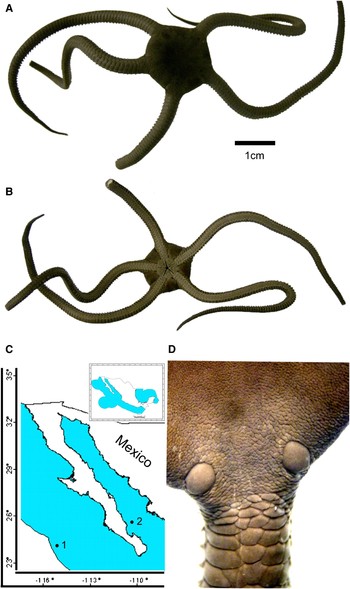
Ophioderma vansyoci: (A) aboral surface; (B) oral surface; (C) map of the Gulf of California, Mexico with the distribution of the species in the two localities: (1) Rocas Alijos and (2) Las Animas. Note: blue colour in the map represents the Mexican Economic Exclusive Zone; (D) detail of the aboral disc showing naked radial shields, flattened granules, and fragmented dorsal arm plates.

MATERIAL EXAMINED
USNM E43359, paratype, one specimen, Rocas Alijos, off the western coast of Baja California, Mexico; ICML–UNAM 3.202.0, one specimen, Las Animas, Gulf of California, Baja California Sur, Mexico, 25°06.716′N, 110°30.651′W, 27.8 m, under rocks, coll. Francisco A. Solís-Marín, SCUBA diving.
DESCRIPTION
The specimen is very similar to those described by Hendler (Reference Hendler and Schmieder1996). Characteristics of the present specimen: disc diameter 18.1 mm, longest arm 101 mm. Oral shields triangular, with lobed corners, the distal edge with a slight central concavity. Madreporite circular, central within one oral shield. The oral shields partially cover the adorals. The dorsal arm plates are divided into three parts; lateral elements are larger than the central, and sometimes fragmented. There are 7–8 flattened arm spines, ventral spines longer than dorsal; the most ventral spine is longer and markedly broader than the others.
COLOUR
Dark-brown when alive and paler when in alcohol, however when dried, the specimen is pale grey. The disc is always darker than the arms and the madreporite plate is light brown.
GEOGRAPHICAL DISTRIBUTION
Rocas Alijos, off the western coast of Baja California, Mexico (15.2–21.3 m) and Las Animas (27.8 m) Baja California Sur, Gulf of California, Mexico.
ECOLOGICAL NOTES
Other echinoderms collected in the area included Nidorellia armata, Narcissia gracilis and Leiaster sp. The habitat, under rocks, is typical for members of the genus Ophioderma.
REMARKS
The genus Ophioderma comprises approximately 28 species (www.marinespecies.org/ophiuroidea). Hendler (Reference Hendler and Schmieder1996) notes that two congeners of Ophioderma vansyoci, O. guttatum Lütken, 1859 and O. squamosissimum Lütken, 1856, resemble O. vansyoci in possessing flattened disc granules and fragmented arm plates; O. guttatum differs in having multi-fragmented irregular arm plates of varying sizes. In O. squamosissimum the disc granules are squamous and irregular rather than narrow and radially aligned, the radial shields are covered with granules or partly naked, and the dorsal arm plates are diamond-shaped and longer than wide.
As Hendler (Reference Hendler and Schmieder1996) has pointed out, O. vansyoci superficially resembles the common eastern Pacific species O. teres Lyman, 1860 in size, colour and habitat, and can easily be mistaken for it. Ophioderma teres differs in having spheroidal disc granules and irregularly fragmented arm plates.
The presence of O. vansyoci inside the Gulf of California was anticipated by Hendler (Reference Hendler and Schmieder1996) when he argued that ‘the seamounts and islands of the province may act as refugia for relict populations of Ophioderma vansyoci and other seemingly rare species’ (Allison, Reference Allison, van Andel and Shor1964).
ACKNOWLEDGEMENTS
To Alicia Durán González for her technical support. Financial support for F.A.S.M. came from Project UNAM PAPIIT IN226308.