INTRODUCTION
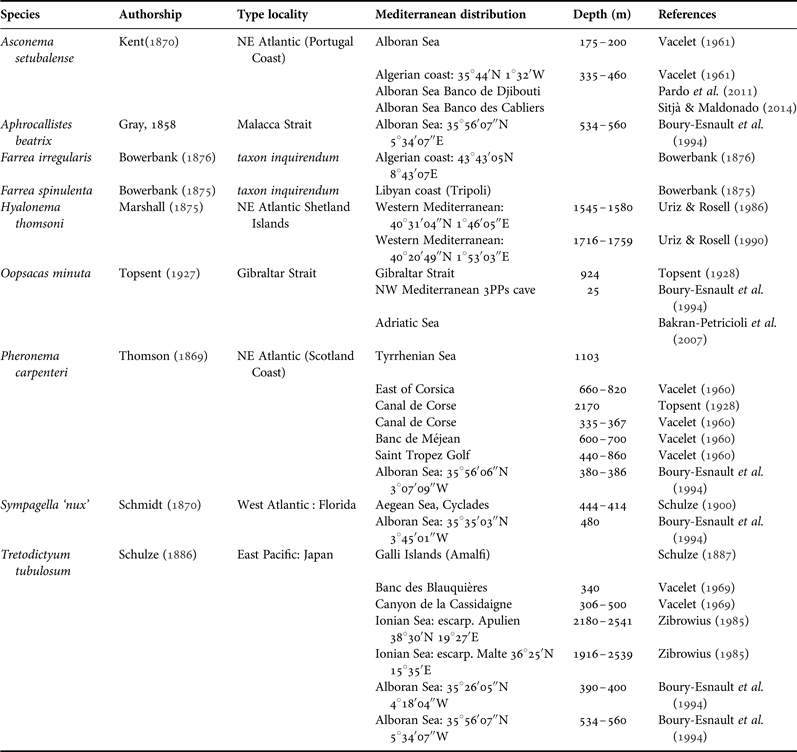
The Mediterranean Sea has long been considered to be a very poor habitat for hexactinellid sponges mainly due to the relatively high temperature (~13°C) of its deep waters and the rather recent history of its deep-sea fauna. During the Pleistocene though, the hexactinellid fauna seems to have been important and fossilized skeletons from this period have been found in the south of Crete (1500–2000 m) and in the South Ionian Sea (Cyrenian escarpment; Zibrowius, Reference Zibrowius1981, Reference Zibrowius1985). This is certainly related to the Ice Age conditions providing colder waters more appropriate for an important hexactinellid fauna. As a consequence of this present poverty, few studies have been dedicated to the Mediterranean hexactinellid fauna. In 1985, eight species were cited from the Mediterranean area in a review on hexactinellid species (Zibrowius, Reference Zibrowius1985), to which one (Hyalonema thomsoni Marshall, Reference Marshall1875) was later added from the Catalan coast by Uriz & Rosell (Reference Uriz and Rosell1986, Reference Uriz and Rosell1990) (Table 1). Three of these species are north-eastern Atlantic species: Asconema setubalense Kent, Reference Kent1870 described from the coast of Portugal, restricted to the Alboran Sea in the Mediterranean (Vacelet, Reference Vacelet1961; Pardo et al., Reference Pardo, Aguilar, García, Torriente and Ubero2011; Sitjà & Maldonado, Reference Sitjà and Maldonado2014), Pheronema carpenteri (Thomson,Reference Thomson1869) locally abundant in the muddy bathyal zone (Vacelet, Reference Vacelet1969) and Hyalonema thomsoni. Oopsacas minuta Topsent, Reference Topsent1927, described from one incomplete specimen from the Gibraltar Strait, was much later discovered to be an inhabitant of some particular shallow, dark caves in the north-western Mediterranean and in the Adriatic (Vacelet et al., Reference Vacelet, Boury-Esnault and Harmelin1994; Bakran-Petricioli et al., Reference Bakran-Petricioli, Vacelet, Zibrowius, Petricioli, Chevaldonné and Rada2007) where it constitutes large populations. The species has never been found outside the Mediterranean Sea. Two species mentioned by Bowerbank (Reference Bowerbank1876), Farrea irregularis and Farrea spinulenta, are nowadays considered as taxa inquirenda (Van Soest et al., Reference Van Soest, Boury-Esnault, Hooper, Rützler, de Voogd, Alvarez de Glasby, Hajdu, Pisera, Manconi, Schoenberg, Janussen, Tabachnick, Klautau, Picton, Kelly, Vacelet, Dohrmann, Díaz and Cárdenas2014) since they lack a proper description. Three other species recorded in the Mediterranean are believed to be cosmopolitan: Tretodictyum tubulosum Schulze, Reference Schulze1886 (type-locality temperate north-west Pacific, Japan), Aphrocallistes beatrix Gray, Reference Gray1868 (Central Indo-Pacific, Malacca Strait) and Sympagella nux Schmidt, Reference Schmidt1870 (Tropical West Atlantic, Florida). Even if the true cosmopolitan nature of these species has been questioned (Vacelet, Reference Vacelet1969), no recent work has been undertaken to test it.
Distribution of hexactinellid species in the Mediterranean

With the development of new techniques of investigation in the deep sea (submersibles and ROVs) a revival of interest for the bathyal zone has recently established that hexactinellid species appear much more frequent than previously thought in the deep Mediterranean (Pardo et al., Reference Pardo, Aguilar, García, Torriente and Ubero2011; Sitjà & Maldonado, Reference Sitjà and Maldonado2014).
Two series of research cruises ‘MedSeaCan’ and ‘CorSeaCan’ were organized by the French Marine Protected Areas Agency (AAMP) from November 2008 to August 2010, to explore the canyons of the NW Mediterranean continental French coast from the Rech Lacaze-Duthiers in the west to the Canyon of Nice in the east and along the western coast of Corsica from the Centuri Canyon in the north to Les Moines Canyon in the south (Fourt et al., Reference Fourt, Goujard, Pérez, Vacelet, Sartoretto, Chevaldonné, Langar, Bouafif and Ouerghi2014). Explorations and sampling were conducted with the ROV ‘Achille’ and the manned submersible Remora 2000 (COMEX Company). Data on the distribution of hexactinellid species collected or identified on video during these cruises are here reported. Among the species collected, a new species of stalked hexactinellid much alike Caulophacus Schulze, Reference Schulze1886 or Sympagella Schmidt, Reference Schmidt1870 was collected in the Valinco Canyon (SW coast of Corsica). With the help of additional specimens sighted and collected by the OCEANA organization in the Alboran Sea, a morphological and molecular study has been undertaken on what appears to be a new species of Sympagella. A redescription of the type species of the genus, Sympagella nux and a revision of the classification of Sympagella and Caulophacus are also here proposed.
MATERIALS AND METHODS
Collection sites
Our reference specimen of Sympagella nux came from the type locality and is in the collection of Harbor Branch Oceanographic Institute (HBOI) under the number 200706081006. It is redescribed in the present work.
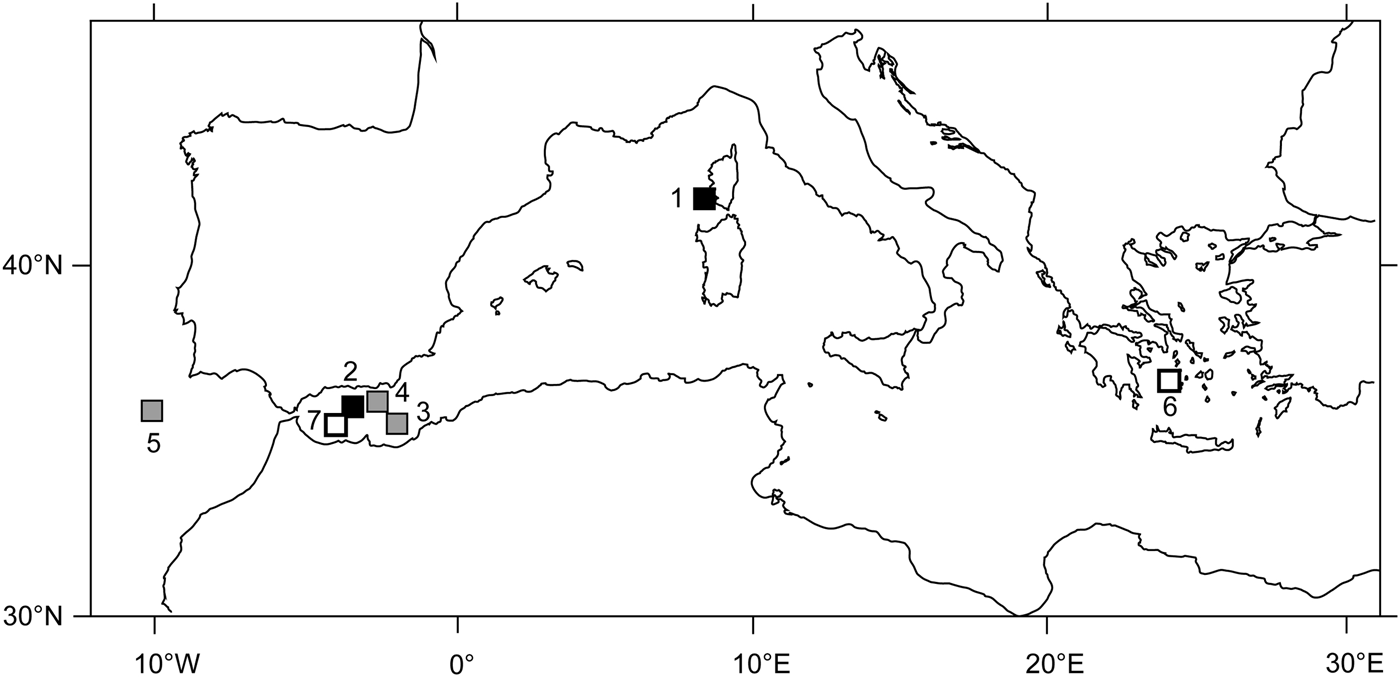
Specimens of the new species of Sympagella were collected in August 2010 by the articulated arm of the ROV ‘Achille’ (Comex) in the Valinco Canyon 41°41′14″N 8°47′27″E (SW Corsica – Sample VAL-ACH-P3_ECH01) at 188 m depth and by a Saab Seaeye Falcon DR ROV (OCEANA) in the Alboran Sea on the Avempace bank 36°23′51″N 03°58′03″W at 388 m (Figure 1).
Distribution map of Sympagella delauzei sp. nov., with recent collection sites (black squares), recent video observations (grey squares) and past collection sites from the literature (white squares). (1) Valinco Canyon, Corsica (type locality – 188 m); (2) Avempace Bank, Alboran Sea (paratype – 388 m); (3) Cabliers Bank, Alboran Sea (320–403 m); (4) Chella Bank, Alboran Sea (363–432 m); (5) Gorringe Bank, Ibero-Moroccan Gulf (350–474 m); (6) Between Serifos and Milos, Cyclades Islands (414 m); (7) Near Tofino Bank, Alboran Sea (480 m).
Spicule and skeleton preparation
The skeletal architecture was studied by light microscopy on whole mounts, hand-cut tangential sections or thick polished sections obtained by sawing specimens embedded in Araldite with a low-speed saw using a diamond wafering blade, and wet-ground on polishing discs (Boury-Esnault et al., Reference Boury-Esnault, Marschal, Kornprobst and Barnathan2002).
For the study of spicules, a rapid method adapted from classical methods was used for both light and scanning electron microscopy (SEM). A small piece of sponge was boiled in a few drops of nitric acid on a microscopic glass slide, renewing the acid two or three times before complete drying. After drying and enough cooling to avoid breakage of the slide, the slide was rinsed with several drops of distilled water and drained. Boiling in nitric acid and rinsing were repeated if necessary to obtain a sufficiently clean slide. The slide was then either mounted in Araldite for light microscopy or sputter-coated with gold–palladium, then observed under a Hitachi S570 SEM (Vacelet, Reference Vacelet2006).
Molecular phylogeny
The specimen of the new Sympagella from Valinco Canyon (Sample ID #VAL-ACH-P3) has been preserved in ethanol 95% after recovery on board. One piece was used for DNA extraction using QIAmp DNA Mini kit (Qiagen). PCR amplification of 1876 bp of the 18S ribosomal DNA (18S) was conducted with primers 18S D and 18S G as in Gazave et al. (Reference Gazave, Lapébie, Renard, Vacelet, Rocher, Lavrov and Borchiellini2010). A consensus sequence was obtained after cloning PCR products, assembling and editing sequences with BioEdit 7.0.9 (Hall, Reference Hall1999). The sequence was deposited in the European Nucleotide Archive (ENA – EMBL) under accession number LN624216.
Our sequence was manually aligned with other 18S sequences of Hexactinellida recovered from nucleotide to build a phylogenetic tree. Phylogenetic reconstruction was estimated through the Neighbour-joining (NJ) method as implemented in CLUSTALX 2.1 (Larkin et al., Reference Larkin, Blackshields, Brown, Chenna, McGettigan, McWilliam, Valentin, Wallace, Wilm, Lopez, Thompson, Gibson and Higgins2007), and with the Maximum likelihood (ML) method as implemented in PhyML 3.0 (Guindon et al., Reference Guindon, Dufayard, Lefort, Anisimova, Hordijk and Gascuel2010). With both methods, bootstrap support was assessed over 1000 replicates.
RESULTS
Description of the species
Hexactinellida Schmidt, Reference Schmidt1870
Hexasterophora Schulze, Reference Schulze1886
Lyssacinosida Zittel, 1877
Rossellidae Schulze, 1885
Lanuginellinae Gray, Reference Gray1872
Sympagella Schmidt, Reference Schmidt1870
Type species: Sympagella nux syntype MCZ PORa-6790;
Type locality: off Sand Key and off American Shoal, Florida, 180–225 m.
DIAGNOSIS
Body is saccular, funnel-like, tubular or mushroom-like, basiphytic, with long or short stalk. Choanosomal spicules are diactins and hexactins. Dermalia are pinular hexactins and/or pentactins. Atrialia are pinular hexactins or pentactins. Hypodermalia and sometimes hypoatrialia, if present, are pentactins. Microscleres are strobiloplumicomes and various combinations of discohexasters, onychasters, hexasters, hemihexasters, hemionychasters and tylohexasters (corrected from Tabachnick, Reference Tabachnick, Hooper and van Soest2002).
Redescription of the type species of the genus
Sympagella nux Schmidt, Reference Schmidt1870
Material studied: specimen HBOI voucher no. 200706081006 collected by A. Wright, D. Liberatore & J. Rob; identified by S. Pomponi (Figure 2A, B).
Sympagella nux and Sympagella delauzei sp. nov. in situ and after collection. (A) Sympagella nux under an overhang, Pourtales terrace (HBOI in situ photo); (B) Specimen studied of S. nux (HBOI photo); (C) Sympagella delauzei sp. nov. from Valinco Canyon (AAMP in situ photo); (D) Sympagella delauzei sp. nov. from Avempace Bank (Alboran sea) (OCEANA in situ photo); (E) Specimen studied of Sympagella delauzei sp. nov. from Valinco Canyon; (F) Specimen studied of Sympagella delauzei sp. nov. from Alboran Sea; (G) Organization of the ectosome of Sympagella delauzei sp. nov.; the pinular pentactine dermalia lay on a layer of pentactine hypodermalia.
Locality: Florida; Pourtales Terrace, South of Marathon, near UM Multibeam Site 23, Bioherm, East Slope; latitude 24°14′22″N; longitude 81°00′46″W; 1666 m depth; under an overhang.
Other material examined: HBOI voucher no. 199411141003 Turks & Caicos; Providenciales Island 1.25 Nautical Miles W of Island; latitude 21°49′23″N; longitude 72°22′13″W; 2827 m depth; large boulder rock outcrop; identifier H.M. Reiswig.
EXTERNAL SHAPE
Group of at least 50 white urn-shaped stalked specimens (Figure 2A), under an overhang. The body of the specimens is 2–4.5 cm high and 2–4 cm in diameter; the peduncle is 5–10 cm long and 3–4 mm wide (Figure 2B). A single large osculum about 6 mm in diameter is present at the top of the specimens.
SKELETON
The ectosomal skeleton is composed of a layer of pinular pentactine dermalia which lay on a layer of smooth pentactine hypodermalia; around the atrial cavity is a layer of pinular hexactine atrialia. The choanosomal skeleton is composed of hexactins and two kinds of diactins. The skeleton of the stalk consists of diactins with rough inflated extremities linked by spiny synapticula which form rectangular meshes.
SPICULE TYPES
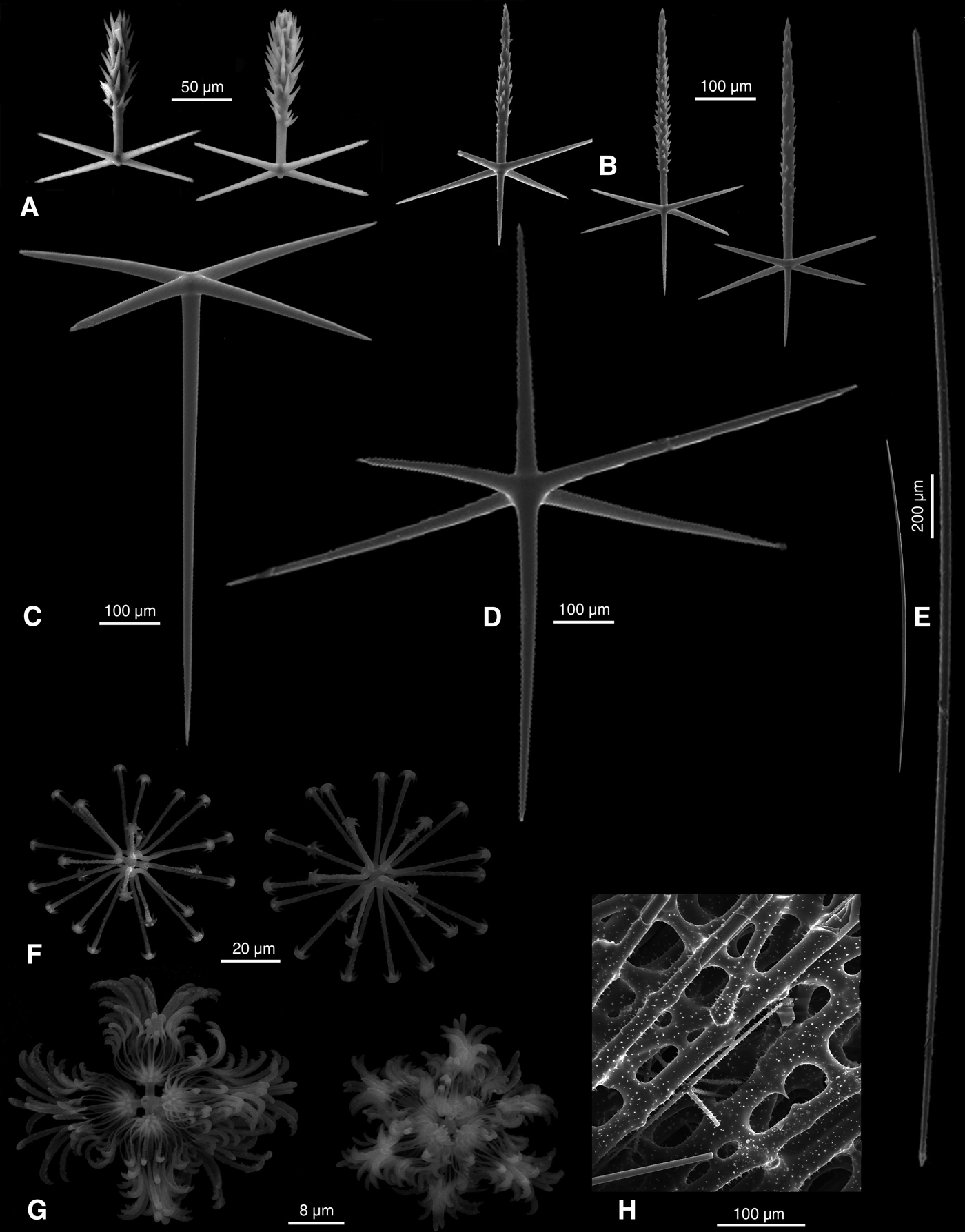
Dermalia: pinular pentactins (Figure 3A): pinular ray 100–165 µm long, 5–10 µm and 13–25 µm wide respectively at the basis and at the most inflated spined part (mean 120/7.3/27 µm); tangential rays slightly spined 65–105/4–8.8 µm (88/5.40 µm) and a rudimentary basal ray 3–5 µm (3.9 µm).
Spicules of Sympagella nux from Pourtales terrace (SEM). (A) Pinular pentactins; (B) Pinular hexactins; (C) Smooth hypodermalia pentactin; (D) Choanosomal hexactin; (E) Choanosomal diactins of two size classes; (F) Discohexasters; (G) Strobiloplumicomes; (H) Synapticulate skeleton of the peduncle with spiny secondary silica layer.
Gastralia: pinular hexactins (Figure 3B): pinular ray 144–676/12–26.6 µm (mean 333.7/16.6 µm); the other rays are slightly spiny, tangential ray 92.4–186.3/5.8–10.3 µm (mean 134.4/7.8 µm), distal ray 115.2–151.8/4.8–11.4 µm (mean 134.4/7.5 µm).
Hypodermalia: smooth pentactins (Figure 3C): tangential ray 310–538/12–39 µm (mean 412.2/28.2 µm), proximal ray often slightly curved 520–740/20–41 µm (637/30 µm).
Choanosomal hexactins (Figure 3D): smooth rays 700–1200/30–75 µm (mean 935/46 µm).
Choanosomal diactins of two size classes (Figure 3E): 620–1350/10–18 µm (mean 1008/12.9 µm) and 1755–3913/27–40 µm (mean 2907/30.7 µm) showing four vestigial rays in the middle.
Discohexasters (Figure 3F): 70–85 µm in diameter with the primary star about 2.5–3 µm in diameter and very thin terminal rays 35–40/1.4–1.6 µm, the disc at the extremities of the rays being about 5–7 µm in diameter.
Strobiloplumicomes (Figure 3G): 35–42 µm in diameter (mean 40 µm); the primary star is about 3–5.5 µm in diameter. The terminal rays are 14–15.6 µm in length, the width is 0.2–0.4 µm at the point of attachment to the primary swelling and 0.7–0.9 µm at the extremity.
Diactins of the peduncle with rough inflated extremities: 2106–5000/15–50 µm (mean 3416/31 µm).
Synapticula (Figure 3H): the meshes of the synapticula are rectangular 55–75/40–45 µm (mean 63/42 µm), the spines which cover the synapticula are about 7.5 µm in length.
DISTRIBUTION
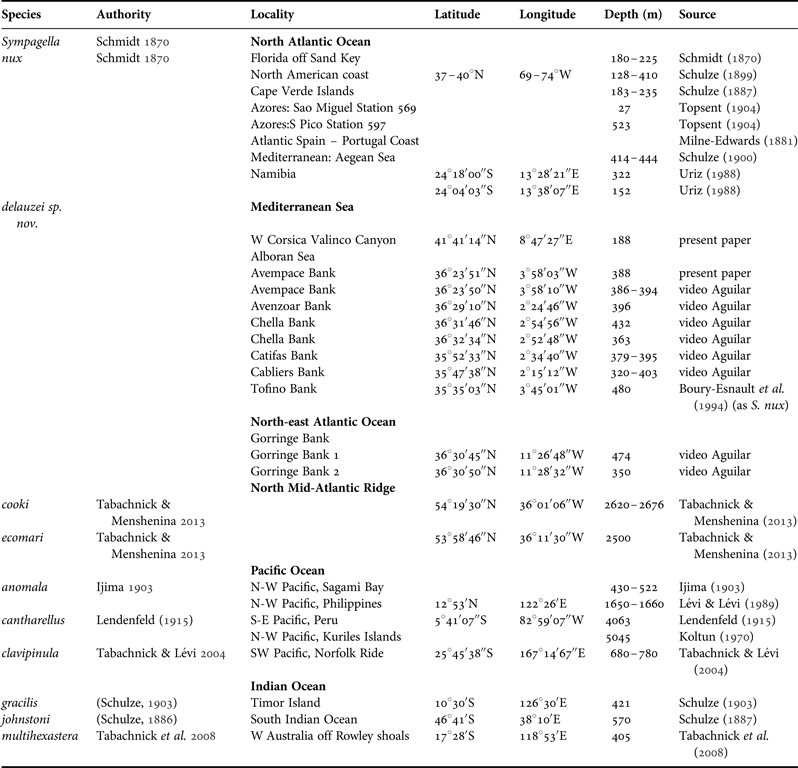
Sympagella nux was described by Schmidt, Reference Schmidt1870 off Sand Key and off American Shoal, Florida, NW tropical Atlantic, 180–225 m. The specimen studied here came exactly from the type locality called nowadays Pourtales Terrace but deeper than Schmidt's specimen. All the occurrences from other Atlantic localities (Table 2) need to be checked.
World distribution of Sympagella species
Description of the new species
Sympagella delauzei Boury-Esnault, Vacelet, Reiswig, Chevaldonné sp. nov.
Holotype VAL-ACH-P3_ECH01 (Figure 2C, E): Valinco Canyon, Corsica: 41°41′14″N 8°47′27″E, 188 m; 18 October 2010. The type specimen is deposited in the Muséum national d'Histoire naturelle de Paris (MNHN) under the number MNHN H.JV-01.
Paratype: Specimen from Avempace Bank, Alboran Sea (Figure 2D, F) 36°23′51″N 03°58′03″W at 388 m; 14 July 2011, deposited in the MNHN in Paris under the number MNHN H.JV-02.
Other material: Balgim collection (NBE personal collection) Station DW 128, Alboran Sea, 35°35′03″N 3°45′01″W, 480 m (Boury-Esnault et al., Reference Boury-Esnault, Pansini and Uriz1994).
EXTERNAL SHAPE
White urn-shaped stalked specimens have been observed on rocks at 188 m depth. The population observed is composed of about 40 individuals often grouped in tufts. The body of the individual specimens is 17–51 mm high and 14–42 mm in diameter (mean 32/23 mm). The stalk is 17–34 mm long and 1.7–2.5 mm wide (mean 25/2.3 mm). A single large osculum 5–8 mm in diameter is present at the top of the specimens (Figure 2C).
SKELETON
The ectosomal skeleton is composed of a layer of pinular pentactine dermalia which lay on a layer of smooth pentactine hypodermalia (Figure 2G); around the atrium cavity is a layer of pinular hexactine/pentactine atrialia. The choanosomal skeleton consists of large smooth hexactins and flexuous diactins. The peduncle consists of diactins linked by slightly spined synapticula which form rectangular meshes, and some spiny pentactins, hexactins and monactins.
SPICULE TYPES
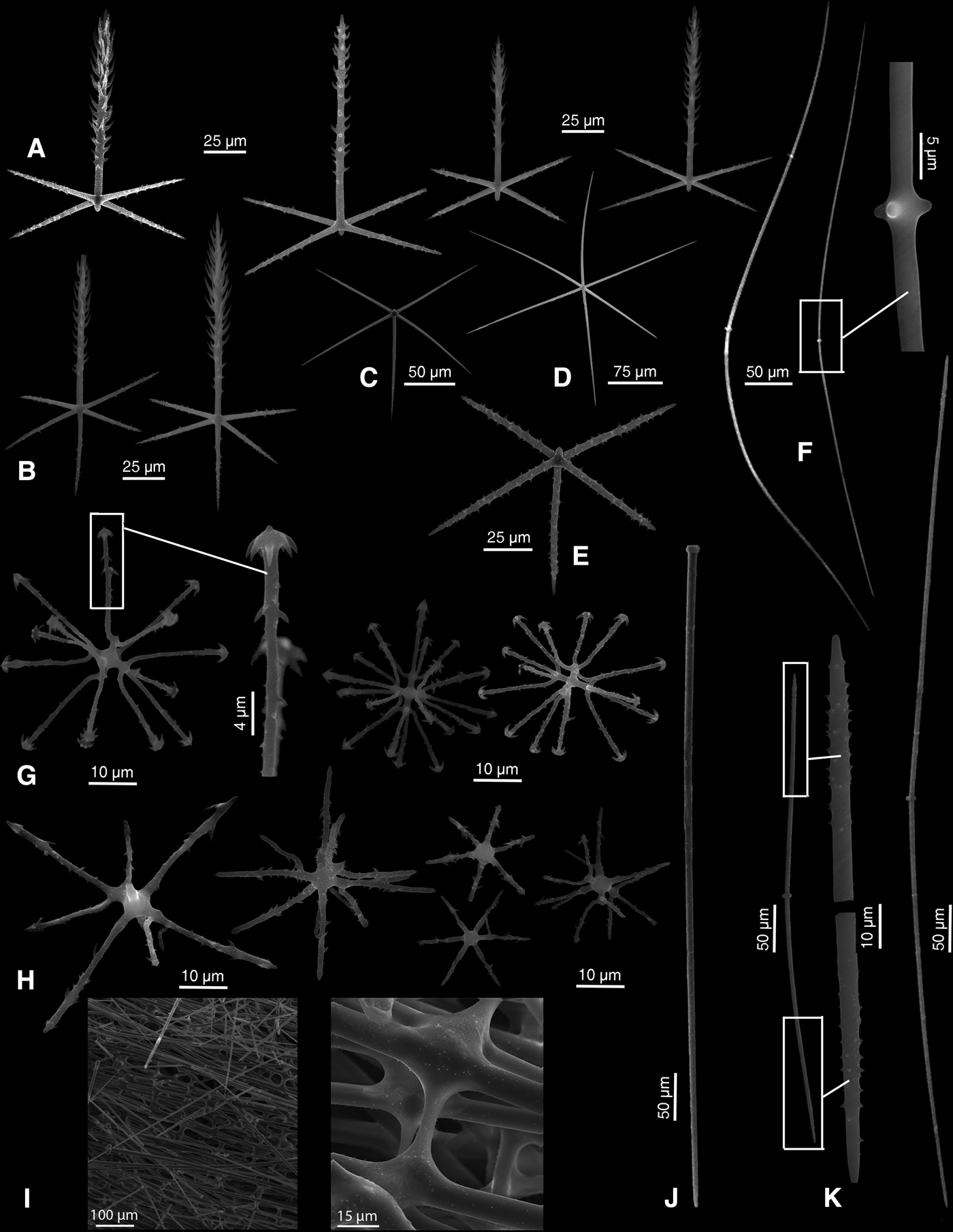
Dermalia: pinular pentactins (Figure 4A): Pinular ray 74–128 µm long, 2–5 µm and 7–12 µm wide respectively at the basis and at the most inflated spined part; tangential rays slightly spined 45–67/1.1–4 µm and a rudimentary basal ray 2.4–7/1–1.6 µm.
- Spicules of Sympagella delauzei sp. nov. from Valinco Canyon (Corsica) (SEM). (A) Pinular pentactins; (B) Pinular hexactins; (C) Smooth hypodermalia pentactin; (D) Choanosomal hexactin; (E) Spiny pentactin from the peduncle; (F) Thin flexuous choanosomal diactin with enlarged middle segment; (G) Discohexasters with enlarged terminal ray; (H) Microhexactins; (I) Skeleton of the peduncle with inset of synapticula; (J) Monactin; (K) Diactins of the peduncle with enlarged ends.
Gastralia: pinular hexactins (Figure 4B): Pinular ray 92–232 µm long, 3.3–5 µm and 6.4–8.4 µm wide respectively at the basis and at the most inflated spined part (mean 140.71/4.4/6.2 µm); tangential rays slightly spined 43–120/2–5.2 µm (mean 80/3.4 µm); proximal slightly spined ray 30–122/1.8–5.2 µm (mean 83/3 µm).
Hypodermalia: smooth pentactins (Figure 4C): Tangential rays 185–470/4.4–12.7 µm (mean 284.8/7.2 µm); proximal ray often slightly curved 190–549.5/3.6–13.7 µm (mean 345.8/8 µm).
Choanosomal hexactins (Figure 4D): 168.3–435/2.6–9.7 µm (mean 323.3/6.9 µm).
Spiny pentactins and hexactins (Figure 4E): Rays 60–125/5 µm (mean 87.5/5 µm) particularly abundant in the peduncle.
Choanosomal diactins (Figure 4F): The choanosomal diactins are flexuous within the middle traces of four vestigial rays 539–760/2.5–3.7 µm (mean 631.7/3.1 µm).
Discohexasters (Figure 4G): 25–75 µm in diameter (mean 42.7 µm) with a primary star 1.4–2.5 µm in diameter, terminal rays I 1–2 µm long and ray II 11.2–24.9/0.5–1 µm long (mean 19.5/0.7 µm), the disc at the extremities being about 3 µm in diameter.
Microhexactins (Figure 4H): 9–66.9 µm (mean 41.3 µm) in diameter and rays 4–33.4/0.5–1.3 µm (mean 21.2/0.9 µm) spiny and very irregular, in some cases secondary links between two adjacent rays.
Synapticula (Figure 4I): the meshes formed by synapticula are rectangular 45–120/4.2–25.2 µm (mean 80.8/13.2 µm), they are barely spiny.
Monactins of the peduncle (Figure 4J): 355–650/5–8 µm (mean 491/6.6 µm), ‘tylostyle-like’ spicules, the head being constituted by four vestigial rounded knobs. They seem to be diactins which have developed only one ray.
Diactins of the peduncle of two size classes (Figure 4K): I – 920–2875/5–10 µm (mean 2001/8.6 µm) with slightly spiny sharp extremities and II – 370–870/5–10 µm (mean 618.3/7 µm) with spiny blunt extremities, both showing four vestigial knobs in the middle.
DISTRIBUTION
The type locality is the Valinco Canyon on the south-western coast of Corsica 41°41′14″N 8°47′27″E at 188 m depth. Other specimens come from the Alboran Sea where the species is common: Avempace Bank, 36°23′51″N 03°58′03″W at 388 m (paratype), and near the Tofino Bank, 35°35′03″N 03°45′01″W, 480 m, described by Boury-Esnault et al. (Reference Boury-Esnault, Pansini and Uriz1994) under the name Sympagella nux. The species has been identified with a reasonable certainty from additional videos and pictures in other locations (Table 2 and Figure 1) in the Alboran Sea, such as Cabliers Bank (35°50′49″N 02°18′14″W) and Chella Bank (36°31′13″N 02°50′44″W) as well as in the Atlantic Ibero-Moroccan Gulf (Gorringe Bank, 36°05′42″N 09°54′00″W).
ETYMOLOGY
This species is dedicated to Henri-Germain Delauze, founder of the COMEX Company, a pioneer in deep submarine exploration always fascinated by the beauty of marine life.
DISCUSSION
18S rDNA phylogeny
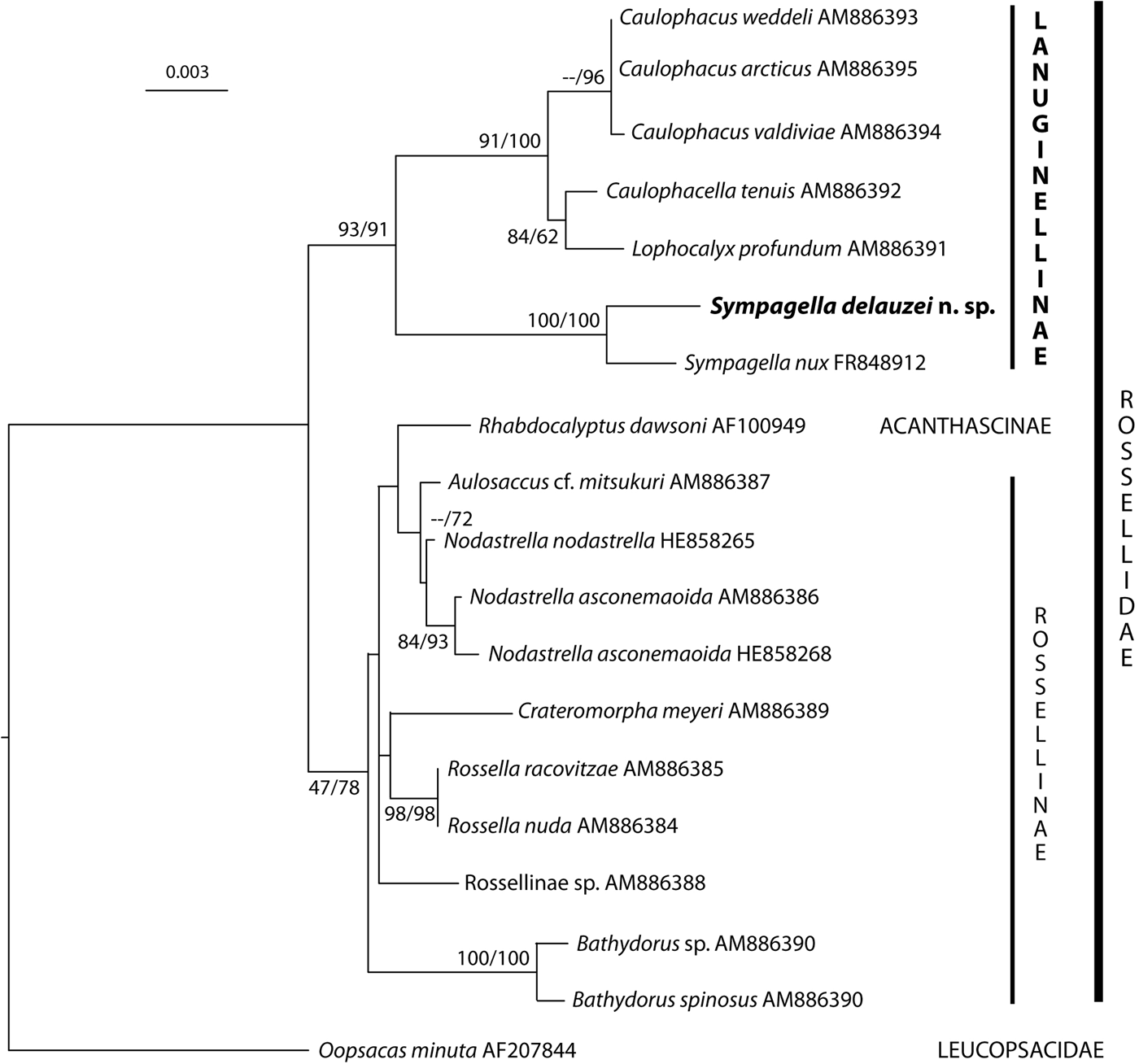
A 1876 bp sequence of 18S rDNA was recovered from our sample of Sympagella delauzei sp. nov. It was aligned with 18S rDNA sequences of other hexactinellids available from nucleotide databases, mostly coming from Dohrmann et al. (Reference Dohrmann, Janussen, Reitner, Collins and Wörheide2008, Reference Dohrmann, Collins and Wörheide2009, Reference Dohrmann, Göcke, Reed and Janussen2012a, b). ML and NJ reconstruction methods produced trees with the same, robust topology (NJ shown on Figure 5, but with bootstrap support from both methods) clearly showing that S. delauzei falls within the family Rossellidae, as currently defined. More precisely, as already shown in Dohrmann et al. (Reference Dohrmann, Göcke, Reed and Janussen2012a, Reference Dohrmann, Haen, Lavrov and Wörheideb), there is a very good bootstrap support (93 and 91% for ML and NJ respectively) for a group of rossellids that includes Caulophacus + Lophocalyx + Caulophacella + Sympagella, which is reminiscent of the former subfamily Caulophacinae Schulze, Reference Schulze1886. This group displays a diagnostic 18 bp deletion in position 667. In more details, the new species is distinctively grouped with Sympagella nux with maximum bootstrap support, which supports the generic allocation of our specimen to Sympagella rather than Caulophacus, Caulophacella Lendenfeld, Reference Lendenfeld1915 or Lophocalyx Schulze, Reference Schulze1887. Moreover it also provides evidence that our specimens are not conspecific with S. nux as available in GenBank. Indeed the two 18S rDNA sequences differ by a dozen base pairs and two indels, which is not compatible with intraspecific variability in hexactinellid 18S rDNA (Dohrmann et al., Reference Dohrmann, Janussen, Reitner, Collins and Wörheide2008, Reference Dohrmann, Collins and Wörheide2009, Reference Dohrmann, Göcke, Reed and Janussen2012a, b).
Neighbour joining and Maximum likelihood phylogenetic reconstructions of the relationships between Sympagella delauzei sp. nov. and available Rossellidae from GenBank (accession numbers reported after taxon name) produced the same topology. NJ tree shown here is rooted with Oopsacas minuta. Bootstrap values (% over 1000 replicates) are shown at main nodes for ML and NJ respectively. Scale bar: genetic distance.
Comparison of S. delauzei with the Atlantic Sympagella spp.
Sympagella delauzei shares with all other Sympagella described so far, a stipitate body with a large atrium which opens in a single osculum, an ectosomal skeleton constituted by pinular pentactins which lay on a layer of smooth pentactins, a surface of the atrium covered by a layer of pinular hexactins, a choanosomal skeleton made of smooth hexactins and diactins, and a skeleton of the peduncle constituted by diactins linked by synapticula. The most abundant microsclere type is a discohexaster present in the type species of the genus and most other species. The main difference between S. delauzei and other Sympagella species is the absence of strobiloplumicome and the presence instead of microhexactins. Most of the spicules of S. delauzei are smaller and the spines of the synapticulate stalk are thinner than those of S. nux. The presence of monactins in the peduncle is unusual. The specimen from the Alboran Sea identified as S. nux by Boury-Esnault et al. (Reference Boury-Esnault, Pansini and Uriz1994) is identical to the new species here described and also lacks strobiloplumicome; it must therefore be considered as a specimen of S. delauzei. Schulze (Reference Schulze1900) had identified Sympagella nux from a broken specimen collected in the Cyclades (between Serifos and Milos, Aegean Sea, east Mediterranean). He had underlined that the pinular pentactins and hexactins are very weak, and the presence of abnormal oxyhexactins. The specimen has all other characteristics of S. nux and especially the strobiloplumicome. This description matches that of the new Mediterranean species except for the presence of strobiloplumicomes. Two hypotheses can therefore be proposed: either (i) the specimen of Schulze belongs to a second Mediterranean species of Sympagella or (ii) it belongs to S. delauzei which can sometimes produce strobiloplumicomes depending on environmental conditions such as the silica content in the sea, as it happens for example in the Mediterranean demosponge Crambe crambe (Maldonado et al., Reference Maldonado, Carmona, Uriz and Cruzado1999).
Tabachnick & Menshenina (Reference Tabachnick and Menshenina2013) described two species from the mid-Atlantic ridge: S. cooki that they differentiate by the absence of discohexasters, and S. ecomari which differs by a set of microsclere types consisting of strobiloplumicomes and discohexasters only. The latter species S. ecomari has been described only from fragments and perhaps will need to be redescribed with better preserved specimens.
Loss of strobiloplumicomes
Tabachnick (Reference Tabachnick1999, Reference Tabachnick, Hooper and van Soest2002) has abandoned the family Caulophacidae due to the fact that ‘the taxon Caulophacidae has no unique or specific features which distinguish it from Rossellidae’ (Tabachnick, Reference Tabachnick1999). He has allocated the different genera of former Caulophacidae in the subfamilies Rossellinae for Caulophacus, Caulodiscus and Caulophacella and Lanuginellinae for Sympagella. However, the characters shared by Sympagella, Caulophacus, Caulodiscus and Caulophacella are numerous and this is even reflected in the definition of the genera given by Tabachnick (Reference Tabachnick, Hooper and van Soest2002, pp. 1503 and 1465).
Three subfamilies are currently recognized within Rossellidae: (1) Lanuginellinae for species which share the presence of strobiloplumicomes, (2) Rossellinae for species without strobiloplumicome or discoctaster, both recognized by Tabachnick (Reference Tabachnick, Hooper and van Soest2002, p. 1491), and (3) Acanthascinae resurrected recently by Reiswig & Stone (Reference Reiswig and Stone2013) for Rossellidae with discoctasters.
It does not seem parsimonious to strictly define a subfamily on the presence or absence of one type of microsclere (Dohrmann et al., Reference Dohrmann, Haen, Lavrov and Wörheide2012b). The loss of spicule types is much more frequent than expected in Porifera and must be clearly distinguished from the absence of a character (e.g. Cárdenas et al., Reference Cárdenas, Pérez and Boury-Esnault2012 for more references). The strong relationship between S. nux and S. delauzei in our molecular tree (Figure 5) clearly supports the loss of strobiloplumicome in the Mediterranean species. Such a loss of microsclere is not an exception in Sympagella, since S. cooki has lost the discohexasters (Tabachnick & Menshenina, Reference Tabachnick and Menshenina2013). Even in the subfamily Lanuginellinae, the genus Mellonympha has a type species (M. velata Thomson, 1873) with strobiloplumicome and another one M. mortenseni (Burton, Reference Burton1928) which lacks strobiloplumicome.
Figure 5 also shows the close relationship between the Sympagella clade and a second clade containing Caulophacus, Caulophacella and Lophocalyx species, which confirms previous results (Dohrmann et al., Reference Dohrmann, Göcke, Reed and Janussen2012a, Reference Dohrmann, Haen, Lavrov and Wörheideb). As already underlined by Dohrmann et al. (Reference Dohrmann, Haen, Lavrov and Wörheide2012b), this is in agreement with earlier classification. We propose, for the time being, to allocate Caulophacus (with its subgenus Caulodiscus) and Caulophacella to the subfamily Lanuginellinae, here strongly supported by our molecular tree (Figure 5, bootstrap support >90%).
Emended diagnosis for Lanuginellinae (revised from Tabachnick, Reference Tabachnick, Hooper and van Soest2002):
Rossellidae with strobiloplumicomes, or if these are absent, the concerned group(s) share so many morphological characters with a group bearing strobiloplumicomes that their common ancestry with loss of that spicule is most parsimonious: specifically Sympagella and Caulophacus share basiphytous attachment, long hollow peduncle composed of diactins fused by synapticula, smooth body without prostalia, pinular hexactins and pentactins as dermalia and atrialia, hypodermalia and hypoatrialia (when present) as pentactins or hexactins, choanosomal diactins and hexactins, discohexasters as the most common microsclere (excluding strobiloplumicomes). DNA sequence analysis supports this diagnosis.
Remarks: In forming this new diagnosis of the subfamily Lanuginellinae, we favour the suggestion by Janussen et al. (Reference Janussen, Tabachnick and Tendal2004) that Caulophacella ought to be moved to subgenus status within Caulophacus. We accept this as a proposal, and if not so considered by others, we here make the formal proposal that Caulophacella be moved to a subgenus of Caulophacus. Our move of Caulophacus from Rossellinae to Lanuginellinae includes all subgenera of Caulophacus.
However it would be necessary to proceed to a molecular phylogenetic analysis of all genera of this subfamily to test its monophyly. A molecular study of all Rossellidae genera would also be important to understand the relationships between the subfamilies and the genera of this large group.
Distribution of Sympagella species (Table 2)
Ten species of Sympagella have been described so far (Table 2): three from the Indian Ocean (Schulze, Reference Schulze1887, Reference Schulze1903; Tabachnick et al., Reference Tabachnick, Janussen and Menschenina2008); three in the Pacific Ocean (Ijima, Reference Ijima1903; Lendenfeld, Reference Lendenfeld1915; Koltun, Reference Koltun1970; Lévi & Lévi, Reference Lévi and Lévi1989; Tabachnick & Lévi, Reference Tabachnick and Lévi2004); and four in the Atlantic Ocean. However until very recently it was considered that S. nux was the only Atlantic Sympagella. Tabachnick & Menshenina (Reference Tabachnick and Menshenina2013) then have described two species from the mid-Atlantic ridge (S. cooki and S. ecomari). With the species described here, four species are now recognized in the Atlantic and Mediterranean. However all the reported occurrences of S. nux in the Azores Islands, Cape Verde Islands and Namibia will have to be checked with regards to S. delauzei.
Distribution of hexactinellid species in the canyons of the French Mediterranean coast and in the Alboran Sea
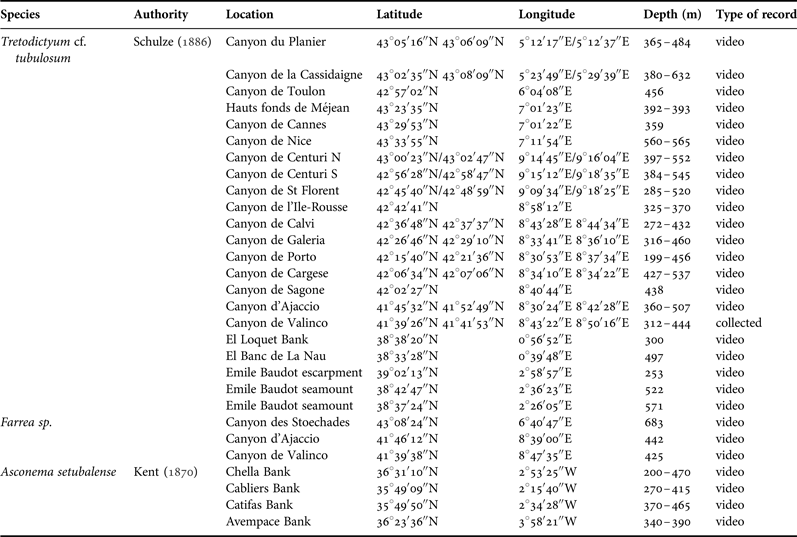
Table 3 summarizes the recent findings of hexactinellids during the French research cruises MedSeaCan/CorSeaCan and by Spanish research cruises in the Alboran Sea. Four species have been observed among the 29 canyons explored along the French Mediterranean coast. Tretodictyum cf. tubulosum was the most abundant, being observed in 6/17 canyons of the French continental coast, 11/12 Corsican canyons (Table 3) and at three seamounts of the Alboran Sea. Oopsacas minuta which displays a large population at the 3PP cave (Boury-Esnault & Vacelet, Reference Boury-Esnault, Vacelet, van Soest, van Kempen and Braekman1994) has not been positively identified in the nearby canyons. In the Valinco Canyon in Corsica, one undescribed species of Farrea was present, not far from the new species of Sympagella. Both Tretodictyum and Farrea species have recently been collected and will soon be studied in more details for a proper description and to solve their identification. Asconema setubalense is abundant in the Alboran Sea (four seamounts), but has not been collected at any other location in the Mediterranean Sea (Table 3).
Distribution of hexactinellid species observed during MedSeaCan and CorSeaCan cruises and OCEANA cruises.
ACKNOWLEDGEMENTS
We thank the COMEX crew for their professionalism and dedication. Caroline Rocher at SCBM (IMBE) provided much appreciated technical help. Shirley Pomponi and the HBOI have provided specimens of Sympagella nux from type locality.
FINANCIAL SUPPORT
We thank the French ‘Agence des aires marines protégées’ and Pierre Watremez for their financial support. OCEANA thanks the specific contribution of INDEMARES LIFE+ Project Co-financed by the European Commission, and the generous and continuous support of Fundación Biodiversidad and Stiftung Drittes Millennium. The results of this work were presented in Bergen in June 2014 in a workshop on deep-sea sponge fauna of the Atlanto-Mediterranean area, thanks to a grant from the Bergen University.