Introduction
Delirium is a severe neuropsychiatric syndrome characterized by acute and fluctuating inattention and other cognitive and perceptual deficits. It is precipitated by physical illness and the side effects of drugs. Occurring in 20% of hospital inpatients (Ryan et al., Reference Ryan2013) it is independently associated with poor outcomes including higher rates of institutionalization and mortality (Witlox et al., Reference Witlox, Eurelings, de Jonghe, Kalisvaart, Eikelenboom and van Gool2010), increased lengths of stay (Holmes and House, Reference Holmes and House2000), greater risk of dementia (Davis et al., Reference Davis2012) and a worsening of existing cognitive impairment (Fong et al., Reference Fong2009). It is also associated with considerable patient and carer distress (Partridge et al., Reference Partridge, Martin, Harari and Dhesi2013). Studies have shown that delirium is partially preventable (Inouye et al., Reference Inouye1999).
Delirium can occur in people of any age but is considerably more common in older people and those with dementia. Dementia is a syndrome that causes chronic, sustained, and progressive impairment of cognition that impacts upon activities of daily living (American Psychiatric Association, 2000).
DSD occurs when a person with pre-existing dementia develops delirium. They frequently co-exist as dementia is an independent risk factor for delirium, increasing delirium risk by two to five times (Fong et al., Reference Fong, Davis, Growdon, Albuquerque and Inouye2015). The prevalence of DSD in community and hospital settings has been shown to range from 22 to 89% (Fick et al., Reference Fick, Agostini and Inouye2002) whilst the prevalence of delirium in people without dementia is approximately 20% (Ryan et al., Reference Ryan2013). One study showed that 68% of people with dementia admitted acutely to hospital from long term care centers had delirium (Voyer et al., Reference Voyer, Cole, McCusker and Belzile2006) whilst a study of outpatients with dementia showed a prevalence of delirium of 19.4% (Hasegawa et al., Reference Hasegawa2013). Greater severity of dementia is associated with increased risk of delirium (Fick et al., Reference Fick, Steis, Waller and Inouye2013). As dementia independently predicts rates of hospitalization, DSD is disproportionately represented in the hospital setting (Albert et al., Reference Albert, Costa, Merchant, Small, Jenders and Stern1999).
Outcomes associated with DSD are worse (Jackson et al., Reference Jackson, Wilson, Richardson and Lord2015), with a hazard ratio of death at 12 months of 2.3 in medical patients with delirium and dementia compared to a hazard ratio of 1.6 with delirium alone (Bellelli et al., Reference Bellelli, Frisoni, Turco, Lucchi, Magnifico and Trabucchi2007). DSD was associated with considerably increased mortality and new institutionalization at one month (Givens et al., Reference Givens, Sanft and Marcantonio2008) and one year along with mobility dependence (Morandi et al., Reference Morandi2014).
Despite the high prevalence and poor outcomes, there are no specific diagnostic criteria for DSD. This may account for the significantly worse rates of recognition of DSD compared to delirium alone (Fick et al., Reference Fick, Hodo, Lawrence and Inouye2007) with detection rates by nursing staff as low as 13% in a long term care facility (Voyer et al., Reference Voyer, Richard, Doucet, Danjou and Carmichael2008). Furthermore, few studies have evaluated the performance of existing delirium assessment tools in people with dementia (Morandi et al., Reference Morandi2012). A particular issue is the diagnosis of DSD when there is lack of availability of a collateral history of cognitive impairment, i.e. known dementia. Another challenge is posed by the overlap in symptoms with the Behavioral and Psychological Symptoms of Dementia (BPSD). Hence there is a gap in the literature concerning the assessment of DSD and the development of agreed reference standards is critical for interpreting existing and ongoing research.
The European Delirium Association (EDA) was established in 2006 (MacLullich et al., Reference MacLullich, Meagher, Laurila and Kalisvaart2007) with the main aims of promoting knowledge of delirium and providing support for research in Europe. The EDA has close links with the American Delirium Association (ADS), Italian Psychogeriatric Association (AIP), and the Australasian Delirium Association (ADA). All were created with similar goals and together aim to coordinate clinical and research efforts to minimize the impact of delirium on short- and long-term health and well-being of patients.
Previously the EDA undertook a survey of general delirium care that demonstrated heterogeneity in assessment and management of delirium amongst an international group of specialists involved in delirium care and clinical practice (Morandi et al., Reference Morandi2013). Following on from this survey we were interested in gaining some insight into the range of opinions among mailing list members and other interested parties on various aspects of DSD diagnosis to assess possible variation in practice. The main area of inquiry for this survey included responses from delirium specialists and other interested parties about perceived knowledge on DSD and measurement of variation in practice.
Methods
Survey development and design
The questionnaire was constructed through an iterative process, which included item generation, construction, pilot testing, and refinement from eight expert members of the EDA and ADS Boards.
The final survey consisted of 23 multiple-choice questions, two self-rating scales, and a free text option at the end. Themes covered by the questions included the assessment and diagnosis of DSD in clinical practice and research studies (supplementary material).
Survey administration
The survey period was March 2014 to October 2014. The invitation to participate in the online survey was distributed by email among members of the EDA, ADS, AIP, and the ADA, with additional publication on the EDA and ADS websites. Reminders were sent out every two months after the initial survey distribution. Responses were anonymized.
Data analysis
The frequency distributions of the results were automatically generated and summarized in chart and table form by the survey package.
The Ethics Committee of the “Fondazione Camplani” Hospital determined that the project did not require full committee review.
Results
Characteristics of the responders
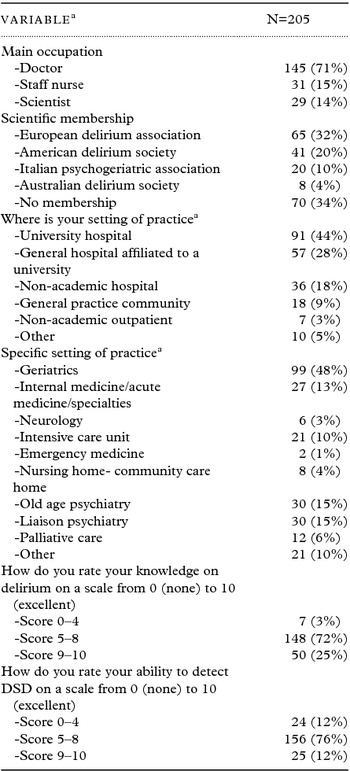
The majority of the 205 responders were doctors (71%), followed by nurses (15%), and scientists (14%). Most responders worked in geriatric medicine (48%), liaison psychiatry (15%), old age psychiatry (15%), and acute/internal medicine (13%) (Table 1). The majority of responders worked in hospitals (university hospital 44%, non-academic hospital 18%).
Characteristics of responders. This table displays the key characteristics of the responders

aResponders could choose more than one setting so answers total more than 100%.
Median self-rated knowledge of delirium was 8 on a scale of 0 (none) to 10 (excellent). Responders were mostly confident that they could detect DSD with 60% (N = 123) rating their confidence at 7 or above on a scale of 0 (none) to 10 (excellent).
DSD versus dementia
One-third of responders (N = 63) stated that it is always possible to distinguish DSD from dementia alone while 57% (N = 117) felt that this is only possible in some circumstances. Forty-one percent of responders (N = 85) felt that it was always possible to distinguish delirium from Behavioral and Psychological Symptoms in Dementia (BPSD). Fifty-eight percent (N = 118) felt that this was only possible in some circumstances and three responders stated that it was not possible to distinguish the two conditions.
Severe dementia was felt to be the most challenging stage of dementia to distinguish delirium from dementia (63%, N = 129). The majority agreed that DLB was the subtype of dementia in which the diagnosis of DSD is most challenging (76%, N = 156).
Assessment and diagnosis of DSD
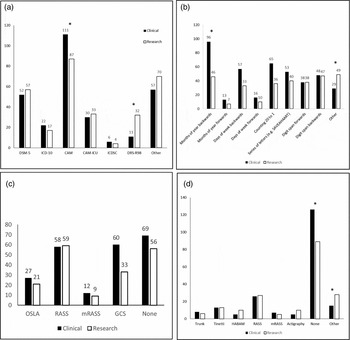
Several criteria and/or scales were used to assess for the presence of DSD in clinical practice including the CAM (54%), DSM-5 criteria (25%), CAM-ICU (15%), and ICD-10 criteria (11%) (Figure 1(a)). The CAM was also most frequently used in research studies (42%) followed by DSM-5 (28%). CAM-ICU and DRS-R98 were the next most frequently used scales in research (16% each) (Figure 1(a)).
Assessment and diagnosis of DSD in clinical practice and research settings. (a) How do you assess for the presence of DSD? (b) Which test do you use to test attention in patients with DSD? (c) How do you measure level of alertness in DSD? (d) Do you have a specific test to monitor motor fluctuations in patients with DSD? These graphs show the frequency with which different methods of assessing and diagnosing DSD are used in clinical practice and research settings. The symbol “*” represents statistical significance (p < 0.05) between clinical and research practice according to χ2 test. Abbreviations—DSM-5: Diagnostic and Statistical Manual of Mental Disorders, Fifth edition (American Psychiatric Association, 2013); ICD-10: International Classification of Diseases; CAM: Confusion Assessment Method (Inouye et al., Reference Inouye, van Dyck, Alessi, Balkin, Siegal and Horwitz1990); CAM-ICU: Confusion Assessment Method – Intensive Care Unit (Ely et al., Reference Ely2001); ICDSC: Intensive Care Delirium Screening Checklist (Bergeron et al., Reference Bergeron, Dubois, Dumont, Dial and Skrobik2001); DRS-R98: Delirium Rating Scale – Revised-98 (Trzepacz et al., Reference Trzepacz, Mittal, Torres, Kanary, Norton and Jimerson2001); OSLA: Observational Scale of Level of Arousal (Tieges et al., Reference Tieges, McGrath, Hall and Maclullich2013); RASS: Richmond Agitation Sedation Score (Sessler et al., Reference Sessler2002); m-RASS: modified – Richmond Agitation Sedation Score; GCS: Glasgow Coma Scale (Teasdale and Jennett, Reference Teasdale and Jennett1974); HABAM: Hierarchical Assessment of Balance and Mobility (MacKnight and Rockwood, Reference MacKnight and Rockwood1995).

Most responders stated that attention (71%, N = 145) and fluctuation in cognitive status (65%, N = 133) were the most useful neurocognitive or motor features when diagnosing DSD followed by arousability (41%, N = 85).
Sustained attention was felt to be the “attention” subtype that should be tested in dementia patients for the diagnosis of DSD (62%, N = 128). Months of the year backwards was the most frequently used test for attention (47%) followed by counting 20 to 1 (32%), days of the week backwards (28%), and series of letters (e.g. SAVEAHAART) (26%) (Figure 1(b)).
Level of alertness was measured in clinical practice using Glasgow Coma Scale (29%) and Richmond Agitation Sedation Score (RASS) (28%). In research, RASS was used most frequently (29%) (Figure 1(c)).
The majority of responders believed that motor fluctuations were important for the diagnosis of DSD (77%, N = 158). However, the majority did not have a specific test used to monitor motor fluctuations in clinical practice (61%) or research studies (43%). In those who did use a specific test, the RASS was most popular in both clinical practice and research studies (Figure 1(d)).
Assessment of dementia
Pre-delirium cognitive status was most frequently defined using a history from family/significant others (82%, N = 169) and previous medical records (59%, N = 120). More formal ascertainment methods, such as the IQCODE (20%, N = 42) and Clinical Dementia Rating Scale (CDR) (9%, N = 19), were used less frequently.
The severity of dementia was most frequently assessed using the Mini-Mental State Examination (MMSE) (57%, N = 116) and CDR (23%, N = 48). These were also most frequently used for this purpose in research studies.
Discussion
Main findings and links to the literature
To the best of our knowledge, this is the only survey of DSD assessment to date. As may be expected in a group of delirium specialists, responders were generally confident in their ability to detect DSD. However, the anticipated degree of consensus in responses amongst this sample of delirium experts was not seen in this survey.
Notably, we found that, in particular, among patients for whom histories of severe dementia were available, the diagnosis of DSD was particularly challenging. This poses problems in clinical practice given that the prevalence of delirium on admission to hospital is highest in patients with severe dementia (Voyer et al., Reference Voyer, Cole, McCusker and Belzile2006). This challenge may account for the fact that 57% of responders felt that it is only possible in some circumstances to distinguish DSD from dementia alone.
The high prevalence of undiagnosed dementia contributes to the challenge of diagnosing DSD. A study of emergency medical admissions found that only a half of patients with dementia had a formal diagnosis (Sampson et al., Reference Sampson, Blanchard, Jones, Tookman and King2009). Even in those with a diagnosis, healthcare professionals may be unaware of this in the acute setting due to the challenges of obtaining a collateral history. This may be due to the unavailability of old notes, particularly if a patient attends alone, or due to the informant being unaware of the diagnosis. A population-based study showed that informants were unaware of the diagnosis of dementia in 42% of patients with a study confirmed diagnosis (Savva and Arthur, Reference Savva and Arthur2015). In our survey, there was general consensus from responders that pre-delirium cognitive status was most frequently defined using a history from family/significant others and previous medical records, but more formal ascertainment methods, such as the IQCODE and CDR, were much less frequently used. This supports the need for more research into the most effective methods of capturing information from caregivers (Morandi et al., Reference Morandi2012).
The prevalence of DSD is often underestimated due to the high prevalence of undiagnosed dementia along with the under-recognition and under-reporting of delirium in hospital. A study of 710 acute elderly medical admissions found that 72% of the 110 cases of delirium were not detected by the clinical teams (Collins et al., Reference Collins, Blanchard, Tookman and Sampson2010). The authors of a systematic review providing the most widely quoted figures for prevalence of DSD in community and hospital settings acknowledge that their review is limited by the differences in study quality, “inconsistent criteria for diagnosis” along with varying study populations (Fick et al., Reference Fick, Agostini and Inouye2002). This further highlights the urgent need for precise diagnostic criteria and comprehensive guidelines regarding the assessment and diagnosis of DSD.
When exploring the methods used to diagnose DSD, the CAM, and DSM-5 were most frequently used. However, these along with other current instruments and rating scales were specifically designed for use in delirium rather than DSD. The CAM was found to have a small overall evidence base to support its specific use in the diagnosis of DSD in a systematic review of delirium tools (Morandi et al., Reference Morandi2012) although the nine studies of sufficient quality to meet inclusion criteria contained only 50 patients with DSD in total. Despite the fact that patients with severe dementia are often the most challenging subtype in which to diagnose DSD, none of the studies in this review reported any effect of dementia subtype or severity (Morandi et al., Reference Morandi2012).
Most responders stated that attention (71%) and fluctuation in cognitive status (65%) were the most useful neurocognitive or motor features when diagnosing DSD followed by arousability (41%). Attentional deficits are the cardinal and required symptoms in DSM diagnostic criteria (American Psychiatric Association, 2013). These deficits were confirmed as the key distinguishing element of delirium in a study comparing neuropsychiatric profiles in delirium and dementia (Meagher et al., Reference Meagher, Leonard, Donnelly, Conroy, Saunders and Trzepacz2010). In our survey, sustained attention was felt to be the attention subtype that should be tested in patients with dementia in order to diagnose DSD. Sustained visual attention has been shown to be highly impaired in those with delirium but intact in those with dementia (Brown et al., Reference Brown, Fordyce, Zaghdani, Starr and MacLullich2011). Spatial span forwards (a visuospatial task using cubes arranged on a grid) may also be useful as a differentiating screening test (Meagher et al., Reference Meagher, Leonard, Donnelly, Conroy, Saunders and Trzepacz2010). However, other tests including months of the year backwards, counting 20 to 1, days of the week backwards and series of letters (e.g. SAVEAHAART) are all being used by the delirium experts in our survey. Importantly, many of these tests show overlap in performance between delirium and dementia (Tieges et al., Reference Tieges, Brown and MacLullich2014). Our survey highlights the lack of consensus regarding the highly important issue of assessment of attentional deficits in DSD.
There was little consensus regarding how best to measure level of alertness, with Glasgow Coma Scale (29%) and RASS (28%) being used in clinical practice. Level of arousal has previously been shown to be highly specific to a diagnosis of delirium (Tieges et al., Reference Tieges, McGrath, Hall and Maclullich2013), has been shown to independently predict length of stay (Yevchak et al., Reference Yevchak2015), and mortality (Han et al., Reference Han2014) and may be particularly valuable in situations where cognitive testing is more challenging due to significant underlying cognitive impairment such as in severe dementia (Morandi et al., Reference Morandi2012).
There was uncertainty regarding the assessment of motor fluctuations which have previously been reported as a possible tool to distinguish DSD from severe dementia in a study using the Trunk Control Test as a measure of motor functions (Bellelli et al., Reference Bellelli, Speciale, Morghen, Torpilliesi, Turco and Trabucchi2011). This study demonstrated that “patients with delirium exhibit a pattern of fluctuating motor performance that is chronologically related with the onset and the end of delirium” (Bellelli et al., Reference Bellelli, Speciale, Morghen, Torpilliesi, Turco and Trabucchi2011). These motor fluctuations were not seen in patients with dementia alone (including severe dementia). Despite the majority of responders believing that motor fluctuations were important for the diagnosis of DSD, most did not have a specific test used to monitor these in clinical practice.
The neuropsychological profile of the different subtypes of dementia varies considerably. For example, attentional deficits and fluctuations are a prominent feature of DLB but are relatively rare in patients with other forms of dementia (Robinson et al., Reference Robinson, Tang and Taylor2015). This overlap in the symptoms of delirium and DLB makes distinguishing DSD from DLB alone particularly challenging. Most respondents were in agreement regarding this, matching the observation that DLB “closely mimics delirium” (Neef and Walling, Reference Neef and Walling2006). A history of delirium is more common in DLB than Alzheimer's dementia (AD) (Vardy et al., Reference Vardy, Holt, Gerhard, Richardson, Snowden and Neary2014) with 32% of outpatients with DLB experiencing delirium as opposed to 15% of outpatients with AD (Hasegawa et al., Reference Hasegawa2013). The development of methods to distinguish the two is highly relevant and has not previously been examined.
Delirium versus behavioral and psychological symptoms
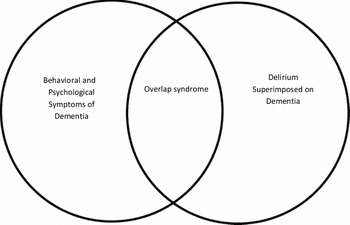
Only 41% of responders felt that it was always possible to distinguish delirium from Behavioral and Psychological Symptoms in Dementia (BPSD). BPSD are common, affecting more than 90% of people with dementia at some stage (Ballard et al., Reference Ballard2009). A study showed that DSD is associated with a higher level of behavioral symptoms of dementia than dementia alone (Landreville et al., Reference Landreville, Voyer and Carmichael2013). There is some overlap in the symptoms of BPSD and delirium and it is possible that in fact what is attributed to BPSD in research and clinical practice is actually DSD. Landreville et al. suggest that delirium interventions should be considered for the management of BPSD. Given the difficulty in differentiating between the two, there is an argument for an overlap group (Figure 2). Given the increased mortality associated with long term antipsychotic treatment in BPSD (Ballard et al., Reference Ballard, Corbett and Howard2014), it might follow that the brain optimization interventions used in the management of delirium should be applied to this overlap group.
Diagrammatic representation of the relationship between BPSD and DSD. There is some overlap in the symptoms of BPSD and delirium and it is possible that in fact what is attributed to BPSD in research and clinical practice is actually DSD.

Strengths and weaknesses
This is the first survey of the practice and attitudes of delirium specialists with respect to the assessment of DSD. Both the sample size and international nature of the survey strengthen the results. Despite being novel, there are several limitations that should be mentioned. It was not possible to calculate a response rate for the survey as the denominator is unknown. This is due to the fact that the survey was published on the websites of four international delirium associations as well as being emailed directly to potential respondents. A second limitation is the relative lack of responses from members of the multi-disciplinary team other than doctors who made up 71% of responders. A third limitation relates to the possible contrast of reported practice and actual practice. This could form the basis of further work. Future studies could also address the management of DSD, which was not covered in this survey that focused largely on diagnosis.
Conclusions
A systematic review of DSD prevalence attributed the variation to “inconsistent criteria for diagnosis” (Fick et al., Reference Fick, Agostini and Inouye2002). This is supported by the range in practice identified by our survey of delirium specialists which showed wide variation in how people conceptualize and operationalize DSD. DSD was minimally considered in the large review of the literature carried out by the National Institute for Clinical Excellence in preparation for writing their guidance on delirium (National Institute for Health and Clinical Excellence, 2010) and guidance regarding distinguishing delirium from dementia does not feature in DSM criteria (American Psychiatric Association, 2013). Our survey has highlighted the need for studies validating existing tools used to detect delirium in patients with DSD and developing new standardized methods for diagnosing DSD.
In conclusion, this first survey of DSD showed that despite good levels of confidence in recognizing DSD, there is a lack of consensus concerning assessment and diagnosis of DSD amongst a relatively large international group of delirium specialists. These results emphasize the need for the development of precise diagnostic criteria and comprehensive guidelines regarding the assessment and diagnosis of DSD.
Conflict of interest
None.
Description of authors’ roles
Study conception and design was done by all the authors. Acquisition of data was done by A. Morandi and D. Davis. Data analysis was done by A. Morandi. Interpretation of results was done by all the authors. Manuscript was drafted by S. Richardson. Critical revision of the manuscript was done by all the authors. Final approval of the manuscript was done by all the authors.
Supplementary material
To view supplementary material for this paper, please visit http://dx.doi.org/10.1017/S1041610215002288.