Worldwide, nearly 35.6 million people live with dementia; this number is expected to double by 2030 (World Health Organization, 2012). More than 97% of residents in nursing homes have dementia (Ministry of Health, Labour and Welfare, 2015). “Better support to caregivers” was incorporated as one of the guiding principles of the Japanese Dementia Strategy (Ministry of Health, Labour and Welfare, 2015). One of the major sources of stress for family caregivers of nursing home residents with advanced dementia is surrogate decision making (Peacock, Reference Peacock2013).
Family conflict between family caregivers and other family members has been clarified as one of the barriers to decision making (Livingston et al., Reference Livingston2010). For family caregivers, family conflict is related to negative psychological effects, such as depression and anger (Semple, Reference Semple1992), stress (Kwak et al., Reference Kwak, Ingersoll-Dayton and Kim2012), anxiety (Bloomer et al., Reference Bloomer, Digby, Tan, Crawford and Williams2016), and complicated grief (Kramer et al., Reference Kramer, Kavanaugh, Trentham-Dietz, Walsh and Yonker2011). As above, measures of conflicts within families of family caregivers of persons with dementia might be useful in developing appropriate and tailored interventions for family caregivers at risk for developing psychological problems arising from the care they provide for their relatives. Thus, it is helpful to measure the context of family conflict after admission to long-term care (LTC) facilities to cope with psychological problems and resolve family conflict for residents with dementia and their families.
To measure family conflict in the caregiving context, marital (Straus, Reference Straus1979; Kinney and Stephens, Reference Kinney and Stephens1989), or overall family, conflict scales (Semple, Reference Semple1992; Moos and Moos, Reference Moos and Moos1994; Lieberman and Fisher, Reference Lieberman and Fisher1999; Clark et al., Reference Clark, Shields, Aycock and Wolf2003; Winter and Parks, Reference Winter and Parks2008) have been used. Conflicts in the families of persons with dementia occur most frequently between family caregivers and other family members, more than between family caregivers and the persons with dementia (Peisah et al., Reference Peisah, Brodaty and Quadrio2006). Hence, there is a need to focus not on interpersonal conflict between family caregivers and persons with dementia but on overall family conflict including all family members except for persons with dementia. Overall family conflict scales (FCS) have been developed to measure conflict in the contexts of caregiving for persons with Alzheimer's disease (Semple, Reference Semple1992; Lieberman and Fisher, Reference Lieberman and Fisher1999), stroke (Clark et al., Reference Clark, Shields, Aycock and Wolf2003), and at end-of-life (Winter and Parks, Reference Winter and Parks2008; Kramer et al., Reference Kramer, Kavanaugh, Trentham-Dietz, Walsh and Yonker2010). General conflict in the family environment is measured using the conflict subscale of the Family Environment scale (Moos and Moos, Reference Moos and Moos1994). The FCS (Semple, Reference Semple1992) measures overall family conflict including all family members except for persons with dementia in caregiving for families of persons with dementia.
The FCS was developed based on qualitative interviews with family caregivers of non-institutionalized persons with Alzheimer's disease. In this study, family conflict was defined as overt interpersonal disagreement, unstated disagreements, or unexpressed hard feelings, specifically confined to incompatible or opposing views or actions between family caregivers and any family member based on Semple's (Reference Semple1992) definition. This scale has 12 items and three subscales that assess caregiver disagreement with anyone in their family. The three subscales are as follows: (1) conflict around definitions of the illness and strategies for care (four items); (2) conflict around family members’ attitudes and actions toward the patient (four items); and (3) conflict around family members’ actions and attitudes toward the caregiver (four items). All items were measured on a four-point scale (4: quite a bit of disagreement; 3: some disagreement; 2: just a little disagreement; 1: no disagreement.)
In a previous study of family caregivers of institutionalized persons with dementia, two FCS factors (second and third subscales) were used (Gaugler et al., Reference Gaugler, Zarit and Pearlin1999). The first subscale, which was not used in the previous study, comprises items assessing the extent of the illness of the family member with dementia, such as degree of cognitive impairment. Cognitive impairment is related to admission to LTC facilities (Gaugler et al., Reference Gaugler, Duval, Anderson and Kane2007). Therefore, all three subscales should be evaluated in institutional situations. Furthermore, family caregivers experience increasing family conflict after admission compared with before admission (Gaugler et al., Reference Gaugler, Zarit and Pearlin1999), so family conflict should be evaluated after admission and it is necessary to support family caregivers of persons with dementia.
Additionally, Semple (Reference Semple1992) mentioned that family conflict is not simply a lack of social support. It is helpful to consult other family members, but family caregivers face difficulties when they do not agree (Livingston et al., Reference Livingston2010). Accordingly, family resources play an important role of social support, but family support does not always reduce family conflict. However, this implication has not been verified empirically. As a hypothesis, a fair but not strong correlation between the FCS (developed in this study) and family function was predicted; each FCSs subscale was predicted to correlate better with each subscale than with family function. While family support is recognized as an important resource for family caregivers in a clinical setting, it might require more attention when healthcare providers intervene to family caregivers who perceive conflict among family members. Accordingly, it is useful to clarify how family support relates to family conflict for developing interventions for family caregivers of persons with dementia who recognize conflict among family members. Therefore, this study aimed (1) to validate the FCS for family caregivers of persons with dementia in LTC facilities and (2) to explore the relationship between family conflict and family support.
Methods
Definition of term
A family caregiver was defined as the family member registered as the key person to provide care for older adults diagnosed with dementia living in a LTC facility.
Procedure
We obtained permission from the FCS developer, Shirley J. Semple. After reviewing the equivalence between the back-translated and original versions with the developer, we produced a pre-questionnaire. Twelve staff members who had worked for more than 2 years for three LTC facilities (two nursing homes, one geriatric health services facility) participated in a group interview or individual interviews. These interviews determined whether the pre-questionnaire could be adapted for family caregivers of persons with dementia in LTC facilities in Japan. After a modified version was verified by the participants and the developer, we produced a pilot questionnaire. Twelve family caregivers participated in the pilot testing and cognitive interview. The time required to complete the pilot questionnaire was measured. Each family caregiver was interviewed afterward about their thought processes when answering the questionnaire, deduced by cognitive interviewing to verify content validity (Fisher and Geiselman, Reference Fisher and Geiselman1992). All 12 items about the extent of disagreements within their family could be adapted for family caregivers of persons with dementia; three subscales were distinguished. The developer reviewed the conceptual and linguistic equivalence between the final Japanese version (FCSL) and the original English version. The test and retest were performed by self-administered questionnaires using the FCSL to verify its feasibility, validity, reliability, and reproducibility.
Data collection
The test and retest were conducted between October 2015 and January 2016. We successfully contacted 261 facilities (25.9%) via telephone or fax out of 1,046 LTC facilities (478 special elderly nursing homes and 568 group homes for older adults with dementia). The list of LTC facilities was downloaded from the website of the Bureau of Social Welfare and Public Health, Tokyo Metropolitan Government, on July 1, 2015 (Tokyo Metropolitan Government, 2015). In addition to these facilities, we also contacted facilities from other prefectures that had relationships with the researchers in our department. We contacted 41 LTC facilities (20 nursing homes, 21 group homes) that were willing to participate to distribute 836 self-administered questionnaires to family caregivers who were determined to meet the operational definition by the staff in the facilities (546 were sent to nursing homes, 290 to group homes for older adults with dementia).
Participants
We collected 334/836 questionnaires from participants in the test (response rate 39.95%; 194 from nursing homes, 140 from group homes). We excluded family caregivers who did not meet the operational definition in this study (i.e. not a family caregiver or the care recipient was not diagnosed with dementia). Questionnaires with missing data were also excluded (66 total; 16 with missing FSCL data, 30 with missing sociodemographic data for the primary caregiver, 13 with missing sociodemographic data for the care recipient; 7 with other missing data). Data from 259/334 questionnaires were analyzed (valid response rate: 31.0%; 156 from nursing homes; 103 from group homes).
We sent retest questionnaires along with rewards worth 1,000 yen to 318/334 participants who had indicated willingness to participate. The interval between test and retest was two weeks. Of those, 303 questionnaires were collected. We excluded participants who were already excluded in the test and who had a change in condition (either the participants themselves or their family members), such as hospitalization or death, during the period between the test and the retest (n = 86). Questionnaires with missing data (n = 9) were also excluded. Data from 208 questionnaires were analyzed.
Measurement
Family functioning
Family APGAR (adaptability, partnership, growth, affection, resolve) was used to assess family functioning perceived by family caregivers. Family APGAR assesses family members’ perceptions of family functioning by examining their satisfaction with family support (Kokubo and Kamibeppu, Reference Kokubo and Kamibeppu2013). Family APGAR includes five items, measured on a three-point Likert scale (0–2), with higher scores indicating higher satisfaction with family functioning. Cronbach's α was 0.931 in this study.
Cognitive function level
The Cognitive Performance scale (CPS; Morris et al., Reference Morris1994) was used to assess the cognitive level of care recipients as perceived by family caregivers. The CPS is composed of cognitive items within a hierarchical seven-category rating scale (0–6), with higher scores indicating more severe impairment of cognitive functioning. Cronbach's α was 0.775 in this study.
Depression and Anger
The Symptom Check List-90 Items-Revised (SCL-90-R; Derogatis, Reference Derogatis1983) was used to assess the severity of depression and anger over the last week and is rated on a five-point Likert scale ranging from 0 (not at all) to 4 (extremely). The SCL-90-R is a self-report instrument and consists of nine symptom clusters/subscales (somatization, obsessive–compulsive behavior, interpersonal sensitivity, depression, anxiety, hostility, phobia anxiety, paranoid ideation, psychotic). In this study, two subscales of depression (13 items) and anger (6 items) from the nine symptom subscales were used. In Japan, the SCL-90-R has demonstrated reliability and validity (Tomioka et al., Reference Tomioka, Shimura, Hidaka and Kubo2008). In this study, Cronbach's α was 0.883 for the subscale of depression, and 0.768 for the subscale of anger.
Sociodemographic variables
We enquired about the following characteristics of family caregivers: age at the time of the study, sex, marital status, relationship of care recipient, family assistance for caregiving, number of family members for assistance, and education level. We asked family caregivers questions regarding the following demographic characteristics of the care recipients: age, sex, period since admission, type of dementia, and level of care required.
Statistical analysis
Descriptive statistics for all variables were calculated; score distributions for FCSL were summarized as means, standard deviations, medians, minimum and maximum scores, percentages of floor (1) and ceiling (4) scores, and kurtosis and skewness. Feasibility was determined based on the amount of time required to complete the pilot questionnaire and the percentage of all missing values in the test. The amount of time for answering the questionnaire has not been described in previous studies. In this study, we decided that a maximum of 5 minutes would be acceptable for answering in a clinical setting. Acceptability of missing values in the test was based on Semple's (Reference Semple1992) original study.
Factorial, external, convergent, and discriminant validity were examined. Factorial validity was first tested by exploratory factor analyses using the principal factor method and promax rotation. The cut-off for factor loadings was less than 0.4. Exploratory factor analyses were conducted and a two-factor model was extracted. Subsequently, confirmatory factor analyses were conducted to compare a two-factor model with a three-factor model identified in the original study. Goodness of fit refers to the following fit indices: χ 2/df, comparative fit index (CFI), root mean square error of approximation (RMSEA), and Akaike information criterion (AIC).
Convergent validity was examined using internal correlations of each FCSL subscale and correlations with family APGAR. The original study (Semple, Reference Semple1992) found that family conflict was not simply due to the absence of social supports, such as family resources. Therefore, a fair but not strong relationship between the FCSL and family APGAR was initially predicted; each FCSL subscale was predicted to correlate better with each subscale than with family APGAR. Discriminant validity was examined using the internal correlations of each FCSL subscale and correlations with depression and anger of the SCL-90-R. Semple's (Reference Semple1992) original study found that anger and depression were correlated (ranging from 0.23 to 0.34) with family conflict. Therefore, a fair relationship between FCSL and depression and anger was predicted; each FCSL subscale was predicted to correlate better with each subscale than with anger and depression in the SCL-90-R. In this study, the criterion of the correlation coefficient was defined as 0.2 < | r | ≤ 0.4 for a fair correlation, 0.4 < |r| ≤ 0.7 for a strong correlation, and 0.7 < |r| ≤ 1.0 for a substantial correlation (Schermelleh-Engel et al., Reference Schermelleh-Engel, Moosbrugger and Müller2003). Moreover, the relationship between family assistance for caregiving and the FCSL was examined using an unpaired t-test. The correlation with number of family members available for care assistance was also tested.
Reliability was tested by Cronbach's α. Good internal consistency was defined as a Cronbach's α value exceeding 0.80. Cronbach's α ranged from 0.80 to 0.86 in Semple's (Reference Semple1992) original study. Retest reliability was examined by the intraclass correlation coefficient (ICC) between the test scores and the retest scores in a one-way random effects model. The criterion was defined as an ICC value of 0.41–0.60 as moderate, 0.61–0.80 as substantial, and 0.81–1.00 as almost perfect. Statistical analysis was conducted using SPSS ver. 21.0 J for Windows and Amos ver. 21.0.0.
Ethical considerations
All questionnaires were distributed to family caregivers by LTC facilities. Return of the questionnaire was regarded as participant consent. In the retest, participants who had sent an envelope with their name and address to the researchers received a questionnaire for the retest. The Ethics Committee of the Graduate School of Medicine and Faculty of Medicine, The University of Tokyo, approved the study.
Results
Participant characteristics
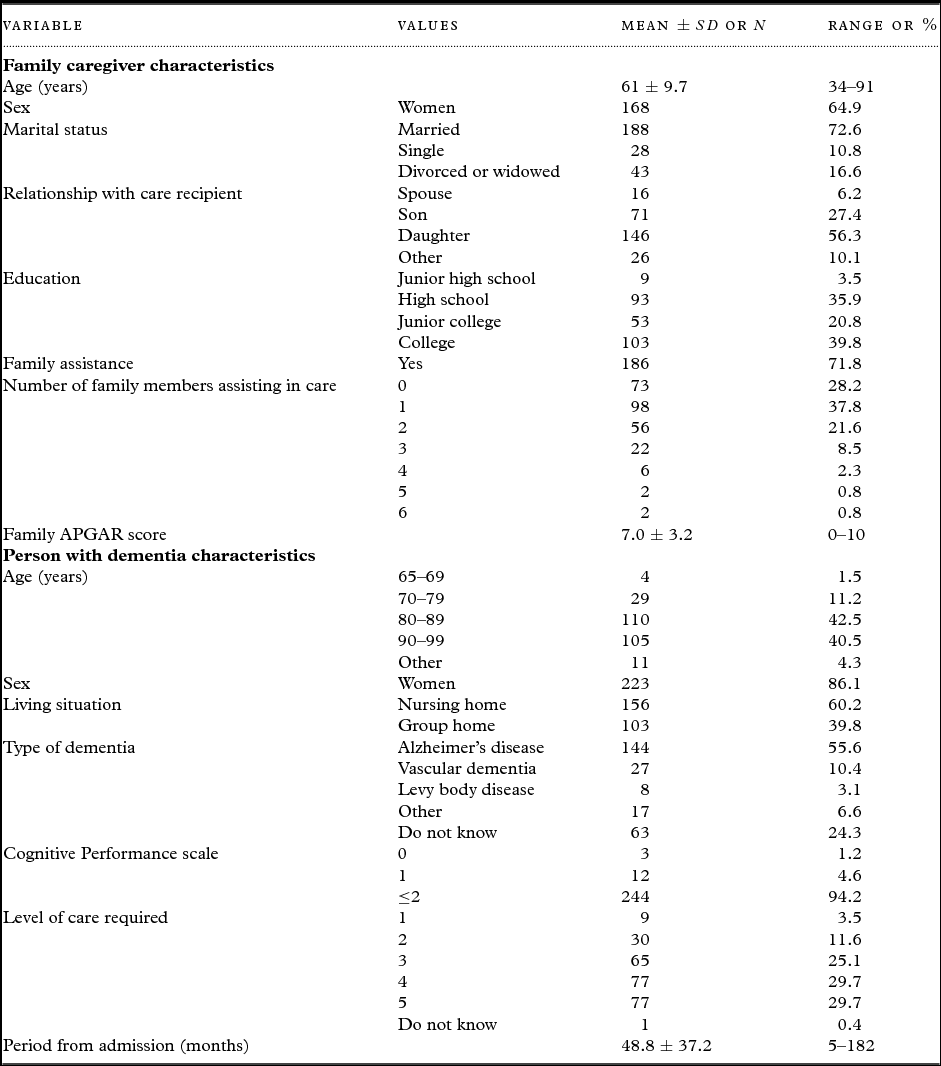
The mean age of family caregivers was 61.1 years and about two-thirds were women. The most frequent relationship with the person with dementia was child. Most family caregivers received family assistance for caregiving. Most persons with dementia were in their 80s or 90s and women. The mean period since admission to LTC facilities was 48.8 months at the time of the survey (Table 1).
Sociodemographic characteristics (N = 259)

Note: SD = Standard deviation; APGAR = adaptability, partnership, growth, affection, resolve. The Cognitive Performance scale was used to assess the cognitive level of care recipients as perceived by the family caregiver. Higher scores indicate more severe cognitive functioning impairment. The level of care required indicates level of long-term care need in Japan (between 1 and 5 based on assessment of care requirements). Higher scores indicate requiring more services in daily life.
Scale descriptions
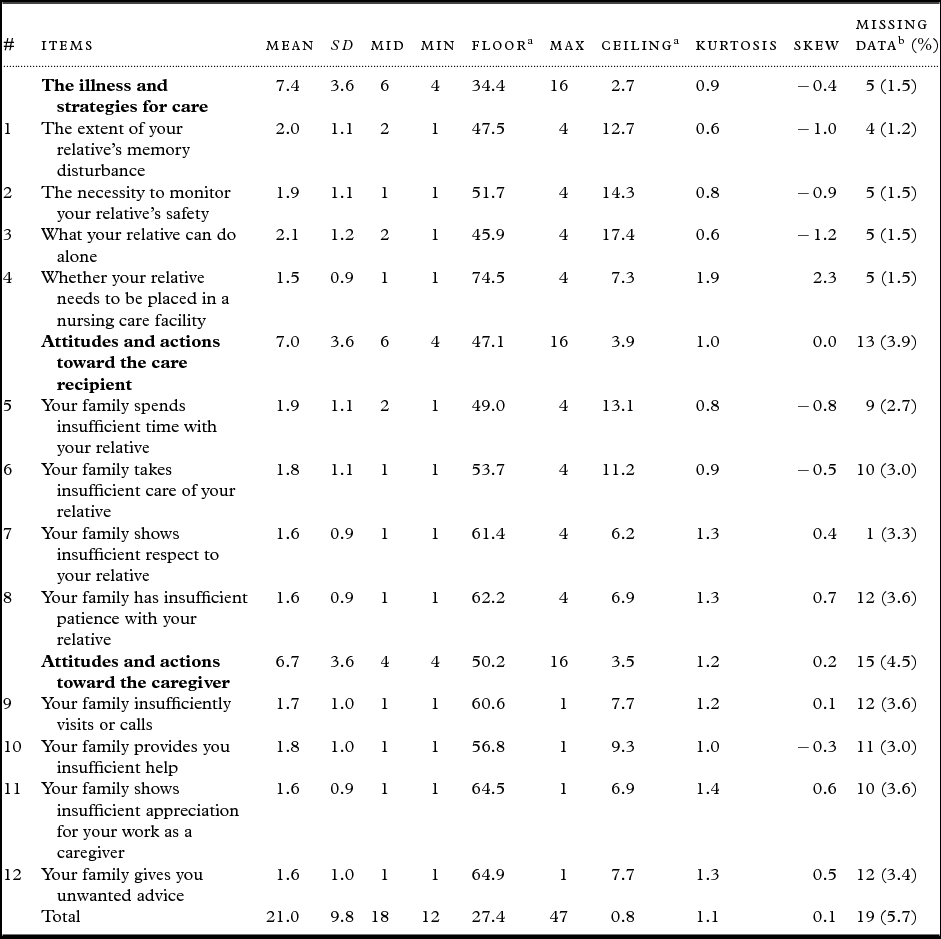
The mean scores for each FCSL subscale of ranged from 6.7 to 7.4 (Table 2). More than 70% of the participants experienced family conflicts, while about half of the participants reported the minimum score possible for each item. Through the interviews, item 4 “whether your relative should be placed into a nursing-care facility” was modified to “whether your relative needs to be placed in a nursing care facility” based on expressions used in interviews of staff members in LTC facilities. Time required to complete the pilot questionnaire was 2–5 minutes. The percentage of missing values in the test was 5.7%.
FCSL items and scores (N = 259)

Note: SD = Standard deviation, FCSL = family conflict scale in long-term care facilities.
aPercent of total.
bMissing data from all participants (N = 334).
Validity
Cognitive interviews of family caregivers confirmed that all 12 items asking about the extent of disagreements within their family could be adapted to family caregivers of persons with dementia. The three FCSL subscales could be distinguished by words expressed by family caregivers, especially the second and third subscales. Thus, the subscales showed content validity.
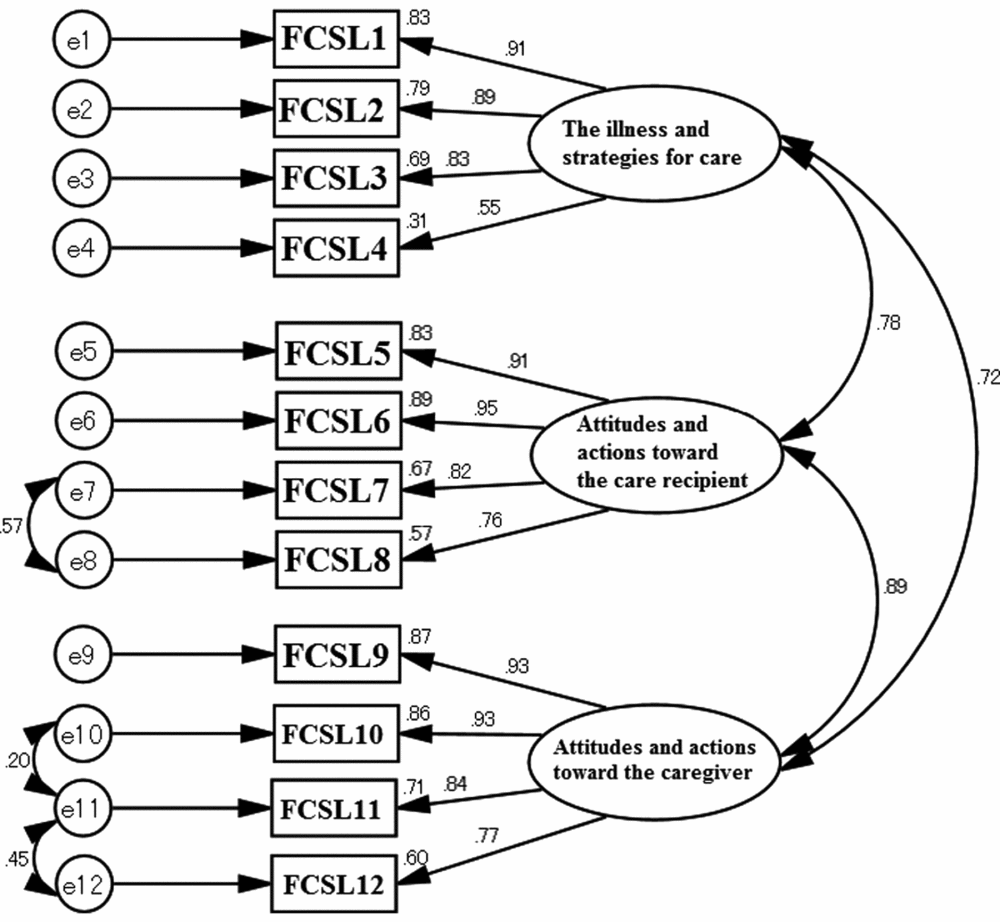
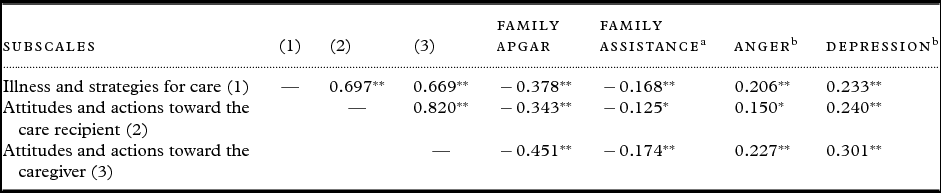
Exploratory factor analyses produced two factors. These corresponded to the first factor of the illness and strategies for care; the second factor combined attitudes and actions toward the patient with attitudes and actions toward the caregiver in the original work. Subsequently, two-factor and three-factor models were compared by confirmatory factor analyses. The fit indices for the two-factor model were as follows: χ 2 = 176.18, χ 2/df = 3.748, p = 0.001; Goodness of fit index (GFI) = 0.891; CFI = 0.957; RMSEA = 0.013; AIC approximation = 238.18. The fit indices for the three-factor model were as follows: χ 2 = 90.95, χ 2/df = 1.895, p = 0.001; GFI = 0.949; CFI = 0.986; RMSEA = 0.059; AIC approximation = 150.95. Both models were improved by drawing a path between error variables based on modifying indices (Figure 1). Thus, the three-factor model showed better goodness of fit than the two-factor model. Regarding convergent validity, internal FCSL correlations were 0.67 or more; correlations with family APGAR were −0.34 to −0.45 (Table 3). Regarding discriminant validity, internal FCSL correlations were 0.67 or more; depression and anger were 0.15–0.30 (Table 3).
Confirmatory analysis of the family conflict scale in long-term care facilities (N = 259).

Correlations of the three subscales of the family conflict scale in long-term care facilities and with family APGAR, family assistance, anger, and depression

Note: *p < 0.05; **p < 0.01.
aNumber of family members (0–6) available to assist in care.
bMeasured by SCL-90-R.
Reliability
Cronbach's α for internal consistency was 0.87–0.94 for subscales and 0.95 for the entire scale. ICC between the test and the retest was 0.69–0.71 for subscales and 0.76 for the entire scale.
Family assistance and family conflict
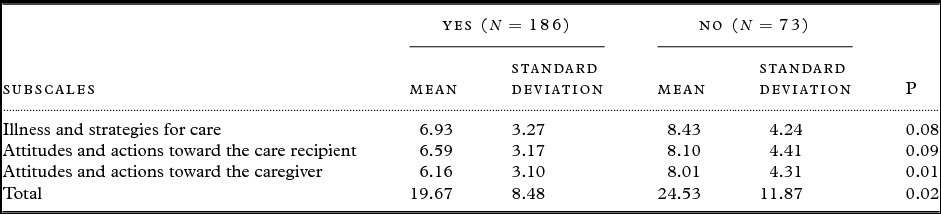
All subscales were sensitive to family assistance for caregiving (Table 4). Family caregivers who received no family assistance for caregiving experienced more conflict in their family than others receiving family assistance. The correlation between FCSL and number of family members for care assistance was −0.13 to −0.17 (p < 0.05).
Family assistance for caregiving and the family conflict scale in long-term care facilities (N = 259)

Discussion
This study was performed to validate the FCS for family caregivers of persons with dementia in LTC facilities and to explore the relationship between family conflict and family support. The FCS for family caregivers of persons with dementia in LTC facilities (FCSL) was developed and its reliability and validity verified. Additionally, as hypothesized, family conflict and family support were related but separate constructs empirically.
More than 70% of the surveyed family caregivers reported conflict in the family. That rate for previous studies conducted in home-setting was 55% (Semple, Reference Semple1992). In a previous study (Gaugler et al., Reference Gaugler, Zarit and Pearlin1999) with comparisons before and after admission, family caregivers experienced increased family conflict after admission. In the same way, it was thought that the group in LTC facilities tended to have higher family conflict compared with the home-setting group (Semple, Reference Semple1992). Additionally, high prevalence of family conflict among adult children caregivers compared with spouses has been reported (Semple, Reference Semple1992; Gaugler et al., Reference Gaugler, Zarit and Pearlin1999). More than 80% of participants in this study were sons or daughters of a person with dementia. As earlier mentioned, the rate of family conflict in this study was reasonable. Regarding score distributions, approximately half of the surveyed family caregivers reported the minimum score possible on values for each item. This result corresponded to previous studies (Semple, Reference Semple1992; Gaugler et al., Reference Gaugler, Zarit and Pearlin1999). Therefore, score distributions were within the expected range. The percentage of missing values was higher than that in the original study. In this study, the missing data were 19/334 (5.7%); in Semple's (Reference Semple1992) original study, responses were obtained by interviews and 2/553 (0.36%) had missing data. It was thought the FCSL missing data was not too high. Therefore, it is acceptable to use the FCSL as a self-administered questionnaire.
Through interviews of staff members in LTC facilities, item 4 was modified to adapt the FCSL to family caregivers in LTC facilities. The modified questionnaire was verified by interviews of family caregivers for content validity. Exploratory factor analyses produced two factors. However, the three-factor model showed a better goodness of fit than the two-factor model in confirmatory factor analyses. The structure of the three-factor model in this study was the same as that in Semple's (Reference Semple1992) original study. As stated in the interviews of family caregivers, the three FCSL subscales were statistically distinct. Therefore, the FCSL showed factorial validity for the three subscales.
As predicted, internal correlations of each FCSL subscale and with family APGAR were fair. Each FCSL subscale had a higher correlation with other subscales than with family APGAR. This result indicated that the scales could be distinguished clearly. Family conflict and satisfaction with family support are different concepts and should be considered separately. Additionally, there was a fair relationship between the FCSL and depression and anger; each FCSL subscale was correlated better with each subscale than with anger and depression in the SCL-90-R, as predicted. This result indicated that the scales could be distinguished clearly from depression and anger. Therefore, both convergent and discriminant validity were verified by examining the correlations of the FCSL with the family APGAR and SCL-90-R.
In this study, the factor loading on item 4 was lower than for the other items. Item 4 assessed whether the family member needed to be placed in a LTC facility. The support for their decision and advice from family were important keys to successful adjustment to nursing homes for family caregivers of persons with dementia (Gaugler et al., Reference Gaugler, Roth, Haley and Mittelman2008). Therefore, this item was essential. Cognitive impairment is related to admission to LTC facilities (Gaugler et al., Reference Gaugler, Duval, Anderson and Kane2007) and therefore relevance to item 1 (the extent of memory disturbance of the family member) within the subscale was expected. Thus, item 4 should be adapted for the subscale on illness and strategies for care. The FCSL has sufficient internal consistency, as Cronbach's α were 0.87 or more for each subscale and for the entire scale. This study also showed that the FCSL has sufficient retest reliability, as the ICC value was substantial at 0.69 or more for each subscale and for the entire scale.
Higher conflict in the family indicated lower satisfaction with family support; the group receiving no family assistance for caregiving perceived more conflict in their families than the group receiving family assistance. Further, increasing numbers of family members for care assistance were related to decreased family conflict. In previous studies of family caregivers in LTC facilities, lack of support from family members was related to greater stress (Stephens et al., Reference Stephens, Kinney and Ogrocki1991) and barriers to family involvement in the nursing home (Port, Reference Port2004). Thus, support from other family members after admission to LTC facilities is necessary. Conversely, while family became a support resource to consult, family conflicts occurred when family members disagreed (Livingston et al., Reference Livingston2010). Family members might be a cause of family conflict. Thus, it was quite likely that family caregivers might experience family conflicts even if they gained family member support. When providing an intervention for family caregivers in a clinical setting, it is necessary to consider the family from multiple viewpoints, including family conflict and support from other family members.
Family conflict between family caregivers and other family members has been clarified as one of the barriers to decision making, such as in end-of-life care settings (Livingston et al., Reference Livingston2010). Family conflict about end-of-life care is related to inconsistency with the elder's wishes (Parks et al., Reference Parks2011). Moreover, admission to a LTC facility may be a good opportunity to review end-of-life care planning (van Soest-Poortvliet et al., Reference Van Soest-Poortvliet2015). Family conflict at end-of-life affects the context of family conflict (Kramer et al., Reference Kramer, Kavanaugh, Trentham-Dietz, Walsh and Yonker2010). It would be beneficial to conduct further research to intervene in planning end-of-life for persons with dementia and their families using this scale in LTC facilities.
A limitation of this study was that it was conducted only in nursing homes and group homes for elderly located in an urban area. Hence, there may be a bias in the selection of family caregivers who participated in this study. Future work is needed to examine construct and external validity in different settings to improve the generalizability. Furthermore, the correlation of family conflict with the relationship of family caregiver with the person with dementia in this study should be considered. Conflicts in the families of persons with dementia occur most frequently between family caregivers and other family members, more than between family caregivers and the persons with dementia (Peisah et al., Reference Peisah, Brodaty and Quadrio2006). Previous studies have focused on the relationship of the family caregiver with the person with dementia (Semple, Reference Semple1992; Gaugler et al., Reference Gaugler, Zarit and Pearlin1999; Kwak, Reference Kwak, Ingersoll-Dayton and Kim2012). Thus, future study is required to examine the correlation of family conflict with the relationship with the person with dementia to understand the relationship.
The FCSL provides a quick and convenient assessment method in a busy clinical environment. To intervene with family caregivers of persons with dementia who perceive conflict among family members, the three FCSL subscales can be used to objectively capture the status of families of persons in LTC facilities. Concurrently, for intervention with family caregivers, staff in LTC facilities should evaluate not only family caregivers’ satisfaction with support from other family members, but also family conflict perceived by family caregivers, using the FCSL.
Conclusion
The FCS for family caregivers of persons with dementia in LTC facilities was developed. It is necessary to consider the three subscales. The reliability and validity of the scale were verified. By using the FCSL, health care providers in nursing homes can capture the family context objectively. It would be useful to adjust family conflict for family caregivers. It is necessary to recognize the difference between family caregivers’ satisfaction with support from other family members and perceived family conflicts.
Conflicts of interest
None.
Description of authors’ roles
Chie Fukui designed the study, and was responsible for writing the paper, data collection, the statistical design of the study, and for carrying out the statistical analysis. Mariko Sakka assisted with the study design, writing the paper, and data collection. Rachel Marry Amiya, Iori Sato, and Kiyoko Kamipeppu supervised the study design, data collection, and wrote the paper.
Acknowledgments
The authors gratefully acknowledge the family caregivers and staff members in the LTC facilities who contributed to this study. This work was supported by a Grant-in-Aid from the Mitsui Sumitomo Insurance Welfare Foundation awarded to Chie Fukui.