Introduction
Severely and persistently mentally ill (SMI) persons constituted the target group of the 1995 Swedish mental health-care reform. The present study concerns persons considered SMI at the time of the reform but not included in the group of persons considered SMI ten years later.
Recovery from severe mental illness
Summarising five large longitudinal studies of recoveries of persons with a diagnosis of schizophrenia, Harding Reference Harding(1988) found that between half and two-thirds had made a total or at least a considerable recovery. In a meta-analysis of 87 studies between 1919 and 1979 (Warner, Reference Warner1985) it was shown that the number of persons who made a total or considerable recovery varies over time and was higher during periods of good economy in society and during periods of optimism in treatment (Topor, Reference Topor2001). On average, the proportion of socially recovered persons was between 30% and 42% and the proportion of totally recovered between 10% and 20%. Another meta-analysis (Hegarty et al. Reference Hegarty, Baldessarini, Tohen, Waternaux and Oepen1994) showed similar results. Harrison et al. Reference Harrison, Hopper, Craig, Laska, Siegel, Wanderling, Dube, Ganev, Giel, an der Heiden, Holmberg, Janca, Lee, Leon, Malhotra, Marsella, Nakane, Sartorius, Shen, Skoda, Thara, Tsirkin, Varma, Walsh and Wiersma(2001) reported a WHO study with 1600 patients from nine countries. Follow-up studies were made after 2, 5, 15 and 25 years. About half of the survived persons were improved after 25 years. However, the number varied between different countries. Other studies show somewhat lower rates of recovery (Robinson et al. Reference Robinson, Woerner, McMeniman, Mendelowitz and Bilder2004; Lauronen et al. Reference Lauronen, Koskinen, Veijola, Miettunen, Jones, Fenton and Isohanni2005; Lambert et al. Reference Lambert, Naber, Schacht, Wagner, Hundemer, Karow, Huber, Suarez, Haro, Novick, Dittman and Schimmelmann2008).
Persons who are considered to be SMI can have different diagnoses though the diagnosis of schizophrenia is the most common. It seems there are no fundamental differences in the process of recovery between groups with different diagnoses (Young & Ensing, Reference Young and Ensing1999; Topor, Reference Topor2001).
One important difficulty in comparing different studies concerns different definitions of the concept of recovery. The meaning of the concept seems to have been changed. The concept of remission is used to describe a reduction in psychotic symptoms while recovery concerns the ability to function socially and vocationally (Lambert et al. Reference Lambert, Naber, Schacht, Wagner, Hundemer, Karow, Huber, Suarez, Haro, Novick, Dittman and Schimmelmann2008). Moreover, lately the concept of recovery is being used to describe a process focusing on individual social development that considers the limitations caused by the illness (Ramon et al. Reference Ramon, Healy and Renouf2007; Corrigan & Phelan Reference Corrigan and Phelan2004; Slade et al. Reference Slade, Amering and Oades2008).
Mortality of severely mentally ill persons
Research on mortality of severely mentally ill persons definitely shows a high mortality risk compared to the rest of the population. Ösby et al. Reference Ösby, Correia, Brandt, Ekbom and Sparén(2000a) report that a number of studies from different countries over a long period have found a doubled mortality risk for schizophrenic patients compared to the general population. This increased risk is still observed (Auquier et al. Reference Auquier, Lançon, Rouillon and Lader2007; Saha et al. Reference Saha, Chant and McGrath2007) and some studies indicate that the survival gap had increased (Saha et al. Reference Saha, Chant and McGrath2007; Capasso et al. Reference Capasso, Lineberry, Bostwick, Decker and St Sauver2008).
Higher mortality rates for persons with other severe psychiatric diagnoses have also been repeatedly reported (Baxter & Appleby, Reference Baxter and Appleby1999; Harris & Barraclough, Reference Harris and Barraclough1999; Joukamaa et al. Reference Joukamaa, Heliövaara, Knekt, Aromaa, Raitasalo and Lehtinen2001; Ösby et al. Reference Ösby, Correia, Brand, Ekbom and Sparén2001; Laursen et al. Reference Laursen, Munk-Olsen, Nordentoft and Mortensen2007). The higher mortality rates have been attributed to both natural (somatic) causes and to unnatural causes like suicide and accidents. The largest rate of higher risk concerns suicide but the largest number of excess deaths have natural causes such as circulatory diseases (Brown et al. Reference Brown, Inskip and Barraclough2000; Auquier et al. Reference Auquier, Lançon, Rouillon and Lader2007; Fors et al. Reference Fors, Isacson, Bingefors and Widerlöv2007; Saha et al. Reference Saha, Chant and McGrath2007). Antipsychotic medication as well as general life conditions and lifestyles of persons considered SMI are related to the excessive death rate. However, some research indicates that those factors do not wholly explain the increased risk (Osborn et al. Reference Osborn, Levy, Nazareth, Petersen, Islam and King2007).
Some studies found increased risk of mortality due to deinstitutionalisation (Ösby et al. Reference Ösby, Correia, Brandt, Ekbom and Sparén2000b; Hansen et al. Reference Hansen, Jacobsen and Arnesen2001) but this was not the case in other studies (d'Avanzo et al. Reference d'Avanzo, La Vecchia and Negri2003; Rantanen et al. Reference Rantanen, Koivisto, Salokangas, Helminen, Oja, Pirkola, Wahlbeck and Joukamaa2009; Sohlman & Lehtinen, Reference Sohlman and Lehtinen1999).
The 1995 Swedish mental health-care reform
Mental health-care reforms have been implemented all over the world with the aim of improving the conditions of persons considered SMI. The contents of the reforms may vary between countries but they all stress the development of community care instead of institutional care (WHO, 2001; Becker & Kilian, Reference Becker and Kilian2006). A reform was implemented in Sweden in 1995 with the target group persons considered as SMI. The municipality of Jönköping, Sweden, where these studies took place, has about 120 000 inhabitants. The changes that were brought by the reform can be summarised as: a lowered capacity of in-patient treatment facilities, new psychiatric field teams primarily oriented towards patients with psychosis, new social service field teams targeting this same group and providing home care and assistance, co-operation between teams, the development of more group homes, day centres and other facilities for daytime activities. It appeared that most communities in Sweden had at least initiated change in this direction.
The aim of the study
The aim of the study was to follow-up a group of persons who were considered SMI in a survey made at the time of the 1995 Swedish mental health-care reform but not so in a new survey ten years later. This aim includes not only knowledge about the number of recovered persons but also knowledge about the mortality of the group.
Method
The sample
During the reform, surveys were made all over Sweden in order to estimate the number of persons considered SMI and their needs (National Board of Health & Welfare, 1999; Stefansson & Hansson, Reference Stefansson and Hansson2001). The definition of SMI used by the National Board of Health & Welfare (1998) was a person with a mental illness that causes a disability to the degree that it influences daily life. The handicap should have a duration of at least 6 months. Persons below the age of 18 or with mental retardation or age dementia were excluded. The Department of Psychiatry at the County hospital of Ryhov and the Social Services of Jönköping municipality co-operated in 1995/96 in carrying out a survey in order to list persons who were SMI according to this definition. The concept ‘a mental illness that causes a disability to the degree that influenced daily life’ was interpreted as a person with a mental illness (i.e. psychiatric diagnosis) who needed some kind of help from society to handle accommodation and/or activities of daily living and/or employment and/or daytime activities.
The staff of the Department of Psychiatry and the Social Services went through their lists of clients and identified persons considered as SMI. The staff consisted of doctors, psychologists, social workers, psychiatric nurses and occupational therapists. Two persons co-ordinated the reports and compiled the final list of persons defined as SMI. Staffs at other service organisations, for example, the social insurance offices and interest groups, were also involved and were given the opportunity to add names of persons unknown to health-care and social services.
Six hundred and two severely mentally ill persons were identified and listed this way (0.67% of the population older than 18 years of age).
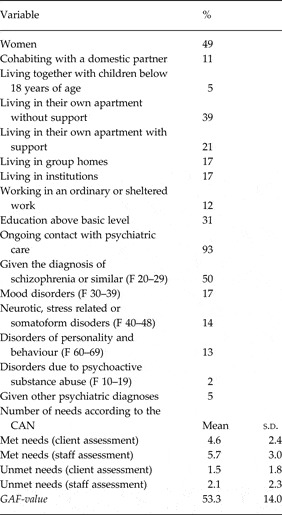
Of the 602 persons, 485 agreed to be interviewed using a questionnaire developed by the National Board of Health & Welfare (1998). The interviews included an evaluation of overall psychosocial functioning on the Global Assessment of Functioning (GAF) scale (American Psychiatric Association, 1994), need assessment according to Camberwell Assessment of Need (CAN) (Phelan et al. Reference Phelan, Slade, Thornicroft, Dunn, Holloway, Wykes, Strathdee, Loftus, McCrone and Hayward1995) and a diagnosis according to ICD 10 (World Health Organisation, 1996). The diagnoses were grouped into six subgroups based on the first diagnosis (Table 1). The CAN assesses needs in 22 different areas. Assessments of each of these areas include the views of both client and staff. Summary scores of total needs, met needs and unmet needs were computed. Test–retest and inter-rater reliability of assessment of needs made by the staff and the patient were investigated by Phelan et al. Reference Phelan, Slade, Thornicroft, Dunn, Holloway, Wykes, Strathdee, Loftus, McCrone and Hayward(1995). Test–retest and inter-rater reliability of the patients’ assessment of needs were investigated in a five-nation European study (McCrone et al. Reference McCrone, Leese, Thornicroft, Schene, Knudsen, Vázquez-Barquero, Tansella, Becker and Chisholm2000). The inter-rater reliability of the Swedish version of the CAN has been tested by Hansson et al. Reference Hansson, Björkman and Svensson(1995) and the test–retest reliability of the Swedish version has been investigated with the same methods used in this study (Arvidsson, Reference Arvidsson2003).
Some characteristics of the surveyed persons in 1995/96. First diagnoses according to ICD 10

One employee from Social Services and one employee from the Department of Psychiatry interviewed the participants. The interviewers were mainly psychiatric nurses, occupational therapists or social workers and at least one of them knew the patient well. Following this interview the employees co-operated in recording their own CAN ratings and made a GAF rating.
There was no difference in gender when comparing the group of persons who participated in the interviews (N = 485) and the group of persons who did not participate (N = 117). However, the non-participating group had a lower mean age (46.8, s.d. = 13.8 compared to 52.3, s.d. = 17.3, t-test p < 0.001).
Some characteristics of the sample are described in Table 1.
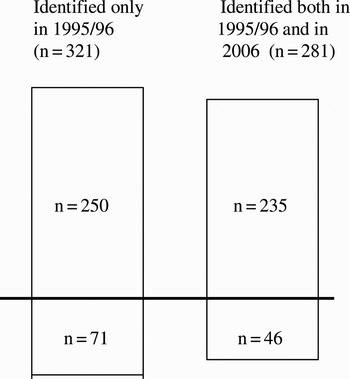
A new survey using the same method and definition of SMI was conducted in 2006. Three hundred and twenty-one persons were identified in the survey in 1995/96 but not in 2006. Accordingly, 281 persons out of the 602 persons were identified as SMI both in 1995/96 and in 2006. (Fig. 1).
Interviewed groups and attrition groups of persons identified in the survey in 1995/96 (N = 602). Interviewed groups are found above and attrition groups below the thick line.

The concept of recovery in this study
According to the definition of the target group of the reform also used in the surveys, SMI were defined as persons with mental illnesses, causing disabilities that had influenced daily life. Persons who were identified as SMI in the 1995/96 survey but not so in 2006 were considered to have recovered from being SMI and consequently estimated to have recovered in the sense that their illnesses did not significantly influence daily life.
Some persons were not identified as SMI in 2006 because their care had been transferred from psychiatric care to other organisations or authorities such as somatic care, dementia care or elderly care. Their disabilities did not seem to have decreased; they had simply changed care provider. These problems were most significant for the older segment of the sample. For the elderly subjects, it was also problematic to determine if their psychiatric problems actually were the main reason for their requirement. Therefore, a somewhat arbitrary age limit was imposed in the present study. Persons aged 65 or above at the time of the 2006 survey were excluded in the analyses of recovered persons. Then, persons in this study who were defined as recovered were those who were surveyed in 1995/96, but not so in 2006, and were aged 64 or below in 2006. Persons surveyed in 1995/96 and still so in 2006, and were aged 64 or below in 2006 were defined as not recovered.
Usage of registers
The national population register was used to identify persons who no longer were in contact with psychiatric care in order to determine whether they had moved from the area or if they were deceased.
The case records of persons who were no longer in contact with psychiatric care in 2006 were examined to find out the status at the end of the contact and if they had care providers other than the psychiatric care organisation.
The observed mortality rates and the causes of death of the sample (N = 602) were studied using the Swedish cause-of-death register. The mortality of the sample was studied from the beginning of 1996 up to and including 2005. The causes of death were registered according to ICD 9 up to 1996 and then according to ICD 10. The mortality rates and causes of death of the population of Jönköping were obtained from the same register. For each year, from 1996 through 2005, the number of expected deaths for men and women and each age group in the investigated sample were computed based on the corresponding death rates in the population. The expected deaths were then compared with the actual number of deaths during the same period.
Statistics
Based on the interviews in 1995/96, comparisons were made between the groups of persons who had recovered from being SMI and the groups who were still considered to be SMI. The statistical method used was a logistic regression (Forward Wald) with the independent variables of age, gender, GAF-value, number of met needs and unmet needs according to both staff and client ratings (CAN), Swedish home language (yes or no), substance abuse problems (yes or no), cohabiting (yes or no), education above basic level (yes or no), social isolation (scale with five grades), diagnosis of psychosis (ICD, F 20–29) (yes or no), diagnosis of mood disorders (F 30–39) (yes or no), diagnosis of neurotic, stress-related or somatoform disorders (F 40–48) (yes or no) and diagnosis of disorders of personality and behaviour (F 60–69) (yes or no). A logistic regression with the same variables was performed concerning differences between the group of persons who died during the 10-year period and the group still alive and considering differences between the groups of persons deceased from natural causes and from unnatural causes.
Standard Mortality Rates (SMRs) were calculated as the observed number of deaths with a 95% confidence interval. SMRs were calculated for all causes of deaths, for natural deaths (ICD classes I–XVI) and for unnatural deaths (ICD: XX). For natural deaths, the SMRs were also calculated for tumours (ICD: II), circulatory disease (ICD: IX) and respiratory disease (ICD: X). Other plausible SMRs were not calculated because of a low number of cases.
Results
Three hundred and twenty-one persons were surveyed as SMI in 1995/96 but not so in 2006 (Fig. 1). Of these at the end of 2006, 174 were deceased. Further 43 persons had moved from the researched area or were not traceable for other reasons. It was not possible to assess if these 43 persons still should be considered as SMI in 2006. Accordingly, 104 persons out of the 321, were alive, lived in the area and were not considered as SMI in 2006.
Mortality
Out of the sample of deceased persons in 2006 (N = 174), 156 persons agreed to be interviewed in 1995/96. Those 156 persons were compared concerning the results of the interviews in 1995/96 with the persons still alive in 2006 and who took part in the interviews (N = 339). The statistical method used was a logistic regression (method and variables described in the method section). Age (OR 1.12, 95% CI 1.10–1.14), GAF value (OR 0.97, 95% CI 0.96–0.99) and substance abuse problems (OR 0.21, 95% CI 0.08–0.51) were significant. Besides higher age, lower GAF-value and the presence of substance abuse problems were significant predictors of mortality.
Causes of death
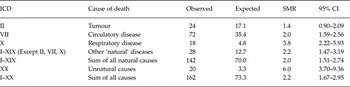
Causes of death were found concerning 162 persons of the 174 deceased persons (Table 2).
Causes of death and SMR during 1996–2005 for persons listed as SMI in 1995/96. The investigated sample was 602 persons

The risk of dying from all causes was about twice that of the standard population. The risk was significantly higher for natural as well as unnatural causes (Table 1). The SMRs were higher for unnatural causes but the total number of excess deaths was about four times higher for natural than for unnatural deaths. The higher risk of dying from circulatory and respiratory diseases was statistically significant but this was not the case for tumour diseases. Of the 20 persons deceased from unnatural causes, nine persons had committed suicide (SMR = 10, 95 CI 4.5–18.9).
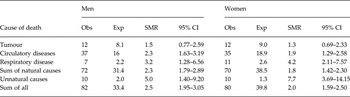
There were no significant differences with regard to gender concerning both natural and unnatural causes (Table 3).
Causes of death and SMRs related to gender during 1996–2005 for persons listed as SMI in 1995/96. The investigated sample was 602 persons

The sample of persons deceased from natural causes (120 persons interviewed out of 142) was compared with the group deceased from unnatural causes (15 persons interviewed out of 20) concerning the results of the interviews in 1995/96. The statistical method used was a logistic regression (method and variables described in the method section). Age (OR 0.93, 95% CI 0.88–0.96) and mood disorders (0.12, 95% CI 0.03–0.50) were significant. Lower age and the presence of mood disorders were significant factors predicting an unnatural death.
Recovery
In this study, 321 persons were identified as SMI in 1995/96 but not so in 2006 (Fig. 1). Out of these 321, 104 persons were alive, lived in the area and were not considered as SMI in 2006. However, in the concept of recovery used in this study an age limit was imposed. Persons aged 65 or above in 2006 were excluded. Of the 104 persons surveyed in 1995/96, 56 persons were aged 64 years or below in 2006. According to the definition of recovery those 56 persons were considered as recovered.
Two hundred and eighty-one persons were considered as SMI in 1995/96 and still so in 2006 (Fig. 1). Out of these 281 persons, 235 were aged 64 or below in 2006. Those 235 persons were considered as not recovered.
Accordingly, 19% (56 persons out of 56 + 235 persons) were recovered in the sense that they were considered SMI in 1995/96 but not so 10 years later.
Recovery rates in different diagnostic groups were: 19% in the group diagnosed with mood disorders (F 30–39), 53% in the group diagnosed with neurotic, stress-related or somatoform disorders (F 40–48), 16% in the group diagnosed with personality and behaviour disorders (F 60–69) and 6% in the group diagnosed with schizophrenia or other psychoses (F 20–29).
The group of recovered persons who took part in the interviews in 1995/96 (40 persons out of 56) was compared with the group of not recovered persons (196 out of 235) who took part in the interviews. The method was a logistic regression (method and variables described in the method section). The only significant variables were diagnoses of psychosis (OR 4.59, 95% CI 1.97–11.25) and diagnosis of neurosis (OR 0.24, 95% CI 0.08–0.70). Diagnoses of neurosis were more common and the diagnoses of psychosis less common in the recovered group.
According to the definition of recovery used in this study the persons no longer considered SMI could still be treated by mental health care. In 2006, none of the 56 persons received inpatient care, but 19 made at least five visits and an additional six persons made between one and four visits to out-patient care. Consequently, almost half of the recovered group (25 out of 56) still had contact with psychiatric care. After studies of the case records of the persons no longer in contact with psychiatric care (31 out of 56) it seemed reasonable to suggest that those persons were recovered according to the definition and none seemed to be in contact with other caregivers for psychiatric problems.
Discussion
Recovery
There are great problems in defining the concept of recovery in such a way that it is possible to compare results from different studies. The definition problems may be the main reason for the differing results in earlier studies. Still, remarkably few persons in the present study were considered recovered. Only 19% were recovered in the sense that they no longer were considered SMI.
The definition of SMI could be one explanation for the relatively low rates of recovery compared to other studies. The most important factor in defining the present sample was not diagnosis but rather function. Although the subjects in the sample had different diagnoses, the inclusion criterion was that the illness influenced daily life. However, this influence may appear many years after the illness debuts; in such cases early recoveries would be missed.
Another reason for the low recovery rates may be sought in the background of the 1995 Swedish reform. The main reason for the reform can be sought in the bad situations of persons considered SMI. This group was described as abandoned by mental health and social services (Markström, Reference Markström2003). One strong intention in the implementation of changes following the reform was not to abandon the target group. A consequence may have been that persons defined as SMI in 1995/96 would have been defined as SMI 10 years later even if considerable improvement in function has occurred. This explanation has some support in another study (Arvidsson, Reference Arvidsson2008) where the conclusion was that this group had made progress with regard to functional ability. Even if the group was still considered SMI the number of met needs had increased and the number of unmet needs in important domains had decreased between 1995/96 and 2006.
As measured in this study needs, GAF value, gender, home language, education level, social isolation and cohabiting status were insignificant as predictors of recovery. However, considerable differences were found concerning diagnoses. Half of the persons given a diagnosis of neurotic, stress-related or somatoform disorders (F 40–48) were recovered after 10 years, but only 6% of those given diagnosis of psychosis (F 20–29).
Death rates and death causes
The mortality rates in this study do not differ significantly from those of other studies. The death risk of a person considered SMI was about twice that of the general population. The largest rate of higher risk concerns unnatural deaths such as suicide but the largest number of excess deaths concerns natural deaths such as circulatory diseases. In this study, it was not possible to follow mortality rates before and after the reform. However, considering the results in other studies it seemed unlikely that death rates and death causes had been significantly influenced by changes in care following the reform.
GAF value and the substance abuse problems were insignificant in predicting recovery but significant in predicting mortality. A low GAF-value and the presence of substance abuse problems in 1995/96 were significant in predicting that the person would be deceased 10 years later. The low GAF-value as a predictor of mortality was not found elsewhere by this author but it seemed reasonable that a low functional level could be a predictor of mortality. Substance abuse problems as a predictor of mortality are well known (Harris & Barraclough, Reference Harris and Barraclough1999). However, diagnosis was more important than substance abuse problems to predict recovery but abuse problems were more important than diagnosis predicting mortality. The findings that younger age and substance abuse problems are more important in predicting unnatural deaths than natural ones are also in line with previous research (Harris & Barraclough, Reference Harris and Barraclough1999). Gender differences are generally found concerning both natural and unnatural deaths (Harris & Barraclough, Reference Harris and Barraclough1999). This was not the case in this study. However, the studied sample was small and the confidence intervals large.
Limitations
Definition problems limit the possibility of generalising the results. The concept of SMI could be defined in different ways (Ruggeri et al. Reference Ruggeri, Leese, Thornicroft, Bisoffi and Tansella2000). One author found 17 different definitions (Schinnar et al. Reference Schinnar, Rothbad, Kanter and Jung1990). Moreover, even if the same definition was used in this study in 1995/96 and in 2006 there was room for changes in interpreting the definition (Arvidsson, Reference Arvidsson2009). The problems in defining recovery were discussed previously. The definition used here covers the ability to function socially. The lately used, more process-oriented definition of the concept was not utilised in this study. Furthermore, members of staff assessed if a person was considered as SMI following a definition that gave scope for mistakes in either direction. Other issues concern the problems in replicating the same procedure of listing on different occasions. Efforts were made to replicate the procedures. However, this was complicated by the fact that many different organisations and persons were involved.
The sample was small and furthermore there were some attrition problems. Some persons (43 of 602) were not traceable in 2006. Some persons refused to be interviewed in 1995/96 (117 of 602). There were differences in age between the interviewed group and the attrition group. These age differences may have had some effect on the results of the variables in the interviews.
Conclusions
In the investigated area, 602 persons were assessed as severely mentally ill and these constituted the target group of the 1995 Swedish mental care reform. After 10 years, 19% had recovered in the sense that they were no longer considered SMI. Differences in the number of recovered persons were only found concerning diagnoses. The relatively low rates of recovery were explained by definition issues and by the intentions of the Swedish reform.
Mortality rates and causes of death in this study seem to be in line with previous research and it seems unlikely that these issues had been affected by the consequences of the reform.
In summarising this study and the Arvidsson, Reference Arvidsson(2008) study concerning the following up of persons defining the target group in the researched area of the 1995 Swedish mental health-care reform, it can be stated that 10 years later relatively few persons were considered recovered. The low rate of recovery concerns, to a great degree, persons diagnosed with schizophrenia. These persons are still in contact with care and services and are in this respect not abandoned. Even if relatively few persons were assessed as recovered the target group had made progress referring to their functional disabilities and efforts from services had increased.
Acknowledgement
This study was supported by the Department of Psychology, University of Gothenburg, Jönköping Municipality, Futurum; The Academy of Health and Care, County council of Jönköping and the Department of Psychiatry; Ryhov County Hospital, Jönköping.
Declaration of Interests
This study was financially supported by Futurum; The Academy of Health and Care, County Council of Jönköping, Sweden. There is no potential conflict of interest related to the present paper.