Cheese rinds are frequently colonized by filamentous fungi during the ripening and storage periods. In some cheese varieties, certain fungal species are intentionally added as starter cultures. For example, Penicillium camemberti is a fungal species whose mycelium gives rise to the so-called ‘bloomy rind cheeses’ (e.g. Camembert, Brie) imparting a whitish velvety aspect. In other cheese varieties, such as Saint Nectaire or Tomme, fungal starters might not be added, but naturally-occurring fungi are encouraged to grow, typically by ripening cheese wheels in high-humidity environments, such as caves or chamber rooms with adjusted conditions. The rinds of these cheeses host diverse microbial communities dominated by filamentous fungi, and less abundant yeasts and bacteria (Wolfe et al., Reference Wolfe, Button, Santarelli and Dhutton2014). These complex microbiomes form very well-defined biofilms or ‘natural rinds’ on the cheese surface.
Besides the situations mentioned above, fungi can also be spoilage agents in many cheese varieties. Strategies such as vacuum packaging or application of coatings with fungistatic activity can be implemented to prevent fungal contamination (Nardoni et al., Reference Nardoni, D'Ascenzi, Caracciolo, Mannaioni, Papini, Pistelli, Basma and Mancianti2018). However, fungal growth is almost unavoidable, especially when cheeses are ripened for long periods, so it is necessary to brush the mold off the cheese wheels periodically (Marín et al., Reference Marín, Ginés, Kochaki and Jurado2018).
Irrespective of the cause of fungal presence in cheese, it is important to consider that molds not only modify the rind characteristics, but also have the ability to alter the organoleptic characteristics of cheese (Ceugniez et al., Reference Ceugniez, Taminiau, Coucheney, Jacques, Delcenserie, Daube and Drider2017). These changes are considered positive or negative depending on the fungal species involved and the variety of cheese considered. One of the organoleptic attributes susceptible to modification by fungi is texture, which is considered a key property of cheese. Texture is a criterion of cheese hardness, which is broadly defined as soft (>55% moisture; e.g. Cottage), semi-soft (41–55% moisture; e.g. Muenster), hard (35–40% moisture; e.g. Cheddar) or extra-hard (<35% moisture; e.g. Parmesan), although these labels and the category boundaries may vary depending on the numerous existing classification systems (McSweeney et al., Reference McSweeney, Ottogalli, Fox, Fox, McSweeney, Cogan and Guinee2004). The texture is influenced not only by moisture content of the cheese (as water content decreases, firmness increases), but also by the integrity of the microstructure of protein matrix (Sousa et al., Reference Sousa, Ardö and McSweeney2001).
Proteolysis in cheese is mostly caused by the residual coagulant, indigenous milk enzymes and bacterial starters (Sousa et al., Reference Sousa, Ardö and McSweeney2001). Many proteases secreted by fungal species commonly used in cheese production have been identified and characterized (McSweeney et al., Reference McSweeney, Ottogalli, Fox, Fox, McSweeney, Cogan and Guinee2004; Button and Dutton, Reference Button and Dutton2012; Sacristán et al., Reference Sacristán, González, Castro, Fresno and Tornadijo2012). Some fungal proteases are even asserted to have a specific role in the decrease of cheese firmness (Boutrou et al., Reference Boutrou, Aziza and Amrane2006; Fernández-Bodega et al., Reference Fernández-Bodega, Mauriz, Gómez and Martin2009; Jurado and Ruiz-Navarro, Reference Jurado and Ruiz-Navarro2018). However, the focus has been on soft or semi-soft cheeses and, for several reasons, it is difficult to extrapolate the data to hard or extra-hard cheeses. On the one hand, the intrinsic chemical and structural characteristics of softer cheeses, mostly related to their higher water contents, are quite different to the harder varieties and, on the other hand, the fungal species associated with cheeses with different moisture contents might differ considerably because the water activity critically affects the distribution and dynamics of fungal populations (Marín et al., Reference Marín, Palmero and Jurado2015).
Therefore, this study investigated the effects of fungal growth on the textural properties of hard and extra-hard cheeses. Penicillium commune was specifically selected as it is one of the most frequently occurring spoilage fungi on cheese (Lund et al., Reference Lund, Nielsen and Skouboe2003), and it is predominantly present on cheeses with low water contents (Hocking and Faedo, Reference Hocking and Faedo1992; Lund et al., Reference Lund, Filtenborg and Frisvad1995; Marín et al., Reference Marín, Palmero and Jurado2015). Different salt concentrations and ripening times were considered to obtain a variety of conditions, and the results were compared with the control treatments.
Material and methods
Cheese manufacture
Hard and extra-hard cheeses were prepared from the same batch of cow milk, which was obtained from a local farm in Guadalix de la Sierra (Madrid, Spain). Milk was pasteurized at 75°C for 20 s in a plate heat-exchanger and cooled at 20°C using the regeneration section of the pasteurizer. Milk was then transferred to a vat, heated to 32°C and a mesophilic starter culture was added (Choozit MA 4001 LYO; Danisco, Copenhagen, Denmark). Milk was ripened for 30 min, and 0.075% CaCl2 and 0.02% chymosin (Laboratorios Arroyo, Santander, Spain) were added to the vat. After 35 min, the curd was cut into cubes of approximately 1 cm2 and the temperature was raised to 37°C for hard cheeses and 42°C for extra-hard cheeses. Curd cubes were stirred for 60 (hard cheeses) or 90 min (extra-hard cheeses), before draining the whey. Curd was then placed into molds, and hard cheeses were pressed in two steps (0.1 MPa, 30 min; 0.2 MPa, 90 min), whereas extra-hard cheeses were pressed in three steps (0.1 MPa, 30 min; 0.2 MPa, 30 min; and 0.3 MPa, 60 min).
After press, cheeses were surface-salted to three different final NaCl concentrations (0.5, 1.25 or 2% w/w), and transferred to a drying chamber maintained at 12 ± 1°C and 70% relative humidity (RH) for 24 h to remove the excess water from within the cheese surface. From all the cheeses elaborated, 36 hard cheeses and 36 extra-hard cheeses were selected to minimize the cheese size variation within each group. The selected cheeses were 15 cm in diameter, with weight and height dimensions of 353 ± 26 g and 5.5 ± 0.3 cm (hard cheeses) and 319 ± 21 g and 5.2 ± 0.2 cm (extra-hard cheeses). The final pH of the cheeses ranged from 5.3 to 5.4.
Cheese inoculation and ripening
Cheeses (triplicate) with different contents of salt were assigned to two different treatments (control and inoculated) and ripening periods (2 and 5 weeks). Control cheeses were coated by immersion with a solution of polyvinyl acetate plastic (Manuel Riesgo, Madrid, Spain) at 20% supplemented with 0.1% natamycin (Danisco, Madrid, Spain) and 4% potassium sorbate (Sigma, Madrid, Spain) as antifungal compounds to avoid any fungal contamination. Inoculated cheeses were also coated with a solution of polyvinyl acetate at 20% containing a spore suspension of P. commune PCOM5 (Marín et al., Reference Marín, Palmero and Jurado2015) to a final concentration of 6 × 10⁵ spores/ml. Spores had been previously collected from 10-d-old cultures grown on Sabouraud dextrose agar (Oxoid, Madrid, Spain). After application of the surface treatment, control and inoculated cheeses were transferred to a ripening chamber maintained at 12 ± 1°C and 85% RH for either 2 or 5 weeks. The ripening chambers had been thoroughly cleaned and sanitized before the study started. Cheeses were inspected daily to visualize fungal growth and turned over every 1 or 2 d throughout the ripening period.
Penetrometer assays
Mechanical strength tests were performed using a Stevens LFRA texture analyzer (Brookfield Engineering Laboratories, Middleboro, MA, USA). A needle probe was used to penetrate the cheeses ripened for 2 and 5 weeks of incubation (control and inoculated) at a constant speed of 0.5 mm/s to a depth of 13.5 mm beneath the suspension surface, resulting in a sampling time of 27 s. Cheeses were equilibrated at room temperature (20°C) prior to testing, and every cheese was measured at different and equidistant points (three per side of the cheese).
The mass component of force (g) was recorded, and the respective force–distance curves were generated using Excel (Microsoft). Firmness was defined as the maximum force detected during the penetration assay, and the total work of penetration was converted to single values of mechanical strength by calculating the area under the force-displacement curve (AUC) with trapezoidal integration technique using Excel.
Determination of weight loss and water contents of cheese
Weight loss of cheese was measured by monitoring the weight changes every 7 d on the batch of cheeses ripened for 5 weeks, and calculated as a percentage of weight loss from the initial cheese weight.
At the end of the ripening period (2 or 5 weeks), cheeses were cut along the vertical axis to obtain different portions: (i) rind, defined as the first 0.5 cm of the surface of cheese, (ii) sub-rind, defined as the portion located between 0.5 and 1 cm, and (iii) core, corresponding to the rest of the cheese. Their respective water contents were determined by measuring the weight loss at 105°C for 24 h until constant weight.
Statistical analysis
All data are expressed as mean ± (sd) (triplicate). Differences between the inoculated and control cheeses were tested by one-way ANOVA using Statgraphics Centurion XVI (Statistical Graphics Corp., Herndon, VA, USA). Post hoc comparisons were achieved using Tukey's HSD test. Statistical significance was set at P < 0.05.
Results
Cheese inspection
All cheeses that were inoculated showed fungal growth after 6–7 d and were completely covered by mycelium after 10–12 d. No evident differences in the progression of growth were found among inoculated cheeses containing different percentages of salt, or between hard and extra-hard cheeses. Control cheeses remained with no visible fungal growth throughout the ripening period.
Penetration assays
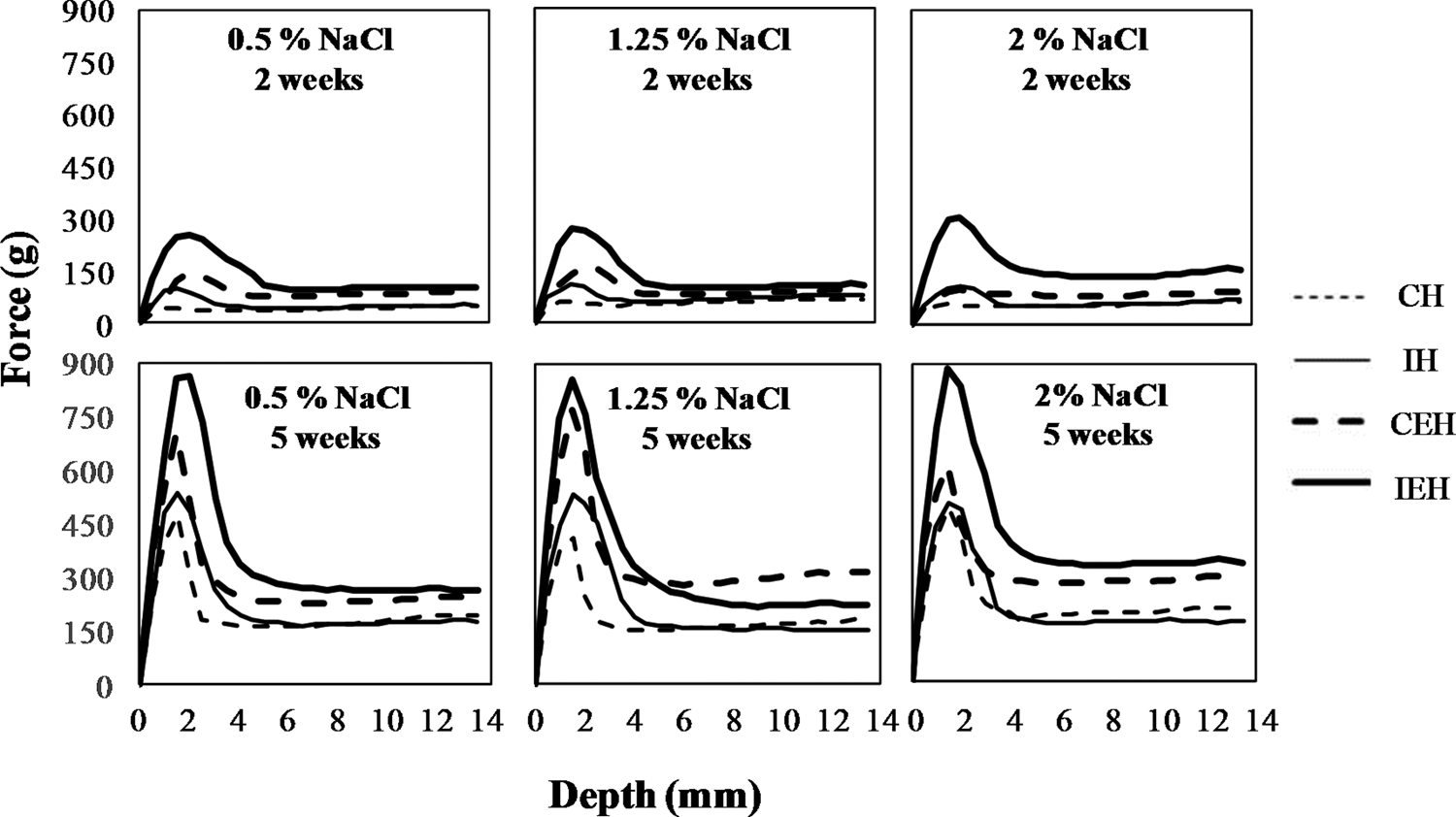
Force-displacement curves of the penetration probes corresponding to hard and extra-hard cheeses with different salt concentrations are shown in Figure 1. Most of the curves displayed a convex-like shape, characterized by a maximum peak after the first 12 mm of depth (coinciding with the maximum force of the rind until its breakage), followed by a decrease in resistance to penetration and a final plateau. The exceptions were the curves corresponding to non-inoculated hard cheeses ripened for 2 weeks, which were more or less flat, thereby indicating the absence of a consolidated rind. The convex-like part of the curve was for inoculated cheeses compared with control cheeses, and consequently, the beginning of the plateau was right-shifted to a higher depth of needle penetration.
Force (g) evolution during penetration assays of control (C) and inoculated (I) hard (H) and extra-hard (EH) cheeses ripened for 2 or 5 weeks and salted with different percentages of NaCl (0.5, 1.25 and 2% w/w). Data represent the mean of three replicates.

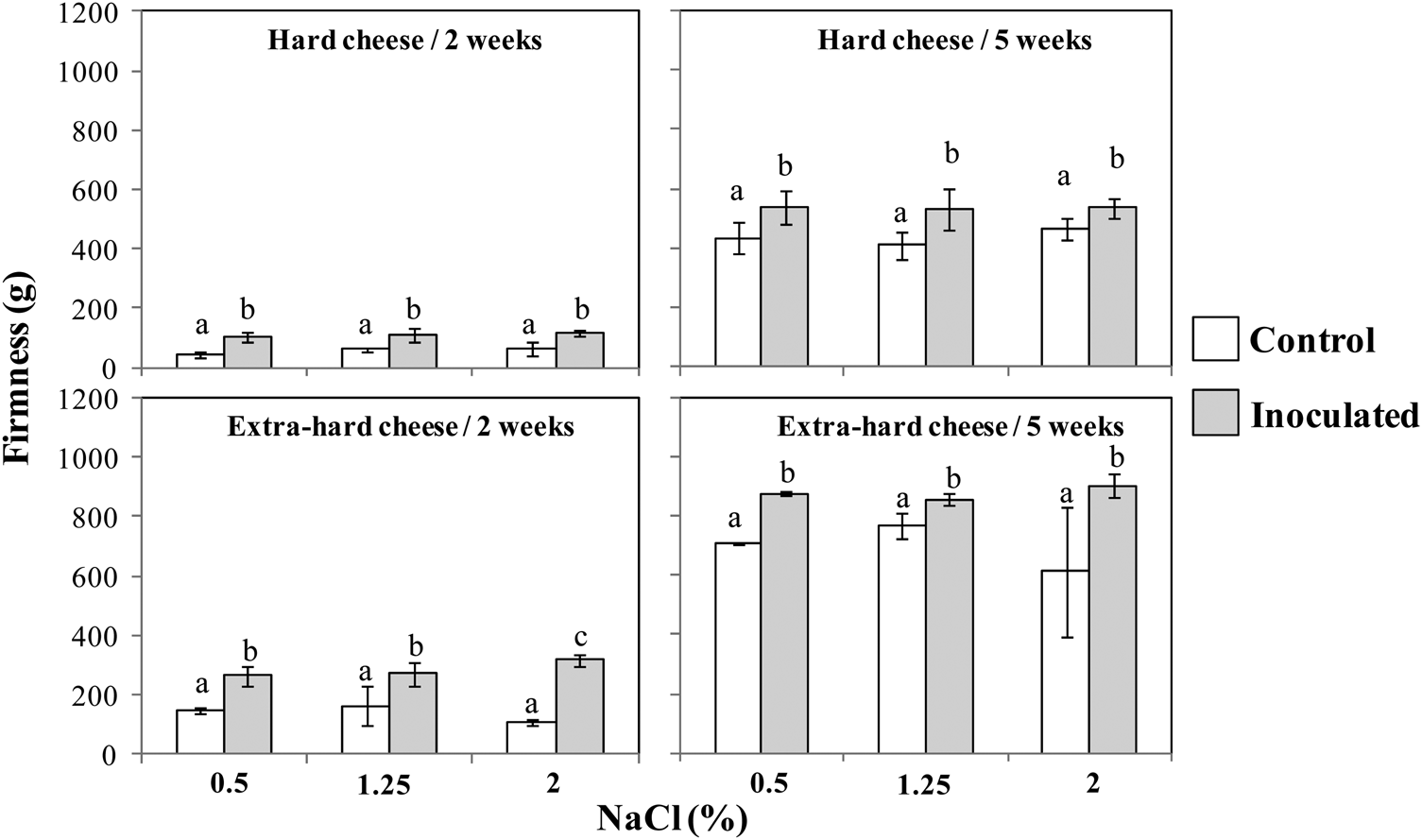
Figure 2 illustrates the cheese firmness (defined as the maximum force detected during the penetration assays). This parameter increased with the duration of the ripening period and was higher in extra-hard cheeses than in hard cheeses, and in inoculated that non-inoculated cheeses. Salt concentration did not influence cheese firmness, except for inoculated extra-hard cheeses salted at 2% and ripened for 2 weeks, which showed higher resistance to penetration in comparison to their counterparts salted at 0.5 and 1.25%. However, these differences in firmness disappeared after 5 weeks of ripening.
Firmness (F) or maximum force achieved during penetration of hard and extra-hard cheeses with different contents of salt (0.5, 1.25 and 2% w/w) and ripened for 2 or 5 weeks. Samples not significantly different share the same letter. Error bars denote the se of the mean of three replicates.

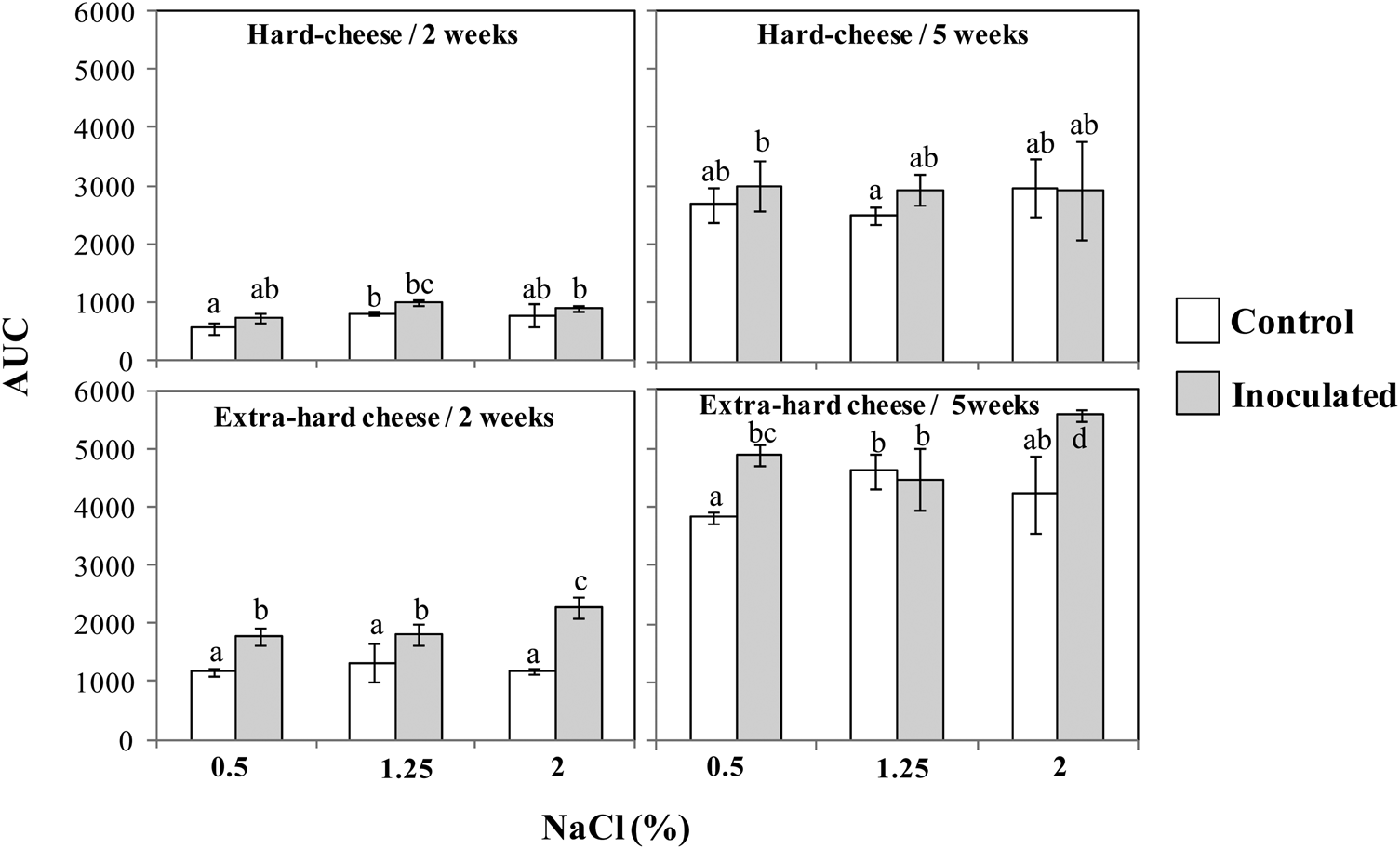
Figure 3 display the total work of penetration (AUC), which is a measure of cheese strength and resistance to probe penetration. AUC increased with the ripening time and was higher in extra-hard cheeses, but there were no differences between the control and inoculated hard cheeses. However, among the extra-hard cheeses, AUC values were higher in the inoculated samples, except for those salted at 1.25% and ripened for 5 weeks, which were not significantly different. Salt concentration did not affect effect AUC in hard cheeses, but salting at 2% increased the work of penetration in extra-hard cheeses ripened for 2 or 5 weeks.
Total work of penetration expressed as the area under curve (AUC) of hard and extra-hard cheeses with different contents of salt (0.5, 1.25 and 2% w/w) and ripened for 2 or 5 weeks. Samples not significantly different share the same letter. Error bars denote the se of the mean of three replicates.

Weight loss and water contents of cheese
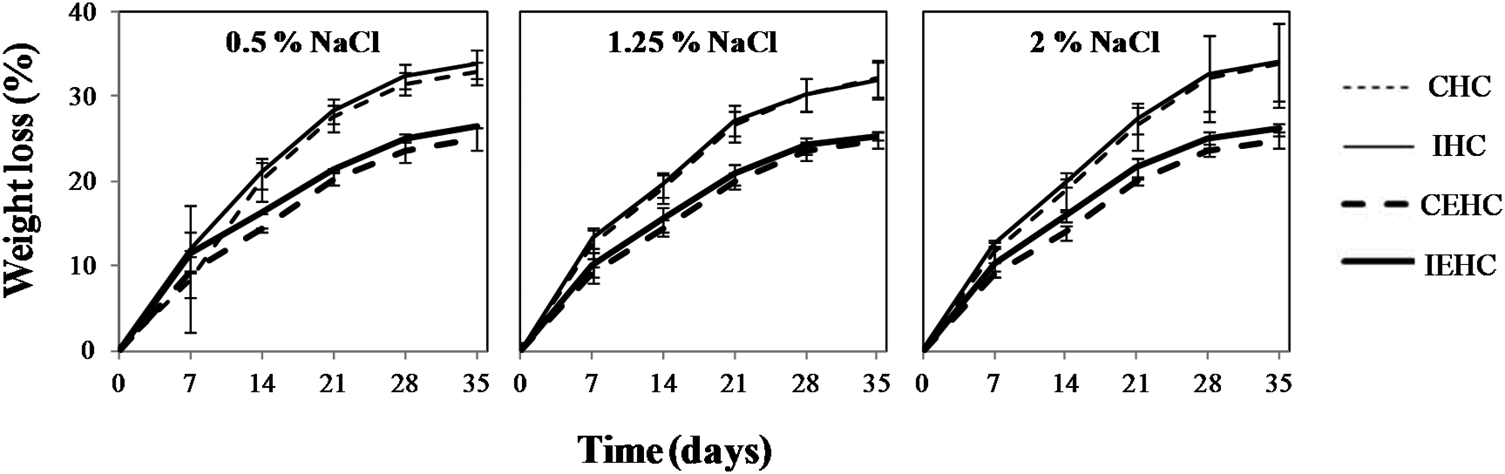
Figure 4 reveals the weekly weight loss of cheeses ripened for 5 weeks. Mass losses were higher at the beginning of the ripening period in both hard and extra-hard cheeses. No statistical differences were found between the control and inoculated cheeses or among cheeses with different percentages of salt, but mass losses were higher in hard cheeses through the ripening period.
Percentage of cheese weight loss evolution of hard and extra-hard cheeses with different contents of salt (0.5, 1.25 and 2% w/w) and ripened for 2 or 5 weeks. Error bars denote the se of the mean of three replicates.

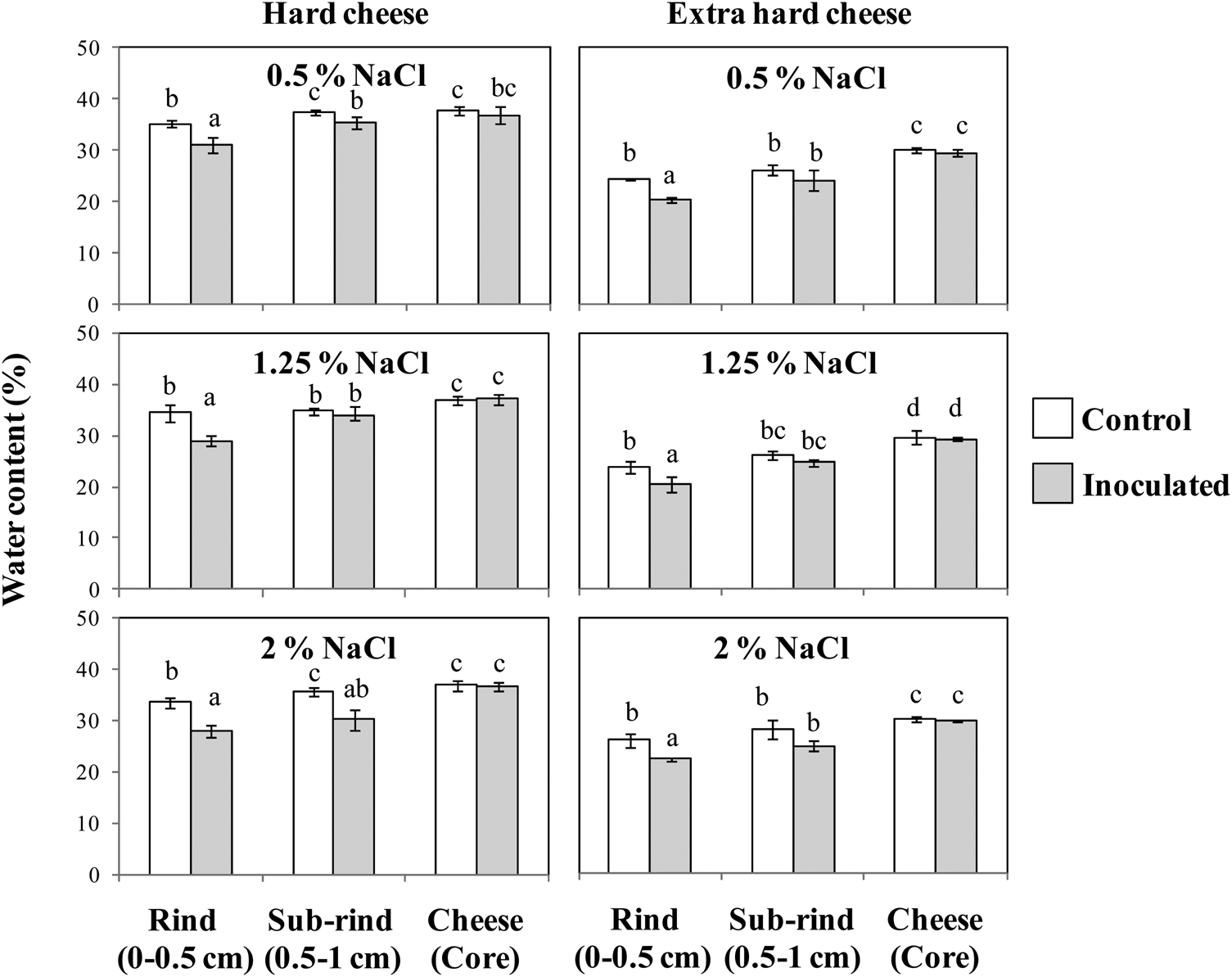
The final water contents were determined in different portions of the cheese after 5 weeks of ripening (Fig. 5). Rind and sub-rinds presented lower water contents than cheese cores. No differences in water contents were detected between the cores of control and inoculated cheeses. On the contrary, the rinds of cheeses inoculated with P. commune presented lower water contents than rinds obtained from the control cheeses, regardless of salt concentration. Sub-rinds of inoculated hard cheeses salted with 0.5 and 2% also presented lower water contents than the controls.
Percentage of water content in different parts (rind, sub-rind and whole cheese) of hard and extra-hard cheeses with different contents of salt (0.5, 1.25 and 2% w/w) and ripened for 5 weeks. Samples not significantly different share the same letter. Error bars denote the se of the mean of three replicates.

Discussion
The ripening period of cheeses is marked by progressive evaporation of water from the cheese surface and a subsequent rind consolidation. Depending on the previous technological procedures performed during the successive cheese-making steps, as well as the environmental conditions present in the ripening rooms, the chemical and microstructural characteristics of these rinds will greatly diverge among different cheese varieties. Several studies have shown that substrate has an important, sometimes limiting, role in the distribution and growth of fungal species in cheese (Marín et al., Reference Marín, Palmero and Jurado2014, Reference Marín, Palmero and Jurado2015). The results obtained in this work showed a rapid progression of growth of P. commune on both hard and extra-hard cheeses at all salt concentrations that would support the great ubiquity of P. commune that has been described in the literature among different varieties of cheese (Lund et al., Reference Lund, Nielsen and Skouboe2003).
The modification of the shapes of the penetration curves in both inoculated hard and extra-hard cheeses, characterized by a wider initial force peak might be due, at least in part, to the mere accumulation of mycelium biomass that would contribute to the formation of a thicker rind. In addition, the increase in the maximum force detected among the inoculated cheeses would also indicate a hardening effect on the rind due to P. commune. The increase in AUC detected among the inoculated extra-hard cheeses could suggest that a lower moisture content could enhance the growth of P. commune, and thereby, its ability to modify the textural properties of cheese. Nevertheless, it is important to note that resistance on penetration remained higher on inoculated extra-hard cheeses than in controls even after breakage of the rind, as evidenced by the higher plateaus reached after the initial peak. Therefore, our results indicate that fungal growth modified not only the texture of the rind but also the texture under the rind. This scenario could have an important impact on the organoleptic properties of these cheeses, because a more heterogeneous texture is generally considered to be less appealing to consumers. The inconvenience of these changes, however, should be carefully evaluated in different cases. For example, a firmer rind could also represent an advantage against mechanical damages of cheese. Some producers of Manchego, the most important pressed cheese produced in Spain, intentionally allow the growth of adventitious fungi during the first weeks of ripening, assuming that it improves the flavor and the consolidation of the rind. After a few weeks, the mold is usually scrapped once the rind is firm, and an antifungal coating is further applied to avoid fungal growth during the rest of the aging period. This potentially beneficial consequence of fungal growth merits thorough analysis not only in Manchego cheese but also in the production of other hard and extra-hard varieties, especially considering the ubiquity of P. commune.
Interestingly, regarding firmness, our results contrast with the reports on soft cheeses, which found that firmness decreased in soft cheeses as a result of the proteolytic activity of fungi (Boutrou et al., Reference Boutrou, Aziza and Amrane2006; Fernández-Bodega et al., Reference Fernández-Bodega, Mauriz, Gómez and Martin2009; Jurado and Ruiz-Navarro, Reference Jurado and Ruiz-Navarro2018). Although P. commune stands out as a proteolytic microorganism (Papagianni, Reference Papagianni2014; Alapont et al., Reference Alapont, Martínez-Culebras and López-Mendoza2015), several factors could contribute to explain the results found in our study. On the one hand, in comparison to soft cheeses, the lower water content and water activity of harder cheeses could reduce the performance of proteases, considering that both parameters influence the enzymatic activity during the ripening process (Saurel et al., Reference Saurel, Pajonk and Andrieu2004). This modification in protease activity could help to explain the role of fungi on proteolysis and firmness reduction described in cheeses with comparatively high water contents, such as Camembert (Leclercq-Perlat et al., Reference Leclercq-Perlat, Buono, Lambert, Latrille, Spinnler and Corrieu2004) and smear cheeses (Bonaïti et al., Reference Bonaïti, Leclercq-Perlat, Latrille and Corrieu2004). On the other hand, it could be hypothesized that the distinctive rigid structure of hard and extra-hard cheeses could hamper the migration of fungal proteases from the rind to the core of the cheese. This effect will be expected to increase throughout the ripening period because, as our results show, water loss progresses during the maturation of cheese. However, even assuming that migration of P. commune proteases could be hindered, this could not completely explain why proteases were unable to reduce the firmness of the rind. In our experience in the cheese industry, hard and extra-hard cheeses that are surface-contaminated with fungi are occasionally prone to suffer proteolysis in the first few millimeters of the rind, revealed as a reduction in firmness and sometimes in severe loss of structure. It could be that only certain species and, or either, very long periods of ripening could eventually lead to intense proteolysis in hard or extra-hard cheeses.
The analysis of the distribution of water in different portions of cheese (rind, sub-rind and core) was of relevance because firmness is not only related to the integrity of the microstructure of the protein matrix but also to the moisture content. Growth of P. commune induced, in all cases, desiccation of the rind, which, in some cases also affected the sub-rind, but not the cheese cores. This loss of water would be the main factor explaining the changes in firmness and AUC. Several studies have attempted to model the water diffusion in cheese, which found that water mobility differ depending on the variety of cheese considered (Pajonk et al., Reference Pajonk, Saurel and Andrieu2003; Bonaïti et al., Reference Bonaïti, Leclercq-Perlat, Latrille and Corrieu2004; Saurel et al., Reference Saurel, Pajonk and Andrieu2004; Hélias et al., Reference Hélias, Mirade and Corrieu2007). Gaucel et al. (Reference Gaucel, Guillermin and Corrieu2012), who proposed a generalized model for determining cheese mass loss during ripening based on the respiration of the microbiome and water evaporation, found that the respiratory activity of the microorganisms at the surface of ripening cheese was the most important factor to predict water diffusion. Concurrently, a metagenomic study performed with different types of rinds established that moisture was the factor that best correlated with microbial diversity (Wolfe et al., Reference Wolfe, Button, Santarelli and Dhutton2014). The authors further noted that Penicillium spp. was the dominant filamentous fungal genus detected in rinds with low water contents. Our results indicated that the presence of P. commune was able per se to modify the water fluxes in cheese, by increasing the water diffusion to the surface. These results reveal that the composition of the microbiome growing on the rind is not just a result of the intrinsic characteristics of the cheese matrix or the environmental factors present in the drying chambers, as has been stated until now. On the contrary, the microbiota seems to exert a significant and reciprocal influence on the resulting characteristics of the rind (and sub-rind), in this case on the moisture content.
Regarding the mechanisms of rind desiccation, a most plausible hypothesis might be that fungal hyphae of P. commune could increase the total surface of the cheese so that more water molecules could evaporate. However, the great microbial diversity present in cheese makes it necessary to direct future research toward providing evidence of the mechanisms involved in water transfer through the rind in the presence of different microbial consortia. This information would be beneficial to elucidate the specific role of these microorganisms in rind formation, and its influence on the textural properties of different cheese varieties.
In conclusion, inoculation of hard and extra-hard cheeses with Penicillium commune increased firmness in both types and increased the total work of penetration but only in extra-hard cheeses, suggesting that the moisture of cheese might be affecting the growth capacities and performance of P. commune. The change in textural properties of cheeses was linked to desiccation of the upper 0.5-cm rind layer mediated by P. commune.