‘Sustainability’ is the dream of passing a liveable earth to future generations, human and nonhuman. The term is also used to cover up destructive practices (Anna Tsing, in Brightman & Lewis Reference Brightman and Lewis2017: 1).
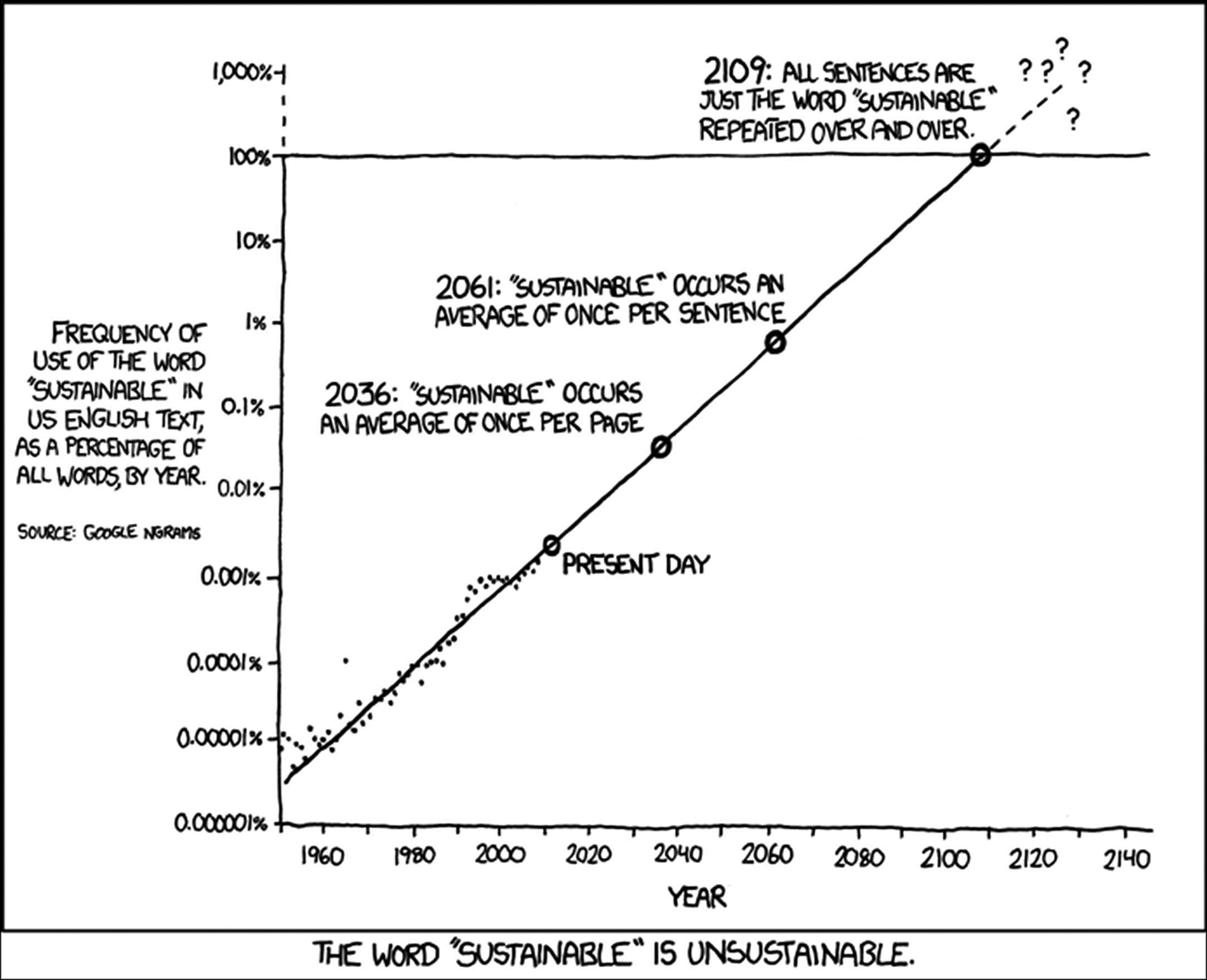
Sustainability has become a trend in archaeology (Childs & Benden Reference Childs and Benden2017; Majewski Reference Majewski and McManamon2017; Ferris et al. Reference Ferris, Cannon and Welch2018). Yet the predictability of archaeologists developing a ‘sustainable’ archaeology (Figure 1)—coupled with the concept's ‘fuzzy’ and ‘self-contradictory’ use beyond the discipline (Baptista Reference Baptista2014: 358; Brightman & Lewis Reference Brightman and Lewis2017: 3)—suggests that a critical review is in order. We therefore ask: what is sustainability, how is it being applied in archaeology and to what end? We operate from the premise that contemporary archaeological theory reflects and serves contemporary society (Wilk Reference Wilk1985; Smith Reference Smith2004; Hutchings & La Salle Reference Hutchings and Salle2018; Hutchings Reference Hutchings, Wells and Stiefel2019).
A commentary on the use of the word sustainable in late modern society (source: xkcd, https://xkcd.com/1007/).

We begin by considering sustainable archaeology ‘in theory’; that is, as an idea (re)produced by archaeologists within the discipline of archaeology (Hutchings Reference Hutchings, De Cunzo and Roeberin press). We then turn to sustainable archaeology ‘in practice’. In our summary discussion, we dig deeper, employing a dialogical or conversational approach.
Sustainable archaeology in theory
In archaeology, sustainability has traditionally connoted people living sustainably in the past. While adaptive and resilient groups lived sustainably within the carrying capacity of their environments, unsustainable groups, less adaptive and with lower resilience, exceeded their environmental capacities. Sustainability has been an integral part of evolutionary discourse in anthropology, particularly in discussions about complexity, progress, overshoot and collapse (Wilk Reference Wilk1985; Tainter Reference Tainter2000).
Today, archaeologists apply the term sustainability not to the past but to the present, and not to others, but to themselves, delineating a ‘sustainable archaeology’ (Ferris et al. Reference Ferris, Cannon and Welch2018). Chapman (Reference Chapman2002: 241), for example, explores the implications of global warming for “sustainable archaeological resource management”, and Childs and Benden (Reference Childs and Benden2017: 12) propose a “checklist for sustainable management of archaeological collections”. Most significant here, however, is Majewski (Reference Majewski and McManamon2017: 164), who connects sustainability with “sustaining professionalism”, in which professionalism is the American cultural resource management (CRM) industry, as represented by the American Cultural Resources Association (ACRA). For Majewski—a CRM archaeologist who has served as ACRA president and on its board of directors—the goal of sustainable archaeology is a “robust and thriving cultural resources management industry” (Reference Majewski and McManamon2017: 175). For Ferris and colleagues, the goal, likewise, is “advancing a sustainable form of archaeological practice and research” (Sustainable Archaeology n.d.), the emphasis being on “how archaeological practice can be sustained going forward” (Ferris et al. Reference Ferris, Cannon and Welch2018: 5). Sustainable archaeology, therefore, is primarily concerned with sustaining the profession of archaeology, not a liveable Earth.
Sustainable archaeology in practice
As such, within the discipline of archaeology, sustainability is being applied in a radically new way. We argue that archaeologists and those affected by archaeological practice should ask why, and to what end. We view sustainable archaeology as futurist rhetoric (Spennemann Reference Spennemann2007a) designed to ease broader institutional anxieties around ethics and an uncertain future. By invoking sustainability, archaeologists transcend past and ongoing ethical violations by focusing myopically on the future. The defining characteristic of this established political manoeuvre is the focus on “tomorrow, not on yesterday” (T. Scott, in Henderson Reference Henderson2019). In this way, sustainable archaeology resembles community, public, collaborative, activist and anarchic archaeologies: all are reactionary status quo theories that serve to cover up ongoing injustice and harmful policies rather than to expose and confront archaeology's collusion in heritage crime (Hutchings & La Salle Reference Hutchings and Salle2015a, Reference Hutchings and Salle2018).
The anxieties that archaeologists experience today are multifaceted and multiscalar, operating on societal, academic, university, disciplinary and individual levels (e.g. Berg et al. Reference Berg, Huijbens and Larsen2016; Högberg et al. Reference Högberg, Holtorf, May and Wollentz2017; Gnecco Reference Gnecco2018; González-Ruibal Reference González-Ruibal2018). Most of these anxieties can be traced back to the fact that archaeology is a capitalist project (Hutchings in press), particularly as manifested in CRM (Smith Reference Smith2004; King Reference King2009; Hutchings & La Salle Reference Hutchings and Salle2015b; Gnecco Reference Gnecco2018; Hutchings Reference Hutchings, Wells and Stiefel2019) and the discipline's colonial/imperial control over Indigenous heritage and thus also over Indigenous peoples (Smith Reference Smith2004; McNiven & Russell Reference McNiven and Russell2005; La Salle & Hutchings Reference La Salle, Hutchings, Labrador and Silberman2018).
Capitalists have affected academia deeply by attempting to economise every aspect of the institution (Berg et al. Reference Berg, Huijbens and Larsen2016: 171). The consequences of this include:
1) Reinforcing competition between individual academics, departments, institutions, disciplines and states.
2) Transforming the academic subject from labourer to human capital.
3) Favouring the market valuation of academic scholarship.
4) Fostering short-termism (e.g. in grants, writing and publishing) so as to be seen as ‘path-breaking’.
5) Necessitating monitoring and accounting systems to ensure both ‘value for money’ and ‘control of control’ for those who fund research and teaching (Berg et al. Reference Berg, Huijbens and Larsen2016: 171).
Each of these outcomes produces anxiety for the academic archaeologist and their discipline (Hutchings Reference Hutchings, Wells and Stiefel2019, in press).
For archaeologists working in CRM, capitalism means being paid to focus on the bureaucratic present. According to Högberg et al. (Reference Högberg, Holtorf, May and Wollentz2017: 644), most heritage professionals are unable to express how they conceive of the future they work for, and how their work will impact on that future. Arguably, in the mind of many archaeologists and heritage professionals, the future does not appear to extend forward from the present, but sits isolated in the distance, some way removed from the present. While many hope that future generations will look back gratefully at the work done by the heritage sector today, there is a lack of understanding of how present-day practices and decisions will contribute to creating a desirable future. In practice, for the heritage sector, the future is expected to be a continuation of the present.
Högberg et al. (Reference Högberg, Holtorf, May and Wollentz2017: 644) conclude that it is “easy to agree with Spennemann (Reference Spennemann2007a & Reference Spennemannb) that the future is often little more than a popular ‘catch phrase’ in relation to cultural heritage, while present practice remains firmly focused on the past and the present”. Sustainable archaeology constitutes such futurist rhetoric.
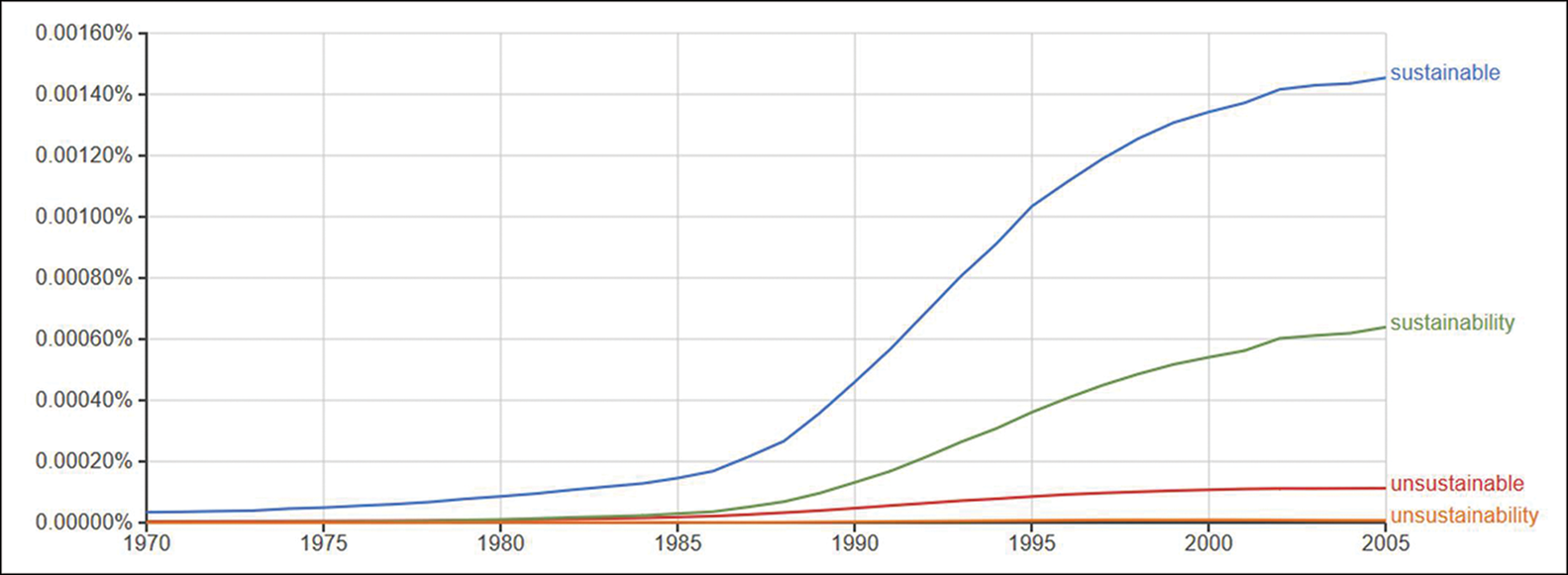
Sustainable archaeology is a new, untapped field to be exploited by career-minded and publication-motivated academic archaeologists who are operating within a structure that rewards individualism and progress (Berg et al. Reference Berg, Huijbens and Larsen2016). This is significant because academics are responsible for much of the literature on sustainable archaeology. Yet, the more need there is to talk about sustainability, the less sustainable things usually are (Figure 2)—a dynamic apparent in the heritage industry's failure to protect archaeological sites (King Reference King2009; Hutchings Reference Hutchings2017; Gnecco Reference Gnecco2018). Sustainability is popular in contemporary archaeology because it is popular in contemporary society (Wilk Reference Wilk1985), where ‘sustainability’ is routinely used to whitewash a lack of actual sustainability.
Relative frequency of the use of the words sustainable, sustainability, unsustainable and unsustainability in books written in English for the period 1970–2005, as a percentage of all words, by year. As shown, ‘sustainable’ is more than twice as common as ‘sustainability’, reflecting the rhetorical disconnect between theory and praxis. ‘Unsustainable’ and ‘unsustainability’ hardly register, indicating their taboo status and the larger cover-up where optimistic outlooks about the future are favoured while critique is marginalised (source: Google Ngram, https://books.google.com/ngrams).

Discussion
Archaeologists are often their own worst enemies […] Changing archaeology's brand can only help! (Zimmerman Reference Zimmerman2018: 524).
To explore sustainable archaeology further and consider its more problematic aspects, we shift gears and take a conversational approach based on a point-and-response system.
Marina La Salle (ML): From our research into the use of the term ‘sustainability’ more broadly, it is clear to me that archaeologists are following a larger trend by choosing to focus on issues of sustainability, rather than unsustainability. This optimistic rebranding feels good, while archaeology's ongoing structural harms are hard to face (e.g. Smith Reference Smith2004; McNiven & Russell Reference McNiven and Russell2005; King Reference King2009; Gnecco Reference Gnecco2018; Hutchings in press).
Richard M. Hutchings (RMH): Yes, this really gets to the heart of the matter. Sustainable archaeology is political discourse, and, as you know, so much political discourse today is Orwellian. This characterisation reflects, in part, the ubiquity of ‘doublespeak’, which is language that intentionally covers up, distorts or inverts meaning. This applies equally to political discourse in archaeology, where archaeologists routinely use language—post-modern jargon, in particular—to misrepresent their practice (Hutchings & La Salle Reference Hutchings and Salle2015a, Reference Hutchings and Salle2018; Hutchings in press). In short, I have always suspected that sustainable archaeology is doublespeak. The task for us, here, has been to assess exactly how archaeologists are defining sustainable archaeology, and then explain why.
ML: We show that archaeologists use the term ‘sustainable archaeology’ to mean ‘sustaining archaeological practice’. Is that doublespeak? Or is calling archaeology Orwellian just hyperbole?
RMH: Sustainable archaeology is doublespeak because when people hear archaeologists use the word ‘sustainable’, many will imagine those archaeologists working to sustain life, not archaeological practice, which actually destroys life via its pivotal role in economic development (King Reference King2009; Gnecco Reference Gnecco2018; Hutchings in press). After all, by permitting development via CRM, archaeology is complicit in the destruction of life-sustaining ecosystems and communities. Calling sustainable archaeology Orwellian is not hyperbolic because archaeology is fundamentally a government project (Hutchings & Dent Reference Hutchings and Dent2017), and the primary goal of sustainable archaeology is sustaining that project.
ML: We connect sustainable archaeology to a general anxiety around ethics and an uncertain future. Can you elaborate?
RMH: I can expand on the uncertain future aspect, but I'll leave the ethics to you since that is your area of expertise. There are many reasons for archaeologists to worry about their future, including climate change, ocean acidification and mass extinction (Fassbinder Reference Fassbinder2017). Of greater concern to archaeologists and other heritage management professionals, however, is the risk of losing authority and credibility (Spennemann Reference Spennemann2007b: 13–14). Consider this from Berkes et al. (Reference Berkes, Armitage, Doubleday, Armitage, Berkes and Doubleday2007: 308):
Resource management is at a crossroads. Problems are complex, values are in dispute, facts are uncertain, and predictions are possible only in a limited sense. The scientific system that underlies resource management is facing a crisis of confidence in legitimacy and power. Top-down resource management does not work for a multitude of reasons, and the era of expert-knows-best decision making is all but over.
Uncertainty is the new normal and it strongly influences what archaeologists say and do. This includes futurist rhetoric. Spennemann (Reference Spennemann2007a: 91) links the steep rise in the popularity of futurist rhetoric in the 1990s (compare Figure 2 with Spennemann Reference Spennemann2007a: 96, fig. 1) to “a public perception of uncertainty about the present and the immediate future”. He identifies ‘unbridled capitalism’ and ‘globalization’—the prime drivers of the global environmental crisis (Fassbinder Reference Fassbinder2017)—as the same drivers of uncertainty and futurist rhetoric (Spennemann Reference Spennemann2007a: 97). Sustainable archaeology is therefore future-making, insofar as its goal is to sustain for archaeologists “a continuing, rolling present”; that is, “the continuation of the status quo” (Högberg et al. Reference Högberg, Holtorf, May and Wollentz2017: 642, 644).
ML: Indeed, given all of the ethical problems with archaeology as it operates in the present, it seems convenient to focus instead on its manifestation in the future. Archaeology, for example, is an exclusive practice governed by experts who are located predominantly outside of the communities whose heritage is being studied and managed. Those power imbalances mirror larger paradigms; in North America, for example, most archaeologists are white, while most of the heritage that they study is Indigenous. That is extremely problematic and unlikely to change any time soon. Similarly, commercial archaeology typically operates as a user-pays model—that is, the developer pays for any archaeological work required. This is a fundamental conflict of interest, as the pressure put on archaeologists to complete their work expediently is directly at odds with their role as stewards of the historical record. This is further complicated by most archaeologists belonging to one or more professional organisations, each of which has their own code of ethics mandating responsibilities to preserve that record.
RMH: The question, then, is who is benefiting and who is being harmed?
ML: Exactly. As we have discussed elsewhere (Hutchings & La Salle Reference Hutchings and Salle2015a), at least 90 per cent of archaeology fits into this dynamic: it is simply not a practice founded in the interests of those most closely connected to the heritage landscapes being impacted. Thus, any opportunity for free, prior and informed consent—the foundation of ethical practice—is unavailable to those communities. Research ethics are typically based on three principles: respect for persons, concern for welfare, and justice. When closely examined, most archaeology contravenes those principles on a daily basis at the hands of archaeologists who are paid by developers and operate by permission of the state. For these reasons, archaeology can be described as a form of state heritage crime (Hutchings & La Salle Reference Hutchings and Salle2017). I do not see any redress for these ethical trespasses in sustainable archaeology as we have encountered it.
Conclusion
Things are only getting better […] The future's so bright, I gotta wear shades (Timbuk 3, reproduced with kind permission of Pat MacDonald).
We conclude with a summary, a prediction and a final observation. As discussed, sustainable archaeology is not principally about sustainability in the past, nor is it about sustaining a liveable Earth into the future, as one might reasonably conclude. Rather, sustainable archaeology is about archaeologists shaping or assembling a future legacy for themselves and their discipline. In this regard, sustainable archaeology is perhaps best understood as archaeological future-making. In our assessment, many archaeologists—acting in a time of great uncertainty—are using sustainability to rebrand their practice as virtuous and ethical when it is not. In this context, sustainability is Brand Management 101: apply positive spin and make the future look bright.
We predict that sustainable archaeology will, over the next decade, become a permanent and prominent fixture in archaeological discourse. For archaeologists, there are few, if any, downsides to this rebranding—it really ‘can only help’ them. Heritage sites and affected communities, however, will continue to suffer for it.
What can be done to address and/or avert this expansion of sustainable archaeology? As we have shown, archaeology is working exactly as designed—as neoliberal statecraft—and it is not in the interests of the discipline to confront, let alone try to correct, its ethical problems. Hence, while alternatives to archaeological management certainly exist (e.g. Indigenous and community-based heritage stewardship), they involve archaeologists losing control, which inevitably disincentivises action. Sustainable archaeology is self-contradictory. While it appears new and different, in practice it embodies the status quo, and represents “a singular and homogeneous construct of the future” (Baptista Reference Baptista2014: 358)—a future that invariably involves ‘more archaeology’. To paraphrase Flatman (Reference Flatman2009: 6), the future is at once very bright for the employment of archaeologists, yet very gloomy for cultural heritage.
Acknowledgements
The lyric from the song ‘The future's so bright’ is reproduced with kind permission of Pat MacDonald.