Introduction
Heavy prenatal alcohol exposure causes a constellation of physical and behavioral effects, including the fetal alcohol syndrome (FAS; Hoyme et al., Reference Hoyme, May, Kalberg, Kodituwakku, Gossage, Trujillo and Robinson2005). Converging evidence demonstrates that neurobehavioral deficits also occur in the absence of physical malformations required for a diagnosis of FAS (e.g., Mattson, Riley, Gramling, Delis, & Jones, Reference Mattson, Riley, Gramling, Delis and Jones1997) and that outcomes of prenatal alcohol exposure occur along a continuum. The nomenclature of the disorder has evolved to reflect the range of potential outcomes. The non-diagnostic term fetal alcohol spectrum disorders (FASD; Bertrand et al., Reference Bertrand, Floyd, Weber, O'Connor, Riley, Johnson and Cohen2004) used herein encompasses individuals with prenatal exposure to alcohol with or without the associated physical features of FAS.
Most published research compares individuals with FASD to typically developing controls and finds deficits in domains of visual attention, learning, psychomotor, verbal, executive, visual-spatial, and adaptive functioning (for review, see Mattson & Vaurio, Reference Mattson, Vaurio, Yeates, Ris, Taylor and Pennington2010). Diminished IQ is documented consistently as a consequence of prenatal alcohol exposure (Steinhausen & Spohr, Reference Steinhausen and Spohr1998; Streissguth, Reference Streissguth and Harris1991), making it difficult to determine if neurobehavioral deficits observed in individuals with FASD are related more generally to lower IQ or more specifically to prenatal alcohol exposure. However, a wide range of IQ scores is observed in alcohol-exposed populations, and the majority of individuals with in utero alcohol exposure do not fall into the intellectually deficient range (Streissguth, Barr, Kogan, & Bookstein, Reference Streissguth, Barr, Kogan and Bookstein1996). Therefore, while IQ deficits are common and an important consideration, children with FASD cannot be identified only by low IQ scores and a more specific profile is needed.
When compared to the body of research comparing neuropsychological function in children with heavy prenatal alcohol exposure and typically developing controls, few studies have examined measures of neuropsychological function in children with prenatal alcohol exposure and IQ-matched controls. Previous studies have attempted to address the contribution of IQ to cognitive deficits by including children with FASD with IQ scores above the intellectually disabled range (Carmichael Olson, Feldman, Streissguth, Sampson, & Bookstein, Reference Carmichael Olson, Feldman, Streissguth, Sampson and Bookstein1998), matching on mental age (Mattson, Riley, Delis, Stern, & Jones, Reference Mattson, Riley, Delis, Stern and Jones1996) or comparing to children from special education classrooms (Coles, Platzman, Lynch, & Freides, Reference Coles, Platzman, Lynch and Freides2002). Combined results from these investigations suggest that after controlling for IQ in some manner, individuals with prenatal alcohol exposure show impairments on neuropsychological measures of focused visual attention, visual–spatial memory, executive function (Carmichael Olson et al., Reference Carmichael Olson, Feldman, Streissguth, Sampson and Bookstein1998), and verbal learning (Coles, Lynch, Kable, Johnson, & Goldstein, Reference Coles, Lynch, Kable, Johnson and Goldstein2010; Mattson et al., Reference Mattson, Riley, Delis, Stern and Jones1996). Increased parent/guardian reported externalizing behavior problems (Mattson & Riley, Reference Mattson and Riley2000) and impaired adaptive ability (Thomas, Kelly, Mattson, & Riley, Reference Thomas, Kelly, Mattson and Riley1998; Whaley, O'Connor, & Gunderson, Reference Whaley, O'Connor and Gunderson2001) are also noted in investigations comparing children with FASD to peers matched on IQ. In contrast, other studies have documented that deficits do not exceed expectations based on IQ in expressive and receptive language ability (McGee, Bjorkquist, Riley, & Mattson, Reference McGee, Bjorkquist, Riley and Mattson2009), retention of learned verbal information (Mattson & Roebuck, Reference Mattson and Roebuck2002), and visual (Coles et al., Reference Coles, Platzman, Lynch and Freides2002) and auditory sustained attention (Coles et al., Reference Coles, Platzman, Lynch and Freides2002; Mattson, Calarco, & Lang, Reference Mattson, Calarco and Lang2006). These investigations demonstrate that certain deficits associated with prenatal alcohol exposure are no longer evident when IQ is controlled, while some deficits are apparent when compared to individuals with similar IQ or similar mental age (i.e., relative deficits).
While previous investigations have focused on particular domains of function, a comprehensive analysis, including diverse neuropsychological and behavioral measures has not been conducted in a sizeable and well-matched sample. Therefore, in the current study we assessed cognitive and behavioral deficits associated with prenatal alcohol exposure, controlling for the effects of IQ. Previous research has excluded alcohol-exposed subjects based on ranges of IQ scores or included both control and alcohol-exposed samples with diminished IQ. In the current investigation we included individuals who were representative of the full range of IQ estimated in the alcohol-exposed population to increase generalizability. The two groups were compared on several neuropsychological domains and parent/guardian reported behavior problems. We anticipated that children with FASD would demonstrate poorer performance on some but not all domains of function when compared to an IQ-matched comparison group. More specifically, because neuropsychological deficits are inconsistent when alcohol-exposed individuals are compared to IQ-matched controls and because many neuropsychological measures are correlated with IQ, we anticipated that there would be no significant difference on the analysis of the broad neuropsychological battery. Similarly, because differences in visual sustained attention were not observed in children with FASD when compared to samples with similar IQ (Coles et al., Reference Coles, Platzman, Lynch and Freides2002), we did not anticipate differences on this cognitive domain. In contrast, impaired verbal learning and recall but intact retention (relative to significantly poorer initial learning) have been consistently reported in heavily exposed groups (Mattson & Roebuck, Reference Mattson and Roebuck2002), in samples with low to moderate alcohol exposure, who have less affected IQ (Willford, Richardson, Leech, & Day, Reference Willford, Richardson, Leech and Day2004), and remain after mental age is controlled (Mattson et al., Reference Mattson, Riley, Delis, Stern and Jones1996; Mattson & Roebuck, Reference Mattson and Roebuck2002). Therefore, we predicted that the alcohol-exposed group would have poorer performance than non-exposed comparison subjects on learning/recall but not retention of verbally learned material. Finally, we hypothesized that the group with heavy prenatal alcohol exposure would show significantly more behavior problems than the IQ-matched comparison group, consistent with previous results delineated above.
Method
General Method
Two groups of children were included in this study: children with heavy prenatal exposure to alcohol (the ALC group) and a comparison group of children without prenatal alcohol exposure (IQC). All children were recruited as part of a larger ongoing study of the behavioral teratogenicity of alcohol. Alcohol-exposed children were recruited into this larger study via several mechanisms, including professional referral or self-referral. The inclusion criteria for children in the ALC group were prenatal alcohol exposure of at least 4 drinks per occasion at least once per week or 14 drinks per week throughout pregnancy. We determined teratogenic exposure history through multi-source collateral report, including review of: medical records, social service records, adoption agency records and maternal report (when available). Direct maternal report was generally unavailable, as many children with heavy prenatal alcohol exposure no longer reside with their biological families. These procedures are in agreement with normative standards for retrospective confirmation of maternal alcohol use within the field of clinical behavioral teratology.
Children in the alcohol-exposed group were evaluated by a dysmorphologist with expertise in alcohol teratogenesis (Dr. Kenneth Lyons Jones). Exams were based on physical measurements (e.g., pre- and or postnatal growth measures), craniofacial structure analysis (e.g., evaluation of palpebral fissures, philtrum, vermillion), alcohol exposure history, and historical record review. Children in the ALC group included those who met full criteria for Fetal Alcohol Syndrome (n = 18) as well as children with confirmed heavy prenatal alcohol exposure who did not have all physical features associated with the disorder (n = 33). Four children in the alcohol-exposed group did not participate in a dysmorphology examination.
Non-exposed subjects were recruited from the community via advertising at various agencies and child-related venues. The majority of children in the IQC group resided with their biological mothers. Therefore, screening for exposure to alcohol or other teratogens in this group was determined through direct maternal report. Exclusion criteria for this group included greater than minimal alcohol exposure in pregnancy, defined as >1oz AA/day or 2 or more drinks on any one occasion. However, mothers of a small number of subjects in this group reported smoking cigarettes (11%) or marijuana (4%) during pregnancy. For the purposes of this study, we selected control subjects from our larger database so that they were matched on FSIQ to the alcohol-exposed group, as described below. Thirteen (23.6%) of these children had FSIQ scores below the average range (<85). There were no systematic reasons for their low IQ scores and no specific medical causes of low IQ were noted. By parent report, some controls had been identified as having a possible “learning disorder” (15% of the whole group) and some were receiving some sort of special services at school (25%) or had repeated a grade (18%). Thus, this sample likely represents a heterogeneous sample of children with a range of IQ scores and no specific etiology is present in the cases of below average IQ scores.
Following informed consent and assent, children were administered a battery of neuropsychological tests, (cf. Mattson et al., Reference Mattson, Calarco and Lang2006; Mattson & Roebuck, Reference Mattson and Roebuck2002). The measures included in the current study are described below. The San Diego State University Institutional Review Board approved all procedures.
Subjects
One hundred ten children (aged 6–16 years) participated in this study: 55 children in the ALC group and 55 children in the IQC group. Fifty-five matched pairs were selected from a larger subject pool so that each pair was matched within 5 points of FSIQ, based on the Wechsler Intelligence Scale for Children–III (WISC–III; Wechsler, Reference Wechsler1991). IQ scores of these pairs ranged from 49 to 128. All subjects were between 6 and 16 years of age.
Measures
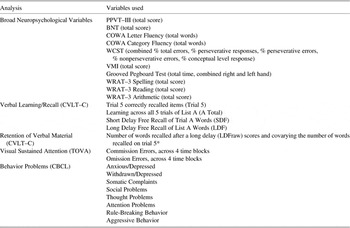
Each child was administered the following neuropsychological tests: Peabody Picture Vocabulary Test – Third Edition (PPVT–III; Dunn & Dunn, Reference Dunn and Dunn1997); Boston Naming Test (BNT; Kaplan, Goodglass, & Weintraub, Reference Kaplan, Goodglass and Weintraub1983); Controlled Oral Word Association Test (COWAT; Strauss, Sherman, & Spreen, Reference Strauss, Sherman and Spreen2006);Wisconsin Card Sorting Test (WCST; Heaton, Chelune, Talley, Kay, & Curtiss, Reference Heaton, Chelune, Talley, Kay and Curtiss1993); Beery Visual-Motor Integration (VMI; Beery, Reference Beery1997); Grooved Pegboard (PEGS; Spreen & Strauss, Reference Spreen and Strauss1998); Wide Range Achievement Test 3 (WRAT–3; Wilkinson, Reference Wilkinson1993); California Verbal Learning Test – Children's Version (CVLT–C; Delis, Kramer, Kaplan, & Ober, Reference Delis, Kramer, Kaplan and Ober1994); Test of Variables of Attention, Visual Subtest (TOVA; Leark, Dupuy, Greenberg, Corman, & Kindschi, Reference Leark, Dupuy, Greenberg, Corman and Kindschi1999); and the Child Behavior Checklist (CBCL; Achenbach, Reference Achenbach1991). See Table 1. These measures were selected to assess the following domains: receptive language (PPVT–III), expressive language (BNT), verbal fluency (COWAT), nonverbal problem solving (WCST), visual–motor ability (VMI), fine motor ability (PEGS), academic achievement (WRAT–3), verbal learning/memory (CVLT–C), sustained visual attention (TOVA), pathological behavior (parent/guardian-reported; CBCL). Full-Scale IQ was obtained from the WISC–III. Tests were administered in the same order to each child and all testing took place over two or three days (depending on the age of the child), within 1 month. Standardized procedures were used for administration and scoring of all tests and examiners were blind to group membership.
Neuropsychology variables included in the current study, with corresponding units of measurement, grouped by multivariate analysis set

*Because of concern of ceiling effects seen in savings scores we examined retention on the CVLT–C, using analysis of covariance to compare groups on number of words recalled after a long delay (LDFraw) scores while covarying the number of words recalled on trial 5 (see Mattson & Roebuck, Reference Mattson and Roebuck2002).
Statistical Analyses
Demographic data were analyzed by χ2 (sex, race/ethnicity, handedness) or standard analysis of variance (ANOVA) techniques (age, FSIQ, and SES [socioeconomic status as measured by Hollingshead]). Significant group differences were followed up with pairwise comparisons.
Neuropsychological outcome variables were analyzed using a doubly multivariate design. This design is a multivariate analog of a matched-pair t test and was selected to maximize power to detect group differences and because this analytic technique best matched the research design. In each multivariate analysis, each ALC participant was compared to his/her IQC subject and therefore the match pair (i.e., group) was the within-subject variable. The neuropsychological outcome variables were the dependent variables. Significant multivariate effects (α ≤ .05) were followed-up with univariate repeated measure ANOVA. Alpha levels for follow-up analyses were determined based on Holm-Bonferroni procedure (Holm, Reference Holm1979), which is a step-down method of controlling family wise error rates. Before conducting the analyses, multivariate outliers were removed (i.e., a matched pair was excluded for each analysis if the pair included an individual who had Mahalanobis Distance > critical χ2 value, p < .001). Because the subjects span a wide range of FSIQ, additional analyses were conducted to determine the influence of IQ on performance. Therefore, analyses described above were repeated including only 38 matched pairs (n = 76) who fell within the average FSIQ range (85–115).
In addition, because groups were not matched on sex or handedness additional analyses were repeated with two samples: (1) including sex-matched participants (n = 21 males and 21 females per group, total n = 84) and (2) including only right-handed participants (n = 43 per group, total n = 86). Descriptive data for these supplemental analyses are included in an electronic appendix.
Data Reduction: Missing data occurred on 1.34% of neuropsychological/parent reported behavior data points due to child noncompliance, computer failure, or failure of the parent/guardian to complete forms. Due to the small number of missing cases, missing value analyses could not be executed. Missing values for continuous variables were imputed using the expectation maximization method (Tabachnick & Fidell, Reference Tabachnick and Fidell2001).
Results
Demographics
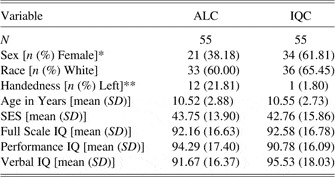
The ALC and IQC groups did not differ on race, age, or SES (p > .05). The ALC group had more male subjects and more left handed subjects than the IQC group (p < .05). As the groups were matched on FSIQ, the groups did not differ on this variable. In addition, groups were not different on PIQ or VIQ (p > .05). See Table 2.
Demographic and IQ data for children in the heavy prenatal alcohol exposure (ALC) and IQ-matched comparison (IQC) groups

Note. SD, standard deviation.
*Significant difference, p < .05.
**Significant difference p < .01.
Broad Neuropsychological Measures
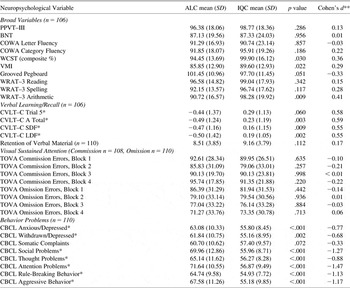
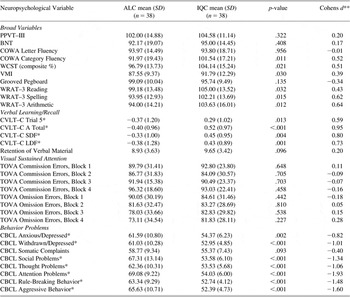
Analysis of the broad neuropsychological variables resulted in a marginally significant effect of group, F(10,43) = 2.02, p = .055, partial η2 = .319. In follow-up analyses, marginally significant univariate effects were noted on the WCST (p = .030), VMI (p = .022), and WRAT–3 Arithmetic (p = .009), with the ALC group having poorer performance than the IQC group on each measure. No significant group differences were observed on the PPVT–III, BNT, COWAT Letter Fluency, COWAT Category Fluency, WRAT–3 Reading, WRAT–3 Spelling, or Grooved Pegboard Test (p > .05). Two matched pairs of subjects (n = 4) were excluded as outliers from this analysis. See Table 3. An overall effect of group was observed on broad neuropsychological variables including subjects with average FSIQ, F(10,28) = 2.47, p = .029, partial η2 = .468. Marginally significant univariate effects were noted on the COWA Category Fluency (p = .011), WCST (p = .021), VMI (p = .030), WRAT–3 Reading (p = .032), WRAT–3 Spelling (p = .015), and WRAT–3 Arithmetic (p = .012). Significant group differences were not observed on the PPVT–III, BNT, Letter Fluency, or Grooved Pegboard Test (p > .05). See Table 4.
Descriptive data for repeated-measure ANOVA analyses, comparing children in the heavy prenatal alcohol exposure group (ALC) to the IQ-matched comparison group (IQC) on neuropsychological outcome variables

Note. Data are presented as means and standard deviations (SD) and represent standard scores (broad neuropsychological variables, TOVA), Z-scores (CVLT–C), raw scores (CVLT–C Retention), T-scores (CBCL).
*Significant difference with Holm-Bonferroni correction.
**For CBCL variables, effect sizes in the negative direction indicate ALC group has more behavioral pathology. For all other measures, effect sizes in the positive direction indicate the ALC group has poorer performance.
Descriptive data for repeated measure ANOVA analyses, comparing children in the heavy prenatal alcohol exposure group (ALC) to the IQ-matched comparison group (IQC), selected to have FSIQ between 85–115, on neuropsychological outcome variables

Note. Data are presented as means and standard deviations (SD) and represent standard scores (broad neuropsychological variables, TOVA), Z-scores (CVLT–C), raw scores (CVLT–C Retention), T-scores (CBCL).
*Significant difference with Holm-Bonferroni correction
**For CBCL variables, effect sizes in the negative direction indicate ALC group has more behavioral pathology. For all other measures, effect sizes in the positive direction indicate the ALC group has poorer performance.
Overall group differences were not observed on the sex-matched sample F(10,32) = 1.33, p = .255, partial η2 = .294, or the sample of right-handed participants, F(10,33) = 1.00, p = .462, partial η2 = .233.
Verbal Learning and Recall (CVLT–C)
Analysis of the CVLT–C learning variables revealed an overall effect of group, F(4,48) = 3.64, p = .011, partial η2 = .233. Significant univariate effects (p<.005) were noted for total number of words learned on list A (A Total), short delay free recall (SDF), and long delay free recall (LDF), while number of words learned on the final learning trial of list A (A5) was not significant (p = .060). The ALC group had poorer performance on each variable. Three matched pairs of subjects (n = 6) were excluded as outliers from this analysis. See Table 3. An overall effect of group was observed with the average IQ subjects, F(4,34) = 4.98, p = .003, partial η2 = .369. Significant univariate effects were noted for ATotal, SDF, LDF, and A5. The ALC group had poorer performance on each variable. See Table 4.
Significant overall group effects were observed on the sex-matched sample F(4,38) = 3.26, p = .022, partial η2 = .256 and the sample of right-handed participants, F(4,39) = 3.37, p = .018, partial η2 = .257.
Retention of Verbal Material (CVLT–C)
No significant group effect was observed using ANCOVA to examine raw scores of long delay free recall when taking into account number of words remembered on Trial A5, F(1,107) = 2.57, p = .112, partial η2 = .023. See Table 3. Group effects also were not observed with the average IQ subjects F(1,73) = 2.85, p = .096, partial η2 = .038 (see Table 4), in the sex-matched sample F(1,85) = 1.46, p = .231, partial η2 = .017, or the sample of right-handed participants, F(1,87) = 2.327, p = .131, partial η2 = .027.
Visual Sustained Attention (TOVA)
No group differences were apparent in the analyses of the two sets of TOVA variables, Omission Errors: F(4,51) = .41, p = .803, partial η2 = .031, Commission Errors: F(4,50) = 1.15, p = .345, partial η2 = .084. One matched pair of subjects (n = 2) was excluded from the analysis of Commission Errors as an outlier. See Table 3. No significant group differences were observed on the TOVA variables for the group of average IQ subjects, Omission Errors: F(4,34) = .877, p = .488, partial η2 = .094, Commission Errors: F(4,34) = .578, p = .681, partial η2 = .064. See Table 4.
Group differences were not observed on the sex-matched sample F(10,32) = 1.33, p = .255, partial η2 = .294, or the sample only with right handed participants, F(1,40) = 1.00, p = .462, partial η2 = .233.
Behavior Problems (CBCL)
Analysis of the CBCL behavior scales resulted in an overall effect of group, F(8,47) = 10.24, p < .001, partial η2 = .635. Significant univariate effects showed that the ALC group had more behavior problems than the IQC group on all CBCL scales, except for the Somatic Complaints scales (p = .072). See Table 3. An overall effect of group was observed with the average IQ subjects, F(8,30) = 9.19, p < .001, partial η2 = .710. Significant univariate effects showed that the ALC group had more behavior problems than the IQC group on all CBCL scales (p < .006) except for the Somatic Complaints scales (p = .093). See Table 4.
Overall group effects were also observed on the sex-matched sample F(8,34) = 5.93, p < .001, partial η2 = .583 and the sample with only right handed participants, F(8,35) = 7.30, p < .001, partial η2 = .625.
Discussion
To our knowledge, this is the most comprehensive comparison of neuropsychological function in children with heavy prenatal alcohol exposure and a group of children with no prenatal alcohol exposure well matched on IQ. The goal of the study was to compare the two groups across a broad battery of neuropsychological measures (receptive and expressive language, verbal and nonverbal executive function, visual–motor integration, fine motor ability, academic achievement) and more specific examination of visual sustained attention, parent/guardian-reported behavior problems, and verbal learning and memory.
Verbal Learning and Memory
The current results are consistent with several previous investigations, which have demonstrated impaired learning but intact retention of verbal material in children with prenatal alcohol exposure when compared to typically developing controls (Mattson et al., Reference Mattson, Riley, Delis, Stern and Jones1996; Mattson, Riley, Gramling, Delis, & Jones, Reference Mattson, Riley, Gramling, Delis and Jones1998; Mattson & Roebuck, Reference Mattson and Roebuck2002; Willford, Leech, & Day, Reference Willford, Leech and Day2006), when compared to children matched on mental age (Mattson et al., Reference Mattson, Riley, Delis, Stern and Jones1996) and in young adults with prenatal alcohol exposure when compared to individuals in special education (Coles et al., Reference Coles, Lynch, Kable, Johnson and Goldstein2010). The current study augments previous findings, suggesting that this previously documented pattern of impaired verbal learning with spared verbal retention in children with prenatal alcohol exposure exists independent of IQ effects. Verbal learning deficits may be related to structural brain changes in posterior temporal regions documented in alcohol-exposed populations (Sowell et al., Reference Sowell, Thompson, Mattson, Tessner, Jernigan, Riley and Toga2001, Reference Sowell, Thompson, Mattson, Tessner, Jernigan, Riley and Toga2002). The association of verbal learning deficits and temporal brain anomalies in individuals with FASD also has been supported by findings of aberrant functional activity in temporal regions during tasks of verbal learning (Sowell et al., Reference Sowell, Lu, O'Hare, McCourt, Mattson, O'Connor and Bookheimer2007). Conflicting data exist regarding hippocampal abnormalities with some results demonstrating reductions in the left hippocampus associated with poorer verbal learning (Willoughby, Sheard, Nash, & Rovet, Reference Willoughby, Sheard, Nash and Rovet2008) and others suggesting sparing of this region (Archibald et al., Reference Archibald, Fennema-Notestine, Gamst, Riley, Mattson and Jernigan2001) in children with prenatal alcohol exposure. Further examination of memory systems and associated brain anomalies would help determine mechanisms for this consistent pattern of impaired verbal learning (encoding) and spared retention.
Behavior Ratings (CBCL)
Increased incidence of behavioral problems in alcohol-exposed populations has been observed across several domains, including aggressive behavior (Griffith, Azuma, & Chasnoff, Reference Griffith, Azuma and Chasnoff1994), attention problems (Coles et al., Reference Coles, Platzman, Raskind-Hood, Brown, Falek and Smith1997), and delinquency (Carmichael Olson et al., Reference Carmichael Olson, Streissguth, Sampson, Barr, Bookstein and Thiede1997; Coles et al., Reference Coles, Platzman, Raskind-Hood, Brown, Falek and Smith1997). When comparing the current results to an investigation that included children with FASD and a group of non-exposed children with matched IQ (Mattson & Riley, Reference Mattson and Riley2000), a similar pattern of CBCL Problem Scale scores was observed. In both studies, larger group differences were noted on externalizing than internalizing scales. In the current investigation, large effects (Cohen's d > 0.8) were observed across externalizing domains while small to medium effects were seen on internalizing domains. The fact that the differences on internalizing scales reached statistical significance in this study but not our previous one may be related to the current matching technique (matched individually rather than by group), which allowed for more power to detect group differences on internalizing domains with similar sample sizes. The finding of increased internalizing problems in children with FASD is consistent with previous reports examining comorbid psychopathology in children and adults with heavy prenatal alcohol exposure, which finds high rates of mood disorders, such as depressive disorders (Famy, Streissguth, & Unis, Reference Famy, Streissguth and Unis1998; Fryer, McGee, Matt, Riley, & Mattson, Reference Fryer, McGee, Matt, Riley and Mattson2007). Therefore, this investigation may be capturing deficits that were not previously detected.
Broad Neuropsychological Variables
As a whole, the results of the broad neuropsychological variables suggest that some deficits observed in individuals with prenatal alcohol exposure, including language, verbal academic function, verbally mediated tasks of executive function, and fine motor dexterity, may be related more generally to IQ levels and not specifically related to prenatal alcohol exposure. It is not surprising that observed deficits are similar to overall IQ as many of these measures are likely to be highly correlated with IQ. After Holm-Bonferroni correction, three of the broad neuropsychological measures (WCST, VMI, WRAT–3 Arithmetic) were marginally significant, suggesting the possibility that these deficits are independent of concurrent IQ deficits. In particular, deficits in math have been noted in children across a range of prenatal alcohol exposure (Streissguth et al., Reference Streissguth, Barr, Olson, Sampson, Bookstein and Burgess1994). Based on these analyses it appears that math deficits may be more specifically related to prenatal alcohol exposure than is verbal academic achievement.
Visual Sustained Attention
The current results are similar to a previous investigation in which subjects with prenatal alcohol exposure did not demonstrate significant visual attention deficits when compared to individuals with similar IQ scores (Coles et al., Reference Coles, Platzman, Lynch and Freides2002). These results are in contrast to previous studies supporting visual attention deficits in children with FASD (Kooistra, Crawford, Gibbard, Ramage, & Kaplan, Reference Kooistra, Crawford, Gibbard, Ramage and Kaplan2010; Mattson et al., Reference Mattson, Calarco and Lang2006). Importantly, these previous studies included a typically developing control group although in the Mattson et al. study, IQ was neither significant as a covariate nor correlated with visual attention outcomes. Thus, while the current results suggest that visual attention deficits observed in this population may be secondary to overall ability levels, additional study may be needed. Importantly, the TOVA is designed to elicit inattentive and impulsive visual attention errors. It may be that incorporating measures of attention focusing on other aspects of attention (e.g., orienting, alerting) may result in different findings. It is important to note that standard scores for both groups degraded over time trials, possibly indicating impairments in both groups in comparison to typically developing controls, and that lower IQ more generally could be related to diminished attention.
Average IQ Subjects
When children with prenatal alcohol exposure were compared to non-exposed peers within the average range of FSIQ, findings were generally consistent with those observed within the larger sample of children. Unlike the larger sample, children with FASD demonstrated deficits on measures of verbal category fluency and spelling achievement. These results suggest that deficits on verbal measures may be more evident in children with prenatal alcohol exposure who fall in the average range of intellectual function.
Implications
Based on the current results, it appears that some but not all deficits observed in children with FASD are secondary to lowered IQ. Information from this investigation also may be useful in increasing specificity of the neurobehavioral profile associated with heavy prenatal alcohol exposure. The results highlight areas of deficit (verbal learning, pathological behavior) as more specific targets of intervention for this population and which may be useful in identification of alcohol-affected individuals. Studies including populations with relatively lower levels of prenatal alcohol exposure have replicated deficits in verbal learning (Willford et al., Reference Willford, Richardson, Leech and Day2004), and increased externalizing behaviors (Sood et al., Reference Sood, Delaney-Black, Covington, Nordstrom-Klee, Ager, Templin and Sokol2001) suggesting that even in individuals who are less affected and have IQ scores more similar to non-exposed peers, these domains may be areas of relative weakness. Because some deficits were secondary to lowered IQ, they may be noted only in more affected children, highlighting the importance of considering overall level of function when defining specific neurobehavioral profiles.
Limitations
An important consideration in interpreting these results is the nature of the sample included in this investigation. Our alcohol-exposed sample is identified retrospectively and is heavily exposed and therefore is likely to be a more significantly affected group than samples with lower levels of prenatal alcohol exposure or those recruited prospectively. However, this is consistent with our focus on alcohol-exposed children with the greatest clinical need—those with clinically significant impairments. While this investigation highlights particular areas of vulnerability, the relationship of timing and dose of maternal alcohol consumption during pregnancy and cognitive deficits cannot be assessed with this sample. Also important to emphasize is that, as in other clinical samples, comparing children with FASD to matched IQ subjects is not the optimal approach for generalizability. The comparison group in this investigation has a mean IQ score that falls below normative expectations and subjects were selected individually based on their IQ score, suggesting these subjects may not have cognitive ability that is generalizable to the larger population of typically developing children (Dennis et al., Reference Dennis, Francis, Cirino, Schachar, Barnes and Fletcher2009).
The approach in this investigation was designed to examine deficits that exist independent of IQ. The lack of differences between alcohol-exposed individuals and IQ-matched controls on verbal measures of executive function and academic achievement, language, and visual attention does not suggest that children with prenatal alcohol exposure will not experience difficulties in these domains. Based on previous investigations, it is likely that when compared to typically developing peers, they may have (for example) decreased attentional capacity in the visual domain (Mattson et al., Reference Mattson, Calarco and Lang2006), diminished verbal fluency (Kodituwakku, Handmaker, Cutler, Weathersby, & Handmaker, Reference Kodituwakku, Handmaker, Cutler, Weathersby and Handmaker1995; Mattson, Goodman, Caine, Delis, & Riley, Reference Mattson, Goodman, Caine, Delis and Riley1999), and difficulty with tasks involving arithmetic (Streissguth et al., Reference Streissguth, Barr, Olson, Sampson, Bookstein and Burgess1994). In addition, while retention of verbal material was spared in these and other investigations, it should be noted that this encoding deficit will be experienced as a “memory” problem in that children with FASD will recall less material than typically developing and IQ-matched peers. These limitations are particularly important to consider within clinical or academic domains, as it is likely that children with prenatal alcohol exposure will have problems with school and other everyday demands despite the fact that they did not demonstrate impairment in comparison to IQ-matched controls.
Effect sizes observed in the current investigation ranged from small to large. In previous studies comparing children with prenatal alcohol exposure to typically developing controls, large effect sizes are often observed (see Vaurio, Riley, & Mattson, Reference Vaurio, Riley and Mattson2008). Therefore, it appears that while children with prenatal alcohol exposure have deficits when IQ is controlled, the degree of these deficits is diminished. A fairly conservative approach was adopted in using Holm-Bonferroni corrections for multiple comparisons, so it may be that a less conservative analytical approach would highlight more areas of weakness in children with FASD.
Groups were not matched on sex or handedness and so analyses were repeated with a sex-matched sample and with right-handed participants. For both of these sets of analyses the majority of results were consistent with the overall analyses (i.e., significant differences on CVLT–C, CBCL analyses, no significant differences on TOVA Commission or Omission analyses). Results of analyses involving the broad neuropsychological measures were less consistent. Overall group differences were significant when only subjects with average IQ scores were included, marginally significant with all subjects, and not significant when subjects were matched on sex or when only right-handed subjects were included. These findings may preclude any conclusions about whether the observed deficits are independent of IQ.
Future Directions
Although a broad neuropsychological test battery was used, the measures included in this investigation are not an exhaustive representation of all cognitive domains. Therefore, future investigations could use a similar design to address domains not assessed such as nonverbal learning, auditory attention or additional aspects of visual attention (e.g., orienting), as well as incorporating additional third-party reports of child behavior (e.g., teacher report). Future studies also might address the nature of learning and memory deficits in children with prenatal alcohol exposure. Importantly, the ability of children with prenatal alcohol exposure to retain already learned verbal information may be related to the implicit organizational strategy that is present in the CVLT–C (Mattson & Roebuck, Reference Mattson and Roebuck2002; Roebuck-Spencer & Mattson, Reference Roebuck-Spencer and Mattson2004). Inclusion of tasks with different types of organizational strategies could illuminate specific memory strategies that alcohol-exposed children are more or less proficient in applying.
While diminished IQ is one commonly noted characteristic of children with FASD, it may be useful to consider comparing children with FASD to samples with other shared cognitive and behavioral deficits such as children with externalizing (e.g., attention-deficit/hyperactivity disorder) or internalizing (e.g., depressive) disorders. These comparisons will allow for improved specificity of neurobehavioral deficits associated with prenatal alcohol exposure rather than demonstrating deficits when compared with typically developing peers. Examinations of executive function (Vaurio et al., Reference Vaurio, Riley and Mattson2008) and social skills (Greenbaum, Stevens, Nash, Koren, & Rovet, Reference Greenbaum, Stevens, Nash, Koren and Rovet2009) have been useful in distinguishing children with heavy prenatal alcohol exposure from those without exposure but with a diagnosis of attention-deficit/hyperactivity disorder and similar studies in the future might use other comparison groups to further develop a neurobehavioral profile.
These findings may be applied in academic and clinical settings. For example, while children with prenatal alcohol exposure are likely to be in special education classrooms, educators should consider that these children have particular difficulty with initial learning and recall of verbal instructions even in comparison to peers with similar intellectual ability. However, alcohol-exposed children appear to be able to retain information they are able to encode, at least when organizing strategies are available. Thus, repeated exposure to verbal material may be beneficial. In addition, measures were included in the current investigation because of their clinical utility and because normative information was available for our population. However, some measures do not provide information of the mechanism of the deficit. For example, these data suggest children with FASD may have particular difficulty with math tasks. Future studies could investigate the nature of the deficit (e.g., basic number processing vs. working memory difficulty) that contributes to these impairments. Screening for comorbid psychiatric disorders also is very important in populations with FASD as problem behaviors associated with a broad range of psychopathology appear to be a consistent finding in this population even after accounting for IQ differences.
Acknowledgments
The authors thank the members of the Center for Behavioral Teratology and the families who graciously participate in our studies. This manuscript and information included in this manuscript have not been previously published, electronically or in print and no conflicts of interest exist in publishing of this document. Research supported by NIAAA Grants R01 AA010820, R01 AA010417, U01 AA014834, T32 AA013525, and F31 AA017334.
Supplementary Material
To review these additional data and analyses, please access the online-only electronic appendix. Please visit journals.cambridge.org/INS, and then click on the link “Supplementary Materials” at this article.