Introduction
With an aging population, increased attention has been paid to behavioral, dietary, and social factors that may build cognitive resilience, or a tendency to maintain functional cognitive status into later life (see Smith, Reference Smith2016 for a review), based on evidence that lifestyle factors play a role in promoting cognitive maintenance. Building from this foundation, there is a growing recognition that personal dispositions may be relevant, given that these dispositional traits influence individual’s propensity to engage in lifestyle behaviors that either promote or hinder cognitive status (e.g., Bogg and Roberts, Reference Bogg and Roberts2004; Hampson, Reference Hampson2012; Smith, Reference Smith2006). Toward this end, researchers have begun to consider sense of purpose, defined as the perception that one has an overarching aim or direction guiding them through life and influencing daily engagements (Ryff, Reference Ryff1989; Scheier et al., Reference Scheier2006). The focus on this disposition is informed by its connections to cognitive performance (Dewitte et al., Reference Dewitte, Lewis, Payne, Turiano and Hill2021; Lewis et al., Reference Lewis, Turiano, Payne and Hill2017; Sutin et al., Reference Sutin, Luchetti, Stephan, Strickhouser and Terracciano2022; Windsor et al., Reference Windsor, Curtis and Luszcz2015), healthy behaviors (Hill et al., Reference Hill, Edmonds and Hampson2019; Kim et al., Reference Kim, Shiba, Boehm and Kubzansky2020), and social connections (Pfund, Hofer, et al., Reference Pfund, Hofer, Allemand and Hill2021; Weston et al., Reference Weston, Lewis and Hill2021). Sense of purpose has been shown to be a powerful promoter of healthy aging (Pfund and Hill, Reference Pfund and Hill2018; Pfund and Lewis, Reference Pfund and Lewis2020; Zaslavsky et al., Reference Zaslavsky2014), with recent evidence suggesting that it may be protective against constructs like depressive symptoms in the maintenance of higher cognitive functioning (Lewis and Hill, Reference Lewis and Hill2021).
The current study sought to replicate and extend this work by evaluating whether associations between cognition and psychosocial dysfunction are moderated by sense of purpose using data (n = 595) from the ongoing St Louis Personality and Aging Network (SPAN) Study (Oltmanns et al., Reference Oltmanns, Rodrigues, Weinstein and Gleason2014). In particular, we tested whether a greater sense of purpose protects against two indicators of personal dysfunction–depressive symptoms and loneliness with respect to self-reported memory concerns. Moreover, we examined whether the findings differed based on race, given the racial disparities in rates of cognitive performance and decline (e.g., Power et al., Reference Power2021; Zahodne et al., Reference Zahodne, Manly, Smith, Seeman and Lachman2017, Reference Zahodne, Morris, Sharifian, Zaheed, Kraal and Sol2020).
Sense of purpose and cognitive resilience
Adults who report a stronger sense of purpose tend to experience better aging outcomes compared to their peers across multiple life domains. For instance, sense of purpose predicts a reduced risk for physical disability (Boyle et al., Reference Boyle, Buchman, Barnes and Bennett2010), cardiovascular illness (Kim, Delaney, et al., Reference Kim, Delaney and Kubzansky2019), and even early mortality (Boyle et al., Reference Boyle, Barnes, Buchman and Bennett2009; Cohen et al., Reference Cohen, Bavishi and Rozanski2016) among older adults. Accruing evidence also points to sense of purpose as a predictor of cognitive functioning, even when accounting for known demographic predictors, such as gender, education, and even subjective health. Older adults with a higher sense of purpose perform better on memory, verbal fluency, and executive functioning tasks (Lewis et al., Reference Lewis, Turiano, Payne and Hill2017; Sutin et al., Reference Sutin, Luchetti, Stephan, Strickhouser and Terracciano2022), and appear to have more positive cognitive trajectories over time (Kim et al., 2019; Windsor et al., Reference Windsor, Curtis and Luszcz2015). Moreover, studies show sense of purpose as a potential protective factor against later Alzheimer’s disease and dementia (Boyle et al., Reference Boyle, Buchman, Barnes and Bennett2010; Wilson et al., Reference Wilson2021), with some suggestion it may serve to buffer against neuropsychological markers of non-normative decline (Boyle et al., Reference Boyle, Buchman, Wilson, Yu, Schneider and Bennett2012).
Two rationales are common for explaining links between sense of purpose and cognitive aging. First, purpose-driven individuals may have greater opportunities to practice their cognitive skills in daily life. Having a purpose in life is thought to help individuals organize their lives in pursuit of personally meaningful aims (McKnight and Kashdan, Reference McKnight and Kashdan2009), so individuals will be motivated toward frequent cognitive exercise, like remembering daily tasks and planning their lives around purposeful pursuits. Second, purposeful individuals appear to live healthier lifestyles, with both cross-sectional (Hill et al., Reference Hill, Edmonds and Hampson2019) and longitudinal (Kim et al., Reference Kim, Shiba, Boehm and Kubzansky2020) studies showing connections between sense of purpose and multiple health behaviors, including greater activity engagement, better physical functioning, and healthier diets. Healthy lifestyle behaviors likely also serve as a mechanism linking purpose to cognitive resilience, aligned with the suggestion that physical exercise and diet can help prevent non-normative cognitive decline (Smith, Reference Smith2016).
However, few studies have considered sense of purpose as a potential barrier against the cognitive decrements associated with psychological ill-being. This buffering account aligns with the suggestion that purpose can serve as a form of resilience regarding older adulthood declines (Nygren et al., Reference Nygren, Aléx, Jonsén, Gustafson, Norberg and Lundman2005). Recent work found that the negative association between depressive symptoms and memory was weaker for those older adults with a stronger sense of purpose (Lewis and Hill, Reference Lewis and Hill2021). Given the marked risk for cognitive decline linked to depressive symptoms (Ownby et al., Reference Ownby, Crocco, Acevedo, John and Loewenstein2006; Wilson et al., Reference Wilson2002; Yaffe et al., Reference Yaffe, Blackwell, Gore, Sands, Reus and Browner1999), this work provides a new avenue for work on how and why purposeful adults may experience better cognitive health.
Work is needed to replicate and clarify these findings before accepting this buffering explanation as a route linking purpose to resilience. First, it is worth noting that findings held only for memory performance and not mental status (Lewis and Hill, Reference Lewis and Hill2021). The mental status measure used may be less sensitive to differences among individuals in relatively normative cognitive functioning, compelling the need to consider whether purpose-moderation effects persist with other cognitive measures. Second, it is unclear whether the findings are specific to depressive symptoms or if purpose can mitigate the cognitive issues associated with other psychosocial dysfunction, like loneliness, given that loneliness has been linked to cognitive functioning (e.g., Donovan et al., Reference Donovan, Wu, Rentz, Sperling, Marshall and Glymour2017; Lara et al., Reference Lara2019; Wilson et al., Reference Wilson2007) and depressive symptoms (Erzen and Çikrikci, Reference Erzen and Çikrikci2018; Van As et al., Reference Van As, Imbimbo, Franceschi, Menesini and Nocentini2021). Past work has shown consistent negative moderate associations between sense of purpose and loneliness (Bondevik and Skogstad, Reference Bondevik and Skogstad2000; Neville et al., Reference Neville2018; Pfund and Miller-Perrin, Reference Pfund and Miller-Perrin2019; Pinquart, Reference Pinquart2002). Because most research has focused on simply linking purpose and loneliness, additional work is needed to better examine the interaction of variables, particularly regarding cognitive functioning.
Current study
The current study sought to consider the buffering effects of purpose using data from the long-running St. Louis Personality and Aging Network (SPAN; Oltmanns et al., Reference Oltmanns, Rodrigues, Weinstein and Gleason2014) study. The SPAN study has advanced the discussion of personality-related dispositions and cognitive performance in previous articles (Best et al., Reference Best, Cruitt, Oltmanns and Hill2021; Cruitt et al., Reference Cruitt, Hill and Oltmanns2021; Cruitt and Oltmanns, Reference Cruitt and Oltmanns2018), and this paper provides our first investigation into sense of purpose and cognitive outcomes with this data. First, the current study sought to replicate past work showing that sense of purpose correlates with better cognitive outcomes in later adulthood (Boyle et al., Reference Boyle, Buchman, Barnes and Bennett2010; Windsor et al., Reference Windsor, Curtis and Luszcz2015), with respect to a new outcome, a recently validated measure of subjective cognitive decline (AD8; Galvin, Roe, et al., Reference Galvin2005) Second, we tested whether a greater sense of purpose protects against two indicators of personal dysfunction – depressive symptoms and loneliness – with respect to subjective cognitive decline. We expected both depressive symptoms and loneliness to be associated with greater subjective cognitive decline. Third, we examined sense of purpose and our two indicators of psychosocial dysfunction as unique and interactive predictors of the cognitive measures; specifically, for adults higher on sense of purpose, the associations between loneliness or depressive symptoms and self-reported decline should be weaker in nature. Finally, given the racial disparities in rates of cognitive performance and decline as Black participants show faster decline than White participants (e.g., Power et al., Reference Power2021; Zahodne et al., Reference Zahodne, Manly, Smith, Seeman and Lachman2017, Reference Zahodne, Morris, Sharifian, Zaheed, Kraal and Sol2020), the SPAN study provides a unique opportunity to consider whether the buffering account differs across White and Black older adults. Thus, we conducted exploratory analyses to examine whether three-way interactions occurred between the moderating effects of purpose and participant race.
Method
Participants
Data for the current analyses comes from the 13th wave of the ongoing St. Louis Personality and Aging Network (SPAN) study (baseline N = 1630), which is a longitudinal study of older adults in the broader St. Louis area community (for more information, see Oltmanns et al., Reference Oltmanns, Rodrigues, Weinstein and Gleason2014). This wave was the first in which a sense of purpose measure was included. Only participants for which all variables of interest were available were included in the current analysis, resulting in a final sample size of 595 (Age: range = 65–76, M = 71.43, SD = 3.52). Approximately 44.0% of the sample identified as male and 79.5% (n = 475) of the sample identified as White (18.3% Black, 1.9% Other) and 56.0% as female. Regarding race, 475 participants identified as white/Caucasian (79.8%), 109 participants identified as Black/African-American (18.3%), and 1.9% identified as another race. Based on the response cutoff set by the AD8 (discussed in more detail below), 15.6% of the sample qualified as having mild cognitive impairment (MCI).
Procedure
All participants who agreed to enter the study completed a 3-hour baseline assessment, which included informed consent, a structured diagnostic interview for personality disorders, self-report measures of personality, and a battery of assessments related to health and functioning in a variety of domains. Following the baseline assessment, participants were contacted approximately once every 6–12 months to complete on-going assessments. Three of those assessments were conducted in person, and the others involved completing a packet of questionnaires at home. All study procedures were approved by the Washington University in St. Louis Institutional Review Board.
Measures
Sense of purpose
Sense of purpose was assessed using the 6-item Life Engagement Test (Scheier et al., Reference Scheier2006). Participants responded to each item on a 5-point Likert scale from 1 (strongly disagree) to 5 (strongly agree). Participants had to respond to 75% of the items to receive a score. Items were averaged, with higher scores representing a higher sense of purpose. This measure displayed good internal consistency (Cronbach’s α = .86).
Loneliness
Loneliness was assessed using the 20-item UCLA Loneliness Scale (Russell, Peplau, et al., 1980). Participants responded to how frequently each item described them on a 4-point Likert scale from 1 (never) to 4 (always). Participants had to respond to 75% of the items to receive a score. Items were averaged, with higher scores representing greater feelings of loneliness. This measure displayed good internal consistency (Cronbach’s α = .94).
Depressive symptoms
Depressive symptoms were assessed using the 21-item Beck Depression Inventory-II. Participants were asked to rate on a 4-point Likert scale how well each item described them over the past 2 weeks. Participants had to respond to all items to receive a score. Items were summed, and higher scores represented higher depressive symptoms. This measure displayed good internal consistency (Cronbach’s α = .89).
Subjective cognitive decline
Subjective cognitive decline was assessed using the self-reported eight-item AD8 questionnaire (Galvin et al., Reference Galvin2005; Galvin, Roe, et al., Reference Galvin, Roe, Coats and Morris2007). Participants were instructed to respond whether they felt they themselves experienced changes in memory or thinking over the past several years. Each of these items reflects whether one has experienced greater issues over time with respect to a specific cognitive task. Participants responded yes or no to items about whether they have noticed changes regarding things like having daily problems with thinking/memory, or repeat themselves frequently regarding questions/stories/statements. To receive a score on this measure, participants were required to respond to all items. Items were summed together, with higher scores representing poorer cognitive functioning.
The self-reported AD8 was originally validated with respect to clinical dementia ratings, participant reports of memory problems, and the Mini-Mental State Examination (Folstein et al., Reference Folstein, Robins and Helzer1983), with all of these measures showing stronger associations that clinician impressions of depression (Galvin, Roe, et al., Reference Galvin, Roe, Coats and Morris2007). Moreover, recent work has demonstrated that both incident cognitive impairment and markers of cognitive performance change added to the prediction of AD8 scores, above and beyond depressive symptoms (Passler et al., Reference Passler2021). As such, although this measure is self-reported and potentially subject to some depressogenic biases, it has been validated with respect to multiple cognitive performance measures.
In addition to its use as a continuous measure, a dichotomous variable was created where people who scored below two were classified as normal cognitive functioning (coded as 0) and two or above were classified as having MCI (coded as 1). Past work has suggested a cutoff of 2 when employing the informant-based version of this measure (Galvin et al., Reference Galvin2005), but recommends either 1 or 2 as a cutoff when using the self-report (Galvin, Roe, et al., 2007), depending on which psychometric properties one is focused. We chose two as the cutoff for the current study as a more stringent guideline; put differently, we erred on the side of caution with respect to classifying someone as MCI. Of the 584 participant, 91 (15.5%) were classified as having MCI. When separated by race, 15.6% of White participants and 15.6% of Black participants had MCI.
Analytic plan
All analyses were conducted using RStudio (RStudio Team, 2020), an IDE for R (R Core Team, 2021). Age, sense of purpose, depressive symptoms, and loneliness were standardized, and gender was coded so 0 represented male. Zero-order correlations were calculated between sense of purpose, loneliness, depressive symptoms, and cognitive functioning (both continuous and dichotomous scores). Next, we used linear and logistic regressions to test whether sense of purpose moderated the associations between loneliness or depressive symptoms and the cognitive decline indices, meaning we included an interaction term for sense of purpose by loneliness in one model and sense of purpose by depression in another. Exploratory moderation analyses further tested whether race interacted with sense of purpose and dysfunction in predicting cognitive decline among the White and Black adult subsamples. Only participants who identified as White/Caucasian or Black/African-American were included based on sample size. Independent samples t-test were conducted to investigate whether there were mean differences on these variables based on race. Finally, for any interactions that were significant, the Johnson–Neyman technique was utilized to determine the region of significance for the slope (Bauer and Curran, Reference Bauer and Curran2005). 95% Confidence Intervals are reported in [brackets].
Results
Descriptive statistics
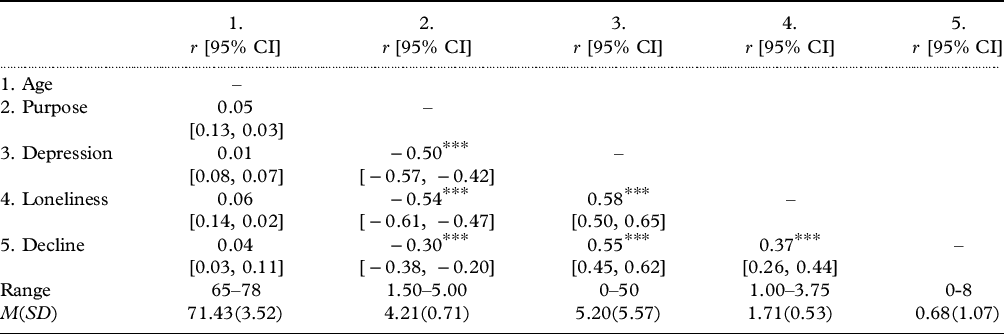
Means, standard deviations, and zero-order correlations for the variables of interest can be found in Table 1. These findings indicate that people who report a higher sense of purpose also report fewer depressive symptoms, less loneliness, and lower cognitive decline (|r|s > .30, ps < .001). Furthermore, cognitive decline shows strong positive associations with both loneliness and depressive symptoms (|r|s > .37, ps < .001). Age was not associated with sense of purpose, depression, loneliness, or cognitive decline (|r|s < .06, ps > .125).
Means, standard deviations, and zero-order correlations for sense of purpose, depression, loneliness, and cognitive decline

* p < 0.05, ** p < 0.01, *** p < 0.001.
Sense of purpose and dysfunction interactions
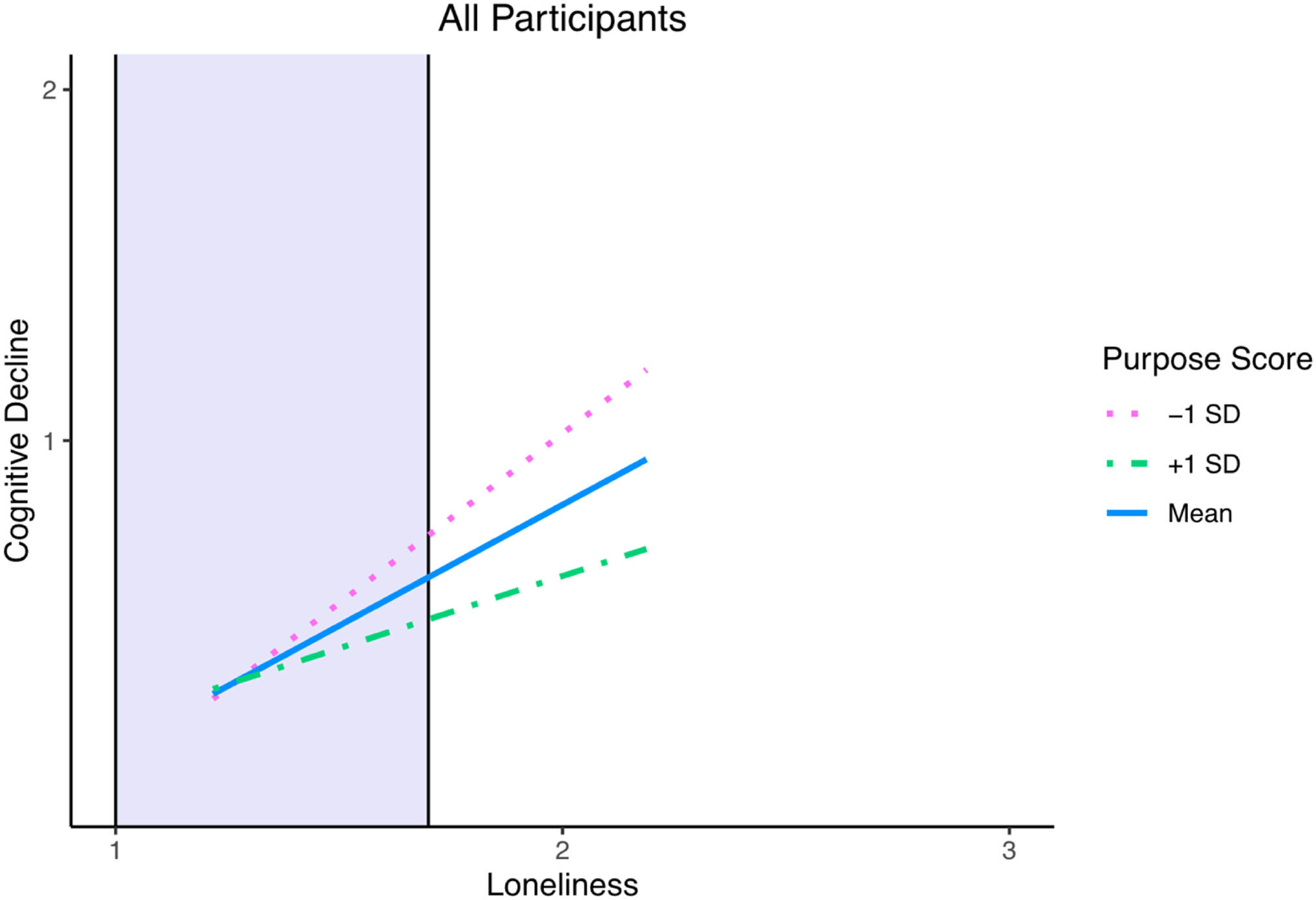
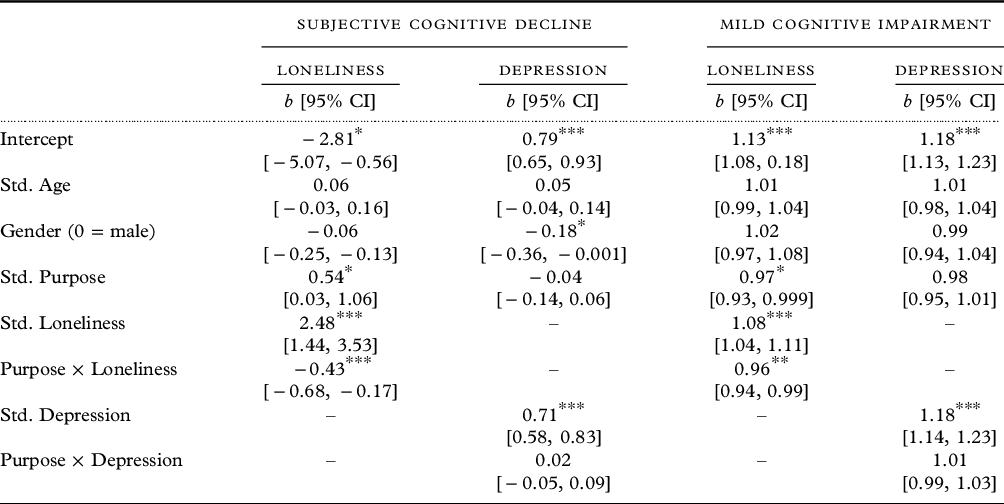
Multiple regression was conducted in which gender, standardized age, sense of purpose, loneliness, and sense of purpose*loneliness predicted cognitive decline. As a sensitivity analyses, a binary logistic regression was also conducted in which gender and standardized age, sense of purpose, loneliness, and sense of purpose*loneliness was regressed onto the dichotomous cognitive functioning variable. Sense of purpose moderated the association between loneliness, but not depression, and poorer cognitive functioning (loneliness: b = −0.43, [−0.68, −0.17], p = .002; depression: b = 0.02, [−0.05, 0.09], p = .634; Table 2). Simple slope tests showed that a higher sense of purpose attenuated the positive relationship between loneliness and cognitive decline (Figure 1). The association between loneliness and subjective cognitive decline for individuals who scored one standard deviation below the mean on sense of purpose was b = 0.78 (p < .001), who scored average on sense of purpose was b = 0.29 (p < .001), and who scored one standard deviation above the mean on purpose was b = .18 (p = .037). Johnson–Neyman analyses revealed that sense of purpose moderated the association between loneliness and MCI at all levels of the loneliness scores above 1.70 (46% of participants scored above).
Simple slopes graph for the association between loneliness and cognitive decline at high (+1 SD), average (mean), and low (−1 SD) levels of sense of purpose when accounting for age and gender with region of nonsignificance highlighted.
Note. X-axis represents loneliness Likert scale ranging from 1 to 4; however, the plotted range was restricted to avoid the exaggeration of the effects.

Regression results predicting subjective cognitive decline as continuous with unstandardized estimates and binary (mild cognitive impairment) outcomes with odds ratios
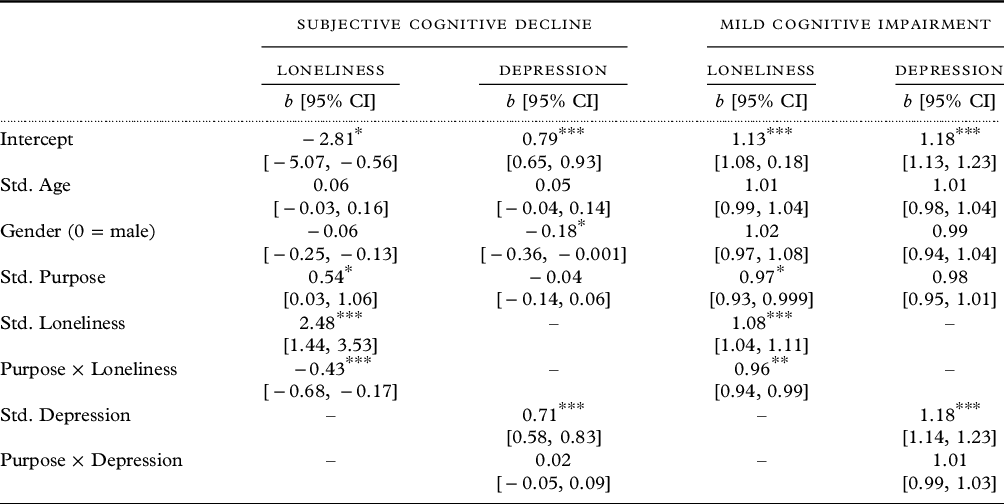
Note. The subjective cognitive decline scores were not standardized and thus are to be interpreted within the context of how the scale was measured; scores were summed and could range from 0 to 8, with higher scores representing greater perception of cognitive decline.
* p < 0.05, ** p < 0.01, *** p < 0.001.
The interactive role of race
Based on independent sample t-tests, Black/African-American participants scored significantly higher on sense of purpose (M White = 4.18, SD = 0.59; M Black =4.36, SD = 0.663; t(177.01) = −2.82, p = .005). There were no mean racial differences for depressive symptoms (t(144.18) = −0.67, p = .503), loneliness (t(148.90) = 0.04, p = .967), or subjective cognitive decline (t(139.62) = −0.74, p = .459). Finally, a chi-square test indicated there was not a significant difference in the proportion of people who qualified as having MCI based on race (χ 2 = 0.00, p = 1.00).
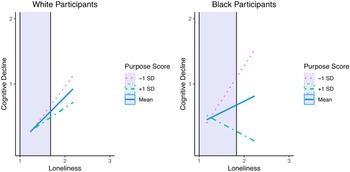
Next, a multiple regression building from the previous models was conducted with the inclusion of a race variable and a three-way interaction term for sense of purpose*loneliness*race. A binary logistic regression was conducted with these variables predicting MCI as a form of a sensitivity analysis. Race moderated the sense of purpose interaction with loneliness, but not depression, in the prediction of cognitive functioning (Loneliness: b = −0.25, [−0.44, −0.04], p = .021; Depression: b = −0.08, [−0.26, 0.11], p = .442; Table 3). The moderating effect of sense of purpose on the loneliness by race association was stronger for Black participants (b = −0.38, [−0.60, −0.16], p < .001) than White participants (b = −0.10, [−0.18, −0.01], p = .025); Figure 2 displays the simple slopes for this three-way interaction. Johnson–Neyman analyses revealed that sense of purpose moderated the association between loneliness and MCI at all levels of the loneliness scores above 1.83 for Black participants (37% scored above) and 1.68 for White participants (46% scored above).
Simple slopes graph for the association between loneliness and cognitive decline at high (+1 SD), average (mean), and low (−1 SD) levels of sense of purpose when accounting for age and gender separately for White/Caucasian and Black/African-American participants with region of nonsignificance highlighted.
Note. X-axis represents loneliness Likert scale ranging from 1 to 4; however, the plotted range was restricted to avoid the exaggeration of the effects.

Regression results predicting subjective cognitive decline as continuous with unstandardized estimates and binary (mild cognitive impairment) outcomes with odds ratios accounting for race interaction
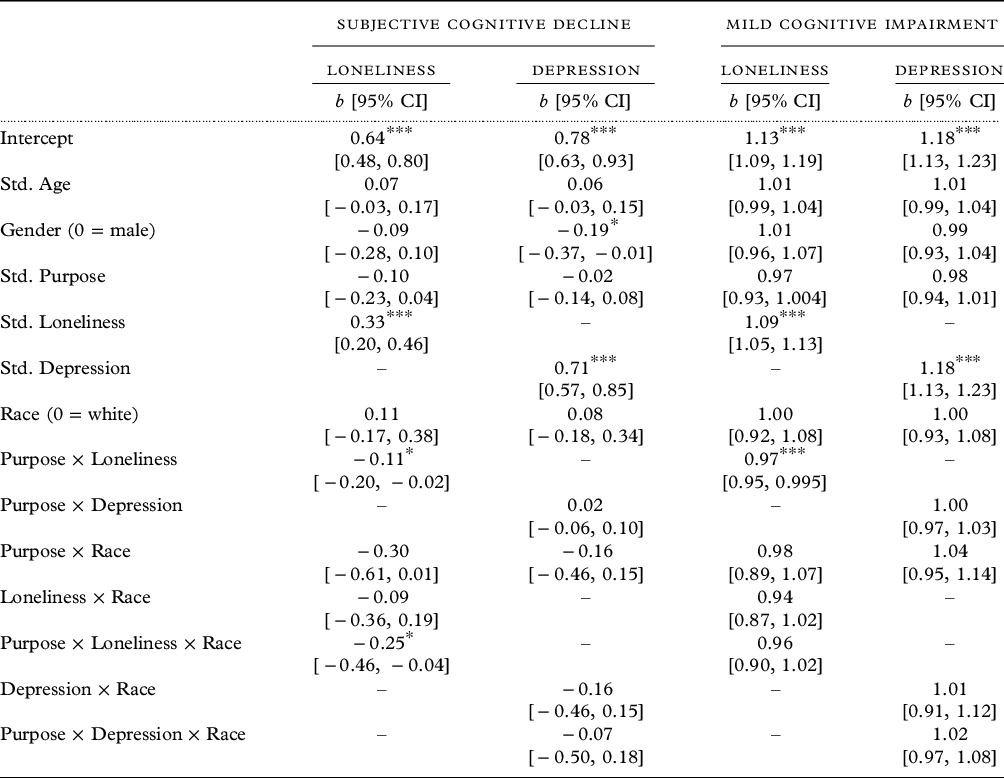
Note. The subjective cognitive decline scores were not standardized and thus are to be interpreted within the context of how the scale was measured; scores were summed and could range from 0 to 8, with higher scores representing greater perception of cognitive decline.
* p < 0.05, ** p < 0.01, *** p < 0.001.
Discussion
The current study provided evidence for three primary claims regarding sense of purpose and cognitive functioning. First, based on effect size cutoffs for psychological research (Funder and Ozer, Reference Funder and Ozer2019), correlational results demonstrated a strong, positive relationship between sense of purpose and healthy cognitive aging. Older adults who reported a higher sense of purpose tended to report fewer memory concerns, using the AD8, a recently validated measure of self-reported complaints related to subjective cognitive decline. Moreover, loneliness and depressive symptoms were strongly and very strongly (respectively) associated with subjective cognitive decline using this instrument. Second, results suggested that sense of purpose moderated the association between loneliness and subjective cognitive decline, with sense of purpose buffering against the negative effects of loneliness. However, sense of purpose did not moderate the association between depressive symptoms and subjective cognitive decline, suggesting that the relationship between these two variables was consistent regardless of sense of purpose levels. Third, further exploration of this interaction suggested that this finding was particularly powerful in Black older adults, with sense of purpose showing an even stronger buffering effect against loneliness for Black versus white older adults. Each of these findings provide valuable steps forward for work on purpose and cognitive resilience.
To start, the current work furthers the evidentiary base for purpose-cognition research, by demonstrating the potential connection using a relatively new measure, the AD8 (Galvin et al., Reference Galvin2005) and a unique sample. The current findings help further the case for considering sense of purpose as a factor in promoting healthy cognitive aging (Boyle et al., Reference Boyle, Buchman, Barnes and Bennett2010; Dewitte et al., Reference Dewitte, Lewis, Payne, Turiano and Hill2021; Lewis et al., Reference Lewis, Turiano, Payne and Hill2017), and continuing to explore the underlying rationales and mechanisms. In addition to the possibilities raised earlier, another pathway that merits exploration is how purposeful people may differentially plan their future and the implications of these plans for healthy aging. Sense of purpose has been associated with better retirement planning (Hill and Pfund, Reference Hill and Pfund2021) and a broader time perspective (Pfund, Ratner, et al., Reference Pfund, Ratner, Allemand, Burrow and Hill2022). This point is critical in the context of the current findings, insofar that both depressive symptoms and loneliness have been linked to perceiving a more limited future (e.g., Bergman and Segel-Karpas, Reference Bergman and Segel-Karpas2018). Building from this work, purposeful older adults may be more likely to plan for the future, in part because they expect it to provide more opportunities, helping to mitigate concerns linked to psychological dysfunction. Future research would also benefit from understanding the unique role of sense of purpose above and beyond related constructs (e.g., Aftab et al., Reference Aftab2019) in helping promote cognitive resilience.
Counter to previous work (Lewis and Hill, Reference Lewis and Hill2020), the current study suggested sense of purpose did not moderate linkages between depressive symptoms and subjective cognitive decline. At least three explanations mount for this lack of moderation effect. First, the current study differed significantly in measurement from the past work with respect to cognitive functioning and sense of purpose. Second, depressive symptoms were the strongest correlate of subjective cognitive decline in the current study, and a predictor of higher scores on this measure in past work (Passler, Kennedy, et al., Reference Passler2021). Bringing these findings together, this measure may reflect that the current cognitive measure was self-reported and more susceptible to influence from a depressogenic mindset. The previous work instead found an interaction with memory performance as the outcome (Lewis and Hill, Reference Lewis and Hill2020), which provides a more objective measure of functioning that is less conflated with depressive symptoms than self-reported issues. Third, given that the current sample was younger on average than the previous study, and overall indicated little subjective cognitive decline or cognitive impairment, it may suggest insights into the time course of when sense of purpose helps to buffer against depressive concerns. This point likely helps explain why findings differed somewhat between the cutoff and continuous measures for subjective cognitive decline, insofar that the former was perhaps underpowered to find interactions given that few participants fell into that group.
Given this last concern, it is particularly impressive that sense of purpose did moderate associations between loneliness and subjective cognitive decline, even with limited variability in the cognitive indicator. This finding underscores the potential that purposeful individuals may be better at maintaining and organizing meaningful engagement, even when they feel alone in these activities. The purpose-by-loneliness interaction was qualified further by race: the potential “buffering” effect for sense of purpose was stronger for Black than White adults. Given that race moderation was tested as an exploratory variable, and research to our knowledge has yet to consider three-way interactions of this nature in any study, further replication is necessary. That said, it is valuable to consider these findings within the context of models that emphasize how loneliness is linked to greater perceptions of social threat, unsafe environments, and the expectation of negative social interactions (e.g., Cacioppo et al., Reference Cacioppo2006; Cacioppo and Hawkley, Reference Cacioppo and Hawkley2009; Hawkley and Cacioppo, Reference Hawkley and Cacioppo2010). In turn, loneliness can yield vulnerability for lowered self-esteem and self-efficacy. Such negative perceptions of the social environment may be more common amongst marginalized communities, who experience greater likelihood for negative social exchanges and experiences of discrimination. The motivational mindset associated with a sense of purpose (e.g., Burrow et al., Reference Burrow, Hill and Sumner2016; Lewis, Reference Lewis2020) could prove particularly valuable for Black adults high on loneliness.
The current work has limitations that merit attention in future research. First, sense of purpose only has been assessed in the most recent wave, limiting the current investigation to cross-sectional associations, so directional claims cannot be made. The cross-sectional nature is also important to consider given that older adults often decline in sense of purpose (Hedberg et al., Reference Hedberg, Brulin, Aléx and Gustafson2011), which could have implications for who may benefit from the buffering effect of sense of purpose against loneliness. Second, although the sample provided a valuable opportunity to examine racial differences, all participants came from the St. Louis community, leaving the need to examine effects beyond this region. Third, all measures were self-reported in nature leading to potential common source biases. It thus would be valuable to supplement the self-report of dementia risk with objective cognitive measures.
These caveats aside, the current study provides valuable insights for future research on the psychosocial factors that impact cognitive functioning. Further support was demonstrated for sense of purpose as a potential resilience factor, and depressive symptoms and loneliness as risk factors, for cognitive decline. The current findings also added to our understanding of how and when sense of purpose may promote healthy cognitive aging, providing additional evidence that it could help reduce the issues associated with loneliness, particularly for Black older adults. Future research may wish to capitalize on these findings for developing programs to reduce the known racial disparities in cognitive performance (Power et al., Reference Power2021; Zahodne et al., Reference Zahodne, Manly, Smith, Seeman and Lachman2017, Reference Zahodne, Morris, Sharifian, Zaheed, Kraal and Sol2020). In an aging world, maintaining and bolstering a higher sense of purpose may help older adults overcome some of the challenges in cognitive functioning often associated with this developmental transition.
Supplementary material
For supplementary material accompanying this paper visit https://doi.org/10.1017/S1041610222000680
Conflicts of interest
The current authors have no conflicts of interest to report.
Acknowledgements
The authors would like to thank SPAN Study participants and staff. This research was supported by National Institute on Aging (NIA) Grants R01 AG045231 (TFO), R01 MH077840 (TFO), and R01-AG061162 (TO; RB). GNP was supported by T32-AG00030-45. SAN was supported by T32-DA007261. RB received the following additional funding support from NIH: R01 DA054750; U01 DA055367; R21 AA027827; R01 DA05486901; R01 DA061162.
Authors’ contributions
G. N. Pfund and P. L. Hill were responsible for creation of the idea and write up of the manuscript. G. N. Pfund was responsible for conducting analyses. Dr Oltmanns and Dr Bogdan were responsible for data collection. All authors contributed to the editing of the manuscript.