Much can be inferred from a few data points. The neighboring states of Florida and Georgia both allow early in-person (EIP), no-excuse absentee vote-by-mail (VBM), and Election Day (ED) voting. Florida was again the most coveted presidential battleground in 2016,Footnote 1 whereas Georgia was treated as a “blackout” state (Gimpel, Kaufmann, and Pearson-Merkowitz Reference Gimpel, Kaufmann and Pearson-Merkowitz2007), despite exhibiting single-digit vote margins since 2008. Before Election Day, Trump was down 246,798 votes in the Sunshine State, based on the sum of EIP and VBM ballots cast (ignoring the much smaller number of provisional ballots). However, on Election Day in Florida, Trump crushed his Democratic rival, taking 56.5% of ED votes—turning an almost quarter-million-vote deficit into a 114,033-vote surplus in the must-win state (Smith, McKee, and Hood Reference Smith, McKee and Hood2017–2018, 125). Although the Peach State did not have the same electoral drama that enveloped its southern neighbor, a similar pattern prevailed, as Trump performed better among ED voters (53.4%) than among EIP voters (52.3%) or VBM voters (51.1%).
The dynamic in Florida and Georgia prompted us to consider the national pattern of voting behavior in the 2016 presidential election with Cooperative Congressional Election Study (CCES) data. Since the remarkably surprising outcome of the 2016 election, political prognosticators have entertained several explanations for why the evidence leaned so heavily in favor of a Clinton victory (Cohn Reference Cohn2017). Using the 2016 CCES data, this study shows that if not for the notable shift of ED voters to Trump, Clinton would have been the 45th President of the United States. Stated another way, Trump was losing before Election Day and would have lost if not for a shift in support among ED voters, especially from those residing in battleground states such as Florida, which provide EIP and VBM options.
DESCRIPTIVE DATA
Throughout this study, we relied on CCES respondents’ self-reports of their presidential vote choice and whether their method for casting a vote was EIP, VBM, or ED. Given the wording of CCES’s question for vote method, it was clear that voters who reported voting EIP or VBM did so prior to November 8, 2016. This was critical for our analysis because our fundamental point is that ED voters throughout the nation—particularly in the battleground states that decided the outcome of the 2016 presidential election—were significantly more likely to support Trump vis-à-vis Early voters (i.e., CCES respondents who voted EIP or VBM). We adopted Politico’s definition of presidential battleground states in 2016: Colorado, Florida, Iowa, Michigan, Nevada, New Hampshire, North Carolina, Ohio, Pennsylvania, Virginia, and Wisconsin.Footnote 2 These 11 swing states arguably comprise a consensus list, given candidate visits, resource allocation, and media “horse-race” coverage of the election.
Stated another way, Trump was losing before Election Day and would have lost if not for a shift in support among ED voters, especially from those residing in battleground states such as Florida, which provide EIP and VBM options.
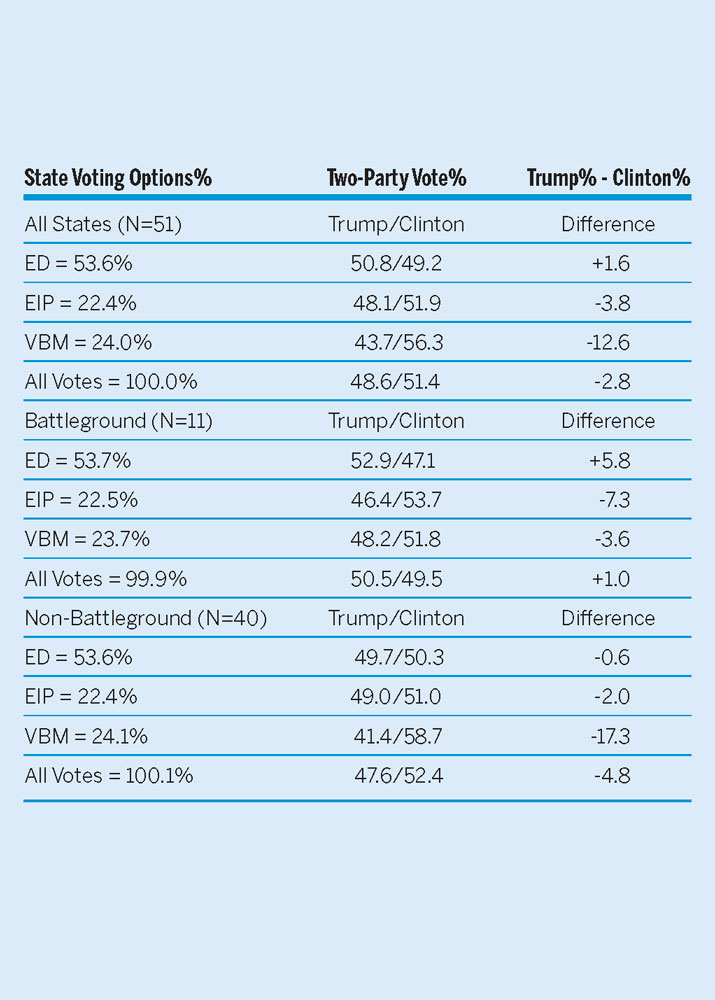
Our assessment of voting behavior is sequential. Table 1 displays the portion of voters using ED, EIP, and VBM options and the two-party split in the presidential vote among those CCES respondents in All States (including Washington, DC), Battleground States, and Non-Battleground States. The right-most column in table 1 shows the percentage-point difference in the two-party vote: Trump minus Clinton, for every category of voter (i.e., ED, EIP, VBM, and All Votes). Starting with All States, Trump won a two-party majority only among ED voters, 50.8% to 49.2%. Clinton prevailed among both types of Early voters, those making use of EIP (51.9%) and VBM (56.3%). Most respondents claimed to vote on Election Day (53.6%) but, of course, Trump is the latest in a small canon of presidents who assumed the office despite garnering a minority of the major-party popular vote. In the Non-Battleground States, Trump was shut out across the board, although he was strongest among ED voters, with 49.7% of the vote. The most telling finding in table 1 and in the following analyses is the behavior of ED voters in the 11 swing states. Again, Trump fell short among EIP voters, but his 52.9% support among ED Battleground State voters was enough for him to secure a narrow popular-vote victory in the states that decided the winner. Ultimately, Trump carried seven of the 11 swing states; in the four that he lost to Clinton, he even lost the ED vote (48.8%)—however, he again did best among this group (data not shown). In the seven battleground states that Trump won, he lost the Early vote (i.e., EIP and VBM) but took 53.9% of the ED vote, which comprised 56.8% of this electorate.
Two-Party Vote for Trump and Clinton by Vote Option and State Competitiveness
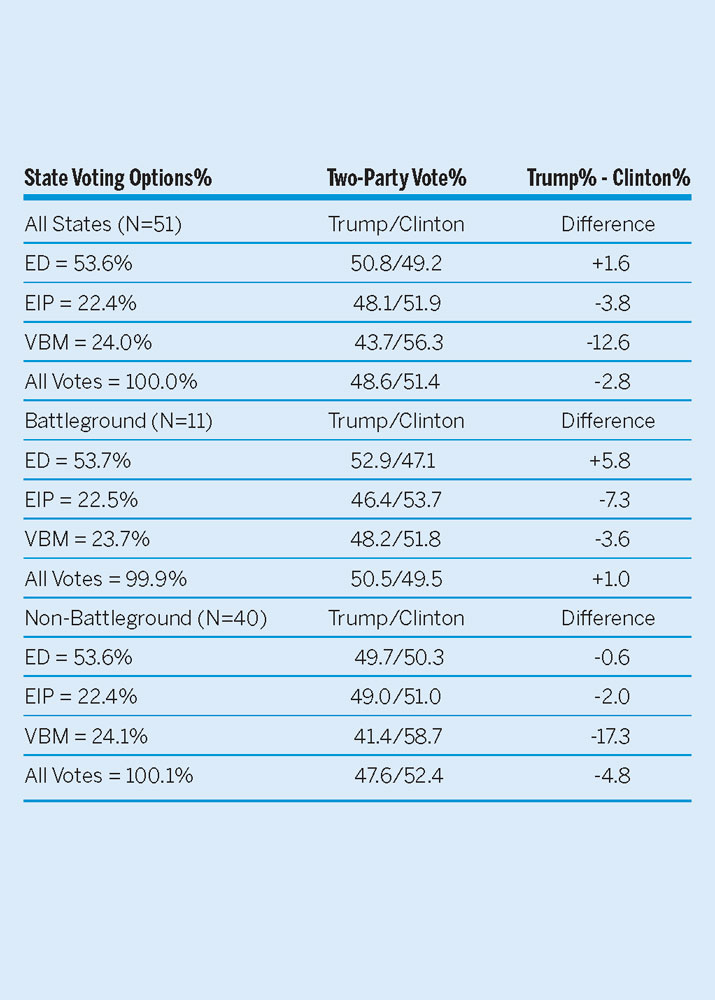
Notes: “ED” = Election Day; “EIP” = Early In-Person; “VBM” = Vote-By-Mail. Data weighted by the CCES post-election weight. Number of observations for All States: ED = 21,893; EIP = 9,148; VBM = 9,782; Battleground: ED = 7,617; EIP = 3,191; VBM = 3,366; Non-Battleground: ED = 14,276; EIP = 5,957; VBM = 6,416. Voting-option categories sum to 100% (barring rounding error). Using the definition from Politico, the 11 Battleground States for the 2016 presidential election are Colorado, Florida, Iowa, Michigan, Nevada, New Hampshire, North Carolina, Ohio, Pennsylvania, Virginia, and Wisconsin.
MULTIVARIATE MODELS AND RESULTS
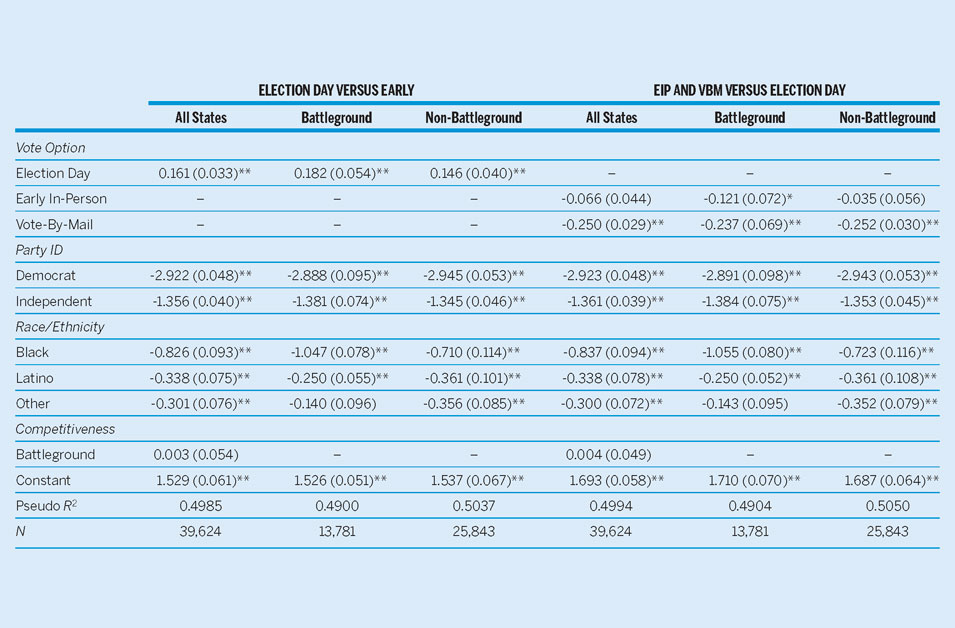
The preliminary evidence in table 1 suggests that ED voters in the Battleground States were the reason that Trump won the presidency; however, to demonstrate the robustness of this finding, we used multivariate analysis. Table 2 presents estimates from six probit regressions. In all of the models, the dependent variable is coded 1 for a Trump vote and 0 for a Clinton vote. Furthermore, we controlled for two of the most compelling correlates of vote choice: party identification (PID) and race/ethnicity. For PID, we dummied out Democrats and Independents so that the omitted reference category was Republicans. For race/ethnicity, we included dummies for black, Latino, and other so that the omitted reference category was white respondents.Footnote 3 Per the progression of table 1, we provided analysis for All States (with a Battleground State dummy), Battleground States, and Non-Battleground States. Finally, because our primary contention was that voters who waited until November 8 to cast their ballot are distinguishable from those who voted prior to the last day, the first three models include a dummy for ED voters so that the omitted comparison combines EIP and VBM voters. In the last three regressions, we left ED voters as the omitted category and included dummies for EIP and VBM voters. We show these models because of the notable and well-established variation in vote choice among EIP or VBM versus ED voters (Stein Reference Stein1998).Footnote 4
In the 1992 Democratic New Hampshire primary, Bill Clinton declared himself the “Comeback Kid” because his second-place finish in a crowded field was a vast improvement over his woeful performance in the Iowa Caucuses (Scala Reference Scala2003). A quarter-century later, his wife seemed almost a certainty to become the 45th president, but her opponent—the political upstart and insurgent amateur Republican, celebrity entertainer, real estate mogul, and erstwhile casino magnate, Donald Trump—became the most surprising “comeback kid” in American history.
Likelihood of Voting for Trump Based on Time of Vote/Vote Option and Competitiveness
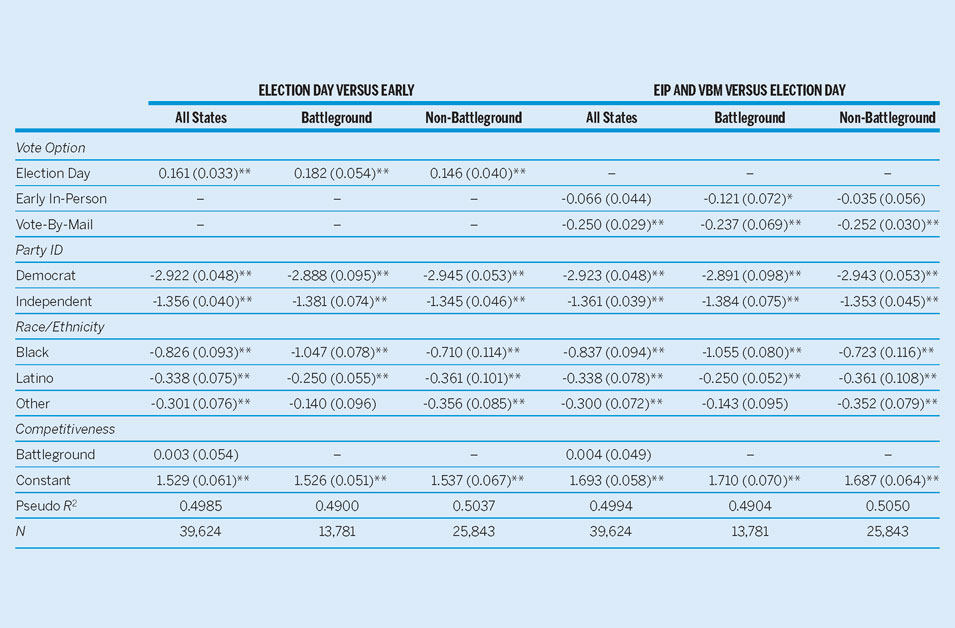
Notes: Probit coefficients with robust standard errors clustered on the state in parentheses. Data weighted by the CCES post-election weight. Dependent variable: 1 = Trump vote, 0 = Clinton vote. For Party ID, Republican is the omitted reference category. For Race/Ethnicity, white is the omitted reference category. Using the definition from Politico, the 11 Battleground States for the 2016 presidential election are Colorado, Florida, Iowa, Michigan, Nevada, New Hampshire, North Carolina, Ohio, Pennsylvania, Virginia, and Wisconsin.
** p < 0.01, *p < 0.10 (two-tailed).
The table 2 results are clearly in line with the descriptive evidence in table 1: ED voters drove the improbable Trump victory. In the first three regressions, Election Day is the key variable of interest. In each model, the dummy variable is positively signed and highly significant: ED voters were much more likely to support Trump compared to Early voters. Furthermore, the size of the coefficient is largest in the Battleground States model. The last three models parse out Early voters by type (i.e., EIP and VBM). We found VBM voters to be significantly less likely to vote for Trump compared to ED voters. Only in the Battleground States model did we find EIP voters to be significantly less supportive of Trump (p<0.10) than ED voters, although the EIP coefficient was always of the expected negative sign. Regarding the controls—as expected—compared to Republicans, Democrats and Independents always reported being less likely to vote for Trump, and black and Latino voters were always more likely to vote for Clinton as compared to white respondents. Other respondents displayed similar behavior except in the Battleground States models where there was no statistical distinction between their preferences and those of their white counterparts.
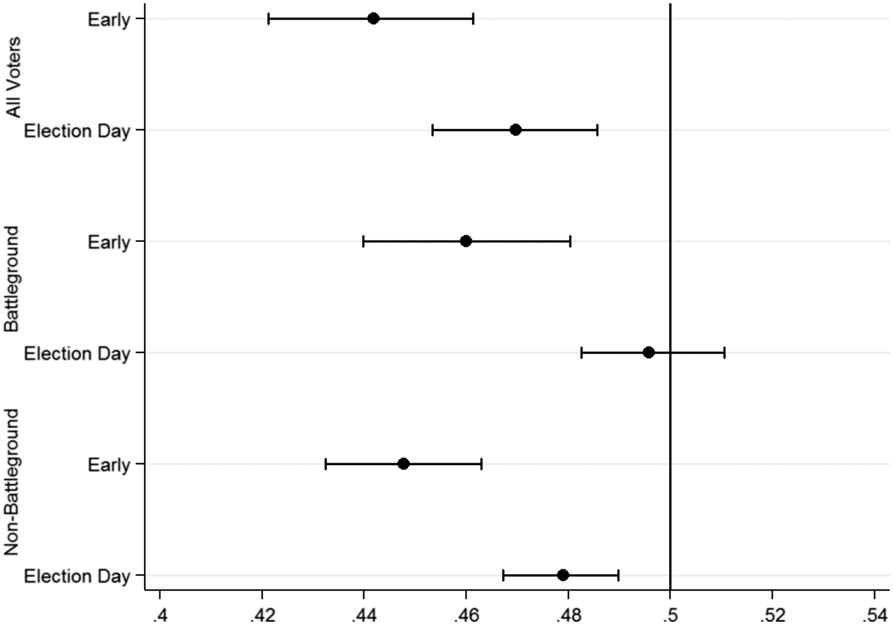
To avoid the non-intuitive nature of interpreting limited dependent-variable coefficients from our probit models, figure 1 displays the probability of voting for Trump for ED versus Early (i.e., EIP and VBM) voters for the first three models in table 2, setting all of the remaining covariates at their observed values (Hanmer and Kalkan Reference Hanmer and Ozan Kalkan2013). Furthermore, each probability estimate is bracketed with 95% confidence intervals. The evidence that it was ED voters in the key swing states that turned the Electoral College in favor of Trump is unmistakable. First, in the All States model (labeled “All Voters” in the figure, which includes a Battleground States dummy), the probabilities overlap at the 95% confidence interval for ED and Early voters. Second, in the Non-Battleground States model, the probability of voting for Trump is clearly greater for ED voters than Early voters, but Trump still netted less than half of the two-party vote irrespective of voting mode (also true in the probability estimates for All Voters). Finally, only in the Battleground States model did we find that the confidence interval spans 0.50. This is the case only among ED voters, who were significantly more likely to vote for Trump vis-à-vis Early voters (because the confidence intervals do not overlap).Footnote 5
Probability of Voting for Trump: Election Day versus Early Voting
Notes: Predicted probabilities were generated from the first three models displayed in table 2 and are based on the observed-value approach (Hanmer and Kalkan 2013). A solid circle indicates the probability-point estimates bracketed by 95% confidence intervals.

CONCLUSION
In the 1992 Democratic New Hampshire primary, Bill Clinton declared himself the “Comeback Kid” because his second-place finish in a crowded field was a vast improvement over his woeful performance in the Iowa Caucuses (Scala Reference Scala2003). A quarter-century later, his wife seemed almost a certainty to become the 45th president, but her opponent—the political upstart and insurgent amateur Republican, celebrity entertainer, real estate mogul, and erstwhile casino magnate, Donald Trump—became the most surprising “comeback kid” in American history. Trump pulled an “inside straight” on Election Day, as voters in battleground states shifted decisively in his favor. Indeed, the 2016 CCES data reveal a remarkable dynamic: in each of the seven swing states that Trump won, he lost the sum of the early vote (i.e., EIP plus VBM). In other words, if not for the marked turn toward Trump on November 8, 2016, in these states, there is no way he would have prevailed.
We leave it to others to dissect whether the “October Surprise” James Comey letter (Silver Reference Silver2017) was a sufficient or only a contributing factor to the collapse of the Clinton campaign in the key states that she had to carry. These included the much vaunted “blue wall” trio of Midwestern states (Michigan, Pennsylvania, and Wisconsin) that a Republican managed to scale for the first time since the 1980s. Furthermore, we are skeptical of the persuasive power of Russian propaganda, but we are certain that 2016 was a “change” election (McKee Reference McKee, DuBose Kapeluck and Buchanan2018, 24). To this end, Hillary Clinton clearly did not represent something new and different, whereas Trump—the victor, for better or worse—epitomized a historically novel choice. What is palpable from our analysis, however, is that polling the 2016 presidential election proved perilous because the profile of voters in the swing states on Election Day was significantly more pro-Trump than the voters who participated before the last day.Footnote 6 In the pivotal states that would determine the Electoral College winner, past was not prologue in 2016. Many who showed up early—and especially those who mailed in their ballot (Meredith and Malhotra Reference Meredith and Malhotra2011)—were registering their preferences before a topsy-turvy campaign ended with short-term conditions breaking for Trump.
Admittedly, there are many questions that remain unanswered with regard to why Trump became one of only a few presidents to take office as a popular-vote loser. Perhaps most obvious, given the thrust of our study, is a more in-depth look at who were those voters that broke late for Trump in the battleground states that he had to win versus those who stayed home or participated earlier in the election cycle. We are certain to have plenty of scholarly company in further assessing the 2016 presidential electorate. For now, this study is important for an initial examination of the prevailing dynamic of voter preferences in the latest presidential contest, when voting was a drawn-out process so that the early stages of the race did not necessarily reflect and represent the latter stages (Gronke Reference Gronke and Streb2012). At least in the 2016 contest, this meant that Hillary Clinton—the all-but-certain winner—was rendered a shocking loser.Footnote 7
SUPPLEMENTARY MATERIAL
To view supplementary material for this article, please visit https://doi.org/10.1017/S1049096518001622